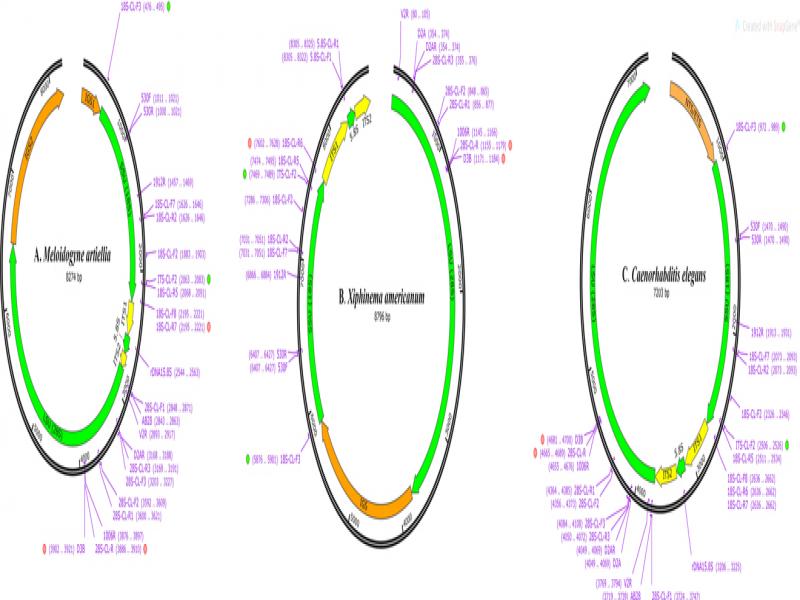
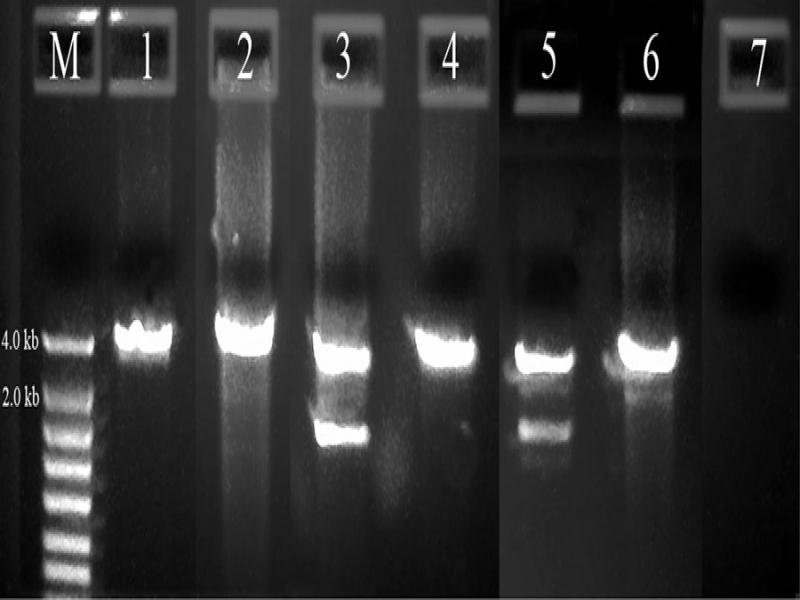
Eukaryotic nuclear ribosomal DNA (rDNA) is arranged in tandem repeat arrays in the genome. Each repeat unit consists of one copy of small subunit (SSU) 18S, internal transcribed spacers (ITS1 and ITS2), 5.8S, and large subunit (LSU) 28S rDNA, and is separated by an external transcribed spacer (EST) and an intergenic spacer (IGS) (Hillis and Dixon, 1991). The copy number of the repeats within most eukaryotic genomes is high, which provide large quantities of template DNA for PCR. In Caenorhabditis spp., for instance, the rDNA copy number was estimated to be as many as 56 to 323 copies within their genomes (Bik et al., 2013). Second, the rDNA polymorphisms among the repeat units are very low within the genome due to concerted evolution (Liao, 1999). These two features make rDNA particularly well suited for taxonomic identification, phylogenetic analysis, and barcoding for nematodes (Blaxter et al., 1998; Floyd et al., 2002; Holterman et al., 2006; Megen et al., 2009; Rodrigues Da Silva et al., 2010). As a result, there have been more than 300,000 nematode rDNA sequences published in GenBank to date. One of the most important means of determining these rDNA sequences is the amplification of the target rDNA loci by polymerase chain reaction (PCR). Usually 18S, 28S, and ITS are amplified separately with different PCR primer pairs; one or more PCR primer pairs are used to amplify 18S to near full length (Carta and Li, 2018), one pair for ITS1, 5.8S, and ITS2 (Ferris et al., 1993; Vrain, 1993; Joyce et al., 1994), and one pair for the D2D3 segment of 28S (Nunn, 1992). This multiple-pair approach is time-consuming and cost-ineffective for the amplification of this long target of approximately, 3.3 to 4.2 kb in length from 18S, ITS1, 5.8S, ITS2 to the D3 of 28S; furthermore, from a probabilistic point of view, the more primer pairs that are applied to amplify this long target, the lower the success rate of the amplification will be. Therefore, minimizing the number of primer pairs is a key to successfully amplifying this long target. In this short technical note, we have tested the PCR amplification of this 3.3 to 4.2 kb rDNA target with one ribosomal primer pair in 17 agriculturally important nematodes and sequenced the resulting amplicons directly with well-positioned and ribosomal-specific sequencing primers.
Materials and methods
DNA extraction
Live J2 from Heterodera spp. and Meloidogyne incognita and live adult nematodes from other taxa described in Table 1 were selected for this study. Template DNA was prepared in the format of one nematode per tube by using freeze-thaw lysis. Before the extraction, the nematodes were washed twice with molecular biology grade water to remove any micro contaminants attached to their bodies. A clean single nematode was picked and transferred to a 0.2 ml PCR tube containing 24 µl of extraction buffer (10 mM Tris pH 8.2, 2.5 mM MgCl2, 50 mM KCl, 0.45% TWEEN 20, and 0.05% gelatin, Williams et al., 1992). The tube was submerged in liquid nitrogen for 10 to 15 sec and then placed at 95°C for 2 min in a C1000 TouchTM thermal cycler (Bio-Rad Laboratories, Hercules, CA). This rapid physical disruption was repeated once. Then the tube was subjected to the third cycle of freezing in liquid nitrogen for 10 to 15 sec and then was slow-thawed at room temperature. The thawed sample was lysed with 1 µl of proteinase K (800 U/ml, Sigma-Aldrich, St. Louis, MO) at 60°C for 60 min, followed by 95°C for 15 min to deactivate the proteinase K. At least three single nematodes from each taxon were picked for the individual DNA extraction. All resulting lysates were stored in a −20°C freezer until needed. The DNA extracts from Ditylenchus, Ecumenicus, and Radopholus were prepared previously by using mechanical lysis (Carta et al., 2010).
Table 1.
Agriculturally important nematodes tested in this study.
| Taxa | Origin and locality | PCR primer pair | Ta (°C) | Sequencing primers | ||
|---|---|---|---|---|---|---|
| Aphelenchoides fragariae | Live specimen 104J12, provided by Dr. Paula Agudelo, Clemson University, Clemson, South Carolina | 18S-CL-F3 and 28S-CL-R | 50 | 530F, 530R, 1912R, 18S-CL-F2, 18S-CL-R2, 18S-CL-R5, ITS-CL-F2,28S-CL-F1, D2AR, 28S-CL-F3, 28S-CL-R1 and 28S-CL-R | ||
| Bursaphelenchus sp. | Live specimen 104J7, isolated from walnut twig beetles, Washington | 18S-CL-F3 and 28S-CL-R | 57 | 530F, -530R, 18S-CL-R2, 18S-CL-F7,18S-CL-F2, 18S-CL-R5, 18S-CL-R7, 18S-CL-F8, ITS-CL-F2, rDNA15.8S, 28S-CL-F1, D2AR, 28S-CL-F3, 28S-CL-R1, 28S-CL-F2 and 1006R | ||
| Bursaphelenchus xylophilus | Live specimen 104H46, isolated from Eastern white pine tree, New Hampshire | 18S-CL-F3 and 28S-CL-R | 57 | 530F, -530R, 18S-CL-R2, 18S-CL-F7,18S-CL-F2, 18S-CL-R5, 18S-CL-R7, 18S-CL-F8, ITS-CL-F2, rDNA15.8S, 28S-CL-F1, D2A, D2AR, 28S-CL-F3, 28S-CL-R1, 28S-CL-F2 and 1006R | ||
| Crossonema sp. | Live specimen 104G38, isolated from the rhizosphere of bamboo, Beltsville, Maryland | 18S-CL-F3 and D3B | 57 | 530F, 530R, 1912R, 18S-CL-F2, 18S-CL-R2, 18S-CL-R5, ITS-CL-F2,28S-CL-F1, D2AR, 28S-CL-F3, 28S-CL-R1 and 28S-CL-R | ||
| Ditylenchus dipsaci | Live specimen 85A5, obtained from French Iris in Wisconsin by USDA-APHIS-PPQ interception | 18S-CL-F3 and 28S-CL-R | 50 | 530R, 1912R,18S-CL-R2, 18S-CL-F7,18S-CL-F2, 18S-CL-R5, 18S-CL-R7, 18S-CL-F8, ITS-CL-F2, rDNA15.8S, AR28, V2R, 28S-CL-F1, 28S-CL-F3, D2AR, 28S-CL-R1, and 28S-CL-F2 | ||
| Ditylenchus sp. | Live specimen 85C1, isolated from the rhizosphere of alfalfa, Moab, Utah | 18S-CL-F3 and 28S-CL-R | 50 | 530R, 1912R,18S-CL-R2, 18S-CL-F7,18S-CL-F2, 18S-CL-R5, 18S-CL-R7, 18S-CL-F8, ITS-CL-F2, rDNA15.8S, 5.8SF, AB28, V2R, 28S-CL-F1, 28S-CL-F3, 28S-CL-R3, 28S-CL-R1, 28S-CL-F2, 1006R | ||
| Ecumenicus sp. | Live specimen 85G11, isolated from the rhizosphere of alfalfa, St. George, Utah | 18S-CL-F3 and D3B | 50 | 530R, 530F,18S-CL-R2, 18S-CL-F7,18S-CL-F2, 18S-CL-R5, 18S-CL-R6, ITS-CL-F2, rDNA15.8S, 5.8SF, V2R, 28S-CL-F1, D2AR, D2A, 28S-CL-R3, 28S-CL-R1, 28S-CL-F2, 1006R | ||
| Helicotylenchus sp. | Live specimen 104G36, isolated from the rhizosphere of bamboo, Beltsville, Maryland | 18S-CL-F3 and D3B | 57 | 530R, 530F,1912R, 18S-CL-R2, 18S-CL-F7,18S-CL-F2, 18S-CL-R5, 18S-CL-F8, ITS-CL-F2, 5.8SF, V2R, 28S-CL-F1, D2AR, 28S-CL-R1, 28S-CL-F2, 28S-CL-R | ||
| Heterodera glycines | Live J2 specimen Hg20, from the isolate, NL1-RHp originally was collected in on the east shore of Maryland and raised on soybean (G. max, cv. Kent) in sand-filled beakers | 18S-CL-F3 and D3B | 57 | 530R, 1912R, 18S-CL-R2, 18S-CL-F7,18S-CL-F2, 18S-CL-R7, 18S-Cl-F8, rDNA15.8S, 5.8SF, AB28, 28S-CL-F1, D2A, 28S-CL-F3, 28S-CL-R1, 28S-CL-F2, 1006R, and 28S-CL-R | ||
| Heterodera orientalis | Live J2 specimen 104F80, isolated from the cyst in the rhizosphere of Miscanthus, Beltsville, Maryland. | 18S-CL-F3 and D3B | 57 | 530R, 530F, 1912R, 18S-CL-R2, ,18S-CL-F2, 18S-CL-R5, ITS-CL-F2, 28S-CL-F1, D2AR, 28S-CL-F3, 28S-CL-R1, 28S-CL-F2, 28S-CL-R | ||
| Hoplolaimus sp. | Live specimen 104G35, isolated from the rhizosphere of bamboo, Beltsville, Maryland | 18S-CL-F3 and D3B | 57 | 530R, 530F, 1912R, 18S-CL-R2, 18S-CL-F2, 18S-CL-R5, 18S-CL-F8, ITS-CL-F2, rDNA15.8S, 5.8SF, AB28, V2R, 28S-CL-F1, D2A, 28S-CL-F3, 28S-CL-R3, 28S-CL-R1, and 28S-CL-F2 | ||
| Litylenchus sp. | Live specimen 104H88, isolated from the leaf of beech, Perry, Ohio | 18S-CL-F3 and 28S-CL-R | 50 | 530R, 530F, 1912R, 18S-CL-R2, 18S-CL-F2, 18S-CL-R5, 18S-CL-R7, ITS-CL-F2, rDNA15.8S, V2R, 28S-CL-F3, 28S-CL-R1, 28S-CL-F2, 1006R and 28S-CL-R | ||
| Meloidogyne incognita | Live J2 specimen Me47 from the isolate, RKN Race 1, originally was collected in Maryland and maintained with ‘PA-136’ pepper in greenhouse pots | 18S-CL-F3 and D3B | 57 | 530R, 530F, 1912R, 18S-CL-R2, 18S-CL-F2, 18S-CL-F7, 18S-CL-R5, 18S-CL-R7, ITS-CL-F2, 5.8SF, V2R, 28S-CL-R1, 28S-CL-F2 and 1006R | ||
| Pratylenchus scribneri | Live specimen Pr1 from a culture maintained with corn root explant; originally collected from soil in Beltsville, Maryland | 18S-CL-F3 and D3B | 57 | 18S-CL-F3, 530R, 530F, 1912R, 18S-CL-R2, 18S-CL-F2, 18S-CL-F7, 18S-CL-R5, 18S-CL-R7, ITS-CL-F2, rDNA15.8S, 5.8SF, Ab28, V2R, D2Ar, D2A, 28S-CL-F3, 28S-CL-R3, 28S-CL-R1, 28S-CL-F2 and 28S-CL-R | ||
| Radopholus similis | Live specimen 31G1, obtained by USDA – APHIS – PPQ interception from Anthurium in Kurtistown, Hawaii | 18S-CL-F3 and 28S-CL-R | 50 | 530R, 530F,1912R, 18S-CL-R2, 18S-CL-F2, 18S-CL-F7, 18S-CL-R5, 18S-CL-R7, ITS-CL-F2, rDNA15.8S, 5.8SF, AB28, V2R, D2AR, 28S-CL-F1, 28S-CL-F3, 28S-CL-R1, 28S-CL-F2 and 1006R | ||
| Xiphinema sp. | Live specimen 06D2, isolated from soil in Clarksville, Maryland | 18S-CL-F3 and D3B | 50 | 18S-CL-F3,530R, 530F,1912R, 18S-CL-R2, 18S-CL-F2, 18S-CL-F7, 18S-CL-R5, 18S-CL-R6, ITS-CL-F2, 5.8S-CL-F1, 5.8S-CL-R1(XitsS3), V2R, D2AR,D2A, 28S-CL-F3, 28S-CL-R1, 28S-CL-F2, and 1006R | ||
| Xiphinema sp. | Live specimen 104F83, isolated from the rhizosphere of bamboo, Beltsville, Maryland | 18S-CL-F3 and D3B | 57 | 18S-CL-F3, 530R, 530F,1912R, 18S-CL-R2, 18S-CL-F2, 18S-CL-F7, 18S-CL-R5, 18S-CL-R6, ITS-CL-F2, 5.8SF, 5.8S-CL-R1(Xist3), V2R, D2AR, 28S-CL-F2, 1006R and 28S-CL-R |
| Primers | Direction | Loci | Sequence (5′-3′) | PCR | Sequencing | References |
|---|---|---|---|---|---|---|
| 18S-CL-F3 | F | 18S | CTTGTCTCAAAGATTAAGCCATGCAT | ✓ | ✓ | Carta and Li (2018) |
| D3B | R | 28S | TCGGAAGGAACCAGCTACTA | ✓ | ✓ | Nunn (1992) |
| 28S-CL-R | R | 28S | CAGCTACTAGATGGTTCGATTAGTC | ✓ | ✓ | This study |
| 18S-530F (530F) | F | 18S | AAGTGTGGTGCCAGCAGCCGC | ✓ | Reverse complement of 530R | |
| 18S-530R (530R) | R | 18S | GCGGCTGCTGGCACCACACTT | ✓ | Thomas et al. (2011) | |
| 1912R | R | 18S | TTTACGGTCAGAACTAGGG | ✓ | Holterman et al. (2006) | |
| 18S-CL-R2 | R | 18S | GTTGAGTCAAATTAAGCCGCA | ✓ | Carta and Li (2018) | |
| 18S-CL-F7 | F | 18S | TGCGGCTTAATTTGACTCAAC | ✓ | This study | |
| 18S-CL-F2 | F | 18S | CTGTGATGCCCTTAGATGTCC | ✓ | Carta and Li (2018) | |
| 18S-CL-R5 | R | 18S | GCGGTGTGTACAAAGGGCAGGGAC | ✓ | Carta and Li (2018) | |
| 18S-CL-R6 | R | 18S | ACCTTGTTACGACTTTTACTTCCTCTA | ✓ | ✓ | This study |
| 18S-CL-R7 | R | 18S | ACCTTGTTACGACTTTTGCCCGGTTCA | ✓ | ✓ | This study |
| 18S-CL-F8 | F | 18S | TGAACCGGGCAAAAGTCGTAACAAGGT | ✓ | This study | |
| ITS-CL-F2 | F | ITS | ATTACGTCCCTGCCCTTTGTA | ✓ | ✓ | Carta and Li (2018) |
| 5.8S-CL-F1 | F | 5.8S | GATTCCATCATTCTAAGC | ✓ | This study | |
| 5.8S-CL-R1 | R | 5.8S | ACCGCTTAGAATGATGGAATC | ✓ | This study | |
| rDNA15.8S | F | 5.8S | ACGAGCCGAGTGATCCACCG | ✓ | Cherry et al. (1997) | |
| 5.8SF | F | 5.8S | CGGTGGATCACTCGGCTCGT | ✓ | Reverse complement of rDNA1.58S | |
| AB28 | R | 28S | ATATGCTTAAGTTCAGCGGGT | ✓ | Joyce et al. (1994) | |
| 28S-CL-F1 | F | 28S | CTGAACTTAAGCATATCAGTAAGC | ✓ | This study | |
| VRAIN 2R (V2R) | R | 28S | TTTCACTCGCCGTTACTAAGGGAATC | ✓ | Vrain et al. (1992) | |
| D2AR | R | 28S | ACTTTCCCTCACGGTACTTGT | ✓ | Reverse complement of D2A | |
| D2A | F | 28S | ACAAGTACCGTGAGGGAAAGT | ✓ | Nunn (1992) | |
| 28S-CL-R3 | R | 28S | GCAACTTTCCCTCACGGTACTTG | This study | ||
| 28S-CL-F3 | F | 28S | AAGAGAGAGTTAAAGAGGACGTGAA | ✓ | This study | |
| 28S-CL-R1 | R | 28S | ACTCCTTGGTCCGTGTTTCAAG | ✓ | This study | |
| 28S-CL-F2 | F | 28S | CGACCCGTCTTGAAACAC | ✓ | This study | |
| 28S-1006rev (1006R) | R | 28S | GTTCGATTAGTCTTTCGCCCCT | ✓ | Holterman et al. (2008) |