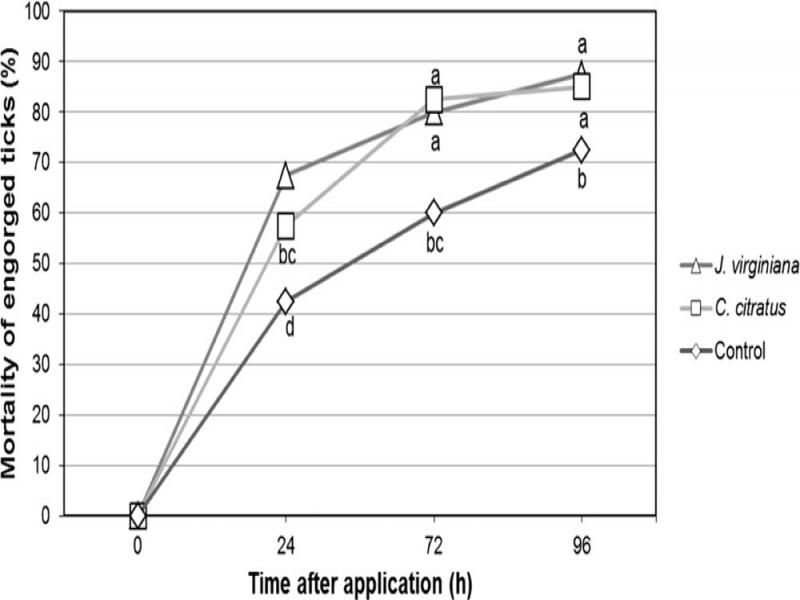
The ticks (Acari: Ixodidae) are widely distributed in the tropical, subtropical and warm areas and are able to parasite vertebrates. In animals, the ticks climb from their feet to the ears, neck and the perianal zone. In these places, the skin is thinner which makes their feeding easier. As many other parasites, they can spread easily throughout their hosts because they hold onto them during long periods and when they finish eating they then drop off the host and go to a new place. This is very important for the dynamic of the illnesses they transmit and the risk of incursion of new pathogens in areas where they were absent (Díaz et al., 2012). It is estimated that around one billion of bovine livestock are found in tropical and subtropical zones exposed to the infestations by ticks and/or illnesses transmitted by them, causing great losses in livestock production (Cruz et al., 2016).
In Mexico, the conventional method to control the ticks is using ixodicides, chemical products that are available in the national market. However, the risk of generating populations of ticks resistant to the ixodicides is higher if its use is not handled as indicated by the standards (Rodríguez-Vivas et al., 2014). Nowadays, there are very few studies on the biological control of ticks using entomopathogenic nematodes (Kocan et al., 1998).
Entomopathogenic nematodes (EPNs) are efficient agents of biological control, and are compatible with some chemical pesticides (Kaya and Gaugler, 1993). The effectiveness of the EPNs in tick's control depends on the time of permanency of the formulation on the pest's body because the infective juveniles (IJs) require enough time to find a host and need protection against adverse abiotic factors such as solar radiation and low moisture. Therefore, when the EPNs are applied in aqueous suspension the efficiency generally decreases. In this work, we aimed to identify the most beneficial combination of a vegetable oil emulsion to extend the shelf-life of EPNs at room temperature and to increase their infectivity on ticks in laboratory and field evaluations.
The compatibility of some vegetable oils with the nematode Heterorhabditis bacteriophora has been reported (Krishnayya and Grewal, 2002; Alves et al., 2017). Furthermore, owing to its viscosity level, the oil sticks for some time and its evaporation is slower compared with water. These physicochemical characteristics can be exploited in the application of EPN by delaying its desiccation and improving their interaction with the insect-pest.
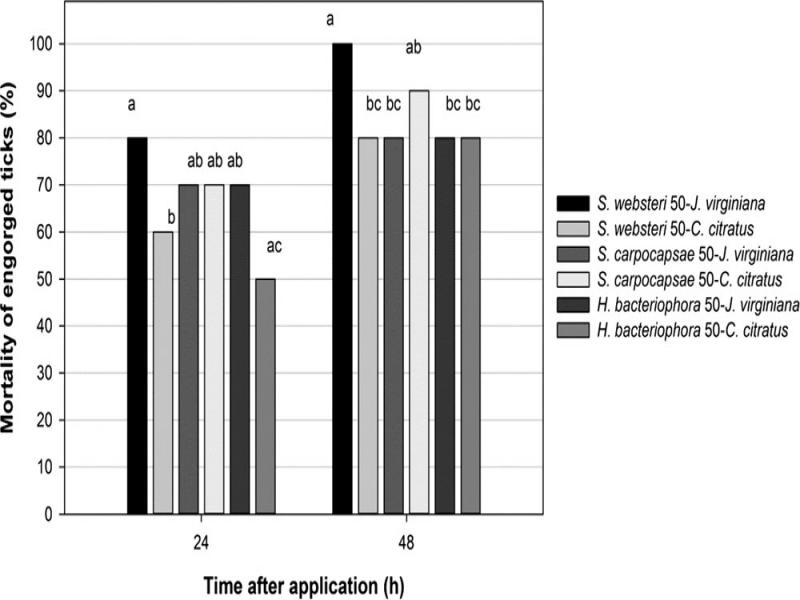
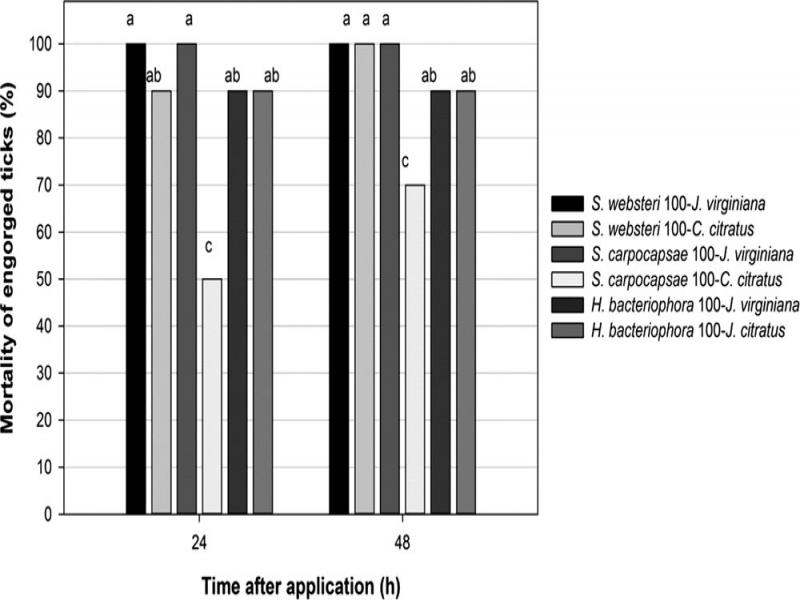
Hence, in an effort to increase the survival time and infectivity of EPNs on ticks, this study aimed to evaluate: (i) the effect of five vegetable oil emulsions on the survival and infectivity of S. carpocapsae, S. websteri and H. bacteriophora on ticks in laboratory and (ii) the control effectiveness (CE) of application of EPNs in oil emulsion on ticks present in infested dogs (Canis lupus familiaris) in field conditions.
Materials and methods
Description of the area of study
This work was carried out under lab and field conditions. The lab experiments were done in the Laboratorio de Nematodos Entomopatógenos at CIIDIR-Oaxaca and the field experiments were done in Santa Cruz Xoxocotlán, Oaxaca, Mexico (17° 01′ 35″N, 96° 44′ 00″O, 1523 m altitude.
Reproduction of entomopathogenic nematodes
The EPNs Heterorhabditis bacteriophora 18S and 28S HB1 Strain (Poinar, 1975), Steinernema carpocapsae 18S Access Gen Bank AF121049.1 (Weiser, 1955) were provided by the Department of Entomology of the University of California, Davis, USA, and Steinernema websteri 28SR and 28SF Access AY84172.1 (Cutler and Stock, 2003) is an native nematode that was isolated from soil in plantations of Agave angustifolia Haw by Delgado-Gamboa et al. (2015). The juveniles were reproduced on last instars larvae of the wax moth Galleria mellonella, following the method proposed by Kaya and Stock (1997). The temperature and relative humidity (RH) in laboratory were 19 to 25 °C and 37 to 64%, respectively. Three days after the inoculation, the infected larvae were set in White traps with filter paper discs (90 mm of diameter, Whatman No. 1). The emerging IJs were collected and maintained in distilled water in culture bottles of 250 mL and stored at 12 ± 1 °C for 24 hr before use.
Collection of ticks
It was done by visual and tactile inspection of the presence of ticks in the infested dogs’ bodies. Adult ticks were collected by following the method proposed by Bonilla-Cárdenas et al. (2014), which consisted of holding the parasite with the index finger and thumb to separate it from the body of the animal pulling in a contrary direction of hair growth to avoid damages on it. In total, 60 adult ticks were collected and were kept in plastic containers of 100 mL which contained a piece of wet cotton to avoid dehydration of the organisms and to provide a suitable micro-environment to maintain their non-parasitic cycle. Furthermore, some 2 mm-holes were made in the lid for air exchange.
Vegetable oils
Essential oils of Citronela (Cymbopogon citratus (de Candolle) Stapf) BIENAT®, Geranium (Pelargonium spp. Linnaeus) Nature's Bliss®, Juniper of virginia (Juniperus virginiana Linnaeus) ESENCIAL®, Roses (Rosa spp. Linnaeus) Nature's Bliss®, and Mint (Mentha piperita Linnaeus) BIENAT® were used for the preparation of water-oil emulsions in different concentrations. These vegetable oils were purchased in local markets.
Survival assays of entomopathogenic nematodes in emulsions
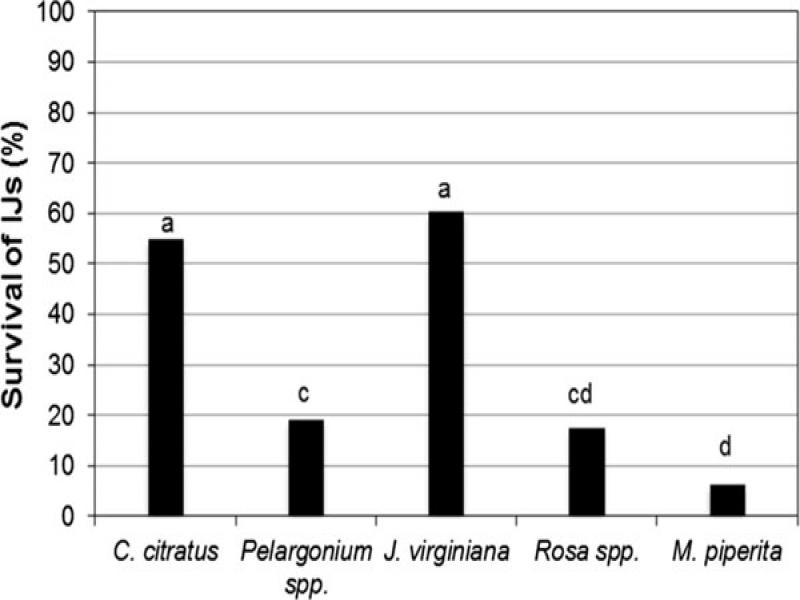
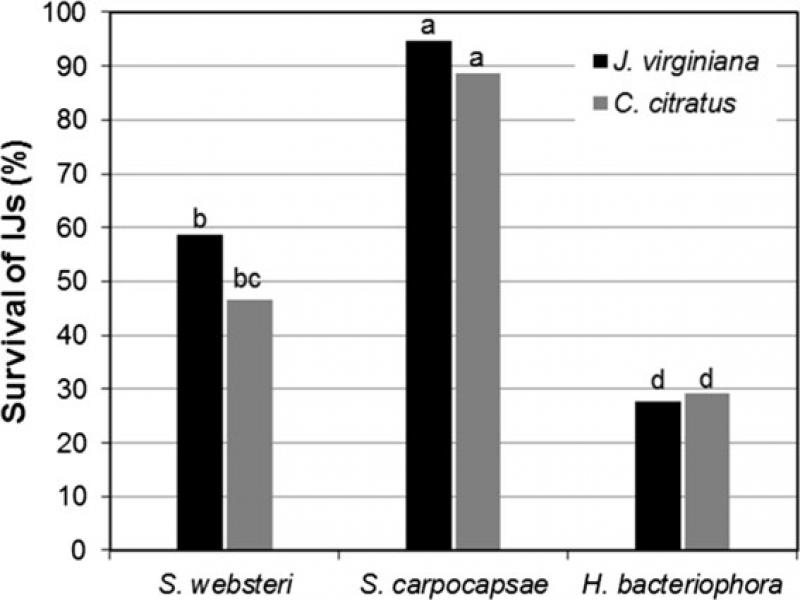
Two emulsions at two different vegetable oil concentrations (13 and 33%) were made. The amount of EPNs in each emulsion was 400 ± 20 IJs, but different amounts of oil and water were used (Table 1). These were placed in plastic petri dishes (55 mm of diameter), which were stored at room temperature (22 ± 3 °C and 37–64% RH). The survival of IJs in oil emulsions was assessed every 24 hr during 6 d. The observation and counting of living and dead IJs was done using a stereoscopic microscope. The IJs were considered alive if they had mobility in the head and tail by themselves (Peters, 2016).
Table 1
Treatments of EPNs in vegetable oil emulsions to evaluate the survival of IJs and control effectivity on adult ticks.
| Final composition | ||||
|---|---|---|---|---|
| Experiment | Treatment (%) | Oil (µL) | Amount of IJs | Distilled water (µL) |
| Survival | Heterorhabdistis bacteriophora – C. citratus 13 | 300 | 400 ± 20 | 2,000 |
| Heterorhabditis bacteriophora–Pelargonium 13 | 300 | 400 ± 20 | 2,000 | |
| Heterorhabditis bacteriophora –J. virginiana 13 | 300 | 400 ± 20 | 2,000 | |
| Heterorhabditis bacteriophora –Rose 13 | 300 | 400 ± 20 | 2,000 | |
| Heterorhabditis bacteriophora –M. piperita 13 | 300 | 400 ± 20 | 2,000 | |
| Heterorhabditis bacteriophora -AD (control) | 0 | 400 ± 20 | 2,000 | |
| Steinernema carpocapsae –C. citratus 13 | 300 | 400 ± 20 | 2,000 | |
| Steinernema carpocapsae –Pelargonium 13 | 300 | 400 ± 20 | 2,000 | |
| Steinernema carpocapsae –J. virginiana 13 | 300 | 400 ± 20 | 2,000 | |
| Steinernema carpocapsae –Rose 13 | 300 | 400 ± 20 | 2,000 | |
| Steinernema carpocapsae –M. piperita 13 | 300 | 400 ± 20 | 2,000 | |
| Steinernema carpocapsae -AD (control) | 0 | 400 ± 20 | 2,000 | |
| Steinernema websteri –C. citratus 13 | 300 | 400 ± 20 | 2,000 | |
| Steinernema websteri –Pelargonium 13 | 300 | 400 ± 20 | 2,000 | |
| Steinernema websteri –J. virginiana 13 | 300 | 400 ± 20 | 2,000 | |
| Steinernema websteri –Rose 13 | 300 | 400 ± 20 | 2,000 | |
| Steinernema websteri –M. piperita13 | 300 | 400 ± 20 | 2,000 | |
| Steinernema websteri -AD (Control) | 0 | 400 ± 20 | 2,000 | |
| Control effectiveness in laboratory | Steinernema websteri –J. virginiana 33 | 833 | 50 ± 5 | 1,667 |
| Steinernema websteri –C. citratus 33 | 833 | 50 ± 5 | 1,667 | |
| Steinernema carpocapsae –J. virginiana 33 | 833 | 50 ± 5 | 1,667 | |
| Steinernema carpocapsae –C. citratus 33 | 833 | 50 ± 5 | 1,667 | |
| Heterorhabditis bacteriophora –J. virginiana 33 | 833 | 50 ± 5 | 1,667 | |
| Heterorhabditis bacteriophora –C. citratus 33 | 833 | 50 ± 5 | 1,667 | |
| Steinernema websteri –J. virginiana 33 | 833 | 100 ± 10 | 1,667 | |
| Steinernema websteri –C. citratus 33 | 833 | 100 ± 10 | 1,667 | |
| Steinernema carpocapsae –J. virginiana 33 | 833 | 100 ± 10 | 1,667 | |
| Steinernema carpocapsae –C. citratus 33 | 833 | 100 ± 10 | 1,667 | |
| Heterorhabditis bacteriophora –J. virginiana 33 | 833 | 100 ± 10 | 1,667 | |
| Heterorhabditis bacteriophora –C. citratus 33 | 833 | 100 ± 10 | 1,667 | |
| Control effectiveness in field | Steinernema websteri –C. citratus 33 | 833 | 119 ± 10 | 1,667 |
| Steinernema websteri –J. virginiana 33 | 833 | 119 ± 10 | 1,667 | |
| Steinernema websteri -AD (Control) | 0 | 119 ± 10 | 2,500 | |