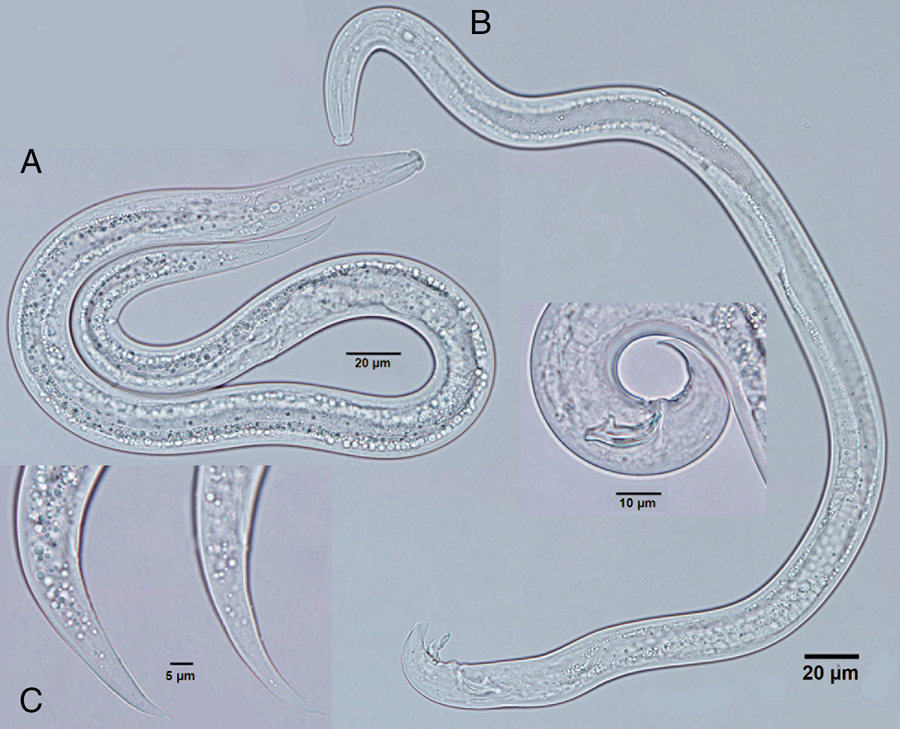
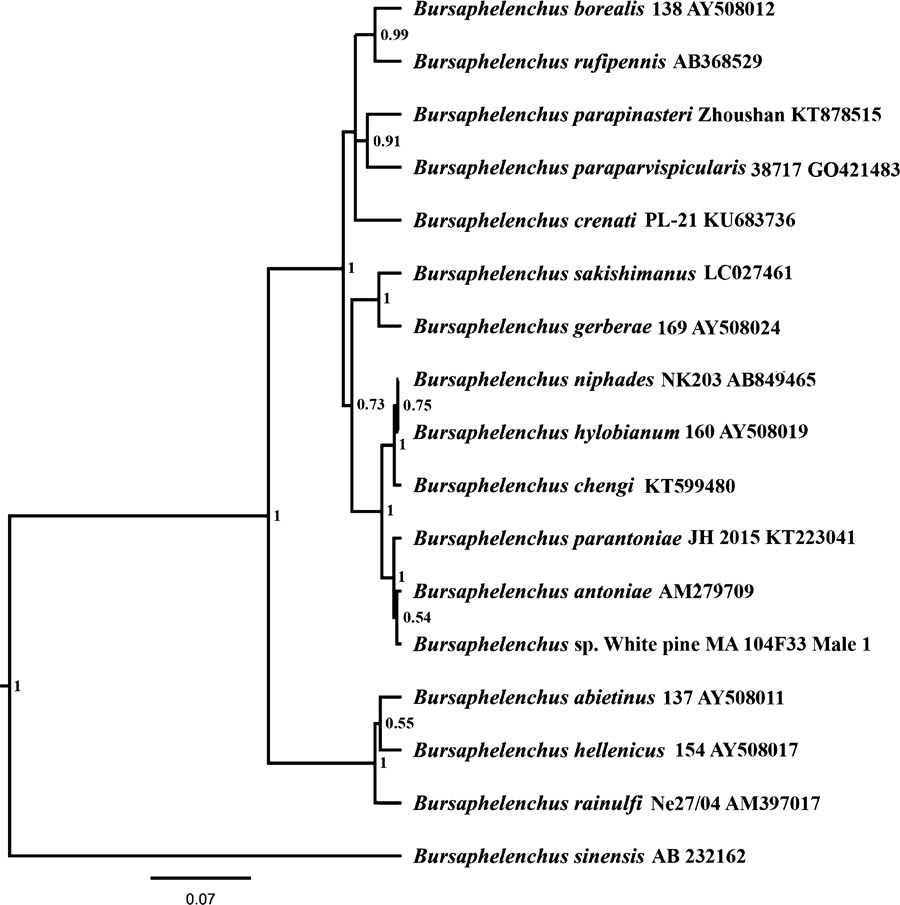
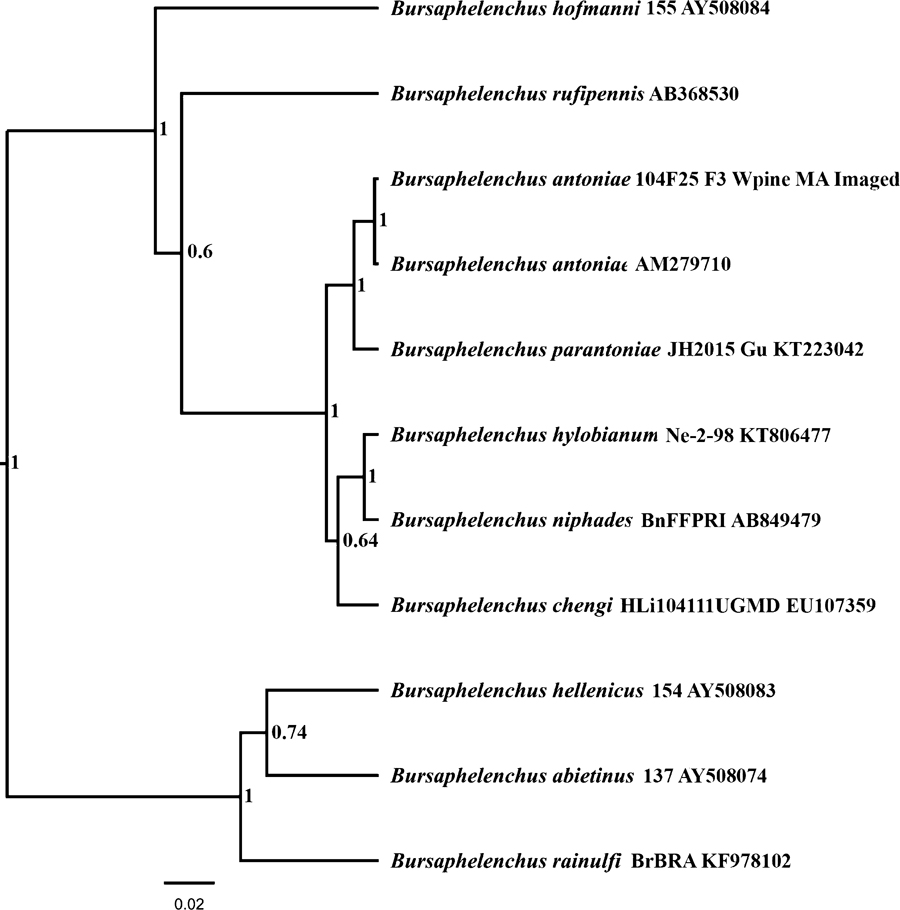
Juvenile, female and male nematodes were discovered in wood chips of white pine Pinus strobus from Ashley Falls, MA. The white pine specimen was submitted to the University of Massachusetts Nematology Lab to examine for the pine wood nematode (PWN), Bursaphelenchus xylophilus, as required for shipment of pine logs to an Asian trading partner. Initial observations suggested these nematodes might be PWN, but closer morphological and molecular characterization proved otherwise. Comparison of measured features with those in the literature indicated this nematode population had some unique characteristics. Female nematodes having a vulval flap but an acute tail did not agree with PWN B. xylophilus that has a rounded tail. Specimens were characterized microscopically and with four molecular markers to identify this population.
Materials and methods
Individual specimens from white pine trees in Massachusetts, and specimens of B. antoniae from Portugal were mechanically disrupted in 20 µl of extraction buffer (Thomas 2011) then stored in PCR tube at –80oC until needed. Each extract was prepared by incubating the tubes at 60oC for 60 min, followed by 95oC for 15 min to deactivate proteinase K.
PCR amplification: Each 25 µl PCR reaction was prepared with 2 µl of the extract and 23 µl of the PCR master mix containing 0.625U TaKaRa EX Taq (Takara Bio USA, Inc., Mountain View, CA) according to the manufacturer’s protocol. The ribosomal 18S SSU DNA, ribosomal 28S LSU DNA, internal transcribe spacer (ITS) and cytochrome c oxidase I (COI) were amplified by PCR with the primer sets described in Table 1. The PCR condition for the 18S was 95oC for 3 min; 36 cycles of 95oC for 30 sec, 50oC for 40 sec, and 72oC for 70 sec; and final extension at 72oC for 5 min, for the 28S was 95oC for 3 min; 36 cycles of 95oC for 30 sec, 58oC for 45 sec, and 72oC for 70 sec; and final extension at 72oC for 5 min, for the ITS was 95oC for 3 min; 36 cycles of 95oC for 30 sec, 55oC for 60 sec, and 72oC for 105 sec; and final extension at 72oC for 5 min, and for the COI was 1X (94°C for 1 min), 5 X (94°C for 40 sec, 45°C 45 sec, 72°C 1 min), 35 X (94°C for 40 sec, 51°C 45 sec, 72°C 1 min), and final extension 72°C for 5 min. PCR products were visualized with the Lonza FlashGelTM DNA system (VWR International, Radnor, PA) and then treated with ExoSAP-IT reagent (Affymetrix, Inc, Santa Clara, CA) according to the manufacturer’s protocol. Direct DNA sequencing was performed bidirectionally with the primers (Table 1) and an ABI BigDye Terminator v3.1 kit and in an ABI 3730xl DNA Analyzer (Applied Biosystems, Foster City, CA, USA) owned by the USDA Systematic Entomology Lab, Beltsville, MD.
Table 1
Primers used for PCR and sequencing.
| Primers | Direction | Sequence (5'-3') | Loci | PCR | Sequencing | Reference |
|---|---|---|---|---|---|---|
| 18S-CL-F3 | F | CTTGTCTCAAAGATTAAGCCATGCAT | 18S | √ | √ | This study |
| 1912R | R | TTTACGGTCAGAACTAGGG | 18S | √ | √ | Holterman et al. (2006) |
| 18S-530R | R | GCGGCTGCTGGCACCACACTT | 18S | √ | Thomas (2011) | |
| 530F | F | AAGTCTGGTGCCAGCAGCCGC | 18S | √ | Thomas (2011) | |
| D2A | F | ACAAGTACCGTGAGGGAAAGTTG | 28S | √ | √ | Nunn (1992) |
| D3B | R | TCGGAAGGAACCAGCTACTA | 28S | √ | √ | Nunn (1992) |
| D3A | F | GACCCGTCTTGAAACACGGA | 28S | √ | Nunn (1992) | |
| ITS-CL-F2 | F | ATTACGTCCCTGCCCTTTGTA | ITS | √ | √ | This study |
| VRAIN 2R | R | TTTCACTCGCCGTTACTAAGGGAATC | ITS | √ | √ | Vrain et al. (1992) |
| rDNA1.58S | R | ACGAGCCGAGTGATCCACCG | ITS | √ | Cherry et al. (1997) | |
| COI-CL-F8 | F | AGAGAGTTCTAATCATAAAGATATTGG | COI | √ | √ | This study |
| COI-R2 | R | GTAGCAGCAGTAAAATAAGCACG | COI | √ | √ | Kanzaki and Futai (2002) |
| COI-F2 | F | CCTGTCTTGGCTGGTGCTATTAC | COI | √ | Kanzaki and Futai (2002) |
| Taxon | Isolate/Strain | Accession | Length (bp) | Locality |
|---|---|---|---|---|
| Bursaphelenchus n.sp. | 104F33 | 978 | MA, USA | |
| Bursaphelenchus abietinus | 137 | AY508011 | 1,706 | Austria |
| Bursaphelenchus antoniae | – | AM279709 | 1,650 | Portugal |
| Bursaphelenchus borealis | 138 | AY508012 | 1,698 | Germany |
| Bursaphelenchus chengi | – | KT599480 | 1,748 | Taiwan |
| Bursaphelenchus crenati | PL-21 | KU683736 | 1,676 | Poland |
| Bursaphelenchus gerberae | 169 | AY508024 | 1,653 | Trinidad & Tobago |
| Bursaphelenchus hellenicus | 154 | AY508017 | 1,706 | Greece |
| Bursaphelenchus hylobianum | 160 | AY508019 | 1,709 | China |
| Bursaphelenchus niphades | NK203 | AB849465 | 1,564 | Japan |
| Bursaphelenchus parantoniae | JH-2015 | KT223041 | 1,748 | Belgium |
| Bursaphelenchus paraparvispicularis | 38717 | GQ421483 | 1,642 | Hong Kong, China |
| Bursaphelenchus parapinasteri | Zhoushan | KT878515 | 1,648 | China |
| Bursaphelenchus rainulfi | Ne27/04 | AM397017 | 1,687 | Brazil |
| Bursaphelenchus rufipennis | – | AM397017 | 1,699 | Alaska, USA |
| Bursaphelenchus sakishimanus | – | LC027461 | 1,699 | Ishigaki Is., JP |
| Bursaphelenchus sinensis | – | AB232162 | 2,525 | Japan |
| Taxon | Isolate/Strain | Accession | Length (bp) | Locality |
|---|---|---|---|---|
| Bursaphelenchus abietinus | 137 | AY508074 | 724 | Austria |
| Bursaphelenchus antoniae | 104F25F3 | MA, USA | ||
| Bursaphelenchus antoniae | AM279710 | Portugal | ||
| Bursaphelenchus chengi | HLi104111UGMD | EU107359 | 741 | Taiwan |
| Bursaphelenchus hellenicus | 154 | AY508083 | 724 | Greece |
| Bursaphelenchus hofmanni | 155 | AY508084 | 725 | Germany |
| Bursaphelenchus hylobianum | Ne-2-98 | KT806477 | 782 | China |
| Bursaphelenchus niphades | BnFFPRI | AB849479 | 708 | Japan |
| Bursaphelenchus parantoniae | JH2015 | KT223042 | 786 | Belgium |
| Bursaphelenchus rainulfi | BrBRA | KF978102 | 785 | Brazil |
| Bursaphelenchus rufipennis | AB368530 | 1,241 | Alaska, USA |