
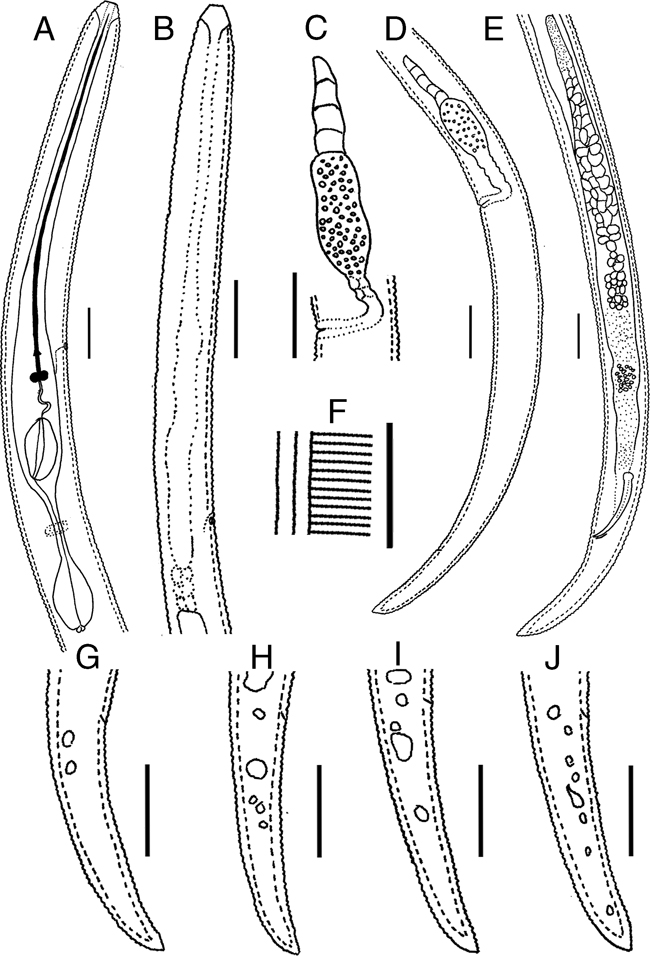
Figure 1
Line drawings of Gracilacus paralatescens n. sp. A: Female pharynx; B: Male pharynx; C: Vulval region and reproductive branch; D: Female posterior body; E: Male posterior body; F: Lateral lines; G-J: Female tails (Scale bars =10 μm).
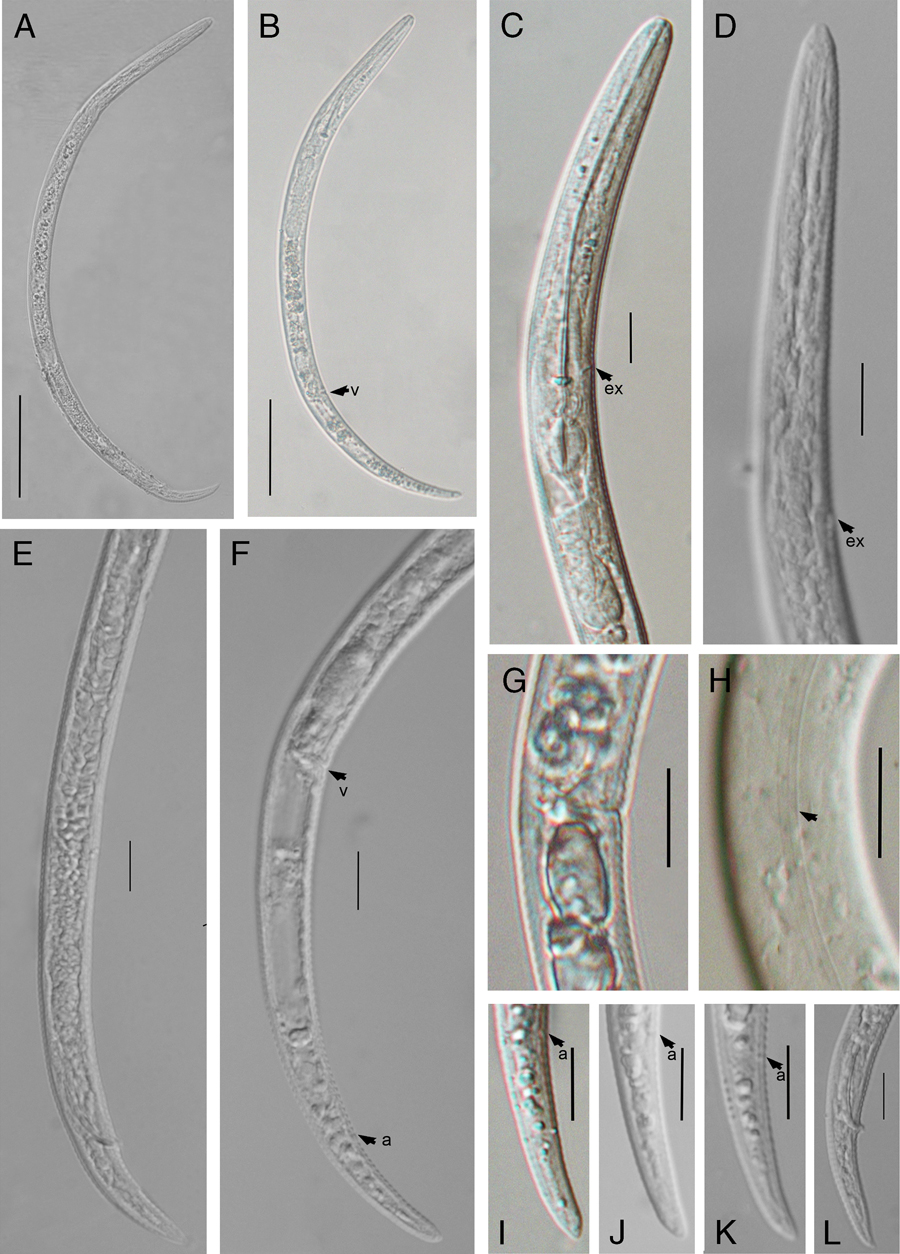
Figure 2
Light photomicrographs of Gracilacus paralatescens n. sp. A: Entire male; B: Entire female; C, D: Female and male anterior regions; E, F: Male and female posterior regions; G: Vulval region region; H: Lateral lines; I-K: Female tails; L: Male tail (Scale bars = A, B = 50 μm, C-L 10 μm). C-L = 10 μm Abbreviations: a = anus; ex = excretory pore; v = vulva).
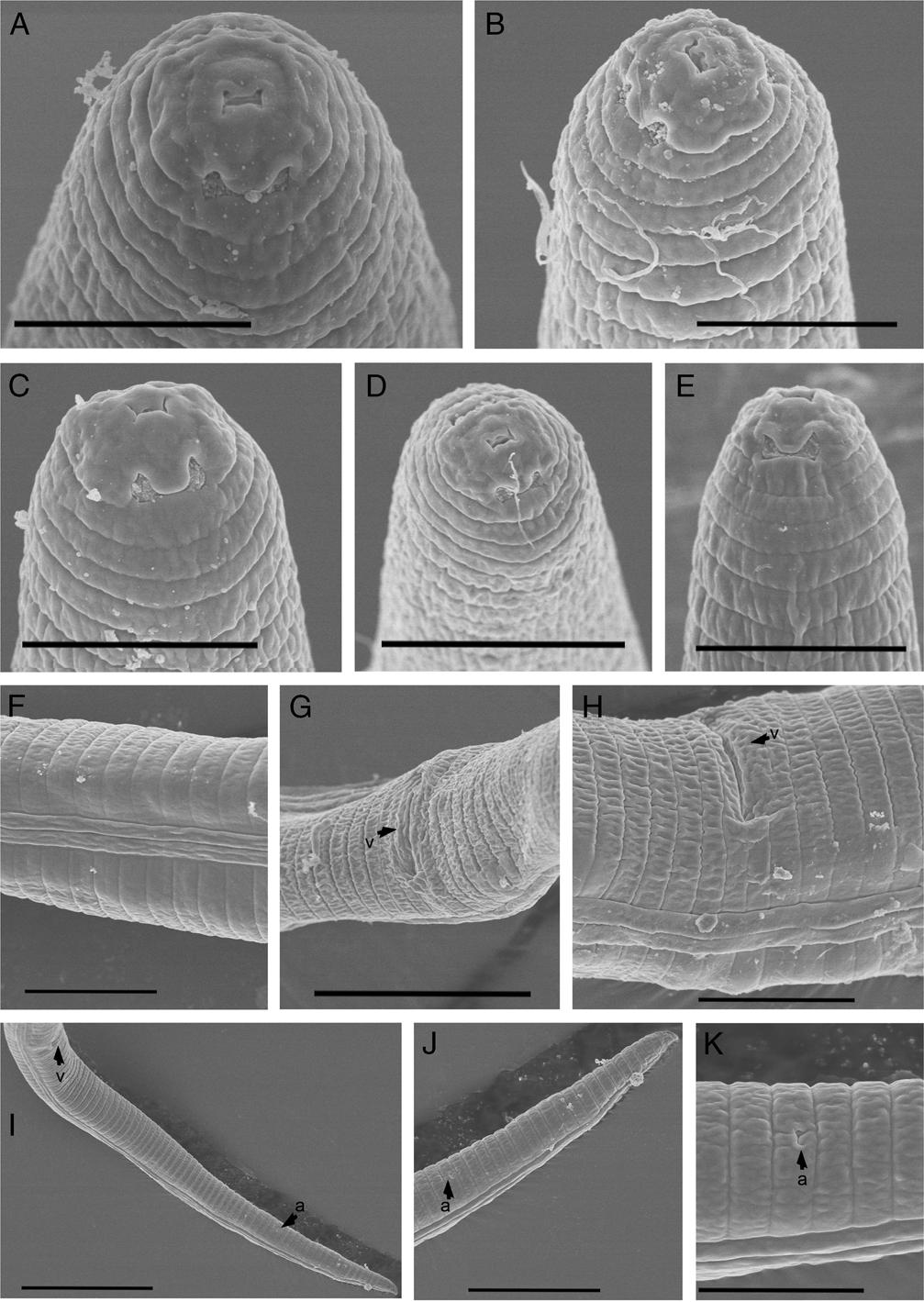
Figure 3
Scanning electron microscopy of Gracilacus paralatescens n. sp. A-E: Lip region; F: Lateral lines; G, H: Vulval regions; I: Posterior region arrows showing position of vulva (v) and anus (a); J: Tail region arrow showing position of anus; K: Anal region (Scale bars, A-C = 3 μm; E, K = 4 μm; D, H = 5 μm; J, G = 10 μm; I =20 μm).
Table 1
Morphometrics data for Gracilacus paralatescens n. sp.
| Paratypes | |||
|---|---|---|---|
| Characters/Ratios | Holotype | Female | Male |
| n | 1 | 26 | 4 |
| L | 285.4 | 290.4 ± 11.8 (271.1-308.1) | 312.8 ± 12.4 (300.3-324.2) |
| a | 25.0 | 25.3 ± 1.7 (22.4-29.0) | 30.2 ± 2.0 (27.6-32.1) |
| b | 2.2 | 2.3 ± 0.1 (2.2-2.5) | 3.5 ± 0.2 (3.3-3.7) |
| c | 11.0 | 11.2 ± 1.1 (9.3-13.8) | 11.1 ± 0.8 (10.3-12.1) |
| c’ | 4.5 | 4.5 ± 0.4 (3.2-5.4) | 3.6 ± 0.3 (3.3-4.0) |
| V/T | 70.6 | 70.3 ± 1.2 (68.2-72.9) | 31.5 ± 5.3 (23.8-35.7) |
| Lip region height | 1.7 | 1.9 ± 0.3 (1.2-2.3) | 2.0 ± 0.1 (1.9-2.1) |
| Lip region diam. | 4.8 | 4.5 ± 0.2 (4.0-4.9) | 3.5 ± 0.2 (3.2-3.8) |
| Stylet | 72.3 | 74.8 ± 2.4 (71.5–78.8) | – |
| Median bulb length | 14.6 | 15.6 ± 1.3 (13.4–18.7) | – |
| Median bulb diam. | 7.4 | 7.5 ± 0.6 (6.2–8.6) | |
| Median bulb clip length | 8.2 | 8.5 ± 1.3 (5.8–9.7) | – |
| Median bulb clip diam. | 4.0 | 4.2 ± 0.2 (4.0–4.5) | – |
| Ant. end to excretory pore | 69.5 | 68.8 ± 2.8 (62.8–73.4) | 66.3 ± 1.9 (63.6–67.8) |
| Pharynx length | 128.9 | 125.6 ± 4.6 (118.7–133.5) | 90.4 ± 2.4 (87.8–93.4) |
| Max. body diam. | 11.4 | 11.5 ± 0.7 (10.3–12.7) | 10.4 ± 0.4 (10.1–10.9) |
| Vulval body diam. | 11 | 10.9 ± 0.6 (9.7–12.5) | – |
| Vulva to tail terminus | 83.9 | 86.3 ± 5.9 (73.6–93.7) | – |
| Anal/cloacal body diam. | 5.8 | 5.9 ± 0.5 (5.0–6.8) | 8.0 ± 0.7 (7.4–8.8) |
| Tail length | 25.9 | 26.2 ± 2.5 (21.3–29.9) | 28.2 ± 1.5 (26.7–29.5) |
| Spicule | – | – | 18.1 ± 0.7 (17.5–18.9) |
| Gubernaculum | – | – | 4.5 ± 0.6 (4.0–5.3) |
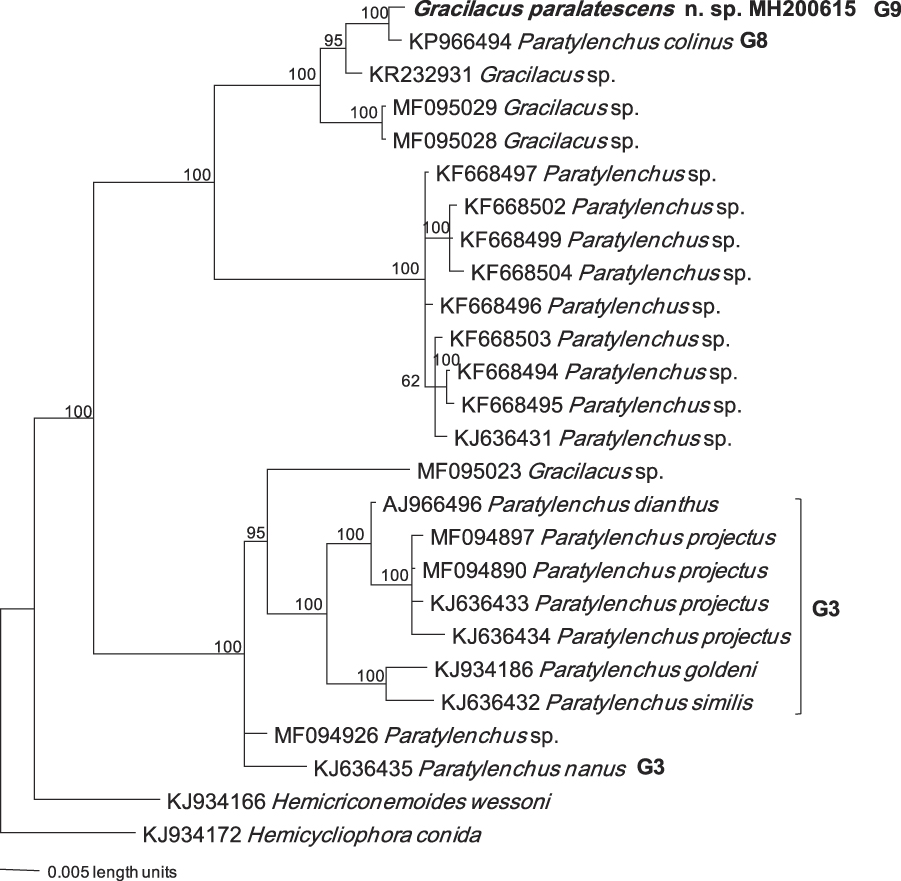
Figure 4
Bayesian consensus tree of Gracilacus paralatescens n. sp. inferred from combined 18S and ITS under TIM+I+G model (-lnL=3318.9573; AIC = 6653.9146; freqA = 0.2748; freqC = 0.2016; freqG = 0.2586; freqT = 0.265; R(a) = 1; R(b) = 2.5867; R(c) = 0.479; R(d) = 0.479; R(e) = 6.0139; R(f) = 1; Pinva = 0.4072; Shape = 0.814). Posterior probability values exceeding 50% are given on appropriate clades.
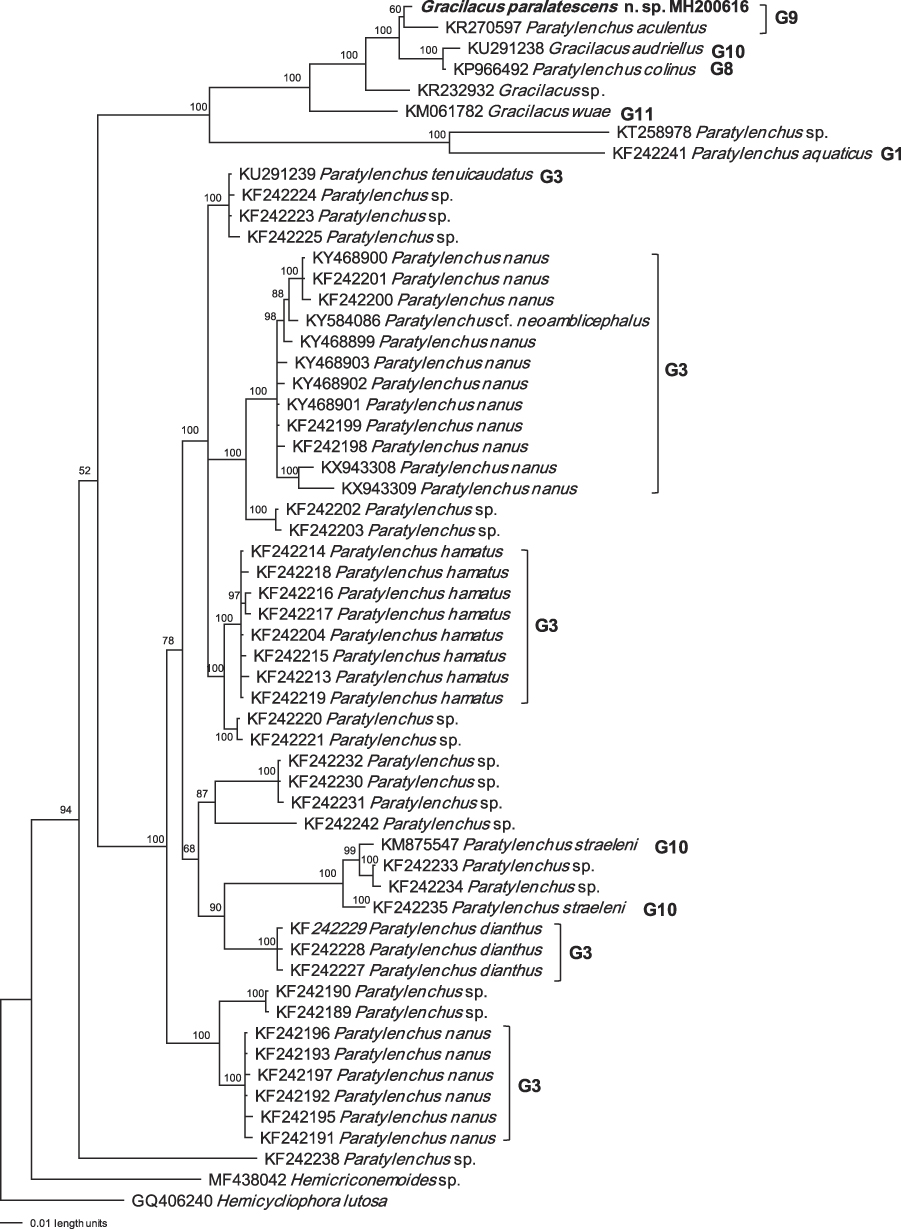
Figure 5
Bayesian consensus tree of Gracilacus paralatescens n. sp. inferred from 28S D2-D3 under GTR+I+G model (-lnL = 6253.7139; AIC = 12527.4277; freqA = 0.2129; freqC = 0.1946; freqG = 0.3023; freqT = 0.2902; R(a) = 0.7174; R(b) = 7.1524; R(c) = 2.4855; R(d) = 0.6881; R(e) = 12.1391; R(f) = 1; Pinva = 0.2537; Shape = 1.3274). Posterior probability values exceeding 50% are given on appropriate clades.
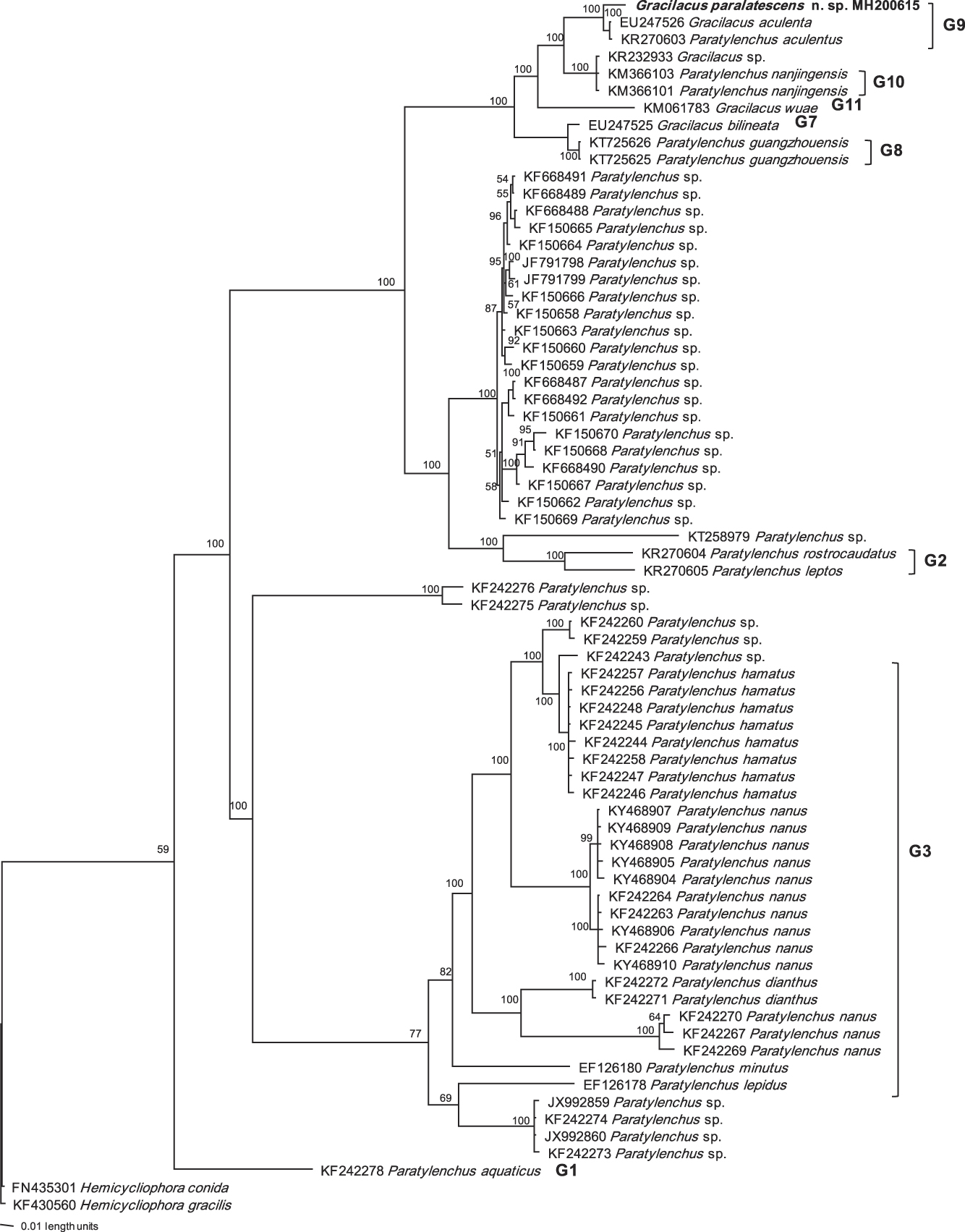
Figure 6
Bayesian consensus tree of Gracilacus paralatescens n. sp. inferred from ITS under SYM+I+G model (-lnL = 9907.1797; AIC = 19828.3594; freqA = 0.278; freqC = 0.2355; freqG = 0.2265; freqT = 0.2601; R(a) = 1.2457; R(b) = 6.0854; R(c) = 2.081; R(d) = 0.4505; R(e) = 7.1498; R(f) = 1; Pinva = 0.0908; Shape = 1.0971). Posterior probability values exceeding 50% are given on appropriate clades.