
Table 1
Morphometrics of Labrys filiformis n. sp. All measurements are in µm and in the form: mean ± standard deviation (range).
| Character | Holotype | Paratype |
|---|---|---|
| n | female | 8 females |
| L | 427 | 440 ±17 (425-463) |
| a | 38.8 | 41.6 ± 2.3 (38.7-46.2) |
| b | 4.9 | 5.1 ± 0.2 (4.9-5.4) |
| c | 3.9 | 3.8 ± 0.2 (3.5-4.0) |
| c' | 13.8 | 14.6 ± 1.1 (13.2-15.9) |
| V | 60.4 | 59.9 ± 1.21 (57.7-61.5) |
| V' | 81.4 | 81.5 ± 1.3 (79.9-84.1) |
| Stylet length | 6 | 6.2 ± 0.4 (6-7) |
| Median bulb valve – anterior end | 44 | 43.7 ± 1.8 (40-46) |
| Excretory pore – anterior end | 69 | 65.5 ± 2.6 (62-69) |
| Neck length (stoma + pharynx) | 87 | 86.1 ± 2.3 (82-90) |
| Lip region to vulva | 258 | 263 ± 8 (256-277) |
| Body width | 11 | 10.6 ± 8.3 (10-11) |
| Anal body width | 8 | 8.0 ± 0.5 (7-9) |
| Anterior genital branch length | 63 | 62.5 ± 5.7 (56-72) |
| Postvulval uterine sac | 6 | 6.4 ± 1.1 (5-8) |
| Vulva – anterior end | 258 | 263 ± 8 (256-277) |
| Vulva to anus distance | 59 | 60.1 ± 5.2 (49-66) |
| Tail length | 110 | 116.6 ± 8.6 (106-127) |
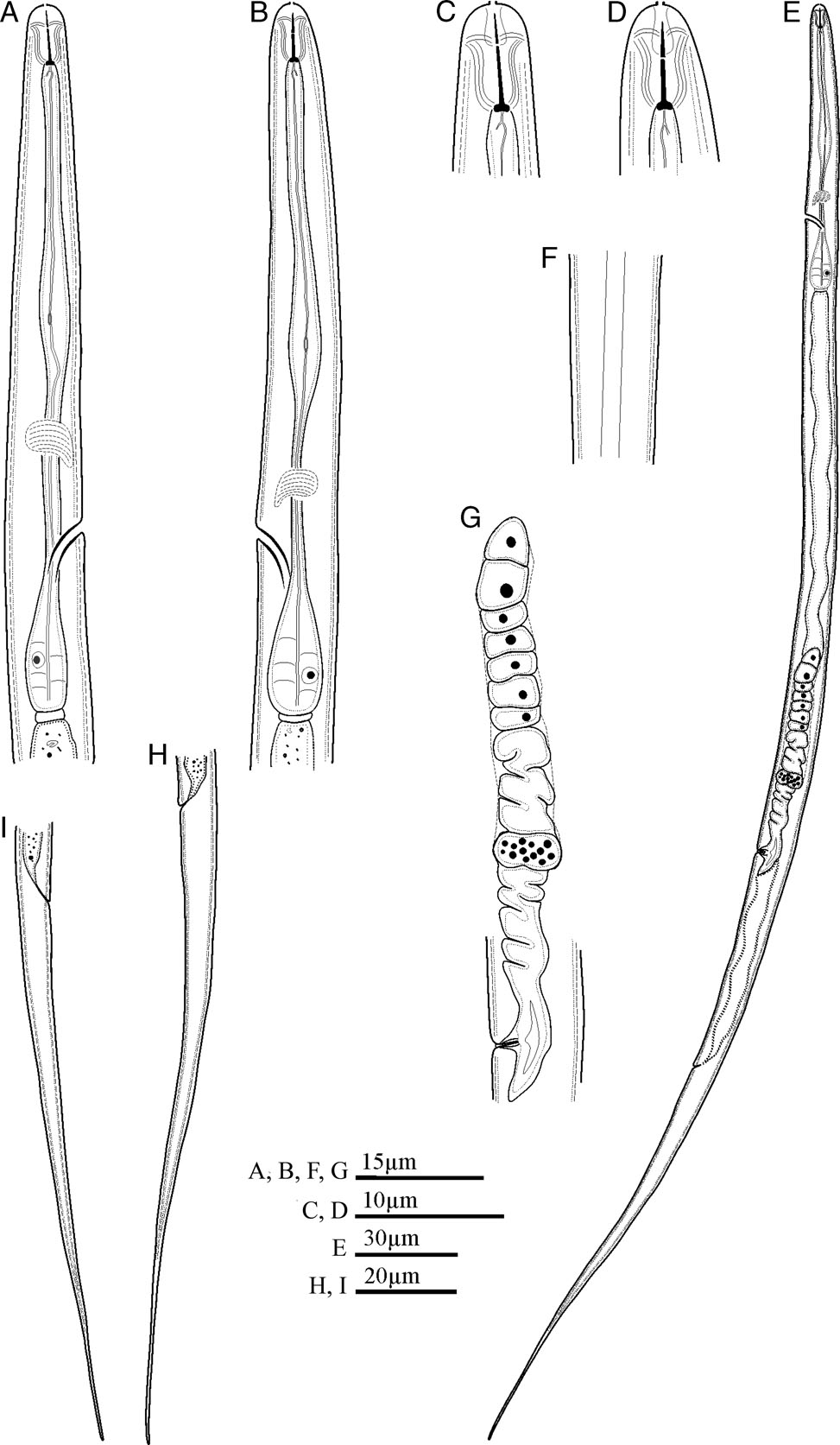
Fig. 1
Labrys filiformis n. sp. (female). A, B: Neck (stoma ; pharynx) C, D: Anterior end E: Entire body; F: Lateral field at mid-body; G: Reproductive system; H, I: Tail.
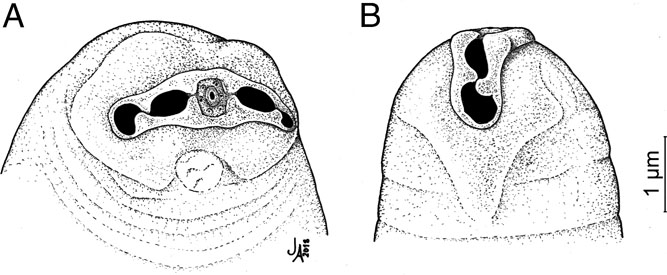
Fig. 2
Interpretative drawing of lip region of Labrys filiformis n. sp. based on scanning electron microscopy (SEM) observations in frontal (A) and lateral (B) view.
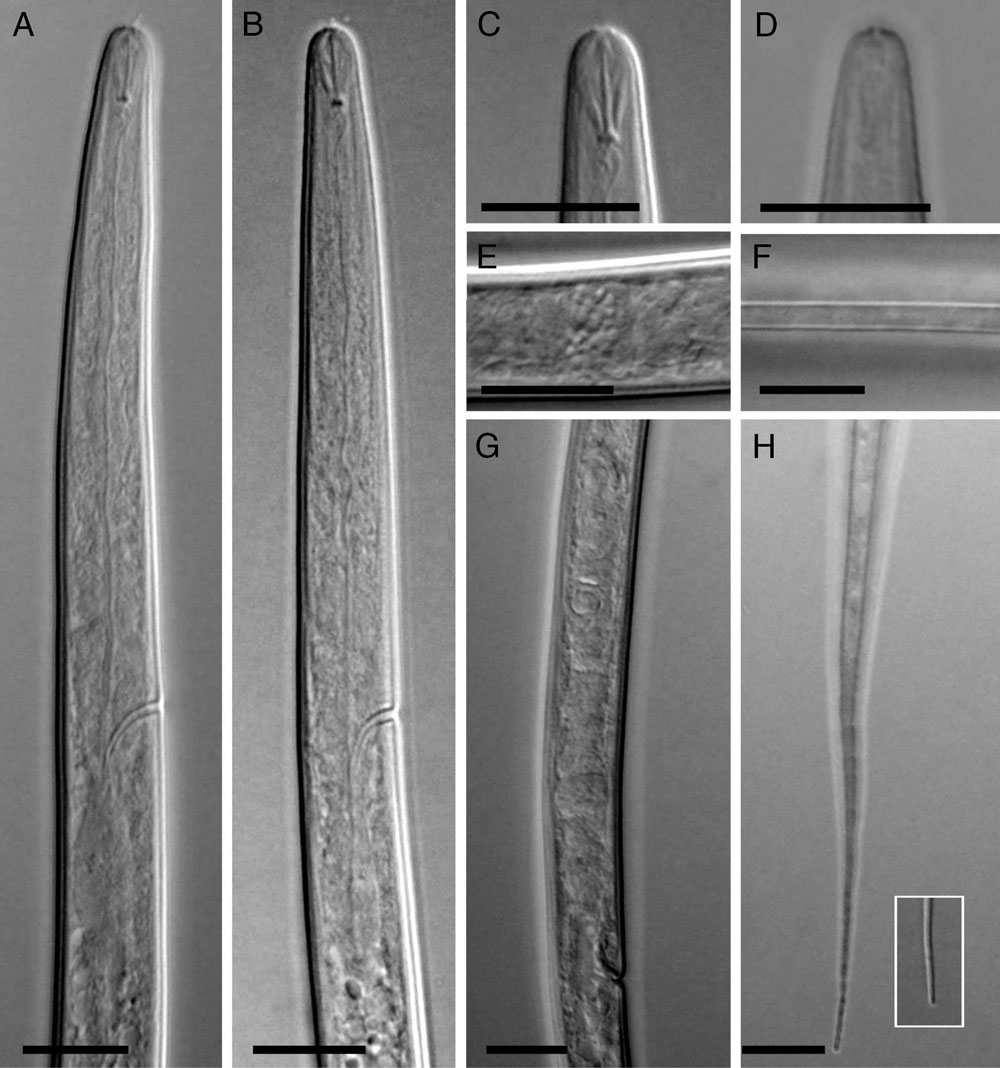
Fig. 3
Labrys filiformis n. sp. (light microscopy, female). A, B: Pharyngeal region; C: Anterior end; D: Amphidial aperture E: Spermatheca filled with sperm; F: Lateral field at mid-body; G: Reproductive system; H: Tail tip. All scale bars =10 µm.
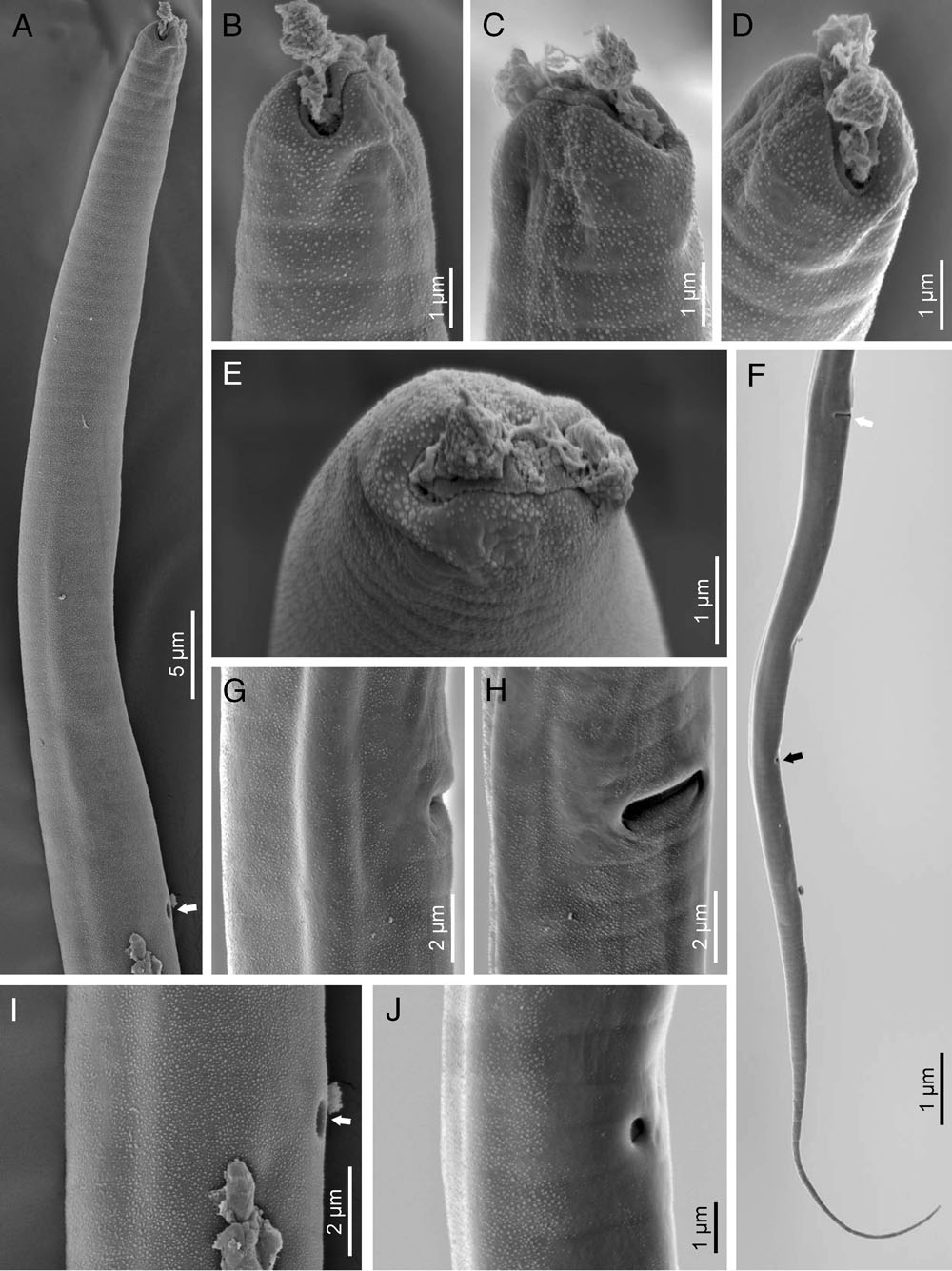
Fig. 4
Labrys filiformis n. sp. (scanning electron microscopy [SEM], female). A: Anterior region (arrow at the excretory pore); B–E: Lip region in right lateral, subdorsal, sublateral and frontal views, respectively; F: Posterior region (white arrow at the vulva, black arrow at the anus); G, H: Vulva in lateral and subventral views, respectively; I: Excretory pore (arrow); J: Anus.
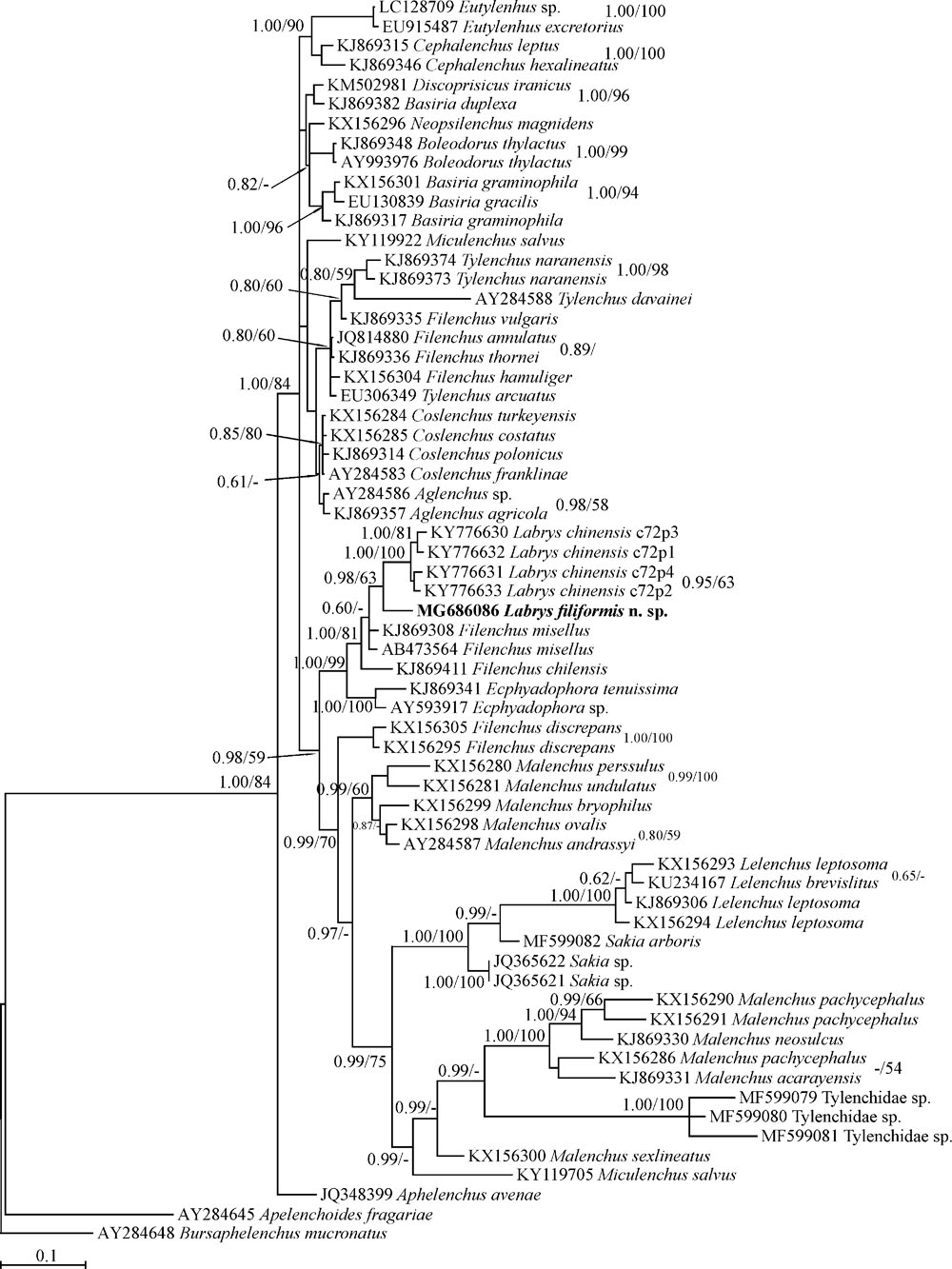
Fig. 5
Bayesian 50% majority rule consensus tree inferred from 64 sequences of 18S rDNA (GenBank accession number and species name) under the GTR+G+I model. Bayesian posterior probabilities and maximum likelihood bootstrap values are given for appropriate clades in the form of BPP/ML BS. The new species is in bold.
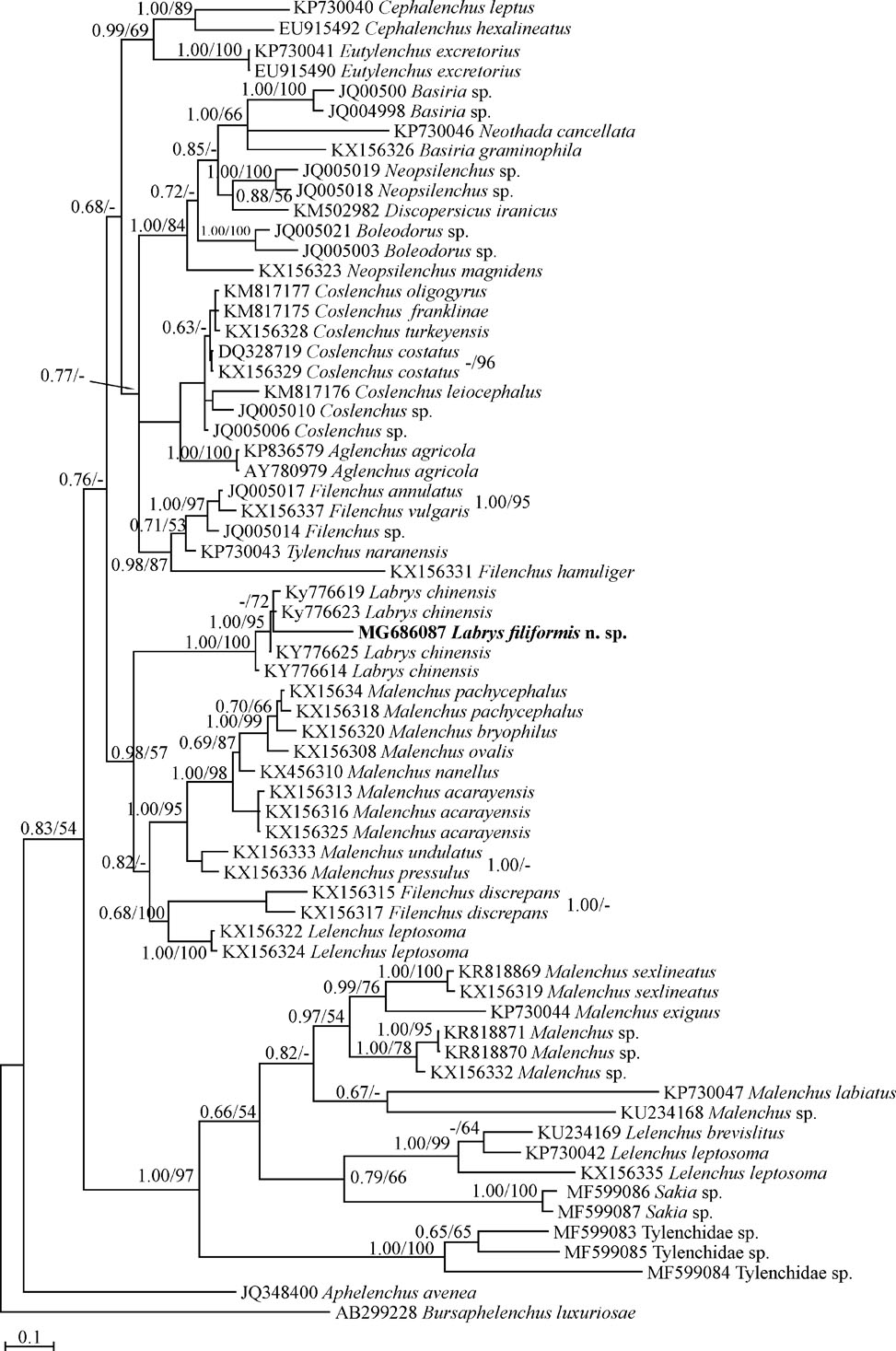
Fig. 6
Bayesian 50% majority rule consensus tree inferred from 66 sequences of 28S rDNA D2-D3 (GenBank accession number and species name) under the GTR+G+I model. Bayesian posterior probabilities and maximum likelihood bootstrap values are given for appropriate clades in the form of BPP/ML BS. The new species is in bold.