Watermelon (Citrullus lanatus (Thunb.) Matsum. and Nakai var. lanatus ) (CL) is among the most commonly cultivated vegetable crops worldwide. Africa is the center of origin (Jarret et al., 1997; Levi et al., 2001, 2011; Chomicki and Renner, 2015) with several Citrullus spp. (Chomicki and Renner, 2015; Paris 2015) exhibiting wide genotypic and phenotypic diversity (Levi et al., 2013, 2016). CL, which includes the sweet dessert watermelon, exists in central and north Africa, also includes a closely related type used for seed consumption known as “Egusi” watermelon (Dahl Jensen et al., 2011). Although watermelon cultivars have close genetic relationships with Egusi watermelons (Guo et al., 2013; Levi et al., 2013, 2016), the later type is also classified as “Citrullus mucosospermus” (Chomicki and Renner, 2015). Levi et al. (2001) indicated that watermelon cultivars share a narrow genetic base. Consequently, they are highly susceptible to soil-borne diseases and pests compared with their counterpart Citrullus accessions collected in the wild (Thies and Levi, 2003; Thies and Levi, 2007; Thies et al., 2012, 2015a; Wechter et al., 2012a, 2012b; Levi et al., 2013).
Until recent years, preplant fumigation of soil beds with methyl bromide has been the main method for suppression of RKN in watermelon fields. Indeed, about 6% of methyl bromide applied for preplant soil fumigation in vegetable crops worldwide was used for watermelon and melon (USDA, 1993). However, methyl bromide has been excluded from the market (U.S. Environmental Protection Agency, 2012) and there is a continuous need to identify and develop new alternatives to combat RKN from attacking vegetable crops. Identifying new resistance sources and utilizing them in breeding for resistant or tolerant varieties is considered the most effective approach for controlling RKN (Mercer and Watson, 1996). Plant resistance could reduce RKN infestation through abiosis, while tolerance allows the plant to sustain RKN presence. A watermelon type that exists in southern Africa and named by native people as cow watermelon, Citrullus amarus (CA), and until recently known in the USA as the Citron watermelon or Citrullus lanatus var. citroides (Chomicki and Renner, 2015), represents a wide genetic diversity and has a viable gene pool useful for improvement of watermelon cultivars for disease or pest resistance (Levi et al., 2013). United States Plant Introductions (PIs) of CA, collected in southern Africa, were identified as resistant to root-knot nematodes (RKN). These CA PIs showed lower gall formation and low RKN egg masses compared with watermelon cultivars (Thies and Levi, 2003; Thies and Levi, 2007). Experiments in fields infested with RKN in the southeast United States showed that CA accessions are robust rootstocks for seedless watermelon while other commercial rootstock cultivars representing Cucurbita spp. or Lagenaria siceraria succumbed to RKN (Thies et al., 2010, 2012, 2015a, 2015b, 2016c; Levi et al., 2014). These studies indicate that the CA accessions have natural resistance against RKN which does not exist in watermelon cultivars (CL), or in pumpkin, squash, or bottle gourd rootstocks used for grafted watermelon.
Plants have a wide range of defense mechanisms by which they respond to biotic and abiotic stresses, mainly in producing defense metabolites. Plant secondary metabolites are an integral part of the host plant’s resistance mechanisms against disease causing organisms, or for interaction with beneficial organisms (Wink, 2003). Prior research using nuclear magnetic resonance (NMR) technology has focused on analyzing watermelon fruits, seeds and leaves (de Miranda Costa et al., 2007; Mahmud et al., 2015) or on finding phytochemicals in the desert watermelon Citrullus colocynthis that have an important medicinal value (Chawech et al., 2015). Although there is sufficient information on roots of RKN-resistant CA accessions versus watermelon cultivars (CL) (Thies and Levi, 2003, 2007), there has not been any study comparing their root metabolites. The overall objective of this study was to elucidate the root metabolite profiles of RKN-resistant CA accessions versus watermelon cultivars using NMR technology.
Materials and methods
Plant material
Seeds of seven homozygous resistant germplasm lines, each derived (through self-pollination and single seed descent through four-five generations) from a PI resistant to RKN (CA) and watermelon cultivars (CL; Crimson Sweet and Charleston Gray) susceptible to RKN (Thies and Levi, 2003, 2007) were grown in a greenhouse at the USDA, ARS, U.S. Vegetable Laboratory in Charleston, SC. All seven PIs showed similar levels of resistance in the field studies performed by Thies and Levi (2007). The seeds were sowed in trays with individual cells containing a steam-sterilized Metro Mix 360 Potting Soil (Sungro, Agawam, MA) free of nematodes (Table 1). On the third day after emergence, and still in the absence of nematodes, seedlings were collected for root analysis.
Table 1
Germplasm lines of Citrullus amarus (CA) and watermelon cultivars (Citrullus lanatus; CL) used in this study.
| Watermelon germplasm line/cultivar | Parental PI of germplasm line | Citrullus spp. | |||||
|---|---|---|---|---|---|---|---|
| W2001 | PI 482303 | CA | |||||
| W1832 | PI 189225 | CA | |||||
| W1849 | PI 482324 | CA | |||||
| W1254 | PI 244017 | CA | |||||
| W1446 | PI 244018 | CA | |||||
| W1813 | PI 482319 | CA | |||||
| W1482 | PI 482259 | CA | |||||
| Charleston Gray | CL | ||||||
| Crimson Sweet | CL | ||||||
| No. | Metabolite | 1H chemical shifts (ppm) (functional group or specific H, multiplicity of peak) | 13C chemical shifts (ppm) (functional group or specific C) | ||||
|---|---|---|---|---|---|---|---|
| 1 | 4-Aminobutyrate | 1.92 (2CH2); 2.30 (1CH2); 3.02 (3CH2) | 26.6 (2CH2); 37.2 ( 1CH2);42.0 (3CH2) | ||||
| 2 | 2-Oxoglutarate | 2.50 (1CH2, t); 3.02 (2CH2, t) | 33 (1CH2); 39 (2CH2) | ||||
| 3 | Acetate | 1.92 (CH3, s) | 26 (CH3) | ||||
| 4 | Alanine | 1.48 (Hβ,d); 3.8 (Hα,q) | 19.0 (Cβ); 53 (Cα) | ||||
| 5 | Arginine | 3.25 (Hδ,t); 1.66, 1.74 (Hγ,m); 1.92 (Hβ,m); 3.8 (Hα,t) | 43 (Cδ); 27 (Cγ); 30 (Cβ); 57 (Cα) | ||||
| 6 | Asparagine | 2.87, 2.96 (Hβ,dd); 4.0 (Hα,q) | 37.5 (Cβ); 54 (Cα) | ||||
| 7 | Aspartate | 2.70, 2.82 (Hβ,dd); 3.90 (Hα,q) | 39.4 (Cβ); 55.1 (Cα) | ||||
| 8 | Betaine | 3.27 (CH3, s); 3.91 (CH2, s) | 56 (CH3); 69 (CH2) | ||||
| 9 | Choline | 3.21 (CH3, s); 3.52 (1CH2, m); 4.07 (2CH2, m) | 56.8 (CH3); 70.3 (1CH2); 58.5 (2CH2) | ||||
| 10 | Ethanolamine | 3.15 (1CH2, t); 3.8 (2CH2, t) | 44.1 (1CH2, t); 60 (2CH2, t); | ||||
| 11 | Formate | 8.46 (CH, s) | 174 (CH) | ||||
| 12 | Fructose | 3.57, 3.72 (1CH2, dd); 3.70, 4.03 (6CH2, dd); 3.80 (3CH, d); 3.8,4.00 (5CH, d); 3.90, 4.12 (4CH, t) | 65.3 (1CH2); 66.2 (6CH2); 70.5 (3CH); 70 (5CH); 72.5 (4CH) | ||||
| 13 | Glucose | 3.25 (2βCH, dd), 3.41 (4CH, dd); 3.47 (5βCH, m); 3.50 (3βCH, t); 3.54 (2αCH, dd); 3.72 (3αCH, t); 3.73 (6βCH2, dd), 3.84 (5αCH, m); 3.90 (6αCH2, dd); 4.65 (1αCH, d); 5.24 (1βCH,d) | 77.0 (2βCH); 72.5 (4CH); 78.8 (5βCH); 78.7 (3βCH); 74.3 (2αCH); 75.7 (3αCH); 63.7 (6CH); 74.4 (5αCH); 98.8 (1αCH); 94.9 (1βCH) | ||||
| 14 | Glutamate | 2.07, 2.14 (Hβ,m); 2.36 (Hγ,m); 3.76 (Hα,t) | 29.8 (Cβ); 36.4 (Cγ); 57.4 (Cα) | ||||
| 15 | Glutamine | 2.16 (Hβ,m); 2.5 (Hγ,m); 3.78 (Hα,t) | 29.1 (Cβ); 34 (Cγ); 57.2 (Cα) | ||||
| 16 | Guanidoacetate | 3.79 (CH2, s) | 46.3 (CH2, s) | ||||
| 17 | Histamine | 3.0 (2CH2, t);3.3 (1CH2, t); 7.10 (2CH, s); 7.86(1CH,s) | 26 (2CH2, t); 41(1CH2, t); 120 (2CH, s); 140 (1CH,s) | ||||
| 18 | Histidine | 3.2, 3.2 (Hβ,dd); 4.0 (Hα,t); 7.10 (Hδ,s); 7.84 (Hε,s) | 31 (Cβ); 58 (Cα); 120 (Cδ); 139 (Cε) | ||||
| 19 | Isoleucine | 0.94 (Hδ,t), 1.02 (Hγ,d); 1.2, 1.5 (Hγ,m); 2.0 (Hβ,m); 3.7 (Hα,d) | 14.0 (Cδ); 17, 6 (Cγ); 39 (Cβ); 62 (Cα) | ||||
| 20 | Lactate | 1.33 (CH3, d); 4.1 (CH, q) | 22.3 (CH3); 71 (CH) | ||||
| 21 | Leucine | 0.96, 0.97 (Hδ,d); 1.7 (Hγ,m); 1.7 (Hβ,m); 3.7 (Hα,m) | 23.8, 24.8 (Cδ); 27 (Cγ); 43 (Cβ); 56 (Cα) | ||||
| 22 | Lysine | 1.4 (Hγ,m); 1.73 (Hδ,m); 1.92 (Hβ,m);3.03 (Hε,t); 3.7 (Hα,t) | 24 (Cγ); 29.3 (Cδ); 32.7 (Cβ); 42.0 (Cε); 57 (Cα) | ||||
| 23 | Malate | 2.37, 2.67 (CH2, dd); 4.30 (CH, dd) | 45.5 (CH2); 73.3 (CH) | ||||
| 24 | Malonate | 3.15 (CH2, s) | 50 (CH2) | ||||
| Methanol (contaminant) | 3.36 (CH3, s) | 51 (CH3, s) | |||||
| 25 | Oxalacetate | 2.41 (CH2, s) | 28.4 (CH2) | ||||
| 26 | Phenylalanine | 3.12, 3.29 (Hβ,dq); 3.9 (Hα,q); 7.34 (Hδ,d); 7.39 (Hζ ,t); 7.43 (Hε,t) | 42 (Cβ); 60 (Cα); 132 (Cδ); 131 (Hζ,t); 132 (Hε,t); | ||||
| 27 | Pyroglutamate | 2.04, 2.51 (Hβ,m); 2.41 (Hγ,t); 4.18 (Hα,q) | 28.2 (Cβ);32.5(Cγ); 61.2 (Cα) | ||||
| 28 | Raffinosea | 5.44 (1′CH, d); 5.00 (1″CH, d)00 | 95.0 (1′CH); 101.00 (1″CH) | ||||
| 29 | Sarcosine | 2.76 (CH3 , s); 3.6 (CH2, s) | 35 (CH3); 53 (CH2, s) | ||||
| 30 | Succinate | 2.40 (CH2, s) | 37.1 (CH2) | ||||
| 31 | Sucrose | 3.49 (3CH, t); 3.6 (2CH, dd); 3.69 (1′CH2, s); 3.77 (4CH, t); 3.85 (5CH, m); 3.83 (6,6′CH2, m); 3.90 (5′CH, m); 4.06 (4′CH, t); 4.23 (3′CH, d); 5.42 (1CH, d) | 72.2 (3CH); 74 (2CH); 64.3 (1′CH2); 75.6 (4CH); 75.3 (5CH); 65.4 (6,6′CH2); 84.2 (5′CH); 76.9 (4′CH); 79.4 (3′CH); 94.9 (1CH) | ||||
| 32 | Tartrate | 4.35 (CH, s) | 77 (CH) | ||||
| 33 | Threonine | 1.33 (Hγ,d); 4.3 (Hβ,m); 3.6 (Hα,d) | 22.3 (Cγ); 69 (Cβ); 63 (Cα) | ||||
| 34 | Trimethylamine functional groupb | 3.22 (CH3, s); 3.225 (CH3, s); 3.23 (CH3, s) | 56.9 (CH3) | ||||
| 35 | Tyrosine | 3.07, 3.18 (Hβ,dq); 3.9 (Hα,q); 6.91 (Hε,d); 7.20 (Hδ,d) | 42 (Cβ); 60 (Cα);120 (Cε); 134 (Cδ) | ||||
| 36 | Valine | 1.00, 1.05 (Hγ,d); 2.3 (Hβ,m); 3.6 (Hα,d) | 19.6, 20.8 (Cγ); 32 (Cβ); 63 (Cα) | ||||
| CA PI versus cultivars | |||||||
|---|---|---|---|---|---|---|---|
| 4-Aminobutyrate | |||||||
| Alanine | |||||||
| Arginine | |||||||
| Asparagine | |||||||
| Ethanolamine | |||||||
| Formate | |||||||
| Fructose | |||||||
| Glutamate | |||||||
| Glutamine | |||||||
| Isoleucine | |||||||
| Succinate/oxalacetate | |||||||
| Unk 6.14 | |||||||
| Unk 7.64 | |||||||
| Unk 7.68 | |||||||
| Valine | |||||||
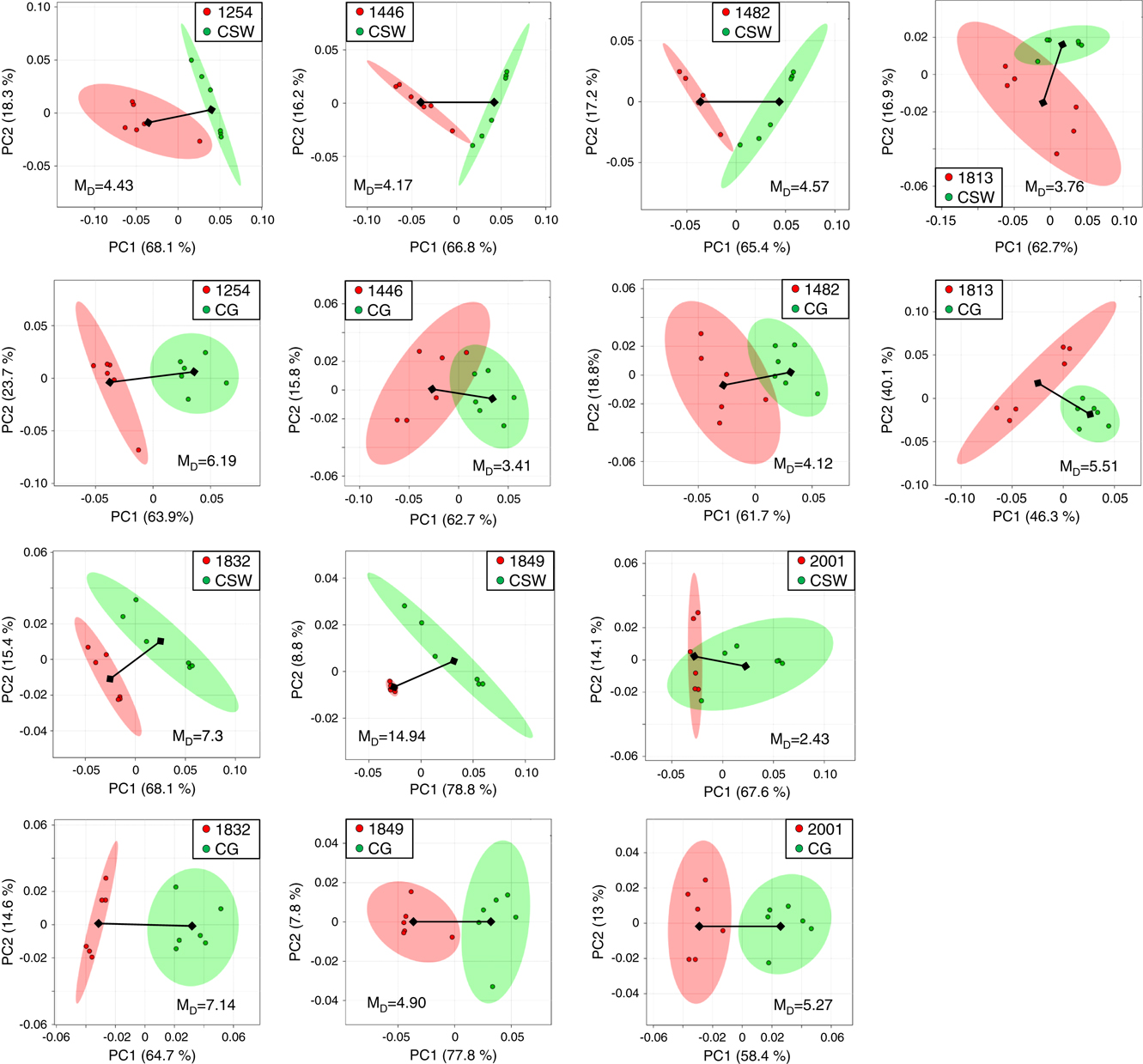
| Statistical Parameter | 1254 vs. CSW | 1446 vs. CSW | 1482 vs. CSW | 1813 vs. CSW | 1832 vs. CSW | 1849 vs. CSW | 2001 vs. CSW |
| D M | 4.43 | 4.17 | 4.57 | 3.76 | 7.35 | 14.94 | 2.43 |
| F-true | 26.48 | 23.49 | 28.24 | 19.09 | 72.91 | 301.50 | 7.95 |
| F-critical | 4.96 | 4.96 | 4.96 | 4.96 | 4.96 | 4.96 | 4.96 |
| Significance status | Yes | Yes | Yes | Yes | Yes | Yes | Yes |
| Statistical Parameter | 1254 vs. CG | 1446 vs. CG | 1482 vs. CG | 1813 vs. CG | 1832 vs. CG | 1849 vs. CG | 2001 vs. CG |
| D M | 6.19 | 3.41 | 4.12 | 5.51 | 7.14 | 4.90 | 5.27 |
| F-true | 51.74 | 15.73 | 22.93 | 41.02 | 68.76 | 32.37 | 37.48 |
| F-critical | 4.96 | 4.96 | 4.96 | 4.96 | 4.96 | 4.96 | 4.96 |
| Significance status | Yes | Yes | Yes | Yes | Yes | Yes | Yes |
| 1832 | 1254 | 1849 | 1813 | 1446 | 1482 | 2001 | |
|---|---|---|---|---|---|---|---|
| Metabolites with higher concentrations in resistant linesa | Crimson Sweet (CSW), Fold Change or Charleston Grey (CG), Fold Change | ||||||
| 2-oxoglutarate + 4-aminobutyrate | – | – | – | – | – | CSW 6.27 | – |
| 4-aminobutyrate | – | – | CSW 5.42 | – | – | – | CSW 6.23 CG 1.66 |
| Alanine | CSW 3.14 | – | CSW 4.53 CG 4.56 | – | CSW 2.11 | CSW 4.02 CG 1.53 | CSW 4.43 CG 1.78 |
| Arginine | CSW 3.4 CG 2.50 | – | – | – | – | – | – |
| Asparagine | CSW 47.72 CG 21.47 | – | – | – | – | – | – |
| Betaine | CSW 5.87 | – | – | – | – | – | – |
| Choline | CSW 2.86 CG 1.76 | – | CSW 2.40 CG 1.50 | – | CSW 1.63 | – | CSW 2.32 CG 1.41 |
| Ethanolamine | CSW 5.77 CG 1.86 | – | CSW 4.11 | – | – | – | CSW 3.77 |
| Formate | – | – | – | – | CSW 2.51 CG 3.07 | – | – |
| Fructose | – | CSW 2.83 CG 1.97 | CSW 2.38 CG 1.85 | – | CSW 2.36 | CSW 3.83 CG 2.33 | CSW 2.79 CG 1.71 |
| Glucose | CSW 4.28 | CSW 2.19 | CSW 2.10 | – | CSW 1.87 | CSW 2.82 CG 1.37 | CSW 3.81 CG 1.26 |
| Glutamate | CG 2.29 | – | CSW 15.60 | – | – | – | CSW 26.02 |
| Glutamine | CSW 5.17 CG 3.09 | – | CSW 6.77 CG 5.40 | – | CSW 3.81 CG 2.32 | CSW 3.81 CG 2.22 | CSW 3.14 CG 2.18 |
| Isoleucine | CG 2.59 | – | CSW 7.18 | – | – | – | CSW 8.73 CG 2.55 |
| Lysine | – | – | – | – | – | – | CG 14.09 |
| Malate | – | CSW 20.6 CG 1.75 | CSW 2.47 | CSW 3.58 | CSW 21.94 CG 1.97 | CSW 9.79 CG 1.61 | – |
| Malonate + ethanolamine | – | – | – | – | – | CSW 2.29 | – |
| Multipleb | CSW 2.27 | – | CSW 2.16 | – | – | – | CSW 2.37 |
| Raffinose | – | – | – | – | – | – | CSW 2.60 CG 2.22 |
| Succinate | – | CSW 1.94 | – | – | CSW 3.23 CG 2.04 | – | – |
| Succinate/Oxalacetate | – | – | CSW 1.92 | – | – | CSW 1.89 | – |
| Sucrose | – | – | – | – | – | CG 2.96 | CSW 4.04 CG 3.67 |
| Sucrose/Choline | – | – | – | – | – | CSW 2.95 | – |
| Tartaric acid | – | – | – | – | – | CSW 2.20 | – |
| Trimethylamine functional group | CG 2.72 | – | CG 1.30 | CSW 1.86 | CG 1.71 | ||
| UNK at 1.22 | – | – | CSW 1.88 | – | – | – | – |
| UNK at 6.41 | CG 5.07 | – | CSW 7.34 CG 7.49 | CSW 5.94 CG 6.12 | – | CSW 5.05 CG 4.92 | CSW 4.94 CG 5.05 |
| UNK at 7.64 | CSW 4.28 CG 5.40 | – | CSW 7.08 CG 8.24 | CG 4.82 | – | CSW 4.20 CG 5.00 | CSW 4.32 CG 5.52 |
| UNK at 7.68 | CG 3.61 | – | CSW 2.08 CG 3.49 | CSW 4.89 CG 4.12 | CSW 1.91 | CG 2.21 | CG 3.02 |
| Valine | CSW 9.94 CG 3.58 | – | CSW 9.47 | – | – | CSW 5.33 CG 3.07 | CSW 10.22 CG 2.59 |