Have a personal or library account? Click to login
Terrestrial Non-Parasitic Nematode Assemblages associated With Glyphosate-tolerant and Conventional Soybean-Based Cropping Systems Cover

Terrestrial Non-Parasitic Nematode Assemblages associated With Glyphosate-tolerant and Conventional Soybean-Based Cropping Systems

Open Access
|Oct 2018

Full Article

Commercial production of genetically modified crops (GM), either herbicide or insect tolerant, commenced in the 1990s (Dill et al., 2008; Shütte et al., 2017). Herbicide tolerance of GM crops to broad spectrum herbicides containing glyphosate (N-phosphonomethyl) as the active substance is the predominant trait of these crops (Newman et al., 2016). Among glyphosate tolerant crops grown globally, soybean (Glycine max L.) dominates in terms of hectares planted (54.2 million ha), followed by maize (Zea mays L.) (13.2 million ha), cotton (Gossypium hirsutum L.) (5.1 million ha) and canola (Brassica napus L.) (2.3 million ha) (Shütte et al., 2017). In South Africa, glyphosate became commercially available more than a decade ago and is now widely used in soybean- and maize-based cropping systems in particular (Dlamini et al., 2014). It is estimated that more than 90% of soybean (630,000 ha) and 16% of maize (284,000 ha) grown in South Africa are glyphosate tolerant (Dlamini et al., 2014; James 2015). The driving force behind the rapid adoption of glyphosate is because producers prefer to use a single herbicide to control a broad spectrum of weeds and grasses, resulting in minimal crop injury and great economic benefits to producers (Hurley et al., 2009).

Glyphosate is often regarded as an environmentally-friendly pesticide due to its low mammalian toxicity, relatively short environmental half-life and very low activity in soil due to its binding to soil minerals (Duke and Powles, 2008; Cerdeira and Duke, 2010). However, the increasing cultivation of glyphosate tolerant crops has raised a wide range of concerns such as its effects on non-target micro-organisms, e.g., nematodes in the soil (Zhao et al., 2013; Allegrini et al., 2015; Newman et al., 2016). Nematodes play a crucial role in important ecosystem services such as nutrient recycling and decomposition, suppression of pathogenic microorganisms, and biodegradation of harmful compounds (Bongers and Bongers, 1998; Ferris et al., 1998; Neher, 2001; Wardle et al., 2005). As a result, changes in nematode community composition (assemblage) may have a substantial impact on the ecosystem functioning (Wada et al., 2011; Fraschetti et al., 2016).

Information about the non-target effects of glyphosate on soil nematodes is scarce and not well documented. More important, often inconclusive and/or conflicting effects of glyphosate on nematode assemblages are reported. Only six scientific reports could be found that dealt with the effects of glyphosate on nematodes. The majority of these focused on the effects that glyphosate has on plant-parasitic nematodes (Osman and Viglierchio, 1981; Vega et al., 1993; Yang et al., 2002, Liphadzi et al., 2005; Cerdeira et al., 2007; Noel and Wax, 2009). Liphadzi et al. (2005), however, reported that different glyphosate dosages had no effect on non-parasitic nematode densities in a growth chamber experiment.

No information on the effects of glyphosate on, or its association with either plant-parasitic or terrestrial non-parasitic nematodes (generally referred to as beneficial or free-living), is available for South African agricultural production areas. Therefore, the main aims of this study were to (i) identify terrestrial, non-parasitic nematode assemblages in commercial soybean fields where glyphosate has been applied regularly versus not applied for at least 5 years prior to this study and (ii) examine whether glyphosate application affected such nematode assemblages in a 2 year soybean-maize cropping system.

Materials and methods
Commercial soybean field study

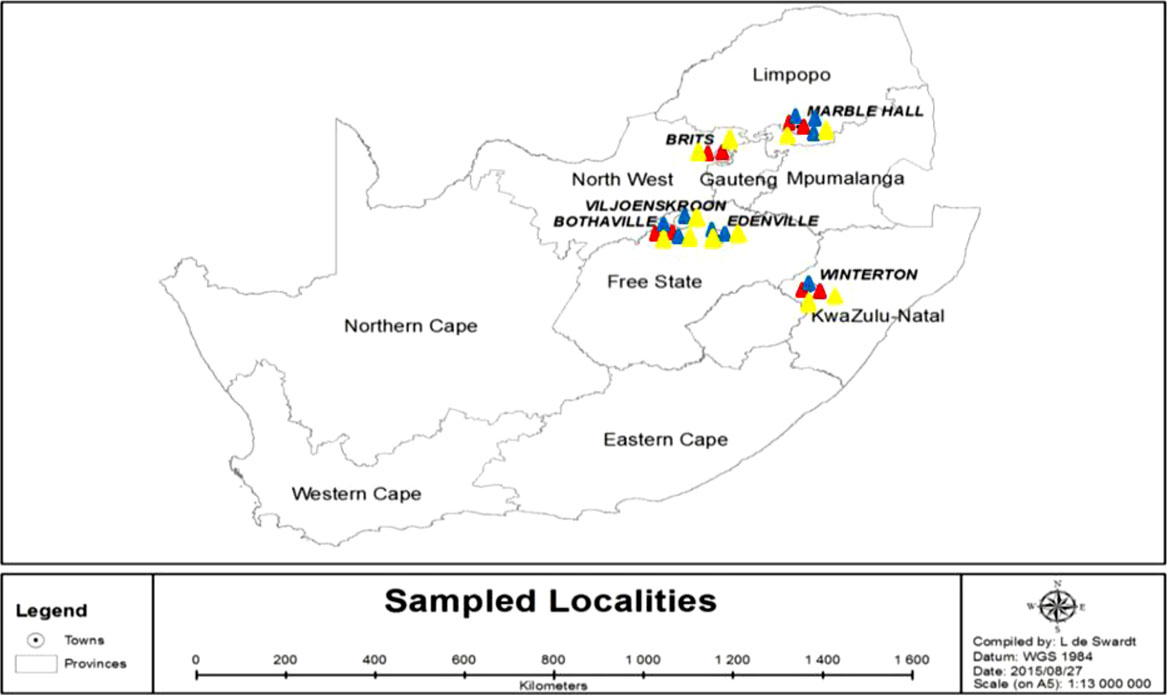
During the 2011/12 growing season, rhizosphere soil was collected from soybean plants that were cultivated at eight local fields. Four of these fields were planted with glyphosate-tolerant and four with conventional soybean cultivars (Fig. 1), representing the two soybean ecosystems. Concurrently, soil samples were also collected from a third ecosystem, viz. natural vegetation (representing a reference system) either adjacent to, or within 50 to 100 m from the soybean fields sampled. From each of these three ecosystems, at each sampling locality 80 rhizosphere soil samples were collected, pooled and 20 sub-samples examined.

Glyphosate had been applied continuously for a minimum of 5 years prior to our study in the fields where glyphosate-tolerant soybean and/or maize cultivars were cultivated. However, in the fields planted with conventional soybean no glyphosate-tolerant cultivars were grown and no glyphosate applied for at least 5 years prior this study or never before. No crop cultivation has taken place for at least 10 years prior to this study in the areas where the natural vegetation was sampled.

During the 2012/13 growing season, the same fields sampled during the preceding season were sampled again as well as nine additional fields and adjacent natural vegetation (Fig. 1). Five of these additional fields were planted with glyphosate-tolerant and four with conventional soybean cultivars, with information about the soybean cultivar planted, crop history and soil properties for each field sampled are supplied (Table 1). Soil properties for each site were determined by the EcoAnalitica Laboratory of North-West University (NWU, Potchefstroom) using internationally-accredited protocols (Walkey and Black, 1947; Bouyoucos, 1962; Beretta et al., 2014). Mean rainfall and temperature data, obtained from the database of the Agricultural Research Council, Institute for Soil, Climate and Water, AgroClimatology for each site, from planting of the soybean crops until nematode sampling are also listed (Table 2). Rip and till was the soil cultivation practice used in all soybean fields sampled.

Table 1

Soybean cultivar planted at each soybean field, crop history, and selected soil chemical and physical properties of each field where plant-parasitic nematodes from roots and rhizosphere soil samples were collected during the 2011/12 and 2012/13 growing seasons.

Soil chemical propertiesSoil physical properties
Sampling seasonLocalityEcosystem and cultivarCrop historypH (H2O)CaMgKNaP% Sand% Silt% Clay% total C
2011/12 and 2012/13BothavilleGlyphosate-tolerant soybean (PAN1664R)Maize/Sunflower6.483811072050.520494.70.74.60.21
2012/13Glyphosate-tolerant soybean (PAN1664R)Maize/Sunflower6.48437811700.517094.50.74.80.10
2011/12 and 2012/13Conventional soybean (Egret)Maize/Sunflower6.8958181246116692.60.76.70.23
2012/13Conventional soybean (Egret)Maize/Sunflower6.43374962030.520394.60.74.70.22
2011/12 and 2012/13Natural vegetation (grass)6.77446781940.516994.50.74.70.21
2011/12 and 2012/13Natural vegetation (grass)6.06574165400525289.63.471.5
2011/12 and 2012/13BritsGlyphosate-tolerant soybean (PAN1583R)Maize/Sunflower7.281,434304497250079.95.514.61.36
2011/12 and 2012/13Conventional soybean (Egret)Soybean/Wheat7.491,69934629158.5399.81.47.6110.76
2011/12 and 2012/13Natural vegetation (grass)7.112,84055941791.550958.312.429.21.51
2011/12 and 2012/13Natural vegetation (grass)7.63,206636342985374.19.116.83.95
2012/13EdenvilleGlyphosate-tolerant soybean (PAN1664R)Soybean6.151,48640141960.54059.319.121.60.20
2012/13Conventional soybean (Superboon)Soybean4.975122132929.511870.79.3200.49
2012/13Natural vegetation (grass)5.923966726839385.93.410.73.89
2012/13Natural vegetation (grass)5.64222522711.58686.63.210.10.34
2011/12 and 2012/13Marble HallGlyphosate-tolerant soybean (PAN1454R)Maize/Soybean6.096662283902040284.96.78.40.56
2012/13Glyphosate-tolerant soybean (LS6164R)Maize/Soybean6.6454114914623118913.75.10.84
2012/13Glyphosate-tolerant soybean (LS6164R)Maize/Soybean6.0782621229117633688.73.77.60.40
2011/12 and 2012/13Conventional soybean (Egret)Soybean7.051,00140239034.56778.68.712.70.58
2012/13Conventional soybean (MC555)Soybean6.621,01224450914.515691.23.75.11.76
2011/12 and 2012/13Natural vegetation (grass)6.8396823834635.515169.29.321.51.8
2011/12 and 2012/13Natural vegetation (grass)6.5245510419224.516486.11.412.60.54
2011/12 and 2012/13Natural vegetation (grass)5.938101213752541983.73.812.52.54
2012/13Viljoens-kroonGlyphosate-soybean tolerant (PAN1583R)Maize/Soybean6.8238196330529594.11.24.70.2
2012/13Natural vegetation (grass)6.144331953709.522784.45.99.71.14
2011/12 and 2012/13WintertonGlyphosate-tolerant soybean (PAN6164R)Soybean5.671,782400.538120.58581.210.48.52.49
2012/13Conventional soybean (Mukwa)Maize/ Soybean6.331,565198182239078.812.98.41.3
2011/12 and 2012/13Conventional soybean (Mukwa)Maize/Soybean5.921,8271395515.553244.838.416.72.77
2011/12 and 2012/13Natural vegetation (grass)6.85751120860.533561.423.315.31.62
2011/12 and 2012/13Natural vegetation (grass)5.658872082954.535845.931.422.82.59
Table 2

Average temperature and rainfall figures for the 28 sites where a nematode survey was conducted during the 2011/12 and 2012/13 growing seasons.

Temperature (°C)
Locality and provinceGrowing seasonMin.Max.Rainfall (mm)
Bothaville (Free State)2011/121326272
2012/131430255
Brits (North West)2011/121633414
2012/131632365
Edenville (Free State)2012/131632303
Marble Hall (Mpumalanga)2011/121831402
2012/131835353
Viljoenskroon (Free State)2012/131431373
Winterton (Kwa-Zulu Natal)2011/121430409
2012/131430417

Nematodes were extracted from 200 g soil samples using the decanting and sieving method (Hooper et al., 2005), and counted and identified to genus level using a 1-ml Hawksley slide and light microscope (1,000 × magnification) (Doncaster et al., 1967). This process was repeated once for each sample and the mean of the two counts were used for data analyses. At least 30 individuals from each genus per sample were, after counting, fixed in a heated formaldehyde-propionic-acid-water (FPG) solution (100 ml of a 40% formalin solution, 10 ml propionic acid and 890 ml distilled water). The glass dish with the fixed nematodes were placed in an incubator at 40°C for 72 hr and the FPG solution stepwise replaced with glycerin (Marais et al., 2017). The fixed nematodes were hand-picked from the glycerin using a fine-tip needle and permanently mounted in glycerin on glass microscope slides according to the paraffin-ring protocol (Hooper, 1986). Genus identification of nematodes was done and verified by Dr Antoinette Swart, a nematode specialist-taxonomist of the Agricultural Research Council – Plant Health and Protection (Roodeplaat, South Africa).

Fig. 1

Location of the six localities where terrestrial, non-parasitic nematodes were sampled from soybean fields (2011/12: red triangles and 2012/13: blue triangles) and adjacent natural vegetation (yellow triangles) during two consecutive growing seasons (Map compiled by: Ms L. de Swart, NWU).

Soybean-maize cropping experiment

The experimental site consisted of a small field (0.028 ha plot) situated on the premises of the Agricultural Research Council’s Grain Crops Institute, Potchefstroom, South Africa. The study was conducted over two consecutive growing seasons (2013/14 and 2014/15) with soybean being cultivated during the first and maize during the second season. The soil of the plot contained 94% sand and 6% clay. The organic matter content ranged from 0.18% (2013/14 season) to 0.23% (2014/15 season), while soil pH (H2O) was 8 for the 2013/14 season and 7.8 for the 2014/15 season. The history about crops grown and herbicides applied on the experimental site, glyphosate application dosages and dates during the experimental period, nematode sampling dates and rainfall, and temperature data are supplied (Table 3).

Table 3

Crop history, agricultural practices, fertilisers applied, glyphosate application dates, and dosage rate, nematode sampling dates, rainfall, and minimum and maximum temperatures recorded of the experimental plot during the 2013/14 and 2014/15 growing seasons.

Crop history: growing season, crop and herbicides appliedGrowing season, crop and cultivar cultivatedAgricultural practice implementedInorganic fertiliser applied and dosageGlyphosate application dates and dosage ratesNematode sampling datesRainfall (mm)Minimum temperature (°C)Maximum temperature (°C)
2011/12, sunflower, no herbicide used (hand-hoeing of weeds)2013/14 (1st year), soybean (cv. LS 6164 R)Reap and plough before plantingNone10 January 2014 and 03 February 2014 @ 2 L/ha1st = 30/01/2014;2nd = 14/02/2014;3rd = 22/04/20146037.930.5
2012/13, maize, Gramoxone® (active substance bipyridyl 200 g/L as dichloride salt 276 g/L) dosage rate 3 L/ha2014/15 (2nd year), maize (cv. DKC 80–30 RR)Reap and plough before planting2:3:2 (26) at planting @ 300 kg/ha Ureum @ 50 kg/ha 4 weeks after planting17 December 2014 and 13 January 2015 @ 2 L/ha1st = 08/01/2015;2nd = 27/01/2015;3rd = 11/03/201551010.030.2

The experimental plot was split into two halves (0.013 ha each), which were divided by a fallow, 2-m buffer strip. Before planting the plot for the first season with soybean, weeds that grew on the experimental plot were mechanically hoed and left on the experimental plot. This is the practice that local farmers use. On 18 November 2013, at the beginning of the 2013/14 growing season, seeds of the glyphosate-resistant soybean cultivar LS 6164R were planted after the soil was ripped and tilled using a tractor. The soybean seeds were planted (170 per row) in 5-m-long rows with intra-and inter-row spacings of 3 cm and 0.9 m, respectively. Each seed was coated with Bradyrhizobium japonicum race WB74 at the recommended dosage rate (Soygro Pty Ltd; www.soygro.co.za). The layout of the experiment was a split-plot design with 12 replicates. Each row represented a replicate.

After germination, soybean seedlings were irrigated with ~25 mm water three times a week using a sprinkler irrigation system, except when it had rained sufficiently. When naturally occurring weeds were 10 to 20 cm tall, one half of the experimental plot was treated with glyphosate (active substance 360 g/l glyphosate present as 441 g/l of the potassium salt at a dosage rate of 2 l/ha) using a knapsack sprayer. Applications were done early in the mornings to avoid wind and possible drift of the product as specified by the owner company of the product used. The other half of the experimental plot was not treated with glyphosate or any other herbicide and represented the control. Weeds in the non-treated plot were removed using a hand hoe and left on the soil. This meant that the upper surface of the soil was disturbed during the hoeing action and organic material was left on the soil to decompose.

Before planting, as well as 10 to 20 days after each glyphosate application and also at 120 to 140 days after planting (i.e., at crop maturity), rhizosphere soil and the root systems of nine soybean plants from each replicate were collected, thoroughly mixed and one sub-sample per replicate used for nematode analyses.

During the winter of 2014, no crop was grown and both halves of the experimental plot were left fallow without any weed control being applied. However, before planting seeds of the glyphosate-resistant maize cultivar DKC 80–30 RR on 18 November 2014 of the follow-up growing season, glyphosate was applied on the same plot half where glyphosate had been applied during the previous season (where soybean was planted). Again, the other half of the experimental plot was not treated and the weeds hand hoed and left on the soil. Ten days later, the soil was ripped and tilled and seeds of commercially available maize cultivar DKC 80–30 RR planted. Twenty-five maize seeds were planted per row, each being 5-m long, with intra- and inter-row spacings of 20 cm and 0.9 m, respectively. Two glyphosate applications were done as described above for the preceding soybean crop.

Ten to 20 days after each glyphosate application and also at 120 to 140 days after planting (i.e., at crop maturity), rhizosphere soil and the root systems of three maize plants from each replicate were collected, thoroughly mixed and one sub-sample per replicate used for nematode analyses. The same protocols were used for soil and root sampling, nematode extraction, counting, and identification to genus level as described for the commercial field sampling study.

Data analyses
Commercial soybean field study

Nematode data were captured and log10(x+1) transformed using Microsoft Excel, Version 2013. Prominence values (PV) were calculated for each nematode genus using the protocol of De Waele and Jordaan (1988). Log10(x+1) transformed nematode data were also subjected to Student’s t-test analyses using Statistica Version 13.2 (www.statsoft.com). This was done to determine whether any significant (P ≤ 0.05) differences existed between the predominant genera at each of the sampling sites with regard to the three ecosystems (viz. glyphosate-tolerant vs. conventional soybean, conventional soybean vs. natural vegetation and glyphosate-resistant vs. natural vegetation). The Mixed models analysis was also done using SPSS software (Version 25) to determine whether the three independent variables, e.g., season (2011/12 and 2012/13), location (eight for 2011/12 and 17 for 2012/13) and ecosystem (glyphosate-tolerant and conventional soybean, and natural vegetation), alone or interactively, affected the abundance of the various nematode trophic groups. In addition, nematode population density data were also illustrated on canonical correspondence analyses (CCA) triplots, using the Canoco 5 software package (www.canococ5.com). This way it was determined whether correlations existed for nematode genera and specific ecosystems for data, pooled across localities and per locality. Finally, to assess soil quality as expressed by the enrichment and structure values according to colonizer-persister (c–p) values of nematode genera, the data were submitted to the faunal analyses (Ferris et al., 2001) using the NINJA tool referred to as “an automated calculation system for nematode-based biological monitoring” (Sieriebriennikov et al., 2014). This way a graphical representation of the soil food web was obtained using enrichment and structural indices (EI and SI, respectively) (Ferris et al., 2001; Ferris, 2010).

Soybean-maize cropping experiment

Student t-test (Statistica, Version 13.2; www.statsoft.com) analyses was done to determine whether significant (P ≤ 0.05) differences existed during both seasons between the two treatments (glyphosate-treated and non-treated plot halves) for the nematode population densities. Data were also subjected to one way analyses of variance (ANOVA) (Statistica Version 13.2) to determine whether significant (P ≤ 0.05) differences existed for nematode population densities among the three sampling dates for both crops. In addition, terrestrial non-parasitic nematode data were subjected to faunal analyses using the program NINJA (Sieriebriennikov et al., 2014).

Results
Commercial soybean field study

Thirty-two non-parasitic nematode genera were collectively identified from soils of the three ecosystems, with 65% identified from soils of glyphosate-tolerant soybean fields, 72% from conventional soybean fields, and 88% from natural vegetation sites (Table 4). The genera identified were represented by different feeding groups and functional guilds, and included bacterivores, fungivores, predators, and omnivores.

Table 4

Non-parasitic nematodes associated with soybean and natural vegetation at 28 sites in the soybean production areas of South Africa during the 2011/12 and 2012/13 growing seasons (√ indicates the presence of a genus; – indicates the absence of a genus).

GenusFunctional guilda, followed by c–p valueb Glyphosate-tolerant soybeanConventional soybeanNatural vegetation
Mesorhabditis (Osche, 1952; Dougherty, 1953)Ba1
Panagrolaimus (Fuchs, 1930)Ba1
Rhabditis (Dujardin, 1845)Ba1
Acrobeles (Linstow, 1877)Ba2
Acrobeloides (Cobb, 1924; Thorne, 1937)Ba2
Cephalobus (Steiner, 1929)Ba2
Chiloplacus (Thorne, 1937)Ba2
Eucephalobus (Steiner, 1936)Ba2
Monhystera (Bastian, 1865)Ba2
Plectus (Bastian, 1865)Ba2
Seleborca (Andrassy, 1985)Ba2
Wilsonema (Cobb, 1913)Ba2
Zeldia (Thorne, 1937)Ba2
Teratocephalus (de Man, 1876)Ba4
Alaimus (de Man, 1880)Ba4
Aphelenchoides (Fischer, 1894)Fu2
Aphelenchus (Bastian, 1865; Cobb, 1927)Fu2
Ditylenchus (Filipjev, 1936)Fu2
Psilenchus (de Man, 1921)Fu2
Tylenchus (Bastian, 1865)Fu2
Coslenchus (Siddiqi, 1978)Fu3
Leptonchus (Cobb, 1920)Fu4
Tylencholaimellus (Cobb, 1915; de Man, 1921)Fu4
Tylencholaimus (de Man, 1880)Fu4
Dorylaimus (Thorne, 1939)Om4
Eudorylaimus (Andrassy, 1959)Om4
Thornenema (Andrassy, 1959)Om4
Mononchus (Chitwood and Allen, 1959)Pr4
Paraxonchium (Krall, 1958)Pr4
Aporcelaimellus (Heyns, 1965)Pr5
Discolaimium (Thorne, 1939)Pr5
Discolaimoides (Heyns, 1963)Pr5

aFunctional guilds (Ferris et al., 2001); bColonizer-persister (c–p) values (Bongers, 1990).

Trophic group with Ba, Bacterivores; Fu, Fungivores; Om, Omnivores; and Pr, Predators.

The predominant non-parasitic nematodes from glyphosate-tolerant soybean sites for the 2011/12 season were Aphelenchus, Acrobeles, and Acrobeloides (Table 5). Aphelenchus occurred in soils from all of glyphosate-tolerant soybean sites while Acrobeles and Acrobeloides occurred in only 50%. For conventional soybean, the predominant genera were Panagrolaimus, Acrobeloides, and Aphelenchus. Panagrolaimus occurred at 75% of the sites, with Acrobeloides and Aphelenchus occurring in 50%. In soils from natural vegetation sites, the predominant genera were Acrobeles, Aphelenchus, and Acrobeloides. Acrobeles occurred at all sites, while Aphelenchus and Acrobeloides were found at 75% of the sites.

Table 5

Prominence values (PV), mean population density (MPD) and frequency of occurrence (FO%) of non-parasitic nematode genera identified from 200 g soil samples from glyphosate-tolerant and conventional soybean fields, as well as natural vegetation from 28 sites in the soybean production area of South Africa during the 2011/12 and 2012/13 growing seasons.

GenusPVFO%MPDGenusPVFO %MPDGenusPVFO%MPD
Glyphosate-tolerant soybeanConventional soybeanNatural vegetation
2011/12 season
Aphelenchus 3,6461003,646 Panagrolaimus 2,723753,144 Acrobeles 3,8851003,885
Acrobeles 2,131503,014 Acrobeloides 1,963502,804 Aphelenchus 3,741754,320
Acrobeloides 982501,403 Aphelenchus 1,683502,380 Acrobeloides 2,758753,185
Eucephalobus 668251,335 Aphelencohides 840251,680 Panagrolaimus 1,310501,853
Aphelenchoides 572251,144 Acrobeles 44450634 Eucephalobus 907501,281
Psilenchus 45225905 Plectus 33825675 Rhabditis 64850915
Panagrolaimus 25325505 Cephalobus 21625431 Cephalobus 570251,139
Rhabditis 19725393 Eucephalobus 17125342 Tylenchus 53475615
Mesorhabditis 16825335 Monhystera 15825315 Psilechus 18450262
Tylenchus 172534 Mesorhabditis 13025259 Zeldia 7125142
Discolaimoides 3255 Tylenchus 402580 Dorylaimus 5259
Thornenema 3255 Psilenchus 202540 Aporcellaimellus 4258
Paraxonchium 2254 Dorylaimus 4257 Discolamium 3255
Discolaimoides 3255 Discolaimoides 2253
Paraxonchium 2253
Thornenema 2253
2012/13 season
Aphelenchus 2,2751002,275 Aphelenchus 1,4481001,448 Aphelenchus 2,5901002,590
Acrobeles 1,230891,304 Eucephalobus 988441,490 Eucephalobus 2,425832,662
Eucephalobus 941781,065 Acrobeloides 821671,003 Panagrolaimus 1,6151001,615
Acrobeloides 827671,010 Panagrolaimus 55333962 Cephalobus 1,414671,728
Rhabditis 824671,007 Acrobeles 36533635 Acrobeloides 1,156831,269
Aphelenchoides 781561,043 Aphelenchoides 33422711 Acrobeles 849561,134
Panagrolaimus 57656770 Seleborca 28622610 Aphelenhoides 81767998
Zeldia 29833519 Cephalobus 58756784 Ditylenchus 32333562
Cephalobus 14822315 Plectus 24122513 Plectus 18333319
Chiloplacus 6311190 Ditylenchus 21222451 Mesorhabditis 15117365
Ditylenchus 5311161 Mesorhabditis 20633439 Seleborca 7717186
Mesorhabditis 4211126 Plectus 20122429 Rhabditis 6817165
Plectus 3411108 Zeldia 9811295 Zeldia 6617159
Tylencholaimus 71122 Chiloplacus 7811235 Wilsonema 6517157
Discolaimium 3227 Dorylaimus 85511 Chilopacus 6317154
Aporcelaimellus 3226 Leptonchus 41111 Teratocephalus 71716
Eudorylaimus 2117 Tylencholaimus 31110 Eudorylaimus 73312
Discolaimoides 2116 Alaimus 3119 Leptonchus 51713
Mononchus 2115 Coslenchus 41710
Tylencholaimellus 4179
Discolaimoides 3178

For the 2012/13 season the predominant genera identified from soils of glyphosate-tolerant soybean sites were Aphelenchus, Acrobeles, and Eucephalobus (Table 5). Aphelenchus occurred at all sites and Acrobeles and Eucephalobus at 89% and 78%, respectively. For conventional soybean, the predominant genera were Aphelenchus, Eucephalobus, and Acrobeloides. Aphelenchus occurred at all sites, with Eucephalobus and Acrobeloides occurring at 44% and 67%, respectively. In soils from natural vegetation sites the predominant genera were Aphelenchus, Eucephalobus, and Panagrolaimus. Aphelenchus and Panagrolaimus occurred at all sites and Eucephalobus at 83%.

Although the abundance of the predominant genera (Acrobeles, Acrobeloides, Aphelenchus, Eucephalobus, and Panagrolaimus) varied substantially for the three ecosystems, it did not differ significantly between ecosystems according to t-Test analyses (Table 6).

Table 6

Non-parasitic nematodes genera mean population density data per 200 g rhizosphere soil of glyphosate-tolerant and conventional soybean crops, as well natural vegetation from 28 sites surveyed in the soybean production areas of South Africa during the 2011/12 and 2012/2013 growing seasons. Values shown are means, followed by the standard deviation (SD).

2011/122012/13
Ecosystems t-value P Ecosystems t-value P
Acrobeles
Glyphosate-tolerant soybean: 603 ± 1,348Conventional soybean: 27 ± 2840.150.88Glyphosate-tolerant soybean: 261 ± 583Conventional soybean: 50 ± 3350.060.97
Glyphosate-tolerant: 603 ± 1,348Natural vegetation: 777 ± 1,737−0.020.98Glyphosate-tolerant soybean: 261 ± 583 Natural veld: 227 ± 5070.010.99
Conventional soybean: 127 ± 284Natural vegetation: 777 ± 1,737−0.170.87Conventional soybean: 150 ± 335 Natural veld: 227 ± 507−0.040.97
Acrobeloides
Glyphosate-tolerant soybean: 281 ± 627Conventional soybean: 560 ± 1,2540.060.96Glyphosate-tolerant soybean: 202 ± 452Conventional soybean: 201 ± 4490.0011
Glyphosate-tolerant: 281 ± 627Natural vegetation: 637 ± 1,4240.080.94Glyphosate-tolerant: 202 ± 452Natural vegetation: 254 ± 5680.020.98
Conventional soybean: 560 ± 1,254Natural vegetation: 637 ± 1,424−0.010.99Conventional soybean: 201 ± 449Natural vegetation: 254 ± 5680.020.98
Aphelenchus
Glyphosate-tolerant soybean: 729 ± 1,631Conventional soybean: 476 ± 1,064−0.040.97Glyphosate-tolerant soybean: 455 ± 1,017Conventional soybean: 290 ± 6480.040.97
Glyphosate-tolerant: 729 ± 1,631Natural vegetation: 864 ± 1,932−0.120.91Glyphosate-tolerant: 455 ± 1,017Natural vegetation: 518 ± 1,1580.010.99
Conventional soybean: 476 ± 1,064Natural vegetation: 864 ± 1,932−0.050.96Conventional soybean: 290 ± 648Natural vegetation: 518 ± 1,1580.050.96
Eucephalobus
Glyphosate-tolerant soybean: 267 ± 597Conventional soybean: 68 ± 153−0.150.89Glyphosate-tolerant soybean: 213 ± 476Conventional soybean: 298 ± 666−0.030.97
Glyphosate-tolerant: 267 ± 597Natural vegetation: 256 ± 573−0.0041Glyphosate-tolerant: 213 ± 476Natural vegetation: 532 ± 1,1910.090.93
Conventional soybean: 68 ± 153Natural vegetation: 256 ± 573−0.140.89Conventional soybean: 298 ± 666Natural vegetation: 532 ± 1,1910.050.96
Panagrolaimus
Glyphosate-tolerant soybean: 101 ± 226Conventional soybean: 629 ± 1,4060.180.86Glyphosate-tolerant soybean: 154 ± 344Conventional soybean: 192 ± 430−0.020.98
Glyphosate-tolerant: 101 ± 226Natural vegetation: 371 ± 8290.130.9Glyphosate-tolerant: 154 ± 344Natural vegetation: 323 ± 7220.070.94
Conventional soybean: 629 ± 1,406Natural vegetation: 371 ± 8290.050.96Conventional soybean: 192 ± 430Natural vegetation: 323 ± 7220.050.96

Mixed Models analysis showed significant (P ≤ 0.05) interactions for fungivores, omnivores, and predators for Season*Locality and for predators for Season* Ecosystem*Locality (Table 7). Due to relative low F-ratios for this interaction for fungivores, and the absence or very low numbers for predators and omnivores (ranging between 2 and 7 for omnivores and 2 and 4 for predators (Table 4) further discussion of the data is abstained from.

Table 7

Significance values (P and F-ratios) for three independent variables (ecosystem, locality, and season), according to a Mixed Models analysis, showing their effects (individually and in combination) on four non-parasitic nematode trophic groups that were identified in the soybean production areas of South Africa during the 2011/12 and 2012/13 growing seasons.

BacterivoresFungivoresOmnivoresPredators
Source F P F P F P F P
Season42.1580.001**17.3220.001**10.0780.006**4.5310.049**
Ecosystem0.4890.6220.5360.5950.6750.5236.3840.009**
Season*Ecosystem0.1230.8850.0210.9800.3000.7451.2380.316
Locality1.3150.3072.4940.0754.8510.007**8.6480.001**
Season*Locality1.0730.3883.5400.039**8.6410.001**24.9990.001**
Ecosystem*Locality0.5800.7940.9300.5260.5540.8142.0010.108
Season*Ecosystem*Locality0.5610.7281.4540.2591.0760.4107.0830.001**

*Indicates interaction between and among independent variables; **Denotes significance at P ≤ 0.05 according to the Mixed Modes analysis (SPSS, Version 25)

Season significantly (P ≤ 0.05) affected the abundance of all four nematode trophic groups (bacteri-, fungi-, omnivores, and predators) (Table 7). The abundance of bacterivores (873 ± 426 vs. 120 ± 430 nematodes/200 g soil), fungivores (283 ± 150 vs. 88 ± 152 nematodes/200 g soil) and omnivores (1.6 ± 0.9 vs. 0.5 ± 0.9 nematodes/2.00 g soil) was significantly higher in Season 2 compared with Season 1. By contrast, predator abundance was significantly (P ≤ 0.05) higher in Season 1 (0.8 ± 0.15 nematodes/200 g soil) than Season 2 (0.38 ± 0.12 nematodes/200 g soil). However, due to either the absence or very low numbers for predators and omnivores discussion of the data for these two trophic groups is abstained from.

Ecosystem affected only predator abundance significantly (P ≤ 0.05), with significantly higher population densities in glyphosate-tolerant (1 ± 0.2 nematodes/200 g soil) compared with conventional soybean (0.3 ± 0.2 nematodes/200 g soil) and natural veld (0.2 ± 0.1 nematodes/200 g soil). However, the very low predator numbers recorded for all three ecosystems warrants no further discussion.

Locality significantly (P ≤ 0.05) affected omnivore and predator abundance but warrants no further discussion due to very low population densities recorded for these to trophic groups (Tables 5 and 7).

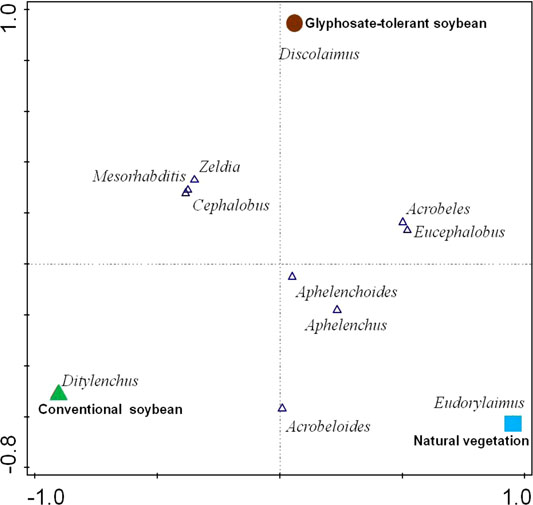
According to CCA analyses, no differences were apparent for the nematode assemblages present in soils from the three ecosystems when data for the sites were combined (data not shown). However, when the three ecosystems were plotted per site, distinct variations existed among the respective nematode communities for the three ecosystems with the cumulative explained variation (Axes 1 and 2) for the different locations for both seasons ranging from 22% to 82% (data not shown). An example is that of Edenville (Fig. 2) with a cumulative explained variation of 48.9%. For the other localities, similar differences between the nematode communities for the three ecosystems were observed (data not shown) although the nematode assemblages associated with each ecosystem differed among the localities.

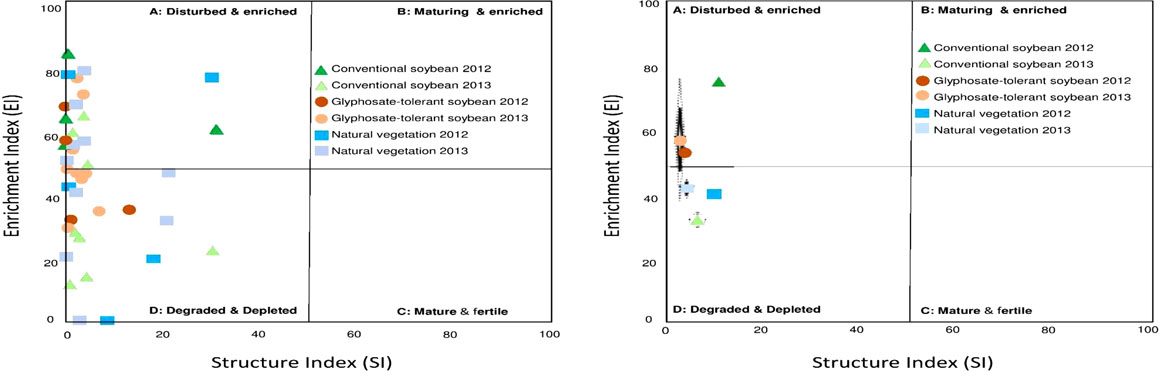
According to faunal analysis, soils from the majority of the sites (54%) of the three ecosystems plotted in Quadrant D due to their Enrichment Index (EI) and Structural Index (SI) being <50% for both seasons (Fig. 3a). Such soils were dominated mainly by the presence of fungivores, especially Fu2. Forty-six percent of the sites plotted in Quadrant A due to their EI being >50% and SI being <50%. These soils were dominated by bacterivores, mainly belonging to Ba1 and Ba2. None of the sampling sites plotted in the Quadrants B and/or C.

The metabolic footprints (data pooled for sites from each ecosystem for each season), for the three ecosystems were small (Fig. 3b). The EI for the three ecosystems was intermediate (38%) to moderately high (68%) and the SI very low (<10%) for both seasons. Small differences were evident for both natural vegetation (plotted in Quadrant D for the two respective seasons) and glyphosate-tolerant (plotted in Quadrant A for the two respective seasons) ecosystems. However, for the conventional soybean ecosystem the difference for the two seasons were more pronounced, plotting in Quadrant A (2011/2012 growing season) and D (2012/2013 growing season). This phenomenon was probably due to a higher percentage of Fu2 being present in soils during the 2013 season.

Fig. 2

Canonical correspondence analyses (CCA) of population densities of terrestrial, non-parasitic nematode genera identified from 200 g soil samples obtained from three ecosystems: glyphosate-tolerant soybean fields, conventional soybean fields, and natural vegetation in Edenville during 2012/13 season.

Fig. 3

(A and B) Faunal profiles (Sieriebriennikov et al., 2014) representing the enrichment and structural conditions of soil food webs on the abundance and diversity of terrestrial, non-parasitic nematode genera identified from soils of glyphosate-tolerant and conventional soybean fields, as well as adjacent natural vegetation sites (39 in total) sampled during 2011/12 and 2012/13 seasons (A) and data for such sites pooled for the two seasons (B) in South African soybean production areas.

Soybean-maize cropping experiment

All nematode genera identified from the experimental plot were present in soil samples taken before the study commenced. Their numbers were, however, low and ranged between two and seven per 200 g soil.

Fourteen non-parasitic nematode genera were identified from rhizosphere soil samples. In general, higher numbers of non-parasitic nematodes were recorded during the 2014/15 compared with the 2013/14 growing season (Table 8). Aphelenchus was most abundant and always occurred in higher numbers in glyphosate-treated plots. Aphelenchoides only occurred in the glyphosate-treated half of the plot while Tylenchus only occurred in non-treated halves of both crops. Acrobeloides, Cephalobus, Eucephalobus, and Panagrolaimus always occurred in higher numbers in the glyphosate-treated compared with the non-treated half of the plots.

Table 8

Number of non-parasitic nematodes per 200 g rhizosphere soil of soybean cv. LS 6164 R and maize cv. DKC 80–30 RR plants in glyphosate-treated and non-treated small-field plot halves at three sampling dates during the 2013/14 and 2014/15 growing seasons. Values shown are means, followed by the standard deviation (SD).

SoybeanMaize
Nematode genusFunctional guild, followed by cp valueGlyphosate-treatedNon-treated t-value P Glyphosate-treatedNon-treated t-value P
Acrobeles Ba2298 ± 527−7 0.001 888 ± 1,029−8.15 0.001
Acrobeloides Ba2201 ± 342155 ± 1720.90.371,001 ± 1,795149 ± 169−1.570.12
Aphelenchus Fu2475 ± 746189 ± 2490.310.762,635 ± 3,0201,762 ± 2,002−6.680.5
Aphelenchoides Fu2240 ± 3945.25 0.001 1,226 ± 2,090−4.15 0.001
Aporcelaimellus Pr50.17 ± 1−10.33
Cephalobus Ba2512 ± 1,011189 ± 2983.73 0.001 745 ± 1,098256 ± 316−0.960.34
Discolaimium Pr50.22 ± 1−0.990.33
Ditylenchus Fu238 ± 923.16 0.002
Eucephalobus Ba2211 ± 40746 ± 200.810.421,000 ± 1,12989 ± 156−3.98 0.001
Leptonchus Fu410 ± 175 ± 131.540.13
Panagrolaimus Ba2544 ± 1,00217.65 0.001 1,350 ± 1,542267 ± 467−3.41 0.001
Teratocephalus Ba42 ± 716 ± 165.46 0.001
Tylenchus Fu2306 ± 537−4.1 0.001 267 ± 4624.16 0.001
Tylencholaimus Fu45 ± 157 ± 17−0.020.9924 ± 3512 ± 23−2.76 0.007

– No nematodes recovered. Functional guilds given according to Ferris et al. (2001); Colonizer-persister (c–p) values given according to Bongers (1990) with Ba, Bacterivores; Fu, Fungivores; and Pr, Predators.

Faunal analysis

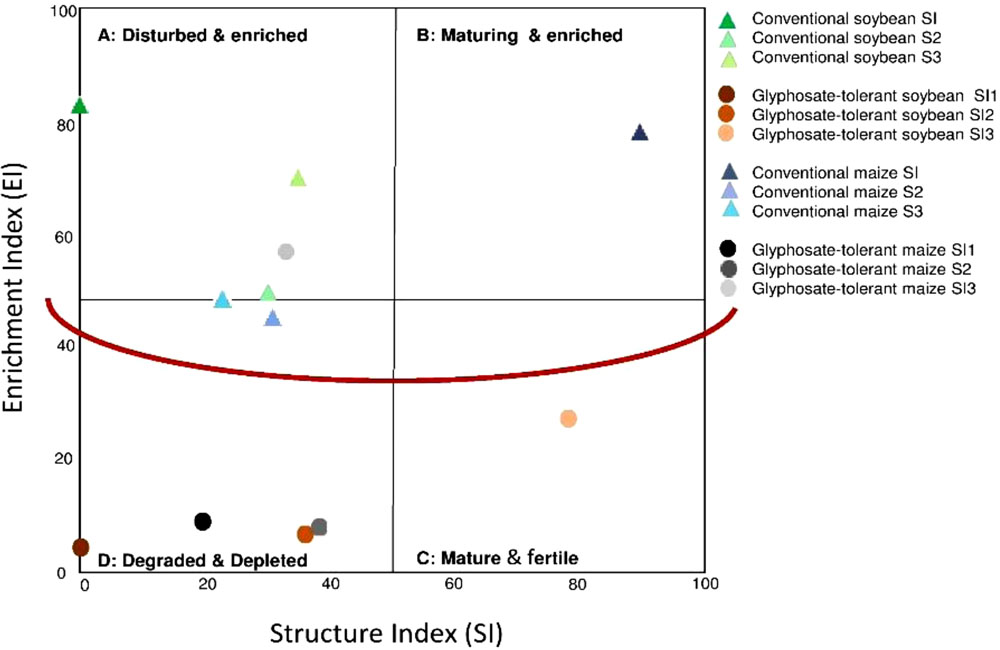
Substantial differences were apparent for non-parasitic nematode assemblages present in soils of the soybean-maize cropping system for the glyphosate-treated (plotted below the red line in Fig. 4) compared with the non-treated plot halves (plotted above the red line in Fig. 4). Data for the non-treated soil of all sampling dates plotted in Quadrants A and B, with EI >45% due to domination by bacterivores (Ba2 in particular representing Acrobeles, Acrobeloides, and Eucephalobus). One sample from the non-treated maize plants plotted in Quadrant B with a high SI (86%) due to the presence of predators (Pr5) belonging to the genera Aporcelaimellus and Discolaimium. By contrast, all samples from the glyphosate-treated plot half, except for one, plotted in Quadrants C and D with a low EI (<35%). This was substantiated by the presence of fungivores, Fu2 in particular belonging to Aphelenchus, and Aphelenchoides while Fu4 was also present and represented by Tylencholaimus.

Fig. 4

A faunal, soil food web profile representing the enrichment and structural indices (EI and SI, respectively) of terrestrial, non-parasitic nematode assemblages identified at the three sampling dates in glyphosate-tolerant and non-treated plot halves planted with soybean (during 2013/14 growing season) and maize (during 2014/15 growing season).

Discussion

The 32 non-parasitic nematode genera identified from the commercial soybean field study and adjacent vegetation, and an experimental site where a soybean-maize rotation was done represent novel information for South Africa. Previous studies in such agricultural areas only focused on plant-parasitic nematodes (Riekert and Henshaw, 1998; Fourie et al., 2001).

Various abiotic factors are known to impact on nematode development and survival (Perry et al., 2013), with season significantly shown to affect the abundance of the four non-parasitic nematode trophic groups recorded in our study. This scenario implies that prevailing environmental conditions played a pronounced role during the two seasons this study was conducted.

Although soils from the commercial glyphosate-tolerant fields were dominated by the fungivore genus Aphelenchus during both seasons of the study, this genus also dominated in soils from conventional soybean and natural vegetation ecosystems in the second season. In the soybean-maize cropping experiment, it dominated in the second season in both plots. These results agree with those by Neher et al. (2014) who recorded higher abundance of fungivores in soils from Bt maize compared with those from their near-isolines. Also, it is to a certain extent in agreement with those by Liphadzi et al. (2005) who stated that fungivores dominated in soils treated with various herbicides. These authors, however, did not refer to glyphosate-treated soils as was done in the present studies.

The abundance and dominance of the non-parasitic nematode genera, however, varied among the three ecosystems sampled during the extensive field study, and for the 2-year experimental soybean-maize cropping study. For the field study, the glyphosate-tolerant soybean ecosystems supported the least number of genera (21), while the natural vegetation supported the most (27), followed by the conventional soybean ecosystem (23). This trend is in agreement with reports by Bekker (2016) that natural vegetation ecosystems adjacent to maize fields in South Africa supported a higher diversity of non-parasitic nematodes than conventional and conservation maize ecosystems. Also, the general trend that nematode communities in soybean fields and natural vegetation sites were dominated by bacterivore genera of the families Acrobelidae, Cephalobidae, and Panagrolaimidae and fungivores of the families Aphelenchidae and Aphelenchoididae is in agreement with results by Bekker (2016) who did a similar study for commercial maize fields. The dominance of bacterivores in terms of the genera diversity in soils sampled during the present studies is also in agreement with reports by Djigal et al. (2004) and Xu et al. (2015). These authors suggested that bacterial feeding nematodes are the most abundant metazoans in soil substrates.

Fungivores were the second most prevalent group in soils sampled in the present studies, which is in agreement with a recent study by Renčo and Čerevková (2017). These authors reported that fungivores are the second most abundant in soil after bacterivores nematodes. The lower abundance and occurrence of predators and omnivores in the commercial field study was not surprising since these two groups are regarded as being very sensitive to soil disturbances (Ferris et al., 2001). A similar trend was reported by Bekker (2016) for a commercial maize field study. Hence, despite that ecosystem significantly affected predator abundance, the very low population densities and/or absence of this trophic group at various sites are suggested to have caused this effect and hence discussion of the data is abstained from. The absence of omnivores in soils of the 2-year experimental soybean-maize study is another interesting observation and cannot be explained at this stage.

Nematode communities generally differ and fluctuate substantially among different locations in terms of abundance, diversity, and occurrence (Franco-Navarro & Godinez-Vidal, 2017). This tendency, although not significant, was apparent for the three ecosystems sampled during the commercial field study. When the three ecosystems were, however, analysed per site using the nematode trophic groups each generally had different nematode communities and was separated from each other according to CCA analyses. However, no trend existed where a specific nematode genus/genera was exclusively associated with either of the three ecosystems. Although it was not possible to deduct the impact of each ecosystem on the nematode communities, our study showed that glyphosate-tolerant soybean had no deleterious effects on non-target beneficial nematodes. This is in agreement with those for other genetically-modified crops, for example, Al-Deeb et al. (2013) and Neher et al. (2014) demonstrating that genetically-modified, Bt maize had no significant adverse effects on non-target, benefical, and plant-parasitic nematodes. Also, Chen et al. (2017) concluded that Bt rice had no remarkable impact on beneficial soil nematode communities and was pest specific. However, Neher et al. (2014) suggested that rhizosphere soil from Bt maize may contain more complex and successfully mature nematode communities opposed to those from non-Bt near isolines which may be applicable to our study also where fungivores generally dominated in soil from glyphosate-treated soybean crops. This phenomenon may be an indication that less disturbance in the glyphosate-treated soybean fields probably can contribute to nematode communities being more matured.

According to faunal analysis, all soybean sites sampled were disturbed and degraded, indicating that the quality of these soils is not optimal in terms of the presence of beneficial nematodes (Ferris et al., 2001). This situation is often associated with management practices such as repeated tillage (Berkelmans et al., 2003) and pesticide application (Carrascosa et al., 2014) which are typical practices in local soybean production areas (Liebenberg, 2012). Contrary to annual crop fields, natural vegetation ecosystems are usually regarded as stable and structured due to either no or minimal disturbances (Ferris et al., 2001). However, in the current study all natural vegetation sites were also degraded or disturbed. This might be explained by the vegetation type that was represented by mainly grasses. Often natural vegetation consists of woody, perennial plants that are mostly considered less disturbed than grassland vegetation (Cullman et al., 2010). The latter vegetation probably experiences periods during which the organic content of the soil is high compared to periods when substantially less organic material is present (Shaw et al., 2016).

Results from the soybean-maize cropping experiment, however, showed that glyphosate applied as a leaf spray twice per season during two consecutive growing seasons generally affected the abundance and diversity of non-parasitic nematodes. This was substantiated by soil food web analysis of the different nematode sampling dates that showed that the majority of the glyphosate-treated plots for both seasons were degraded and depleted opposed to the non-treated plots that were disturbed but enriched. These results are not in agreement with those of the commercial field study and also those reported by Liphadzi et al. (2005), who found that glyphosate application had no effect on the abundance and diversity of non-parasitic nematodes in glyphosate-treated plots during a 3-year study.

It is worth mentioning that the non-treated plot, was hoed, implying some disturbance in the upper soil while organic material was also added to the soil. Both these activities might have had an effect on non-parasitic nematode communities and probably favoring bacterivore genera.

Ultimately, results from the two South African studies conducted showed similarity in terms of Aphelenchus domination. However, glyphosate application did not affect the general abundance of non-parasitic nematodes compared with those from conventional soybean fields and natural vegetation sites where no glyphosate had been applied for at least 5 years prior to this study or never before.

DOI: https://doi.org/10.21307/jofnem-2018-028 | Journal eISSN: 2640-396X | Journal ISSN: 0022-300X
Language: English
Page range: 243 - 260
Published on: Oct 17, 2018
In partnership with: Paradigm Publishing Services
Publication frequency: 1 issue per year

© 2018 Akhona Mbatyoti, Mieke Stefanie Daneel, Antoinette Swart, Dirk de Waele, Hendrika Fourie, published by Society of Nematologists, Inc.
This work is licensed under the Creative Commons Attribution 4.0 License.