
Table 1
Morphometrics of female Stauratostoma shelleyi n. gen., n. sp. from Apheloria montana.
| Paratype females (n = 30) | |||||
|---|---|---|---|---|---|
| Measurements (µm) | Holotype female | Mean | SD | Range | CV |
| Length | 2,522 | 2,357 | 249 | 1,805‒2,683 | 10.6 |
| Maximum width | 192 | 178 | 33.9 | 98‒237 | 19.1 |
| First annule width | 11.1 | 10.3 | 0.89 | 8.1‒12.3 | 8.3 |
| Second annule width | 8.4 | 7.8 | 1.2 | 5.3‒9.9 | 14.9 |
| Esophagus length | 508 | 486 | 50.0 | 347‒548 | 10.3 |
| Basal bulb length | 116 | 111 | 8.6 | 84‒126 | 7.8 |
| Head to excretory pore | 404 | 389 | 43.9 | 274‒445 | 11.3 |
| Vulva to anterior head | 991 | 935 | 105.3 | 676‒1066 | 11.3 |
| Anus to anterior head | 1,570 | 1,517 | 174.1 | 1,105‒1,715 | 11.5 |
| Egg length | 75.2 | 74.2 | 3.4 | 67.2‒79 | 4.5 |
| Egg width | 48.4 | 49.1 | 2.7 | 43.9‒55.4 | 5.4 |
| Tail length | 952 | 84.0 | 90.8 | 649‒973 | 10.8 |
| Ratios | |||||
| a | 13.1 | 13.6 | 2.2 | 10.1–18.4 | 16.5 |
| b | 5.0 | 4.9 | 0.43 | 4.3‒5.9 | 8.9 |
| c | 2.6 | 2.8 | 0.2 | 2.4‒3.3 | 5.5 |
| V | 39.3 | 39.7 | 2.4 | 33.2‒44.4 | 6.1 |
| V′ | 0.63 | 0.62 | 0.03 | 0.53‒0.69 | 5.1 |
Table 2
Genera of xystodesmid millipedes dissected.
| Species | Millipedes dissected (n) | Millipedes with Stauratostoma shelleyi | Total S. shelleyi | Mean | Range |
|---|---|---|---|---|---|
| Apheloria montana | 77 | 59 | 269 | 3.5 | 0‒19 |
| Apheloria tigana | 4 | 0 | 0 | 0 | 0 |
| Apheloria virginiensis | 56 | 35 | 276 | 4.9 | 0‒31 |
| Boraria deturkiana | 1 | 0 | 0 | 0 | 0 |
| Brachoria initialis | 6 | 4 | 41 | 6.8 | 0‒21 |
| Brachoria ochra | 3 | 2 | 45 | 15 | 0‒32 |
| Cherokia georgiana | 47 | 5 | 41 | 0.9 | 0‒23 |
| Dicellarius talapoosa | 2 | 0 | 0 | 0 | 0 |
| Harpaphe haydeniana | 29 | 0 | 0 | 0 | 0 |
| Pleuroloma cala | 56 | 0 | 0 | 0 | 0 |
| Pleuroloma flavipes | 44 | 0 | 0 | 0 | 0 |
| Sigmoria ainsliei | 2 | 2 | 20 | 10 | 5‒15 |
| Sigmoria aphelorioides | 1 | 0 | 0 | 0 | 0 |
| Sigmoria cheiropus | 14 | 1 | 6 | 0.4 | 0‒6 |
| Sigmoria mimetica | 10 | 2 | 2 | 0.2 | 0‒1 |
| Total | 352 | 110 | 700 | 2.8 | 0‒32 |
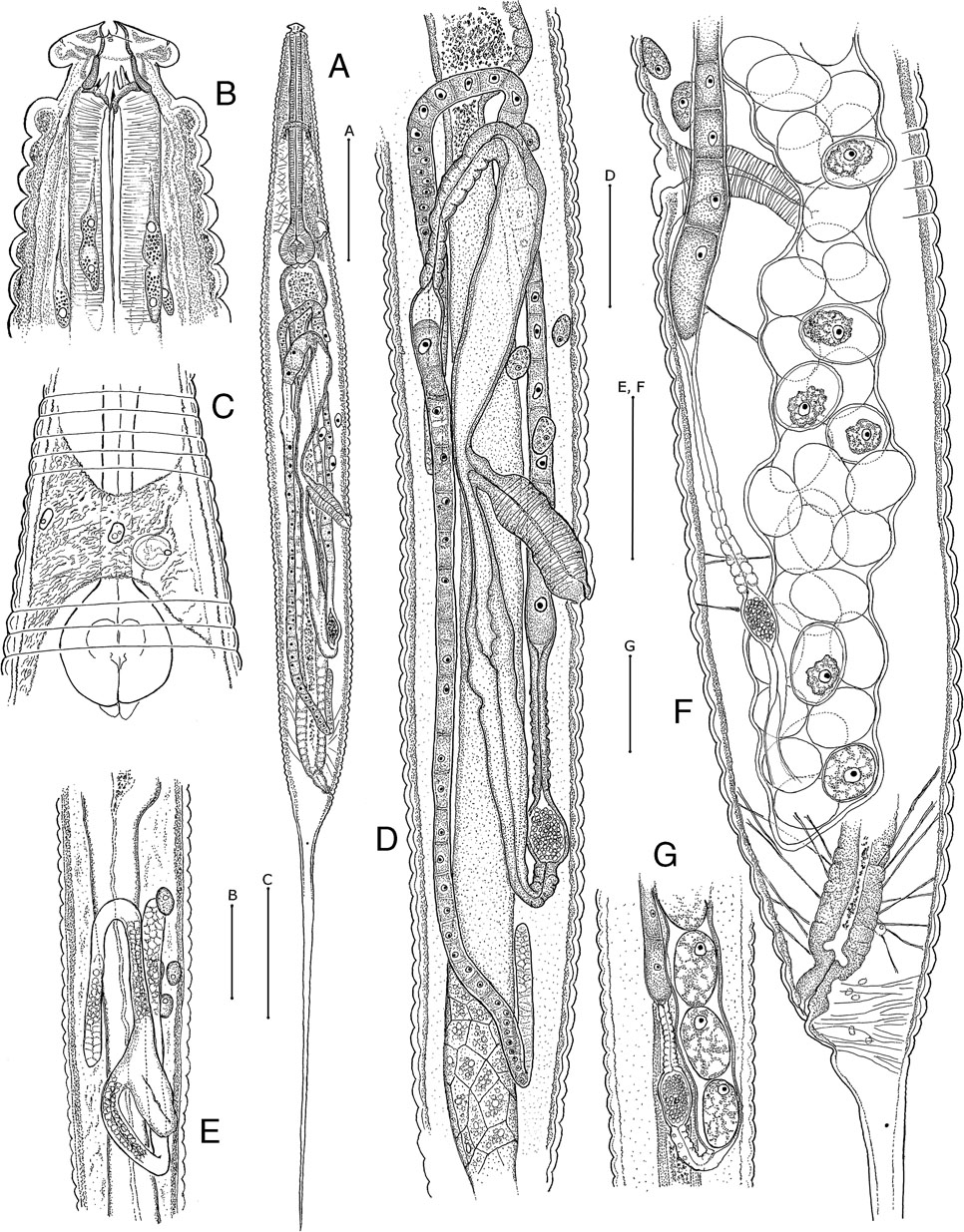
Fig. 1
Stauratostoma shelleyi n. gen., n. sp. A, Habitus, lateral view. B, Anterior end, lateral view. C, Secretory-excretory system region, ventral view. D, Reproductive system of non-gravid female, right-side lateral view; intestinal detail provided only for anterior and posterior parts. E, Developing reproductive system of presumed fourth-stage juvenile. F, Posterior region of reproductive system of older gravid female, left-side lateral view; only the posterior end of the digestive system is illustrated. G, Posteriormost portion of posterior gonad of younger female with eggs in single file. Scales: A = 200 μm; B, E, F = 50 μm; C, D, G = 100 μm.
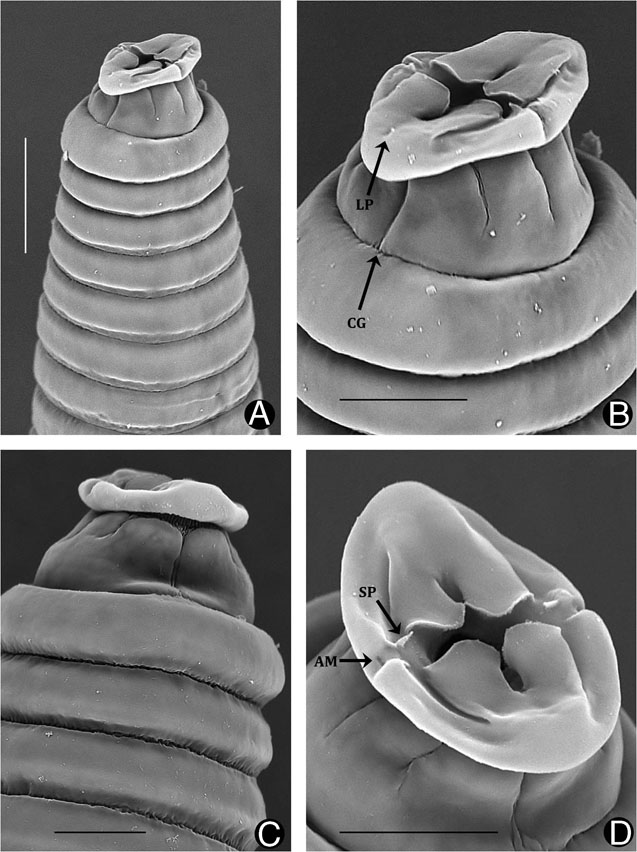
Fig. 2
Stauratostoma shelleyi n. gen., n. sp., scanning electron microscope. A, Anterior region, sublateral view. B, Enlargement of 2A, showing lateral labial pit or depression (LP), complete dorsal or ventral groove (CG) and sublateral and lateral incomplete grooves. C, Dorsal or ventral view showing complete groove and reticulated surface between lobes and labial disc. D, Labial disc with amphid aperture (AM) and associated spine (SP). Scales: A = 20 μm; B–D = 10 μm.
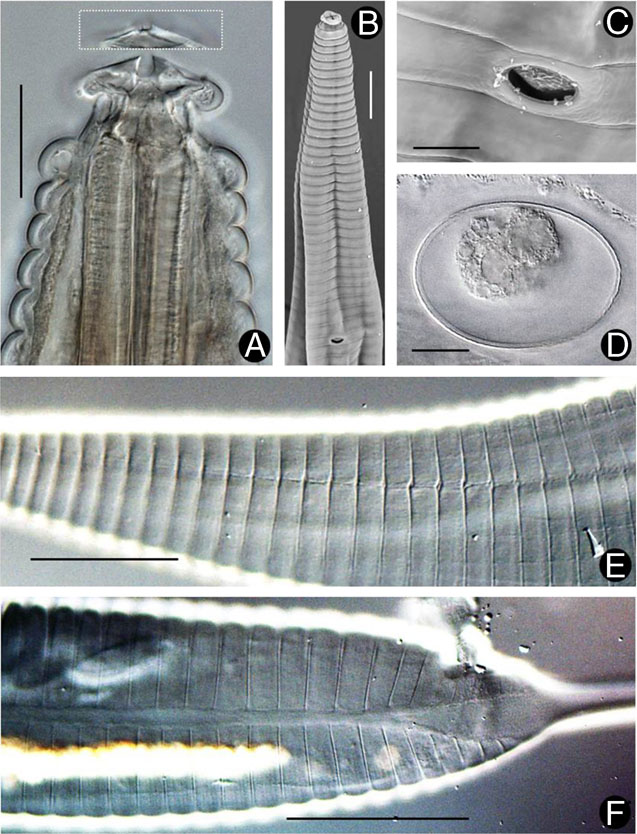
Fig. 3
Stauratostoma shelleyi n. gen., n. sp. A, Head end, lateral view; inset shows accessory spine near amphid aperture. B, Scanning electron microscope of anterior region showing large S–E pore. C, S–E pore with operculum. D, Typical egg, with slightly roughened outer layer. E, Lateral field, esophageal region. F, Lateral field, posterior region. Figures 3E, F are phase-contrast images. Scales: A, D = 20 μm; B, F = 50 μm; C = 10 μm; E = 100 μm.
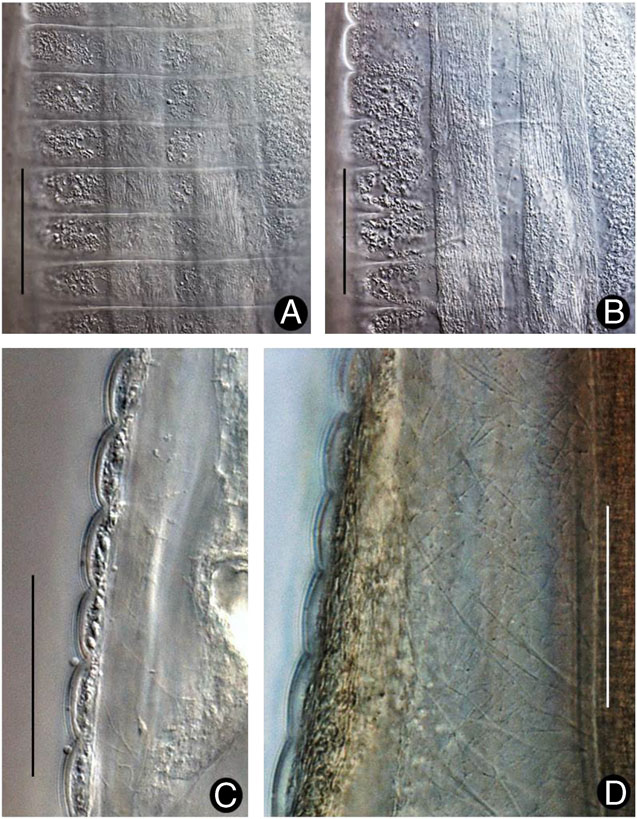
Fig. 4
Stauratostoma shelleyi n. gen., n. sp. A, B Pebble-like longitudinal subcuticular bands alternating with muscle bands; figures are of same area but imaged at different focus depths. C Annules in profile with pebbly subcuticle. D Annules in profile at a muscle zone, and extensive lattice of fibers in pseudocoel. Scales = 50 μm.
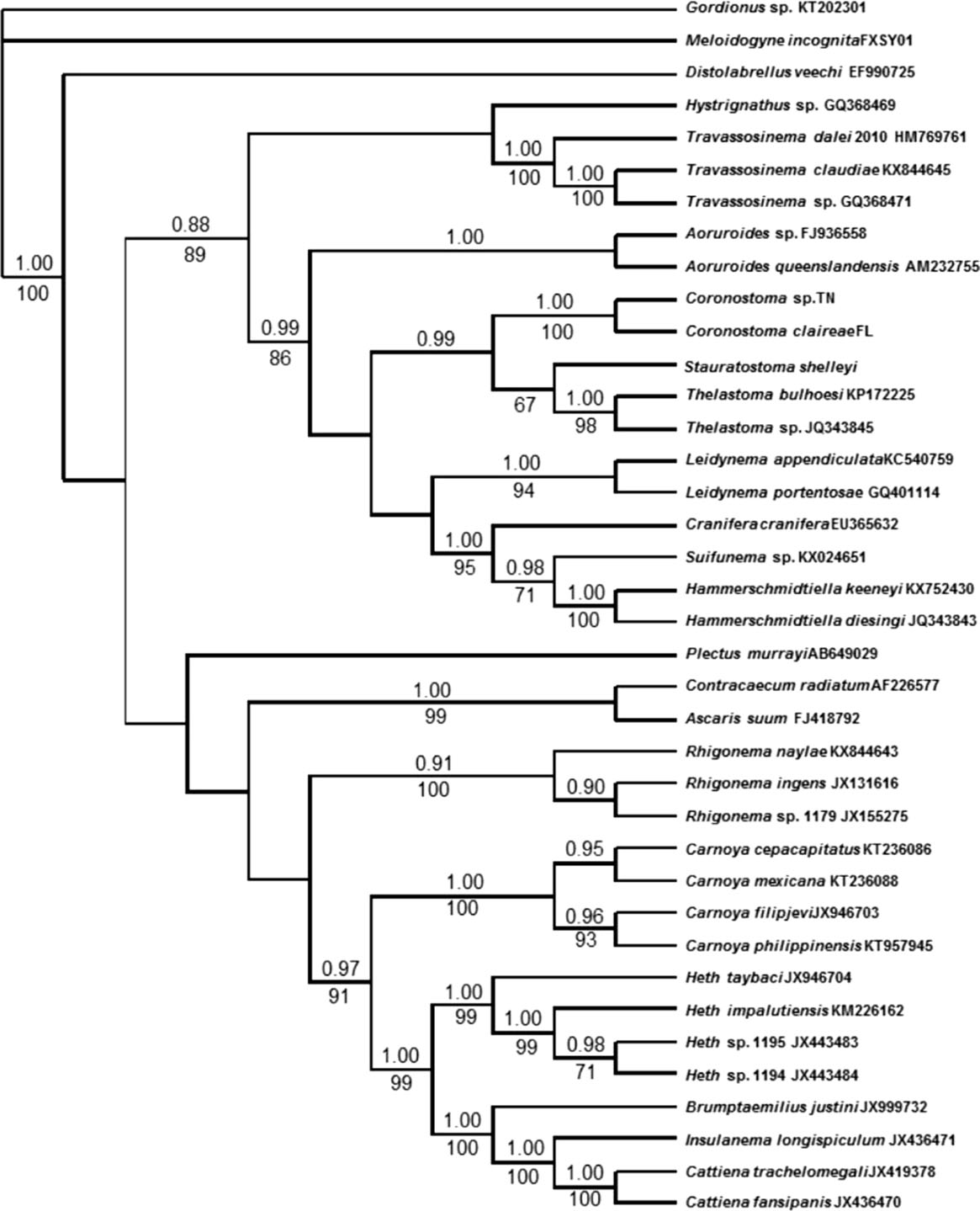
Fig. 5
Molecular tree of millipede-parasitic nematodes based on partial 28S rDNA analysis. Stauratostoma shelleyi is shown as the sister group to Thelastoma spp. Posterior probabilities are shown above the nodes and bootstrap values are below the nodes.
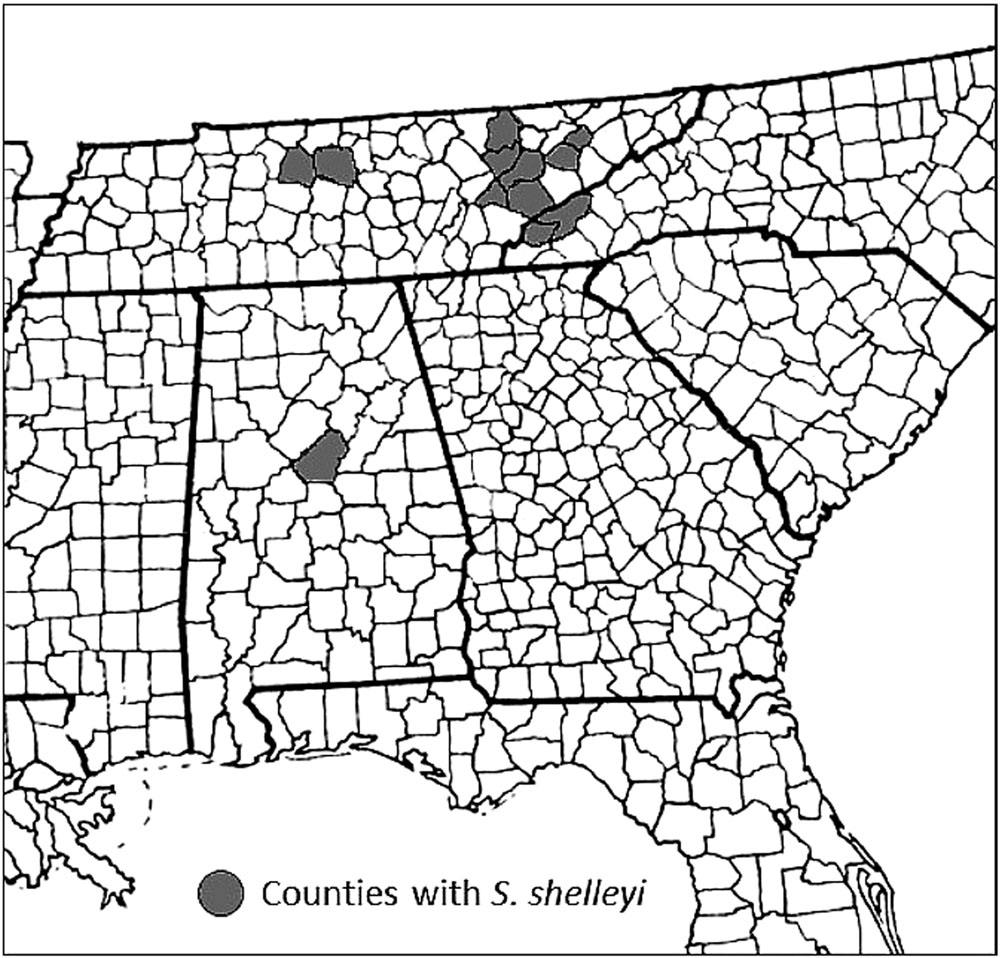
Fig. 6
Stauratostoma shelleyi n. gen., n. sp., known distribution by county in southeastern United States.
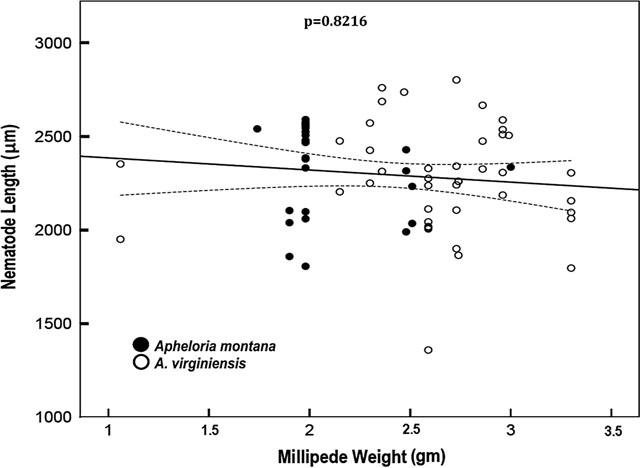
Fig. 7
Correlation of nematode length and millipede weight for two Apheloria spp., 95% confidence limits shown.