Meloidogyne arenaria race 1, the peanut root-knot nematode, is considered as one of the most important soilborne pathogens affecting peanut, Arachis hypogaea in the southern USA. This species is prevalent in Alabama, Florida, Georgia, and Texas (Ingram and Rodriguez-Kabana, 1980; Starr et al., 2002; Dickson and DeWaele, 2005). The suppression of peanut yields caused by this nematode can reach 80% or greater in heavily infested fields (Dickson and Hewlett, 1988).
Resistant cultivars potentially provide the most economical and effective means of managing nematode diseases on agricultural crops. Before 2001 there were no peanut cultivars with root-knot nematode resistance, yet a number of Arachis spp. were observed to be highly resistant to the peanut root-knot nematode (Baltensperger et al., 1986; Nelson et al., 1989; Holbrook and Noe, 1990). Genetic material from a wild peanut species, Arachis cardenasii was introgressed into cultivated peanut resulting in the first root-knot nematode resistant cultivar, COAN (Simpson and Starr, 2001). The second nematode resistant peanut cultivar, NemaTAM was released in 2002. This cultivar had the same resistance level as COAN, but had greater yield potential (Simpson et al., 2003). The resistance gene in COAN was reported to have three different effects on M. arenaria (Bendezu and Starr, 2003). The first was to reduce the number of the second-stage juveniles (J2) of M. arenaria that penetrated roots; second, the resistance gene prevented most J2 from developing further, and third, the resistance gene delayed further development. No hypersensitive reaction (HR) was observed in the early stage of M. arenaria infection in COAN roots, which is considered as a common defense mechanism produced by resistant plants to disease pathogens (Bendezu and Starr, 2003).
Neither of these two cultivars was considered for planting in the southeastern U.S. because of the prevalence and severity of tomato spotted wilt virus(TSWV) and other important fungal diseases in this peanut growing region (Holbrook et al., 2008). In 2008, a runner-type peanut cultivar (Arachis hypogaea L. subsp. hypogaea var. hypogaea), Tifguard was released by the USDA-ARS and the Georgia Agricultural Experiment Station (Holbrook et al., 2008). The breeding population was generated by hybridizing C-99R (Gorbet and Shokes, 2002), a peanut cultivar with good field resistance to TSWV (Wells et al., 2002) with COAN. Tifguard was reported to have a high level of resistance to both TSWV and M. arenaria (Holbrook et al., 2008).
Temperature is an important factor influencing the expression of resistance genes in plants to parasitic nematodes. For example, it was observed that susceptible alfalfa plants were infected with greater numbers of J2 of Meloidogyne hapla than resistant plants, but the magnitude of this difference decreased when temperature increased (Griffin, 1969; Griffin and Elguin, 1977). In addition, half of the resistant alfalfa plants grown at 32°C had galled roots, whereas no galled roots were observed at 28°C. Similarly, the number of adult Meloidogyne incognita and M. hapla increased in resistant and susceptible common bean as the soil temperature increased from 25°C to 30°C (Irizarry et al., 1971). Increased temperature also affected nematode resistance in soybean and tomato cultivars (Dropkin, 1969; Holtzmann, 1965). Greater penetration and development of M. incognita was observed in resistant tomato roots at 30 and 34.5°C than at 20 and 25°C. In other studies on tomato, decreased hypersensitive necrotic response to nematode infection was reported at temperatures near or above 30°C (Paulson and Webster, 1972). The Mi-1 gene in tomato confers resistance to root-knot nematodes; however, it is reported in some studies to become nonfunctional when the temperature is at or above 28°C (Williamson, 1998). Changes in the response of resistant plants to root-knot nematode infection by high soil temperature has been reported under both greenhouse and field conditions (Philis and Vakis, 1977; Tzortzakakis and Gowen, 1996; Noling, 2000). It appears that heat stress affects the function of resistance genes in host plants (Ammiraju et al., 2003). On the other hand, it is well known that root-knot nematodes are dependent on temperature for vital physiological activities. Temperature affects root-knot nematode migration, development, and the nematode’s ability to sense host roots (Tyler, 1933). The optimal temperature for root-knot nematode development was reported to be 28°C, above which development was reduced with no development occurring at 36.5°C (Tyler, 1933).
In a comparison of the number of the J2 of M. arenaria in different peanut genotypes at 2 and 7 days after inoculation (DAI), higher numbers of J2 penetrated the roots of the susceptible peanut cv. Florunner than the resistant COAN (Bendezu and Starr, 2003). Since the recent release of root-knot nematode resistant peanut cultivars, there have been no studies on how temperature affects the number and development of M. arenaria in resistant peanut. The objectives of this study were to determine the effect of temperature on i) the number of M. arenaria that penetrated roots, and ii) the nematode’s development in resistant and susceptible peanut.
Materials and methods
Nematode origin: Meloidogyne arenaria was isolated from infected peanut roots from an infested farm located in Levy County, FL, and maintained on the susceptible tomato cultivar (Solanum lycopersicum L. cv. Agriset 334) in the greenhouse. Polyacrylamide gel electrophoresis was used as an aid in identification of the species based on malate dehydrogenase and esterase phenotypes (Esbenshade and Triantaphyllou, 1985). Eggs were extracted from infected tomato roots with the 0.25% NaOCl (Hussey and Barker, 1973) method as modified (Bonetti and Ferraz, 1981). A modified Baermann funnel method was used for egg hatching (Rodriguez-Kabana and Pope, 1981). Second-stage juveniles collected after a period of 48 hr were used as inoculum.
Penetration and development of Meloidogyne arenaria
Peanut seed of Tifguard and Georgia-06G were provided by the peanut breeder Corley Holbrook, USDA-ARS, Tifton, GA. Tomato cv. Agriset 334 was used as a susceptible plant to ensure inoculum viability. Peanut seeds were surface-treated by soaking in 0.6% NaOCl for 1 min followed by rinsing in sterile distilled water (Bendezu and Starr, 2003). They were placed in a petri dish with a piece of moistened paper towel for germination at 28°C for 5 days. Seedlings were transplanted into 250 ml plastic cups filled with autoclaved sand and grown at 28°C for 7 days. Holes were punched into the cup bottoms to provide drainage. All seedlings were inoculated with 2,000 freshly-hatched J2 of M. arenaria, and then transferred to environmental growth chambers set at either 28, 31, or 34°C with a 12-hr photoperiod. The seedlings of each cultivar were completely randomized within the chambers and were watered daily.
Data collection
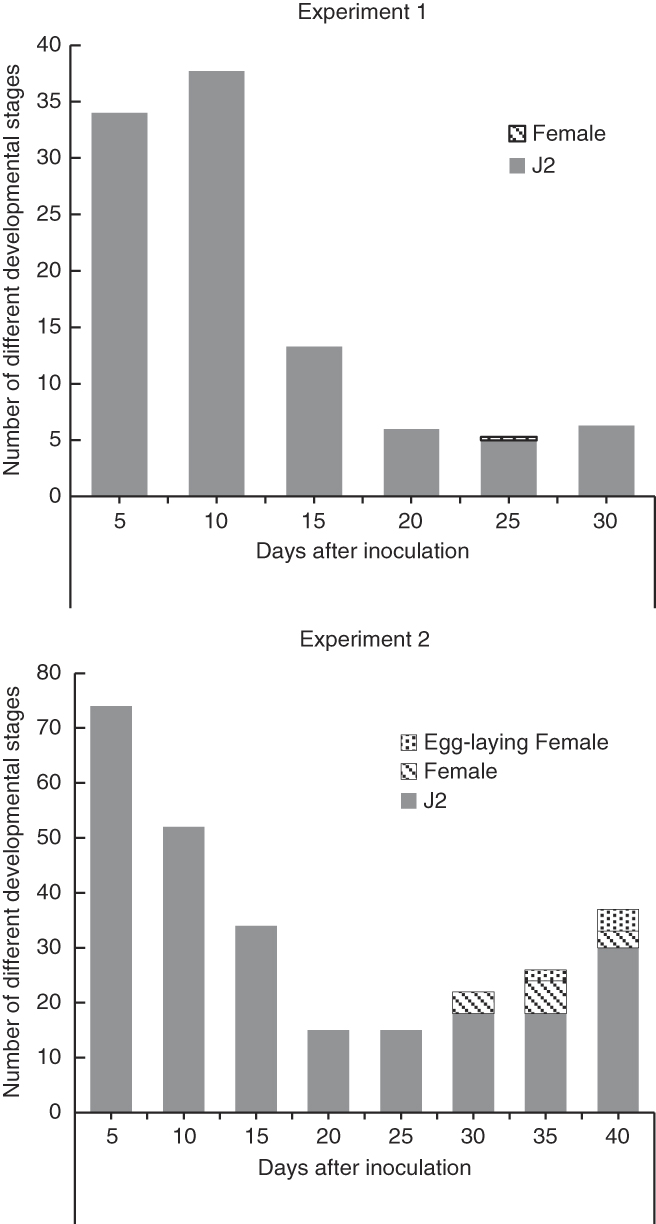
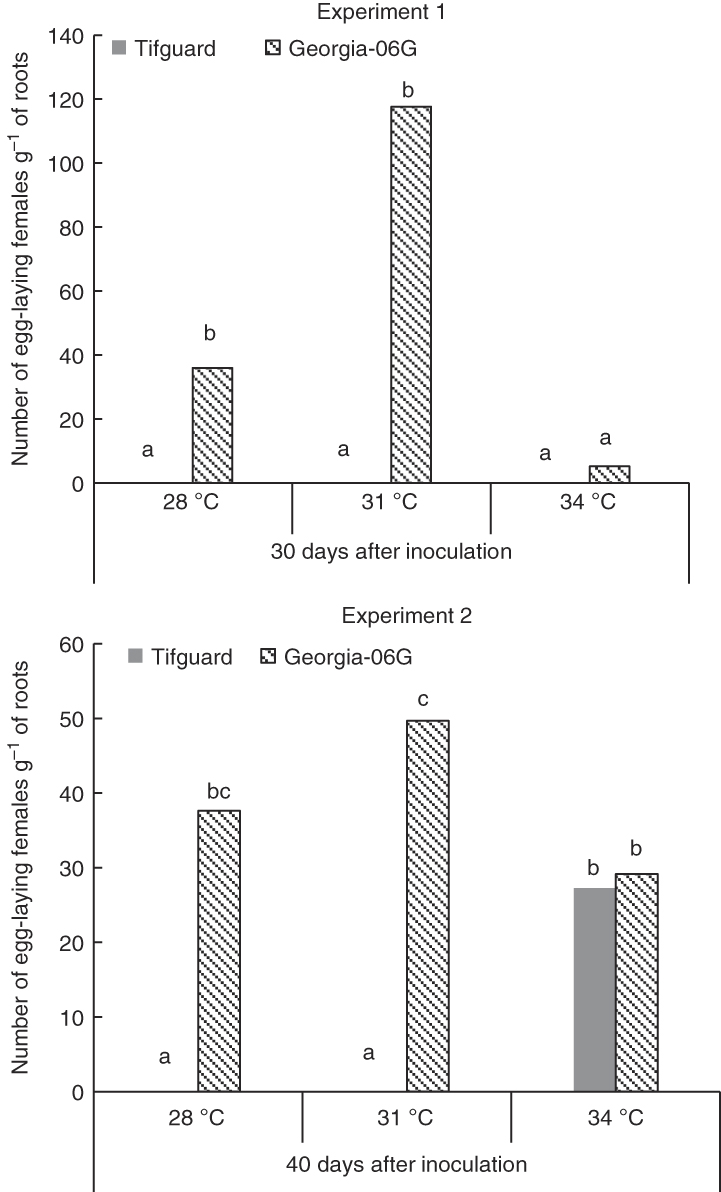
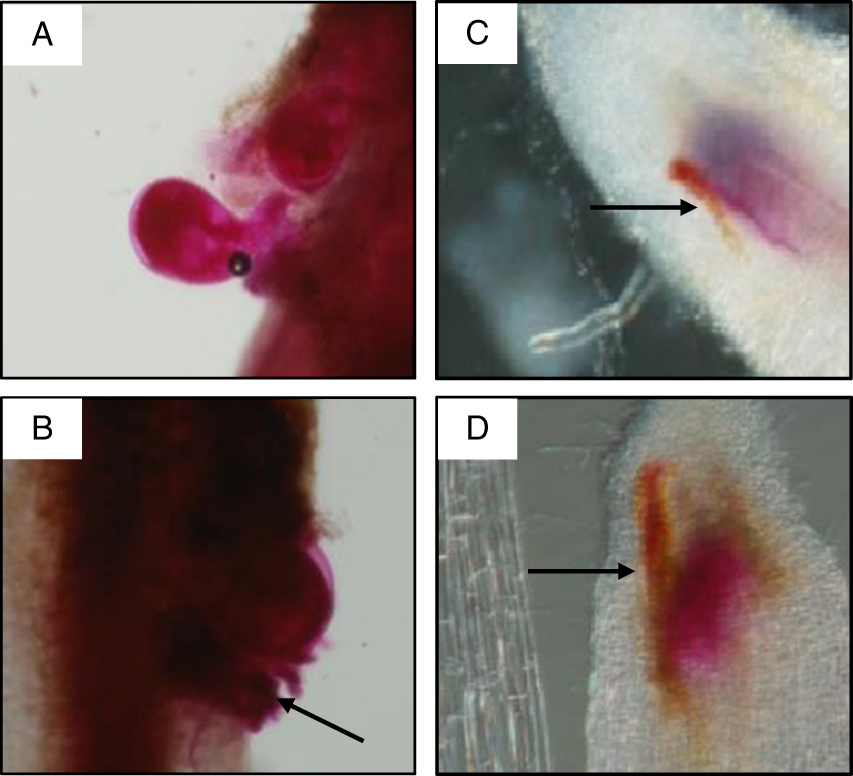
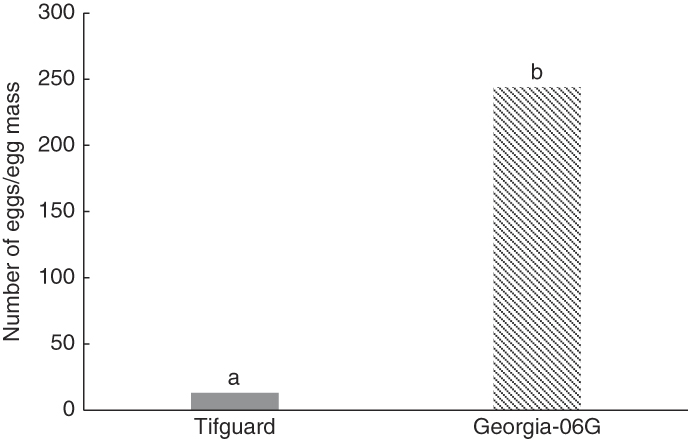
Three plants were removed at 5-day intervals following inoculation (DAI), washed in tap water, dried with a paper towel, and weighed. Roots were fixed, stained and cleared for microscopic examination (Byrd et al., 1983). The number and images of nematodes in the roots were recorded based on their developmental stages as follows: (i) J2; (ii) J2 with swollen body (late-J2); (iii) third and fourth stage juveniles; (iv) female; (v) egg-laying female; and vi) male. Red food coloring (20%) was used to stain egg masses once they were observed on roots (Thies et al., 2002). The experiment was repeated once. In Experiment 1, harvest ceased at 30 DAI, whereas in Experiment 2, harvest was extended to 40 DAI to provide more time to determine if egg masses of M. arenaria would form on Tifguard roots. Root-knot nematode egg masses were hand-picked (three egg masses per repetition per cultivar) from both peanut cultivars once they were observed at 40 DAI.
Statistical analysis
The effects of temperature, host genotype, and DAI on the number of different developmental stages of M. arenaria per gram of root tissue were subjected to analysis of variance using R programming software (R 3.1.2 with R studio). The means were compared by Tukey’s honest significant difference test. The data from tomato were not included in the statistical analyses. Values were subjected to arcsin (√x) transformation before analysis of variance. The number of eggs per egg mass was subjected to mean separation by student’s t-test.
Marker analysis for AdSNP92
In the first experiment, a young leaflet from any Tifguard plant with root-knot nematode infection was collected and genotyped with nematode resistance marker AdSNP92 (Chu et al., 2016). Samples that tested negative for the nematode resistance marker were excluded from analysis. In the second experiment, all of the Tifguard seeds were genotyped with marker AdSNP92, thereby assuring three replicates for each treatment.
Results
Penetration of Meloidogyne arenaria
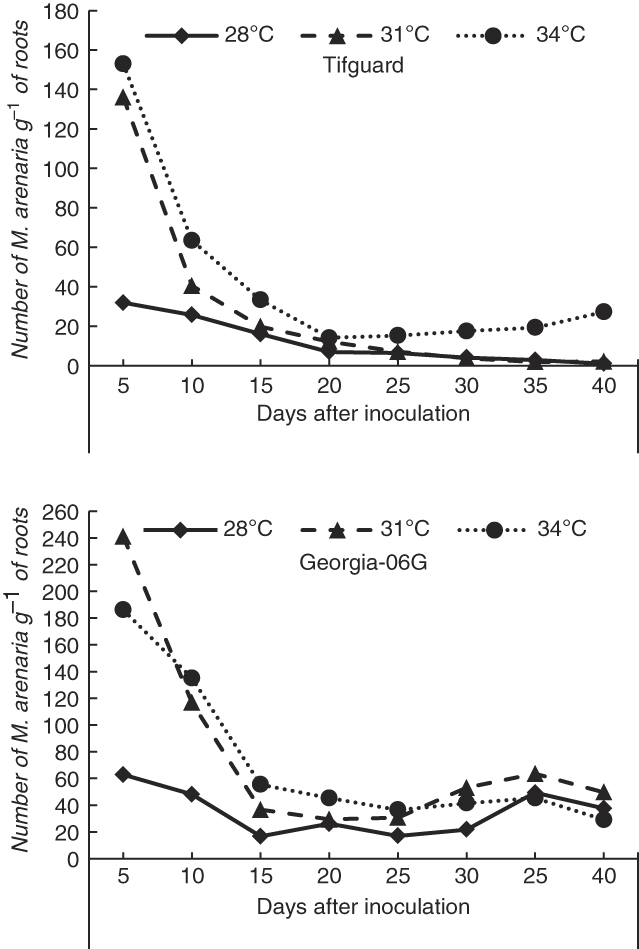
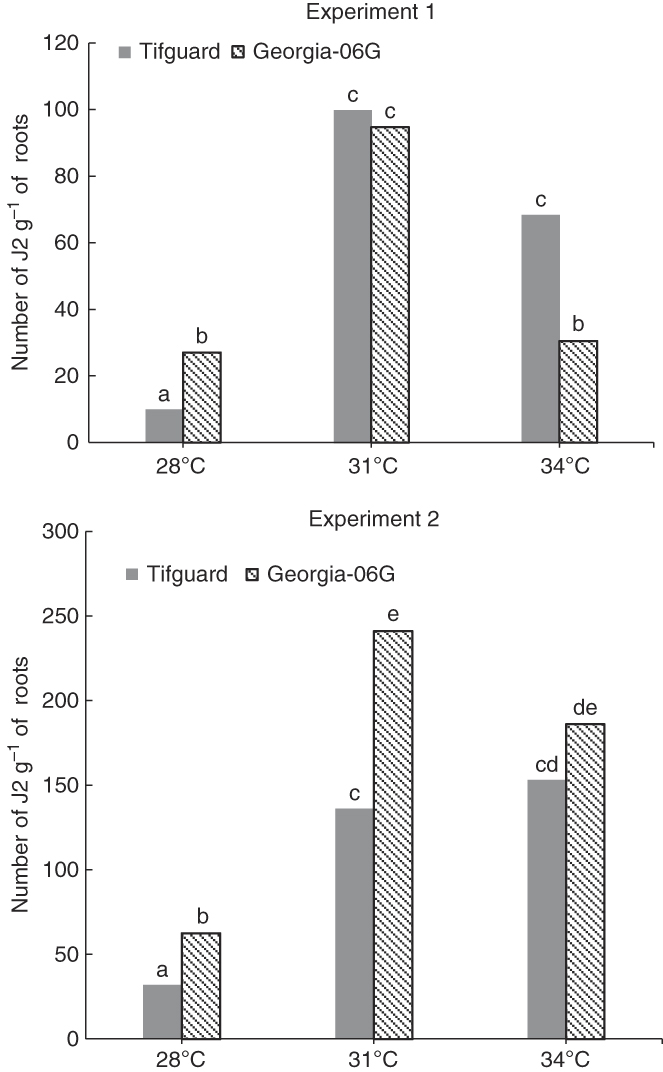
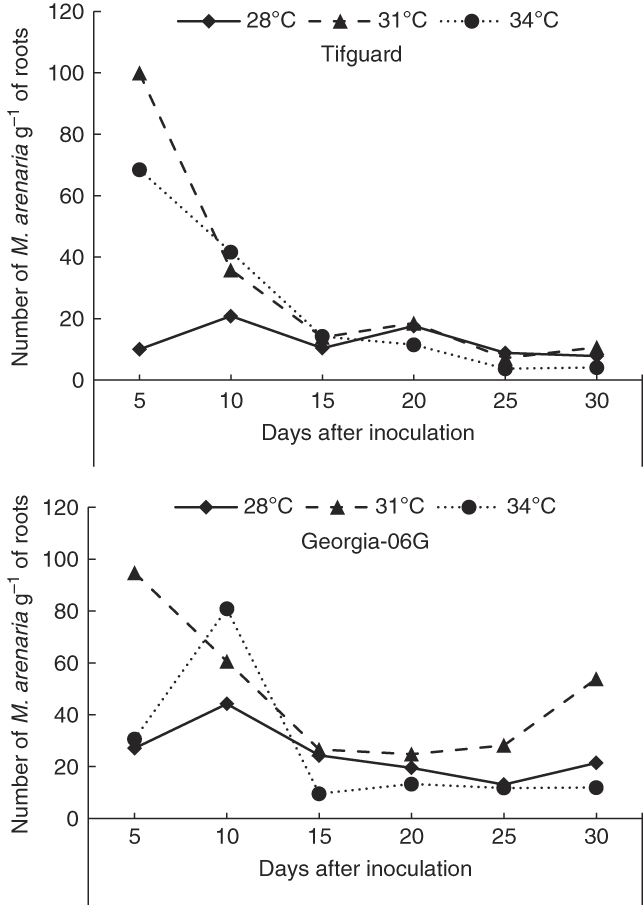
The root systems from Georgia-06G were generally 1 to 1.5-fold greater in size than that from Tifguard (P ≤ 0.05) (Table 1). Thus, the number of each developmental stage of M. arenaria per gram of roots was calculated.
Table 1
Analysis of variance of root weight, number of Meloidogyne arenaria per gram of roots of peanut cultivars Georgia 06G and Tifguard.
| Source of variance | F value |
|---|---|
| Root weight | |
| Cultivar | 2.744e-06 *** |
| Temperature | 0.6528 |
| DAIa | <2.2e-16 *** |
| Cultivar × Temperature | 0.7204 |
| Cultivar × DAI | 1.896e-08 *** |
| Temperature × DAI | 0.8505 |
| Cultivar × Temperature × DAI | 0.7657 |
| M. arenaria per gram of roots Experiment 1 | |
| Cultivar | 0.0009106 *** |
| Temperature | 0.0059029 ** |
| DAI | <2.2e-16 *** |
| Cultivar × Temperature | 0.0374213 * |
| Cultivar × DAI | 0.0005185 *** |
| Temperature × DAI | 4e-07 *** |
| Cultivar × Temperature × DAI | 0.0197020 * |
| M. arenaria per gram of roots Experiment 2 | |
| Cultivar | 6.651e-07 *** |
| Temperature | 0.0001727 *** |
| DAI | <2.2e-16 *** |
| Cultivar × Temperature | 0.0109771 * |
| Cultivar × DAI | 3.001e-09 *** |
| Temperature × DAI | <2.2e-16 *** |
| Cultivar × Temperature × DAI | 6.126e-06 *** |