Caenorhabditis elegans elegans has long been known to display chemotactic behavior to small water-soluble compounds like cAMP and NaCl, and neurons and genes required for these responses have been described (Croll, 1970; Ward, 1973; Dusenbery, 1974; Bargmann et al., 1993; Mori, 1999).
The organic compounds are generally more attractive than the ions. Studies also showed that many volatile organic compounds (VOCs) including alcohols, ketones, esters, aldehydes and aromatics are attractive for nematodes (Bargmann et al., 1990; Sengupta et al., 1994). In the soil environment, microorganisms such as bacteria can produce diacetyl (butabediol) as attractants for nematodes (Zhang et al., 1997). Some bacteria such as the Bacillus nematocida B16 is capable of releasing a variety of food-like odors as attractants, including benzaldehyde, 2-heptanone, indole, naphthalene, 2, 5-dimethy-lanisole, benzyl benzoate and acetophenone, and these VOCs have shown potent nematode-attracting abilities (Niu et al., 2010).
Monoson and Ranieri (1972) found that attractants for the nematode Aphelenchus avenae were related to trap formation of Arthrobotrys oligospora. Balan et al. (1974) found that the trapping devices of Arthrobotrys dactyloides, Arthrobotrys oligospora, Arthrobotrys conoides and Monacrosporium rutgeriense were all capable of attracting Panagrellus redivivus. They also provided evidence that the attractants differed from the nematode-killing substances. Volatile methyl 3-methyl-2-butenoate produced by A. oligospora additionally triggered strong sex- and stage-specific attraction in several Caenorhabditis species. It might mimic sex pheromone in Caenorhabditis species (Hsueh et al., 2017). Stropharia spp. can produce unique stellate cells, which resemble a sharp sword and can damage the nematode cuticle, resulting in leakage of nematode inner materials (Luo et al., 2006).
In this study, chemotaxis of the nematode C. elegans toward Stropharia rugosoannulata was increased, when the fungus was cultured on water agar (WA) plates supplemented with two of ten different amino acids tested. VOCs produced in these cultures were analyzed by using solid-phase microextraction (SPME) in combination with gas chromatography-mass spectrometer (GC-MS). Meanwhile, we also investigated contribution of attractants produced by S. rugosoannulata on nematode mortality.
Materials and methods
Strain and nematode cultivation
S. rugosoannulata stain 1.2052 was isolated from a forest in Yunnan Province, P. R. China, and stored in Yunnan University. The free-living nematode C. elegans var. Bristol strain N2 was cultured on semi-liquid oat medium (10 g of oats, 6 ml of distilled water) at 28°C for 6 to 8 days. The cultured nematodes were grown to adulthood separated using the Baerman funnel technique, and distilled water suspension of the nematode was prepared as a working stock (Niu et al., 2010).
Chemotactic assay
S. rugosoannulata stain 1.2052 was cultured on WA plates (10 g agar, 1,000 ml distilled water) supplemented with one of 10 different amino acids (0.4 g/liter), including L-Phenylalanine, L-Tryptophan, L-Lysine, L-Proline, L-Asparagine, L-Threonine, L-Valine, L-Leucine, L-Histidine and L-Tyrosine. These plates were incubated at 28°C for 7 days. The inoculated dish was inverted and placed on top of another dish without medium but containing 10 µl nematode suspension in the center (~500 nematodes). The two dishes were sealed with parafilm and were incubated in a dark chamber at 28°C. After 48 hr, the number of nematodes on the upper dishes and total nematodes was counted by using a stereomicroscope. The attraction rate was calculated the percentage of number of nematodes on the upper dishes in total. As controls, we tested WA plates inoculated S. rugosoannulata but without amino acid and WA plated containing the amino acid but without S. rugosoannulata at the same time. All experiments included five parallel assay plates and repeated three times.
SPME/GC-MS analysis
Cultures used in the chemotactic assay were analyzed by GC-MS. Five samples were analyzed: strain 1.2052 cultured on WA media supplemented with L-Phenylalanine and L-Tryptophan, non-inoculated WA medium supplemented with L-Phenylalanine and L-Tryptophan, and strain 1.2052 inoculated on WA medium without an amino acid. VOCs produced by these cultures were analyzed using SPME in combination with GC-MS. The column temperature was programmed to stay at 50°C for 2 min, next increased to 180°C at the rate of 4°C/min, then raised to 280°C for 10 min at the rate of 6°C/min. The temperature of the injector and detector was 250°C. The split ratio was 10:1 (v/v), and the ionization voltage was 70 eV. The VOCs were collected by 75-μm CAS/PDMS silica fibers (Supelco,57318), and the SPME fibers were inserted into the front inlet of Agilent 7890A gas chromatograph connected to an HP 5975 mass spectrometer. After the VOCs desorption at 250 °C for 2 min, individual VOCs were identified by comparing the mass spectrum of the substance with GC/MS system data banks (NIST05, NIST98, and Wiley 275).
The mortality of attracted nematodes
Strain S. rugosoannulata was inoculated on the center of the petri dishes (diameter, 9 cm). When the diameter of the fungal lawn grew to 2 cm, 150 nematodes (C. elegans) were placed on five spots 3 cm from the edge of fungi. The plates were sealed with parafilm and incubated in a dark chamber at 28°C. After 48 hr, the attraction rates were assessed by counting the number of nematodes climbed over the edge of the fungal colony and total nematodes using a stereomicroscope. The mortality was calculated the percentage of dead worms in attracted nematodes climbed over the edge of the fungal colony. All experiments included five parallel assay plates and repeated three times.
Statistical analysis
Results were tested with SPSS version 13.0 for Windows by one-way analysis of variance (ANOVA).
Results
Chemotactic assay
Two treatments produced a significant chemotaxis (Fig. 1). Specifically, 6.5% C. elegans adults migrated up to the plate of the S. rugosoannulata mycelial lawn cultured on WA supplemented with L-Tryptophan and 15.8% moved up to the lawn containing L-Phenylalanine. There was no significant chemotaxis toward the non-inoculated WA medium supplemented with phenylalanine or tryptophan, or toward strain 1.2052 cultured on WA without amino acids (Fig. 1).
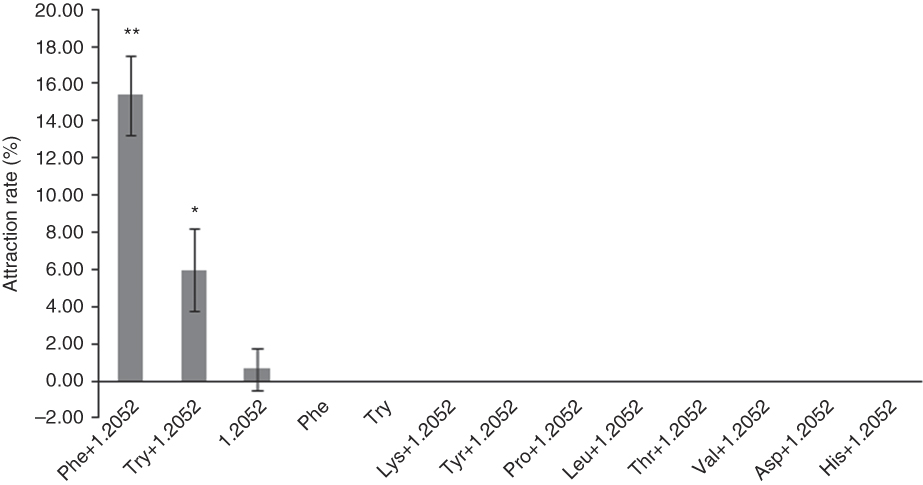
Figure 1
Chemotaxis (percent attracted) of Caenorhabditis elegans toward Stropharia rugosoannulata stain 1.2052 cultured on water agar supplemented with amino acids. Controls are phenylalanine or tyrosine alone and strain 1.2052 alone. The error bars indicate standard deviation. The statistical differences were analyzed using one-way ANOVA, *P < 0.05, **P < 0.01.
SPME/GC-MS analysis
By comparing VOCs produced by the five cultures with chemical databases, we observed that 1-octen-3-ol was produced and benzaldehyde increased when L-phenylalanine was added to the WA medium. Similarly, when L-tryptophan was added to the medium, benzaldehyde, 1-octen-3-ol and indole were all induced (Table 1 and Fig. 2).
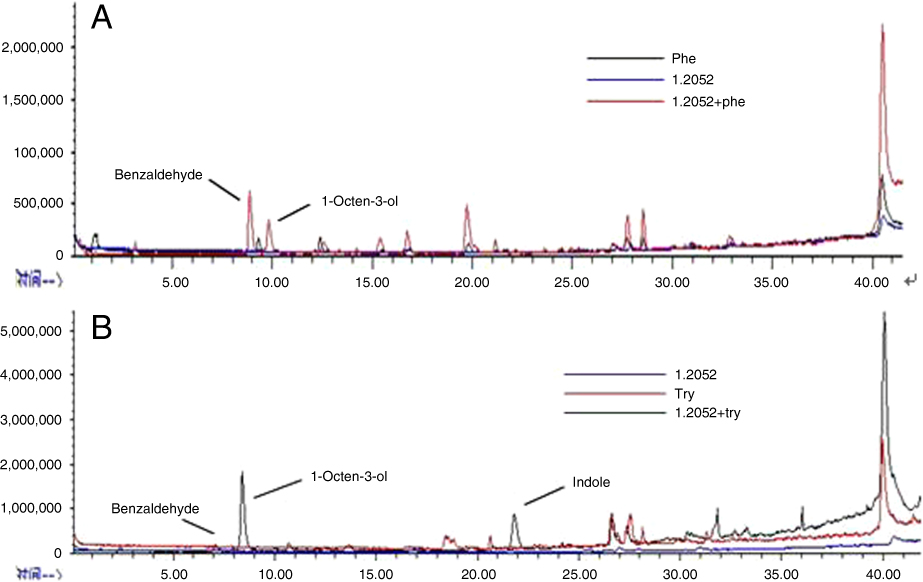
Figure 2
GC-MS total ion chromatography of different samples. A: L-phenylalanine alone, strain 1.202 alone and strain cultured on water agar plus L-phenylalanine, benzaldehyde was increased and 1-Octen-3-ol was newly produced from strain 1.2052 cultures added L-phenylalanine; B: strain 1.202 alone, L-tyrosine alone and strain cultured on water agar plus L-tyrosine, benzaldehyde was decreased and 1-Octen-3-ol and indole were newly produced were produced from strain 1.2052 cultures added L-tyrosine.
The mortality of nematodes after attracted
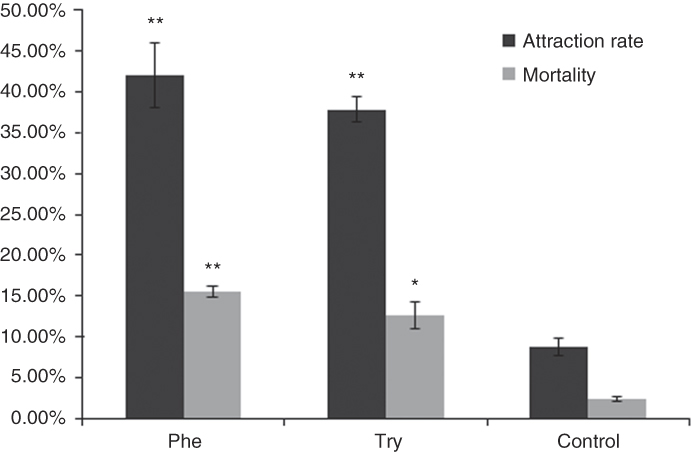
Stropharia spp. can produce unique stellate cells which resemble a sharp sword causing damage to the nematode cuticle, resulting in leakage of nematode inner materials (Luo et al., 2006). In this experiment, we tested whether nematode attractants contribute to fungal nematicidal activity. After 48 hr, more than 6 times C. elegans was killed compared to control (Figure 3).
Table 1
The attractants produced in the groups supplemented amino acids.
| Tested group | Compound name | % area relative content (SD) | Quality (%) |
|---|---|---|---|
| Phe+1.2052 | Benzaldehyde | 0.90 (0.2) | 95 |
| 1-Octen-3-ol | 0.51 (0.1) | 90 | |
| 1.2052 | - | - | -a |
| Phe | Benzaldehyde | 0.61 (0.2) | 91 |
| Try+1.2052 | Benzaldehyde | 0.09 (0.05) | 91 |
| 1-Octen-3-ol | 1.01 (0.3) | 90 | |
| Indole | 0.66 (0.2) | 97 | |
| 1.2052 | - | - | - |
| Try | - | - | - |