Introduction
Brain-computer interfaces (BCIs) have been markedly developed to serve paralysis patients via assistive technology (Brunner et al., 2014). BCIs can be categorized as invasive or noninvasive. Most BCIs are noninvasive systems. Electroencephalography (EEG) measures the field potentials produced by neurons from the scalp, and it has been widely used in clinical applications and BCI systems (Abdulkader et al., 2015; Nicolas-Alonso and GomezGil, 2012). Currently, brain acquisition technology is developing rapidly. Neuroheadsets (Chamola et al., 2020) based on dry electrodes can acquire EEG signals and other relevant signals, such as electrooculogram and facial electromyogram (EMG) signals (Jang et al., 2016; Šumak et al., 2019; Yulianto et al., 2020). The Emotiv and NeuroSky companies have presented dry electrode systems for entertainment and other applications (Brunner et al., 2014; Yulianto et al., 2020). BCI devices and applications have mainly been used for smart homes, control of prosthetic devices, such as arm and hand exoskeletons, artificial arms, and power wheelchairs, and assistive and rehabilitation devices (Ben Taher et al., 2015; Long et al., 2012). In addition, BCIs can be beneficial for people with quadriplegia paralysis (severe disabilities). For people with hemialgia or paraplegia paralysis, an MYO gesture armband (Chu et al., 2020) and video-based human action recognition (Sarabu and Santra, 2021) can be suitable to extend their activity.
Currently, hybrid BCIs can yield high efficiency in practical devices and systems to serve people with severe disabilities. An improvement over the conventional BCI has been proposed by combining it with other BCI modalities. Electrooculography (EOG) measures potential changes, while controlling eye movements such as wink and blinks. EOG is widely utilized in cooperation with EEG-based BCI systems (He et al., 2020; Punsawad et al., 2010; Yang et al., 2016). A facial EMG signal measures changes in electrical potential that occur when facial, jaw, and tongue movements are executed. BCI-based assistive technology has been developed to serve disabled patients who have lost movement ability in their upper or lower limbs. A wheelchair is an assistive mobility device that can increase the level interaction between patient abilities and the external environment. Paralysis is the most common neural disorder that causes the loss of control of one or more muscles in the body. Because the different types of paralysis are a challenge in BCI development, we have tried to create a BCI-based assistive technology strategy for tetraplegia, especially in terms of mobility enhancement. Previous research has demonstrated many techniques and modalities that can be employed to build assistive mobility devices for patients with all paralysis types. Artifacts are other internal biomedical signals and other external signals that interfere with EEG signals within the same frequency range (Brunner et al., 2014). For example, facial and head movements are some of the most common signals that appear when people blink or move their eyeballs or eyelids. A hybrid BCI (Amiri et al., 2013; Richard et al., 2015) is a highlighting technique that improves the interaction performance of the given system by combining multiple or different input channels with BCI channels. The modalities of hybrid BCIs consist of (i) hybrid BCIs that combine multiple brain signals; (ii) combination of brain activity with other physiological signals such as EMG, EOG, and electrocardiogram (ECG) signals; and (iii) a combination of two BCI channels or a combination of a BCI with special assistive input devices (e.g., joysticks, smart wheelchair systems, etc.) (Hernandez-Ossa et al., 2017; Richard et al., 2015; Tang et al., 2018; Yang et al., 2016).
At present, there are few assistive devices for patients with quadriplegia paralysis on the market. Nevertheless, biomedical signal acquisition techniques and devices have been continuously developed for medical applications, such as a biosignal-based wearable device with a wireless biomedical sensor network (WBSN) for home healthcare. Therefore, we aim to develop a BCI system that can integrate a WBSN and serve a patient with quadriplegia paralysis in daily activities. In this paper, we develop a practical BCI system using EEG motion artifacts from a neuroheadset for assistive mobility device control in patients with quadriplegia paralysis. By employing EEG artifacts to control an electric wheelchair, a simulator is proposed. We design a control creation and translation strategy of EEG artifacts and motor imagery for a user-friendly BCI-controlled electric wheelchair simulator. The efficiency of the system and the user are verified. To evaluate the EEG headset, it is compared with previous work that involved an electrode placed on the skin.
The paper can be divided into four main sections, of which the first section is the introduction. The second section will describe research methods and includes four parts, i.e., (i) the proposed system, (ii) signal acquisition and preprocessing, (iii) feature extraction and algorithms, and (iv) command translations. The third section presents experimental results and discussions to demonstrate the efficiency of the proposed system and algorithm from the second section for online testing. In the last section, the outcome and outlook of the proposed system will be presented as a conclusion, and future work will be suggested.
Research methods
Proposed system
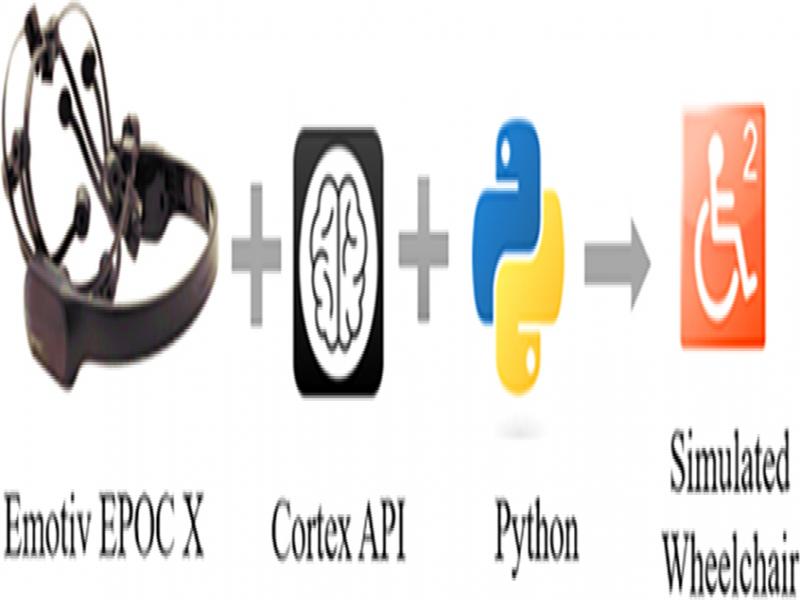
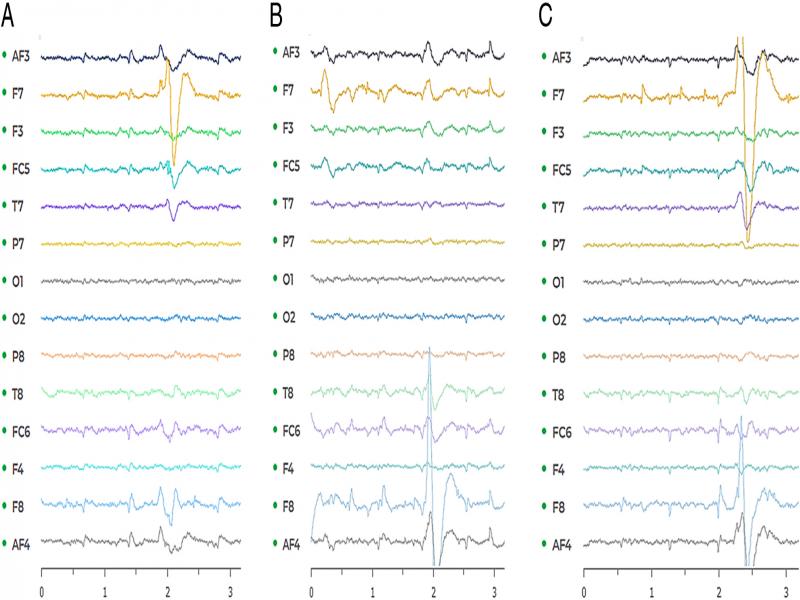
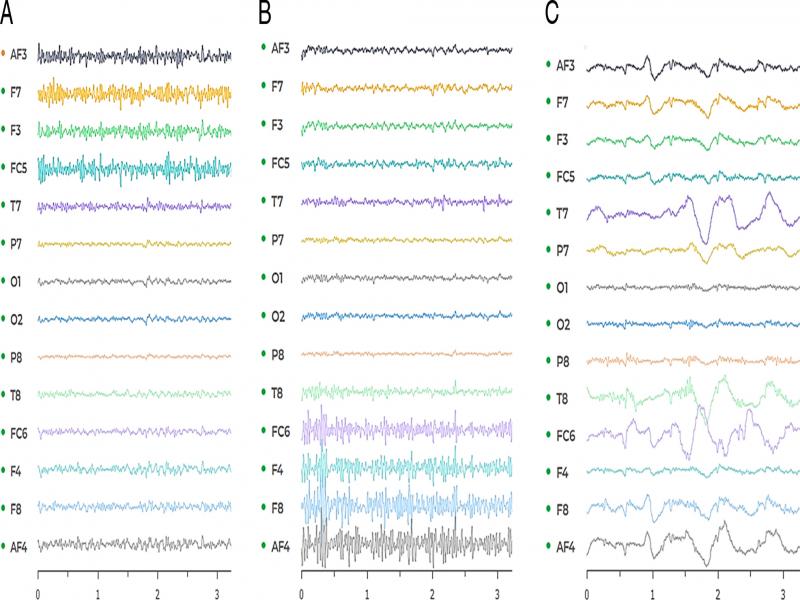
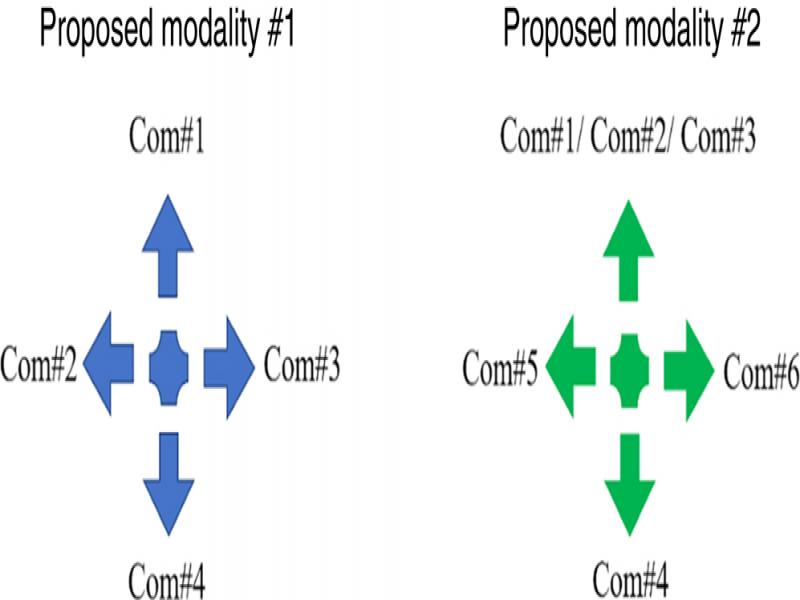
In this work, we propose a human-machine interface system by using EEG artifacts obtained from an Emotiv EPOC X neuroheadset. The main idea is to use EEG artifacts that are generated from eye winking and jaw chewing to control the direction of a wheelchair. Four commands for direction control consisting of going forward, turning left, turning right, and reversing were created by employing an EEG artifact-based face-machine interface with two proposed command strategies. For the first command modality, we set a forward translation by using both jaw chewing (turning left by jaw chewing on the left, turning right by jaw chewing on the right) and eye winks (reversing by winking both eyes). The second modality consists of forward commands generated by jaw chewing (left or right or both), turning left with a left eye wink, and turning left with a left eye wink, as well as a backward command generated by winking both eyes. In the idle state, the wheelchair is stopped. However, in an emergency, the user winks both eyes three times to toggle off the wheelchair controller system, and the wheelchair stops immediately; winking three times again reenables the system. An overview of the proposed system for real-time simulated wheelchair control is shown in Figure 1. The process consists of preprocessing, algorithms, and command translation. A simple method is utilized for EEG feature extraction and classification. The details of each part are presented in the second section (Table 1).
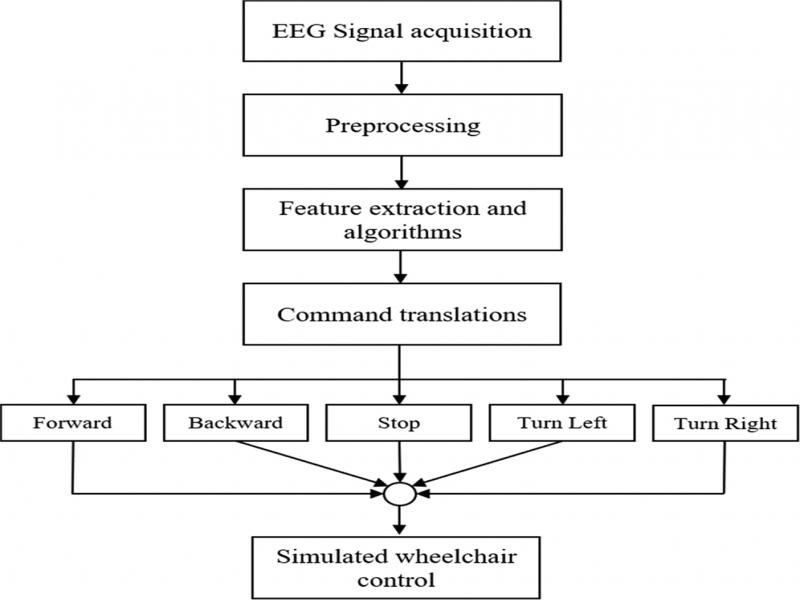
Figure 1:
The proposed face-machine interface system for simulated wheelchair control using artifacts from an EEG neuroheadset.
Table 1.
The commands for simulated wheelchair control.
| Commands No. | Actions | Output commands | |
|---|---|---|---|
| 1 | Jaw chewing on both sides | Forward | |
| 2 | Jaw chewing on the left side | Turn Left | |
| 3 | Jaw chewing on the right side | Turn Right | |
| 4 | Winking both eyes | Backward | |
| 5 | Winking the left eye | Turn Left | |
| 6 | Winking the right eye | Turn Right | |
| Optional | Winking the left eye and then the right eye within 3 sec | Enable/Disable System | |
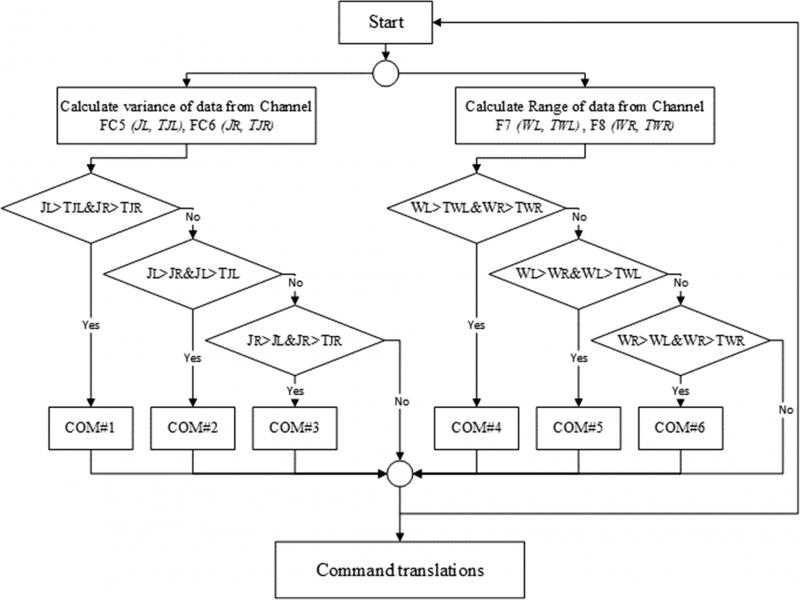
| if JL >TJL & JR>TJR, | Decision is “Com#1” | ||
| if JL>JR & JL>TJL, | Decision is “Com#2” | ||
| if JR>JL & JR>TJR, | Decision is “Com#3” | ||
| if WL >TWL & WR>TWR, | Decision is “Com#4” | ||
| if WL >WR & WL>TWL, | Decision is “Com#5” | ||
| if WR>WL & WR>TWR, | Decision is “Com#6” | ||
| Otherwise, | No Decision | ||
| Sequence No. | Commands | Sequence No. | Commands |
|---|---|---|---|
| 1 | Turn Left | 7 | Turn Right |
| 2 | Turn Right | 8 | Turn Left |
| 3 | Turn Right | 9 | Backward |
| 4 | Turn Left | 10 | Turn Left |
| 5 | Forward | 11 | Turn Right |
| 6 | Backward | 12 | Forward |
| Average accuracy (%) | ||
|---|---|---|
| Participants | Proposed modality #1 | Proposed modality #2 |
| 1 | 95.8 | 100 |
| 2 | 95.8 | 100 |
| 3 | 91.7 | 95.8 |
| 4 | 87.5 | 95.8 |
| 5 | 91.7 | 100 |
| 6 | 87.5 | 91.7 |
| 7 | 95.8 | 95.8 |
| 8 | 91.7 | 95.8 |
| Mean ± SD | 92.2 ± 3.46 | 96.9 ± 2.94 |