
Body awareness and spatial concepts are aspects of orientation and mobility (O&M) that are usually learned incidentally by typically developing children as they interact with their environments. However, children who are blind miss out on these developmental aspects unless timely intervention is provided. Golledge (1993) observed that the ability to travel independently and interact with the wider world is one of the greatest challenges for people with visual impairments (VIs). Similarly, Bruce et al. (1991) found that 20% of the young people who were registered as blind in the UK had not left their homes in one week, only 34% had traveled locally and only 41% had left their homes alone and on foot. Body awareness refers to the names, functions and movements associated with each body part (Fazzi and Petersmeyer, 2001; Maloney, 2016) and it requires that a person understands the spatial concepts that are necessary to determine the position of one’s body in relation to the locations of other people and objects, and within the environment.
According to Fiehler and Rosler (2010), the visual, auditory, tactile, vestibular and proprioceptive sensory systems work in cooperation to guide movements within a space. Similarly, Sherrington (1906) described proprioception as the process in which information concerning the body’s position is received and analyzed through continuous feedback to the central nervous system (CNS) from the receptors in the joints. Therefore, any interference with the sensory systems or the CNS may affect the development of body awareness and spatial concepts, which are necessary for safe, efficient and independent movement through the environment. However, a VI may diminish the ability to use visual information to check the accuracy of movements (Toole et al., 1984). Although students with multiple disabilities may often be responsive to music, they often have mobility limitations and difficulty with change (Piaget, 1952). These students need a learning environment with a variety of communication systems (e.g., picture, tactile and object symbols). Research-based strategies (e.g., repetition and consistent cues) which have been successfully used with students with multiple disabilities often incorporate verbal and physical prompting (Erin, 2017). Erin explained that routine provides a sense of control and students with disabilities usually feel “comfortable when they anticipate events” (p. 331). Music has also been found to help students learn (Sarcomo and Soto, 2012). Other related research includes Sapp (2011) who recommended structured music activities for teaching O&M skills, Molloy-Daugherty (2013), and Barney and Prusak (2015) who observed that children were more active and likely to enjoy participating in activities when there was music playing.
Structured movement routines (SMR) are routines that are made of a series of movements and/or poses. An SMR can allow for the integration of music, communication systems, prompting and movement. When all the strategies are integrated and embedded into individually designed SMR, students are more likely to anticipate movement and connect language to corresponding body and spatial concepts. Sequenced yoga sessions that have a predetermined set of poses in a specific order can be considered types of SMR. In this regard, Bonney et al. (2017) have indicated that the best way to enhance transfer and retention of learning is to train learners using a variable practice structure rather than a repetitive practice.
The idea of developing this app was motivated by the need to help professionals design SMR for their students with VIs and additional disabilities. Research shows that when assistive technology (AT) is used with students with disabilities, the AT promotes attentiveness by allowing for differentiated instruction. The ATs are also less stigmatizing than other types of intervention (Doenyas et al., 2014; Kagohara, 2011). Valentino-Devries (2010) also observed that principles of Universal Design for Learning are incorporated into the use of the iPad. Therefore, iPads are increasingly being used by special educators (Herbert, 2010). Nonetheless, there is still no app available that is specifically designed to support the learning of body awareness and spatial concepts by children who have VI and additional disabilities. Therefore, a multidisciplinary team has been designing, developing, and testing an app called Body Awareness through Music and Movement (BAMM) to help children with VI and additional disabilities improve in body awareness and spatial concepts.
Purpose
The purpose of this paper is to report a case study of a design-based research (DBR) effort to create an app that supports understanding of body awareness for children with VI and additional disabilities.
Research questions
The following research questions guided the progress of this study:
Method
Research design
A DBR was used in this study. Wang and Hannafin (2005) define DBR as a “flexible methodology that focusses on improving educational practices through iterative analysis, design, development and implementation based on collaboration among researchers and practitioners in real world settings” (p. 6). Additionally, Stokes (1997) and Schoenfeld (1999) observed that DBR allows educational researchers to study theory and application. In DBR, an intervention is designed, based on current theory to solve actual user problems. The intervention is put into practice leading to new or revised theories that generate more effective interventions and/or new applications. Smith et al. (2013) argued that the design of practical and implementable special education interventions can be improved by DBR. BAMM team’s goal was not only to design an app but to advance the theory that body awareness can be supported by SMR in the student’s natural setting.
There are different ways to conduct DBR, and the BAMM study followed McKenney and Reeves’ (2012) model. The team comprised professionals with expertise in different areas, with the lead researcher being an itinerant certified O&M specialist (COMS). Other team members were: an itinerant teacher of students with visual impairments, a music therapist and a researcher with experience in working with children with VI and additional disabilities, an autism specialist, a children’s dance instructor and a physical fitness expert, a designer for children’s art and a software developer. It was imperative that the app be developed using the universal design for learning. It needed to be engaging and inclusive of all students.
Materials, structure and acts of the app
BAMM’s design proceeded through cycles of three phases: analysis and exploration, design and construction and evaluation and reflection. The initial analysis focused on establishing the content and features of the app. Guided by the principles of universal design for learning, the app would provide a selection of “acts,” each one a combination of a song and movements synchronized to the lyrics of the song.
A board certified music therapist composed a specific song for each act. Text moved to introduction as advised. To create the music for each act, the music therapist chose specific words, composed specific lyrics and used elements of melody, harmony and rhythm to musically facilitate the targeted movement in each act. The lyrics contained language that would reinforce body and spatial awareness (e.g. “hands together, palms touching, in the center”). The instrumental aspects of the music reflected the targeted movement in terms of timing, force and size.
An individualized student playlist was created by selecting appropriate acts from the variety of movements incorporated in standing, prone, supine and seated positions. The ultimate goal was for the app to consist of acts with a range of complexity of movement and language. The initial prototype would consist of simple movement and language.
The idea of designing an engaging character was informed by the need for a model for the movements. The BAMM team thought that the students with residual vision would be attracted to an engaging character that would model movements on the app. After several trials, the final design of the demo character named “BAMMboo” was adopted. BAMMboo is blue, gender neutral, wears a yellow orange top, bright red pants and purple shoes and is visible in the playlist editor shown in Figure 1. The colors selection was based on the fact that children with cortical visual impairments which accounts for 30–40% of VI in children in the USA (Roman-Lantzy’s, 2007) prefer brightly colored objects (Good et al., 1994). The app would provide suggestions for object symbols. These symbols are often a way to communicate with students regarding their preferences about the order of the movements.
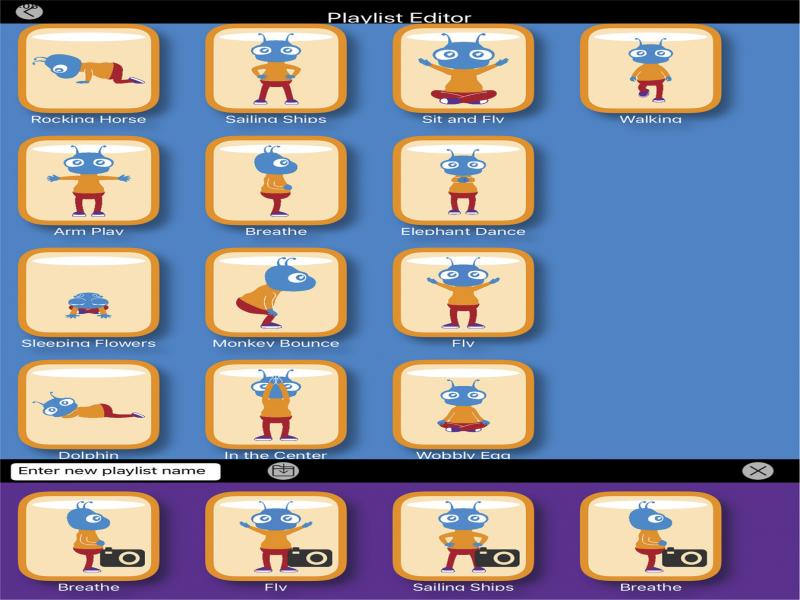
Figure 1:
Screenshot of BAMM Playlist Editor.
The requirements for the interface included: simple and intuitive creation and editing of individual playlists, the ability to select a picture from the iPad library or take a picture of individual object symbols that would appear beneath the corresponding act within each playlist, the ability to stop and resume playing acts by tapping anywhere on the screen, playlists created by arranging icons that depict starting position or representative pose of each act, uncluttered and visually stimulating screens, the ability to speed up and slow down acts as appropriate and the ability to name playlists and insert photo of choice within playlists icon (see Fig. 1).
Design and construction–designing the prototype
A simple reaching movement was adopted from the book “teaching Age-Appropriate Purposeful Skills” (TAPS, 2012) and the factors necessary to develop the act agreed on (e.g. the software used to create the music had to be compatible with the standard audio formats available for iOS). The artist had to have a clear understanding of the movements and the key positions to draw, and for accuracy, movements had to be modeled in three dimensions. Approximately 60 movements of various levels of complexity and in a variety of positions were modeled. This would be the BAMM video library from which all movements of the acts would be selected. All the movements consisted of motions typically used in daily living and did not require above average range of motion, strength or endurance. Through collaboration, trial and error, the first act “In the Center,” a “tune in” act (Maloney, 2016) was designed.
In total, 12 simple movements including, “In the Center” were selected from the video library for use in the first set of acts that would be included in the first prototype of the app (see Table 1). Each movement has a description, functional purpose, concepts emphasized, possible vocabulary and actual vocabulary. Each act had a number and a corresponding video number. “In the Center” was the first act and the relaxation act (Maloney, 2016) was next on the priority list. The remaining 10 acts were randomly sequenced so that team members could be sure to simultaneously work on the same one. Each time an act was selected to be in a student’s playlist, the instructor would have the opportunity to select a picture of an object or tactile symbol from the iPad’s album or to take a picture with the iPad’s camera. When the playlist was used, that picture would appear below the symbol. DBR allows repetition of steps both within and between each phase. Review and revision would occur within each phase before proceeding to the next phase (see Fig. 1). Each iteration of the app would be an outcome of one circle.
Table 1.
Sample of Conceptualization of Acts for Prototype from Video Library.
| Name acts.ppt slide no. MOV no. | Description | Functional purpose | Concepts emphasized | Possible vocabulary (suggestions) | Actual vocabulary |
|---|---|---|---|---|---|
| In the center 1. no. MOV | Begin-palms together, arms up, Circle down, palms together | Opening act: balance, centering, readying, coordination at midline and laterally | Beginning and ending, breathing | Hands, palms, begin, center, arms, head, overhead, sides, palms, thighs, around, up, arms down, end | Hands, palms, begin center, arms, overhead, around, up, arms up, arms down, end |
| Fly 8 no. MOV | Startarms out stretched; raise and lower to music | Reaching literally at various heights in search of objects, balance and coordination; moving arms simultaneously | High; low; reaching; up; down; sides; wings; flying | Arms; arms out; straight to each side; low; high; arms down; arms up; low; high; shoulder height | Arms; arms out; straight to each side; low; high; arms down; arms up; low; high |
| Sailing ships 5 30 | Hands on hips; alternate bending and straightening left and right knee. Alternate shifting weight left and right | Components of walking; Alternating sides | Knees; bending; hips; weight; shifting | Hands; hips; knee; right; left; right knee; left knee; straight knees; shift right; shift left | Hands; hips; knee; right; leftright knee; left knee; straight knees; shift right; shift left |
| Monkey bounce 3 67 | Hands on hips; bend and straighten both knees simultaneously; small motion; feet close and feet wide | Transitioning from sitting to standing and visa-versa | Slow; fast; simultaneous; together; close feet; wide stance | Straight bend; knees; hands on hips; bounce; up; down; stop; hands; faster; monkey; stop; done; wider; closer; feet | Straight bend; knees; hands on thighs; bounce; bouncing, up; down; stop; hands; faster; monkey; stop; done; wider; closer; feet |