
TABLE I.
Comparison of image semantic segmentation networks
| Mothods | Features | Advantages | Disadvantages |
|---|---|---|---|
| FCN[14] | Proposes novel end-to-end network architecture ; Encoder-decoder architec-ture ; Fully connected output classification. | Images of any size can be split. | The large number of parameters and the pooling opera-tion caused a loss of spatial information in the images and a low accuracy rate. |
| SegNet[15] | Symmetrical Encoder-Decoder architecture ; up-sampling to recover im-age size at the decoding stage using unpool-ing; full convolutional layer output classification. | The small number of parameters compared to FCN maintains the integrity of the HF information. | The computational effort is too large to meet the real-time requirements of lane detection. The up-sampling operation also loses adjacent informa-tion. |
| Unet[16] | Symmetrical structure; co-nnects each stage to the encoder feature map with the upsampled feature map of the decoder. | Can be trained end-to-end from very small data sets; fast. | More suitable for segmentation of medical images |
| ENet[17] | Consisting of Bottleneck mod-ules; with a large encoder-small decoder st-ructure. | Greatly reduces the nu-mber of parameters and floating point operations, takes up less memory and has high real time performance. | Increases the number of calls to the kernel function; not very precise and unstable results. |
| PSPNet[18] | Improving ResNet structures using null conv-olution ; A pyramid pooling module has been ad-ded. | The segmentation acc-uracy exceeds that of models such as FCN, DPN and CRF-RNN. | Obscured situations between targets are not handled well and the edges are not seg-mented accurately enough. |
| ERFNet[19] | ENet network improve-ments; the adoption of factorized convolutions; | Non-bottleneck is more accurate to bottleneck. | High calculation volume compared to Enet. |
| DeepLab V3+[20] | Uses a modified version of Xception as the base network; uses atrous[19] convolutional kernels. | More accurate segmentation of target edges; considers global information, eliminates noise interference and imp-roves segmentation accuracy. | The model does not run at a high speed and has a high storage space requi-rement. |
| FPN[21] | Combining FCN and Mask R-CNN[13] using rich multi-scale features. | Semantic segmentation and instance segmentation tasks can be solved simultaneously. | Increased inference time; larger memory footprint; use of image pyramids only in the testing phase. |
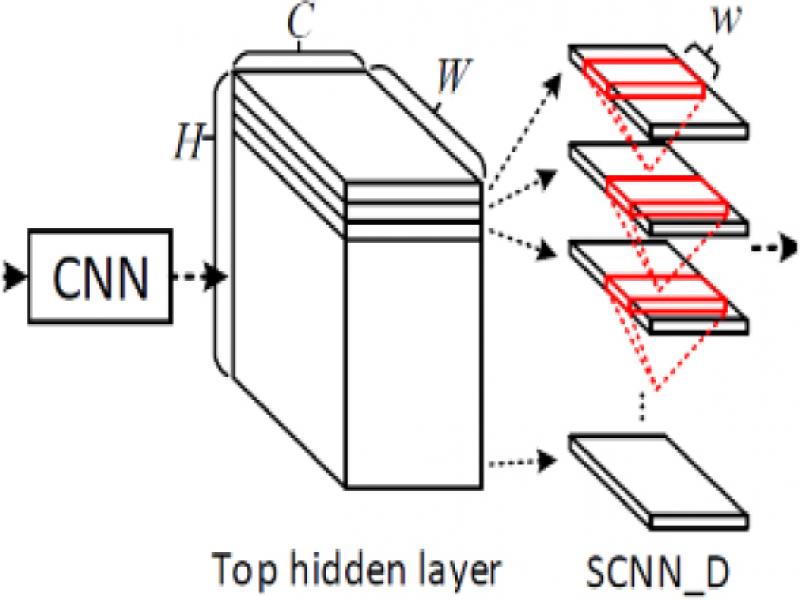
Figure 1.
SCNN_D module
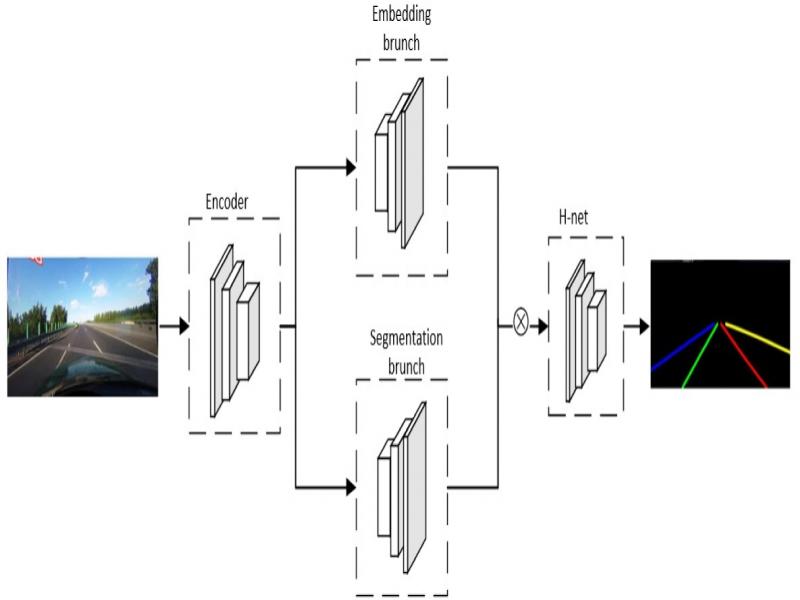
Figure 2.
LaneNet network framework
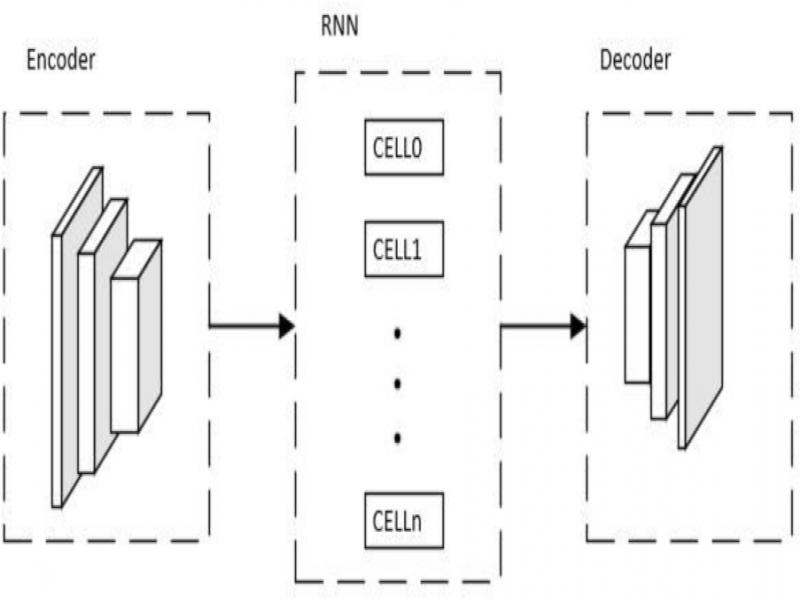
Figure 3.
DCNN+DRNN network framework
TABLE II.
Accuracy comparison of lane line detection in different scenes of CULane
| Methods | Normal | Crowded | Night | NoLine | Shadow | Arrow | DazzleLight | Curve | Crossroad | Total |
|---|---|---|---|---|---|---|---|---|---|---|
| SCNN | 0.906 | 0.696 | 0.661 | 0.434 | 0.669 | 0.841 | 0.585 | 0.644 | 0.532 | 0.716 |
| LaneNet | 0.921 | 0.708 | 0.714 | 0.563 | 0.697 | 0.850 | 0.635 | 0.746 | 0.591 | 0.742 |
| DCNN+DRNN | 0.984 | 0.652 | 0.797 | 0.724 | 0.840 | 0.852 | 0.774 | 0.731 | 0.787 | 0.782 |