I. Introduction
Lane detection is an integral step in the field of driverlessness, allowing cars to identify lanes so that vehicles know which direction they are travelling in and avoid them pulling out of their lanes. Lane detection was first done based on the feature approach, which extracts features and fits them based on lane line image features (e.g. colour, shape). However, feature-based methods are susceptible to poor feature extraction due to factors such as light and obstacle occlusion, and the algorithm for fitting lanes requires a range of parameters based on lane characteristics, often with many limitations. Therefore, feature-based algorithms are not suitable for practical applications.
A. Traditional methods
Due to developments in computer vision, lane detection based on model algorithms has been proposed and this method is mainly divided into straight line detection and curve detection. Most algorithms for straight line detection use the Hough transform to perform this method, which equates straight line detection to coordinate statistics, simplifying detection, but frequent coordinate mapping will increase the complexity of the algorithm and cause a reduction in real-time efficiency. A number of improved algorithms have been subsequently introduced to address this algorithm. For example, the maximum length straight line based lane line detection algorithm proposed by Xie Mei et al. This algorithm connects broken straight lines by setting a maximum straight line gap, selecting the maximum length straight line in the vertical direction on either side of the vertical centre of the image, using the maximum length straight lines on each side as edges, binarising the interior of the edges, and subjecting the interior image to Hough straight line detection, with the line closest to the vertical centre being the final detected lane line. This method greatly reduces the search area, simplifies the difficulty of the algorithm and speeds up detection efficiency.
There are also many different detection methods for bend detection, most algorithms use different line shapes to fit the lanes and rely on different models, the higher the complexity of their models, the better the fit to the lanes, but taking into account the efficiency of the algorithm also requires a streamlined model. Some of the better known lane modelling methods are the B-spline model and the IPM model (Inverse Perspective Transformation Model)[5]. The IPM model converts the monocular vision image into a bird’s eye view by applying an inverse perspective transformation, converting the lanes from far to near into parallel lanes, which reduces the difficulty of lane detection. However, this method requires knowledge of the camera’s internal parameters, and then determines the transformation matrix for the inverse perspective based on the specific parameters, so when the camera’s internal parameters are not known, the inverse perspective transformation model is not very widely used. The B-spline model uses multiple control points to fit the lane lines, also based on parallel perspective technology, and the algorithm is highly accurate but has poor real-time performance; moreover, the method divides the lane lines into multiple areas for separate detection, especially in the presence of false lane lines or lane wear, and the accuracy of the algorithm is not guaranteed, and the lane line jump is serious.
B. Deep learning methods
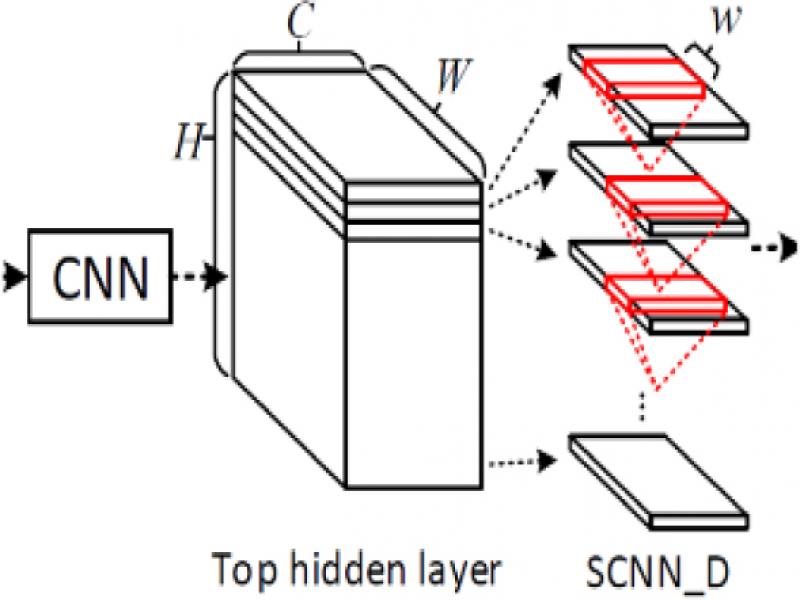
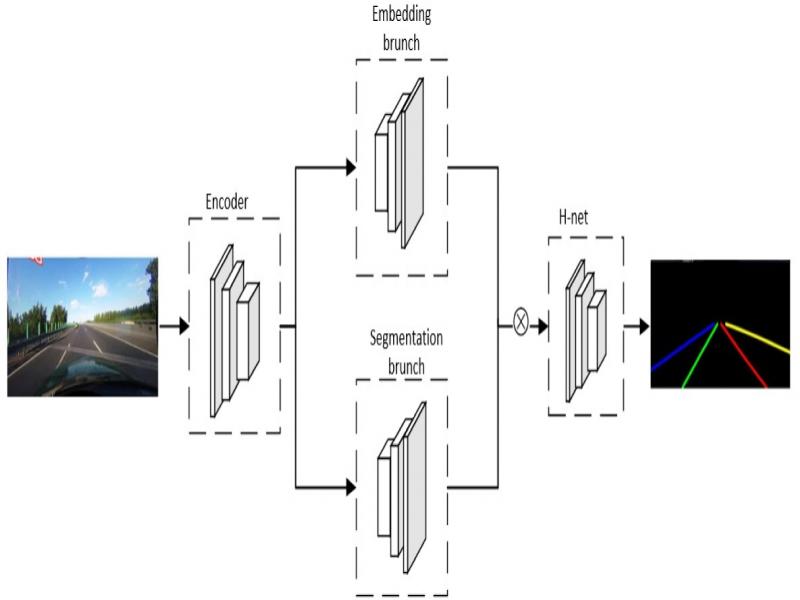
Research on lane detection based on deep learning neural networks has been conducted in recent years, and the results have been a great improvement compared to traditional algorithms. Due to the variability of the practical situation, most scholars have transformed the lane detection problem into a semantic segmentation problem. Convolutional neural networks have had great success in image detection and recognition, so convolutional-based semantic segmentation networks also have a wide range of applications in lane detection. The laneNet network proposed by Davy [1] et al. converts lane processing into an end-to-end instance segmentation problem, using a lightweight ENet network as the main structure and adding instance segmentation branches to classify different lanes into different categories. XingGang Pan[2] et al. proposed a spatially based deep neural network SCNN (Spacial CNN), which was trained to classify the network for the poorly conditioned dataset CULane, and the network performance was substantially improved in lane detection compared to the traditional convolutional network. The ENet-SAD[3] network is based on the lightweight neural network model ENet incorporating elements of SAD, Self-Attention Knowledge Distillation, which has 20 times fewer parameters, runs and is 10 times faster and more accurate than the state-of-the-art SCNN. While domestic scholars have paid much attention to the diverse road conditions, an improved YOLOv3 model was proposed by Zhang Xiang [4] to improve the adaptive and accuracy problems of lane detection technology in complex road environments, where complex road problems refer to road potholes, rugged mountain roads and other problems. A multi-scale MFCN model was proposed by Shuaihua Wang et al. to solve the lane line sample inhomogeneity problem, using a weighted loss function to solve the lane line inhomogeneity problem. For sharp turns, over curved lanes, CurveLane-NAS, a lane sensitive architecture search framework combining NAS with curved lane detection algorithms proposed by Huawei Noah’s Ark Lab and Sun Yat-sen University [6], can automatically capture long-distance coherent and accurate short-distance curve information to solve the problem of curved lane detection.
The neural network methods described above are all based on semantic segmentation networks for end-to-end lane line detection, i.e. the lane detection problem is converted into a multi-category segmentation problem where each lane belongs to one category, which enables the end-to-end training of a well-classified binary graph. This paper therefore focuses on describing the current state of development of lane detection based on semantic segmentation networks.
II. Semantic Segmentation Network
There are many applications of neural networks in the field of computer vision, such as image classification [11], target detection [12], semantic segmentation [14], and instance segmentation [13]. One important problem in computer vision is the semantic segmentation network, as its work is much more complex than the classification and detection tasks. Semantic segmentation of images means that each pixel of the input image is assigned a semantic category to it, thus obtaining a dense classification for each pixel. That is, it requires learning the contour of the object, the location of the object and the class of the object from high-level semantic information and local location information, and thus scholars in general view the semantic segmentation problem as a pixel-level target segmentation.
Traditional semantic segmentation is generally classified into threshold-based segmentation methods [8], region-based segmentation methods [9], edge-based segmentation methods [10] and so on. The threshold segmentation method is one of the commonly used segmentation techniques, which in essence automatically determines the optimal threshold value based on certain criteria and uses these pixels according to the grey level i n order to achieve clustering. Region-based segmentation is a segmentation technique based on the direct search for new regions and can be divided into two basic extraction methods: region growing and region splitting and merging. Region growth is based on individual pixel points, which are aggregated together to form regions with similar features, and is computationally simple and works well for uniformly distributed images. Region splitting and merging starts from the overall image and obtains each sub-region by splitting between pixel points, the quadtree decomposition method is a typical representative method. Edge detection-based segmentation methods segment images by detecting the edges of different regions. The simplest edge detection method is the parallel differential operator method, which uses the nature of discontinuous pixel values in adjacent regions and uses derivatives to detect edge points. Most traditional methods work by extracting low-level semantics of the image, such as size, texture, colour, etc. In complex environments, the response capability and accuracy is far from adequate.
With the development of deep learning, the proposal of convolutional neural networks has allowed significant progress to be made in combining semantic segmentation and neural networks. Because of the powerful generalisation ability of convolutional networks to acquire image features, they have shown excellent performance in different areas of image and video such as image classification, target detection, visual tracking and action recognition. The following subsections describe the development of semantic segmentation networks based on deep learning.
A. Derivation of the semantic segmentation network model
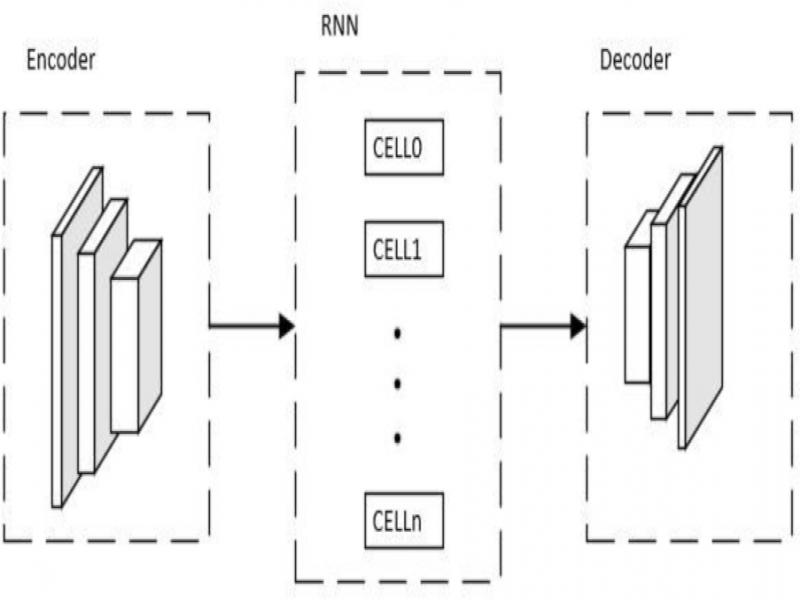
A turning point in the development of semantic segmentation based on deep learning was the FCN, a fully convolutional neural network for end-to-end segmentation, proposed by Jonathan Long [14] et al. in 2014, when a major breakthrough in semantic segmentation was achieved. It upsampling the local information loss caused by the convolutional neural network with a deconvolution operation that restores the feature map to the original image size, hence the current general semantic segmentation network architecture is an encoder-decoder structure. Where the encoder is usually a pre-trained classification network, the task of the encoder is to semantically project the discriminable features learned by the encoder onto the pixel space to obtain dense classification.
A number of scholars have since proposed a number of sophisticated network frameworks, but most have been studied on the basis of fully convolutional networks. In this paper, we only discuss semantic segmentation networks that are applicable to lane detection, and the research in recent years is shown in the following Table 1:
TABLE I.
Comparison of image semantic segmentation networks
| Mothods | Features | Advantages | Disadvantages |
|---|---|---|---|
| FCN[14] | Proposes novel end-to-end network architecture ; Encoder-decoder architec-ture ; Fully connected output classification. | Images of any size can be split. | The large number of parameters and the pooling opera-tion caused a loss of spatial information in the images and a low accuracy rate. |
| SegNet[15] | Symmetrical Encoder-Decoder architecture ; up-sampling to recover im-age size at the decoding stage using unpool-ing; full convolutional layer output classification. | The small number of parameters compared to FCN maintains the integrity of the HF information. | The computational effort is too large to meet the real-time requirements of lane detection. The up-sampling operation also loses adjacent informa-tion. |
| Unet[16] | Symmetrical structure; co-nnects each stage to the encoder feature map with the upsampled feature map of the decoder. | Can be trained end-to-end from very small data sets; fast. | More suitable for segmentation of medical images |
| ENet[17] | Consisting of Bottleneck mod-ules; with a large encoder-small decoder st-ructure. | Greatly reduces the nu-mber of parameters and floating point operations, takes up less memory and has high real time performance. | Increases the number of calls to the kernel function; not very precise and unstable results. |
| PSPNet[18] | Improving ResNet structures using null conv-olution ; A pyramid pooling module has been ad-ded. | The segmentation acc-uracy exceeds that of models such as FCN, DPN and CRF-RNN. | Obscured situations between targets are not handled well and the edges are not seg-mented accurately enough. |
| ERFNet[19] | ENet network improve-ments; the adoption of factorized convolutions; | Non-bottleneck is more accurate to bottleneck. | High calculation volume compared to Enet. |
| DeepLab V3+[20] | Uses a modified version of Xception as the base network; uses atrous[19] convolutional kernels. | More accurate segmentation of target edges; considers global information, eliminates noise interference and imp-roves segmentation accuracy. | The model does not run at a high speed and has a high storage space requi-rement. |
| FPN[21] | Combining FCN and Mask R-CNN[13] using rich multi-scale features. | Semantic segmentation and instance segmentation tasks can be solved simultaneously. | Increased inference time; larger memory footprint; use of image pyramids only in the testing phase. |