
1. Introduction
Interlocking directorates, i.e., “when a person affiliated with one organization sits on the board of directors of another organization” (Mizruchi, 1996, p. 271), have been studied since 1914 (Dixon, 1914; Durand, 1914) as a central mechanism shaping corporate governance, strategic decision-making, and the distribution of power across firms. Answering the question of “what do interlocks do?” (Mizruchi, 1996), diverse theoretical perspectives have conceptualized interlocks as mechanisms of monitoring and control (Mizruchi, 1996), channels for the diffusion of practices (e.g., Davis, 1991), sources of resource access (Pfeffer & Salancik, 1987), and elite political coordination (Useem, 1984).
While this breadth reflects the empirical importance of interlocks, it also introduces substantial conceptual and empirical heterogeneity across studies. Academic studies of interlocks have come under criticism for failing to predict firm behavior and for being reductionist in their quantification of complex dynamics (Córdova, 2019; Faizabad et al., 2021; Fligstein & Brantley, 1992; Mizruchi, 1996). Several conceptual reviews highlight that interlock studies yield inconsistent results. Early work already reported contradictory evidence on the effect of boards of directors on corporate financial performance (Zahra & Pearce, 1989), and Mizruchi (1996) similarly claimed that researchers at the time failed to demonstrate a consistent positive effect on firm profitability (Mizruchi, 1996). More recent studies confirm this trend, showing no clear trend across outcomes such as financial outcomes, market behavior, and attracting resources (Córdova, 2019), no systematic relationship with financial performance (Lamb & Roundy, 2016), while related research on corporate, social, and political networks likewise concludes that the research findings are mixed and that it is not possible to establish consensus (Faizabad et al., 2021). Throughout the history of interlock studies, the literature has struggled to reach consensus on their consequences. While early critics of interlock studies argued that they were overly descriptive, interlock studies are now criticized for failing to establish consensus on their outcomes (cf. Burris, 2005; Córdova, 2019), raising the question of why findings remain inconsistent.
Before attributing the lack of consensus to absent effects, alternative explanations should be considered. The research field on interlocking directorates is theoretically diverse (e.g., Mizruchi, 1996), and a lack of consensus may first reflect an unresolved conceptual disagreement over which perspective provides the most valid explanation. For example, while resource dependence theory highlights the organizational benefits of interlocks as a means to secure critical resources and manage uncertainty (Pfeffer & Salancik, 1987), agency theory, by contrast, focuses on individual motives and views interlocks as potentially harmful to firms as they may facilitate conflict of interest (Jensen & Meckling, 1976). Thus, theories differ in their assumptions about whether the firm or the individual constitutes the primary unit of analysis (Stokman et al., 1988) and in whether interlocks are expected to have positive or negative effects on that unit.
While dependence theoretical expectations about interlocking directorates are well known, comparatively less is known about how these theories are translated contextually and empirically. A second explanation of absent effects may be that theories, largely rooted in Anglo-Saxon contexts of dispersed ownership and shareholder-oriented governance, may not generalize to other contextual settings, and therefore require adaptation according to variations in, for example, ownership structures or state involvement (e.g., Caiazza et al., 2019; Scott, 1991). A third explanation may reflect differences in operationalizations, as this review will nuance. Construct clarity is required not only at the level of theory but also in its empirical measurements in order to compare empirical results (Post et al., 2020; Suddaby, 2010). As such, even though existing work has engaged with differences in the link between theoretical perspectives and operationalizations, highlighting that both units and levels of analysis vary (Mizruchi, 1996; Stokman et al., 1988), a more comprehensive and systematic assessment remains warranted to understand the extent to which conceptual assumptions of interlock studies match operationalizations. Thus, this article aims to clarify the construct (Krause et al., 2022; Post et al., 2020; Suddaby, 2010) of the concept of interlocking directorates by focusing on its empirical operationalizations. Against this background, this paper conducts a systematic literature review (Simsek et al., 2023) of 146 papers to investigate how interlocking directorates have been empirically operationalized across contexts and theoretical traditions in research on their outcomes.
At a theoretical level, this study argues that the seemingly contradictory expectations about the consequences of interlocks are not mutually exclusive, as they refer to different traits of interlocks and to different levels of analysis. Second, taking a departure from Mizruchi’s (1996) definition of the concept of interlocking directorate, this article suggests that the definition of interlocking directorates varies across three levels of analysis: at the organizational level, at the level of the unit within the organization, and at the individual level, for both the focal firm and the interlocked organization. The study, moreover, argues that theoretical expectations of the antecedents and consequences of interlocks cannot be formulated without considering transnational variations in institutional settings. Based on these theoretical assertions, this study conducts a systematic review of empirical studies examining the effects of interlocks. The review concludes that the variety of theories, boundary conditions, empirical constructs, and institutional settings across the sampled papers is so diverse that they do not test the same phenomena when examining interlocks. Thus, until theoretical specificity and operational consistency are ensured, the review argues that it will not be meaningful to synthesize broad systematic insights on the effects of corporate interlocks. To assist future research, the review provides a roadmap for connecting concepts, boundary conditions, and empirical operationalizations within the article. The article, moreover, calls for greater case variation in interlock studies to expand beyond US-centered research to a wider range globally, and for building subconstructs in future theorizing if the effect of corporate interlocking directorates is to be compared and understood from a global perspective.
2. Theoretical background
2.1. Theoretical conceptualizations of interlocking directorates
To clarify the construct of interlocking directorates, it is first important to understand how the term interlocking directorate has been conceptualized theoretically. Several theories have sought to explain the antecedents and outcomes of interlocks, the most mentioned theories being resource dependence theory, agency theory, and the class hegemony theory (Bilgili, 2022; Caiazza et al., 2019; Koenig et al., 1979; Lamb & Roundy, 2016; Mizruchi, 1996; Zahra & Pearce, 1989).
Agency theory examines conflicts of interest between managers and owners, emphasizing the role of external board members (Jensen & Meckling, 1976). Central to agency theory is, therefore, the board’s independence from the company’s management, understood as the presence of outside directors on the board to monitor management. A second issue concerns busy boards, i.e., when the board members hold multiple board positions, and, consequently, are believed to be overboarded to the extent that effective oversight is compromised (Ferris et al., 2003). Whereas a focus on board independence supports a positive interpretation of board interlocks, the literature on busy boards emphasizes the potential negative economic consequences of interlocks for firms.
Resource dependence theory (Pfeffer & Salancik, 1987) focuses foremost on the external organizational level, and sees interlocking directorates as an instrument for organizations to reduce environmental uncertainty as interlocks enable access to resources, advice, information, and legitimacy, eventually benefitting the firm (Fennema & Heemskerk, 2018; Hillman et al., 2009; Lamb & Roundy, 2016; Mizruchi, 1996; Selznick, 1949). However, following the logic of cooptation, not all interlocks are considered equally beneficial. The external organization must qualify as beneficial, for example, firms in sectors that constrain the focal firms’ profit, large firms as sources of consumption or suppliers, or financial institutions as sources of access to credit (Burt, 1978). Interlocks can also be understood as instruments of monitoring and control, benefiting the monitoring entity in the interlock relation at the expense of the monitored entity, as in the case of financial or bank control (Koenig et al., 1979; Mizruchi, 1996).
A third group of theories is often bundled under the heading of class hegemony theory or the class cohesion perspective. Specific to class hegemony theory is the focus on benefits stemming from broad interlock networks across sectors such as business, politics, and organizations, and the assumption that belonging to the core of such inter-sectoral networks, referred to as the power elite (Mills, 1965) or the inner circle (Useem, 1984), is a particularly advantageous position. Class hegemony theory thereby brings into focus the ecological level of the corporate network structure. Whereas the benefits of interlocks in other theories are often formulated in relation to firm performance, class hegemony theory thematizes how interlocks create class cohesion helping the business community shape political collective action (e.g., Domhoff, 1967; Mills, 1965; Useem, 1984; Zahra & Pearce, 1989), while it is less clear to what extent belonging to a hegemonic bloc benefits the firm (Mizruchi, 1996). Class hegemony theory, moreover, brings into focus how the individuals composing such a cohesive network can form their own class identity and agenda, transgressing the interests of the individual firm (Koenig & Gogel, 1981; Lamb & Roundy, 2016; Zahra & Pearce, 1989).
Social network theory is closely related to the method of social network analysis, which can be methodologically integrated across theories. Still, I argue that social network theories constitute a fourth heterogeneous group of theoretical assumptions central to interlock studies. Seminal social network theories focus on how specific connections, such as weak ties (Granovetter, 1973), and positions, such as structural holes (Burt, 1992), are beneficial in serving as bridges to new information. The focus of central network scholars, such as Granovetter (1973) and Burt (1992), thus expands beyond the relations between focal units (such as individuals or organizations). The social relations between groups or clusters of units become central, yet network scholars maintain a mid-range focus on the local network properties of the units rather than the global properties of the network ecology. More recent network scholars underscore the importance of recognizing the “duality of persons and groups” (Breiger, 1974) in network formation, as both organizational- and individual-level dynamics coexist and drive network outcomes and firms' performance (Burris, 2001; Koskinen & Edling, 2012; Stokman et al., 1988; Valeeva et al., 2020).
The term interlocking directorate is thus used in theoretically eclectic ways, encompassing multiple sub-themes, as the theories vary quite significantly in their conceptualization of interlocks (Koenig et al., 1979; Valeeva et al., 2020). Adding the theories to the typology of interlock studies advanced by Stokman et al. (1988) – which distinguished interlock studies by their focal unit (individuals vs companies) and level of analysis (agent-level vs system-level) – Table 1 summarizes how the theories diverge in their focus on the focal unit of analysis, the interlocking unit, the level of analysis, and the expectations of the effect of interlocks. Empirical operationalizations of the term interlock will therefore potentially be contingent upon the theory used to conceptualize interlocking directorates.
Table 1
Differences among central theories, conceptualizations, and expectations to interlocks.
| Agency theory | Resource dependence theory | Social network theory | Class hegemony theory | |
|---|---|---|---|---|
| Unit of analysis | Individual | Organization | Organization, individual, or both | Organization/individual |
| Interlocking organization | Firm | Organization (unspecified) | Organization (unspecified), individual, or both | Inter-sectoral organizations |
| Level of analysis of interlock | Individual | Organization | Local network | Global ecology |
| What do interlocks do? | Undermine financial performance | Improve financial performance | Improve financial performance | Establish the possibility of capitalist class cohesion and joint political action. The effect on financial performance is unclear |
Source: Author’s contribution.
Despite theoretical disagreement over the consequences of interlocks (Lamb & Roundy, 2016; Mizruchi, 1996), it is important to consider the extent to which the multiple theories’ expectations regarding their consequences can coexist. Many of the seemingly contradictory consequences of interlocks are compatible, as they refer to different units of analysis (Valeeva et al., 2020). Distinguishing between individual-level incentives and organizational-level incentives (Stokman et al., 1988), it is, for example, theoretically possible for both the proposition that information stemming from interlock networks provides information to a firm and the proposition that overly busy individuals are detrimental to a firm to be true at the same time, as these are not essentially the same phenomena. The expectations regarding interlocks should therefore not be understood as mutually exclusive from a theoretical point of view.
2.2. Interlocking directorates – definition and boundary specification
Early studies of interlocking directorates highlighted variations in its definition (Dixon, 1914), and still existing studies of interlocking directorates have not coalesced on a single definition thus far. When discussing the possible boundary specifications of the concepts, this review will take departure in Mizruchi’s (1996) influential definition of interlocking directorates as it accommodates the theoretically eclectic uses of the concept. Mizruchi (1996) defines “interlocking directorates” as “when a person affiliated with one organization sits on the board of directors of another organization” (Mizruchi, 1996, p. 271).
Network scholars have long highlighted the importance of defining boundary conditions for both positions and relations when studying networks (Emirbayer & Goodwin, 1994; Laumann et al., 1983). Considering the concept of interlocking directorates in network terms, it permits variations in the boundary conditions of (1) the positions, in other terms the sampling criteria for individuals and organizations (Huijzer & Heemskerk, 2021; Stokman et al., 1988), and (2) the relations, which in the case of interlocks is the simultaneous positions of the individuals.
Elaborating on Stokman et al.’s (1988) typology of interlock studies, this article thus argues that boundary conditions for the term interlock need to be specified at three levels, as visualized in Figure 1: (1) the organizational level: Specifying the focal organization will be related to specifying the interlocking organization in the sense that defining the boundaries for the focal organization will restrict the range of potentially relevant interlocked organizations. (2) the level of the unit within the organization: for example, “board interlock,” referring specifically to interlocks between boards, is often used interchangeably with “interlocking directorate,” yet other units of analysis, such as the top management team or supervisory board committees, in some cases, provide equally relevant units of analysis. (3) at the individual level: For example, agency theory distinguishes between different types of individuals, and directions of interlock tie, like the difference between “directional interlocks” when an executive director of an organization sits on the board of another organization, and “nondirectional interlocks,” which are when two organizations are linked through a non-executive individual (Richardson, 1987).
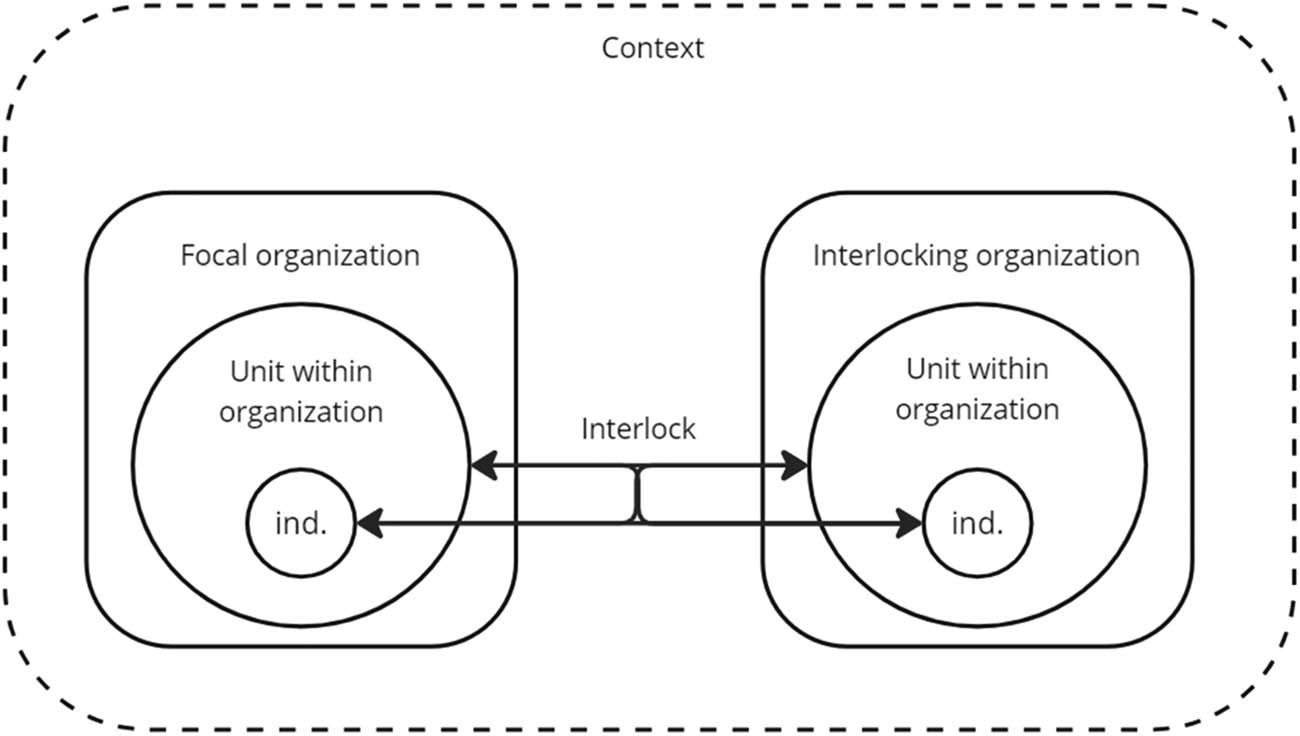
Figure 1
Boundary specification of the term “interlock”.
Source: Author’s contribution.
Thus, the great variation in the first three levels of boundary conditions for the concept of interlocking directorates is not merely conceptual but has important theoretical and empirical implications for how to understand power dynamics and causal mechanisms: interlocks such as directional CEO interlock from firm A to firm B or non-executive ties between a bank and a lending firm may reflect a resource dependence-based mechanisms of monitoring and control (Mizruchi, 1996), yet non-executive tie between firms A and firm/organization B may reflect a mechanisms of either information diffusion (Davis, 1991) or elite cohesion (Useem, 1984).
2.3. Contextual variations altering the role of interlocking directorates
Scholars studying interlocks in contexts other than the Anglo-Saxon highlight how the literature on interlocking directorates has developed in the Anglo-Saxon world and that theory and empirical evidence from this setting may not be sufficient to describe emerging markets with different institutional settings and different firm structures than in the Anglo-Saxon setting (e.g., Cárdenas, 2012; Caiazza et al., 2019; Scott, 1991; Watkins-Fassler et al., 2023). Interlock theories and boundary conditions, therefore, cannot be defined without considering the context, as also highlighted in Figure 1.
Agent-principal theories of interlocks, such as Berle and Means’ (1932) attention to how the separation of ownership and control generates agency problems, may be descriptive of governance structures in the common law governance system of the Anglo-American world. But the dispersion of ownership and control is less common globally (La Porta et al., 1999). The civic law governance system of Continental Europe, East Asia, and Latin America stresses the concentration of ownership in fewer hands through state-owned enterprises, family ownership, or large business groups, such as the Korean chaebol, Chinese qiye jituan, or Japanese keiretsu. Interlocks among business groups or family firms can be argued to create structures of information flow and resource allocation that are opportune to the listed firm in accordance with resource dependence theory. Yet ownership concentration has been highlighted as structurally enabling other forms of agency conflict, such as conflicts among principals. In cases of ownership concentration, interlocks might favor the majority shareholders or the family if they are used as an instrument to establish control not over a single firm but over a business empire (Caiazza et al., 2019; Cao et al., 2022; Young et al., 2008). Specifically, when studying family firms, the perspective of the agency of the individuals and the family becomes central, as the interest of the family may not be solely economic performance, but could extend to other agendas, such as career opportunities of succeeding generations (e.g., Caiazza et al., 2023; Yoshikawa et al., 2014; Watkins-Fassler et al., 2023). Additionally, the relevance of the busyness theory across ownership variations can be questioned, as an open question is whether holding multiple positions within the same business group can be understood as equivalent to holding multiple positions across firms.
Scholars of emerging economies have argued that interlocks with political agents can play a significant role for corporations in this context specifically, following the claim that interlocks substitute formal institutions and information channels in settings in which institutions are weaker and environmental uncertainty is higher (Chen et al., 2023; Dieleman & Boddewyn, 2011; Keister, 1998; Li et al., 2013; Peng, 2003; Shaw et al., 2016), and especially research on interlocks in Asia tends to highlight the importance of the state (Caiazza et al., 2019; Chen et al., 2023; Carney et al., 2020; Scott, 1991). Yet, political interlocks are not solely viewed as beneficial in emerging economies; they can also pose reputational risks for firms seeking to collaborate with international companies (e.g., Dieleman & Boddewyn, 2011). As interlocks between corporations and political bodies differ across national political systems, organizations of interest groups, and political economies (Hillman et al., 2004), an important task for interlocks research will be to address the consequences of interlocks across varieties of capitalism (Hall & Soskice, 2001).
Financial interlocks have often been formulated either as part of the resource dependence theory or as descriptions of the central organizations in the business network. Banks have historically been central to the US corporate network, but lost their integrative role during the nineteenth century (Davis & Mizruchi, 1999), leading Mizruchi (2013) to argue that the US corporate network consequently lost its political unity. Scholars studying transnational interlocks, however, argue that a rise in transnational interlocks has developed alongside the decline of national interlocks (Carroll & Fennema, 2002; Heemskerk et al., 2016), and that other types of interlocks, such as international or non-financial interlocks, could take up the integrating role originally played by bank interlocks (Murray, 2017). The effect of interlocks will thus depend on the historically contingent role of the organization in the broader institutional ecology, in this case, the integrating role of banks, and whether structurally equivalent types of interlocks emerge across time. Financial institutions might moreover not perform the same role across national contexts. Banks have, for example, not played the same integrating role in other national contexts such as Scandinavian countries like Denmark or Norway (Grønmo & Løyning, 2003; Larsen & Ellersgaard, 2018), and while bank interlocks have been shown to occur when firms are in financial difficulties in contexts like US or Japan (Kaplan & Minton, 1994; Mizruchi, 1996), this is not the case in other contexts, such as China (Keister, 1998). The role of interlocks is thus contingent upon national variations in interlock structures, different systems of corporate law (David & Westerhuis, 2014), and organizational-level contextual information, such as the economic performance of the firm receiving a financial interlock.
The relevance of specific theories and types of interlocks, as well as the expectations for outcome measures, will thus depend on the context, including ownership and governance structures, the political economy, and historical variations. Several further examples of how interlocks are contextually contingent exist, but the examples are sufficient to show how both micro, meso, and macro-level contextual information alter the role of interlocks, and an open question is thus whether consensus on the effects of corporate interlocks is a reasonable research objective across institutional settings (Mizruchi & Galeskiewicz, 1993).
3. Data and methods
3.1. Analytical approach
Due to the great variation in theoretical conceptualizations, possible boundary specifications, and contextual settings of interlock research, the analytical aim of this review is to clarify the construct (Krause et al., 2022; Post et al., 2020) of the concept of interlocking directorates by focusing on its empirical operationalizations in empirical research on the effect of interlocks. The identification of potential gaps in consistency between theory and operationalizations is key before aggregating and comparing results – especially as fields evolve and adapt to cover new fields of which the theory was not originally proposed (Post et al., 2020; Suddaby, 2010). A meta-analysis of potentially incomparable phenomena would not be fruitful1.
To clarify the construct of interlocking directorates in the sampled papers, the articles were coded with the main aim of identifying the (1) main theoretical foundation and conceptualization, (2) empirical context (country and sample restrictions), (3) empirical boundary specification, and (4) operationalization. Systematically coding the research articles based on objective categories, rather than interpretation, thus reduces coding errors (Simsek et al., 2023).
3.2. Data
To ensure transparency in the sample selection process, a systematic review was conducted (Simsek et al., 2023) following Hiebl’s (2023) three-step approach to sample selection criteria. This section, therefore, will first present the inclusion and exclusion criteria for the identification of potentially relevant articles, second, present the screening criteria for relevant research items, and third, disclose the final review sample.
3.2.1. Search inclusion criteria
This review used a database-driven search approach (Hiebl, 2023), restricting the search to academic journal papers retrieved from the three online databases Scopus, Web of Science, and EBSCO. This approach has been chosen over other approaches, such as the journal-driven approach, as scholars examining corporate networks span multiple research fields and thus publish in different journals. A journal-driven approach would thus not have provided a sufficiently large sample for a review.
The focus of the search is to identify papers that investigate the effects of interlocks. In accordance with similar systematic reviews (e.g., Lamb & Roundy, 2016), the search terms were first restricted to “interlock*.” While a limitation of this narrow search strategy is that it may overlook studies using adjacent terms to examine the same phenomenon, its advantage lies in maintaining a clear conceptual focus on interlocks and avoiding conflation with related but distinct constructs, in line with the article’s aim to clarify this specific concept of interlocking directorates.
As interlock studies are a mature field spanning multiple theories, a diverse range of outcome measures has been tested in relation to interlocks, and a significant increase in new outcome measures, such as social responsibility and gender diversity, has been identified in recent research (Ramsawak et al., 2024). To maintain a clear focus and restrict the sample, this review focuses on two central effects expected from theories of interlocking directorates: firm performance and political cohesion. Outcome measures on firm performance were identified by searching for the terms “performance,” “profit*,” “sales,” “declin*,” and “firm value” and a focus on outcome measures related to political cohesion by searching for the terms “political action,” “political cohesion,” “political consensus,” “political unity,” “collective action,” “policy-planning,” “donation*,” “lobby*,” “campaign,” “political action committee,” and “class-wide unity,” in the paper title, abstract, and keywords when possible. Searches were moreover restricted to themes within the social sciences published by 01.08.2023.2 Based on these search inclusion criteria, the search identified 1,310 unique papers for screening.
3.2.2. Paper screening criteria
Papers must be empirical investigations into the relationship between interlocking directorates and firm performance or political cohesion to be included in the final sample. The boundary condition for the focal organization has been defined as firms, while the boundary condition for the interlocking organization remains open, cf. Figure 1. The term interlock must be used in the study as either a theoretical concept or an operationalized concept (i.e., a variable). Only published peer-reviewed articles have been included, thus excluding reviews and meta-analyses from the sample. Further, only English-language articles have been included.
3.2.3. Disclosure of sample
The process of identifying the papers to include in the sample is displayed in Figure 2 in a Preferred Reporting Items for Systematic Reviews and Meta-Analyses (PRISMA) diagram (Liberati et al., 2009). 150 articles were found relevant for inclusion, yet 146 papers were retrievable and included in the review, thus resulting in a sample size slightly bigger than the average sample size of systematic reviews in management research (Hiebl, 2021).
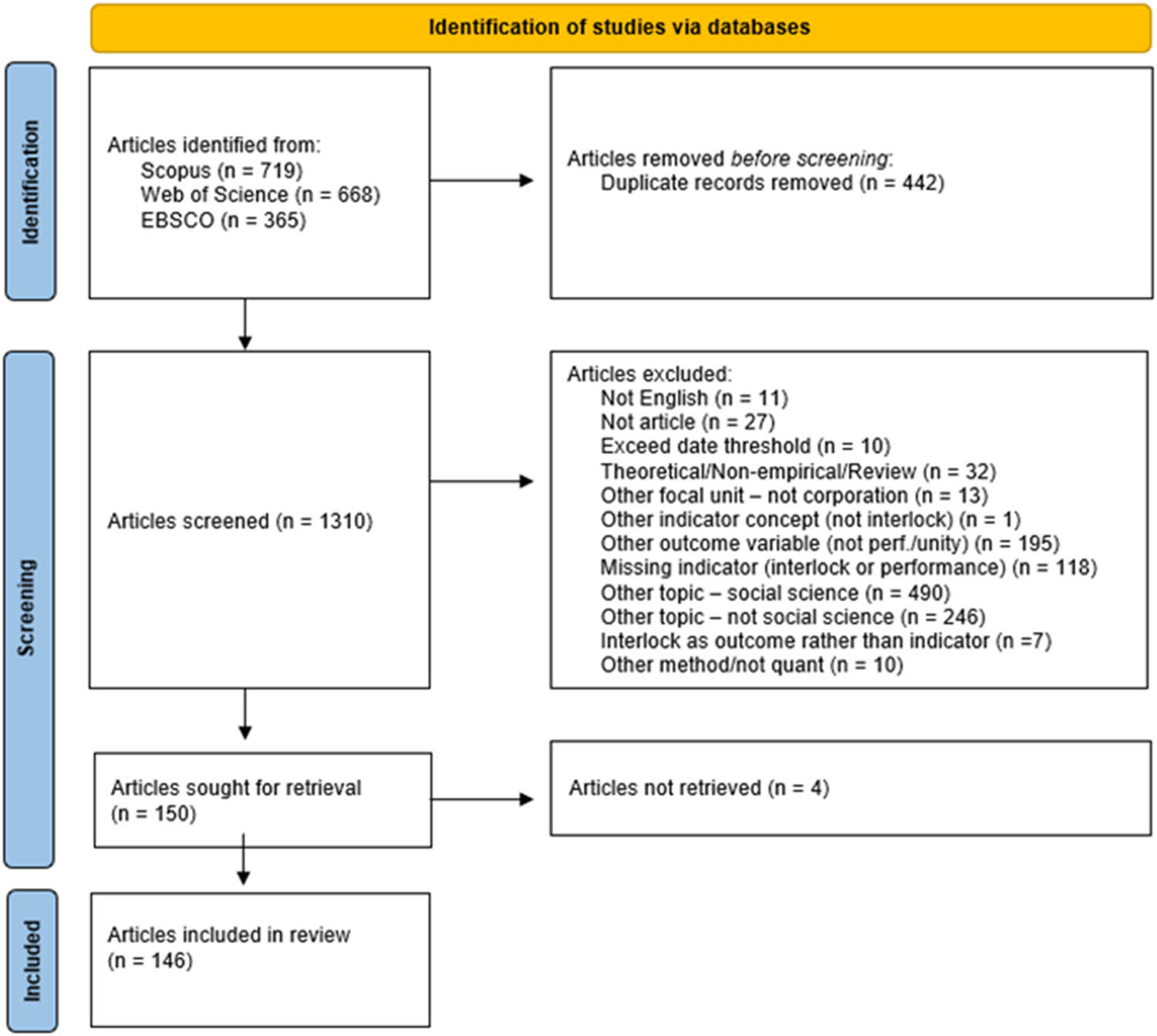
Figure 2
PRISMA diagram.
Source: Author’s own analysis and data. Figure adapted from the PRISMA 2020 flow diagram template (Page et al., 2021), licensed under CC BY 4.0.
Figure 3 displays the time of publication of the sample of article items. A peak in yearly included articles is seen from 2010 onwards, indicating a current resurgence of papers studying how interlocks affect economic performance, potentially driven by both the recent availability of online resources and a shift in research interest driven by management research interested in firm performance outcomes (Heemskerk et al., 2018; Ramsawak et al., 2024).
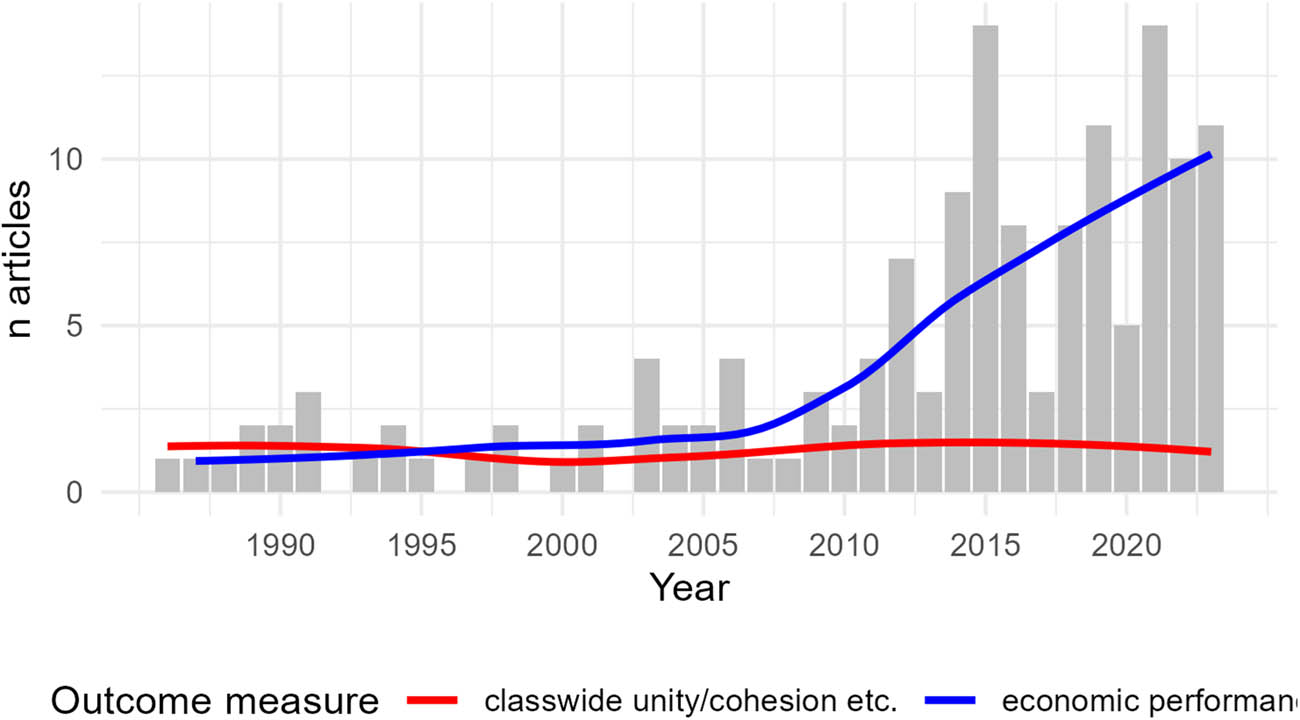
Figure 3
“Articles in sample per year.”
Source: Author’s contribution.
4. Findings
4.1. Conceptualization – what are the most common theoretical foundations?
It was assessed how the concept of interlocking directorates in the sampled papers is situated within theory. A paper was coded as applying a main theoretical framework if the paper either directly states to use a specific theoretical perspective, formulates hypotheses in relation to a specific theory, or if one or more theories appear dominant in the paper. The mere mentioning of various theories, or single references to central theoretical papers, does therefore not in itself qualify a theory to be coded as a main theory of a paper.
While some studies do not explicitly refer to any theoretical traditions, other studies seek to test one or more theoretical assumptions. Thus, 68 (47%) papers frame the study in relation to one main theory, 61 (42%) use two or more main theories, and 18 (12%) do not incorporate any theory of interlocks.
The most common theoretical frameworks are shown in Table 2. As expected, papers studying cohesion as an outcome measure predominantly use class cohesion theory as a framework. Of the 24 papers applying the hegemony perspective in combination with cohesion measures as outcomes, 19 studied the US context, thereby cementing the US dominance in empirical tests of the class cohesion framework.
Table 2
Main theoretical frameworks of the sampled papers.
| Economic outcome | Cohesion as outcome | Total | ||||
|---|---|---|---|---|---|---|
| n | % | n | % | n | % | |
| Agency theory | 35 | 30 | 1 | 4 | 36 | 25 |
| Resource dependence theory | 48 | 41 | 3 | 11 | 51 | 35 |
| Social network analysis | 16 | 14 | 0 | 0 | 16 | 11 |
| Hegemony | 4 | 3 | 24 | 86 | 28 | 19 |
| Other | 15 | 13 | 7 | 25 | 22 | 15 |
| None | 16 | 14 | 1 | 4 | 17 | 12 |
| N Papers | 118 | 100 | 28 | 100 | 146 | 100 |
Source: Author’s contribution.
As is foreseeable, there is greater variation in the theoretical frameworks used to study the economic outcomes of interlocks. When studying economic outcomes of interlocks, resource dependence theory has, however, been the most common framework applied by 48 or 41% of the sampled papers using economic outcome measures. The related perspectives of legitimacy and bank control have been coded as separate theories, but, when clustered with resource dependence theory, these perspectives would together be represented in 62 papers, or 53% of the sampled papers. The second-most frequent theory is agency theory, with 30% of the sampled papers relying on it. These findings align with previous reviews that highlight these theories, amongst others, as central perspectives (Dalton et al., 1998; Johnson et al., 1996; Lamb & Roundy, 2016; Smith & Sarabi, 2021). Yet not highlighted as a central theory in earlier reviews of interlocks, the social network perspective has emerged in empirical research from 2010 onwards and is applied by 16 or 14% of the sampled papers using economic outcome measures.
4.2. Boundary specification – what constitutes an interlock?
The analysis of the empirical boundary specifications of the term interlock has been conducted according to three levels of variations: (1) at the organizational level, (2) at the level of the unit within the organization, and (3) at the individual level, for both the focal and interlocked firm, of the term interlock as outlined in Section 2.1. The boundary conditions defined in the articles are presented in Table 3.
Table 3
Operationalizations of interlocks grouped by boundary conditions.
| Operationalization: What constitutes the interlock? | N | Pct. |
| Interlocking organization | ||
| Not clearly specified (but probably firms) | 22 | 15% |
| Firm | 108 | 74% |
| (Firm) + Political Party/ Government/Organization | 16 | 11% |
| Unit within the focal firm | ||
| Not specified/Ambiguous (often “directors”) | 29 | 20% |
| Board | 96 | 66% |
| Board + Executive(s) | 8 | 5% |
| Management/Executive(s) | 10 | 7% |
| Committee | 3 | 2% |
| Unit within the interlocking organization | ||
| Not specified/Ambiguous (often “directors”) | 63 | 43% |
| Board | 64 | 43% |
| Board + Executive(s) | 7 | 5% |
| Management/Executives | 4 | 3% |
| Committee | 3 | 2% |
| Other (position, auditors, etc.) | 5 | 3% |
| Individuals within the focal firm | ||
| Links from one single individual (CEO, Board chair) | 9 | 8% |
| Individuals added to the sampled individuals (adding the CEO, siblings, etc.) | 7 | 6% |
| Individual traits used to restrict individuals in the sample (independent board members, female-only) | 10 | 8% |
| Individuals within the interlocking organization | ||
| Specific individual (CEO, Board Chair, Proprietary director) | 3 | 3% |
| Individuals added to the sampled individuals (CEO) | 6 | 5% |
| Individual traits used to restrict individuals in the sample (independent board members, family relations with the focal firm) | 5 | 4% |
Source: Author’s contribution.
4.2.1. Organizational boundary specification
The focal organization was predefined during the sample screening process, but the interlocking organization was not. It is first noteworthy that 15% of the papers do not explicitly specify whether the interlocking organizations are firms, interest organizations, etc. Yet, all papers that do not explicitly specify this boundary condition nonetheless seem to implicitly inspect interlocks among firms only. While 74% of the papers in the sample define the interlocking organization as a firm, this proportion would rise to 89% if only papers that implicitly examine interlocks among firms were included. Only 11% of the papers in the sample include interlocks with organizations other than firms, such as political parties, government institutions, the military, trade unions, and interest groups.
4.2.2. Boundary specification of the unit within the organization
The units within the focal and interlocking firms are commonly specified as the board of directors. The board of directors (sometimes in combination with other units or individuals) is thus defined as the boundary condition for the unit within the focal firm and interlocking firm in 66% and 44% of the sampled papers, respectively.
A concern is again that 20% of the papers did not specify the unit within the focal firm, and 43% did not clearly specify the unit within the interlocking firm. Grouped, 46%, that is almost half of the articles in the sample, did not specify the unit of analysis in either the focal or interlocking firm. This lack of specification is often due to the unit of analysis being denoted as the “directors” or the “directorate,” but this concept is ambiguous as it can refer to both the board of directors and also managers, such as the CEO. This inadequate specification of the units of analysis raises validity problems and questions scientific ideals such as transparency and replicability. Second, the inadequate specification is theoretically problematic, as agency theory stresses a potential conflict of interest between managers and board members, and it holds different expectations for the interlocks of board members vs management team members.
4.2.3. Boundary specification of individuals
Few papers mention specific individuals or individual traits in their boundary specification, but given that a paper specifies the boundary at the unit level, such an absence of discussion of individual traits is not considered problematic. Generally, very few studies in the sample focus on interlocks involving a single specific individual, such as the CEO or board chair, although few papers test concepts such as “CEO reciprocal interlock.” The specification of individuals is more often used to identify a subunit within the sample, such as independent board members or female-only board members, or to add further individuals of interest to the analysis, most often the CEO.
4.3. Operationalizations – how are interlocks measured?
The most common empirical operationalizations of interlocks are displayed in Table 4. Dummy measures of interlocks are used by 39 papers (27%) in the sample. Papers using dummy variables are theoretically heterogeneous, as the dummy variables are used to refer to anything from a company having at least one shared board member with another company to more specific types of interlocks, such as CEO reciprocal interlocks or political ties. Formulating general expectations for this dummy measure, without elaborating on the boundary specification of the dummy measure, is thus difficult.
Table 4
Operationalizations of interlocks grouped by type of empirical measure.
| Operationalizations – which measure?* | N | Pct. |
|---|---|---|
| Focal firm: Dummy measures | ||
| Interlock dummy (specific individual) | 10 | 7% |
| Interlock dummy (org. level) | 33 | 23% |
| Total papers using dummy measures | 39 | 27% |
| Focal firm: Individual-level count and busy measures | ||
| N connections (degree) at the individual-level (squared and average measures included) | 19 | 13% |
| Busy director threshold | 12 | 8% |
| Total papers using individual-level count and busy measures | 32 | 22% |
| Focal firm: Firm-level count measures | ||
| N connections (degree) at the firm/unit level (squared and weighted measures included) | 61 | 42% |
| Percentage of unit interlocked | 10 | 7% |
| Total papers using focal firm organizational level count measures | 71 | 49% |
| Interlocking firm: Contextual measures | ||
| Interlock with non-firm: political/governmental/trade association ties | 11 | 8% |
| Inter-/Intra-industry interlocks | 12 | 8% |
| Performance of an interlocked firm (profitability, penalized firm, etc.) | 7 | 5% |
| Interlock with a bank/financial institution | 11 | 8% |
| “Vertical interlock”/business group interlock | 7 | 5% |
| Total papers using contextual measures on interlocked organization | 45 | 31% |
| Network measures** | ||
| Structural hole: Betweenness, Burt’s constraint | 17 | 12% |
| Well-connected neighbors: Eigenvector centrality, Bonacich Power | 16 | 11% |
| Global network measures: Closeness, clustering coefficient, cliques, K-core | 12 | 8% |
| Total papers deploying network measures | 28 | 19% |
*As papers often have more than one operationalization and thus measures of interlocks, the counts of operationalizations do not summarize the total number of papers included.
**Although many papers conceptualize the number of connections of the focal firm in network terms as degree centrality, degree centrality is not grouped under network operationalizations but instead grouped under count operationalizations.
Source: Author’s contribution.
Thirty-two (22%) papers in the sample use individual-level count measures of interlocks, such as the average number of interlocks per individual, the total number of interlocks held by all individuals, or a threshold for classifying an individual as busy. Papers deploying individual-level measures are generally coherent in their focus on agency theory and the busy-board hypothesis, which is operationalized at the individual level, although there is no agreement on how to empirically test the subtheme of busy boards.
Focal firm-level count measures are the most common operationalization of interlocks, used by 71 (49%) papers in the sample. The most common count measure is various firm-level degree measures, that is, simple counts of the number of connections a firm has to other unique organizations, which is applied by 61 (42%) papers. Often, taking a theoretical offspring in resource dependence theory (as well as social capital theory or social network theory), many papers using firm-level count measures expect the firm-level degree to positively influence firm performance. However, firm-level count measures such as the (squared) number of interlocks are also sometimes conceptualized in relation to the busyness hypothesis. The concept of interlock is thus operationalized as a firm-level degree in empirical research, framed by agency theory, resource dependence theory, and social network theory, regardless of the theories' divergent focus on the level of analysis or the expected outcome.
Finally, a heterogeneous set of operationalizations considers contextual information, most often about the interlocked organization. Twenty-eight (19%) papers in the sample deploy network measures as operationalizations of interlocks, considering the relational positioning as an important context. Resource dependence theory, class hegemony theory, and social capital theory highlight the importance of investigating a firm’s relational position or embeddedness within a field. Moreover, a diverse range of contextual measures, considering traits of the focal or interlocked firm, comprises 44 papers (30%) of the sample. As some of these measures take the contextual setting into account, they will be unfolded in Section 4.4 on how the contextual setting shapes the study of interlocks.
4.4. Contextual setting – where are interlocks studied?
Variations in (inter)national cases in the sampled papers are visualized in Figure 4 and summarized by region in Table 5. Most papers in the sample studied singular national contexts, as is typical for interlock studies. Anglo-American, notably American, research has long been highlighted as dominating the field of interlock studies (Scott, 1991; Smith & Sarabi, 2021) – a trend that is reflected in the sampled papers, as 32% of the papers solely study the context of the USA. The field thus still lacks a balanced global outlook.
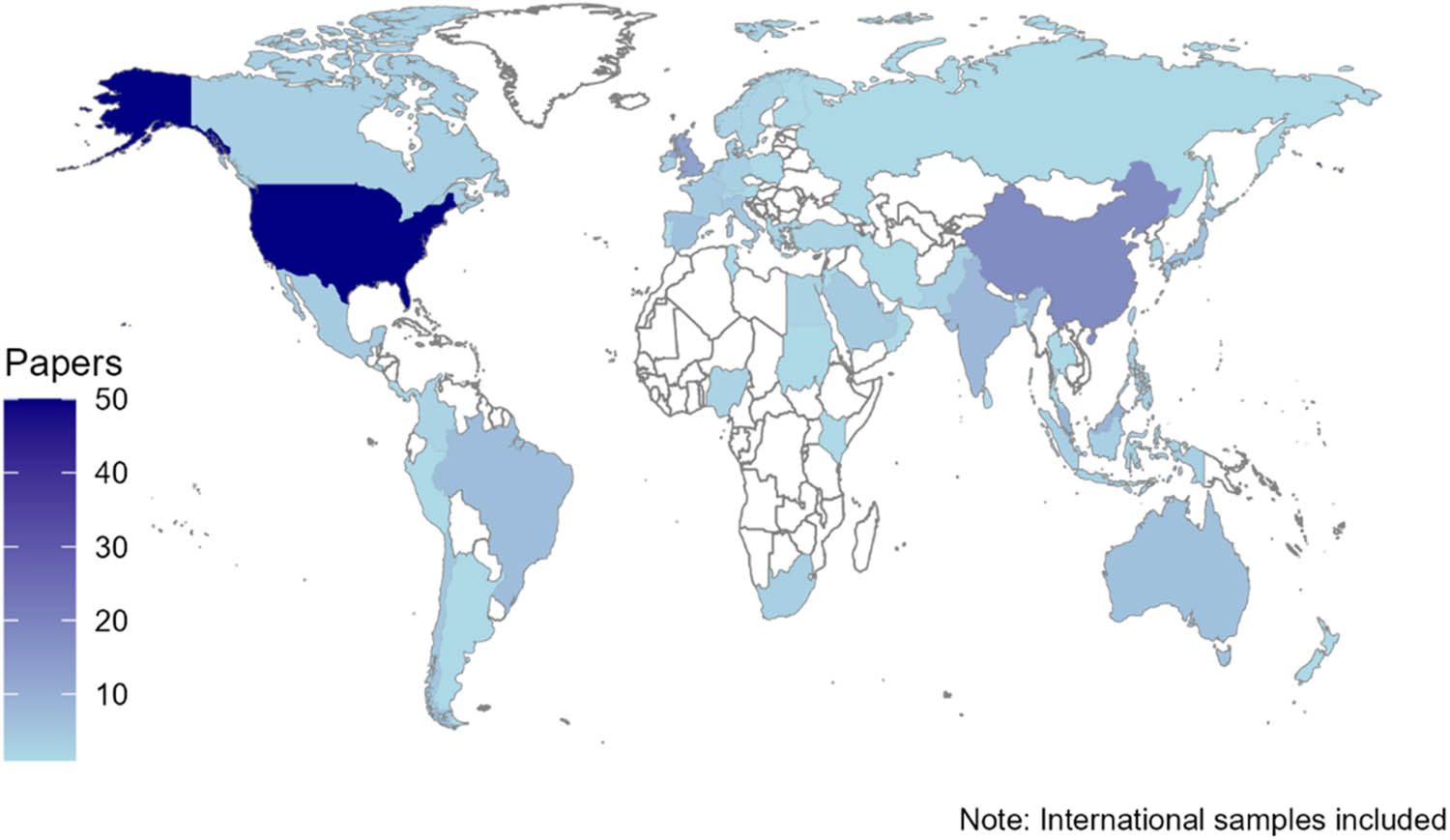
Figure 4
“Articles in sample per country”.
Source: Author’s contribution.
Table 5
“Articles per region.”
| Region | N | Percent |
|---|---|---|
| Africa | 1 | 1% |
| Anglo-Saxon* | 64 | 44% |
| Asia** | 40 | 27% |
| Europe | 18 | 12% |
| Middle East | 2 | 1% |
| South America | 14 | 10% |
| Trans-national | 7 | 5% |
| Total | 146 | 100% |
*of which 46 papers study the USA (accounting for 32% of the total sample).
**of which 15 papers study China (accounting for 12% of the total sample).
Source: Author’s contribution.
Despite the more recent focus on the globalization of corporate networks (David & Westerhuis, 2014; Sapinski & Carroll, 2018), comparative research designs and transnational interlocks were thus largely absent from the sample. Only eight papers studied interlocks across multiple countries, of which seven applied a transnational design spanning regions.
Nonetheless, an increasing number of papers examine other contexts than the USA. 27% of the papers study interlocks in Asian countries, with China emerging as a frequent national case accounting for 12% of the sampled papers. This trend is particularly pronounced in papers studying the effect of interlocks on financial performance, while the literature on class cohesion is heavily US-centric. As the sampled papers are heavily skewed toward studies of the Anglo-Saxon context, general patterns in the use of theory or operationalization across regions could not be identified.3 Yet emerging themes show that diverse national cases may have implications for how interlocks are studied.
Thus, despite interlocks with a diverse range of organizations being central to class hegemony theory, only 7 of 28 papers (25%) that apply class hegemony theory include non-corporate ties in their boundary specification. However, papers that investigate political or government ties most often examine the context of authoritarian regimes like Russia or China, or emerging markets, while only one such paper examines the US context. The reasoning behind empirically testing the effects of interlocks on organizations or political ties thus seems motivated not solely by the interlock literature but also by contextual specificities, such as the political economy of the national context.
An emerging theme in non-US research is ownership and civil law governance structures. As evident from Table 5, the concept of vertical interlocks, defined as the interlocking directorate between a controlling shareholder and a subsidiary listed firm, has started to gain ground in the interlock research, now being tested as an interlock type with specific boundary conditions. Also, the theme of family firms is emerging in the sampled papers, with five specifically studying them. Yet, unlike papers studying vertical interlocks, those studying family firms do not develop specific boundary conditions for family firm interlocks; instead, they predominantly, though not exclusively, sample family firms.
5. Ensuring within-paper validity and conceptual clarity in future research
The broad definition of an interlocking directorate does not specify which traits are included or excluded, resulting in low discriminant validity (Podsakoff et al., 2016). To assist researchers in ensuring conceptual clarity and within-paper validity when conducting empirical research on interlocking directorates, this review proposes the following protocol, shown in Table 6. As discussions on best practice operationalizations of conceptual frameworks are ongoing, Table 6 should be understood as non-exhaustive. I argue that future research, rather than aiming for theoretical and conceptual homogeneity between papers, should explicate theoretical heterogeneity and elaborate on distinguishable concepts. The protocol, therefore, suggests that theoretical (sub)constructs, such as busy directors or the inner circle, will be essential when specifying the empirical interlock measures, as they exhibit higher discriminant validity.
Table 6
Roadmap for enhancing construct clarity in empirical measures of interlocks.
| Theoretical framework | Theoretical (sub)construct | Boundary specification | Empirical measures |
|---|---|---|---|
| Agency theory | Busy directors | All simultaneous positions of board members across sectors | Individual-level measures:
|
| Busy boards | All simultaneous positions of board members across sectors | Board-level measure:
| |
| Board independence | Within-company mapping of managers on the board |
| |
| Vertical interlocks | Board and/or management interlocks between a controlling shareholder and a subsidiary listed firm |
| |
| Family/kinship interlock | Board and/or management interlocks between firms in a family business group | ||
| Resource dependence theory | Cooptation | Board and/or management interlocks with organizations of choice. The relevance of an interlocking organization (firm, financial institution, state agency, etc.) will depend on the case |
|
Monitoring
| Focal firm receiving a manager from x organizations of interest on the board. A focal firm receiving a manager from a financial organization (often as a lending financial institution) to its board | Interlocks with specific monitoring organizations measured as a dummy variable, such as:
| |
| Social network theory | Centrality | Boundary specification will depend on the case and research interest |
|
| Structural hole |
| ||
| Well-connected neighbors |
| ||
| Bipartite interlock network |
| ||
| Class hegemony theory | “Power elite” interlocks | Managers’ and board members’ positions in organizations across sectors (firms, government bodies, trade organizations, etc.) |
|
| “Inner circle” interlocks | Managers’ and board members’ positions in companies |
| |
| Transnational interlocks (transnational capitalist class) | Managers’ and board members’ positions in international organizations across sectors |
|
Source: Author’s contribution.
Future research addressing what interlocks do, especially outside the US context, is still much warranted. If economic actors are to be understood as both culturally and historically embedded within social relations (Granovetter, 1985), research should not expect context and time-invariant generalizations about the effects of corporate interlocking directorates (Scott, 1991). An important task for future research is to investigate how contextual variations alter the role of interlocking directorates if the consequences of interlocks are to be understood from a transnational perspective. To study such variations, alongside ensuring within-paper validity and conceptual clarity, theory building and the development of further subconstructs will be essential tasks. For example, while the subconstruct of vertical interlocks is emerging in the literature, other subconstructs, such as family or kinship ties, are a much-overlooked theme, given that family firms are the most common type of enterprise globally (Algthami & Hussin, 2021; Caiazza et al., 2019), and as family firms tend to form more national and international interlocks (Rivas et al., 2023).
While many of the boundary conditions and operationalizations in Table 6 will be familiar to the current practice, other combinations will be new to some fields. For example, relatively few papers in the sample investigated ties to noncorporate organizations, which was not surprising given that fewer papers applied the class hegemony framework. However, as non-corporate ties are potential channels of information, and an individual's busyness is affected by positions in organizations, state agencies, etc., Table 6 suggests that non-corporate ties are equally important to consider from the perspectives of agency theory, resource dependence theory, and social network theory.
The analysis showed that count measures at both the organizational and individual levels were the most common operationalizations of the term interlock. As the busyness hypothesis expects that all additional ties impose an extra workload on individuals and that this extra workload is essentially negative, individual-level count measures are consistent with agency theory’s focus on busy directors. Individual-level count measures might nonetheless not be well-suited for testing other frameworks. Although Useem (1984) originally identified inner circle members based on the count measure of individuals having two or more boards of large corporations, scholars have recently challenged such count measures, arguing that sophisticated network clustering measures better capture the central agents, thus the “inner circle,” whereas count measures potentially reflect ties within conglomerates (Larsen & Ellersgaard, 2018). Resource dependence theory assumes interlocks, at its weakest, to provide a potential for positive outcomes (Scott, 1991; Heemskerk et al., 2018), but stripped of contextual information on the interlocked organization, it is not sound to assume that all ties provide equally beneficial information to the firm (e.g., Koskinen & Edling, 2012; Raddant & Takahashi, 2022). The significance and relevance of a potential interlock must be considered in future research to establish theoretical and operational distinctions and test potential trade-offs, such as whether the positive effects of access to valuable information, cf. resource dependence theory, could be outweighed by the negative effects of an individual being too busy, cf. agency theory.
Network constructs can be understood as a variation of the heterogeneous group of contextual measures insofar as they take network relational aspects into account (Sapinski & Carroll, 2018). Network measures can bridge the gap between micro, meso, macro levels of analysis (Breiger, 1974; Granovetter, 1985) by both measuring the positional advantages of the focal firm, like being in a structural hole position, contextually informed measure related to the interlocked organization, like the relative influence of having well-connected neighbors, and macro measures of a firm’s position within an overall network, like core or clustering measures. Yet, network measures also face contextual challenges. Network measures are sensitive to the network’s boundary specification and to missing data. The omission of relevant organizations or interlocks among them can alter the analysis, potentially leading to a fundamental misrepresentation (Huijzer & Heemskerk, 2021; Laumann et al., 1983). Moreover, network measures generally assume that all potential links are equally beneficial to each network member and that resources and information are distributed equally among them (Afuah, 2013; Urry, 2004). The assumptions of network homogeneity can thus be criticized for lacking contextual information about the attributes of network members and the quality of connections among them. Most empirical network studies tend to reduce bipartite networks of organizations and persons to their one-mode projections of either individuals or organizations, leading not only to a loss of information but also to empirical biases such as inflated connectivity and theoretical biases like overemphasizing either individuals or organizations when explaining tie formation (Burris, 2001; Burris, 2005; Koskinen & Edling, 2012; Valeeva et al., 2020). The biases arising from failing to account for the dual focus on both persons and groups should be recognized as an important issue for future interlock scholars, regardless of the theoretical lens.
Contextually informed measures are advantageous because they neither assume that all potential links equally benefit the focal firm nor that resources and information are equally distributed. Measures that include contextual information about the focal or interlocked organization can thus avoid the dichotomy of expecting either positive or negative outcomes from interlocks (Burt, 1978; Connelly & Van Slyke, 2012). Yet, measures incorporating contextual information about the focal firm were rarely used in the sampled papers. Future studies would benefit from contextual measures that allow comparisons of the differential effects of interlocks across the traits of both the focal and the interlocking organizations.
While several studies use historical datasets and panel data analysis, interlocks are most often studied as historical snapshots, while longitudinal network measures are rarely considered, thereby constituting a central knowledge gap. Although not highlighted in Table 6 (as such dynamics are important to investigate regardless of theoretical lens), future interlocks studies would benefit from studying and theorizing on the contextual effect of long-term vs short-term embeddedness, as well as focusing on the dynamics of the formation of interlocking directorates and firm outcomes as a coevolving process (Koskinen & Edling, 2012; Valeeva et al., 2020).
6. Conclusion
Interlocking directorates have long been studied across theoretical disciplines. The various theories conceptualizing interlocks highlight different traits of interlocks, leading to an eclectic use of theories, boundary conditions, and the lack of clear boundary specification in the broad definition of an interlocking directorate results in low discriminant validity of the concept.
Based on a systematic review of 146 articles’ operationalizations of the concept of interlocking directorates, I find that empirical research on interlocking directorates displays a discernible lack of within-paper validity and operational consistency. Empirical research on interlocking directorates thereby lacks comparability, as the papers, rather than testing one phenomenon, test different aspects of the same phenomenon when investigating interlocks. As theories on interlocking directorates are not mutually exclusive, this article argues that variations in measurement are not problematic, yet alignment between the theories and operational measures is key for future research.
Lack of comparability is different from conflicting results on the effect of interlocks. An open question is therefore whether the mixed effects observed in interlock studies could partly be due to differences in the theoretical foundations, operationalizations, and institutional settings of the papers. Thus, before answering the question “what do interlocks do?” researchers should consider the correspondence between theory, context, and empirical measurement of interlocks. To this end, this paper outlines a roadmap for future research, advocating that instead of pursuing theoretical and conceptual uniformity, researchers should emphasize heterogeneity and refine distinct sub-concepts to advance empirical knowledge. Further, with interlock studies expanding to diverse national settings, a central task for future research will be to move theory forward by accounting for contextual variation and building more nuanced, contextually grounded constructs and measures that enhance within-paper validity across global cases.
Acknowledgements
I would like to thank Christoph Ellersgaard and Marte Lund Saga for their constructive comments on earlier drafts of this manuscript and Sven Kunisch for his introduction to systematic literature reviews.
Funding information
As part of the “Consequences of Long-term Organizational Embeddedness” (CLONE) research project, this work was supported by the Velux Foundation (grant No. 301436).
Author contributions
The author Majsa Grosen was solely responsible for all aspects of the manuscript, including its conception, design, analysis, and writing.
Conflict of interest statement
The author has no known competing financial interests or personal relationships that could have appeared to influence the work reported in this manuscript and has thus no conflict of interest to disclose.
Data availability statement
The data underlying this article are available from the corresponding author, Majsa Stina Grosen, upon request.
Appendices
Appendix
Appendix A: Search inclusion criteria
To obtain a reasonable number of papers for the abstract screening process, searches were restricted to themes within social science, broadly understood. The search restriction criteria provided by the three online platforms Scopus, Web of Science, and EBSCO were not identical, which led to variations in the search criteria among the three platforms. Only Scopus’ and Web of Science’s platforms provided the opportunity to search for subject areas of the journal, and Scopus’ and Web of Science’s journal subject areas are not identical.
Thus, on Scopus, the searches were restricted to 3 out of 28 categories: “Social Sciences,” “Business, Management and Accounting,” and “Economics, Econometrics and Finance.”
On Web of Science, the searches were restricted to the subjects 29 out of the 254 categories, namely, “Anthropology,” “Area Studies,” “Asian Studies,” “Behavioral Sciences,” “Business,” “Business, Finance,” “Demography,” “Development Studies,” “Economics,” “Family Studies,” “Geography,” “History,” “History & Philosophy of Science,” “History of Social Sciences,” “Humanities, Multidisciplinary,” “International Relations,” “Management,” “Mathematics, Interdisciplinary Applications,” “Multidisciplinary Sciences,” “Political Science,” “Psychology,” “Psychology, Social,” “Public Administration,” “Regional & Urban Planning,” “Social Issues,” “Social Sciences, Interdisciplinary,” “Social Sciences, Mathematical Methods,” “Social Work,” and “Sociology.”
Because the EBSCO platform did not allow topic-specific journal searches, a broad search was initially conducted on EBSCO. It was then manually coded whether the journals of these articles belong to the social sciences to match the inclusion criteria of Scopus and Web of Science. Only papers from social science journals were then retained for abstract screening.
The search terms were restricted to “interlock*” in combination with a focus on financial outcome measures that were identified by searching for the terms “performance, “profit*,” “sales,” “declin*,” and “firm value”4 and a focus on outcome measures related to political cohesion by searching for the terms “political action,” “political cohesion,” “political consensus,” “political unity,” “collective action,” “policy-planning,” “donation*,” “lobby*,” “campaign,” “political action committee,” and “class-wide unity,” in the paper title, abstract, and keywords when possible. The addition of new terms like “death” and “turnaround” did not lead to identification of further relevant papers.
Appendix B: Bias in sample favoring newer articles
The oldest included article in the sample was published in 1986, but generally, fewer studies from the 1980s, 1990s, and 2000s are included. The fact that few studies from the 1980s and 1990s are included, although the field became established by the 1990s (Caiazza & Simoni, 2019), is partly caused by the restrictions of the search inclusion criteria excluding formats other than papers (e.g., Carrington, 1981; Meeusen & Cuyvers, 1985; Pennings, 1980), the search restriction to title, abstract, and keywords as some early articles do not contain an abstract (e.g., Baysinger & Butler, 1985), as well as the strict focus on the term “interlock,” excluding papers using related terms such as R&D networks (e.g., Powell et al., 1996), board of directors (e.g., Hillman, 2005), etc. As this study focuses on conceptually clarifying the construct of interlocks, this exclusion is however not heralded as a problem. Figure 3 can therefore be interpreted as showing an increase in empirical papers published in academic journals that use the concept of interlocks and test how such interlocks influence firm financial performance or political cohesion.
Appendix C: Regional differences
Regional differences in use of theory:
| Africa | Anglo-Saxon | Asia | Europe | Middle East | South America | Trans-regional | Total | |||||||||
|---|---|---|---|---|---|---|---|---|---|---|---|---|---|---|---|---|
| n | % | n | % | n | % | n | % | n | % | n | % | n | % | n | % | |
| Agency theory | 1 | 100 | 12 | 19 | 11 | 28 | 6 | 33 | 2 | 100 | 2 | 14 | 2 | 29 | 36 | 25 |
| Resource dependence theory | 0 | 0 | 18 | 28 | 19 | 48 | 8 | 44 | 2 | 100 | 3 | 21 | 1 | 14 | 51 | 35 |
| Social network analysis | 0 | 0 | 5 | 8 | 8 | 20 | 1 | 6 | 0 | 0 | 1 | 7 | 1 | 14 | 16 | 11 |
| Hegemony | 0 | 0 | 22 | 34 | 2 | 5 | 0 | 0 | 0 | 0 | 2 | 14 | 2 | 29 | 28 | 19 |
| Other | 0 | 0 | 14 | 22 | 6 | 15 | 2 | 11 | 0 | 0 | 0 | 0 | 0 | 0 | 22 | 15 |
| None | 0 | 0 | 4 | 6 | 4 | 10 | 2 | 11 | 0 | 0 | 6 | 43 | 1 | 14 | 17 | 12 |
| Total | 1 | 100 | 64 | 100 | 40 | 100 | 18 | 100 | 2 | 100 | 14 | 100 | 7 | 100 | 146* | 100 |
Regional differences in operationalization measures:
| Africa | Anglo-Saxon | Asia | Europe | Middle East | South America | Trans-regional | Total | ||
|---|---|---|---|---|---|---|---|---|---|
| Focal firm | n | 0 | 16 | 13 | 2 | 1 | 5 | 2 | 39 |
| Dummy measures | % | 0% | 25% | 33% | 11% | 50% | 36% | 29% | 27% |
| Focal firm | n | 1 | 14 | 7 | 5 | 1 | 3 | 1 | 32 |
| Ind. level count | % | 100% | 22% | 18% | 28% | 50% | 21% | 14% | 22% |
| Focal firm | n | 0 | 28 | 21 | 10 | 2 | 6 | 4 | 71 |
| Firm level count | % | 0% | 44% | 53% | 56% | 100% | 43% | 57% | 49% |
| Interlocking firm | n | 0 | 24 | 11 | 4 | 0 | 2 | 4 | 45 |
| Contextual | % | 0% | 38% | 28% | 22% | 0% | 14% | 57% | 31% |
| Network | n | 0 | 9 | 10 | 2 | 0 | 6 | 1 | 28 |
| Measures | % | 0% | 14% | 25% | 11% | 0% | 43% | 14% | 19% |
| Total papers | n | 1 | 64 | 40 | 18 | 2 | 14 | 7 | 146 |
| % | 1% | 44% | 27% | 12% | 1% | 10% | 5% | 100% |
Appendix D: Variations in results based on operational differences
This review finds it relevant to consider whether the challenges in establishing a consensus on the effects of corporate interlocks could partly be due to a lack of theoretical specificity and operational consistency (Johnson et al., 2013) within the field of interlock studies. This review does not aim to perform a meta-analysis but to address this question, this section will give examples of how such consistencies initially can be identified.
Papers studying political cohesion are difficult to compare as there is a greater variation in the outcome measures. Yet operational differences among the papers studying political cohesion in the USA during the 1980 presidential election year can show how they might lead to different results. Among these studies, multiple papers show that interlocks among dyads of firms and individuals, respectively, lead to similarity in political behavior. Inspecting the variations in operationalizations of these studies, it can be observed that among dyads of firms only indirect interlocks through banks lead to similarity in contributions (Mizruchi, 1989, 1990; Mizruchi & Koenig, 1988, 1991), among dyads of individuals both direct and indirect interlocks are associated with similarity in political behavior (Burris, 2005), while interindustry interlocks, on the contrary negatively affect consensus between dyads of industries (Mizruchi, 1986). Studying the effect of interlocks during the same election, these papers demonstrate how operational differences can yield divergent results among those studying political cohesion.
The findings on the effect of interlocking directorates on firm performance are presented second, grouped by the operationalizations in Table 6. Table 6 presents no clear picture regarding the operational group and the statistical findings, but some findings are more common across certain operationalizations. Negative findings of interlocks’ effect on firm performance are most common among studies deploying individual-level count measures and busy thresholds, while positive findings are most common among studies deploying organizational-level count measures. These findings indicate that operationalizations that align with the assumptions of the busy-board thesis to a greater extent verify the negative expectations of this theory, while operationalizations that align with, e.g., the resource dependence theory to a greater extent verify the positive expectations of this theory. Findings thus seemingly vary with the type of operationalization. As Table 6 is based on a small n, the summary should, however, be understood as indicative rather than a summarizing meta-analysis.
Findings of tests of interlocking directorates’ effect on firm performance based on the groupings of operationalizations.
| Operationalization type | N | Positive findings | Negative findings | Mixed findings | Insignificant findings |
|---|---|---|---|---|---|
| Focal firm dummy measures | 28 (100%) | 6 (21%) | 7 (25%) | 8 (29%) | 7 (25%) |
| Individual-level count and busy measures | 27 (100%) | 9 (33%) | 8 (30%) | 6 (22%) | 4 (15%) |
| Organizational-level count measures | 59 (100%) | 34 (58%) | 5 (8%) | 8 (13%) | 14 (24%) |
| Network measures | 24 (100%) | 13 (54%) | 0 (0%) | 6 (25%) | 4 (17%) |
Appendix E: Theory matrix
Appendix F: Papers in the sample
Abebe, M. A., Angriawan, A., & Ruth, D. (2012). Founder-CEOs, External Board Appointments, and the Likelihood of Corporate Turnaround in Declining Firms. Journal of Leadership & Organizational Studies, 19(3), 273–283. https://doi.org/10.1177/1548051812442746.
Akram, F., & Abrar Ul Haq, M. (2022). Integrating agency and resource dependence theories to examine the impact of corporate governance and innovation on firm performance. Cogent Business & Management, 9(1), 2152538. https://doi.org/10.1080/23311975.2022.2152538.
Allen, M. P. (1991). Capitalist response to state intervention: Theories of the state and political finance in the new deal. American Sociological Review, 56(5), 679–689. https://doi.org/10.2307/2096088.
Andrikopoulos, A., Georgakopoulos, A., Merika, A., & Merikas, A. (2019). Corporate governance in the shipping industry: Board interlocks and agency conflicts. Corporate Governance: The International Journal of Business in Society, 19(4), 613–630. https://doi.org/10.1108/CG-07-2018-0224.
Banerjee, T., & Burroway, R. (2015). Business unity and anticorporate protests: The U.S. Fortune 500 in 2010*. Mobilization: An International Quarterly, 20(2), 179–206. https://doi.org/10.17813/1086-671X-20-2-179.
Banerjee, T., & Murray, J. (2015). What shapes corporate involvement in voter referendums? The case of opposition to GM food labeling. Sociological Perspectives, 58(3), 464–489. https://doi.org/10.1177/0731121414566888.
Banerjee, T., & Murray, J. (2021). Class dominance or fracturing? Sources of broad interest in lobbying by fortune 500 corporations. Sociological Perspectives, 64(2), 157–175. https://doi.org/10.1177/0731121420921883
Barroso-Castro, C., Villegas-Periñan, M. del M., & Casillas-Bueno, J. C. (2016). How boards’ internal and external social capital interact to affect firm performance. Strategic Organization, 14(1), 6–31. https://doi.org/10.1177/1476127015604799.
Benischke, M. H., Singh, R., & Bhaskarabhatla, A. (2023). The effect of incoming board interlocks with public firms on private firms’ survival: Large-scale evidence from India. Journal of Management. https://doi.org/10.25384/SAGE.c.6617600.v1.
Benton, R. A., & Cobb, J. A. (2019). Eyes on the horizon? Fragmented elites and the short-term focus of the American corporation. American Journal of Sociology, 124(6), 1631–1684. https://doi.org/10.1086/702916.
Bischoff, O., & Buchwald, A. (2018). Horizontal and Vertical firm networks, corporate performance and product market competition. Journal of Industry, Competition and Trade, 18(1), 25–45. https://doi.org/10.1007/s10842-017-0250-7.
Biswas, S. (2019). Understanding the small-world nature of board network in India. Cogent Economics & Finance, 7(1), 1710424. https://doi.org/10.1080/23322039.2019.1710424.
Blanco-Alcántara, D., Díez-Esteban, J. M., & Romero-Merino, M. E. (2018). Board networks as a source of intellectual capital for companies: Empirical evidence from a panel of Spanish firms. Management Decision, 57(10), 2653–2671. https://doi.org/10.1108/MD-12-2017-1238.
Bond, M. (2004). Social influences on corporate political donations in Britain. British Journal of Sociology, 55(1), 55–77. https://doi.org/10.1111/j.1468-4446.2004.00006.x.
Boudiab, M., Ishak, S., & Dhamari, R. A. A. A. (2022). The influence of risk management committees on the financial performance of non-financial companies in Malaysia. International Journal of Trade and Global Markets, 16(1/2/3), 47. https://doi.org/10.1504/IJTGM.2022.128119.
Braun, M., Briones, I., & Islas, G. (2019). Interlocking directorates, access to credit, and business performance in Chile during early industrialization. Journal of Business Research, 105, 381–388. https://doi.org/10.1016/j.jbusres.2017.12.052.
Brown, A. B., Dai, J., & Zur, E. (2019). Too busy or well-connected? Evidence from a Shock to multiple directorships. The Accounting Review, 94(2), 83–104. https://doi.org/10.2308/accr-52165.
Broyles, P. A. (1993). The corporate elite goes to washington: Presidential campaign contributions of corporate officers. Social Science Research, 22(1), 72–91. https://doi.org/10.1006/ssre.1993.1004.
Bugador, R. (2015). The effects of business group control advantages and affiliate level advantages on affiliate performance. Corporate Ownership and Control, 13(1), 125–135. https://doi.org/10.22495/cocv13i1p12.
Burris, V. (2001). The two faces of capital: Corporations and individual capitalists as political actors. American Sociological Review, 66(3), 361–381. https://doi.org/10.2307/3088884.
Burris, V. (2005). Interlocking directorates and political cohesion among corporate elites. American Journal of Sociology, 111(1), 249–283. https://doi.org/10.1086/428817.
Burris, Val. (1991). Director interlocks and the political behavior of corporations and corporate elites. Social Science Quarterly (University of Texas Press), 72(3), 537.
Cao, S., Fang, Z., Pu, W., & Ruan, Y.-Y. (2022). Vertical interlock and firm value: The role of corporate innovation. Emerging Markets Finance and Trade, 58(4), 1061–1077. https://doi.org/10.1080/1540496X.2021.1927699.
Cárdenas, J., & Robles-Rivera, F. (2021). Corporate networks and business influence in Panama, Costa Rica, and El Salvador. Colombia Internacional, 107, Article 107. https://doi.org/10.7440/colombiaint107.2021.04.
Chen, L. Y., & Lai, J. H. (2015). The relationship between interlocking directorate and stock market reaction to international merger and acquisition announcements: The moderating effect of cultural distance. European J. of International Management, 9(3), 342. https://doi.org/10.1504/EJIM.2015.069132.
Chen, V. Z., Hobdari, B., & Shen, C. (2023). Board social ties, institutional change asynchronicity, and performance. Industrial and Corporate Change, 32(3), 774–794. https://doi.org/10.1093/icc/dtac046.
Chen, X., & Yang, C. (2021). Vertical interlock and the value of cash holdings. Accounting & Finance, 61(1), 561–593. https://doi.org/10.1111/acfi.12587.
Chen, Y. (2014). Directors’ social networks and firm efficiency: A structural embeddedness perspective. China Journal of Accounting Studies, 2(1), 53–73. https://doi.org/10.1080/21697221.2014.887415.
Cheng, W., & Jiang, Y. (2022). Falling in the same predicament again? A network embeddedness perspective of organizational failure recidivism in special treatment firms. Management Decision, 61(3), 815–837. https://doi.org/10.1108/MD-11-2021-1426.
Clawson, D., & Neustadtl, A. (1989). Interlocks, PACs, and corporate conservatism. American Journal of Sociology, 94(4), 749–773. https://doi.org/10.1086/229067.
Colvin, C. L., De Jong, A., & Fliers, P. T. (2015). Predicting the past: Understanding the causes of bank distress in the Netherlands in the 1920s. Explorations in Economic History, 55, 97–121. https://doi.org/10.1016/j.eeh.2014.09.001.
Croci, E., & Grassi, R. (2014). The economic effect of interlocking directorates in Italy: New evidence using centrality measures. Computational and Mathematical Organization Theory, 20(1), 89–112. https://doi.org/10.1007/s10588-013-9154-1.
Dal Vesco, D. G., & Beuren, I. M. (2016). Do the board of directors composition and the board interlocking influence on performance? BAR - Brazilian Administration Review, 13(2). https://doi.org/10.1590/1807-7692bar2016160007.
D’Aveni, R. A. (1990). Top managerial prestige and organizational bankruptcy. Organization Science, 1(2), 121–142. https://doi.org/10.1287/orsc.1.2.121.
De Jong, A., Fliers, P. T., & Westerhuis, G. (2021). Exceptional big linkers: Dutch evidence from the 20th century. Business History, 63(7), 1144–1174. https://doi.org/10.1080/00076791.2019.1676736.
Deloof, M., & Vermoesen, V. (2016). The value of corporate boards during the great depression in Belgium. Explorations in Economic History, 62, 108–123. https://doi.org/10.1016/j.eeh.2016.07.002.
Devos, E., Prevost, A., & Puthenpurackal, J. (2009). Are interlocked directors effective monitors? Financial Management, 861–887.
Drago, C., Millo, F., Ricciuti, R., & Santella, P. (2015). Corporate governance reforms, interlocking directorship and company performance in Italy. International Review of Law and Economics, 41, 38–49. https://doi.org/10.1016/j.irle.2014.09.003.
Dreiling, M. C. (2000). The class embeddedness of corporate political action: Leadership in defense of the NAFTA*. Social Problems, 47(1), 21–48. https://doi.org/10.2307/3097150.
Dreiling, M., & Darves, D. (2011). Corporate unity in american trade policy: A network analysis of corporate-dyad political action. American Journal of Sociology, 116(5), 1514–1563. https://doi.org/10.1086/657524.
Edacherian, S., Richter, A., Karna, A., & Gopalakrishnan, B. (2023). Connecting the right knots: The impact of board committee interlocks on the performance of Indian firms. Corporate Governance: An International Review, 1–21. https://doi.org/10.1111/corg.12523.
Fahlenbrach, R., Low, A., & Stulz, R. M. (2010). Why do firms appoint CEOs as outside directors? Journal of Financial Economics.
Falato, A., Kadyrzhanova, D., & Lel, U. (2014). Distracted directors: Does board busyness hurt shareholder value? Journal of Financial Economics, 113(3), 404–426. https://doi.org/10.1016/j.jfineco.2014.05.005
Farías, P. (2014). Business group characteristics and firm operating performance: Evidence from Chile. Academia Revista Latinoamericana de Administración, 27(2), 226–235. https://doi.org/10.1108/ARLA-08-2013-0115
Ferguson, A. J., Ormiston, M. E., & Wong, E. M. (2019). The effects of cohesion and structural position on the top management team boundary spanning–firm performance relationship. Group & Organization Management, 44(6), 1099–1135. https://doi.org/10.1177/1059601119840941
Fich, E. M., & Shivdasani, A. (2007). Financial fraud, director reputation, and shareholder wealth$. Journal of Financial Economics.
Filatotchev, I., Chahine, S., & Bruton, G. D. (2018). Board interlocks and initial public offering performance in the united states and the United Kingdom: An institutional perspective. Journal of Management, 44(4), 1620–1650. https://doi.org/10.1177/0149206315621145.
Firth, M., Wong, S., Xin, Q., & Yick, H. Y. (2016). Regulatory sanctions on independent directors and their consequences to the director labor market: Evidence from China. Journal of Business Ethics, 134(4), 693–708. https://doi.org/10.1007/s10551-014-2391-5.
Geletkanycz, M. A., & Boyd, B. K. (2011). CEO outside directorships and firm performance: A reconciliation of agency and embeddedness views. Academy of Management Journal, 54(2), 335–352. https://doi.org/10.5465/amj.2011.60263094.
Geletkanycz, M. A., & Hambrick, D. C. (1997). The external ties of top executives: implications for strategic choice and performance. Administrative Science Quarterty, 42, 654–681.
George, G., Robley Wood Jr, D., & Khan, R. (2001). Networking strategy of boards: Implications for small and medium-sized enterprises. Entrepreneurship & Regional Development, 13(3), 269–285. https://doi.org/10.1080/08985620110058115.
Ghosh, S. (2018). Banker directors and firm performance: Are family firms different? Future Business Journal, 4(1), 1–15. https://doi.org/10.1016/j.fbj.2017.11.002.
Godechot, O., Horton, J., & Millo, Y. (2022). Executive Pay: Board Reciprocity Counts. European Journal of Sociology / Archives Européennes de Sociologie, 63(2), 165–211. https://doi.org/10.1017/S0003975622000194
Gomes, T., Maria Beuren, I., & Rodrigues Vicente, E. F. (2019). Influence of the characteristics of the board of directors on the performance of companies with board interlocking. Brazilian Journal of Management / Revista de Administração da UFSM, 12(4), 645–662.
Gonzalez, C. (2019). Transnational board interlocks as a source of non-experiential knowledge for the firm in foreign markets. British Journal of Management, 30, 459–472. https://doi.org/10.1111/1467-8551.12357.
Hamdan, A. (2018). Board interlocking and firm performance: The role of foreign ownership in Saudi Arabia. International Journal of Managerial Finance, 14(3), 266–281. https://doi.org/10.1108/IJMF-09-2017-0192.
Haniffa, R., & Hudaib, M. (2006). Corporate governance structure and performance of Malaysian listed companies. Journal of Business Finance & Accounting, 33(7–8), 1034–1062. https://doi.org/10.1111/j.1468-5957.2006.00594.x.
Heerwig, J. A., & Murray, J. (2019). The political strategies and unity of the American corporate inner circle: Evidence from political donations, 1982–2000. Social Problems, 66(4), 580–608. https://doi.org/10.1093/socpro/spy014.
Horton, J., Millo, Y., & Serafeim, G. (2012). Resources or power? Implications of social networks on compensation and firm performance. Journal of Business Finance & Accounting, 39(3–4), 399–426. https://doi.org/10.1111/j.1468-5957.2011.02276.x.
Janney, J. J., & Gove, S. (2017). Firm linkages to scandals via directors and professional service firms: Insights from the backdating scandal. Journal of Business Ethics, 140(1), 65–79. https://doi.org/10.1007/s10551-015-2662-9
Jebran, K., Chen, S., & Zhang, R. (2022). Board social capital and stock price crash risk. Review of Quantitative Finance and Accounting, 58(2), 499–540. https://doi.org/10.1007/s11156-021-01001-3.
Kaczmarek, S., Kimino, S., & Pye, A. (2014). Interlocking directorships and firm performance in highly regulated sectors: The moderating impact of board diversity. Journal of Management & Governance, 18(2), 347–372. https://doi.org/10.1007/s10997-012-9228-3.
Kallamu, B. S., & Saat, N. A. M. (2015). Audit committee attributes and firm performance: Evidence from Malaysian finance companies. Asian Review of Accounting, 23(3), 206–231. https://doi.org/10.1108/ARA-11-2013-0076.
Keister, L. A. (1998). Engineering growth: Business group structure and firm performance in China’s transition economy. American Journal of Sociology, 104(2), 404–440. https://doi.org/10.1086/210043.
Khalil, A., & Ben Slimene, I. (2021). Financial soundness of Islamic banks: Does the structure of the board of directors matter? Corporate Governance: The International Journal of Business in Society, 21(7), 1393–1415. https://doi.org/10.1108/CG-06-2020-0237.
Khalil, A., & Taktak, N. B. (2020). The impact of the Shariah Board s characteristics on the financial soundness of Islamic banks. Journal of Islamic Accounting and Business Research, 11(10). https://doi.org/10.1108/JIABR-08-2018-0127.
Kiel, G. C., & Nicholson, G. J. (2003). Board composition and corporate performance: How the Australian experience informs contrasting theories of corporate governance. Corporate Governance: An International Review, 11(3). https://doi.org/10.1111/1467-8683.00318.
Kiel, G. C., & Nicholson, G. J. (2006). Multiple Directorships and corporate performance in Australian listed companies*. Corporate Governance: An International Review, 14(6), 530–546. https://doi.org/10.1111/j.1467-8683.2006.00528.x.
Kirschbaum, C., Rossoni, L., Minardi, A., & Da Silva, E. B. (2023). The tradeoff between private equity sponsorship, board centrality, and experience as credible signals for IPO performance. Management and Organization Review, 19(3), 462–497. https://doi.org/10.1017/mor.2022.55.
Knoben, J., & Bakker, R. M. (2019). The guppy and the whale: Relational pluralism and start-ups’ expropriation dilemma in partnership formation. Journal of Business Venturing, 34(1), 103–121.
Koh, W. C. (2011). What drives firms’ decisions to lobby and determinants of their lobbying positions: Evidence from firms’ comment letter submissions during FASB’s stock option expensing proposal in 2004. The International Journal of Accounting, 46(1), 1–24. https://doi.org/10.1016/j.intacc.2010.12.003.
Kok, S. K., & Shahgholian, A. (2023). The impact of proximity within elite corporate networks on the Shariah governance-firm performance nexus: Evidence from the global Shariah elite. Emerging Markets Review, 54, 100998. https://doi.org/10.1016/j.ememar.2023.100998.
Lai, J. H., Chen, L.-Y., & Song, S. (2019). How outside directors’ human and social capital create value for corporate international investments. Journal of World Business, 54, 93–106. https://doi.org/10.1016/j.jwb.2018.11.006.
Lancaster, R., & Uzzi, B. (2012). Legally charged: Embeddedness and profit in large law firm legal billings. Sociological Focus, 45(1), 1–22. https://doi.org/10.1080/00380237.2012.630845.
Larcker, D. F., So, E. C., & Wang, C. C. Y. (2013). Boardroom centrality and firm performance. Journal of Accounting and Economics, 55(2–3), 225–250. https://doi.org/10.1016/j.jacceco.2013.01.006.
La Porta, R., Florencio Lopez-de-Silanes, & Shleifer, A. (1999). Corporate Ownership around the World. The Journal of Finance, 54(2), 471–517. http://www.jstor.org/stable/2697717.
Lerner, M., & Osgood, I. (2023). Across the boards: Explaining firm support for climate policy. British Journal of Political Science, 53(3), 934–957. https://doi.org/10.1017/S0007123422000497.
Li, L., Tian, G., & Yan, W. (2013). The network of interlocking directorates and firm performance in transition economies: Evidence From China. Journal of Applied Business Research (JABR), 29(2), 607. https://doi.org/10.19030/jabr.v29i2.7661.
Liao, F.-N., & Chen, F.-W. (2021). Independent director interlocks: Effects and boundary on the earnings persistence of the firm. Economic Research-Ekonomska Istraživanja, 34(1), 383–409. https://doi.org/10.1080/1331677X.2020.1788965.
Liu, J. S., & Yang, C. (2008). Herding of corporate directors in Taiwan. Emerging Markets Finance and Trade, 44(4), 109–123. https://doi.org/10.2753/REE1540-496X440409
Lu, Y., Shailer, G., & Wilson, M. (2016). Corporate political donations: influences from directors’ networks. Journal of Business Ethics, 135(3), 461–481.
Lychakov, N. (2021). The Value of Banks’ Political and Business Connections in the Russian Industrialization of the 1890s and the Crisis of 1899–1902<BR>[Знaчeниe Пoлитичecкиx И Дeлoвыx Cвязeй Бaнкoв B Индycтpиaлизaции Poccии 1890-X Гoдoв И Кpизиce 1899-1902 Гoдoв]. Economic Policy. Russian Presidential Academy of National Economy and Public Administration, 2, 136–161.
Markarian, G., Parbonetti, A., & Previts, G. J. (2007). Circumstances relating to interlocking directorates in Italy: An exploratory study. Corporate Ownership and Control, 4(2), 192–204. https://doi.org/10.22495/cocv4i2c1p4.
Martin, G., Gözübüyük, R., & Becerra, M. (2015). Interlocks and firm performance: The role of uncertainty in the directorate interlock-performance relationship. Strategic Management Journal, 36, 235–253. https://doi.org/10.1002/smj.2216.
Mbanyele, W. (2023). Economic policy uncertainty and stock liquidity: The role of board networks in an emerging market. International Journal of Emerging Markets, 18(1), 122–147. https://doi.org/10.1108/IJOEM-05-2020-0492.
McKeown, T. J. (1994). The epidemiology of corporate PAC formation, 1975–1984. Journal of Economic Behavior & Organization, 24(2), 153–168. https://doi.org/10.1016/0167-2681(94)90023-X.
Miglani, S. (2014). CEO characteristics and corporate turnaround: Evidence from Australia. Corporate Ownership and Control, 11(2), 362–376. https://doi.org/10.22495/cocv11i2c3p5.
Miglani, S., Ahmed, K., & Henry, D. (2020). Corporate governance and turnaround: Evidence from Australia. Australian Journal of Management, 45(4), 549–578. https://doi.org/10.1177/0312896220902225.
Ming, T. C., & Chong, L. L. (2014). Board structure and firm performance: Some evidence from malaysian government linked companies. Corporate Ownership and Control, 12(1), 345–351. https://doi.org/10.22495/cocv12i1c3p4.
Mintz, B. (1995). Business participation in health care policy reform: Factors contributing to collective action within the business community*. Social Problems, 42(3), 408–428. https://doi.org/10.2307/3096855.
Mizruchi, M. S. (1989). Similarity of political behavior among large American Corporations. American Journal of Sociology, 95(2), 401–424.
Mizruchi, M. S. (1990). Similarity of Ideology and Party Preference among Large American Corporations: A Study of Political Action Committee Contributions. Sociological Forum, 5(2), 213–240.
Mizruchi, M. S., & Koenig, T. (1986). Economic Sources of corporate political consenses: An examination of interindustry relations. American Sociological Review, 51(4), 482. https://doi.org/10.2307/2095582
Mizruchi, M. S., & Koenig, T. (1988). Economic concentration and corporate political behavior: A cross-industry comparison. Social Science Research, 17(4), 287–305. https://doi.org/10.1016/0049-089X(88)90005-1.
Mizruchi, M. S., & Koenig, T. (1991). Size, concentration, and corporate networks: Determinants of business collective action. Social Science Quarterly (University of Texas Press), 72(2), 299–313.
Mohammed, N. (2018). Board characteristics and performance: Empirical evidence from Turkey. The Journal of The University of Duhok, 21(1), 423–430. https://doi.org/10.26682/hjuod.2018.21.1.23.
Murray, J. (2014). Evidence of a transnational capitalist class-for-itself: The determinants of PAC activity among foreign firms in the Global Fortune 500, 2000-2006. Global Networks, 14(2), 230–250. https://doi.org/10.1111/glob.12037.
Murray, J. (2017). Interlock globally, act domestically: Corporate political unity in the 21st century. American Journal of Sociology, 122(6), 1617–1663.
Nam, H.-J., & An, Y. (2018). The effect of interlocking directors network on firm value and performance: Evidence from korean-listed firms. Global Economic Review, 47(2), 151–173. https://doi.org/10.1080/1226508X.2017.1374197
O’Hagan, S. (2015). Are American interlocking directorates associated with brain circulation and do they translate into higher corporate performance? Geographical Review, 105(3), 344–359. https://doi.org/10.1111/j.1931-0846.2015.12075.x.
O’Hagan, S. B. (2017). An exploration of gender, interlocking directorates, and corporate performance. International Journal of Gender and Entrepreneurship, 9(3), 269–282. https://doi.org/10.1108/IJGE-09-2016-0032.
O’Hagan, S. B., & Rice, M. D. (2015). The geography of Canadian interlocking directorates: How do they relate to brain circulation? Urban Geography, 36(6), 823–843. https://doi.org/10.1080/02723638.2015.1069664.
Okazaki, T., & Sawada, M. (2012). Interbank networks in prewar Japan: Structure and implications. Industrial and Corporate Change, 21(2), 463–506. https://doi.org/10.1093/icc/dtr046.
Okazaki, T., Sawada, M., & Yokoyama, K. (2005). Measuring the extent and implications of director interlocking in the prewar Japanese banking industry. Journal of Economic History, 65(4), 1082–1115.
Ong, C.-H., Wan, D., & Ong, K.-S. (2003). An exploratory study on interlocking directorates in listed firms in Singapore. Corporate Governance: An International Review, 11(4), 322–334. https://doi.org/10.1111/1467-8683.00330.
Ortiz-de-Mandojana, N., Aragón-Correa, J. A., Delgado-Ceballos, J., & Ferrón-Vílchez, V. (2012). The Effect of Director Interlocks on Firms’ Adoption of Proactive Environmental Strategies. Corporate Governance: An International Review, 20(2), 164–178. https://doi.org/10.1111/j.1467-8683.2011.00893.x
Overfelt, W. V., Annaert, J., Ceuster, M. D., & Deloof, M. (2009). Do universal banks create value? Universal bank affiliation and company performance in Belgium, 1905–1909. Explorations in Economic History, 46(2), 253–265. https://doi.org/10.1016/j.eeh.2008.07.001.
Ozdemir, O., & Kilincarslan, E. (2021). The governance role of shareholders and board of directors on firm performance: An eclectic governance-performance model. International Journal of Accounting & Information Management, 29(4), 493–527. https://doi.org/10.1108/IJAIM-10-2020-0172.
Panicker, V. S., & Upadhyayula, R. S. (2020). Limiting role of resource dependence: An examination of director interlocks, board meetings and family ownership. Cross Cultural & Strategic Management, 28(2), 424–451. https://doi.org/10.1108/CCSM-01-2020-0006.
Peng, M. W. (2004). Outside directors and firm performance during institutional transitions. Strategic Management Journal, 25(5), 453–471. https://doi.org/10.1002/smj.390.
Peng, M. W., Mutlu, C. C., Sauerwald, S., Au, K. Y., & Wang, D. Y. L. (2015). Board interlocks and corporate performance among firms listed abroad. Journal of Management History, 21(2), 257–282. https://doi.org/10.1108/JMH-08-2014-0132.
Pérez-Calero, L., Villegas, M. del M., & Barroso, C. (2016). A framework for board capital. Corporate Governance, 16(3), 452–475. https://doi.org/10.1108/CG-10-2015-0146.
Phan, P. H., Lee, S. H., & Lau, S. C. (2003). The performance impact of interlocking directorates: The case of Singapore. Journal of Managerial Issues, 15(3), 338–352.
Pombo, C., & Gutiérrez, L. H. (2011). Outside directors, board interlocks and firm performance: Empirical evidence from Colombian business groups. Journal of Economics and Business, 63(4), 251–277. https://doi.org/10.1016/j.jeconbus.2011.01.002.
Raddant, M., & Takahashi, H. (2022). Corporate boards, interorganizational ties and profitability: The case of Japan. Empirical Economics, 62(3), 1365–1406. https://doi.org/10.1007/s00181-021-02062-y.
Richardson, R. J. (1987). Directorship interlocks and corporate profitability. Administrative Science Quarterly, 32(3), 367. https://doi.org/10.2307/2392910.
Rocha, J. M. (2012). Business Groups as Hierarchical Clique Structures: A Conceptual and Methodological Discussion as it applies to the Mexican Experience. British Journal of Management, 23(3), 291–306. https://doi.org/10.1111/j.1467-8551.2011.00740.x
Rossoni, L., Aranha, C. E., & Mendes-Da-Silva, W. (2018). Does the capital of social capital matter? Relational resources of the board and the performance of Brazilian companies. Journal of Management & Governance, 22(1), 153–185.
Roudaki, J., & Bhuiyan, M. B. (2015). Interlocking Directorship in New Zealand. Australasian Accounting, Business and Finance Journal, 9(3), 45–58. https://doi.org/10.14453/aabfj.v9i3.4.
Saidin, N., Malek, M., & Saidin, S. F. (2013). The Impact of Interlocking Directorates on Corporate Performance of Bursa Malaysia Listed Companies. Pertanika Journal of Social Science and Humanities, 21.
Sánchez, L. P.-C., & Barroso-Castro, C. (2015). It is useful to consider the interlocks according to the type of board member (executive or non-executive) who possesses them? Their effect on firm performance. Revista Europea de Dirección y Economía de la Empresa, 24(3), 130–137. https://doi.org/10.1016/j.redee.2015.04.001.
Santos, R. L., Da Silveira, A. D. M., & Barros, L. A. (2012). Board interlocking in Brazil: Directors’ Participation in multiple companies and its effect on firm value and profitability. Latin American Business Review, 13(1), 1–28. https://doi.org/10.1080/10978526.2012.673419.
Sarabi, Y., Smith, M., McGregor, H., & Christopoulos, D. (2022). Market ranking and network structure: Pathway to dominance. Management Decision, 60(1), 167–188. https://doi.org/10.1108/MD-04-2020-0473.
Sarabi, Y., Smith, M., McGregor, H., & Christopoulos, D. (2023). Gendered brokerage and firm performance – An interlock analysis of the UK. International Journal of Productivity and Performance Management, 72(2), 306–330. https://doi.org/10.1108/IJPPM-01-2021-0022.
Sattiraju, S. A., Chakraborty, A., Shaijumon, C. S., & Manoj, B. S. (2020). Corporate linkages and financial performance: A complex network analysis of indian firms. IEEE Transactions on Computational Social Systems, 7(2), 339–351. https://doi.org/10.1109/TCSS.2019.2960799.
Sewpersadh, N. S. (2019). Governing board attributes as profitability influencers under endogeneity: An econometric analysis in South Africa. ACRN Journal of Finance and Risk Perspectives, 8(1), 133–151. https://doi.org/10.35944/jofrp.2019.8.1.009.
Shao, G. (2010). The effects of board structure on media companies’ performance: A stakeholder perspective. Journal of Media Business Studies, 7(3), 1–16. https://doi.org/10.1080/16522354.2010.11073508.
Shaw, T. S., Cordeiro, J. J., & Saravanan, P. (2016). Director network resources and firm performance: Evidence from Indian corporate governance reforms. Asian Business & Management, 15(3), 165–200. https://doi.org/10.1057/s41291-016-0003-1.
Sheppard, J. P. (1994). Strategy and bankruptcy—an exploration into organizational death. Journal of Management, 20(4), 795–833.
Shi, L., Hong Teoh, S., & Zhou, J. (2023). Non-audit services in audit committee interlocked firms, financial reporting quality, and future performance. Journal of Accounting, Auditing & Finance, 38(4), 804–832. https://doi.org/10.1177/0148558X211015552.
Sierra-Morán, J., Cabeza-García, L., & González-Álvarez, N. (2023). The moderating effect of interlocking directors on the relationship between R&D investments and firm value. The Journal of Technology Transfer, 46, 1016–1042. https://doi.org/10.1007/s10961-023-10012-2.
Silva, F., Majluf, N., & Paredes, R. D. (2006). Family ties, interlocking directors and performance of business groups in emerging countries: The case of Chile. Journal of Business Research, 59(3), 315–321. https://doi.org/10.1016/j.jbusres.2005.09.004.
Song, H. J., Lee, S., & Kang, K. H. (2021). The influence of board interlocks on firm performance: In the context of geographic diversification in the restaurant industry. Tourism Management, 83, 104238. https://doi.org/10.1016/j.tourman.2020.104238.
Sotiropoulos, D. P., Rutterford, J., & Van Lieshout, C. (2021). The rise of professional asset management: The UK investment trust network before World War I. Business History, 63(5), 826–849. https://doi.org/10.1080/00076791.2019.1656197.
Swiatowiec-Szczepanska, J., & Stępien, B. (2022). Impact of corporate network position on strategic risk and company’s performance—Evidence from Poland. Corporate Governance, 5, 947–978. https://doi.org/10.1108/CG-02-2021-0061.
Tabeta, N. (1998). The Kigyo Keiretsu organization and opportunism in the Japanese automobile manufacturing industry. Asia Pacific Journal of Management, 15, 1–18.
Thorsell, A., & Isaksson, A. (2014). Director experience and the performance of IPOs: Evidence from Sweden. Australasian Accounting, Business and Finance Journal, 8(1), 3–24. https://doi.org/10.14453/aabfj.v8i1.2.
Wang, W.-K., Lu, W.-M., Kweh, Q. L., Nourani, M., & Hong, R.-S. (2021). Interlocking directorates and dynamic corporate performance: The roles of centrality, structural holes and number of connections in social networks. Review of Managerial Science, 15(2), 437–457. https://doi.org/10.1007/s11846-019-00347-2.
Wang, W.-K., Lu, W.-M., Ting, I. W. K., & Chen, Y.-H. (2021). Social Networks and Dynamic Firm Performance: Evidence from the Taiwanese Semiconductor Industry: Redes sociales y rendimiento dinámico de la empresa: Evidencia de la industria de semiconductores de Taiwán. Revista de Contabilidad - Spanish Accounting Review, 24(1), Article 1. https://doi.org/10.6018/rcsar.374161.
Watkins-Fassler, K., Fernández-Pérez, V., & Rodríguez-Ariza, L. (2016). President interlocking, family firms and performance during turbulent times: Evidence from Latin America. European Journal of Family Business, 6(2), 63–74. https://doi.org/10.1016/j.ejfb.2016.12.001.
Watkins-Fassler, K., Rodríguez-Ariza, L., Fernández-Pérez, V., & Briano-Turrent, G. D. C. (2023). Interlocking directorates and family firm performance: An emerging market’s perspective. Journal of Family Business Management. https://doi.org/10.1108/JFBM-02-2023-0018.
Yang, C., Chen, X., & Chen, X. (2021). Vertical interlock and stock price crash risk. Pacific-Basin Finance Journal, 68, 101387. https://doi.org/10.1016/j.pacfin.2020.101387.
Yeo, H.-J., Pochet, C., & Alcouffe, A. (2003). CEO reciprocal interlocks in French corporations. Journal of Management and Governance, 7, 87–108.
Yin, H., Jin, X., Quan, X., & Yu, J. (2022). Does social network improve corporate financing efficiency? Evidence from China. Pacific-Basin Finance Journal, 74, 101802. https://doi.org/10.1016/j.pacfin.2022.101802.
Yoo, J. W., Reed, R., Shin, S. J., & Lemak, D. J. (2009). Strategic choice and performance in late movers: Influence of the top management team’s external ties. Journal of Management Studies, 46(2), 308–335. https://doi.org/10.1111/j.1467-6486.2008.00802.x.
Yousaf, U. B., Ullah, I., Wang, M., Junyan, L., & Rehman, A. U. (2021). Does board capital increase firm performance in the Chinese tourism industry? Corporate Governance: The International Journal of Business in Society, 22(4), 653–679. https://doi.org/10.1108/CG-04-2021-0165.
Zhao, T. (2021). Board network, investment efficiency, and the mediating role of CSR: Evidence from China. International Review of Economics & Finance, 76, 897–919. https://doi.org/10.1016/j.iref.2021.08.005.
Zheng, W., Singh, K., & Mitchell, W. (2015). Buffering and enabling: The impact of interlocking political ties on firm survival and sales growth. Strategic Management Journal, 36(11), 1615–1636. https://doi.org/10.1002/smj.2301.
Zona, F., Gomez-Mejia, L. R., & Withers, M. C. (2018). Board Interlocks and firm performance: Toward a combined agency–resource dependence perspective. Journal of Management, 44(2), 589–618. https://doi.org/10.1177/0149206315579512.