
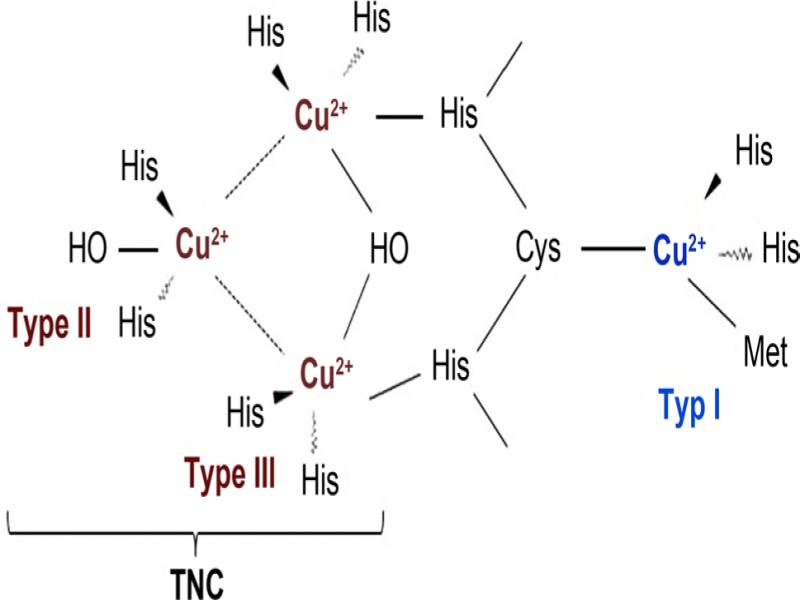
Fig. 1.
Model of the catalytic cluster of MCO.
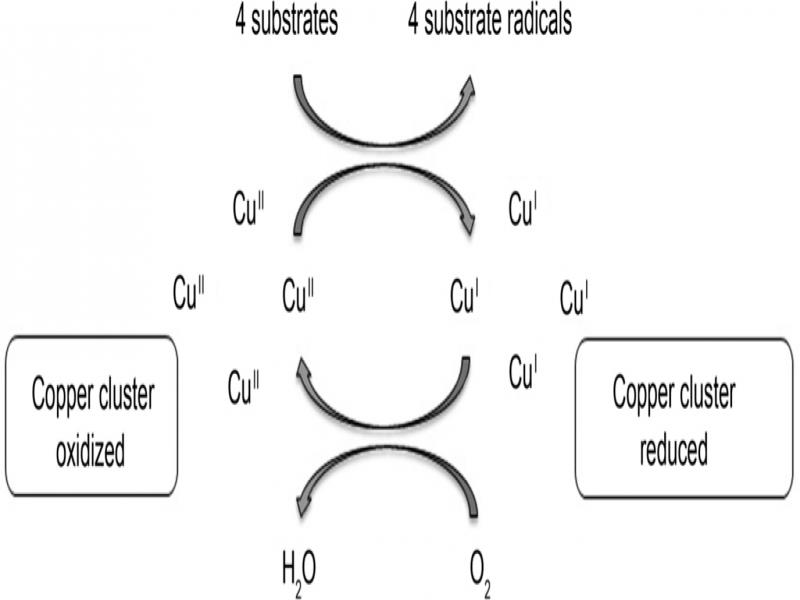
Fig. 2.
Schematic of the catalytic mechanism of laccase.
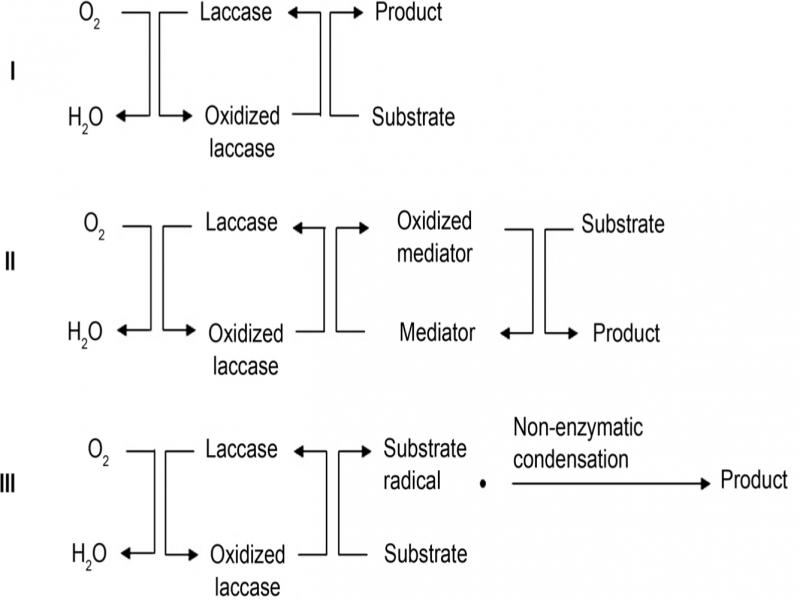
Fig 3.
Mechanisms of reactions catalyzed by MCO.
I – reactions occurring directly, II – reactions occurring in the presence of a mediator, III – coupling reactions [Polak i Jarosz-Wilkołaka [66], modified].
Table I
Classification of multicopper oxidases
| Group of MCOs | Microorganism | Enzyme characteristic | References |
|---|---|---|---|
| Basidomycota laccases | Trametes pubescens | pH 3–4.5; DMP, syringaldazine | [21] |
| Ascomycota MCOs | Aspergillus niger | pH 5–6; DMPPDA | [90] |
| Insects laccases | Anopheles gambiae | pH 6; ABTS | [46] |
| Fungal pigments MCOs | Aspergillus niger | pH 5; DMPPDA | [90] |
| Fungal ferroxidases (Fet3p) | Saccharomyces cerevisiae | pH 5; p-phenylendiamine | [86] |
| Ascorbate oxidases | Brassica oleracea var. italica | pH 7 ascorbic acid solution | [80] |
| Plants laccases | Rhus vernicifera | pH 9; syringaldazine | [96] |
| Bilirubin oxidases | Myrothecium verrucaria | pH 8; syringaldazine | [96] |
| Copper efflux proteins (CueO) | Escherichia coli | pH 6.5; DMP | [72] |
| Bacterial laccases (CotA) | Bacillus subtilis | T ½ in 80°C after 2–4 h | [61] |
| Copper-resistance proteins (CopA) | Pseudomonas syringae | pH 5; DMP | [84] |
1 MCO classification according to Hoegger et al. [26] with characteristic of enzymes and examples of organisms producing them
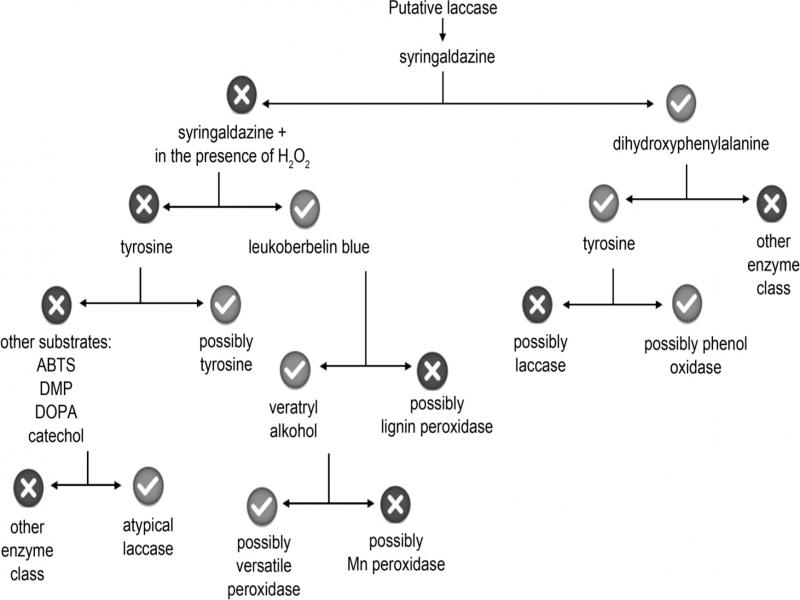
Fig. 4.
The proposed scheme for the differentiation of laccases from other ligninolitic enzymes. According to Fernandes et al. [18], modified.
Table II
Reactions of synthesis, detection and biodegradation catalyzed by enzymes from the MCOs group
| Application | Enzyme, activity | Organism | Substrate, catalyzed reaction | Reaction conditions, process efficiency | References |
|---|---|---|---|---|---|
| Biodegradation of xenobiotics | Multicopper oxidase (1.5 U/mL) | Spirulina platensis CFTRI | Reactive Blue 4 (100 mg/L) | 96%; 4 h | [1] |
| Laccase | Pleurotus ostreatus | Atrazine, pentachlorophenol, naproxen, oksybenzone (0.5 mg/L) | 60–99%; 24 h; vanillin | [3] | |
| Bilirubin oxidase | Magnaporthe oryzae | Remazol Brilliant Blue R (80 mg/L) | 95%; 20 min.; ABTS | [14] | |
| Laccase cocktail (100 U/L) | Pycnoporus sanguineus CS43 | Bisphenol A, 4-nonylphenol, tricolsan (10 mg/L) | 89–100%; 5 h | [22] | |
| Laccase (3 U/mL) | Phoma sp. UHH 5-1-03 | Sulfamethoxazole (0.25 mM) | 87%; 22 h | [27] | |
| Laccase (0.05 U/mL) | T. versicolor | Chloropyrifos, atrazine, chlorothalonil, pyrimethanil (20 mg/L) | 90–100%; 24 h – 8 days | [38] | |
| Bilirubin oxidase | Myrothecium sp. IMER1 | Remazol Brilliant Blue R (80 mg/L) | 91, 5%; 25 min.; ABTS | [48] | |
| Laccase-like multicopper oxidase (2 U/mL) | Streptomyces sp. C1 | Indigo Carmine, Diamond Black PV | 56–84%; 2 h; syringaldehyde | [49] | |
| Laccase (100 U/L) | Pycnoporus sanguineus CS43 | 2,4-dichlorophenol, β-nonylphenol (10 mg/L) | 71–97%; 8 h | [75] | |
| Immobilized laccase (1 U/mL) | Trametes pubescens Cui 7571 | Acid Black 172 (50 mg/L) | 69%; 48 h | [100] | |
| Synthesis and polymerization reactions | Laccase | Trametes versicolor | 4-methyl-3-hydroxyanthranilic acid | Actinocin syntesis, pH 5, immobilization in polyacrylamide gel | [63] |
| Laccase | Myceliophthora thermophila | methyl-1,4-hydroquinone, 2,3-dimethyl-1,4-hydroquinone | Synthesis of β-lactam antibiotics | [56] | |
| Laccase (350 U/mg) | Coriolus hirsutus | Aniline (50 mM) | Polymerization of vanillin in lignosulfonate complex at pH 3.5–4.4 | [42] | |
| Laccase | Trametes pusbescens | Biosynthesis of totarol dimers | 62.6% conversion of totarol after 24 h; pH 4.5–5, 30°C | [62] | |
| Detection reactions | Lacasse (0.29 U/mL) | Aspergillus oryzae | Detection of luteolin | Immobilized in chitosan (Chi) chemically cross-linked; with cyanuric chloride (CC) | [20] |
| Laccase cocktail (31.5 U/mL) | Pleurotus ostreatus | Detection of adrenaline and dopamine | Adsorption on carbon paste; pH 7.0 | [47] | |
| Bilirubin oxidase (50 U) | Myrothecium verrucaria | Detection of bilirubin | Immobilization in gold nanoparticles, pH 8.4 | [41] | |
| Glucose dehydrogenase and laccase complex | Coriolus hirsutus | Detection of morphine | Immobilization in polyvinylalcohol (PVA); pH 6.5 | [5] |