
Introduction
Lack of inclusion has been a prevalent issue in engineering programs for many years. Engineering, as a discipline has historically struggled with the enrollment and retention of students of color, and especially Black students, based on enrollment and attrition rate trends (Brooms & David 2017; McGee 2020; Strayhorn et al. 2013). Previous studies have explored the Black student experience in engineering, citing systemic barriers, such as scarcity of professional role models in the field (Anderson et al. 2017; Verdin & Godwin 2018), limited access to pursue STEM (Perry et al. 2012), and challenged sense of belonging in engineering environments (Marra et al. 2012). While the experience of Black engineering students at traditionally White institutions (TWI) has been studied in formal academic contexts, less is known about Black students’ experiences in informal engineering contexts (i.e., makerspaces) and the influence it has on engineering identity formation either at TWIs or at historically Black colleges and universities (HBCUs) and other Minority Serving Institutions (MSIs). Note that while institutions of higher learning in which Whites account for 50% or greater of the student enrollment have been referred to as predominantly White institutions (PWI) (Lomotey 2010), we instead refer to these institutions as traditionally White institutions (TWI) to intentionally acknowledge of the legacy of Eurocentric centering, white majority student bodies, and Whiteness.
Further, Black engineering undergraduate men, as a demographic, have been understudied despite their unique experiences in the engineering discipline, often in terms of challenges to the affirmation of their racial identity, especially at TWIs (Hunter et al. 2019). Such institutionalized barriers impose difficulty for Black men in establishing their engineering identities at TWIs (Mobley et al. 2021). This “balancing act” involves navigation and negotiation between multiple social spaces and corresponding identities, especially in White-majority spaces (Hunter et al. 2019).
Recently, many academic institutions have considered the potential for makerspaces as an expansion of teaching and learning environments for engineering students. Defined as workspaces equipped with a myriad of supplies, tools and other machinery, makerspaces are spaces “devoted to creative and technical work for individual tinkering, social learning and group collaboration on innovative and technological projects” (Saorin et al. 2017, p. 190). Makerspaces have also been acknowledged for the particular informal learning afforded through the collaborative problem-solving cultures they espouse (Hsu et al. 2017). This refers to the intellectual and creative freedom of the making culture that enables students—embedded in a community—to engage in active learning through developing, building, design, and iteration (Sheridan et al. 2014). Makerspaces have gained traction in academia as spaces that promote positive collaborative learning outcomes and experiences for engineering students through a hands-on problem-solving approach (Martin 2015). Further, with their informal environments and open collaborative culture, makerspaces offer potential as spaces where Black men students can engage in ways that promote and affirm their engineering identities (Tomko et al. 2021). Given that the reinforcement of a positive identity associated with STEM has been shown to be extremely important to how underrepresented students engage in the engineering discipline Strayhorn et al. (2013), being able to simultaneously work in community to iteratively solve problems through hands-on approaches could serve as an optimal learning environment compared to the typical engineering classroom. Engineering academic makerspaces offer a potential pathway of cultivating deep engagement in engineering which could influence engineering identity formation for Black students in a more promising manner than traditional learning spaces where learning is primarily facilitated through formal lectures.
Despite this potential, little research has been done exploring how the greater institutional cultures impact and influence the cultures and operationalization of these academic makerspaces. Universities, as racialized structures, heighten the difficulty level faced by minoritized STEM students through discriminatory beliefs, policies, values, and the unequal distribution of resources (McGee 2021). Given the propensity for institutions of higher education to operate as racialized organizations (ASEE 2020), it is important to investigate how these cultures manifest when positing educational innovations such as academic engineering makerspaces as gateways to increasing and expanding participation in engineering (Hiraldo 2010). We believe it critical to understand associations between institutional context and the operationalization of academic makerspaces as represented through student experiences.
Investigating the role of institutional context and its influence on the makerspace culture could advance our understanding of the potential for making spaces to serve as affirming learning spaces for minoritized students, and specifically, Black males. Leveraging the experiences of the Black male engineering undergraduates across three different types of institutions—a historically Black college/university (HBCU), a traditionally White institution (TWI), and an Asian American Native American Pacific Islander serving institution (AANAPISI)—the purpose of this study was to investigate how engaging in makerspace housed in different institutional contexts influenced their engineering identity development. Additionally, the study sought to understand whether engineering academic makerspaces perpetuate non-inclusive aspects of engineering culture in ways that impact student engagement. This work was informed by the following research questions:
RQ1: How do Black male undergraduate engineering students experience from participating in makerspaces?
RQ2: What do the stories of Black men undergraduate student makers reveal about the culture of makerspaces as microcosms of the institutions and engineering schools in which they are housed?
Literature review
Black men in engineering
Black undergraduate male and females combined both received only 4.2% (136,233 total; 3,748 Black males, 1,332 Black females) of the bachelor’s degrees awarded across all engineering disciplines in 2018 (ASEE 2020). Black male students have often described navigating engineering to challenge their feelings of condescension, isolation, super visibility, invisibility, and presumed incompetence resulting in lower academic expectations for Black students attending TWIs as noted by Jackson et al. (2013) and Leath et al. (2022). Black male students are often impacted by stereotype threat, spurring them to assimilate their values and behavior to avoid confirming negative preconceived notions associated with a group (Burt et al. 2019; McGee 2020). As noted by Strayhorn (2015), Black male students have often been portrayed through a deficit lens in the research, as emphasis has wrongfully been placed on Black student outcomes without consideration of the contributing factors to those outcomes such as missed opportunities to adopt culturally relevant learning and/or the opportunity to learn by doing and failing-forward (Ladson-Billings 2021). Essentially, the onus has historically been placed on the students of color rather than on the institutions and their need to address the existing inequities. A study by Burt et al. (2019) highlighted the impact of racial microaggressions Black men often navigate while dealing with their non-identity sharing academic advisers. The study raised concerns about the frequency and severity of racial microaggressions that Black men experience in higher education, focusing especially on their interactions with faculty advisors across multiple contexts (e.g., classroom, research settings, academic meetings). Such interactions are not limited to faculty as similar dynamics have been experienced by peers as well (Burt et al. 2018; Coley & Thomas 2023; Coley et al. 2023; Greene et al. 2019; McGee & Kruger 2022). Showing that these interactions can be impacted by the setting in which engagement occurs further warrants investigating the extent to which the culture of engineering, and the greater institutions of which they are a part, are operationalized in the microcosms of the institution such as its makerspaces. This information is critical to determining whether these microcosms can truly afford a different learning opportunity that promotes engineering identity formation for Black male students.
Makerspaces
According to the Building a Nation of Makers report (2014), the increasing demands of the engineering industry necessitate a future workforce that possesses a comprehensive set of skills beyond mere technical competence alone. Such dynamic demands along with the increasing accessibility of prototyping equipment have spurred the growth of makerspaces (Blikstein et al. 2017). Specifically, in higher education, former President Obama’s support in fostering a generation of makers has catalyzed hundreds of universities to make institutional commitments to promoting maker culture, commonly demonstrated in the enhancement or establishment of university-affiliated makerspaces. University-affiliated makerspaces are those found within and supported by the institution for the benefit of the student body, and potentially others.
Making is widely embraced for the informal, hands-on, iterative, and collaborative experiences in building, creating, and designing it affords (Tomko et al. 2021). Hence, makerspaces foster innovation, creativity and curiosity through hands-on learning experiences. While the equipment available in the makerspaces—3D printers, laser cutters, and computer-aided design tools—does not drastically differ from a machine shop, they have been designed with the purpose of establishing a culture and interactions that transcend traditional stigmas and offer points of differentiation. These spaces aim to encourage Americans to become “producers of things rather than consumers of things” (retrieved from https://obamawhitehouse.archives.gov/nation-of-makers), while simultaneously advancing domestic innovation, entrepreneurship, manufacturing, and STEM education (Nation of Makers 2014). Oplinger et al. (2014) mentioned that a crucial benefit of makerspaces is their association with the desire to create, build, iterate, and make that reinforces engineering identities. One of the critical arguments of the benefits of makerspaces is the establishment of communities of practice for university student makers (Greene et al. 2019). Andrews et al. (2021) concluded that gains in belonging to the makerspace were not equal across racial groups, even though this study was focused on a single site makerspace. Their research also summarized that while makerspaces might be spaces for educating innovative problem solvers, an intentional focus towards avoiding the reproduction of existing disparities in STEM education was paramount. Therefore, thought must be given to how individuals from groups traditionally underrepresented in engineering engage in academic makerspaces, given that they could be extensions of perpetuated cultures of inequity.
Institutional culture
As engineering academic makerspaces are in close association with the overarching institution, the culture of the institution will likely also play a role in influencing the interactions that will occur within the makerspace. For the purpose of this study, we will be exploring interactions between the institution, engineering (i.e., as a whole represented by the department/school), and the engineering academic makerspace (the makerspace unit housed within engineering, specifically as opposed to other makerspaces of the school/university such as a library makerspace) for three institutional contexts: traditionally White institutions (TWIs), historically Black colleges and universities (HBCUs), and Asian American, Native American and Pacific Islander serving institution (AANAPISIs). According to Gasman et al. (2017)
High achieving Black students in STEM at [predominately White institutions (PWIs)] also referred as TWI throughout this manuscript often have to deal with stereotypes that undermine their achievement and are hampered by stereotype threats and negative stereotypes that question their place and abilities in the STEM disciplines’ (Gasman et al. 2017, p. 184).
Conversely, the culture of STEM at HBCUs is approached differently. Due to the circumstances under which they were established, HBCUs have historically provided Black students safe learning environments and identity affirmation in STEM disciplines (Gasman et al. 2017). The HBCUs offer Black students engineering environments absent the climate of hostility associated with race and with significantly reduced risk of racialized experiences with peers, faculty, or administration (Brooms & David 2017; Harper 2013). Winkle-Wagner and McCoy (2016) noted that HBCUs recruit more people of color. As a result, academic communities are often formed with a better alignment of familial capital (Chang et al. 2011). Familial capital reflects a concern for “cultural knowledge nurtured among familia (kin) that carry a sense of community history, memory, and cultural intuition” (Yosso 2005, p. 79). The AANAPISIs were formed as a resistance space for Asian Americans and pacific islanders to fight racism and stereotype (Park & Teranishi 2008). Gogue et al. (2021) noted that AANAPISIs offer a variety of programs and services dedicated to developing Asian American and Pacific Islander students’ leadership. They note that:
[Asian American and Pacific Islander] students with various opportunities to engage in activities and discussions that demystify notions of traditional leadership; gain skills through experiential learning in areas that intersect with AAPI community issues and collaborate with campus and community partners to expand students’ leadership repertoire” (Gogue et al. 2021, p. 103).
Academic successes have been shown to occur for students when their culture is treated as an asset rather than a deficit (Tierney 1999); a similar outcome is possible for Black students engaging in makerspace environments. Makerspaces that encourage the integration of culture as students work to solve community driven problems that are socially grounded within the concept of equity have been shown to foster their creativity and engineering identity (Noel et al. 2016). There remains a significant gap in the literature regarding the engagement of undergraduate Black men in makerspaces and how these experiences shape their identity development. Examining how institutional type and culture influence the makerspace, this work offers new insights into how engineering identity develops uniquely for Black male engineering students engaging in makerspaces across different institutional contexts.
Theoretical framework
Ecological systems theory
Bronfenbrenner’s (1992) Ecological Systems Theory suggests that an individual’s development is shaped by multiple interconnected environmental systems. These range from immediate, close-knit surroundings like family and peers to broader societal and cultural frameworks. Development occurs when an individual gains a deeper, more nuanced understanding of their ecological environment and is driven to engage in activities that uncover its characteristics, maintain its integrity, or transform it into something more complex and enriched in structure and substance. This theory enables an individual to be understood in context to their surrounding environment, such as their neighborhoods, households, and classrooms, while simultaneously accounting for the macrocosm and its contribution to their development. The ecological systems framework can be broken down into four different sublevels: the microsystem, mesosystem, exosystem, and macrosystem (Bronfenbrenner 1992), as shown in Figure 1. In this study, those levels are represented by the makerspace (microsystem), engineering school/programs/departments (mesosystem), institutional context (exosystem), and the overall societal systems, practices and culture (macrosystem). The makerspace represents the microcosm in this study because of its direct relation to fostering student interest in engineering through engagement in the space. By viewing the setting, culture, and external influences as an individual-centered system, it is possible to see the compounded effect on the individual. While the individual is the focal point for this theory, there are other important interactions that are occurring simultaneously with the potential to effect learning outcomes. One such interaction of interest to this study is that between the makerspace and the engineering school/program/department. Specifically, we are interested in observing whether the traditional norms of engineering culture are found to permeate these nascent microcosms in the engineering academic makerspaces. Each subsystem in this theory is most impacted by and has the strongest impact on the adjacent level. These bidirectional influences create a ripple effect throughout the other layers, making even small changes in the outermost systems possible for influencing the individual (Berk, 2015). Ecological Systems Theory underscores the importance of incorporating considerations of both personal interactions and cultural influences on an individual’s immediate environment, making it an appropriate framework for investigating the development of Black male engineering identity in the context of makerspace engagement. In the context of this study, direct influences will take place on the microsystem level—the makerspace—though each system undoubtedly plays a role in the identity development of the student. Each system represents a sub-system culture which may or may not align with the surrounding levels.
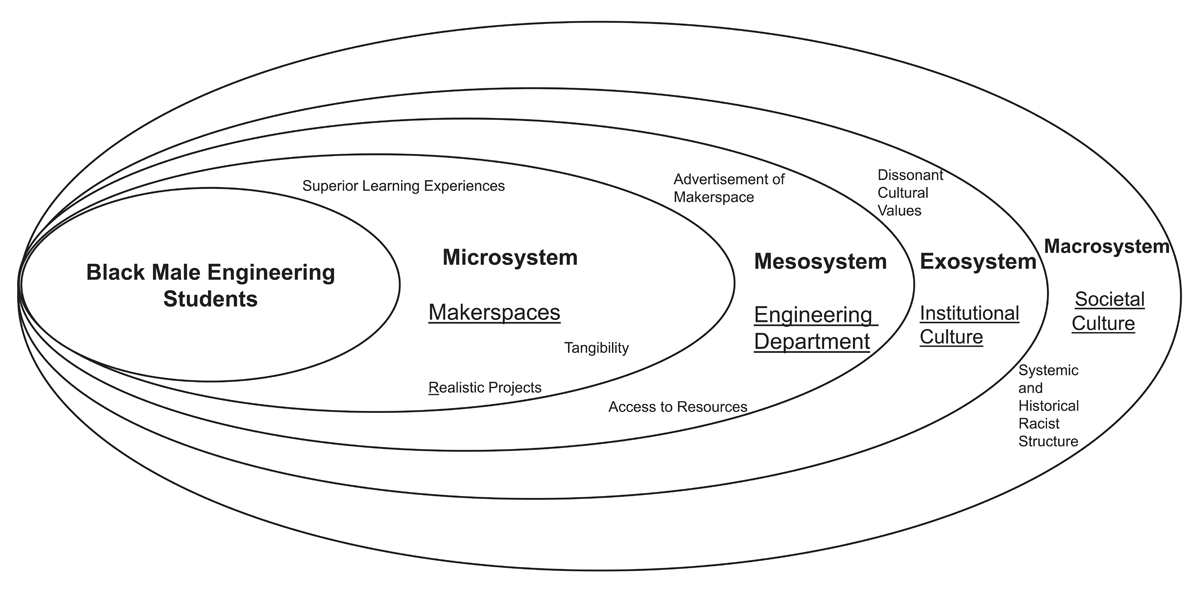
Figure 1
An Ecological Systems Theory framing of Black male engagement in engineering academic makerspaces.
The microsystem is composed of settings or environments with which an individual interacts on a regular basis. This study employs the engineering academic makerspace as the microsystem. According to Bailey (2017), each microcosm incorporates a different influence as the individual interacts with each environment in unique ways. Therefore, individual identity will have an influence on the manner in which the student interacts, perceives, and internalizes interactions within an engineering academic makerspace. Likewise, engineering academic makerspace culture, and subsequently the experiences in that space, will potentially be influenced by the surrounding context of adjacent systems. Given that institutions of higher learning and engineering programs—the exosystem and mesosystem in this context, respectively—have traditionally served as marginalizing environments for Black men undergraduate students, it is possible that their cultures may translate to the new microcosms formed within such settings such as the makerspaces. According to Seifert and Barrafato (2001), the cultural message of ideological support in White familial culture can be one of cultural disapproval for families of minority cultures or among communities of color, much like the dissonance found between the identities of Black students that are often not affirmed in the culture of Whiteness pervasive in engineering.
The extent to which the culture of engineering propagates into engineering academic makerspaces is currently unknown. We ground this work in ecological systems theory to observe the translation of these subcultures into the realm of the engineering academic makerspace. Further, we conduct this study across three varied institutional contexts that primarily serve different student demographics including White students, Black students, and Asian American, Native American and Pacific Islander students. Our logic here is that each institution type will have cultural norms aligned with the advancement of success of the students it serves, which will likely influence its surrounding realms. For students holding identities differing from those primarily served at their institution, the experience of the culture could be incongruent to their own ways of knowing and doing which could serve to inhibit feelings of belonging when engaging in its microcosms. This work will enable us to observe whether nascent engineering academic makerspaces assume the culture of their adjacent realms of the engineering programs and institutions they are housed in and the influence that such has on Black male students’ engagement in the space.
Methods
Research design
We adopted an exploratory case study methodology with a narrative approach. Yin (2003) explained that using case study unpacks the contextual conditions for a particular phenomenon. We embraced the multiple case study (Yin 2003) to unpack the experiences of Black men engaging in engineering academic makerspaces across three institutional contexts. Yin (2003) defined case study methodology as a comprehensive methodology as opposed to a research design. Yin also addressed case study as a suitable methodology for exploratory qualitative research because they answer the ‘how’ and ‘why’ questions. A multiple case study, also referred to as “collective case studies,” “cross-case study,” “multi-case,” or “comparative case studies” was applied in this work (Merriam 2009). This research was modeled after a case study design because it enabled us to conduct an in-depth and multifaceted exploration of the complexities embedded within a social, real-life context (Lewis & Shah 2021). We used cross-case analysis as our design is based on our aim to explore engagement and its impact on engineering identity for Black men undergraduates utilizing engineering academic makerspaces across institutional contexts through multiple interactions and observations over the span of a few days. In this work we compare their experiences at an HBCU a TWI, and an AANAPISI. After analyzing the individual data, we found commonalities and differences across the three student makers’ stories.
Participants
Data for this study is drawn from a larger IRB-approved national study. Undergraduate students enrolled at colleges or universities with engineering academic makerspaces were recruited to participate in the study through their institutions. The participant pool has representation from all five regions of the United States including universities/institutions from the West, Midwest, Northeast, South, and Pacific regions. Institutions were recruited through engineering listservs and the research teams’ network. Ten separate engineering-academic makerspaces across seven institutions were studied. Similar approaches to engaging with students present in the makerspace were taken at each institution. Research team members spent a total of three days at each site to minimize the artifact of collecting data on a bad day (i.e. low attendance day) and to observe students naturally engaging in the makerspace (i.e., as they would without awareness of researchers being there interested in their stories). Makerspace administrators were given advance notice of scheduled visits based on requests of the research team to identify anticipated high traffic periods; however, we wanted the engagement to be natural and asked that makerspaces administrators not advertise the research team’s visit in advance. This increased the likelihood that students’ engagement in the makerspace during our data collection was authentic and not related to the opportunity to participate in a research study. In total, n = 68 participants were included in the larger study with interviews ranging from 30–90 minutes in duration. All participants were compensated for their participation with a $25 Amazon gift card immediately following completion of the interview. Following the interviews, audio recordings were transcribed using Rev, a third-party transcription service. The resultant transcripts were cleaned by the research team to ensure accuracy and served as the primary source of data for this work.
For this study, we wished to conduct a case study of the Black male participants encountered across the various institution types. Thirteen of the 15 male students were encountered at the same institution, the HBCU site included in the study. In contrast, only two Black men were found to engage in the makerspaces across the other six institutions visited over the duration of our data collection (three-day period) with those being at one of the TWIs and the AANAPISI. Given the many individuals engaging in the HBCU makerspace, we considered their making background in selecting the student maker for that makerspace. As a result, we chose one participant, Byron, of the n = 13 at the HBCU to serve as a unit of analysis. At the time of interview, he had already participated in makerspaces for multiple years and was serving in an administrative role in the makerspace. We posited these additional experiences might support the meaning making of his engagement in the HBCU makerspace. The other two participants were the only Black male students encountered at their respective institution types; thus, Blake and Barrett were chosen as the representative cases for the TWI and AANAPISI, respectively. The demographic information for these participants is provided in Table 1.
Site descriptions
Eastern Ridge University (TWI)
Our first site for the study was Eastern Ridge University (ERU, a pseudonym), a private liberal arts college located on the east coast. Today, ERU offers more than 60 majors in three top colleges: arts and sciences, engineering, and management. Broken down by race and/or ethnicity, the student population is more than 70% White and roughly 10% Hispanic or Latino and Black, combined (US news 2021). Recently, ERU has made some effort to advance racial equity and broaden participation. Their website also mentioned that the university had taken steps to advance diversity, equity, and inclusion (DEI), including establishing an antiracism fund, expanding the President’s leadership team, and joining more than 50 colleges to form a new racial equity leadership alliance. They also reported development of DEI councils across the university.
Coastal South University (HBCU)
The second site for our study was Coastal South University (CSU, a pseudonym), a private, liberal arts historically Black college and university in the south. At CSU, among the enrolled student population, more than 70% are Black or African American and multi-racial, Hispanic or Latino, White, and American Indian or Alaska Native, combined, make up less than 5%. This includes both full- and part-time students as well as graduates and undergraduates. The HBCUs were formed to provide undergraduate and graduate level educational opportunities to people of African descent which had been denied due to racial discrimination (Albritton 2012). These institutions also served as spaces of resistance for Black students to have refuge from racism and prejudice (Albritton 2012). The Hussar et al. (2020) reported there were 101 HBCUs located in 19 states in the US. Of these institutions, 52 were public and 49 were private institutions. The number of HBCU students increased by 47% between 1976 and 2010, then decreased by 15% between 2010 and 2020 (Hussar et al. 2020). HBCUs are at the front line of fighting racism (McGee 2021) and have played a critical role for Black scholars in STEM education and in STEM careers (Toldson 2018).
Rainbow Warriors University (AANAPISI)
The third site for our study, Rainbow Warriors University (RWU, a pseudonym), was a public land grant research university. The AANAPISIs are defined under the Higher Education Act (HEA) as colleges or universities with an undergraduate enrollment that is at least 10% Asian American and Native American Pacific Islander. Their student body is just over 30% Asian, nearly 30% Caucasian, 20% Native Hawaiian or other Pacific Islander, about 16% Multiracial, and less than 10% international, Hispanic, Black or African American, and American Indian or Alaska Native, combined (University of Hawaii, 2022). The AANAPISIs were formed as a resistance space for Asian Americans and Pacific Islanders to fight racism and prejudice (Park & Teranishi 2008). Programs were developed by the RWU to support and retain Asian American and Pacific Islander (AAPI) students. The RWU recently expanded their efforts to retain and recruit more faculty from Asian American and Pacific Islander backgrounds and are strategizing efforts towards exploring the needs of this population.
Data collection
Through their stories, we sought to develop an understanding of how students engaged in makerspaces and how it influenced the formation of their identity as engineers. This necessitated we capture their experiences, perceptions of the culture and belonging within their respective makerspaces. To develop the interview protocol, primary research questions were identified as the overarching question (i.e., What are the personal growth and identity development stories of Black male engineering students who engage in and experience makerspaces?). The interviews consisted of two parts: a narrative phase and a conversation phase. First, a narrative prompt was used to elicit the student maker to tell their story and expand on their experiences in the makerspace. The overarching question was then translated into a narrative interview question, which served as the initial prompt:
I am interested in hearing your story, as a Black male student maker, of how you got to where you are today. What experiences helped steer you to where you are as an engineering student? Consider the full spectrum of your experiences, these could be from your childhood, family interactions, interactions with friends, experiences working…
With the initial prompt, Black male student makers were encouraged to respond in the manner that felt authentic and organic to them and without interruption from the interviewer; that was the narration phase.
Following that, the interviewer expanded on pivotal experiences and critical incidents mentioned using semi-structured questions to delve deeper into their experiences and to address relevant topics that didn’t arise; this constituted the conversation phase. These questions were related to sub-research questions (i.e., What kinds of lived experiences have led you to develop your identity as an engineer?) which were also translated into narrative questions (i.e., Describe a time when you really felt like you were an engineer or were meant to be engineer). Other examples of these narrative follow-up questions included but were not limited to:
Tell us about your experiences in making, including what first got you involved in making.
How have the makerspace faculty, management and/or staff influenced you as a maker?
Do you feel productive and happy in engineering environments?
What about making environments? How has your identity influenced how you engage the space?
Are there aspects of the makerspace that differ from your formal academic environments (i.e., the classroom vs. the makerspace)?
The goal of these questions was to encourage the participants to share rich accounts of their experiences as a Black male engineering student and maker. Our narrative approach created space to richly explore the experiences of the student makers. Researchers were intentional to convey a sincere interest in the participant’ stories to aid in their comfort taking longer turns to develop their story (Kim 2016). We also incorporated observation as a secondary method of our data collection which involved observing interactions in the space between students, documenting imagery and symbols in the space, and watching the engagement between the makerspace personnel and students engaging in the space.
Data analysis
The data analysis was carried out in three systematic steps: deductive coding, inductive coding, and the creation of a composite codebook (Saldaña 2016). Initially, deductive codes were developed based on the semi-structured interview questions, allowing for a rapid and organized understanding of the data for example, to understand their experiences of making, their overall experiences in engineering, their identity and how that influenced making, role of faculty and staff to engage them, learning in the engineering classrooms vs makerspaces etc.
Subsequently, recurring themes were identified through open coding, which involved closely examining all the transcripts to highlight compelling sections and detect patterns. This process revealed key constructs such as “pedagogical and other experiences that shape identity,” “stories of values, knowledge skills and practices in makerspace,” “stories of bias, prejudice, discrimination, marginalization and stereotypes.” Pedagogical and other experiences that shape identity captured experiences and learning environments that influenced the students professional identity formation as engineers. Stories of values, knowledge, skills, practices, and norms in makerspaces referred to articulated characteristics that distinguished makerspaces from engineering classrooms, while stories of bias, prejudice, discrimination, marginalization, and stereotype addressed the culture of engineering academic makerspaces and racialized experiences across the institutional contexts and all those findings are presented later.
Finally, a composite codebook was developed by integrating insights from both deductive and inductive coding (Please see Table 2). In the last stage, pattern coding was applied to each transcript to synthesize the data into higher-order categories and deepen the analysis. The data shared here describe our analysis of each case as represented by the coded excerpts attached. We had multiple parent codes associated with their child codes and finally we presented the data based on the research questions.
Table 2
Codes and their excerpts.
| CODES | QUOTES |
|---|---|
| Experiences that shape identity | I guess here I can say … a good example when I worked here over the summer would be when I started using the PCB mill I guess because you were able to see this is what’s on the inner side of things in electrical devices and things like that, which is making the actual circuit board that was in here, so that was cool; when I made my first circuit board. |
| Roads of trials in Engineering | Maybe not so much in the maker spaces. As a student probably so, people are just hesitant to … I don’t know if ‘cause I’m older or it’s because I’m Black. But I think even with my first degree, there was … you know I was a little bit, it was a little bit harder to take me in as a … as one of their friends. And I don’t know … yeah I can just say that yeah, across the board, throughout my long life in school … I would have to be, if say I were integrated I could probably … if I didn’t express myself, if I didn’t take initiative to talk to somebody I’d probably not know very many people in my program. I could see that happening. And I think that one or two semesters, that’s happened before. Definitely. And I don’t know if that’s just because, you know my ethnicity, or it’s because of my personality. But, I feel like it has something to do with my ethnicity. That’s just the, I can’t really place it, but I think it’s there. |
| Stories of bias, prejudice, and stereotype | I guess you could say how strong-minded and driven I am. It’s not what people typically expect or when they see or hear what I’ve done it’s not typically what is to be expected. Even in high school. I guess … yeah. Even in high school, people didn’t necessarily expect that I was a smart kid or things like that, or they’re like, “Oh, he was the valedictorian?” Things like that. Or even when people figure it out here, they’re typically surprised…Well, I guess also, it’s kind of different here because they’re like, “Oh, he’s a black man that goes to ECU. He’s probably smart.” It’s kind of twofold. You kind of get both sides of it. It’s like, “Oh, well, if you go to ECU, you’re probably smart.” But then it’s like, “Oh, wow, he’s black and he goes to ECU? Yeah, he’s gotta be smart.” |
| Value of making | This 3D print is finishing, can I stay here so I can go ahead and put this together? It was just exciting. After last summer, we’ve had the most people come back. Now, different projects we did was drone building and RC car racing where students built their own cars and built their own drones. The thing with the cars were they had first person view goggles so they would sit in the front of the room where we were presenting. Put the goggles on and they set up an obstacle course where they raced around the room without ever seeing, so … |
Across the three cases we were primarily focused on the ways that making was described to influence engineering identity formation. We zoomed in on the stories identified related to skills and practices of makerspaces, and especially those relating to engineering identity. Similarly, we focused on descriptions that articulated how Black male students’ engagement in the makerspaces was influenced by their identity and/or how the culture experienced in the makerspace compared to that found in traditional engineering environments, which was found in their stories of marginalization encountered in their engagement. For each case, we present each participant’s story of the influence of their makerspace engagement on their engineering identity Additionally, we present their descriptions of racialized experiences in the makerspaces, which often served to cancel the positive attributes afforded in their engagement.
Findings
This case study utilized narrative analysis techniques to amplify the counter stories of Black undergraduate men student makers while recognizing commonalities across their experiences in engineering and/or the makerspace. To effectively represent the participants’ experiences, three unique student perspectives were selected to represent makerspaces housed in three different institution types including: TWI, an AANAPISI, and a HBCU. Participants Blake, Barrett, and Byron, all pseudonyms, were chosen as the stories to represent each institution, respectively. These three stories show a range of participant experiences while also highlighting how cultural norms manifested across the three academic makerspace environments.
Blake and the case of the TWI
Participation in makerspace
The first case for this study addressed that of Blake, a third-year electrical engineering student, who attended Eastern Ridge University (TWI). Though he had not been previously exposed to making or the concept of makerspaces, Blake’s high school experiences working with both computer hardware and software instilled in him a penchant for working with his hands as well as a curiosity for how things worked. His first formal exposure to making occurred in his first year of the engineering program. There were no formal programs or workshops that drew him to the makerspace, but rather, his own intrinsic interest that drove him to explore:
Well, coming on campus or tours and things like that, you always get a quick overview of it; like different things like 3D printing and laser cutting, so to me, naturally, it was just interesting. I wanted to know how it worked or be able to use a machine to create…
Blake’s intellectual curiosity about the machines utilized in the makerspace ultimately led him to initiate his engagement in the space. Once he was able to find the time to engage in the makerspace, he found that it was a great place for exploration of his creative ideas. Such exploration in the engineering academic makerspace at his TWI afforded opportunities for him to experience himself as an engineer:
A good example [of] when I [felt like an engineer was]…when I worked here over the summer…would be when I started using the PCB [Printed Circuit Board] mill I guess because you were able to see this is what’s on the inner side of things in electrical devices and things like that, which is making the actual circuit board that was in here, so that was cool; when I made my first circuit board.
Blake, through his time spent in the makerspace, had been able to develop a plethora of skills that he believed would serve him well as an engineer in the future, while helping him to further develop his engineering interests. He even, through his time spent working in the makerspace, developed proficiency using the printed circuit board (PCB) mill, a machine used to create motherboards. As both an employee and a maker for the engineering academic makerspace at his institution, Blake was able to perceive the benefits and disadvantages of his engagement in makerspaces. One of the things he found most useful in the makerspace where he worked was the availability of the space itself:
The [Makerspace Management Team] have made it in a sense that you should be … I wanna say self-sufficient, kind of, as in they’ve made tutorials that you can follow so even if they’re not available, there is something that you can use, or if they aren’t there, there is something you can use. So, just making the space … and it’s open 24 hours, too, so just making the space available all the time when they’re not available.
Accessibility to the space proved to be important to Blake in his engagement along with the promotion of autonomy that was facilitated by the approach adopted by the makerspace personnel. Even when the makerspace personnel were not available, the space was. However, more significant than the accessibility of the makerspace was the supportive and collaborative culture fostered by the staff of the makerspace to be “willing to help you in any way shape or form” when they are present in the space. Blake described the makerspace personnel’s openness to answer an unbounded number of questions without concern for being perceived as annoying or other associations with students asking a lot of questions. Blake saw the 24-hour access to the makerspace coupled with the helpful nature of the leaders onsite to be a great asset and attributed much of his engagement in the makerspace to that.
However, Blake’s experience in the makerspace differed from that of his engineering classroom where he spoke of faculty being a “little awkward.” Specifically, he described interactions with faculty in the engineering classroom being contingent on the faculty’s own experiences and/or interactions with minority students, and implicitly, lacking the openness and flexibility found in the makerspace. A culture of hypervisibility for Black students was apparent in Blake’s story where he shared that he and other students often recollected that on the first day of classes, his and other Black students’ names were often already known by the faculty. Faculty were also characterized as “making sure they didn’t say the wrong thing” and being “on edge” when it came to dealing with Black students in the classroom. Blake attributed his ability to see most faculty as cooperative and understanding on how “strong-minded” and “driven” he was, rather than on faculty’s ability to facilitate an inclusive environment. Entering engineering, Blake was aware that “…it wasn’t going to be easy…but knowing that wasn’t going to make him stop.”
Racialized experiences in the making and the culture of makerspace
Blake also explained the stigmas and stereotype threats associated with him being at a TWI. On the one hand, as a Black man at a TWI, people assumed “he must be smart.” Yet, in the makerspace, he often felt overlooked as a resource by his peers because he was Black, despite the culture of collaboration espoused by the leaders of the space. His being overlooked was anchored in the assumption that he would not be a possessor of knowledge. Being a Black man attending a TWI, Blake had explicit awareness that his experiences in the makerspace were different from his majoritarian peers, stating that other participants in the makerspace “might not necessarily ask [him] for assistance first versus somebody else unless they’re like, ‘oh, no he knows how to do it.’” He then continued to clarify that by somebody else, he was referring to “someone who doesn’t look like [him].” Blake viewed the makerspace culture overall as collaborative with nuanced marginalization, and primarily, from his peers. He also described the faculty as “overall collaborative and understanding” although they were described as awkward and/or apprehensive in their interactions with Black students. Blake was able to identify positive aspects of both the makerspace and classroom; however, this might be reflective of how Black students have been normalized to accept marginalization as the status quo as faculty were still viewed as understanding despite the noticeable awkwardness he described.
These microaggressions, defined as “subtle, stunning, often automatic, and nonverbal exchanges which are ‘put downs’ of Blacks by offenders,” can often have a profound effect on a Black man or member of an underrepresented group. McGee and Martin (2011) asserts that “once the stereotype has been activated and perceived as a racialized threat, its longevity exists far past the situation or event in which the student was stereotyped” (McGee & Martin 2011, p. 1355). The described manifestations of marginalization could represent how institutional culture gets transferred into makerspaces and other such microcosms.
Barrett and the case of the ANAPISI
Participation in Makerspace
Our second case was Barrett, a returning student pursuing his second undergraduate degree in mechanical engineering while attending Rainbow Warrior University (AANAPISI). He was drawn to engineering by his curiosity for manufacturing as well as the versatility it offered when searching for a career. Entering the program with a wealth of experience from industry and past academic experiences, Barrett tried to capitalize on the many opportunities and resources offered on campus at his university with the engineering academic makerspace being one of them.
His first exposure to the makerspace came through a circuits course project where he was required to fabricate a small part. Having utilized many different types of workspaces in his career outside of academia, Barrett commented on the similarity of his experiences, claiming many of the workspaces on campus to be “like machine shops with different tools.” Despite this, Barrett was able to utilize the makerspace at his institution to enhance his own engineering skills while learning valuable lessons about the realities of engineering:
Well, it requires you to be patient. I think a lot of students in the engineering program are impatient. They just, you know, ‘Oh I can do this equation, and I can write it out, the numbers worked out and I’m done,’ you know. And I can move onto something else, you know. When you’re in a makerspace, you have to sit there, you know, make sure it’s done right and make sure it’s done right the first time if that’s going to be your product. If it’s not done right the first time you have to be willing to sit there and learn how, you know, learn where the errors are. So, if you’re not ready to troubleshoot and spend that extra hour or two, then you probably don’t need to be in the makerspace. I think probably the biggest thing I noticed with a lot of students like “Oh, yeah, we’re going to CAD this out, go out there and do it in five minutes then we’ll be done.” But, no, it takes like five hours, you know for something really, rudimentary so, that was probably, I mean even for me, I have the same tendency to try and get it done fast and get out of there and get onto the next thing. But, across the board it teaches you to be more patient and more willing to see the process through.
For Barrett, the makerspace helped him establish engineering skills while building his self-efficacy. Carlone & Johnson (2007) break science identity into three components: competence, performance, and recognition. The skill acquisition and confidence Barrett was able to develop in the makerspace contributed positively to his ability to see himself as an engineer, as his competence in completing engineering tasks and his belief in himself as an engineer increased (Godwin et al. 2016; Henderson et al. 2021). When asked about how people interacted in the space itself, he acknowledged that most tend to “keep to themselves,” engulfing themselves in their own projects, but still being available to help when needed:
Everybody’s very helpful, especially the people that are there all the time. You may have to go and ask them though. If you’re somebody who’s new in there, you may not be like, ‘oh I can just go, I’ll just go and talk to that guy.’ You just randomly ask people, and they let you know.
Barrett perceived the makerspace to be a place where people often kept to themselves though they would likely be open to helping if asked. His sharing informed that newcomers to the space might not have immediately experienced it as a communal environment, which could have implications for perceptions of belonging in the space.
Racialized experiences in the making and the culture of makerspace
While makerspaces are intended to be open and collaborative environments, the interactions described by Barrett alluded to the potential intimidation and/or discomfort that those unfamiliar to the makerspace could experience as being unwelcoming. As a tall, Black man with dreadlocks, Barrett acknowledged that he “stood out” in his engineering academic environments as one of few Black students in his classes and even fewer engaging in the makerspace. Although Barrett described feeling his identity as minoritized in his everyday classroom experiences, the makerspace offered a realm where he could work without constant reminders of his race, despite his initial engagement with the makerspace being somewhat unwelcoming. When asked about his identity-related experiences across his academic trajectory, Barrett shared observations of racialized experiences in navigating the engineering undergraduate fabrication lab (one of two engineering academic makerspaces on his campus):
Maybe not so much in the makerspace. As a student, probably so, people are just hesitant to… I don’t know if it was because I’m older or because I’m Black. But I think even with my first degree, there was… you know, I was a little bit… it was a little bit harder to take me in as a … as one of their friends. If I didn’t express myself, if I didn’t take initiative to talk to somebody, I’d probably not know very many people in my program. I could see that happening. And I think that one or two semesters, that’s happened before.
Here we see the invisibility that Black men face in traditional engineering environments (McGee 2018). Barrett felt that in order to be acknowledged by his peers, he had to first assert himself in a way that those holding a majority identity would likely not have to. Essentially, as he noted for the classroom, he had to make himself visible, which he described to be exacerbated by his additional axes of minoritized identity in being an older, nontraditional student. The makerspace was the only engineering academic environment mentioned in this story where Barrett felt that his experiences were less driven by race and more by his identity as a maker. Barrett’s engagement in his makerspace proved conducive for contributing to the development of his engineering identity. Additionally, while he didn’t have racialized experiences in the makerspace, there were also no intentional measures adopted to affirm his Blackness.
Byron and the case of the HBCU
Participation in Makerspace
Our last case for this study addressed Byron, a third-year computer science student with experience participating in the engineering academic makerspace housed at Coastal South University (HBCU). Byron had been exposed to coding and computers early on in life through his father who was an IT professional. His first experience with making occurred during the summer preceding his first semester at CSU as part of a bridge program for STEM students. At CSU, an intentional program was created to promote students’ integration to the campus, forming community with peers and making connections across the technical and social through engaging in the university makerspace for six weeks over the summer. For Byron, the makerspace was a bridge to undergraduate education, community and identity affirmation. In his summer project, Byron was tasked with designing a containment unit for a camera that would be attached to a high-altitude balloon. Reflecting on the experience, Byron said:
It was pretty fun. I mean, it was boring watching it go up, but leading up to it, building the carrier for the camera to make sure when it did hit the ground, not everything shattered into pieces, that was all fun. That was my first taste into engineering, building that cradle.
This first experience gave him early exposure to engineering, piquing his interest in both making and engineering enough to continue engaging in the makerspace. As a result of his demonstrated passion and commitment in the space, he was later offered a position as a staff member in the makerspace. In this position, he was able to make changes that he believed would enhance the experiences of other students to create a space where more students could thrive and be ignited in their own interests and endeavors:
After my first semester, they made me a full-time engineer in the lab, where I would bring in other people to do projects, start my own projects and that’s what led to my first summer working at [CSU] where I ended up teaching at the same summer program that I took the previous summer. That’s when we started shifting into opening up different projects. So, the application process was saying, what kind of things are you interested in? Because not everyone is interested in building. Not everyone is interested in coding.
Byron recognized that not everyone would be interested in conventional engineering projects, so for the sake of showing the students a positive experience, he reimagined the projects for the program, allowing students to choose topics with which they could engage more deeply. As Byron found the creative freedom and ability to tinker through real life projects to be fascinating aspects of the makerspace, he leveraged his role as an opportunity to draw more people into the space through expansion of these aspects. In being intentional in his position in the makerspace, Byron interacted with a variety of peers with different identities in unique ways:
When you come in here, you get to really see what’s going on. It’s open for anyone to come in. It’s not particular to STEM majors who want to build something off the top of their heads. Some business majors have ideas, and they find their people to work with and build their project from there. One of my favorite things that I was part of in the summer… I can’t think of the name of the program, but it was me, another student and a sociology professor. The sociology professor came to us with his idea of what he wanted to do, and we all worked together to build the presentation, build the model. It was called ‘A Day in the Life.’ And the idea was, what if it was this little booth you could step into, where you get to experience someone else’s life. For us, one of the main ones we hit was homelessness. And you walk into this ice-cold box where it’s like sprinkling rain, but you have no type of jackets or anything. You’re sitting there trying to move to the side, and it’s just not a comfortable feeling to be there. To give more awareness to the situation that these people are in.
Teaming up with other makerspace participants, Byron was able to develop and build a project creating awareness and fostering empathy for greater inclusion, making the experience more impactful for him. This experience was made even more impactful as it afforded him the opportunity to travel to a conference to present his work. Though the “A Day in the Life” project was able to give him the most mobility, the makerspace project that Byron was most proud of was the aerial drone he built:
So, for me, I started building the drone from scratch. And it was in this lab that I started getting the resources and all that. And when I finally got everything put together, and started coding it, I was like ‘wow, I really took this small thing that just sits here on a table and put code into it that allows it to fly in the air.’ I can push a button, and it will start doing figure 8s, flying in circles or whatever and I don’t have to do anything. I just sit there and watch it work. And for that, that was amazing for me. There are so many things where building is just one side. So, if you learn code, then when someone hands you something you can make it do stuff. But if you learn to build and code, that’s a full package.
This project was vital for Byron’s development as an engineer, a computer scientist, and a maker. Due to the resources provided by the makerspace, Byron found a marriage of the physical and theoretical portions of a unique project, giving him the feeling of being “the full package.” Affirmations of engineering identity, as we saw from Byron, align well with the goal of engineering academic makerspaces as places that allow for more comprehensive engineering learning experiences and visualization of one’s full self as being necessary to actualize what it means to be an engineer. Further, underlying Byron’s story was a care for other students which was grounded by the ethos of the institution and the STEM program with us also observing the value for interdisciplinarity and collectivism. Marginalization due to race never emerged in Byron’s story, as at CSU, he was amidst a critical mass of Black students where there was an intentional effort made to connect students to the makerspace and early on in their academic journeys. Additionally, the makerspace was envisioned as more than a space of making, but rather a place where culture and community were purposefully interwoven to facilitate and affirm identity.
Discussion
The first research question we asked was to understand Black male undergraduate engineering students experience from participating in makerspaces. The makerspaces were described to be essential places for actualizing engineering identity in action rather than theoretically. By affording opportunities to learn by doing, Black men engaging in the makerspace were able to take learning risks not typically supported in the engineering classroom. Given the challenges that Black men face persisting in toxic engineering environments, the integration of an engineering identity into their self-concept can help to “smooth out the supposed contradictions between these multiple facets of self, allowing Black men engineering students to gain an understanding about their place in engineering” (Brown-Collins & Sussewell 1986). As an example of the way the makerspace challenged these contradictions, students felt received and welcomed in their curiosity and question-asking compared to thoughts of being perceived as “annoying” for similar behaviors when occurring in the classroom, serving to discourage and/or distance full participation from such students. One of the biggest factors facilitating identity development for Black men when engaging in engineering academic makerspaces was the ability to use failure as a mode of learning. McGee (2018) showed how the thought of punitive outcomes impacted how students navigated situations of stereotype threat (McGee & Martin 2011). Traditionally, failure serves to validate the negative perceptions held by community members—both faculty and peers—of Black students in the classroom; however, in the makerspace, it is viewed as a positive, allowing students to more authentically explore their intrinsic engineering interests without penalization or an associated negative connotation. Students were encouraged to fail adventurously while working in makerspace environments, shifting closer toward identities as engineers as they tested out thought processes and solutions for real-world problems and applications. The makerspace environment enabled Black men student makers to engage collaboratively in an exchange of ideas and to design novel inventions much like Byron’s “A Day in the Life” project or Blake’s gaming table that he made throughout the summer as a fun activity. The makerspace provided a safe space to explore technical interest while simultaneously fostering agency and identity. Additionally, the perceived support in the makerspace was also notable. Such was observed in students communicating an onus for their own success in the classroom while feeling supported in their success by makerspace personnel even if it required them initiating the ask. This support also encompassed the various ways identity was affirmed in the makerspace such as Byron being offered a full-time engineering position in the lab. Beyond the position, the gesture was affirming to his engineering identity as it demonstrated his being recognized for his contributions as an engineer despite him being very early in his education. Such experiences can be significant when considering the cultural context of the institution as it can demonstrate how minority serving institutions, and specifically, those primarily serving Black students, are intentional in the offering of critical resources (i.e., summer bridge program leveraging makerspace) and creation of opportunities to affirm students in their personal (i.e., Black) and professional (development of) (i.e., engineer) identities. These insights suggest that engagement in makerspaces can be a powerful tool for supporting engineering identity formation The findings also suggest room for improving these spaces to better support the academic identity development of Black male students in engineering.
With the second research question we asked (What do the stories of Black men undergraduate student makers reveal about the culture of makerspaces as microcosms of the institutions and engineering schools in which they are housed?), we sought to understand whether the cultural context of the institution as implied by the population it serves (i.e., traditionally White versus minority serving) translated to the culture of its microcosms, such as engineering as a discipline and the engineering academic makerspaces contained within it. We learned from the students’ comparisons of their experiences in formal learning environments primarily represented by engineering classes (or classrooms) to those of engaging in the makerspace that there were ways of knowing and doing common to engineering that were observed in the makerspaces. As an example, even though makerspaces were amongst the most inclusive environments experienced in their academic trajectories, participants still encountered racialized experiences with the exception of the one student case at the HBCU. It was also found that how students came to engage in the makerspaces was a function of the culture. The student at the TWI had an interest driven introduction to the space compared to a course being the impetus for the student at the AANAPISI to enter the makerspace. However, it was only at the HBCU where the student’s introduction to the makerspace was made possible through an intentional opportunity designed to bridge students’ interest in STEM through making. Also noted relevant to the cultures were the values of the makerspaces expressed through the students’ stories. Values for interdisciplinarity, collectivism and empathy arose as being thoughtfully woven into the programming and projects created in the HBCU makerspace. Only as it related to the HBCU were interdisciplinary, collective learning through projects considering humanity, need, and a desire to contribute to public good explicitly communicated as a priority.
Even though all of the participants of this study reported an experience of collaboration or camaraderie within the makerspace; however, the non-HBCU attending participants were not always made to feel a part of the space, and specifically, at the TWI. Our student case at the TWI encountered extensions of engineering classroom norms in the makerspace as his peers overlooked him, influencing his feelings of invisibility. Students and fellow peers influenced Black men student makers in our study to grapple with feelings of being overlooked, invisible, and presumed incompetent. Though these students were well-versed in navigating the makerspace, their race was made salient through their lack of interactions with peers and/or having to first prove their knowledge to be seen as visible for interacting with by their peers. These instances of “othering” directly mirror attitudes extending from the antiBlackness pervasive throughout the greater culture of engineering and institutions anchored in racist histories (Coley et al. 2023; McGee 2020; McGee 2021). Byron was the only participant of the three that did not have a racialized experience in the makerspace, likely due to the fact that he was at the HBCU with a critical mass of Black students. In fact, the HBCU was the only site where several other Black men (and women) were observed engaging in the space across the window of the research team’s data collection (~2–3 days). While this did invalidate the positive aspects of engaging in the makerspace for Blake or Barrett, the fact that student makers encountered racialized experiences in non-HBCU reduces their ability to be promoted as supportive and personal identity-affirming spaces for Black students.
Implications
As learned from the example of the HBCU, engineering programs at TWIs (traditionally White institutions) may consider utilizing makerspaces more strategically, i.e., as a part of bridge programs for Black engineering students in support of more seamless transitions into engineering, and potentially campus life. Further, facilitating more intentional connections to the makerspace (e.g., courses, extracurricular clubs, etc.) could promote greater opportunities and pathways for more students to engage in learning beyond the classroom that informs development of their engineering identity. Since making experiences proved positive learning experiences and lesser racialized encounters for Black men, makerspaces can be promoted as a site for learning engineering especially for Black and other groups of students minoritized in engineering. Introductions to the realm of making in engineering could offer a novel way to engage incoming Black first-year engineers in a more inclusive way. While makerspaces, like other engineering environments, are not immune to racism and microaggressions, they uniquely position all participants as makers and engineers first. This perspective can be particularly empowering for Black and potentially other minority students, offering them a distinctive opportunity to develop their engineering identity. Although institutional culture is reflected in these spaces, the inherent aspects of making and collaboration contribute unique value to the experience.
While engineering academic makerspaces demonstrated potential to complement formal learning through the creative nature of making and the opportunity to authentically leverage one’s ways of knowing and doing in the cultivation of their engineering identity, for Black men students engaging in the makerspace, such still came at a cost. It is imperative that engineering academic makerspaces wishing to realize the potential they afford inquire with Black students to know their experiences and needs in the spaces. This could include deliberate efforts of the makerspace leadership and personnel following up directly with students after visiting the makerspace to communicate care and an effort to iteratively create a community where all students feel valued, visible and welcomed. Without an intentional effort to disrupt the engineering norms that create unsustainable conditions for learning and thriving, Black students will be left to contemplate the cost-benefit ratio of engaging in such spaces. It is crucial that attention be given to the culture of makerspaces to mitigate the mirroring of engineering norms that marginalize Black students as the greatest outcomes for Black men student makers occurred when the makerspace was both engaging and inclusive.
Limitations
One limitation of this study was the short duration of data collection, which involved observations over the course of a few days at each of the data collection sites. This limited timeframe may not have provided sufficient depth to fully capture the range of student engagement within the makerspace (i.e., if the busiest day in the makerspace happened to be on a Thursday and our data collection occurred Monday through Wednesday). The research team worked to coordinate the most ideal timeframes for data collection, but such was still random and influenced by student schedules and shifting priorities as a function of the academic semester. Additionally, all major institution types are not represented here as there was not a case for Black male students at the Hispanic serving institution (HSI). Within the dataset there were no Black men student makers interviewed at the HSI studied. While we acknowledge that individual experiences cannot fully represent the entire institution or its makerspace culture, we desired to have a case of the various experiences of Black male engineering makers representative of each of the institution types included amongst our data collection sites. Finally, we acknowledge that some opportunities that may not be available to traditionally aged students (in Barrett’s case) or typical makerspace users (in Blake’s case), shaping how they experienced the makerspace. As a result, our findings may not fully reflect the experiences of students who enter college directly from high school or those with limited access and responsibility because Blake and Barret experienced makerspaces differently due to their background and exposure. However, since the focus of this study was on male undergraduate engineering students’ experiences in makerspaces and how these spaces function as microcosms of their institutions and engineering schools, their prior experiences had minimal impact on our study.
Conclusion
Engagement in makerspaces facilitated engineering identity development through learning experiences that supported Black men student makers feeling like engineers. Black men benefitted from participating in makerspaces through their ability to apply their creativity and problem-solving skills in ways that are limited, if not discouraged, in the classroom. Having the opportunity to work on interesting and culturally relevant tasks facilitated an ease of learning in being able to incorporate their own self-image into their projects and applications. However, traces of traditional engineering cultures were found to permeate makerspaces as the cultures of three different makerspaces were shown to be influenced by the institutional context in which they were housed. The shared associations of culture between the institution, engineering and makerspace at the non-HBCU sites hindered Black men students’ ability to feel like an integral part of the space, despite the many positive factors that came from their engagement. Future work should investigate the integration and identity formation of other non-Black students with minoritized identities within engineering academic makerspaces. We acknowledge that makerspaces hold significant potential for fostering and promoting engineering identity among Black undergraduate students. Yet, we stand firm that the benefits cannot be realized in a space where one’s identity is compromised or questioned. The cultures of engineering academic makerspaces warrant further attention if their potential to serve as catalysts in engineering identity formation, for all students, is to be realized.
Competing Interests
The authors have no competing interests to declare.