
Not only does one trapped between two sets of social norms understand each better, but he is often blinded to the ways in which they are in conflict. Duality can breed insight, but it can also breed delusion. Holding two sets of social selves, two ways of being and understanding the world at one time, may soften the edges so much that for the liminal, the edges no longer exist.
Introduction
Undergraduate engineering students encounter complex mathematical, scientific, and sociotechnical concepts during their education while simultaneously grappling with their own developing identities as engineers. This process of identity development can raise many different questions for students: Do I consider myself an engineer? Do others consider me an engineer? If the answer to one or both of those questions is not yet, what factors prevent me from—and need to occur before—I can claim a fuller engineering identity? Does it involve certain credentials, industry experiences, learning outcomes, or something else? These and other questions characterize the liminality of engineering identity during an undergraduate engineering education.
This study explores undergraduate engineering student identity development as communicated by the students themselves and interpreted via inductive analysis of focus group data. It emerged from a larger project that aimed to better understand the formation of sociotechnical thinking in engineering students resulting from integration of various sociotechnical topics into three engineering courses. As part of the broader project, eleven focus groups were held with engineering students at two universities to understand their perspectives on sociotechnical thinking, their own engineering identities, and their views of professional engineering practice.
In subsequent analysis of the focus group data, the theme of liminal engineering identities emerged. A liminal identity exists “when a person is in-between two identity constructions: when they are neither one thing nor the other” (Beech, 2011, p. 286). In this paper, we propose the concept of liminal engineering identities to describe the stage of engineering identity development when students see themselves as “neither one thing nor the other”—as both an engineer and not an engineer, as both an engineering professional and an engineering student. The purpose of the study described in this paper was to better understand how liminal engineering identities are manifested by exploring the justifications engineering students give for their liminal engineering identities. Using student focus group data, we address the following research question:
How do engineering students talk about their liminal engineering identities?
For engineering undergraduates, there are clear criteria for entrance into the identity of being an engineering student: college admissions offices admit students into programs, creating official pathways to recognize these individuals entering engineering programs as incoming and developing engineers. Similarly, there are clear criteria for students exiting undergraduate degree programs to earn the credential of the bachelor’s degree and be granted the status of engineering graduate rather than student. Between those two points, the status of “student” is salient and well-understood as a transitional, temporary, and liminal identity, with “graduate” as the end goal (Field & Morgan-Klein, 2010), frequently followed by an engineering professional role. Students understand they are on a journey through their undergraduate degree programs, with maps in the form of curricular requirements and degree flowcharts, and guides in the form of academic advisors and mentors. This journey has a clear beginning and ending. However, when questioned, many students comment on not being engineers, yet—a subtle indicator that they are continually working on moving towards the end point of graduation, even if they are still a significant distance away from it. Furthermore, even after being conferred an official engineering degree and embarking on a career as an engineering professional, some individuals still may not feel fully like engineers, illustrating the complexity of engineering identity formation and development.
The engineering identity development process may be different from other parallel identity development processes among undergraduate students. Specifically, engineering education often conflates engineering student and professional identities, further complicating how students, faculty and researchers define what it means to be, and identify as, an engineer. For instance, engineering is one of the very few fields that refers to its students as “engineers,” bequeathing them with the title even before earning the associated degree. This does not happen in other professional fields such as law or medicine (Rossmann & Armstrong, 2021, p. 5). This unique quality of engineering education—the field’s emphasis on acting as an engineer during the course of an engineering education—may render unique aspects of identity development, as this paper shows: a tension between identifying as both a student of engineering and an engineer—though perhaps not fully as an engineer yet. We see in this tension traces of liminal identity.
This study augments the literature on engineering identity development by applying the concepts of liminality and liminal identities, borrowed from other social science disciplines, to engineering education where they have not been previously explored at length. It uses liminality to describe and explore the space where students are in-between two identities: that of an engineering student and an engineering professional. This work identifies and describes six broad categories that emerged from our data and that collectively describe the reasons engineering students gave for holding liminal engineering identities. Our findings demonstrate that the process of developing an engineering identity is neither linear nor guaranteed. Instead, the reasons engineering students provided for not (yet) having engineering identities inform our understanding of both how engineering identities are developed (or hindered) and how students perceive professional engineering practice.
Background and Theoretical Frameworks
In this section, key concepts and theory from the literature are explained. These include liminal identity and engineering identity, which together make up the theoretical frameworks upon which this work builds. We also include a discussion of prior work on how identities and engineering identities are developed, multiple identities, and identity conflicts and interference. These areas of research are complementary to the lens of liminal engineering identities.
Liminal identities
Identities change over time and across situations depending on both sociocultural factors and structural conditions. Calling an identity liminal draws specific attention to the ways in which identities shift and transition, develop and evolve through academic years, coursework, experiences, and relationships. According to the anthropologist Turner, who first used the concept of liminality to describe in-between spaces, positions, and periods, “Liminal entities are neither here nor there; they are betwixt and between the positions assigned and arrayed by law, custom, convention, and ceremonial” (1969, p. 95, emphasis added). Since then, liminality has proven particularly useful for analyses of identity construction and development (Beech, 2011). This study leverages the concept of liminal identity to investigate influences on engineering identity as students who are not yet “engineers.”
This study focuses on understanding the influences on students’ engineering identities when they are caught betwixt and between the known starting point of an incoming first-year or transfer engineering student and the ending point as a graduate with a bachelor’s degree in engineering. They are also caught between not being an engineer yet and being an engineer (defining “engineer” in any way that they care to). This liminal status of being an engineering student is neither a permanent state of being nor a static identity; rather, it is constantly being challenged, constructed, and reconstructed in response to specific events, structural conditions, and internal shifts in mindsets and understandings (Kendall & Joslyn, 2021). Studying engineering identity in the context of liminality is a way of revealing how these transient and in-between identities are affected by the process of existing and learning within the systems and structures of engineering education. As Field and Morgan-Klein suggested, studying how liminal student identities shift and change is a means of understanding “the different ways in which participating in learning is implicated in people’s sense of who they are” (2010, p. 6).
Engineering identity and its development
Engineering identity has emerged as a powerful concept for understanding feelings of belonging in undergraduate engineering education, motivation to remain in undergraduate degree programs, and persistence in engineering majors and the engineering workforce. This body of research has shown the ways that the formation of an engineering identity is influenced by factors both internal and external to the engineering student. Stevens et al. wrote that “becoming an engineer” involves not only self-identifying as an engineer, but also being identified by others as one “within the various social fields in which [they] act, including friendships, families, universities, and professional contexts” (2008, p. 357). The authors called this quality of identity “double sided” (p. 357, 360). Similarly, Tonso explained the ways that campus culture influences the development of engineering identities, describing it as “a complicated process through which campus engineer identities […] provide a lens of meaning through which to ‘recognize’ (or not) performances of engineer selves as engineers” (2006, p. 273). Yet neither of these descriptions of identity formation and the importance thereof explicitly considered the ongoing liminality and transitional identity involved in being an engineering student.
Other engineering education researchers have drawn from social science theories like future time perspective (FTP) and possible selves to examine how students perceive their futures, future careers, and possible future selves (Kirn et al., 2014; Spence & Benson, 2020). This work has demonstrated the effect of these visions and expectations of the future on persistence in undergraduate engineering programs. While clearly related to the concept of liminal identity, future time perspective and possible future selves (Vignoles et al., 2008) are distinct theoretical constructs which enable contrasts between present attitudes and perceptions of the future. Focusing on liminal identity characteristics enables a deeper look at how experiences in the past and present challenge or reinforce students’ beliefs about their progress towards becoming an engineer when they are between the identities of engineering student and engineer.
Developing an engineering identity—both identifying oneself as an engineer and being identified by others as an engineer—can have wide-ranging implications on a student’s pathway to and through engineering. Research on STEM identities, broadly, has suggested that students’ sense of themselves is connected to whether they pursue and attain a STEM degree (Barton & Tan, 2009; Carlone & Johnson, 2007). In engineering education, a student’s development of an engineering identity has been linked to improved learning (Pierrakos, et al., 2009; Stevens et al., 2008; Tonso, 2014), increased persistence in engineering (Foor et al., 2007; Hughes et al., 2019) and the ability to envision a future as an engineer (Bennett & Male, 2017; Cech et al., 2011). In short, engineering identities shape who attains and does not attain an engineering degree, and thus influence who is included—and excluded—from the group of engineering graduates who gain entry to the engineering profession.
Moving through the liminal identity space is a contested process for engineering students who must grapple with numerous and varied challenges to forming an identity as an engineer, despite the importance of such development. For example, the positioning of engineering itself as a “worthy” subject, superior field, and elite discipline leads to adverse consequences for any students who feel themselves to be unworthy of such a lofty degree or uninterested in being superior to other college majors (Leydens & Lucena, 2018; Rohde et al., 2020). What students perceive to be their future as professional engineers can be detrimental while they are learning to become engineers, particularly for women: Cech et al. demonstrated how the construction of a professional engineering identity has gendered components which “may leave women in engineering with less career-fit confidence than men,” undermining women’s nascent engineering identity formation (2011, p. 648). Finally, Niles et al. have shown that students with public welfare concerns have to defend their identities as legitimate engineers to those who frame engineering as purely technical since anything outside of the technical realm is considered “to be either of lesser value or outside the scope of engineering” (2020, p. 497). These and other scholars have demonstrated how engineering identity formation can be a fraught process, which engineering students who may also experience varied doubts or challenges to their own feelings of worthiness or legitimacy in engineering must navigate.
Research on the impacts of an engineering identity on student outcomes raises questions about how a student’s engineering identity is formed. One of the most widely adopted models of engineering identity includes three components of identity formation: an individual’s interest in engineering, their perceptions of their performance/competence in engineering, and their sense that they are recognized by others as an engineer (Carlone & Johnson, 2007; Friedensen et al., 2020; Godwin, 2016; Hazari et al., 2010). Given engineering’s position as a profession with a shared set of practices and skills, researchers have expanded this framework to also include measures of affinity for a set of six factors related to professional practice (e.g., tinkering, problem solving), distinct from what they refer to as the three “academic factors” for engineering identity mentioned above (interest, performance/competence, and recognition) (Choe et al., 2019). These authors found that these six professional factors were important predictors of engineering identity in addition to the three academic factors.
Adding liminality to the understanding of engineering identity enables an even finer grained analysis of what factors and influences are consequential to students as they occupy the liminal space between engineering student and professional, and an investigation into how these factors themselves interact and counteract within transient identity formation processes. To date, explorations of liminal identities within engineering have been limited. Dutta explored how international female engineering students navigate liminal identities while studying in the United States (2015, 2016). While Dutta’s work drew upon the theory of liminal identities to study engineering students, it did not specifically investigate liminal engineering identities. Other work that applied liminality within engineering education did not focus on identity formation at all, but rather applied the idea of liminal spaces to the learning of computing (McCartney et al., 2009) and the learning of social justice in engineering (Baillie & Male, 2019; Kabo & Baillie, 2010).
In the Findings and Discussion sections of this paper, we detail how concepts from the literature—including the idea of liminal identities, the double-sided nature of engineering identity employed by Stevens et al. (2008), the components of engineering identity identified by researchers such as Hazari et al. (2010) and Godwin (2016), and the professional considerations that engineering uniquely demands, as pointed out by researchers like Choe et al. (2019)—are operationalized for this analysis of students’ liminal engineering identities.
Multiple identities, identity overlaps and identity interference
Social psychologists have noted that individuals possess multiple identities, with specific identities more salient or prominent than others within different contexts and situations. In studying college students, Stryker and Serpe (1994) identified five categories of identity that encompass campus life: academic, athletic/recreational, extracurricular, friendship or personal involvement (nonorganizational), and dating. Our study does not seek to understand how these different identity categories apply to our student participants in different environments. Rather, we are focused on understanding how engineering identity—one aspect of students’ academic identities which influences their extracurricular, recreational, friendship, and dating identities—is discussed through the lens of liminality.
Other researchers (e.g., Burke, 2003; Kendall and Joslyn, 2021) have investigated how individual identities are tied into social structures, attempting to understand how multiple identities influence behavior depending on how prominent each identity is, connecting to identity salience and commitment. Researchers have leveraged the concept of intersecting identities and intersectionality to make visible the interplay among multiple identities and the consequences thereof (Crenshaw, 1991). From the intersection of multiple cultural, social, and academic identities, students and groups can experience spaces including engineering education differently because of the distinct ways one’s identities interact multiplicatively rather than additively, with particular cultural and social identities prone to experiencing systemic and systematic marginalization (Rodriguez et al., 2022). Within the context of STEM education, the intersections of gender identity and science identity have been explored to reveal how identity centrality (or how important an identity is to an individual) (Settles, 2004) may operate to protect an individual’s psychological well-being within a hostile climate (Settles, O’Connor & Yap, 2016). While identifying with the liminal or space between is not specifically mentioned in most identity development theories, it is often assumed that students find and obtain legitimacy identifying with social, cultural, academic, and other roles in a variety of ways. By maintaining the focus on the liminal space between entering engineering undergraduate schooling and graduation, this paper enables greater understanding of how connections across multiple types of identities shift and change while moving through the experience of undergraduate engineering education.
Framing engineering identity and its development exclusively in terms of academic and intersecting factors also yields an incomplete picture. A more complete view of engineering identity emerges when factors unique to engineering practice are considered, as done by Choe et al. (2019). Choe et al. identified engineering practice factors such as tinkering, design, framing and solving problems, and collaboration, and found that students who had positive views of these factors also had stronger engineering identities (Choe et al., 2019). This expanded engineering identity framework has also been used to explore the gender gap in engineering professional identification (Patrick et al., 2021) and the intersections of academic and professional factors (e.g., Cech et al., 2011; Kendall et al., 2019a; Kendall et al., 2019b).
Although framings of engineering identity in terms of intersecting, academic, and professional factors may seem like three distinct research areas, overlaps among these are inevitable since individuals (in all their intersectional complexity) exist in social contexts, imbued with academic and professional values, that shape them and are shaped by them. In our work, we acknowledge that students hold multiple identities, of which engineering is just one. Our aim is not to identify how the multiple identities that individuals hold impact their behaviors or outcomes in engineering. Instead, we are exploring and listening to the ways students talk about not yet being engineers, recognizing that a greater understanding of how students’ liminal engineering identities are formed and maintained may eventually enable engineering educators and administrators to better design climates and curricula to support learning, retention, and persistence in engineering majors. While the experiences of students possessing marginalized identities in engineering are certainly distinct and important to acknowledge, we maintain our narrow focus on examining liminal engineering identity development independent of other social identities in the hopes that subsequent work can do a deeper exploration of how marginalized students specifically experience the liminal identity space of undergraduate engineering education.
Our study considers students whose identities inhabit the space between an engineering student identity and engineering professional identity. The inherent ephemeral or time-limited nature of the student identity underlines the usefulness of liminality in our analysis. For most engineering students, their ideal trajectory involves graduating and transitioning out of the formal role of “student” to become an “engineer.” It is the transition from one to another through a liminal space that is the focus of this paper. Our main research contribution is not to study the complete process of developing an engineering identity, but rather to propose liminality as a lens to better understand and describe a specific space in the development of such an identity—a stage that is betwixt and between an engineering student identity and an engineering professional identity (Turner, 1969, p. 95).
Methods
This study is part of a larger research project focused on understanding the development of sociotechnical thinking in engineering students which was not originally designed to study liminal identity in particular. We reported initial research exploring the intersection of sociotechnical thinking and engineering identity through work which sought to answer the research question, “How are students’ conceptions of engineering identity linked to their perceptions of sociotechnical thinking?” (Claussen et al., 2021, p. 3). While analyzing student focus group data for this earlier paper via an inductive analysis framework, the theme of liminal identity emerged sufficiently strongly that we were compelled to pursue it further. We decided to frame our research question to investigate how students discussed their liminal engineering identities, which is the focus of this paper. Thus, the analysis and findings qualify as secondary data analysis, as the research question addressed here differs from the ones asked in our original study (Johnston, 2014; Sherif, 2018).
For both the 2021 paper and this one, we drew our data from eleven focus groups with participants from two public universities in the Western U.S. These participants were enrolled in one of three classes: a first-year, project-based introduction to engineering class that we will refer to as “Projects,” which is open to students in any major; a second-year introductory design course for mechanical engineering majors (“Intro to ME”); and a third-year engineering science core course on electromagnetics for students majoring in electrical engineering (“Electromagnetics”). Both University A and University B are public universities in the Rocky Mountain West region of the United States. University A is a STEM-focused university and University B offers a wide variety of majors and has a much larger student population. At the time of data collection, all co-authors were employed by one of these two universities. All three classes were taught by one of the co-authors of this paper at least once, though the Fall 2019 iteration of the Projects course was primarily taught by a different University B faculty member with one of this paper’s co-authors serving as a guest lecturer. In all three courses, we created space for students to think sociotechnically about the course content, as described in (Claussen et al., 2019; Erickson et al., 2020; Johnson et al., 2019; Leydens et al., 2018; Swartz et al., 2019). The courses, semesters of study, and number of focus group participants are outlined in Table 1.
Table 1
Focus group enrollment used as the source of data for this study. Numbers indicate the number of focus group participants for each class in each semester. Most but not all semesters had two focus groups per class. Blank cells indicate no focus groups for that particular class in that semester (not all classes were taught every semester).
| UNIVERSITY | COURSE | FALL 2018 | SPRING 2019 | FALL 2019 | SPRING 2020 | TOTAL |
|---|---|---|---|---|---|---|
| University A | Intro to ME | FG1: 6 FG2: 4 | FG1: 2 | 12 | ||
| Electromagnetics | FG1: 4 FG2: 5 | FG1: 4 | FG1: 5 FG2: 7 | 25 | ||
| University B | Projects | FG1: 4 FG2: 4 | FG1: 4 | 12 | ||
| Total FG Participants | 8 | 19 | 10 | 12 | 49 |
All focus groups were led by a co-author of this paper. At the start of each focus group, we asked participants to select a pseudonym for themselves. These pseudonyms are used to identify participants in this paper. After the focus group was completed, participants were provided with a $40 gift card to incentivize participation. The focus groups asked questions about the students’ experiences in the intervention courses; their perceptions of sociotechnical engineering and its integration into their coursework; their views on engineering practice; and their engineering identities. Appendix A provides the protocol used for these semi-structured focus groups. The focus groups were recorded, after which the audio recordings were transcribed for analysis. All necessary human subjects research approvals were obtained from our institutions prior to the research.
The amount of demographic data collected for each focus group varied by semester, with more information collected in Spring 2020 than in earlier semesters; only gender was consistently collected throughout the study. A total of 31 men and 18 women participated in the focus groups; no students self-identified with another gender. Seven of the focus groups had both male and female participants; one Projects focus group had only women, and three Electromagnetics focus groups had only men. Of the 14 students we explicitly asked about race and ethnicity, 10 identified as White, one as Hispanic, one as East Asian, one as Multiracial (White and East Asian), and one as Native American and White. Of the 21 students we asked, three identified as first-year students (all in Projects), five as sophomores (both Intro to ME and Electromagnetics), nine as juniors (all in Electromagnetics), and four as seniors (all in Electromagnetics). Of the 14 students we asked, only two identified as transfer students and none identified as international students.
The first nine focus groups took place before the start of the COVID-19 pandemic and were held in person. The last two focus groups in Spring 2020 took place virtually. Students who were enrolled in the Electromagnetics class that semester started the course in person, then transitioned to virtual learning in March. We did not specifically study the impact of the pandemic on the data, though it is likely that the pandemic or the resulting shift in the format of the focus groups did have some impact on participants’ responses.
In our 2021 paper (Claussen et al., 2021), we examined how five focus group participants connected their engineering identities and their perspectives on sociotechnical thinking. In this current paper, we substantially extend the analysis to look more deeply into the ways that liminal engineering identities manifested in our data and the justifications students gave for possessing such identities. To answer our research question for this study, we analyzed data from all 49 participants in all 11 of the focus groups using a process outlined in the Analysis Phases subsection below.
Our methodology aligns with a collective case study approach (Case & Light, 2014; Stake, 1995) in that we are examining the experiences of students enrolled in classes in which space was created for sociotechnical thinking. Briefly, a case study can be used to understand “the specific application of initiatives or innovations to improve or enhance learning and teaching” (Case & Light, 2014, p. 538) and is heavily context dependent. Although a common critique of a case study is its lack of generalizability, it can still provide rich information about specific questions in context. The three classes can be considered sub-cases since we would expect differences to emerge from the data based on the differing populations of students enrolled in each and the substantially different course content. By the nature of the case study methodology and our relatively small sample size per sub-case, we do not claim to create widely generalizable knowledge, but rather to better understand the liminal engineering identities of the students who participated in our focus groups (Stake, 1995). We note that this approach is similar to one performed by members of our team to better understand student perceptions of social justice in a different engineering science core course (Leydens et al., 2021).
Positionality
Although we are all university faculty members, over the course of the analysis and writing of this paper, we came to the realization that none of us always feels like we belong in engineering, which may partially explain why the sense of liminality—that is, of being “not an engineer yet”—resonated powerfully within our data. We began asking ourselves when or if “yet” would arrive, including for the four of us who hold PhDs in engineering and teach required fundamental engineering courses.
Among us we have a wide variety of family histories impacting our perspectives, from first- to third-generation college graduates and first- to fourth-generation immigrants. We hold different faculty positions: non-tenured associate teaching professor, tenure-line assistant professor, full professors, and director of a dual-university partnership program. Four of the five authors identify as women. The four of us who hold engineering degrees hold them in electrical and mechanical engineering; the fifth author is a social scientist who predominately teaches engineering students and studies the nexus between engineering and society. We describe ourselves individually with the following phrases: as “[holding] an oppositional identity towards traditional mechanical engineering cultural norms”; as “focusing on engineering and social justice as well as sociotechnical thinking”; as “having positionality across several engineering and other social disciplines including, but not limited to, manufacturing, sustainability, ethics, and sociotechnical engineering integration”; as “comfortable in interdisciplinary spaces (where engineers are not always comfortable)”; and as having the goal to “fix engineering.”
Three of this paper’s co-authors also served as instructors for the three engineering courses that are the focus of this project’s curricular interventions. Our positionalities seeing ourselves as (to varying degrees) outside of engineering and its cultural norms likely served as unconscious motivation for our participation in this project. We have also considered how our personal identities (namely, our identities as women and as relatively junior faculty members) may have served to undercut the sociotechnical integration we were doing in the classroom and the messages we were attempting to convey about its importance. Finally, we note that our own positionalities may have led us to be more receptive to our research participants’ critiques and non-traditional viewpoints of engineering.
We acknowledge that our perspectives of being outside of or near the boundaries of engineering cannot help but shape our interest in and analysis of the data in this paper. The next subsection therefore describes our analysis process in detail so that readers can assess our efforts to minimize the impacts of potential biases.
Analysis phases and inductive analysis framework
The analysis was divided into three phases, each described in more depth in this section:
Phase 1: Pilot analysis of broad identity themes from our focus group data and creation of a template table for analysis,
Phase 2: Completion of the template liminal identity table, individual analytic research memos, and consensus analytic research memos, and
Phase 3: Completion of a liminal identity construct table and cross-analysis summary.
Prior to Phase 1, we had evaluated a smaller subset of focus group participants in order to better understand differing dimensions of students’ perceptions of engineering and their identities as engineers (Claussen et al., 2021). In Phase 1, we started the pilot analysis of liminal identity for this paper. Two of this paper’s co-authors created a template liminal identity table, Table 2, to better structure the data from each focus group for analysis, and piloted it with one transcript. The table was used in subsequent phases of analysis as a way to organize the responses students gave to the three focus group questions most pertinent to this study. We also included in the table student perspectives that were given in response to a different focus group question not included in the table but clearly related to the topic of each column. Each row of the table corresponded to a student in the focus group; we replaced “Student 1,” “Student 2,” and so on with the pseudonyms self-selected by each student.
Table 2
Identity table template for individual analytic research memos. Each researcher filled in the blank cells to capture each student’s response to these three focus group questions which were identified as most relevant to answering our research question. At least two researchers completed the table for each focus group.
| WHAT DO PRACTICING ENGINEERS THINK, DO, BELIEVE? | TO WHAT DEGREE DO YOU IDENTIFY AS AN ENGINEER? | VALUES OR ATTITUDES THAT INFLUENCE YOUR IDENTITY OR LACK OF IDENTITY AS AN ENGINEER? | |
|---|---|---|---|
| Student 1 | |||
| Student 2 | |||
| Student 3 (…and so on) |
Also in Phase 1, we defined prompts related to liminal engineering identities and related topics that were emerging from our initial analysis. These prompts were used to create a template for the individual analytic research memos (iARMs) written by the two researchers involved in analyzing the first focus group during this initial pilot phase and the subsequent consensus analytic research memo (cARM) that they wrote together about said focus group (Bryant & Charmaz, 2007; Glaser & Strauss, 1967). An example of a prompt used includes, “How do students conceive their future selves and future work?” These prompts served to synthesize the complex themes we had started to observe that motivated this paper and led to the formal research question articulated in the introduction.
In Phase 2, we assigned each of the remaining ten focus groups to a pair of researchers for analysis. As part of this analysis, the two researchers first individually filled in the identity table template for their assigned focus group (Table 2) and wrote an iARM about the themes that emerged from that focus group, both in response to the prompts developed in Phase 1 and any additional themes unique to that focus group. These pairs then met to discuss the focus group and created a cARM for each focus group.
At the end of Phase 2, we decided to focus exclusively on the portions of the cARMs which discussed students’ liminal engineering identities. This decision led us to the third and final phase of our analysis. In Phase 3, we collaboratively created a table termed the “liminal identity construct table,” which was based on the categories that had begun to emerge around liminal engineering identities during Phase 2. These categories were listed across the top row of the table, and data related to each category was inserted into the table along with information about the focus group and pseudonym of the student who provided the data (quotes). This table also included an “Other” category for items that didn’t fit into the themes that had already emerged from previous data analysis.
We divided our team into two subteams, and each subteam filled out the liminal identity construct table with evidence for each category drawn from the cARMs written for each focus group. After the subteams completed their construct tables, our entire team met to find areas of overlap and discrepancies. This process eventually led to the findings in this paper via the inductive analysis described in the next paragraph. It was also during this time that we began to draft and negotiate several iterations of the liminal continuum visual representation that eventually led to the figures in the Findings section.
The phases described in this section started with specific data—in this case, focus group transcripts—and moved toward more general themes or domains using a process inspired by Hatch’s (2002) Inductive Analysis Model, which itself draws from other qualitative research methods such as grounded theory (Glaser & Strsecauss, 1967). In particular, the co-authors assigned to read and analyze each focus group transcript in Phases 1 and 2 recorded specific students’ answers to three key focus group questions via Table 2, then used this table to answer our more abstract questions on liminal identities and sociotechnical engineering in an iARM. This movement from concrete data (quotes) to abstract concepts is aligned with the movement from data to domains to themes in Hatch (2002). (Note that, in this paper, we refer to our findings as categories, which is synonymous with Hatch’s idea of domains.)
The three phases of analysis described here allowed us to collaboratively and collectively analyze our data while also attempting to mitigate our biases. Using pairs of researchers in Phases 1 and 2 and two subteams (of 2–3 researchers) in Phase 3, we were able to minimize the impacts of our biases as individual researchers. At the end of Phase 2, and then again in Phase 3, we collaboratively challenged each other in regular meetings of the entire co-author team to ensure that all of our emerging categories and themes were supported by the data. The act of forming consensus in Phase 3 did not exclude divergent categories but rather sought to refine our understanding of the relevant categories emerging from the data.
Findings
In examining our data, six categories emerged from our focus group data which captured how students’ liminal engineering identities are experienced and expressed: Mindsets and Related Personal Characteristics; Knowledge; Experience; Engineering Coursework and Degrees; the “Real World”; and Other People. Each of these six categories are described in the subsections below. In some cases, a student’s response indicated that their liminal engineering identity stemmed from only one of the categories. In others, a student exhibited liminality between categories, identifying as an engineer according to elements of one or more categories but not identifying as an engineer according to elements in other categories. We also note that any gendered language used in reference to a participant in the sections below is based on how participants self-identified during data collection.
During our analysis, evidence emerged on both sides of the double-sided identity formation framework proposed by Stevens et al. (2008): how students come to self-identify as engineers and how others position them and recognize them as engineers. These two sides of identity formed a continuum along which we were able to position the six categories of how students expressed their liminal engineering identities, as shown in Figure 1. Some of the categories we found are more internally shaped (e.g., influenced by how students’ mindsets and perceptions of their personal characteristics, the knowledge they report developing or needing to develop), while others are more clearly external factors (i.e., other people exerting influence on the students’ self-conceptions as—or not as—engineers). However, the self/internal and others/external factors shape each other and cannot be fully separated. Instead, we found in our data that the internal and external sides of identity manifested as two ends of a spectrum rather than separable descriptions. For example, categories closer to the top of Figure 1, like Mindsets and Knowledge, tended to be more internal, while the “Real World” and Other People tended to be more external and are therefore placed near the bottom of Figure 1. Nonetheless, overlap existed between internal and external identification in some of the quotes within these categories. We also point out that although the figure suggests the possibility of an end point at “engineering professional identity” on the right, in reality we leave open the possibility that there might be a lifelong progression toward and away from this identity. Hence, the horizontal arrows representing each category are purposefully pointing in both directions.
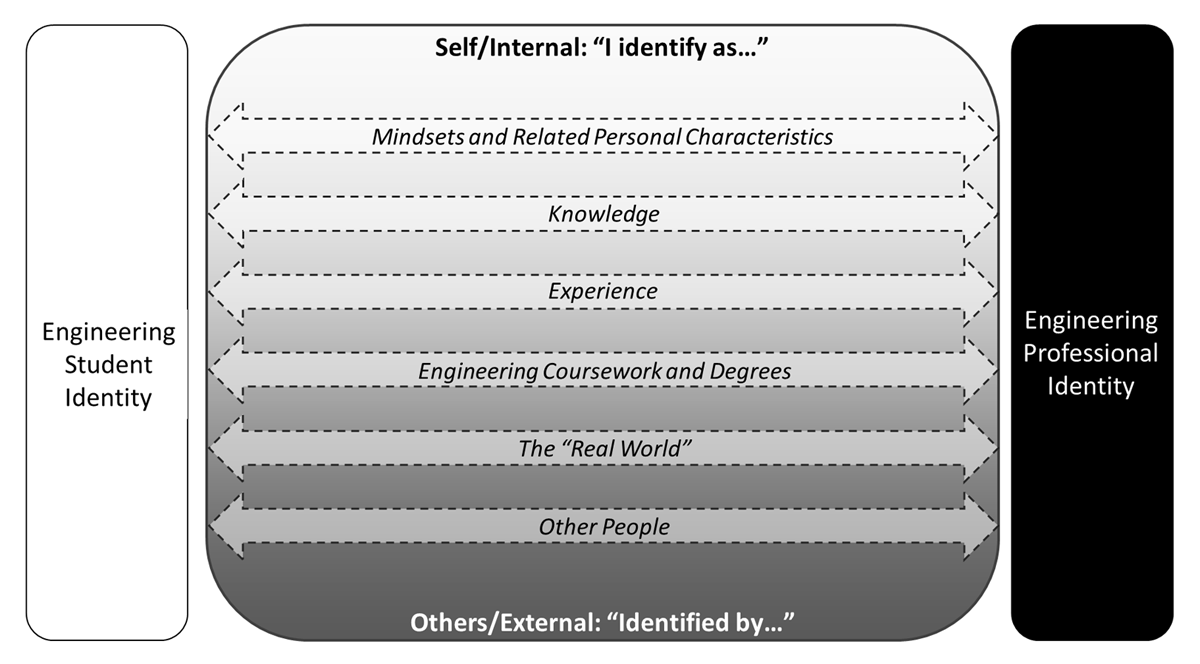
Figure 1
Framework of influences on liminal engineering identities. We assume some progression from “Engineering student identity” generally but not uniformly towards “Engineering professional identity” that is shaped by the six categories arising from our data. Some categories are more driven by the students themselves, whereas others are shaped more by external people and forces, though data suggests that most categories are informed by both. Bi-directional arrows indicate that movement can be in either direction.
Finally, we acknowledge that the boundaries between these categories are porous, and many student responses inevitably straddle multiple categories. In the category descriptions that follow, we occasionally point out the interplay between multiple categories that emerges from some students’ perspectives. At the end of our findings, we also share a few select student responses that exemplify this interplay between some categories.
Category 1: Mindsets and Related Personal Characteristics
In our data, we see many instances in which students explain how they exhibit characteristics of being an engineer through possessing certain mindsets. By “mindsets,” we refer to the goals, attitudes, values, and objectives that our focus group participants identified as shaping their engineering identities (or lack thereof).
Some students perceived their mindsets and personal characteristics as reasons for them not having complete engineering identities. For example, in one Projects focus group, one participant contrasted her views of what is expected of engineers with her own personal strengths and interests:
I would identify as an engineer. Partially because of how I look at situations and how I think about things, but it’s also kind of where I don’t identify as an engineer. […] The stereotypical engineer is very logical, math- and science-oriented, but I really enjoy a lot of creative writing or reading and just anything that will take me to a different world or universe instead of just staying in this one. And that doesn’t normally fit with engineering. (Becca, Projects, Fall 2018 FG1, 22:23, 22:38)
Becca referred to some of her personal characteristics (e.g., how she “look[s] at situations”) as contributing to her engineering identity, and other characteristics (e.g., her enjoyment of creative writing and fantasy) that led her to not identify as an engineer. Another participant in the same focus group, Emily, then built off her. Emily first identified as an engineer but then quickly relocated that engineering identity in the future. She said, “I feel like my strengths lie in other things [besides science and engineering]. And I’m working on building up these strengths, so it’s probably gonna take me a while to actually feel like I am being an engineer” (Emily, Projects, Fall 2018 FG1, 23:45, 24:03). Emily’s choice of words, “being an engineer,” conveys just how far she saw herself from an engineering identity. She did not say that it would be a while before she feels like she is an engineer. Rather, she said it will be a while before she feels like she is “being an engineer,” a phrase which implies another perceived layer of separation between where she was in the present moment, where she will be in the future, and an engineering identity.
Other students saw their mindsets and characteristics as positively contributing to their engineering identities, with varying degrees of confidence in such identities:
For me, the reason for the upward trend [toward an engineering identity] is I just think of my attitude before school and then how it’s changed up to this point, and I feel like I approach things from a much more problem-solving mindset. Like when I hear about a problem, I’m always immediately inclined to start thinking about the inputs and the outputs and what the possible solutions might be. (Baphomet, Electromagnetics, Spring 2020 FG1, 24:06)
Baphomet’s response pointed to a liminal identity, as he situated himself in the process of becoming an engineer (with a qualifying phrase, “upward trend”). Other students referenced the way they think or their imaginations as contributing to the liminality of their engineering identities—helping them to identify as engineers, even when other factors caused them to place limits on those identities.
In contrast, one student, Jerry, had a very secure engineering identity, which was rare for Projects students like himself. He explained that he already had some of the mindsets (e.g. the motivation to be an engineer) due to being an older student, and he had acquired additional mindsets in his introductory courses:
I would say I do identify as an engineer, coming from a slightly different background where I’m going back to school later in life, and it’s for the explicit goal of getting into the engineering field. With the limited engineering classes I’ve taken so far, it’s already got me thinking about problems from the perspective of design, iterate, prototype, and just that mindset is what I think helps me identify as an engineer. (Projects, Fall 2019 FG1, 00:23:54)
In summary, we observed students cite their mindsets and related personal characteristics as both contributing to the development of their engineering identities and as hindering the development of such identities. In nearly all cases, when students discussed the connection between their own traits and characteristics and their engineering identities, the language they used was very self-focused, leading us to place their self-identification closest to the internal side of Figure 1’s internal-external spectrum. However, student understandings of the mindsets and other characteristics required to be engineers are shaped by both internal and external sources. This leads us to conclude that even in a very internally focused category such as this one, the external influences of others—in this case, the messages received from others about what it takes to be an engineer—are still at work.
Category 2: Knowledge
This category captures instances in which students hedged their engineering identities by stating that they did not yet have sufficient engineering knowledge to have secure engineering identities. Though this category clearly relates to another one proposed in this paper, Engineering Coursework and Degrees (Category 4), they differ in the following way: this Knowledge category explores the references students would make to either the broad idea of engineering knowledge (often using words like “know” or “knowledge”) or to specific technical content or bodies of knowledge that they perceive as relevant to their engineering identities. This contrasts with the Engineering Coursework and Degrees category, which encompassed references to specific classes, curricula, or other formal academic contexts.
In the data that contributed to this category, we saw a distinction between how the students from lower division courses (Intro to ME and Projects) described the need for engineering knowledge compared to the students from the upper division course (Electromagnetism). Students in the lower division courses tended to emphasize the acquisition of knowledge as key to their identities. For example, Penny said,
I just feel like I couldn’t call myself an engineer yet, because I don’t have the knowledge yet that I think an engineer should have. (Projects, Fall 2019, 23:07)
She did not elaborate on how she developed a sense of what knowledge an engineer “should” have, but it is clear she has incorporated this sense into her own engineering identity. Here, we again see how the external messages about engineering that are communicated to students influence how they see themselves and self-identify.
Similarly, some students said that they did not yet possess the engineering knowledge to have a full engineering identity, but that they did possess other traits—namely, motivation—which led to a partial, liminal engineering identity:
I feel like before you even come to college, you’re sort of halfway there at engineering, because, yes, half of it is knowing thermodynamics and knowing what designs will work, what designs won’t work, but the other half of it is the ambition, the want to do something, the creativeness. […] It’s not just pure knowledge that is the only valuable thing. (Bob, Intro to ME, Spring 2019 FG1, 24:05)
We see Bob comparing his perceived lack of content knowledge (which hinders his engineering identity) with a personal characteristic that he points to as supporting his engineering identity. In Bob’s response, we see him differentiate between this Knowledge category and the previously described one, Mindsets and Related Personal Characteristics.
In comparison, students in Electromagnetics tended to emphasize more the application of their engineering knowledge (rather than just the acquisition of such knowledge) as key to further adopting engineering identities. For example, Jay identified as an “aspiring engineer,” and continued,
I think that you’re an engineer when you start to apply all this stuff that we’ve been learning. And so, hopefully when I graduate I’ll be able to apply it, and then I can consider myself an engineer then. (Electromagnetics, Fall 2019, 26:00)
A few minutes later, he clarified,
I guess on my point it wasn’t really about the job aspect, it’s more of… Because like me personally, I haven’t done a whole lot of outside of school projects and stuff, which I would consider engineering then. (28:00)
Jay focused on how he would use the knowledge he has acquired in his engineering studies. He hesitated to identify as more than an aspiring engineer because he lacked the experience of applying his knowledge outside of school, which connects to the Experience category described next.
In this Knowledge category, we observe students talking about the acquisition and application of their engineering knowledge as reasons for their liminal engineering identities. Statements such as Penny’s “I couldn’t call myself an engineer yet” and Bob’s “you’re sort of halfway there” indicate evidence of liminal identities related to knowledge and a suggestion that they expect to gain that knowledge at some time in the future – and in turn, be able to claim more of an identity as an engineer. The frequent connections that students at varied points in the engineering curriculum made between knowledge and their engineering identities were unsurprising given the fact that engineering education tends to emphasize the process of learning content and frequently prioritizes it above the development of skills or mindsets (e.g. Felder, 2014; Felder & Brent, 2016; Jonassen, 2014; Trevelyan, 2014).
Category 3: Experience
In this category, students cited their lack of experience as a reason for their liminal engineering identities. We placed responses in this category when the student either used the word “experience” in reference to something they saw as a requirement for the achievement of an engineering identity (as was most frequently the case) or, more rarely, when they cited a specific form of an experience (like an internship) that contributed to the liminality of their engineering identity. For example, Roy epitomized this category when he said, “I feel like I just don’t have the experience yet to call myself an engineer” (Electromagnetics, Spring 2020 FG2, 34:28). Another student, Roxy, gave a similar explanation:
I don’t yet identify as an engineer because I am still a student and I haven’t had that much hands-on experience in the field I want to go into. I don’t know if I’ll feel it that way as I go further in my education or if it’s going to be the day I get the diploma or what it is, but at this point I don’t think I am. (Electromagnetics, Spring 2020 FG1, 18:35)
Similar to students’ preoccupation with acquiring engineering knowledge (Category 2), the emphasis that some placed on engineering experience as a precursor to engineering identities is unsurprising given a culture of engineering that values hands-on experience like that developed in lab-based courses and internships. And yet, the way the students talked about this need for experience is vague and general. No student in our focus groups offered any clues into what they think they will gain from such experience or why they believe experience is important. Rather, they see the need for engineering experience, broadly, as something required to be an engineer.
Category 4: Engineering Coursework and Degrees
This category focuses on the role that credentialing, such as completing specific coursework and degree programs, plays in students positioning their engineering identities in a liminal space. It also encompasses references that students made to their status as students progressing through a degree program or as engineering majors.
Multiple participants anchored their engineering identities in their present school environment or spoke generally about their status as students, including Roxy in her Category 3 quote above when she said, “I don’t yet identify as an engineer because I am still a student.” Another student, Rex, referred to herself multiple times throughout the focus group as an “engineering major,” and explicitly not an engineer:
I would consider myself an engineering major, but I wouldn’t just call myself an engineer, because I’m still on my way there. […] I need to have the degree before I can call myself an engineer, versus saying I’m an engineering major. [I’m] pretty confident in [calling myself an engineering major], because of the classes I’m taking. (Projects, Fall 2019, 00:23:25)
Responses like Rex’s (and other students who referred to themselves as engineering students rather than engineers) remind us that an identity of “college student” is largely synonymous with a liminal identity, as observed by other researchers (Field & Morgan-Klein, 2010).
As shown below, in addition to speaking generally about their status as students, our focus group participants frequently referenced specific aspects of the student experience (advancing through the formal curriculum by completing specific coursework and graduating with a degree) as relating to their liminal engineering identities. We organize the remainder of this section into two sub-themes related to these aspects.
Advancing through the curriculum
Students frequently cited their current status within the curriculum and having not yet completed certain courses as contributing to their liminal engineering identities. For example, Dakota identified as someone who is “really good at math,” but not yet an engineer because he has not yet taken upper-division coursework: “I would say I don’t really feel like an engineer yet, ’cause, really, thus far this is a sophomore-level class. For the most part, we’re just pretty good at math. Most of us haven’t really gotten too much into thermodynamics or fluid dynamics, any of that” (Dakota, Intro to ME, Spring 2019 FG1, 23:00).
It is interesting that we saw responses like these across all three courses that were a part of our study. Even as students progress to being juniors or seniors within a program, they still are influenced by the messages conveyed by demanding engineering curricula reinforcing that they are not yet engineers. We do note, however, that there were a few select instances when students referenced certain classes which strengthened their engineering identities. For example, Cleopatra mentioned that design classes “make me feel the most like an engineer” (Intro to ME, Spring 2019 FG01, 24:37).
Diploma/degree/graduation
Participants would frequently cite their future graduation as the time when they would be able to fully embrace an engineering identity, including Roxy (Category 3) and Rex (earlier in this section). Such references were much more frequent among the more advanced students in Electromagnetics. For example, Baphomet explained, “I’ve always tried to refrain from calling myself an engineer because at this point I’m only a student, but I have one semester left, and it is starting to feel more like an identity that is mine, which is cool” (Electromagnetics, Spring 2020 FG1, 17:59). Here, Baphomet referenced “one semester left,” which could be a reference to both his remaining coursework and the short time until he graduates. Jelly specifically referenced his graduation, saying, “The only thing that would lead me to say that I’m not [an engineer] is just I haven’t graduated and I haven’t worked an engineering job yet, just as a student” (Electromagnetics, Spring 2020 FG2, 32:55). His answer also connects to Category 3 (Experience), as he references both his completion of the engineering degree and his future professional role.
Both of these students’ comments are grounded in the present yet project into the future. We see here that students’ liminal identities are related to time, the anticipation of a forthcoming credential (engineering degree), and what students see as missing coursework and workplace experience.
In summary, this category encapsulates times when students explained their liminal engineering identities by referring to themselves as students or engineering majors (and juxtaposing that identity with a reluctance to identify as an engineer). It also includes instances when students would reference their progress through the engineering curriculum or their lack of an engineering degree as reasons for their liminal engineering identities. Of the six categories that emerged from our data, this one sits most comfortably at the middle of the internal/external identification spectrum used in Figure 1. We see students self-identifying as engineers—or deliberately not identifying as engineers—based on their progress in the midst of the engineering curriculum and on how close they are to completing their degrees and earning their diplomas. Yet, these markers of identity (the curriculum, an engineering diploma, etc.) are also constructed by other people such as faculty members, academic programs, degree-granting institutions, and accreditation bodies. The creation of engineering curricula and granting of degrees are manifestations of external forces identifying these students as engineers.
Category 5: The “Real World”
This category emphasizes the many ways that students’ notions of the “real world” influence their liminal engineering identities. Though many students used these precise words (“real world”), we also include responses when students suggested what the real world represents to them, including explicit references to professional work or to applications of their engineering knowledge that exist beyond any formal academic assignment or requirement.
Many students with responses in this category specifically discussed their lack of experience with real-world engineering problems:
[I identify as] an engineer-in-training […] because until we actually get work experience, the real world is way different than what we’re taught here. There’s going to be, I guess, obstacles that we’ll have to jump through and understand that the world’s not ideal and that we have to kind of adjust our way of thinking [about] problems to like try to balance that; and they try to teach us that here and tell us it’s not going to be exactly like it is on paper, but in reality we have no idea until we actually go to the workforce and see it for ourselves, firsthand. (Cheddar, Electromagnetics, Spring 2019 FG1, 23:54)
Here, Cheddar described himself as an “engineer-in-training,” and then went on to explain that he believes only work experience will be able to really teach him to account for the non-idealities that occur in the real-world applications of what he has learned in school.
As another example, Jane indicated that she does not yet consider herself an engineer due to a lack of experience applying her knowledge in real-world settings:
I definitely think that to consider yourself an engineer, you have to really at least focus on the actual application of solving those problems and doing that, and I don’t think I’ve done a lot of that yet. So I would also say not yet. (Electromagnetics, Spring 2020 FG1, 19:04)
Jane put forth a vision or perception of what engineers do—“focus on the actual application of solving problems”—and contrasted her own experiences with this perception. It is noteworthy that the majority of references to the “real world” were made by students enrolled in Electromagnetics (including Jane and Cheddar), which is the most advanced course of the three investigated in this study. We will discuss this trend more in the Discussion section.
Responses in this category show a preoccupation with what students know about the real world of engineering practice, and how their perceptions of the real world seem to influence the development of their engineering identities. This category tracks with other findings from our broader research study about how students and educators see the role of real-world examples in engineering education and how such examples relate to and differ from sociotechnical integration (Erickson et al., 2020).
In Figure 1, we placed this category closer to the external identification side of the internal/external identification spectrum because it seems to loom so largely for the students as an external entity that identifies them as engineers or non-engineers. At the same time, students also indicated and strongly implied that real-world experiences—and the knowledge, skills, and insights that emerge from them—are what are missing in them as people, so this category too has an internal dimension in shaping their self-perceptions of liminality.
Category 6: Other People
This category was used to classify instances when students positioned their engineering identities in a liminal space due to the input of other people. We see in our data other people identifying these students as engineers, or, in one case, identifying a student as not-yet an engineer. Many students described a family narrative that supported or encouraged their engineering identities:
Yes, [I identify as an engineer]. Mainly because I spent a lot of time working in the field and pretty much when my family talks about me, they’ll always mention, “Oh, he’s in engineering,” so […] it is already something that I would say I identify as. (Link, Electromagnetics, Spring 2020 FG1, 17:13)
Link connects here his experience working in engineering (Category 3) and his family’s willingness to identify him as an engineer (Category 6) as reasons for his own engineering identity.
One student, Cleopatra, described an interaction with recruiters at a career fair that left her with the feeling of not being an engineer yet:
I would agree [with not feeling like an engineer yet], especially with going to career fairs and talking to companies. As soon as they hear you’re a sophomore, they kind of shut you down and they’re like, “Well, we’d like to see these classes before we bring you in.” And so, I don’t know, it’s still frustrating at this point because I feel like, yeah, I put in so much work, but I’m not there yet. So I can’t call myself an engineer yet. (Intro to ME, Spring 2019 FG1, 23:22)
Cleopatra’s marginalization by recruiters places her in a liminal space. She feels like she has “put in so much work,” only to be reminded by other people that she lacks certain coursework in order to qualify for an internship. In this example, we see the interplay of many categories: the role of other people (Category 6) acting as gatekeepers to an experience (Category 3) which could cement Cleopatra’s identity as an engineer, and for those gatekeepers to not identify her as an engineer (yet) due to her lack of sufficient courses (Category 4). It also reinforces our earlier claim that often students’ identities take on a liminal quality due to the messages they receive from other, external forces about who is and is not an engineer.
This category is the closest to the external identification side of the internal/external identification spectrum in Figure 1. We see here how other people identify students as engineers, at times before they have even started their formal engineering education, and how that in turn influences the students’ own self-identification. We also see how the identification of a student as a non-engineer by a respected industry representative, namely a career fair recruiter, led that student to not identify as an engineer yet.
Interactions Between Categories
The six categories that emerged from our data show the diversity of how students described their liminal engineering identities and the wide range of influences on those identities. However, as noted occasionally in our descriptions of each category, there were instances when a student’s response could be placed in multiple categories due to the diversity of what they described. In addition, there were some responses where the categories seemed to be in conflict, with one supporting and another limiting students’ engineering identities. In this section, we highlight a few representative quotes that fall within multiple categories to illustrate these complexities.
One student, Dorothy, clearly connected her liminal engineering identity to her limited knowledge and engineering experience (Category 2: Knowledge and Category 3: Experience), her position within her engineering curriculum (Category 4: Engineering Coursework and Degrees), and her conceptualization of engineering work (Category 5: The “Real World”):
I do have some engineering experience, but I don’t think I could label myself as that because I don’t know enough, and I’m not confident enough that I could be like, “I could go out into the world right now and make a difference,” because I feel like I don’t have enough to back that, but I also agree […] that taking classes that help you think like an engineer, I think that those can make you feel more like an engineer, so in that aspect I think I’m getting there by taking these classes and being able to understand how to think and do projects like engineers. I think the Projects class is a great example of that, but I still agree that I’m not there yet. But I think definitely after I have my degree and I have more experience under my belt then yeah, I could call myself an engineer. (Projects, Fall 2019, 00:24:28)
In Dorothy’s statement, we see that her perception of herself as having as insufficient amount of engineering experience coupled with her beliefs about what is required to make a difference in the world hinder her willingness to call herself an engineer. Furthermore, Dorothy’s position as a first-year engineering student served to both limit her engineering identity—since she didn’t yet “know enough”—and bolster it, via the positive experiences in classes she had already taken.
As another example of the interplay between multiple categories, we can look at Mark, who discussed the engineering mindsets that he had while also talking about other factors that gave an element of liminality to his engineering identity:
I wouldn’t say that I feel comfortable identifying as purely an engineer because of a lot of the reasons other people [in the focus group] have been saying with the real-world experience. That being said, […] when I walk around and I see something new and I wonder how it works, and sometimes I can pull in a little bit from the classes and my concepts from the classes that I’ve taken. […] So I would say that I have an engineering mindset, but maybe I’m not necessarily a practicing engineer in the sense of the term. (Mark, Electromagnetics, Spring 2020 FG2, 00:35:08)
Mark described his ability to combine knowledge from classes with his engineering mindsets, which served to strengthen his identity. Yet, he also felt he lacked “real-world” experience. His answer drew from three categories (Mindsets & Related Personal Characteristics (Category 1), Engineering Coursework and Degrees (Category 3), and the “Real World” (Category 5)). In responses like Mark’s, we see that for some students, these categories served to mediate or neutralize each other, causing them to both identify and not identify as an engineer at the same moment in time.
Despite the complex interplay among them, the six categories identified in this paper each contribute uniquely to our understanding of how and why students position their engineering identities in liminal spaces. In particular, the distinctions between seemingly overlapping categories (for example, the Knowledge and Engineering Coursework & Degrees categories) aid us in discerning why students situate their engineering identities in a liminal space, as discussed further below.
Discussion
This paper aims to understand how engineering students discuss their liminal engineering identities. Our objective is to introduce the theory of liminal identities to engineering education research, providing researchers in the field with another way to understand and consider the ways engineering identities are developed in students. The analysis of our focus group data led to the emergence of six categories which describe the reasons and justifications that students give for placing their engineering identities in a liminal space. In this discussion section, we begin by comparing these six categories to prior frameworks that have emerged from research on science and engineering identity development. Such a comparison is critical to understanding how the concept of liminal engineering identities furthers existing research on engineering identity development. We then discuss some of the differences we observed between the responses given by students in the three different courses in our study and hypothesize what these differences may tell us about how liminal engineering identities shift based on a student’s progress through the engineering curriculum. Finally, we discuss the role of time in how students talked about their liminal identities.
Intersections between our categories and prior work on dimensions of engineering identity
Research on engineering identity has led to a widely used engineering identity framework with three dimensions: performance/competence, interest, and recognition (Carlone & Johnson, 2007; Choe et al., 2019; Friedensen et al., 2020; Godwin et al., 2013; Godwin, 2016). In our findings, we saw liminality manifest itself in our students’ responses in ways that align with and complement this established framework. This manifestation is evident in how the six categories characterizing students’ liminal engineering identities map on to these previously established three dimensions of engineering identity, as we describe here. We see this alignment between our findings and this existing engineering identity framework as an important validity check for our results.
Interest is defined by Godwin as “desire/curiosity to think about and do well in engineering” (2016, p. 3). We see interest playing a role most prominently in two of our categories, Mindsets and Related Personal Characteristics (Category 1) and the “Real World” (Category 5). The first category captures the goals, attitudes, values, and objectives that our focus group participants identified as lending liminality to their engineering identities. Interest intersects here specifically with regard to the values and objectives students possess and how these values/objectives mediate their engineering identities. The second category, the “Real World,” captures students’ notions of what engineering practice is like. Here, too, we see interest plays a role, as students’ understandings of the “real world” often serve to pique their interest in engineering.
Performance/competence is defined by Godwin et al. as, “an individual’s beliefs in their ability to perform effectively (e.g., on an engineering exam) and be competent in engineering (e.g. understand engineering concepts)” (2013, p. 51). We see this dimension overlapping with three categories of liminal engineering identities: Knowledge (Category 2), Experience (Category 3), and Engineering Coursework & Degrees (Category 4). In the Knowledge category, the students convey the vague sense that possessing specific—and largely technical—bodies of knowledge is required to have an engineering identity; if their grasp of this knowledge is incomplete or weak, they are not (yet) engineers. In their responses in the Experience category, we saw instances where the students implied that experience with engineering would allow them to bolster the performance/competence dimension of their engineering identities. Finally, in the Engineering Coursework & Degrees category, students demonstrate their competence and performance in engineering through the completion of courses and a degree. It is interesting that Carlone and Johnson (2007) emphasize that, in the context of science identity, performance often manifests as the ability to use certain tools and carry out certain tasks. By contrast, the students in our study did not reference specific engineering skills or tools in describing their liminal identities, beyond vague references to “hands-on experiences.” This may be because of the way many U.S. engineering programs prioritize engineering science courses (Lucena, 2005) at the expense of an emphasis on skill-building and hands-on experience.
Finally, the recognition piece of engineering identity has clear overlaps with Engineering Coursework & Degrees (Category 4) and Other People (Category 6). Recognition is defined as an individual’s beliefs that they are seen by other people (parents, professors, their peers) as a good engineer (Godwin, 2016), echoing the second side of engineering identification proposed by Stevens et al. (2008) (being identified by others as an engineer). Thus, we speculate that the recognition component of engineering identity actually cuts across all our categories of engineering identity, and most closely aligns with the vertical spectrum of our framework, which spans internal identification (identification by self) to external identification (identification by others).
As mentioned in the Findings section, the dual nature of identification discussed by Stevens et al. (2008)—identifying oneself as an engineer and being identified by others as an engineer—also serves as a useful lens through which to view our results. We found that the process of self-identifying as an engineer is influenced by internal engineering mindsets, perceptions of the inherent qualities and characteristics aligned with engineering, and individual experiences as students traverse through years of acquiring engineering knowledge. Similarly, the process of being identified as an engineer by external entities has several aspects. Most obviously, it involves the acquisition of a degree—a formal credential—which is easily recognizable by employers and professional engineering licensing boards as a marker of “engineering professional” rather than student status. Completion of coursework as affirmed by their professors and engineering programs also constitutes external validation in route to becoming an engineer. Finally, our participants also mentioned the influence of other people, especially family, on whether they felt like an engineer or not at any given point.
Differences in student responses across courses
The broader project from which this paper stems provided the opportunity to compare student perceptions across three engineering courses offered at different timepoints in an engineering degree and across different majors and two universities. The analysis described in this paper was not intended to make comparisons across the students in the different courses. However, it was difficult to avoid making such comparisons. Here, we outline one of the biggest differences we saw across courses—namely, how students referenced time or specific points in time (past or future), in relation to liminal identity. We then relate our observations to prior work on identity development.
The most notable differences we saw were in how the Projects students (primarily first-year students) and the Electromagnetics students (primarily third- and fourth-year students) discussed time. In general, the Projects students seemed very focused on the present, rather than their future selves. For instance, one student, Rex, referred to herself as an “engineering major,” and explicitly not as an engineer. It may be harder for these students, so early in their college careers and in many cases not yet enrolled in a specific major, to project themselves into the future. References that Projects students did make to the future were most often made in the context of students relating their present selves to anticipated future events (such as classes they might take, experiences they might have, or knowledge they might gain).
By contrast, the Electromagnetics students seemed to be imagining their present-future connections much more. This may be because, compared to the Projects students, these students were relatively close to milestones like graduation and starting their professional careers. Another key distinction between the Projects and Electromagnetics student responses is that the former included more vague allusions to future events and/or growth, whereas the latter were more detailed, specific, and concrete. This finding aligns with results from the work of Kirn and colleagues, who similarly found that engineering students’ views of the future correlated with how far they had progressed through their engineering degrees (Kirn et al., 2014; Kirn & Benson, 2018). In addition, the Electromagnetics students possessed an almost singular obsession with the “real world”; the vast majority of references in this category are made by these students. This seems to support our conjecture that anticipating the demands that will be placed on them in industry or career contexts is a more pressing concern among these third- and fourth-year students than among the first and second-year students in the Projects and Intro to ME courses. We wonder if these students perceive engineering differently because they are currently at different points in the engineering curriculum, and thus are identifying with different pictures of engineering (Chachra et al., 2008). These findings on present-future connections also echo previous work, which identified engineering student perceptions on the point in time when one knows that one has become a professional engineer, including tangible markers such as a degree or job title, external approval via a job assignment or relatives and co-workers, and internal qualities such as technical competence (Loui, 2005).
Such differences between the courses, however, could also be due to other factors, including the gender breakdown of our participants. We note that 75% of our Projects focus group participants but only 16% of those from Electromagnetics were women, potentially leading to a bias in the overall responses in the focus groups for one course compared to another.
The influence of time on liminal engineering identities
In addition to participants’ perceptions of time serving to differentiate responses between the courses, the concept of time also influenced our analysis broadly as we developed our framework. In early stages of our analysis, we had time as a seventh, stand-alone category in Figure 1 describing how students referenced their liminal identities. However, we came to realize that in all of the utterances that made up that category, time was always referenced in addition to some other influence; students would often reference the coursework, knowledge, or experience that they would acquire at some later time. For example, both Dakota’s and Emily’s quotes in Category 4 illustrate the impact of time on their acquisition of knowledge or completion of coursework, using phrases like “right now” and “later on” to contrast where they felt their knowledge was presently and where they anticipated it being in the future.
Because students did not discuss time completely independently from the other categories that emerged in the data, we eventually removed it as its own distinct category. The unfolding of time was an ever-present backdrop to their engineering identities, and yet was not in and of itself a reason that students cited for occupying a liminal space. Instead, what we saw was that the progression of time did not imply a continuous forward march on the path to a secure engineering identity. As shown in Figure 2, as time went on, students sometimes moved back and forth between identifying as a student (or non-engineer) and as an engineer or engineering professional. Such movement could be due to experiences solely within one category, or due to the interactions between categories. As an example of the former, we can look to many of the Electromagnetics students who, despite being only a few semesters from completing all the courses required for their degree and graduation (Category 4: Engineering Coursework & Degrees), were often hesitant to embrace an engineering identity. This apparent contradiction may be because the longer they spent in engineering education, the more they came to revere real-world experience and the more they perceived themselves to be lacking such experience (Category 3: Experience and Category 5: The “Real World”). In effect, there is also a liminality between categories, with students being closer to having engineering identities when they considered one category, yet further from such identities in light of another.
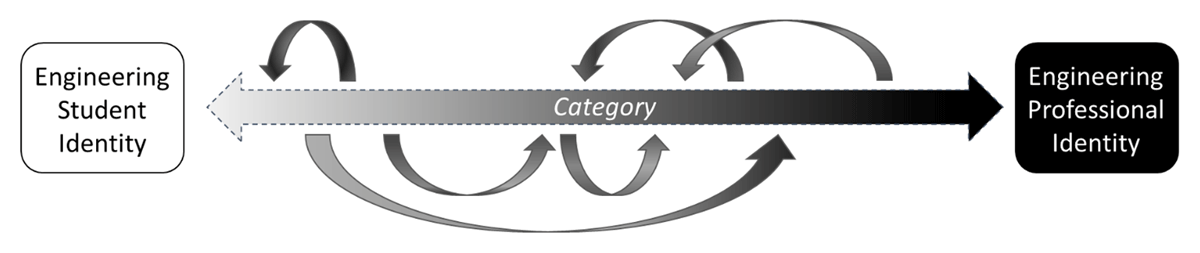
Figure 2
Although Figure 1 implies a single bidirectional spectrum from student identity to engineering identity to maintain its readability, in reality the data suggest a fair amount of shuttling back-and-forth in time along each category, as visualized for a single generic “Category” here.
The fact that a transition in time is not perfectly synonymous with a liminal engineering identity also serves to emphasize one of the main contributions of this work to our understanding of engineering identity development. Our findings are not focused on the mechanics or the process of developing an engineering identity. Rather, liminality can be used to describe and understand a space along a continuum between an engineering student identity and an engineering professional identity that exists for many engineering students.
This point resonates with how Carlone and Johnson (2007) present science identity as a path with coherence, but without a fixed course or destination: “Our labels for different science identity groups highlight an identity as a path or a trajectory (Wenger, 1998). We do not want to imply that the trajectory has a fixed course or destination, but rather that it ‘has a coherence through time that connects the past, the present, and the future’ (Wenger, 1998, p. 154)” (2007, p. 1197). In our model, we see that the students are certainly aware of the progression of time, but that time by no means guarantees the future acquisition of an engineering identity. In other words, not every student will emerge from this liminal space with an engineering identity. Carlone and Johnson remind us that identity is a trajectory without a “fixed course or destination” (2007, p. 1197).
Conclusions and Future Research
As articulated in prior research on liminal identities, many engineering students find themselves betwixt and between two identities, a point that resonated with this paper’s authors negotiating our own identities near the boundaries of engineering. In most cases in this study, our students identified as “not yet” engineers—as primarily having an engineering student identity—and at the same time, they described characteristics of an emerging engineering professional identity. Both internal self-identity and external sources shaped their emerging sense of themselves as (future) engineers. Figure 1 indicates a complex, overlapping, dynamic interplay between internal and external factors in co-constructing their emerging identities. That interplay exists in varying degrees within each of the six categories identified in this work.
The broader implications of our study emerge in realizing two key ideas. First, the study supports the idea that engineering identity has a both/and quality to it rather than an either/or one: students can and frequently do occupy a liminal identity space where they identify, at the same time, as both an engineer and not yet an engineer. Conceptualizing engineering identity as an either/or duality oversimplifies the complexities inherent in identity formation; future research adding to the understanding of these complexities could be valuable to engineering curriculum and professional development. Our work aligns with research carried out by other researchers who similarly theorize that engineering identity can be formed, but that this formation is neither uniform in how it is experienced by different people nor an either/or prospect (Godwin, 2016; Godwin & Kirn, 2020; Kirn & Benson, 2018). Second, the study shows an intricate and intersecting multiplicity of ways in which students construct and justify their emerging engineering identities, as well as provides their reasons for reticence in fully adopting an engineering identity. This complexity has been alluded to in Morelock’s systematic literature review of engineering identity, in which he calls for the use of additional research methods that measure engineering identity beyond “a simple binary observation via tangible markers,” as such measures undermine, “the complex nature of identity” (2017, p. 29). The work described in this paper helps expand this more nuanced and fragile picture of engineering identity (Carlone & Johnson, 2007; Kendall & Joslyn, 2021).
Future work could interface this study’s focus group data with empirical observations of students in various contexts of their engineering education, such as while solving closed-ended problems, defining and framing open-ended problems, or working in teams. Connecting student self-reported focus group data with observational data can help researchers explore whether other, perhaps implicit, factors are at work in co-constructing or mitigating their emerging engineering identities. Future work in this vein could also explore if different levels of student identification with a liminal engineering identity are differential indicators for their likelihood to persist in engineering. Greater understanding of how central engineering identity is to individual students in connection to how they view and experience their liminal engineering identity development could provide insights into how students self-regulate these identity aspects throughout their undergraduate experience, including considerations of interest and performance/competence (Godwin, 2016; Godwin, 2013) that can be crucial to intrinsic motivation and persistence through engineering programs and persistence.
Beyond the research elements related to liminal identity development, increased understanding in this area might support improved academic programs. Engineering educators can use the understanding developed in the current and future work to think about which aspects of liminal engineering identity could be protective or help students cope with setbacks or obstacles as they are becoming engineers and update courses and programs accordingly.
Future research could also explore whether curricular and extracurricular interventions might help to move students who hold a liminal engineering identity toward the “engineering professional identity” side of the continuum in Figure 1 and if so, what such interventions specific to liminal identities might look like. Caution is warranted, however, against framing liminal engineering identity as a “problem” to “fix,” as such problem-solution framing fails to capture the complexity and promise of understanding liminal identity spaces. Finally, future research could also explore the liminality of the engineering identities of practicing engineers or faculty. Such questions and others provide fertile terrain for future research on liminal engineering identity.
Appendices
Appendix A: Semi-Structured Focus Group Protocol
What score on a scale from 1 to 100 with 100 being the most useful undergraduate course and 1 being the least useful undergraduate course: How would you score this course?
Tell us more about what impacts that score? (What elements of the course did you consider when determining that score?)
Have you heard the phrase “sociotechnical engineering” previously?
Have you heard it in the context of (GEEN1400/MEGN200/EENG386)? What about your other engineering classes?
What does it mean to you?
Tell me some words or phrases that describe what you think practicing engineers do, think, and believe.
Do you identify as an engineer? Why or why not?
What values or attitudes do you hold that influence your identity or lack of identity as an engineer?
What did you learn in your (GEEN1400/MEGN200/EENG386) course, which you did not previously know, regarding sociotechnical elements of engineering?
How did your (GEEN1400/MEGN200/EENG386) instructor convey the concept of sociotechnical engineering?
What could your instructor have done to better prepare you as an engineer to consider sociotechnical elements of engineering?
How appropriate is it for engineering professors to teach sociotechnical concepts in technical engineering courses?
How appropriate is it for practicing engineers to consider sociotechnical concepts when designing engineering solutions?
Acknowledgements
The authors also wish to thank the other members of our larger research team.
Funding information
This material draws from work supported by the National Science Foundation under Grant No. EEC-1664242. Any opinions, findings, and conclusions or recommendations expressed in this material are those of the author(s) and do not necessarily reflect the views of the National Science Foundation.
Competing Interests
The authors have no competing interests to declare.
Author Contributions
Claussen led the conceptualization and writing of the manuscript and coordinated the associated data analysis. Tsai collaborated with Claussen on initial brainstorming for this study and co-led the analysis. Johnson led the overarching research project. Leydens contributed the initial idea of applying the theory of liminal identity to our data on engineering identity. Johnson and Leydens led the collection of the focus group data. All five co-authors contributed to the data analysis and conceptualizing and writing of the manuscript.