
Introduction and Background
Self-efficacy refers to individuals’ belief in their capabilities to perform a domain-specific task (Bandura, 1994). Bandura’s self-efficacy theory (Bandura, 1995) suggests self-efficacy plays a significant role in guiding human action and change by mediating influence on individuals’ interest in particular tasks, persistence in the face of obstacles, choice of behavioral activities, and task performance. Engineering-related self-efficacy referred to in this study is defined as students’ beliefs about their capacity to execute the behaviors and cognitive processing necessary to be considered an “engineer.” This includes, but is not limited to, their ability to execute engineering design, come up with solutions, communicate or teach others what they have learned, and understand what being an engineer means.
Significant efforts in engineering education have been made to understand students’ self-efficacy because of its demonstrated impact on student outcomes, such as academic achievement (Loo & Choy, 2013; MacPhee et al., 2013), interest (Czocher et al., 2020; Lent et al., 2008), and persistence (Mamaril et al., 2016; Sheu et al., 2018). Previous research on the sources of self-efficacy influencing engineering undergraduate students suggests the significant impact of pre-college engineering exposure (Fantz et al., 2011; Verdín et al., 2021). Examples of pre-college experiences include those in formal settings (e.g., pre-engineering classes, such as Project Lead the Way; Lammi et al., 2022) and informal settings (e.g., engineering hobbies; Main et al., 2022). Explorations of self-efficacy associated with pre-college experiences have primarily focused on undergraduate engineering students reflecting back, despite the importance of understanding students’ experiences in pre-college engineering programs. These studies provide valuable findings on how students’ self-efficacy in diverse engineering-related tasks impacts various outcomes. Much still needs to be understood about what contributes to the development of self-efficacy in each of the investigated tasks—the sources of self-efficacy. The extant literature suggests a clear need for further investigations of engineering-related self-efficacy with students currently in pre-college education settings.
Developing pre-college educational experiences for students and understanding how they can be effective sources of self-efficacy is of vital importance to ensuring successful outcomes during undergraduate years. This includes engineering major pathways shown to be influenced by pre-high school exposure and experiences with engineering, STEM-oriented clubs, pre-college internships within engineering, and/or STEM-oriented hobbies during high school (Main et al., 2022). Verdín et al. (2021) also note that an essential source of self-efficacy for first-generation college students is to engage in and associate tinkering experience around the house with an engineering education. It is evident that pre-college experiences act as sources of self-efficacy for students in their undergraduate studies, and that providing these opportunities to students can help them develop self-efficacy when studying engineering.
Very few formalized opportunities in engineering have been created for high school students. The Engineering for Us All (e4usa) curriculum was established and developed in 2018 as a series of courses to introduce and demystify engineering (Reid et al., 2020). This study investigates the impact of the e4usa curriculum on the multiple sources of self-efficacy for students as they advance through their pre-college education. Focus group data was used to determine themes that capture how high school students’ classroom experiences influenced their self-efficacy, and how each theme relates to the multiple sources of self-efficacy from Bandura’s theory (1994). The focus on self-efficacy highlights the importance of early exposure to engineering design and provides evidence for the effectiveness of e4usa.
Research Purpose and Questions
For more than two decades, engineering education researchers have investigated student self-efficacy beliefs in various engineering-related tasks, such as engineering design self-efficacy (Carberry et al., 2018) and engineering tinkering self-efficacy (Baker et al., 2008). Significant efforts have been made to understand students’ self-efficacy considering its demonstrated impact on student outcomes and other psychological constructs, such as academic achievement (Anwar et al., 2020), identity beliefs (Flowers & Banda, 2016; Syed et al., 2019), and motivation (Yusof et al., 2021). Despite the substantial body of self-efficacy research in engineering education, relatively little attention has been paid to the source of self-efficacy. The majority of the research has investigated the measurement of self-efficacy concerning academic tasks or performance (Aleta, 2016; Wu et al., 2020; Wu et al., 2021) or the relationships between measured self-efficacy with student characteristics, such as race/ethnicity, gender, group membership, and the like (e.g., Marra et al., 2009; Verdín & Godwin, 2018). While exceptionally valuable in understanding the role self-efficacy plays in engineering students’ experiences and success, these studies primarily focus on measuring self-efficacy that has already been developed and understanding its impacts, rather than investigating the mechanism of how and why self-efficacy can be developed through exploring the source of self-efficacy.
To bridge this gap, this study investigates the sources of engineering-related self-efficacy in the context of a pre-college engineering design curriculum, addressing the following research questions: (1) What perceived experiences are significantly related to students’ engineering-related self-efficacy? and (2) How are these significant experiences related to the four primary sources of self-efficacy from Bandura’s self-efficacy theory?
Theoretical Framework
This study uses Bandura’s self-efficacy theory (Bandura, 1994) as a conceptual framework for organizing and discussing the findings. Bandura hypothesized that self-efficacy within specific domains can be developed by four primary sources of experiences: (a) mastery experiences or performance accomplishment, (b) vicarious learning, (c) verbal or social persuasion, and (d) physiological arousal (Bandura, 1994).
A mastery experience refers to judgment of capability on a task, based on the interpretation of one’s prior experience of successes and failures on similar tasks (Capa-Aydin et al., 2018). Bandura’s theory posits that “successes raise mastery expectations; repeated failures lower them” (Bandura, 1977, p. 195). The impacts of success or failure on self-efficacy can be mediated by diverse factors, including the timing and context of the experiences and the difficulty level of the given task, which can create opportunities to develop self-efficacy through the practice of exerting control over the task (Bandura, 1997).
Contrary to mastery experiences that are based on one’s direct encounters with learning activities, vicarious experiences refer to the observations of others performing a task. While Bandura hypothesized that vicarious experiences have a relatively smaller impact on self-efficacy compared to mastery experiences (Bandura, 1994), empirical evidence suggests that vicarious experiences can be particularly effective in contexts where individuals cannot adequately recall or rely on their prior mastery experiences.
Verbal or social persuasions refer to reinforcements, both encouraging and discouraging messages, about the individuals’ engagement with a task, such as feedback, judgments, and appraisals, given to them by significant others (Capa-Aydin et al., 2018). Such sources are not strong enough to make a significant impact on self-efficacy, but they have been known to have a greater impact if they are synergized with mastery or vicarious experiences (Bandura, 1994). Bandura adds that verbal or social persuasions, such as the faith in a student’s capability expressed by peers and an instructor in a classroom context, are particularly impactful when people face difficulties in conducting a task and have doubts about their capabilities (Bandura, 1994).
Lastly, psychological arousal refers to the mental and emotional state of the student. A positive mindset can enhance a student’s self-efficacy beliefs, whereas anxiety and apprehension may negatively affect them (Bin Hasan et al., 2014). For example, emotions such as enthusiasm or anxiety associated with task performance can influence these beliefs, either positively or negatively.
Studies in higher and STEM education have examined the impacts of and interplay among the four sources of self-efficacy. The relative significance of each source’s effect varies depending on factors related to educational contexts (e.g., disciplines, educational levels) and student characteristics (e.g., race/ethnicity, gender, majority vs. minority group status) (Schunk & DiBenedetto, 2021; Usher & Schunk, 2017). There is a gap in the current literature on self-efficacy within engineering education given the identified importance of investigating the sources of self-efficacy in conjunction with research context (e.g., pre-college engineering experiences).
Literature Review
Many studies have been conducted exploring domain-specific self-efficacy within STEM, specifically in engineering contexts. The chosen work presented in this literature review highlights the significance of exposure to engineering and the interplay between curriculum and student group status in self-efficacy development.
Sources of Self-Efficacy in Engineering Undergraduate Contexts
Studies on the sources of self-efficacy within engineering education contexts have provided valuable insights into the impact of engineering exposure on engineering learner self-efficacy. Mastery experiences associated with understanding course materials (Hutchison et al., 2006), course performance (Usher et al., 2015), prior engineering- and technology-related classes, and engaging in related hobbies (e.g., programming, electronics, robotics) (Fantz et al., 2011) were confirmed to be the most impactful source on engineering-related self-efficacy. Vicarious experiences in the form of teaming, seeking help, and early exposure to engineering through family, media, or reading underscored the importance of mastery experiences. Social persuasion via peer support and feedback, as well as emotional states (e.g., enjoyment, interest, and satisfaction) were also revealed to impact self-efficacy. Despite the consistent significance, most research on sources of self-efficacy in engineering education rely on quantitative investigations situated within undergraduate contexts. This leaves students’ pre-college engineering experiences underexplored and open for in-depth qualitative exploration into the why and how behind existing quantitative findings.
Sources of Self-Efficacy through the Curriculum
Limited attention has been given to the interplay between curriculum and sources of self-efficacy in engineering education, despite more than a decade of research within the broader STEM education literature demonstrating its effectiveness (Czocher et al., 2020; Getachew & Birhane, 2016; Huang et al., 2020; Loo & Choy, 2013; Zakariya, 2022). Consequently, sources of self-efficacy research through the curriculum have not been researched as deeply in engineering education as it has in other STEM education disciplines. The few studies that have explored this space have shown impacts on self-efficacy driven by project-based course redesign (Godwin & Boudouris, 2020; Wu et al., 2021) and faculty encouragement (Hsu et al., 2021). The literature collectively presents the effectiveness and potential of using the curriculum, instructional practices, or teaching methods in supporting different sources of self-efficacy among engineering students with an opportunity to expand this work within pre-college settings.
Self-Efficacy for Underrepresented Students in Engineering
Existing literature on self-efficacy in engineering also highlights potential differences based on students’ characteristics. Mastery experiences, vicarious experiences, and social persuasion have been shown to play significant roles in developing self-efficacy among traditionally underrepresented minority students in engineering (Hutchison et al., 2006; Litzler et al., 2014). Underrepresented students who maintain strong family connections, build relationships with professors, and navigate the academic landscape effectively tend to have higher levels of engineering self-efficacy due to the influence of social persuasion (Dika et al., 2015). Students with double-minority status in engineering, such as being both female and African American, face increased barriers to self-efficacy development, underscoring the need to consider students’ underrepresented group status in self-efficacy research in the context of engineering education (Marra et al., 2009).
The current study aims to bridge the identified gaps in the existing self-efficacy literature by investigating the sources of engineering-related self-efficacy within a pre-college engineering design course. Specifically, we explore the mechanism behind changes made in students’ self-efficacy through the curriculum while considering student characteristics.
Context
The setting for this study occurred within classrooms around the United States teaching the e4usa curriculum. The e4usa curriculum was piloted in nine classrooms for the first time during the 2019–2020 academic year. Through 2024–2025, e4usa has involved more than 100 participating schools, impacting over 10,000 students. The initial course was designed and informed by a variety of pre-college engineering education stakeholders to provide a common engineering experience that demystifies engineering “for all.” The intended goal is to ensure that all students across the US understand what engineering is to democratize engineering education (Carberry et al., 2022).
The overall e4usa program consists of multiple sub-projects directed toward providing engineering education for students and professional learning for educators with all types of backgrounds. The curriculum was initially designed for the pilot using “big ideas” or threads. These threads allowed students to explore the “why” and “who” of engineering, rather than focusing on the specific technology of engineering disciplines. The four big ideas of e4usa at the point of data collection for this study are: 1) connect with engineering, 2) engineering in society, 3) engineering professional skills, and 4) engineering design. Connect with engineering explores what it means to engineer and be an engineer. Engineering in society examines the impact of engineering successes and failures on society. Engineering professional skills provide opportunities to develop and practice skills applicable to many aspects of life (e.g., communication and teamwork). Engineering design facilitates a process for identifying and solving problems that afford students hands-on experiences. The latest iteration of the curriculum now includes multiple pathways, including making, design, and programming. The interwoven threads embedded within the curricular units empower students to understand that engineering is everywhere, creative, human-centered, responsive, intentional, iterative, personal, and reflective. The learning experiences designed for each thread are intended to build students’ self-efficacy in engineering-related domains (Dalal et al., 2025).
Positionality Statement
The authors of this paper include principal investigators and research team members associated with e4usa. We aim to be transparent about our identities, values, and commitments and how we construct knowledge so that readers can more fully understand the context from which this research emerges. The first author is an engineering education researcher investigating the conceptual structure of, or mechanisms for developing, psychological constructs such as sense of belonging and self-efficacy. She identifies as an Asian cisgender woman with experience teaching engineering design courses at various levels in higher education. She joined the e4usa as a post-doc and later as a university faculty liaison, often interacting with students and instructors participating in e4usa. She contributed to the study’s design and played a primary role in data analysis and interpretation, drawing on her combined experience in research, teaching, and observations of participants from e4usa.
The second author, an Asian cisgender woman, is an engineering education researcher and a research co-lead on the e4usa team. She was involved in the study design, data collection and analysis. She worked closely with the first author and the graduate research assistant, often reviewing codes and acting as arbiter. Her experiences teaching engineering design for first-year students in higher education directly influences how she makes sense of curriculum design, student learning, and their experiences. She contributed primarily to the methods section of this manuscript.
The third author, who identifies as a White cisgender man, is an engineering education researcher whose work focuses on motivation and self-efficacy research. As a new member of the research team, they were not involved in data collection or analysis but have recently joined the e4usa team as a researcher and leveraged their knowledge to contribute to this manuscript. They relied heavily on their theoretical expertise and understanding of self-efficacy and its sources when developing the literature review. Their role on the manuscript was primarily writing the literature review section.
The fourth author identifies as a Korean American cisgender heterosexual male trained in vocational psychology and psychological measurement with over a decade of experience collaborating with engineering educators. He has studied self-efficacy in the context of engineering interest and persistence and contributed to the research program during the first phase of the e4usa. He primarily contributed to the initial development of the study and final edits to the manuscript, enriching the discussion on sources of self-efficacy.
The final author is an engineering education researcher, co-principal investigator, and a research co-lead on the e4usa team. He identifies as a White cisgender man. He contributed to the development and design of the program’s curriculum and professional development offerings. He brings his experience teaching engineering design for lower-division undergraduate students, his current role as an administrator for an engineering education unit, and his prior work in studying engineering design self-efficacy when engaging in this research. He primarily contributed to the initial development of the study as well as final edits to the manuscript.
As members of the e4usa team, we all have a shared and invested interest in the goals of the program. This embeddedness provides us with insider knowledge and a strong sense of commitment to its success. We also recognize that this closeness introduces the potential for bias or overly favorable interpretations of data. These possibilities were mitigated by implementing several strategies, including collaborative data analysis, reliability checks, regular reflexive discussions among the research team, and verifications with external colleagues. Most importantly, we have ensured that interpretations of study results were examined in light of prior self-efficacy theory and research.
Research Methods
This study was framed under a qualitative research design. Participants involved a subset of high school students (N = 470) who had enrolled in the e4usa course during the 2019–2020 academic year. This research was approved by the Arizona State University Institutional Review Board.
Institutional Sample
Research permissions were received from eight of the nine public (n = 7) and charter schools (n = 1) where the e4usa curriculum was piloted. The schools are geographically located in Arizona, Maryland, Pennsylvania, Tennessee, Virginia, and Washington DC. Participating schools were classified as a large city (n = 2), large suburban (n = 6), and remote rural (n = 1) per National Center for Education Statistics (NCES, 2020).
Data Collection
Data were collected over two focus group sessions conducted at the end of the Fall and Spring terms in all eight participating schools. The fall focus groups were conducted in person, while the spring focus groups were conducted online due to the COVID-19 restrictions. The sessions lasted approximately 45 to 60 minutes, depending on the classroom timetable. A single semi-structured interview protocol was used for both sessions. The protocol asked participants five questions to understand their engineering-related self-efficacy while probing for sources of self-efficacy and nuances behind the classroom experiences. The five questions were: (1) How well do you think that you understand what engineers do? (2) How certain are you that you could help design a solution to a challenge that requires engineering design skills? (3) Describe how confident you feel about going through the engineering design process. (4) Do you believe that you could help another student understand the engineering design process? If so, why? If not, why not? (5) How confident are you that you could learn what is required to become an engineer?
Participants
Teachers were requested to solicit students’ voluntary research participation by first collecting student assent and parental consent forms. A heterogeneous group of four to eight students for each focus group was recruited; diversity of gender, race, ethnicity, and differences in performance were considered when recruiting participants. A total of 80 students (40 females) across eight schools participated in the focus groups; 47 students (22 females) during the Fall session and 33 students (18 females) during the Spring session (Table 1).
Table 1
Participant Numbers Across Schools.
| SCHOOL LOCATION (TYPE) | FALL TERM FOCUS GROUPS | SPRING TERM FOCUS GROUPS | ||
|---|---|---|---|---|
| FEMALE | MALE | FEMALE | MALE | |
| Arizona (City) | 2 | 2 | 4 | 1 |
| Maryland (Suburban) | 2 | 3 | 6 | 2 |
| Virginia (Rural) | 1 | 2 | 2 | 2 |
| Washington DC (City) | 1 | 4 | N/A | N/A |
| Pennsylvania (Suburban) | 3 | 4 | 0 | 6 |
| Tennessee (Suburban) | 2 | 5 | N/A | N/A |
| Maryland (Suburban) | 6 | 2 | 5 | 0 |
| Maryland (Suburban) | 5 | 3 | 1 | 4 |
[i] NOTE: N/A represents locations where focus groups were not conducted due to COVID-19 restrictions.
Data Analysis
Qualitative data analysis followed an inductive, two-cycle coding approach (Saldaña, 2009). We selected an inductive, rather than deductive approach to surface students’ voices and context-specific meanings without constraining interpretation to a priori constructs. Using Bandura’s (1994) framework to code from the outset risked forcing excerpts into predefined categories and obscuring unanticipated themes or contradictions.
The qualitative research tool, Dedoose, was used for codebook development. Two members of the research team open-coded data units while also looking for repeated instances of the underlying concepts across the data units and transcripts (Corbin & Strauss, 2015). This process continued until coding saturation was reached, and no new codes were added with the analysis of the fifth transcript from the Fall focus group session. Similar codes were merged, higher-level coding categories were created, and a codebook was developed. Next, two other members of the project team coded the remaining three transcripts from the Fall session while looking out for inconsistencies in the codebook. Some code definitions were revised for further clarity based on the feedback. A graduate research assistant then coded the Spring session transcripts with the revised codebook and re-coded the initial eight Fall session transcripts. Credibility and rigor (Walther et al., 2013) were addressed by checking inter-rater reliability (IRR). We used Dedoose’s built-in IRR functionality. About 30% of the data units were randomly sampled across all transcripts and presented to the second coder as uncoded excerpts (original codes hidden). They independently applied the shared codebook to these units. Dedoose calculated IRR by comparing the second coder’s labels with the previously coded statements which was 81%, within the almost perfect range (81% to 100%) explained by Landis and Koch (1977). Remaining discrepancies were then reviewed to clarify code definitions. Finally, the codes were compared with each other to identify themes. Emergent themes were then aligned with Bandura’s four sources of self-efficacy to answer the research questions. We believe this sequencing of inductive coding followed by matching emergent themes with Bandura’s theory reduced confirmation bias and preserved student voices.
Limitations
The current study inherently has limitations that need to be acknowledged, as with all research. First, data collection was conducted at a subset of schools participating in e4usa, involving 80 students, which accounts for approximately 18 percent of the total participants during 2019–2020. Although the data includes experiences from students at most of the participating schools, we acknowledge that the findings do not represent the experiences of all participants concerning their self-efficacy and the e4usa curriculum. Second, method-related limitations include the use of focus groups, which may have led us to capture predominantly dominant opinions and voices. Unpopular perspectives may not have been shared during the discussion because participants might have been unwilling to go against prevailing narratives or viewpoints (Smithson, 2000). Third, while focus groups allowed us to collect data from a relatively large number of participants for a qualitative study, they limited our ability to link demographic characteristics to individual quotes in the findings, which could have enriched the discussions. Fourth, given the study’s focus on the interplay between sources of self-efficacy and the curriculum components of e4usa in developing self-efficacy, we recommend that future quantitative research examine the relationships between specific sources of self-efficacy and curricular elements. This recommendation is based on our findings, which suggest a potential influence of certain curriculum components on specific sources of self-efficacy, as well as the degree to which qualitative methods allow for causal interpretations. While these limitations exist, using focus groups enabled the research team to capture the collectively constructed understanding of students’ experiences with complex phenomena by observing how individuals communicated, agreed, or disagreed with one another. Given the current lack of research on sources of self-efficacy in engineering education, the qualitative nature of this study offers valuable insights by moving beyond quantitatively assessed levels of self-efficacy and providing an exploratory understanding of how curriculum components relate to self-efficacy development.
Findings, Discussion, and Recommendations for Practice
The results will be discussed in three subsections that address the research questions on the curriculum and course elements, while also providing evidence-based recommendations on instructional strategies for practitioners. First, the Findings subsection will present emergent themes from inductive coding to address the first research question exploring students perceived significant experiences related to their engineering-related self-efficacy. Second, the Discussion section will interpret the emergent themes to address the second research question. The four primary sources of self-efficacy from Bandura’s self-efficacy theory (1995) are used as a lens to gain a deeper understanding of the mechanisms of change in engineering-related self-efficacy underlying the observed interactions between the curriculum and course elements. Lastly, the Recommendations for Practice section will present instructional strategies to develop self-efficacy through effective course implementation. These strategies will be based on insights gained from the findings and provide suggestions beyond the curriculum design. Our results deviate from most self-efficacy literature in engineering education, which has focused primarily on assessing self-efficacy and its relationships with other constructs. Our study provides new insights into how to cultivate engineering-related self-efficacy by exploring the interplay between curriculum design and instructional strategies on opportunities for sources of self-efficacy.
Findings
Analysis of the collected data identified six themes that describe various elements of either the engineering design process or e4usa curriculum that played roles as sources of students’ engineering-related self-efficacy. The resultant themes include Hands-On Experience, Repetition, Step-by-Step Process, Coopertition (Competition + Cooperation) (FIRST, n.d.), Working with Clients, and Lack of Engineering Identity. The following sections present the themes organized by the four threads of the e4usa curriculum (i.e., Engineering Design, Engineering Professional Skills, Engineering in Society, and Connect with Engineering) to better understand how different topics or curriculum elements emphasized by each thread positively or negatively affect students’ experiences with engineering-related self-efficacy. Table 2 displays the descriptions and illustrative quotes of the themes, organized according to the e4usa curriculum threads.
Table 2
Emergent Themes, Descriptions, and Example Quotes.
| CURRICULUM THREAD | THEME | DESCRIPTION |
|---|---|---|
| Engineering Design | Hands-on Experience | Students’ perceived increased engineering-related self-efficacy through engaging in, or observing others, hands-on activities on the engineering design process in class. |
| Repetition | Students’ experience of repeating the engineering design processes in the course was either positively or negatively related to their engineering-related self-efficacy. | |
| Step-by-Step Process | One of the characteristics of the course curriculum that supports students in learning the engineering design process step by step which was perceived as helpful for developing engineering-related self-efficacy. | |
| Engineering Professional Skills | Coopertition (Competition + Cooperation) | Students’ perceived “good competition” that incorporates cooperation and communication alongside the spirit of competition, which was positively related to engineering-related self-efficacy. |
| Engineering in Society | Working with Clients | Interacting and communicating with real-world clients for the classroom engineering design project that boosted students’ engineering-related self-efficacy by guiding them to design viable solutions. |
| Connect with Engineering | Lack of Engineering Identity | Students’ doubts about their real-world design abilities outside the classroom were due to limited experience in mapping classroom learning to real-world design examples, which were negatively related to engineering-related self-efficacy. |
“Engineering Design” Thread
Hands-On Experience
Students frequently expressed that they became more confident about their learning of engineering or the design process by experiencing hands-on activities in class. Hands-On Experience is an essential element of the “Engineering Design” thread and was often described by students as “what makes it [the e4usa course] stand out” from other engineering-related, lecture-based courses that they had previously taken.
Many students noted that experiencing hands-on activities made them feel like “knowing what you’re doing, feeling what you’re doing,” which positively influenced their engagement in the engineering design process. One of the students further explained how the deeper experiential involvement with the design process impacted the students’ engineering identity, “But now, it’s different to be involved in the process and think of yourself. It kind of makes you think of yourself as an engineer, even if you’re not exactly, and it’s like I am solving problems.” In addition to hands-on activities in student learning, hands-on teaching practices are also described to help increase students’ self-efficacy in explaining the engineering design process, as it was stated by a student, “I think I am pretty confident about it [explaining the engineering design process]. I’ve heard the same thing she [teacher] said, teaching by doing it. Like explain it through the process by actually showing how it works because that’s the way I learn how to see [sic] how it works out.”
Hands-On Experience was also shown to help students to have positive emotional reactions (e.g., interest, excitement, etc.) to the course content as it was described by a student, “When you listen to it, you don’t think if [it] will be as fun as when you actually get to participate in it. So I think that [hands-on experience] is one of the best things about being here.” Students also shared how such emotional states contributed to their engineering-related self-efficacy. A student stated:
I feel like I feel more confident learning about engineering rather than other classes because I, here we go hands-on and we get to experience everything that we do instead of just talking about or taking notes all day, so they don’t lose our interest. So we will be really paying attention to what we’re doing. So I feel like I could really learn more, because I guess it’s really hands-on.
Repetition
Another theme connected to the “Engineering Design” thread is the students’ experience of repeating the engineering design process in the course, which showed a positive or negative influence on their engineering-related self-efficacy. A student expressed that they felt like they “could definitely be able to keep learning more about it [the engineering design process] and expanding” through the repetition of applying the design process to a series of engineering projects in the course. This student also stated, “I feel like, if I had more classes and more experiences throughout junior year and senior [year], I feel [like] I could become more confident [in engineering].”
In addition, repetitions of the engineering design process provided students opportunities to compile experiences that were perceived as either successes or failures in conducting the design process. For students who had perceived successful experiences in developing and applying the design process to solve engineering problems, these experiences played significant roles in building their engineering design self-efficacy. A student illustrated:
If I wanted to actually go about creating a product, and I followed this design process, I feel like I could. If I put in the effort and the time, I could probably, I’m pretty confident that I could get the project that [I] want to create [sic], or the concept like carried out. I feel pretty confident about it, like, I’ve been shown that the design process actually works and it’s a legitimate process, so I’m pretty confident.
On the other hand, students who had experienced perceived failures or made mistakes in repetitive course activities expressed negative consequences on their emotions or interests in the course activity (i.e., the engineering design process), which are factors linked to the development of self-efficacy (Bandura, 1994). A student stated, “Having it fail multiple times. It’s a little nerve-wracking,” illustrating the generation of negative emotional states (e.g., anxiety, frustrations, etc.) regarding the engineering design process. Another student’s description also indicates that the iterative nature associated with the e4usa curriculum and engineering design process can potentially make it difficult to sustain the students’ interests if the opposite of successes in the repetitive engineering design process is perceived as failures. The significance of positive perceptions towards failures or mistakes in developing students’ self-efficacy was also represented in a student’s description, “I think I could do it. I just need more practice and learning from, like, you know, like simple like mistakes. If I was very interested in that field, I think with all the things I learned in this class, I think I could do it.”
Step-by-Step Process
One of the characteristics of the curriculum associated with the “Engineering Design” thread is to help students learn the design process one step at a time, which was cited by participants as helpful for their learning and confidence. A student described, “I like the way the course teaches the steps through the innovation portal. It tells you what step you’re on and what time. So, I think that would [be] really helpful.” Breaking down multiple steps of the engineering design process, which can be regarded as initially complicated by students, into individual topics per course helped participants to perceive each step as relatively easier to digest. Another student cited, “Mr. X taught it to us. It seemed very simple and easy to learn, but it’s like complicated, but once you break it down, it’ll be [an] easier thing to grasp,” which consequently positively influenced the student’s confidence in learning the engineering design process.
“Engineering Professional Skills” Thread
Coopertition (Competition + Cooperation)
The shared perspective of the students suggests that setting ambitious goals for the team and collaborating with teammates towards the goals contributes to increasing their engineering design self-efficacy. A student’s illustration reflects that this theme not only represents competitive spirits between teams but also includes the concept of cooperation among teammates and growth as a teammate, which is closely connected to the emphasized elements of the “Engineering Professional Skills” thread.
I’m gonna say one thing I liked about this class, is that how we’re all equally competitive, but it’s not like, that competitive, where we’re all like… to each other, but it’s like a good competitive. We’re all invested in certain stuff. About how we’re all like talking about each other’s designs and how well all piggyback off each other, like designs and stuff, and how when we talk about, like, how there’s a lot of fun in this class when it comes to.
Students highlighted their feelings of confidence in being able to complete design tasks, which were fostered through coopetition facilitated by a collaborative team and positive team experiences. A student described, “I feel as though if I could choose my own team… If I could choose a team to help me with it, then I [would] feel pretty confident. But if I have to do it myself, I feel less confident.” Many students stated the significance of having teammates “who are committed to completing the task, people who can work well together and have good cooperation and communication skills” for a positive teamwork experience.
On the other hand, one of the students expressed challenges coming from unfamiliarity in working with others with differences in social identities, ideas, or work styles:
Go off what he said about teamwork, I think because this class is filled with many different, like, many different people we’re so used to working on, working with the same group of people. So for me, the challenge [is] working with different people I don’t really normally talk to. Because I mean, I’m, I’m so comfortable working with, like, the same group of people. I don’t really branch out with other people. So I guess that and having different ideas and having leaders, but I know I never really had a problem with having a leader in a group. But, um, I guess like getting to know people, especially since this is my last year being here.
Yet, the potential positive impact of such a diverse teamwork environment as a “positive challenge” was implied in the students’ continued description, “Getting to talk to people that I normally would just like, walk across the hall and not really get to know them. So I guess that’s a good positive, like a positive challenge in this class. I talked to students I normally wouldn’t talk to.”
“Engineering in Society” Thread
Working with Clients
The illustrative quotes suggest that many students viewed having clients in the classroom projects as boosting their confidence in being able to design viable solutions to engineering problems. This theme is closely related to the “Engineering in Society” thread, which aims to help students be equipped with a holistic perspective to understand the impact of engineering successes and failures by taking into account stakeholders, including real-world clients. A student’s description provides insight on which aspect of having clients in the e4usa course affected the students’ engineering-related self-efficacy: “We all came out more confident because we realized [we needed to be] more specific to a client. You have to ask different questions from just the regular or generic ones.” This quote explains how interactions and communications with actual clients throughout the design process to define a problem and understand criteria and constraints from the clients’ perspective contributed to the students’ self-efficacy in developing a tailored and viable solution.
Students viewed the incorporation of society-related components (e.g., client, community, etc.) as something newly introduced by the e4usa course. Similar to what emerged in the Hands-On Experience theme, the addition of the client component contributed to shifting students’ previous conception of engineering from a mere competition to a broader and more comprehensive problem-solving activity designed to help people. A student shared,
I feel like I would feel confident that we could come up with a viable solution. In the past for our engineering courses we just did competition, so introducing a client is new for this course, which I like a lot. It brings something else to it. But I feel like we would be able to give an eligible design.
“Connect with Engineering” Thread
Lack of Engineering Identity
Most themes are considered to positively relate to students’ engineering-related self-efficacy, except for the theme Lack of Engineering Identity. Despite students increased self-efficacy in the engineering design process through the e4usa curriculum, this theme captures the doubts some students had about their real-world design abilities outside the classroom, due to a limited understanding of what it means to be an engineer. This theme is closely related to the “Connect with Engineering” thread that aims to evolve the students’ understanding of and identification with engineering through regular reflective activities. A student stated:
The problem is that I have confidence in a classroom, but I feel like if I were to get fieldwork, really, something like that is gonna make me feel uncomfortable because I don’t understand my job outside of doing calculations or working on smaller projects or seeing a project through all the way to completion. So, I think that’s my problem there.
The student’s description reflects a limited connection between the classroom project work and the responsibilities of a real-world engineer, implying that their understanding of what it means to be an engineer had not yet evolved into identifying engineers as problem solvers in a broader real-world context, which involves their responsibilities as a “designer, creator, and manager of the entire system” (Rothschild, 2025, p. 4). This lack of proper understanding of an engineer seemed to be an obstacle to transfer learning by hindering applications of what was learned in “smaller (course) projects” to “get fieldwork,” impairing self-efficacy in real-world design ability.
Discussion
We address our second research question through a discussion of our findings considering the four primary sources of self-efficacy (i.e., mastery experiences, vicarious experiences, physiological states, and social and verbal persuasions) from Bandura’s self-efficacy theory (1995) as shown in Figure 1.
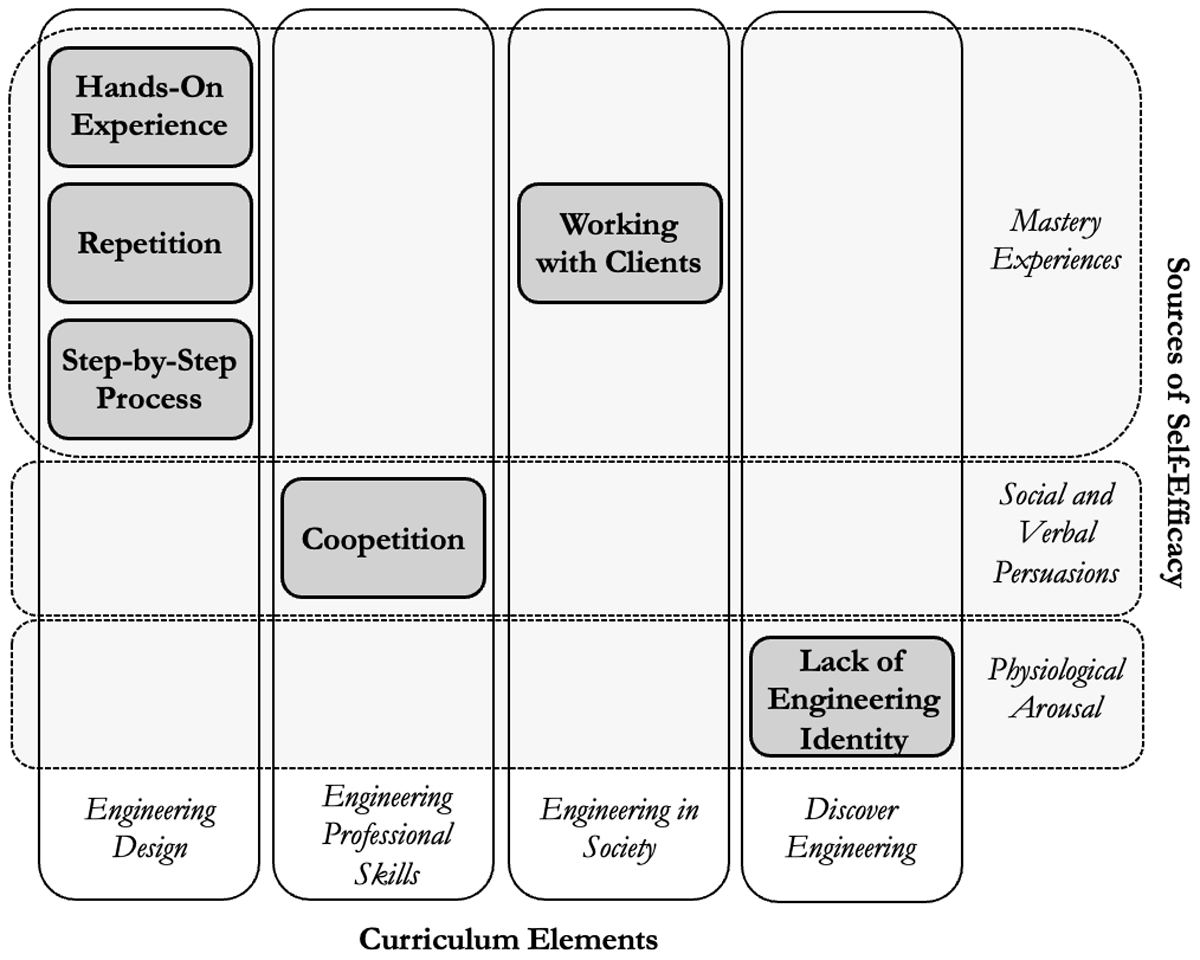
Figure 1
A Schematic Figure of Themes and Their Connections to Curriculum Elements and Sources of Self-Efficacy.
Our findings revealed that experiences related to specific topics or curriculum elements within the “Engineering Design” and “Engineering in Society” threads (i.e., Hands-On Experience, Repetition, Step-by-Step Processes, and Working with Clients) affect students’ perceived engineering-related self-efficacy. These experiences, for the most part, can be classified under Bandura’s self-efficacy theory as positive mastery experiences and physiological arousal. For example, learning to solve problems through hands-on activities on the engineering design process and first-hand experiences with real-world clients helped students understand what they are mastering by doing. Achievable goals designed for individual class units and multiple classroom projects throughout the semester further guided students’ learning by providing sufficient opportunities for repeated positive performance accomplishments, that is, mastery experiences, and associated positive emotional reactions (e.g., interest, excitement), relating to physiological arousal.
The team-based aspects of e4usa, represented through the “Engineering Professional Skills” thread (i.e., Coopertition (Competition + Cooperation)), are also associated with engineering-related self-efficacy through social and verbal persuasions, both positively and negatively. For instance, a “good competition” between teams that is centered on collaboration within each team offered opportunities for positive and encouraging peer interactions—social and verbal persuasion, through interactions like “talking about each other’s designs,” whereas it also posed challenges in interactions for students who are unfamiliar with “working with different people.”
While most of the e4usa threads, according to our findings, are positively related to engineering-related self-efficacy, some students described a lack of belief in themselves as engineers, which was interpreted as being associated with doubts about their engineering-related self-efficacy. For example, students described a lack of self-efficacy outside the classroom, particularly if they were to “get fieldwork” and solve real-world problems that were more complex than “smaller projects” in the classroom, which they felt they didn’t understand and thus believed they couldn’t accomplish enough as engineers. This self-doubt can also be explained in connection with vicarious experiences, as students may have had limited opportunities to observe someone similar to themselves accomplishing tasks that are complex enough to be perceived as professional engineering work. Thus, they view such tasks as well beyond their skills, negatively impacting their engineering-related self-efficacy. Engineering identity is a concern of the “Connect with Engineering” thread, which aims to develop an engineering identity, and our sole code for this thread is a negative one (i.e., Lack of Engineering Identity).
Designing Mastery Experience through Curriculum
Many emergent themes related to students’ engineering-related self-efficacy were relevant to mastery experiences, supporting the theoretical and empirical evidence indicating that mastery experiences are the most influential source of self-efficacy (Bandura, 1997; Bin Hasan et al., 2014; Van Dinther et al., 2011). Our findings further build on existing research by highlighting the significant role of curriculum design in providing opportunities for mastery experiences accompanied by diverse psychological reactions. This claim is not new, as argued by Ponton et al.’s (2001) theoretical work on integrating self-efficacy principles into engineering course design, but our findings advance this claim by expanding upon Ponton’s work, which is grounded in a traditional lecture-based engineering course setting and applying it to an engineering design course context with specific examples, as seen in the recent experiential learning literature (Steele, 2023). Accordingly, the discussions on the findings related to mastery experience will be guided by two key considerations in designing mastery experiences: “what to master” and “how to let students know what to master,’ as suggested by Ponton et al. (2001). In our context, the goals for mastery experience for engineering-related self-efficacy include students’ ability to execute an engineering design process, develop viable solutions based on real-world requirements and constraints, teach others their acquired knowledge, effectively work in teams, and understand what it means to be an engineer, per the e4usa’s objectives.
First, the themes of Hands-On Experience and Working with Clients showed how these curricular elements helped students better understand what to master, particularly concerning engineering design and the development of viable solutions, respectively. Hands-on activities tied to the engineering design process (Hands-on Experience), “instead of just talking about or taking notes all day,” provided students opportunities for deeper experiential learning experience of “know what you’re doing, feel what you’re doing.” The positive psychological states from the first-hand experiences, such as excitement and interest, motivated students to initiate and sustain their experiential learning of the engineering design process, enabling them to “feel more confident learning about engineering rather than other classes because I, here we go hands on.” On the other hand, the Working with Clients element of the curriculum, which includes the semester-long communications and interactions with actual clients, supported students in gaining mastery experiences of designing viable solutions through multiple opportunities to ultimately tailor the problem, criteria, and constraints to the clients’ needs successfully. These two curriculum elements, unique to the engineering design course compared to traditional engineering courses, were mentioned by students either as the best part of or the new component that students encountered in the e4usa. In line with that, the students’ experiences related to these curriculum elements, accompanied by the positive feelings and perspectives generated, contributed to their mastery experiences not only of the engineering design process but also in broadening their conception of an engineer as a problem solver for the greater good, rather than merely someone in a competitive job: understanding what it means to be an engineer.
Second, the synergistic incorporation of the Step-by-Step Process and Repetition elements in the curriculum ‘supported students in clearly knowing what to master’ in each unit and throughout the course, that is, “how to let students know what to master” (Ponton et al., 2001). Specifically, breaking down the engineering design process into manageable units (Step-by-Step Process) alleviated students’ feelings of being overwhelmed by their preconception of engineering as a complicated process by helping them perceive each unit as more manageable and easier to comprehend. Beyond its impact on students’ perceptions, setting achievable goals for each step encouraged students’ commitment to subsequent steps or projects by helping them accomplish the goals for earlier steps (Bandura, 1997; Ponton et al., 2001). This scaffolding effect of the Step-by-Step Process element in enhancing mastery experiences was further strengthened by another curricular element, the repeated small-scale classroom projects (Repetition). The incorporation of the Repetition element enabled students to build upon knowledge from earlier projects to achieve success in later ones, as evidenced by increasing engineering-related self-efficacy along with their progression through increasingly complex projects. For the study’s participants, most of whom had limited previous experience in engineering-related tasks, the incorporation of the Repetition element in the curriculum appeared to have additional impacts on their future self-efficacy in higher education by providing opportunities to establish “previous experiences of success” that would support their future engineering self-efficacy (Aleta, 2016; Britner & Pajares, 2006; Burnham, 2011).
Lastly, despite the established or increased engineering-related self-efficacy expressed in most themes, students still expressed persistent doubts or confusion about viewing themselves as engineers in the real world (see Lack of Engineering Identity), which, in turn, was negatively associated with their self-efficacy. The findings suggest students’ frustration with not being able to map their learning through the e4usa curriculum to complex real-world engineering examples they know about, as described by one student: “because I don’t understand my job [as an engineer] outside of doing calculations or working on smaller projects.” This means that even if students’ self-efficacy in engineering design and the associated problem-solving and professional skills were developed throughout the course, students may still have regarded their learning as insufficient to solve real-world problems as professional engineers, providing a potential explanation of this gap between engineering-related self-efficacy and identity. Students’ perception of a significant gap between their own experiences and those of professional engineers, coupled with uncertainty about what they still needed to learn, also helps explain the negative association between this theme and engineering-related self-efficacy with mastery and vicarious experiences. On the other hand, it is not unexpected that students’ engineering identities are at a nascent stage or not yet evident, given the life and academic stage of the participants, who are pre-college students. Identity development typically emerges and is shaped through experience (McLean & Pasupathi, 2012), and the e4usa course can be regarded as one such experience upon which an emerging engineering identity is built.
Barriers to a “Good Competition”
Beyond the curriculum elements related to the students’ direct encounter with learning activities, the project- and team-based course design played a role in creating a space for social and verbal persuasion, as shown mostly in the Coopertition (Competition + Cooperation) theme. The team setting created more opportunities to provide and receive feedback, appraisals, or judgement about their performance, as described in “we’re all like talking about each other’s designs” and “all piggyback off each other,” which collectively support, or hinder, the interpersonal mechanisms behind social and verbal persuasion (Baker & Galanti, 2017; Ponton et al., 2001). It is not surprising that the positive impact on vicarious experience and social and verbal persuasion derives particularly from a “good competition” that aligns with the findings from previous research (C. K. Baker & Galanti, 2017) on the impact of engineering design team experience on self-efficacy, both as a hindrance and support, for an undergraduate female student. Our study further sheds light on what characterizes or hinders a “good competition,” mainly cooperation and collaboration among peers integrated into a competitive context, and its impact on students’ experiences of social and verbal persuasion. The identified characteristics are particularly important in our context where students are uncertain about their abilities in a specific task due to a lack of prior mastery experiences or being in an unfamiliar environment, as their self-efficacy may then largely depend on the efficacy expectations expressed by others in a classroom through social and verbal persuasion (Hutchison et al., 2006; Kudo & Mori, 2015). The added significance of social and verbal persuasion in developing self-efficacy is also supported by the findings from research focused on underrepresented students in the context of engineering education (Litzler et al., 2014; Marra et al., 2009).
According to the findings, a “good competition” was described as one that incorporates perceived growth and fair competition through cooperation and communication, with the spirit of competition. The barriers to a “good competition” pointed out in our study include the interplay of students’ unfamiliarity with settings (e.g., teamwork, contents, tools, physical settings) and the challenges from being and working with “different people I don’t really normally talk to,” leading to poor team communication and project outcome, perceived failure, and thus, also impacting mastery experiences. The findings also highlighted what had contributed to students’ perceived unfamiliarity, with the most frequently mentioned being discomfort in working with people from different social identities, those they “don’t really normally talk to,” rather than differences in ideas or work styles. This further explains the additional challenges that underrepresented students in engineering face in an engineering design team, where they typically struggle to find the “same group of people” due to their underrepresentation, despite the added significance of social and verbal persuasion in developing their self-efficacy (Litzler et al., 2014; Marra et al., 2009) to overcome the uncertainty of unfamiliarity they may face more frequently.
Recommendations for Practitioners
The findings from students’ experiences also provided insights into the synergistic role of instructional strategies in developing self-efficacy through successful course implementation, which will be presented in this section as practical implications.
Shape ‘Positive’ Challenges and Failures
Despite the positive impacts of curriculum elements (e.g., Repetition) in generating opportunities for mastery experiences, the negative effects of multiple mistakes and repeated failures associated with these repetitive activities also emerged in our findings. Notably, the findings showed varied responses to failure or mistakes concerning engineering-related self-efficacy, depending on students’ perspectives on these negative experiences rather than the experiences themselves. For example, students who framed their unsuccessful experiences as “simple mistakes” in the learning process or as “positive challenges” in their first-time teamwork with diverse peers still expressed confidence in their self-efficacy beliefs. This contrasting impact can be explained by the developmental nature of self-efficacy, which evolves through a continuous, iterative process that is reciprocal with the learning process and can create positive or negative feedback loops depending on students’ perceived experiences (Bandura & Locke, 2003). It suggests an opportunity for curriculum improvement through instructional strategies, specifically, shaping students’ perceptions of negative experiences not as failures that are opposed to success in the repetitive engineering design process, but rather as an inherent part of the iterative nature of engineering design.
Tell Students “What to Master” and “Why”
Our findings showed a gap between students’ efficacy beliefs in the engineer’s core tasks (e.g., engineering design and problem solving in a team) and their self-efficacy in becoming an engineer in the real world, by failing to map their learning through the curriculum’s real-world engineering problem. Ponton et al.’s (2001) work that highlighted the importance of clearly stating the skills for mastery experiences—the learning objectives for the e4usa—and the reasons why those skills are important to master as core responsibilities of an engineer provides potential explanations on the reason for this disconnect. Consequently, the significant role of an instructor in clearly defining and communicating the tasks for mastery experiences while reinforcing the value of mastering these tasks for real-world engineering practice is suggested. This instructional approach will help students know that the concepts they master through their experiences in the techniques or components incorporated in the e4usa curriculum, such as Hands-On Experience, Repetition, Step-by-Step Process, Coopetition (Competition + Cooperation), and Working with Clients, are to prepare them as engineers, positively influencing their self-efficacy in becoming engineers. Considering that individuals’ occupational information, such as what engineers do and where they work in the study’s context, is one of the most effective career interventions reported in vocational research (Brown & Ryan Krane, 2000), providing more information about being an engineer could be a valuable recommendation for the e4usa curriculum to support the development of engineering identity.
Create Opportunities for Modeling and Interactions
Contrary to students’ experiences with curriculum components related to mastery experiences, relatively few negative experiences emerged in the Coopetition (Competition + Cooperation) component, which is closely tied to vicarious experiences and social and verbal persuasions. This highlights an area for improvement to help students expand positive experiences and overcome the identified barriers through curriculum revisions and instructional strategies. For instance, regarding positive experiences, the findings emphasized the beneficial impact of observing the teacher’s hands-on demonstrations on students’ vicarious experiences. This aligns with findings from Bettencourt (2021), which showed that lower-class students developed a greater sense of capability in completing their bachelor’s degrees by modeling the success of upper-class students, reinforcing the recommendation to incorporate instructional strategies that provide opportunities for modeling.
Contrarily, given the lack of evidence on vicarious experiences among peers in our findings, the e4usa curriculum could continue exploring ways to enhance student interactions within teams by structuring opportunities for students to observe their peers’ capabilities (Bettencourt, 2021), thereby fostering vicarious learning experiences. Furthermore, our findings suggest that additional support is needed to help students adjust to new teamwork environments and develop comfort, alongside scaffolding social and verbal persuasions in teamwork experiences. The discomfort students expressed regarding teamwork, which hindered their engagement, indicates the need for targeted interventions. Prior studies suggest the necessity of faculty oversight (Micari & Pazos, 2016) in team-based projects to enhance students’ self-efficacy and emphasize the importance of encouraging students to seek help. Additionally, the limited evidence of the instructor’s verbal persuasion mechanism in our findings suggests a need for instructional strategies that actively enhance students’ self-efficacy by verbally reinforcing their capability to complete desired tasks (Ponton et al., 2001) in a responsible manner.
Conclusions
In this work, we explored how various elements in the e4usa curriculum, designed to introduce high school students to the engineering design process, interact as sources of engineering-related self-efficacy. The six emergent themes from the analysis of focus group data with a total of 80 students participating in the e4usa curriculum highlighted key experiences that were positively or negatively related to their perceived engineering-related self-efficacy. A discussion of the findings provided insights into “how” and “why” different curriculum and course components contribute to the development of students’ engineering-related self-efficacy, grounded in the four primary sources of self-efficacy from Bandura’s self-efficacy theory. The findings and discussions collectively support our argument for the importance of researching curriculum design grounded in both students’ lived experiences (LaChapelle et al., 2025) and established theoretical frameworks. Despite recommendations on the need to design evidence-based curriculum from prior studies in broader STEM education (Borrego & Henderson, 2014; Krajcik et al., 2023; Merritt et al., 2022; Riley, 2014), this topic has not yet been widely investigated in self-efficacy research within engineering education. Prior work has primarily focused on quantitatively measuring what changes occur in self-efficacy as a result of curriculum implementation. Given that the current literature provides limited insights into the “how” and “why” behind the change, this study contributes to advancing the field by addressing the remaining questions about the mechanisms underlying changes in engineering-related self-efficacy and suggesting practical implications for designing evidence-based engineering design curricula.
Acknowledgements
In addition to the support of the e4usa team, the authors would like to express their sincere gratitude to Dr. Cathy Lachapelle for her invaluable guidance throughout this study. Her insightful feedback and expertise in STEM curriculum development were instrumental in refining the manuscript.
Competing Interests
The authors have no competing interests to declare.
Author Contributions
The paper presents ideas that the authors developed collaboratively. The first and second authors engaged in data collection and analysis, and all authors contributed to the writing and revision of the manuscript. Detailed roles and responsibilities for each author are described in the positionality statement.