Have a personal or library account? Click to login
Looking Through Students’ Eyes to Build Faculty’s Empathic Understanding: The Figured Worlds of the Audio for Inclusion Project Narratives Cover

Looking Through Students’ Eyes to Build Faculty’s Empathic Understanding: The Figured Worlds of the Audio for Inclusion Project Narratives

Open Access
|Aug 2026

Figures & Tables

Figure 1

Analytical Operationalization of the Theory of Figured Worlds (Holland et al.).
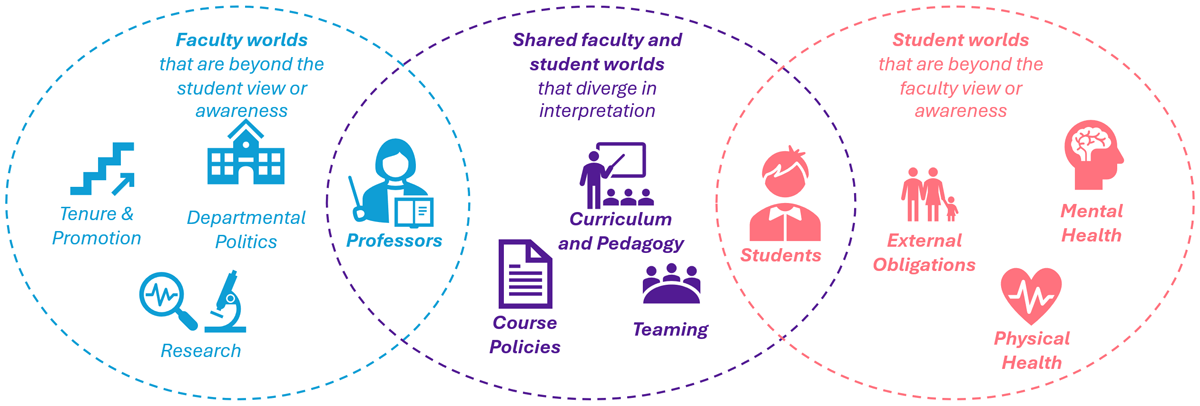
Figure 2

Faculty and Student Figured Worlds.

George

A Trans man with Anxiety and ADHD

Click to listen

Amber

A Transracial Adoptee from China with Anxiety and Depression

Click to listen

Enola

An Indigenous Woman with Hispanic Ancestry

Click to listen

George

A Trans man with Anxiety and ADHD

Click to listen

Enola

An Indigenous Woman with Hispanic Ancestry

Click to listen

Sophie

A White-passing Mixed-Race Woman

Click to listen

Srihari

An Asian international woman with epilepsy

Click to listen

Srihari

An Asian international woman with epilepsy

Click to listen

Sophie

A White-passing Mixed-Race Woman

Click to listen

Amber

A Transracial adoptee from China with anxiety and depression

Click to listen

Sophie

A White-passing Mixed-Race Woman

Click to listen

Enola

An Indigenous Woman with Hispanic Ancestry

Click to listen

Alejandro

A Hispanic Adult learner, part-time student, veteran

Click to listen

Jakobe

A Black man, first generation, housing insecure

Click to listen

Srihari

An Asian international woman with epilepsy

Click to listen

Alice

A Hispanic international student with anxiety and medical issues

Click to listen

Table 1

Practice Recommendations for Issues Raised in the Student Narratives.

TOPICAL WORLDPARTICIPANT/NARRATORCHARACTERIZATION OF THE WORLDRECOMMENDATIONS
ProfessorsGeorge
Amber
View of professors as scary and unapproachable
PedagogyGeorge
Enola
Norms are fast-paced and impersonal;
Ramadan and cultural considerations
Assignments and PoliciesSophie
Srihari
Accommodations policies;
Academic dishonesty
  • Take accommodations seriously (McCall et al., 2020, p. 86)

  • Follow policy and talk through accommodations personally

  • Consider how some disabilities fall outside our accommodation norms (McCall et al., 2020)

  • Consider how to accommodate individuals in group projects

  • Consider the scariness of academic dishonesty accusations and find the truth sensitively

Teaming and Student InteractionsSophie
Amber
Bias in team and homework groups;
Microaggressions
  • Believe students who tell you about biased experiences

  • Syllabus language and classroom announcements for inclusive norms (Zanotti, 2020)

  • Read between the lines of team evaluations, intervene in issues (Dickerson et al., 2024)

  • Connect inclusive students with each other to help form teams and study groups

Mental healthSophie
Enola
Mental health support is empty words;
Need for long term support beyond the syllabus statements
  • Syllabus statements supporting mental health are a good start, but may appear limited

  • Remind students of your commitment to mental health during midterms + deadline pressures

  • Follow up with students who reveal challenges to you, are things going better—have they talked to someone

  • Knowledge about challenges going on beneath the surface can help inform sensitivity (Sánchez-Peña et al., 2025)

  • Some challenges are not diagnosed, some are still too sensitive to share (Sánchez-Peña et al., 2025)

Poverty and post-traditional statusAlejandro
Jakobe
Outside obligations take up time;
Poverty and outside obligations can organize your life differently
  • Gain knowledge of and give flexibility towards older/post traditional students’ circumstances (Kali et al., 2024)

  • Poverty shapes ones’ thinking and may be sensitive to share about (e.g., scarcity mindset, Pearson, 2020)

  • Keeping class material costs low, policies for financial support

Health issues and international statusSrihari
Alice
International status makes medical challenges more challenging;
Some medical challenges are triggered by stress, require flexibility
  • Support creating policies to help international students find medical support

  • Consider how stress can trigger medical issues; being away from family can magnify that stress

  • Be sensitive when asking for medical proof for health issues, these issues are private

Illustration containing multiple aspects of a person
Illustration with a question ‘What is apparent in an engineering classrom?’
DOI: https://doi.org/10.21061/see.200 | Journal eISSN: 2690-5450
Language: English
Page range: 61 - 88
Submitted on: Dec 12, 2024
Accepted on: Mar 19, 2026
Published on: Aug 7, 2026
Published by: Virginia Tech Publishing
In partnership with: Paradigm Publishing Services

© 2026 Stephen Secules, Maimuna Begum Kali, Cassandra McCall, Gabriel Van Dyke, Vanessa Tran, published by Virginia Tech Publishing
This work is licensed under the Creative Commons Attribution 4.0 License.