
1. Perspective-taking as Inclusivity
We open with a question:
What would it take for faculty to become change agents for an inclusive engineering educational culture?
Perhaps the first answers that come to mind include: Faculty are typically ineffective or damaging regarding an inclusive culture, so they aren’t the source of change. Faculty don’t want to become change agents and don’t care about students. Faculty don’t have any training in this area and wouldn’t be effective without a change to the system.
We see these as partially true, although partially they take a limiting and deficit lens regarding faculty potential, just as diversity and inclusion scholars would advocate we avoid subjecting students to. We know that faculty are influential actors in the lives of their students (Cutler & Coso Strong, 2023). If we presume many faculty care, many faculty want to learn, and all faculty could learn, we can think again about this question in terms of what faculty know or know how to do and how they could take the next step in their learning about inclusivity.
To bring new insight to this topic, we incorporate an anthropological focus on faculty and student cultural worlds, which Holland et al. (1998) term as figured worlds. This lens shows how faculty in engineering education are interconnected with their students yet disconnected from them. They are interconnected because faculty and students often occupy the same physical space and interact regularly in the educational process. Faculty and students occupy the same worlds and are key players in each other’s worlds. At the same time, faculty are disconnected from their students, because faculty can be in the same space as students and may misunderstand them, misperceive them, misapprehend them. They are disconnected because certain influential experiences of students are hidden from the faculty view. Students may not tell faculty their deep challenges because faculty may not appear empathetic or have the time to listen, and faculty may not gain new empathy for students because they do not listen to them. One way to shift the culture of engineering education could be to help faculty better understand students’ perspectives, to help them see and understand students’ worlds.
This paper is part of a larger change-oriented broadening participation research effort to foster connection between the student perspective and faculty perspective through storytelling and audio-based dissemination methods (Kali et al., 2022; Secules et al., 2023). This paper’s specific purpose is to highlight the theoretical grounding of the project as it attempts to fill the empathic understanding gap between engineering professors and students. The paper presents excerpts from the audio narratives of marginalized and hidden identity1 engineering students to highlight the cultural worlds that faculty and students occupy. To help clarify how we conceive of this cultural landscape, we next present our theoretical framework.
2. Theoretical Framework
2.1 The Figured Worlds of the Engineering Classroom
The cultural theory of figured worlds (Holland et al., 1998) helps us conceptualize the multiple intersecting cultural settings at play in engineering education. Holland and coauthors’ theory of figured worlds emphasizes three principal parts: identity, culture, and agency. Culture is conceptualized as the overlapping “worlds” that we each encounter. The figured worlds contain within them certain norms, meanings, and identity roles that are expected and understood. The worlds are “figured” in that they have some subjectivity associated with them, the worlds are interpreted and understood by the people who participate within them, even as they are co-created by the collective. Within these figured worlds, certain identities are more legible and meaningful, or less; certain identities have more status and power, or less. In this way, figured worlds structure certain aspects of our participation and the roles/identities we carry in participation with others. While the relationship with culture and identity seems rather fixed (i.e., structured), the final component of the theory, agency, allows for the improvisation to adapt and undercut the rules, norms, and roles in the figured world.
Since any cultural space that carries rules, norms, and identity roles can be conceived of as a figured world, figured worlds are often overlapping conceptually and ontologically.2 Some figured worlds are conceptual domains, such as grading (Horn, 2007), campus identities (Tonso, 2006a), or marriage (Olson, 2015), while some others are physical spaces such as a classroom (Francois, 2024; Rainio, 2008). The figured world of a particular engineering classroom has rules, norms, and identity roles that relate to the figured world of the engineering discipline, and, even more, the figured world of engineering education. Some cultural aspects of engineering and engineering education include individualism, depersonalization, technocracy/meritocracy, depoliticization, competition, and a presence of White heteronormative masculinity (Cech, 2014; Secules, 2019). Thus, within the figured world of the engineering classroom, one of the norms is an emphasis away from the personal and political, a focus on technical content, and a tendency to look towards individual explanations for difficulties over collective/structural explanations. This figured world positions women and people of color as relative outsiders who are hyper-visible while positioning straight White men as normative/expected (Blosser, 2020; McLoughlin, 2005). Further, other identities (e.g., LGBTQ, disability) are positioned as even more hidden/invisible within the engineering educational context (Henning et al., 2019; Secules & McCall, 2019, 2020; Yang et al., 2021), because an overall culture of de-politicization and depersonalization (Cech, 2014) precludes sharing less apparent identities and personal lives. That is, if the working rules of the engineering classroom are to leave personal issues outside, students will not bring their whole selves into their education or view them as relevant to their education (Van Dyke et al., 2023).
2.2 Empathy to Foster Inclusive Teaching
Similar to Jaber et al. (2024), we position empathy and perspective-taking as a key ingredient in responsive teaching. For responsive or inclusive teaching to occur, a professor must know their students and understand what would be most conducive to their learning, what would be alienating, what particular challenges could arise, and they must balance these perspectives across their many varied student particularities. The mechanisms for supporting genuine responsive teaching to a particular group of students, then, could happen through intentional open communication to hear the perspective of students or through something more like a thought experiment, anonymous feedback, or offline study of issues affecting students. In a different classroom culture (e.g., many humanities seminars) where the mutual sharing about personal lives and their intersections with the content is normal, this empathy or perspective taking could happen through conversation.
In a typical engineering cultural norm of depersonalization, this open dialogue sharing about oneself is not expected or normal. The cultural norm of depersonalization creates a particular challenge for engineering professors to pursue responsive education; it is hard to respond to students we do not know or understand personally. A professor who wishes to change the depersonalization norm of the engineering classroom may encounter cultural resistance; even if they hold the most individual power within the cultural setting, they are working against a norm and a mental model students have for what it means to study engineering. Meanwhile, students experience challenges and marginalization, some of which are caused directly by professors or curricula or the structures of the classroom, while others are caused by peers, outside-of-class life, or personal issues. Professors themselves were once engineering students, who most likely navigated challenges by bottling emotions and not sharing with their professors (Secules et al., 2021). If the classroom is a primary space for creating inclusion for particular students, a de-personalized classroom will struggle to provide the necessary communicative groundwork to understand those students. Thus, the cultural rules at play within the figured world of engineering education may perpetuate a dynamic where a well-meaning but unaware engineering professor does not gain the empathic communication skills or communicative awareness necessary for creating responsive and inclusive education.
We recognize that the cultural reality in many engineering classrooms may not be safe for students to share vulnerably, it may not be advisable for an engineering professor to initiate such dialogue without training in how to foster and support inclusive dialogues. Thus, we conceive of the foundation of our study as simulating the type of communication an inclusive professor may hear about the perspectives and personal lives of their students to help other instructors understand, imagine, and perspective-take regarding their own students and identify ways to welcome other aspects of identity in the classroom.
3. Literature review: Overlaps and Disconnects Between Faculty and Student Worlds
We utilize this literature review (1) to further operationalize the theoretical framework by highlighting the respective cultural worlds of faculty and students and (2) to motivate the importance of research that can bridge the understanding between faculty and student worlds toward enhanced empathy and perspective-taking.
In defining faculty worlds, we highlight how many different types of faculty there are and how many different roles these faculty hold (Cutler & Coso Strong, 2023). For many of these faculty whose job responsibilities focus on research or administration, teaching and interacting with students may be a smaller or bigger part depending on that role. For others, as contingent faculty or teaching track, high course loads may limit their capacity for attending to these challenges or for professional growth. Coso Strong and colleagues’ (2023) work on faculty agency highlights the limited but significant agency of faculty who want to engage as engineering education change agents. As we conceive of influencing faculty and their capacity to support students, we recognize that diverse professional responsibilities and limited bandwidth are factors that constrain their roles.
Faculty’s lives are made more challenging by discrimination (Archer, 2008; Turner et al., 2008), job security (Benson et al., 2020), and global pandemics (Hilliger et al., 2023; Xia et al., 2022). New faculty also experience steep learning curves and fears regarding legitimacy in their roles (Amundsen & McAlpine, 2011; Archer, 2008). As faculty progress, they may be overloaded with additional responsibilities (Coso Strong et al., 2023) to the point they risk burnout (Sabagh et al., 2018). When we attempt to influence faculty through this project, we do so in light of these constraints and challenges. We can call attention to faculty to have more empathy or understanding for their students, but we need to recognize that for many faculty, they are fighting their own battles and students are not the sole or central characters in their worlds.
Nevertheless, much of the literature on faculty perspectives (e.g., on diversity, on teaching) showcases the ways faculty see students within their worlds. A growing body of literature has discussed educators’ perceptions of diversity in general (Cross & Cutler, 2017; Gordon et al., 2010), of a specific identity dimension (e.g., Beddoes & Panther, 2018; Blosser, 2020), or of inclusive pedagogical practice (Matters et al., 2021; Thiry & Hug, 2019). Additional literature interrogating the nature of faculty discourse has helped characterize the interpretive frames for faculty conceiving of equity issues (Gordon et al., 2010; McCoy et al., 2015). For example, Blair et al. (2017) highlighted the ways STEM instructors discussed gender equity, characterizing their views as gender blindness, gender acknowledgement, or gender intervention. These interpretive frames help indicate that not only are students key players within faculty worlds, but the ways faculty interpret or “figure” the worlds impact what they can “see” regarding their students.
Students also live within a number of cultural worlds, which are apparent in the literature. Student worlds highlighted in the literature include: teaming and student interactions (Tonso, 2006b), classroom and pedagogy (Gonsalves et al., 2016), accommodations/assignment policies (Lovett & Leja, 2013), grading (O’Connor et al., 2016), physical and mental health challenges (Priestley et al., 2022), outside student obligations (Kali et al., 2024), and legal/international issues (Chang et al., 2017). Some of these worlds prominently include faculty as key players with a high potential to influence students and as a topic of student interpretation. Classroom dynamics, which often prioritize speed to “cover” content, can send messages of a lower value of deep sensemaking (Danielak et al., 2014); for example, classroom dynamics that move quickly without repeating information may set implicit expectations that engineering students should learn quickly and accurately the first time (Secules et al., 2021). Other student worlds are significantly outside of the view of faculty, including the worlds of religious observances, outside employment, family obligations, and international student status.
Thus, the worlds of faculty and students are both subjective and intersubjective. Some worlds are intersubjective and overlapping in that they are interactive spaces wherein each party influences the others’ world; that is, faculty are participants in students’ worlds and vice versa. They share these worlds as physical spaces, but each likely have different subjective interpretations of the reality and their actions impact the other. Some worlds are distinct and mutually exclusive in that some of the worlds experienced by faculty and students are experienced separately and out of the view and understanding of the other party (e.g., student social lives and faculty promotion policies). While this sense of connection and disconnection has been highlighted in the literature (e.g., Lim et al., 2018, regarding contrasting student and faculty views of veterans), it has been relatively understudied, and it is rarely explicitly considered as a motivation for research and intervention to promote inclusivity in engineering education.
4. Research purpose and questions
In this paper, we ask an overarching research question that draws out the theoretical dimensions of the student narratives we generated as part of the Audio for Inclusion project (Secules et al., 2023) and additional component interpretive questions that directed our analysis.
What is the value of “looking through students’ eyes,” or what can student narratives reveal about the figured worlds of engineering education?
How do students narrate the worlds that are typically outside of faculty view?
How do students narrate the worlds that they typically share with faculty?
We leverage the metaphor of “seeing” to invoke the difference in perspective that comes from the different perceptions and positions of faculty and students and not as “seeing” in a literal sense. As a theoretical and student-centered exploration, we do not directly empirically interrogate the faculty perspective within this paper (although this is a formal and ongoing project activity). Thus, we do not empirically establish the difference between student and faculty views but instead use the student views to suggest a contrast with a faculty reader audience. To arrive at these interpretations, we drew on our coauthor positionalities as faculty, students, and other demographic identities to help identify the ways that the student narratives could surprise or inform faculty perspectives.
5. Method
5.1 Overarching Project Methodology
The paper highlights key insights from the Audio for Inclusion project, which is an NSF-funded project aiming to broaden participation in engineering (Kali et al., 2022; McCall et al., 2024; Secules et al., 2023). The project utilizes qualitative interviews conducted with undergraduate engineering students with marginalized, minoritized, and/or hidden identities. These interviews were then transcribed and analyzed using narrative techniques to develop narrative scripts that were later voice-recorded by student actors. These recordings, shared via YouTube, constitute an audio resource for faculty to gain insight about student experiences. Although the categories of marginalized and hidden identities can overlap, within marginalized identities we include apparent but historically excluded identity intersections such as being a Black woman, and within hidden identities we include identities that are generally non-apparent to others such as being autistic or LGBTQ (Secules & McCall, 2020).
As motivated earlier, we see an empathic communication gap between professors and students, and we see the potential for qualitative research to become a feedback loop that helps fill that gap. However, we think that qualitative research that is disseminated traditionally as long-form paper writing is unlikely to offer faculty the immediacy and accessibility that hearing directly from students would. On the other hand, there are reasons that private and painful experiences shared by students would not be shared directly with those professors who may not have established the relationship worthy of their trust. Thus, we set out to design a study that could preserve the privacy of students while allowing faculty to learn deeply from listening to their stories with the hope of inspiring broader efforts to create more inclusive experiences for all. Such approaches enable a single story to be shared and translated across faculty’s various institutional contexts and overcoming communicative barriers related to trust, rapport, and personal boundaries.
This project is framed as change-oriented research focused on broadening participation in engineering education (Secules & McCall, 2023), which is conceptualized in light of key stakeholder constraints, possibilities, and engagements to bring about change towards equity and inclusion. In our research design, we draw on both pragmatism (Foster, 2024) and critical theory (Secules & Mejia, 2021) to focus on practical impacts toward a more equitable world. Rather than a pure theorization, the theoretical frameworks we employ are leveraged to help us draw insight and impact that attempts to shift the world towards equity and inclusion. Our project draws on approaches and conceptions from both critical qualitative research and faculty development to produce research which is clear-eyed about documenting equity issues and attends to faculty learning about those issues in equal measure (Secules & Kali, 2022).
5.2 Positionality
The coauthor team included both faculty (Secules and McCall) and student (Kali and Van Dyke) researchers, both US and non-US nationalities, men and women, racial identities including White and Asian, and people who identify and people who do not identify as disabled and LGBTQ, respectively. As a coauthor and collaborative research team, we drew on these respective positionality perspectives to help us situate the findings in ways that highlight what may be surprising to faculty or insightful regarding the student experience or particular demographic perspective.
5.3 Data Collection
The data collection for the project consisted of 21 interviews with undergraduate engineering students with marginalized, minoritized, and/or hidden identities. We recruited nationally across the country using email addresses for offices of diversity, disability resource centers, education centers, and other contacts, requesting that those receiving the email forward them to any students who may be eligible and interested. We provided a recruitment survey consisting of primarily open-ended questions to help students identify for us their primary experiences of hidden or marginalized identities. We asked short versions of our interview prompts in these open-ended questions to help us gauge which students had a significant story to tell, insight about engineering education, and/or feedback for their professors.
The majority of our survey respondents and interviewees came from large public R1 universities. We chose to interview select participants who represented contrasting identity and experience perspectives and whose survey responses demonstrated a depth of critical thought about engineering education and its culture. We scheduled Zoom interviews in 60–90-minute blocks. The interview protocol had five major sections, with some follow-up prompts contained within them. The five major sections were: 1) establishing salient identities using a visual aid to help students reflect and explain the reasons these identities were salient in their lives, 2) discussing the stories of their identities in the engineering classroom, including hidden or apparent dimensions specific to engineering contexts, 3) probing things that they would change about engineering education or its educational culture, 4) providing any feedback for the professor, and 5) providing any advice they may have for students like them in engineering education. Questions 4 and 5 were developed to help end the interview in responsive but constructive ways, after the interviews could get somewhat heavy in topic #3. We developed question 5 specifically when, sometimes, students had no answers for question 4. Interviews were conducted by members of the coauthor team (primarily by graduate student researchers, with faculty mentors only helping to conduct a couple of pilot interviews) and reviewed by the entire research team for refining and mentoring on the interview process (e.g., identifying more articulate wording to facilitate in-depth conversation during interviews). We provide the full interview protocol in Appendix A.
5.4 Data Analysis
Participant interviews were transcribed using automated transcription tools and checked for accuracy by the research team. We iteratively chose participant interviews for narrative analysis and construction, and our selection criteria included (1) representing as many different identity experiences as possible across participants (i.e., achieving a level of qualitative saturation), (2) integration of narrative between identity and engineering cultural experiences, and (3) level of perceived impact on a faculty audience. We ultimately focused on 10 student participants’ narratives for analysis. All of these participants were studying at large public university contexts at the time of the interview. These 10 participants were selected both for the insight provided by their interviews and because they represented a variety of identities and experiences, including mental health challenges, gender marginalization, neurodivergence, temporary disability, post-traditional experience, and a variety of racial or cultural identities (Black, Latinx, Asian, Indigenous, and White).
As each transcript was assembled, we began a process of collaborative narrative construction and refinement. We looked towards Kellam and colleagues’ (2015) three forms of narrative analysis for guidance. As our final narrative product in this project was a script to be read aloud by a student actor, we incorporated direct quotes into the script but did not retain a distinction between direct quotes and paraphrased elements (i.e., Kellam’s et al’s 2nd approach). The analysis was typically led by graduate students, with reflexive and iterative discussions with the rest of the research team to incorporate some of the embodied positionality of the faculty coauthors and multiple identity perspectives.
Because people tend to describe themselves and tell stories in a circuitous and non-linear way, and in response to feedback from our grant advisory board, our process included iteratively reorganizing the narrative around a narrative structure. Our narratives were organized into three main sections: 1) identity, 2) experiences in engineering education, and 3) advice for faculty or students. We also conducted narrative smoothing to remove most filler words (e.g., um, like) and to rephrase content for clarity and ease of reading. As we synthesized the scripts with narrative smoothing and continuity, we used iterations of versions with tracked changes to be able to retain and backtrack to original meanings and original phrasings.
We looked for narrative continuity with what was shared, for example, to ensure the identities shared in section 1 generally had some continuity with the experiences allocated to section 2 and the advice identified for section 3. Sometimes, this resulted in a longer narrative emphasizing multiple intersections of identity in a single narrative; sometimes it resulted in a pair of shorter narratives that had greater continuity as shorter and distinct examples. Our aim was for each student’s audio narrative length to be between 5 and 15 minutes, based on our knowledge of the attention span for listening to audio and the planned-for utility in faculty development sessions. In total, we created 13 scripts from the 10 participants’ narratives,3 re-recorded them with the help of student actors, and tested the audio narratives with focus groups of engineering faculty to examine and gauge their impact (McCall et al., 2024).
The research team gave the student actors feedback on tone and delivery to help match the original interview. Consistent with our IRB procedures, we were able to play deidentified audio excerpts of the original interview for the student actor to help them understand further subtleties of tone and emotion. The research team made repeated attempts to member check the narratives with students at each stage of development of the narrative: after transcription, after initial narrative construction, and after the final audio recording. However, the amount of actual feedback we received was limited by the amount that students responded to our check-in attempts.
For this paper, we present a secondary analysis of the existing narrative scripts and provide direct links to our online audio narratives to allow an interactive audio experience while readers engage with this manuscript. Where audio narratives are excerpted, we have included the participant’s pseudonym corresponding to the appropriate audio clip on YouTube. We conceive of our dataset as the published audio narratives of the project. As such we can provide this entire dataset to the reader for full context and as supplementary material: George Narrative, Sophie Narrative 1 and 2, Jane Narrative, Enola Narrative, Amber Narrative, Srihari Narrative, Jakobe Narrative, Alejandro Narrative, Deborah Narrative 1 and 2, and Alice Narrative 1 and 2.
Our specific analysis in this paper focuses on the figured worlds that are present in the student worlds. We operationalize the complex framework of figured worlds by looking for a few key dimensions (Figure 1).
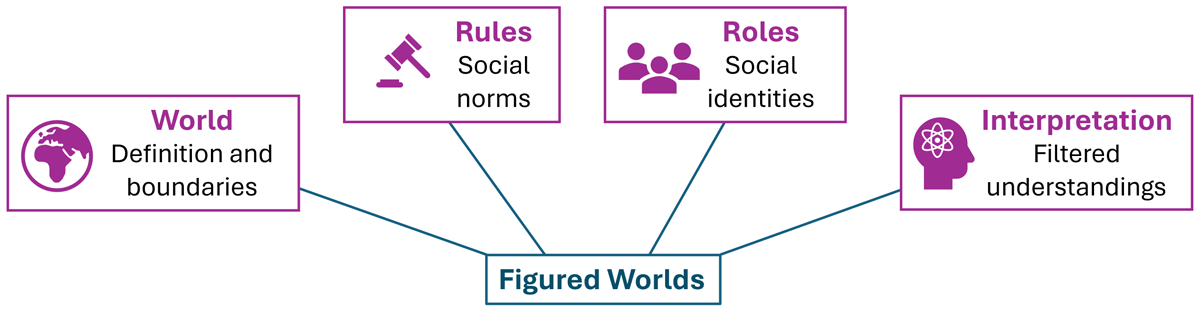
Figure 1
Analytical Operationalization of the Theory of Figured Worlds (Holland et al.).
First, we note the distinct worlds that students describe and that faculty would either notice or not notice. There is some flexibility in what counts as a “world,” where mental health could be a “world” in itself (akin to the figured world of romance as explored in Holland & Eisenhart, 1990), or it could be a component of a world such as student private lives. We note our list of figured worlds is only emergent and indicative, it is not meant to be an exhaustive account of all possible worlds. Second, we note the implicit or explicit cultural rules and norms associated with those worlds, when students find their actions are dictated or anticipated by the cultural rules of, for example, an engineering classroom. Third, we note the roles and identities available in the world, and how these roles are historically created and prefigure the world already before and as the student enters them. For example, professors and students are each viewed as having a certain role in the engineering culture which can constrain their actions or assign certain meanings to the actions they take. Fourth, we note the important aspect of interpretation, where student interpretations (“figuring”) are consequential and may diverge in topic and logic compared to the interpretation of a faculty member. The narrative selection and interpretation of quotes for this paper was led by the first author and checked with all other coauthors.
5.5 Ethical Considerations and Procedures
While all research methods involve power dynamics, we recognize that narrative research has particular ethical dimensions throughout—in procuring student stories, interpreting them, recrafting them towards coherence for a specific audience, and reinterpreting them in this paper. In addition to our member checking process described, our narrative analysis was guided by a reflexive collaborative team process, wherein we attempted to balance our sense of what the student was saying with how a faculty member would understand it, and what the truth of the situation was with what story construction might best influence faculty inclusivity.
Nevertheless, we do not disregard the possibility that we may have unintentionally misrepresented some of the students’ stories. Within the triangulated power dynamic, we conceived (researcher, student, faculty), we see ethical affordances in our attempt to represent the stories of students (those with less relative power) to represent them back to faculty (relatively higher power). The way these stories may typically get shared in everyday engineering education would not come with the anonymity and protection which our research method can provide. Among many possible research approaches which could have been taken within the power-laden landscape of inclusive engineering education, we accept the risks alongside the benefits of this particular methodological approach.
5.6 Study Limitations
The representations of engineering education in our work are limited by the stories our specific participants told. When presenting a story related to a specific identity or experience, we note that the broader engineering education literature base has a number of more comprehensive studies on the experiences of students from underrepresented identity groups. We do not seek to represent whole identity groups on the basis of single interviewee narratives, but to leverage these experiences to help faculty better identify ways to support their students.
Additionally, as with most qualitative research, our analysis for educational implications relies heavily on both researcher and reader interpretations. For this work to become truly useful for engineering faculty, there must be a shared investment in and attention to what faculty know and understand about their own learning environments and students. Even if readers do not specifically know a student in the same situation as our study participants, they can identify ways to attend to support needs related to our participants, and in doing so, proactively support their students. We suggest that the power of this work resides in its unique approach to generating qualitative insight – it is up to the reader to examine how they can take the information provided in this manuscript and translate it to their own contexts.
6. Findings: Looking through Students’ Eyes
Our organizational approach for this is arranged in approximate order of proximity to the faculty/professor (Figure 2). On the left, we note but do not formally discuss worlds that faculty primarily occupy. In the center, the first topics discussed in the findings are the shared worlds that faculty and students both occupy, but they may have different subjectivities/views on. On the right, the topics shift then towards student worlds that are primarily out of the vision of faculty but are nevertheless salient to students’ engineering education. This organizational strategy is not an explicit empirical finding based on differences in subjectivities but is intended to help frame and spur reflection on what a professor typically knows and does not know about their students.
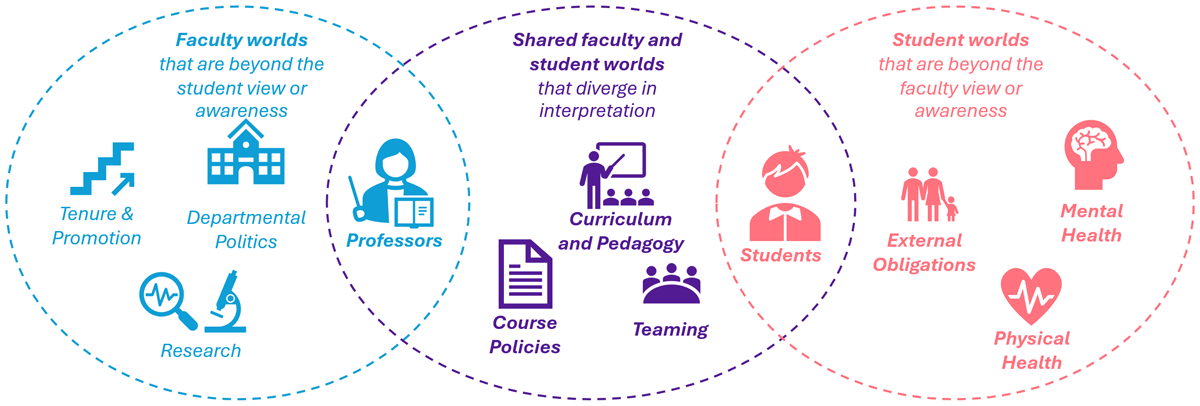
Figure 2
Faculty and Student Figured Worlds.
In the following sections, we dive deeper into these worlds from student perspectives. First, we explore how students describe their experiences with worlds that overlap with faculty; second, we examine how students describe their experiences with worlds that are kept – both intentionally and unintentionally – from faculty view. Each figure includes the student participant’s pseudonym (i.e., assigned name) and, below that, the basic identities or characteristics that the student’s perspective comes from. This provides helpful context to understand the student perspective and to support the transferability of stories and advice for faculty readers. If you would like to hear the recorded audio narrative associated with each participant, please click on the cartoon avatar to open the YouTube link to the appropriate audio section.
6.1 Shared Faculty and Student Worlds
First, we highlight student narratives regarding the worlds that faculty and students primarily share but with different subjective experiences/interpretations: student impressions of faculty, curriculum and pedagogy, assignments and course policies, and teamwork.
6.1.1 Views of Faculty
Although students may not have in depth knowledge of faculty lives, they do have a view and an interpretation of the faculty they see and interact with in their classes every day. Several students commented on their view of professors overall or their interactions and relations with them. George expressed two contrasting views of professors that emerged as he reflected on the differences between interacting with them during and outside of class:
George
A Trans man with Anxiety and ADHD
A lot of the time in lectures, you don’t talk to your professor. You listen to your professors. And you kind of get this image of like, “Alright, they’re strict, and all they do is teach.” It comes across as very one-sided, where you’re listening to their lecture on a topic, and you don’t really get to know who they are as a person or see that other side of them. So, going to office hours, you’re able to sit and talk through a solution, and you’re able to see, like, how they would approach helping a student out with an issue, even a personal issue. I had a professor, and after going to their office hours, we’ll talk about hobbies or the recent exam that we took. And you know there’ll be jokes that are thrown into the conversation. So, it’s more like, I guess, a personal connection, seeing them as a person rather than a professor. I think it just kind of gives you that inside scoop. Professors get to know you, and you get to know them, which can be a win-win on both ends.
George’s initial view of professors is based on their role in the classroom as he states, “all they do is teach.” He associates this role with a classroom culture as “one-sided” and “You don’t talk to your professor[s]. You listen to your professors.” His statements encompass clearly understood rules of the cultural space of the engineering classroom. George seems to attribute the classroom dynamic to a personality trait of the professor as someone who “you kind of get this image of like ‘Alright, they’re strict’”.
Later, George comes to the realization that this cultural setting has provided a narrow view once he meets professors in office hours. Office hours are a different cultural world, with different communication norms and constraints that allow for more personal information sharing and humor from both faculty and students. Ultimately, these figured worlds overlap, and George interprets his professors differently in the figured world of the classroom once he interacts with them in office hours. George notices that he can talk to faculty about their faculty worlds (e.g., hobbies) in this setting, whereas that is not part of the cultural script (i.e., rule) in the classroom setting.
Similarly, Amber describes her view of professors as “authority figures” and recounts having limited interactions with them, and those that she does have are bound to the classroom context:
Amber
A Transracial Adoptee from China with Anxiety and Depression
I have a lot of anxiety about authority figures and stuff. Basically, I’m very worried about doing the wrong thing, in a sense, because I’ve developed the mindset that- if I do better, whatever that means in whatever situations, people will like me more. And so, when someone has the authority to reprimand me, even if their criticism is constructive– that really stresses me out. Because I feel like I’m not doing well enough, and people must like me less, and that is evidenced by them reprimanding me. Some professors are great at answering questions, but some of them are like really bad at it, and they make you feel bad and dumb for asking these questions, and you feel undeserving to even ask them. Because they’re soooo smart about the topic, it’s like, how would you not know that? It’s also really difficult to find professors that would be able to relate to my experience. A lot of them are old, White, Americans, guys. My guess is that professors would be understanding if I did go to them. But when you’re in engineering class, you don’t really get a sense about who this professor is beyond the classroom. Instead I get the sense that it is a very professional relationship, ‘we’re here to get business done, and nothing else,’ pretty cut and dry.
She takes an implicit message from the classroom culture that “we’re here to get business done, and nothing else.” In describing her experiences, Amber emphasizes the professor role in answering questions (well or poorly), their identity as “soooo smart”, and the typical identity of the engineering professors as “old, White, American, guys”. These descriptions reflect her views of professors as inaccessible and unapproachable, which ultimately leads her to assume they would not be able to relate to her. At the same time, her own anxiety frames her interaction with professors such that she is wary of approaching them and subjecting herself to critique, even if she knows they may be understanding or will offer constructive feedback. Lastly, Amber acknowledges she does not attempt to test out or challenge her own hypothesis by reaching out to professors, but she remains open to the possibility that her narratives about them are limited by her assumptions.
This student interpretation of professors as aloof and unapproachable was a common element across student narratives. However, a typical professor who lectures in classes likely doesn’t view their teaching as particularly strict or one-sided or unapproachable; they likely see these interactions as one aspect of their job and perhaps a practical limitation of their class size or the nature of course content. While both George and Amber remain open to the knowledge or reality that professors are more complex than these simple characterizations, their primary views of a strict, business-focused, no-nonsense lecturer would be worthy of attention and counteracting to create a more inclusive culture.
6.1.2 Engineering Curriculum and Pedagogy
Another way faculty and student worlds overlap is through engineering curriculum and pedagogy, with faculty as designers and facilitators and students as participants. Enola characterizes her typical STEM classes and her core beliefs as a Native American are, at times, hard to integrate:
Enola
An Indigenous Woman with Hispanic Ancestry
Usually, all of my classes are very scientific, and in big lecture halls and my STEM classes, there is not a lot of room for me to express something that connects with my native identity. So usually, I don’t bring it up. Whereas in my French conversation class, I might talk about indigenous tribes or something when I’m presenting in French. More recently, I was sitting in a class on the environment, so I did have the ability ‘cause we had a lot of discussions in my class, and that’s when it was very easy to bring my identity up and be like, “yes, you know, some of the techniques they use for environmental sustainability and engineering is similar to like what tribes use.” So, I think it’s not until I actually have a conversation with the professor or peers that they realize that I’m a Native American or I’m indigenous.
Enola is an environmental engineering major who has a particularly strong connection to the earth and environment, which stems from her tribal knowledge and religion. However, the figured world of the engineering classroom does not make space for her to integrate this knowledge in expanding concepts of environmental engineering or for others to fully understand her, who she is, and what she brings to the topic. Compared to the culture of a French classroom, which has rules or norms that naturally integrate personal conversations about student identities, Enola characterizes the figured world of the engineering classroom as large and impersonal. While, as Enola implies, various practical factors such as class size and subject matter also dictate some of this culture, this impersonal classroom culture is also collectively produced (i.e., constructed or figured) by those who participate in it (i.e., faculty and other students). Each in their own ways, Enola, her classmates, her professors, and a collective – such as the field of engineering, generally – co-create a cultural environment in engineering education where sharing identity stories is neither common nor appears possible.
During his interview, George also discussed the way lecture- and discussion-based pedagogy interacts with his neurodivergent identity:
George
A Trans man with Anxiety and ADHD
In terms of my ADHD, I think the most obvious impact would probably just be my focus. I’m not the type of person who can just sit there on the spot, and it clicks in my head, you know like they’re teaching something and all of a sudden, I just understand it, and I think that’s the way for a lot of people. Sitting through an hour and 20 minutes worth of lectures is quite difficult, and just sitting back and watching somebody work through a problem doesn’t really help me to learn. Like for me, I learn from actually physically doing the problem myself and being able to work through it, and seeing the steps play out. So I feel like the way engineering is taught, it would be more beneficial for somebody like me to be able to sit and work through the problems rather than having them worked through for you.
Particularly, in classes where we do a lot of discussion, we’ll be asked to discuss with people around us. And a lot of times, it feels like there’s this extra pressure put on my back to get it right or know what the answer is supposed to be, even when, in theory, it’s just a discussion. I feel like, a lot of times, I come off a little standoffish, and I think most people don’t understand that it’s hard for me to express what I have learned and prove that I am smart enough to comprehend what’s going on. And a lot of people, I feel like, kind of take that for granted, you know, like share whatever they please. And it’s like when I’m not contributing answers in a group discussion, they’ll get frustrated with me. So I get frustrated that I’m not contributing to the work and helping out, whereas they don’t understand or see that, it’s actually just a mental struggle to be able to express it to them and to say like, what I feel and come up with the right answer. I guess it’s like inner perfectionism like I can’t mess it up, and I can’t, you know, ruin the project or something along those lines. So I feel like people may see me as being the kid that slacks off or the kid not super into learning the material.
Here, George highlights challenges with two typical forms of pedagogy. In lecture-based classes, George struggles to pay attention for long periods of time without application or physical engagement. While he expresses elsewhere that he has documented accommodations (a key component of the figured world), these are phrased as simple procedures (e.g., time and a half on exams, a note taker, etc.) and do not provide the same sense of nuance that is reflected in George’s classroom experiences. Similarly, in a discussion-based class, George feels on the spot and under pressure and that his mind may work more slowly than his peer group. If we imagine neurodivergence shifting the view or interpretation of the world of the classroom, based on perception and individual identity, we can conceive that the classroom may feel too fast or too slow for some more so than others. Again, this suggests a deeper sense of needed and intentional accommodations that move beyond simple rules and procedural implementation.
Other narrative examples highlight aspects of university and classroom norms that might be surprising to the typical engineering professor but specifically integrate student religious or cultural identity perspectives. In these instances, the worlds of faculty and students overlap through a fluid context of students’ experiences at the university that also shapes classroom norms and interactions and vice versa:
Enola
An Indigenous Woman with Hispanic Ancestry
The one time being indigenous was kind of an issue when I was a resident assistant last year, and we had a de-stress event where the students could smash watermelons. And so I had an issue with that. I talked to my supervisor about it and explained that I thought it was ironic because that very day, we had a discussion on food insecurity. And yet we have these events where we smash, and we destroy food. So is there not a more productive way to, you know, just de-stress? And I also explained that, to me, in particular, watermelon is important because, in my culture, I’m supposed to fast from it for the majority of the year. And so for me, whenever I get to eat watermelon, I’m really grateful to have the opportunity to eat it. So I was like, “I guess, in my opinion, I don’t think it’s a great idea, and I think that’s something you should consider in the future.”
…
I think it would be important if professors are required to learn a bit more about their students’ backgrounds. To give some examples, so I understand that Muslims, during Ramadan, are supposed to fast, and that can really affect their ability to go to school for that whole month. And so I think if Professors are talking to a student, and maybe they might not understand what students are going through, that they’re fasting, why they’re not getting the assignment done on time. Maybe the professor has snacks in their classroom and is giving everyone snacks, and that’s not very inclusive for the person who’s fasting right now; so, similar to that watermelon smashing event, I think just those things where professors can be mindful about peoples’ cultures and being like, “OK, how can I accommodate them? Is there a way that I can make them feel more welcome in my classroom?”
In this excerpt, Enola highlights food as a core aspect of multiple students’ religious and cultural identities that normative western cultural practices of engineering would not recognize or acknowledge. Food-based activities for students, whether in classroom or out-of-classroom, can directly conflict with these students’ religions. In this case, the rules of the classroom become more visible when placed in contrast to the rules Enola knows from the figured worlds of her own tribe. In the engineering classroom itself, using food for snacks or a reward is simple and unproblematic; for Enola, it represents a violation of rules that she thinks others could and should respect. Enola suggests that professors have a role in understanding students by better knowing about their backgrounds – including by leveraging a collective understanding of specific groups. Gaining insights into these types of student backgrounds could help broaden faculty understandings of the variety of factors that can shape a student’s role in the classroom from a non-deficit perspective. For example, a student who may not be getting assignments done on time may not necessarily unmotivated or uninterested – this could be attributed to other hidden factors such as fasting for religious purposes.
6.1.3 Assignments and Policies
The next aspect of the figured world we consider is assignments. Many students shared stories and highlighted perspectives on accommodation policies, such as Sophie:
Sophie
A White-passing Mixed-Race Woman
Usually, the classes in the university go at a really fast pace, and the university has an issue with mental health. I think a lot of people here, tried really hard in high school, and then you come to university, and you start struggling, and I’m sure that can really mess with an identity of like who you thought you were. However, one time that was kind of affecting things was, during COVID. My sister has mental and physical disabilities. So when I was home, I had to help her with some of her classes while still maintaining my own. And that was frustrating because, you know, professors really don’t really slow down for much, but I didn’t have enough of the situation I felt in which I could ask for really special treatment or accommodation. Also like, I don’t want to sound like I would be using my sister as an excuse or anything; that feels weird. Yeah, so it’s not like professors are ignoring my situation specifically because I did not ask for any time or anything, but they just–- they don’t really like, leave wiggle room for if you’re in any situation that might not be like, you know, dean excusal level, but it still makes things harder for you. Also, I’ve heard dean excusals can be a little strict. So, I wasn’t about to try and go through that process. So these additional obligations are not really seen by professors but are there, and they affect my school work. They don’t leave room for things like that, and then it ends up, like, I’m home and trying to help my sister with her classes, and still having like three exams in one day.
Accommodation policies could be considered a key sub-component of the engineering pedagogical figured world, which comes with its own rules and roles. Sophie references that some of these rules include the student having a role to be proactive and speak up, that some processes are “a little strict,” and that little “wiggle room” is provided for students who have constraints they do not disclose. While a professor probably sees accommodation policies as needing to be clear and fair, the situations Sophie brings up present grey areas that may not be worth the trouble of seeking a Dean’s approval for the excusal if they are unlikely to be reviewed favorably. Sophie’s framing of “wiggle room” provides a contrast for more flexible rules than those that require clear cut situations and Dean excusals. Particularly, since Sophie notes she does not speak up about things when she anticipates they will not rise to Dean excusal level, there is a clear benefit to hearing her perspective on this aspect of the figured world.
Like Sophie, Srihari also describes how cut-and-dry accommodation policies can be challenging for students:
Srihari
An Asian international woman with epilepsy
They say in accommodation statements that you should probably email the professor like 24 hours before to give them a heads up. I don’t know if other disabilities work that way, but mine doesn’t. Like, I don’t know when my body’s going to be like, “Okay, you can’t do this anymore” kind of thing. Or I start having seizures every few minutes.
So there was a professor whose class is one of the hardest classes, at least in computer science. And it was the first assignment. And I don’t know why, maybe I just pick bad partners, but the assignment was due that night, and my partner wasn’t responding to me, and he hadn’t done the part he said he knew how to do. So I emailed the professor and I was like, “Hey, I really need this extension. I’m not okay. I’m losing it.” He didn’t reply until like a week later; I didn’t get the extension. After that, I was pretty uncomfortable going to that professor for help or anything, but I still did. And I’m glad I did because I think our relationship got better because of it. I gradually felt more and more comfortable with the professor as I tried to go into office hours more often.
This narrative excerpt from Srihari highlights how the different stakes of accommodations for students and professors can shape their sense of the rules of the figured world. That is, Srihari took the rule in the extension policy to provide 24 hours’ notice of a request for accommodation quite literally. Perhaps some of her professors would recognize Srihari’s circumstances and would be happy to make a singular exception for her; however, the text of the overall syllabus-level accommodation policy seems to give Srihari pause. In another instance, Srihari asks for an extension in a computer science class and does not hear back on the extension decision until a week later. This makes her uncomfortable going to the professor for help—she interprets her professor as uncaring because he does not fulfill her role expectation in granting her request. Yet, considering these interconnected perspectives, the stakes of the student’s request for accommodation are high, whereas the sense of urgency in response from faculty (regarding one homework and in light of possible faculty overwhelm from emails) might be low. Specifically, Srihari notes that her original interpretation of events, “I don’t think I want to go to a professor who will not respond to my emails till a week later” could have been unfounded. Perhaps many professors are bad with email but ultimately caring if you remind them. The excerpt shows how interactions and events can shape the cultural environment of this figured world for students.
Finally, Srihari shared a challenge related to academic dishonesty policies:
Srihari
An Asian international woman with epilepsy
Another challenge I’ve had, this past semester, is I was partnering with my roommate on a CS assignment, and she plagiarized on the assignment. Obviously, I didn’t realize because she did her part, and I did my part. When I looked at it, I was like, well, it looks right. I’m not comparing it to anyone else’s. And they gave me an F for that class, just because my name was on the assignment, which was really unfair. The university honor court system is basically you’re guilty until proven innocent, which is, I think, the most backward system. The honor court will usually send you the email at like 4 p.m. on Friday and be like, “Hey, your professor cited you for cheating,” but they won’t tell you why, and they won’t even respond to you until Monday. I already have anxiety, and my stress is super high, which triggers my seizures. So having a gap in communication like that is really bad for me. At that point, I had no support. I would just call my parents and start freaking out, but they’re so far away. Even if we wanted legal help, that’s not something international students can just get easily. No advice. Nothing like that. So that was really difficult, just sitting and waiting. My parents were not sleeping back home because they were worried about how I was doing.
Another time, one of my professors was talking about reporting 60% of the class for cheating. 60%! When he’s teaching 800 students, that’s really not great. I mean, if you think that many kids plagiarized, maybe the assignment was too hard or you didn’t teach them well enough.
Here, we see an interesting case of the overlapping view and interpretation of this faculty/student figured world. The student interpretation of academic dishonesty policies is of course fundamentally more nuanced, since a professor who has to consider academic dishonesty does not ever truly know whether a student intentionally cheated, plagiarized, or misrepresented something, whereas the student does. The particular way the academic dishonesty system notified Srihari caused undue stress and did not interrogate individual student contributions on a group assignment. Srihari goes on to reframe cheating as not solely an individual choice and responsibility, but also something that circumstances can promote or discourage. This framing is different from her professors’, and her shifting responsibility back on to the professor if 60% of the class has plagiarized, reinterprets the typical figured world of cheating which is typically individualistic as mutually constituted. Srihari highlights a professor’s role in creating circumstances where cheating is tempting or seemingly required.
6.1.4 Teaming and Student Interactions
As we begin to shift away from the shared figured worlds of the professor, we encounter worlds of student interactions. Stories such as Sophie’s are directly tied to their educational experience and are still the purview of the professor, but since they happen outside of the professor’s view and control, they may present a new and important figured world for faculty to become aware of and consider:
Sophie
A White-passing Mixed-Race Woman
When you work in teams with people, or you’re working on homework, you notice that they treat you differently than they treat the other men. I have had a weird amount of experiences where men just give offhanded comments like they’re explaining things that I never asked for.
For example, I was in a BME class, and I knew I was good at Systems Physiology. So when I would say something and do it, my peers would immediately doubt it, then they would ask a TA, and the TA would confirm what I said. That really frustrated me because like I was very confident, and they had not known me long enough to be doubting me.
Also, one time I worked in a group with like two electrical engineers, and I am a biomedical engineer, and we were working on our presentation. I asked them to explain a part that they worked on because I had to present it, and this man looked me dead in the face and goes, ‘you wouldn’t understand it anyway.’ And then laughs. And I was like, uh, what? Like you’re not going to try? I mean, these weird experiences have been happening for so long that I kind of expect them, right? There could be a million reasons why they’re saying that to me, could be because I am BME, or it could be because I’m a woman. It could be because maybe I say things that are dumb in team settings, and they think that it’s something that I wouldn’t end up understanding. When it’s women, I assume, I might just give off some spacier sort of vibe. But when it’s men, I’m usually like, ‘okay, this is probably a little something else mixed in there.’
The figured world of teaming and group projects, a component of broader engineering pedagogical space, is further removed from faculty knowledge because much of the salient interactions happen outside of the classroom space. Within this world, Sophie finds herself experiencing a gendered teaming and group studying experience where her knowledge and intellect are discounted directly. Sophie needs to actively wonder and interpret to what extent this “weird amount of experiences” relates to gender, her major in biomedical engineering, or coming across as “spacier” (i.e., not knowing information as deeply as her peers). Knowing that some students may have laughed at a fellow student and demeaned them with the comment, “you wouldn’t understand it anyway” are unfortunately key and common aspects of engineering team and group marginalizing experiences and are typically outside of faculty’s direct observation. While team and group experiences are important for learning, it is important to recognize the types of problematic interaction that can come along with that learning experience and when students are given more agency to work with each other.
Amber also related experiences of peer interactions and the ways that gender and racial stereotypes are leveraged at her:
Amber
A Transracial adoptee from China with anxiety and depression
I think when people, like my peers, notice my identity, it can go one of two ways. Either they see me and assume that I don’t know anything because I am a woman. Or they assume that I’m very studious and I know everything, because I’m Asian and ‘super perfect at all of my studies’. Well, neither of those are true.
Sometimes, my classmates just underestimate me. One time when I was taking Calc II, one of my peers basically said, the professor favors female students over male students. And they were kind of rude, like, “oh, you’re not actually that smart. The only reason why you got those high grades was that the professor likes girls.” Stupid! I was like, “what a way to belittle both my academic success and my identity all in one swoop”. It was just an offhand comment, but I remember it pretty well. I guess just some of these things stick with you, even though he probably doesn’t remember saying it. I was just good at the class; there’s no reason to think that I was schmoozing my way up to the top or whatever.
Another time while studying for an exam in a study group. I asked a specific question, and basically, all of these guys were like, ‘oh, you don’t know how to do that? I know how to do that.’ And they spent like 15-20 minutes talking to themselves but they wouldn’t tell me how to do the problem. And I was thinking, “ah, Okay, this is really annoying. Can you get off your high horse and, like, help me here? Whatever, I’ll just figure it out on my own.” I don’t know exactly what their thoughts were, but I felt really underestimated. But then we got to the exam, I did really well, and they didn’t. It was nice that they got their comeuppance in a way for being that rude, but at the moment, it was really frustrating.
Similar to Sophie, Amber recounts experiences of gender marginalization that would be concerning to most professors if they happened during an engineering classroom session, so she helps demonstrate the value of gaining the student perspective. That they happen in the figured world of a study session does not make them less significant, and one can imagine the marginalization from peers seeps its way back into the view of the cultural landscape of the engineering classroom, surrounded by the same peers. On top of the gender marginalization, Amber experiences racial stereotyping as an Asian which, although “positively” associated with smartness, is still unwelcome and tokenizing as a “model minority.” Thus, Amber’s experience is of occupying a role of being othered through both gender and racial stereotypes and narratives.
6.2 Student Worlds
Some aspects of student worlds are kept separate and are distinctly not shared faculty and student worlds, such as mental health, physical health, and non-academic obligations.
6.2.1 Mental health
Mental health was discussed frequently, and it inherently constitutes an aspect of student worlds that remains further out of the view of professors. Sophie and Enola share similar stories of the ways mental health is approached by their professors:
Sophie
A White-passing Mixed-Race Woman
There are some wonderful professors, who will make adjustments. Like, I had one who would check for big events like Capstone or other major finals that were happening, and he tried to schedule around them for as many people as he could. He adjusted it so it would be less stressful for as many people as he could accommodate. Like I have another Professor who is like, ‘I know, midterms are super busy. So, you know, like we have exams this week. I’m not going to assign you anything for the next week, right? Some professors have flexible attendance policies or allow one dropped quiz that helps everyone relax a bit more.
But there are always the other ones who talk and then do nothing. I had a physiology Professor who taught us about the health effects of chronic stress, and how it can hurt you. Then proceeded to have an exam scheduled for the first day back from Thanksgiving break. And everyone’s like, ‘hey, we really need this break. Would you mind moving it?’ and they gave us a straight ‘No’.
So it definitely feels like a priority on academics at my school. I mean, it’s so easy to fall behind because they give so much work that it feels like you have to prioritize academics no matter what. They say they care about mental health. But then, like they don’t make any adjustments, even if you ask. And it’s like, stuff like that Thanksgiving break situation. All that talk about care for mental health just kind of feels like empty words.
Enola
An Indigenous Woman with Hispanic Ancestry
Also, during COVID, I had a very rough time; my mental health was very poor, and I think a lot of people from my background, being indigenous and Hispanic, have a lot of not only trauma they might have from their present family circumstances, but also intergenerational trauma that comes from assimilation or genocide, and it kind of like passes on through each generation. For me, COVID was very stressful because a lot of my elders in my tribe were passing away. And it gave me a lot more anxiety because not only are they passing away but also all of the language, the culture, and all the stories they have, are disappearing with them, which is a problem because a lot of indigenous tribes don’t have a written language.
Usually, Professors talk about like, “if you have mental health issues, go to psychological services, like tell us about it.” But then it’s like, yeah, you can tell the Professor that you’re not feeling good and you’re having a really hard time, but that doesn’t really mean anything to them. It’s like, “well, you know that’s too bad– the homework is still due at this time.” So, there’s not really a lot of action or accommodation around it. I think, in the way it’s written in the syllabi, they kind of assume that “Yeah, you should be OK, now that you went to the counseling center once. You should be good.” Which is like the exact opposite: it takes a lot of time.
Although some professors may gain the trust of students to hear about mental health struggles, in general they may not do so in classroom time, and they are not therapists or counselors themselves and may need to keep some boundaries regarding mental health issues. Nevertheless, both Sophie and Enola interpret their professors’ statements about mental health as lip service or empty words because they are primarily enacted through syllabi and are not followed up with over the course of the semester, over the long term, or in key moments of courseload overwhelm. We can imagine the faculty may interpret student mental health as something that is private, that should not be pried into, and that can be addressed by offering support resources in the syllabus. For this reason, many faculty often feel constrained or challenged to make too many changes to course expectations for individual student requests. This creates an inherent tension for faculty trying to maintain authority with flexibility and responsiveness. Nevertheless, it is helpful to know that, for students, these same actions may be interpreted as hypocrisy or empty words. Although the rule of the engineering classroom to not delve into overly personal matters seems to be playing a role here, given its negative consequences for students, perhaps a reminder for caring faculty to share more consistently and thoroughly their views around mental health would help.
6.2.2 Post-traditional status/outside life
Another example of a student figured world that is beyond the view of professors are those of post-traditional students who may have significant outside employment or family/childcare responsibilities. Alejandro shares some of these circumstances:
Alejandro
A Hispanic Adult learner, part-time student, veteran
I think my age plays a big role in my studies. My schedule is always different because I have very different priorities than a lot of other students. You know, I have a family, so I don’t have time for hanging out after class in the library and getting together and forming study groups. I just have a completely different life. I don’t participate in any clubs or associations or extracurricular. I just go to class and come home, so I can take care of what I need to do; whether it’s home improvement or all of my other tasks and chores, like mowing the lawn, laundry.
Especially once I picked up an internship; it just became work and school and then, you know, life at home, because time is the most valuable asset. It changed how I study. I think part of it is my age where I have more discipline and I treat it like it’s my full time job, instead of like- just school. I have to kind of build education around my life as opposed to someone who’s younger, who builds their life around their education.
Alejandro summarizes the large extent of his outside-the-classroom life as he “build[s] education around [his] life” as opposed to his younger peers “who build their li[ves] around their education.” This important experiential difference between Alejandro and his peers is worth being aware of for faculty perspectives.
Jakobe describes other life circumstances that can have a large impact on studies:
Jakobe
A Black man, first generation, housing insecure
I think that poverty shapes your mind and your decisions. I think many of my decisions are based on risk aversion, which can keep me from enjoying or participating in certain opportunities because I’m afraid of the fallout. For example, in my classes, when professors offer extra credit assignments or opportunities to become more involved with the course, it’s hard for me to find the time to do it. I work roughly 30 hours per week and go to school full-time. I always have to think about my current situation. I’m envious of those who are able to be just students; they don’t have the added pressure of also needing to work to support themselves and their families. It has not allowed me to fully experience the university the way other students do. Just being able to go to school and just think about school and not have these other worries on your mind. Like, I have never actually experienced it.
Jakobe is also a post-traditional student working significant hours a week outside of this coursework. His description of his financial position as a risk aversion towards poverty makes his employment seem more deeply necessary. Similar to Alejandro, Jakobe finds that post-traditional and outside life circumstances limit his capacity to engage fully as a student. Without knowing about financial and life circumstances, Jakobe thinks professors may see him in the role of a disengaged or less committed-to-school student, whereas a student may be working even harder than their traditional student peers. Thinking about the way some demographic identities are hidden leaves professors with the challenge of either seeking to know their students more or taking a generous view of their students when interpreting their actions.
6.2.3 Health issues and international issues
Students also shared issues related to health challenges and international statuses. Srihari discussed the way being international makes health challenges harder, noting that stress interrelates with these health challenges and can spiral into more complications and anxieties:
Srihari
An Asian international woman with epilepsy
I know every school has an international center, but I think international students need more resources. Like when they tell you to get a physician’s note for a class exception, but they won’t take notes from the school health center. If you won’t accept the school’s physician’s note, at least have contacts on hand who can help. Maybe a local physician who takes international student insurance in the surrounding area and could write a note. And I don’t just need class exceptions; my disability calls for specialized medical help as well, but when I asked the health center about a neurologist, they just said, “We don’t have one.” That’s not the response I want. I want, “okay, come over. We’ll see what we can do to help.” Like anything, even the smallest things would help. Even if they have a contact 30 minutes away. Phone number, address, anything that international students or disabled students can go to to get help.
Anyway, my seizures get triggered by stress and they’ve been really bad, especially this last year. They’ve occurred way more often than they were supposed to. It’s a lot to explain to professors because they wouldn’t see the causes a lot. It’s weird, you know, going to them. In CS, you work a lot with other people, and sometimes those other people mess things up for you, which adds more stress, which makes my seizures worse. For example, one time I had an unreliable partner and there was more than one instance where I had to ask for a 24-hour extension. I just felt guilty. The extensions were not because of me, it was because the other person wasn’t on top of their work, and they didn’t want to go ask for an extension. They’d be like, “Oh, you have accommodations; you should do it.” So I would have to do it. And that made me feel not great. So that’s really bad, you know. I don’t know how to explain to people that these things are serious; they just can’t take advantage of people like that.
Srihari’s narrative further highlights the ways international students’ worlds are more constrained and with less networked resources than many domestic students typically have. While a student health center making generic referrals is understandable, Srihari reimagines this world to be more truly international-student-centered by making specific and actionable recommendations for health care. The challenges with accommodations, stress, and medical issues become exacerbated when Srihari’s peers take advantage of the possibility her accommodations present for their own benefit. This world is once again, quite salient to engineering professors, but those complex interactions in how disability accommodation policies are being used and abused are beyond their typical knowledge. With this expanded knowledge provided by the student view, professors can update their policies and communicate clearly surrounding them.
Finally, Alice shares her own medical challenge that was out of the full view and understanding of professors.
Alice
A Hispanic international student with anxiety and medical issues
So I went to the ER-- I had an Uber take me to the ER because I was home alone. And I was like 10 hours in the ER, between CT scans, EKGs, medication, an IV flowing into me because I was dehydrated. At the end of the night, the doctor was just like, “You know, everything looks good. And if I may say so I think you may have just had a panic attack.” And I was so mad-- I was frustrated and thinking “I just lost all this time when I could have been doing my project” the whole time in the ER I just kept thinking: “My project”, “My project”, “My project.”
And as soon as I got home, I emailed my professor, and I had to submit the part of the project that I had done at that point, cause it was a group project. He never got back to me about an extension. He actually never responded to that email. So in the next class, I had to show him like all my medical stuff that had the hour and the date, and I was like, “this is where I was that day, so can I have an extra day to improve the project submission?” He didn’t allow an extension. So that was horrible.
Looking back at it, I should never have to worry about school more than my own health. I should have just been worried about my health. And I was too worried that professors weren’t going to understand. And they didn’t. And this was going to end up affecting my grades. Why is it so hard to understand that everyone is human and that things can happen? [Professors] think you’re a student first and then you’re a person. Why does school have to be above all, school above everything, above your health, above disasters, above your life? Why am I nothing but a student?
Alice’s panic attack was triggered by stress and exacerbated by her international student status and related constraints, similar to Srihari. There is a sense of the divergence between the student and faculty worlds here; for Alice, this is a major medical event that may still be private and painful (“had to show him all my medical stuff…that was horrible”), whereas for the professor, this is likely a scenario where a group project has one group member out for a medical reason and does not receive an extension for just her part. There is a sense of not sharing the same frame for the events that speaks to interpretation as a key aspect of the figured world. More broadly, the vivid sense we get from Alice’s narrative of the hospital visit and her own sense of being embedded in a high-pressure school culture is something far beyond faculty view, but important in thinking about how to better care for Alice and help her care for herself.
7. Discussion
7.1. Figured worlds as a window into the communication gap
We wrote this paper motivated by a broader project to better communicate student stories to faculty audiences. We sensed a communication gap and sensed that closing the communication gap could expand faculty empathic understanding. From a theoretical perspective grounded in figured worlds, we reemphasize a key claim: students and faculty occupy different and sometimes intersecting cultural worlds. As shown in Figure 2, some worlds are shared (e.g., the classroom, assignments, grading, policies), some worlds reside either in the faculty purview (e.g., tenure, department politics), and some are in the student purview (e.g., their mental and physical health, their family obligations). This insight is likely intuitive to readers, and we build upon other literature that has also highlighted the contours and impacts of these differences. And yet, our theoretical focus provides us with an opportunity to more carefully consider how and why these worlds diverge and what it would mean to try to increase understanding.
For their part, we find that some faculty’s lack of understanding and appreciation for student worlds is a key component of marginalization and a key opportunity for improvement. While the stories presented here are only told from students’ perspectives, we see in these stories several experiences that a faculty may simply never learn about (e.g., Jakobe’s financial difficulties) and faculty who seem to disregard the ways their policies or actions impact students (e.g., how Sophie’s professors handled exams after a break). Students, on the other hand, sometimes lack an understanding and appreciation for faculty worlds, and this can result in a level of misinterpretation. We see students, like Srihari, coming to a conclusion that professors do not care and, like George, coming to an interpretation that professors are impersonal, only to find their impressions changed later once they know their professors more. While communication and understanding is a two-way street for which both parties are responsible, and while students can help bring themselves to better understand their professors, we broadly conclude that the onus is not on the student to divulge and communicate, but on the faculty and the culture of engineering education to help create a more communicative, student-centered, and inclusive educational environment.
7.2. Interrelationship of the components of the figured worlds
Beyond the broad claim about our differing cultural worlds, our theoretical analysis can help consider the dimensions and components of those worlds. We note that identities, which we conceived as roles, are both constrained and given meaning by culture. Students like Enola find they are constrained and do not bring their identity into their engineering class cultures because of the size and depersonalized pedagogy and curriculum (i.e., the structures and boundaries of the engineering classroom world). Enola finds important meaning for her Indigenous identity in the culture of her home tribe but finds that meaning is shifted once she must explain and represent her identity for her university campus and community. Our identities travel with us as we travel into new cultural worlds, but as we bring those identities in, the new cultural space reconfigures our personal identity into a role in that space. Students are often making these transitions as they enter college, shift between engineering classroom spaces and home, and make choices regarding how to present or disclose their identities.
As culture configures our identities, it brings upon us new rules, and these rules could be thought of as restrictions of agency. Agency is a key part of Holland et al.’s cultural framework, which we can see in relief as the capacity to navigate and self-actualize in spite of the rules and boundaries imposed by the culture and structure of the engineering education. Broadly, we consider the communicative act of narrating these stories, including oppressive conditions, to be a form of agency (hooks, 1992; Secules et al., 2018), and we see reflection as a possible tool to help take more proactive steps to reconfigure and reorient the figured world. Is it possible that Sophie could speak up about the gendered team dynamics, that Alice could advocate for her mental health, or that George or Srihari could reach out to professors for more understanding about accommodations? Yes, and, although it is that simple, it is not that easy. The first steps we can take in changing our educational and disciplinary cultures are reflecting and recognizing the challenges, creating conditions for speaking up and for listening, and then speaking up and looking for allies to help shift them.
7.3 Lessons learned from the figured worlds
As a step towards improving the communication gap and as we take up our faculty-focused research where we share these audio narratives with professors, we highlight the specific lessons learned we think can come out of listening to the stories for creating more inclusive engineering education (Table 1). These recommendations primarily come from logical inference based on the narrative experiences and from Secules’s and McCall’s positionalities and experience trying to help support inclusive engineering educational cultures in our own teaching practice. To indicate further resources and an evidence base for the recommendations, where applicable, we triangulate with papers that provide evidence-based recommendations for creating an inclusive culture in engineering education.
Table 1
Practice Recommendations for Issues Raised in the Student Narratives.
| TOPICAL WORLD | PARTICIPANT/NARRATOR | CHARACTERIZATION OF THE WORLD | RECOMMENDATIONS |
|---|---|---|---|
| Professors | George Amber | View of professors as scary and unapproachable |
|
| Pedagogy | George Enola | Norms are fast-paced and impersonal; Ramadan and cultural considerations |
|
| Assignments and Policies | Sophie Srihari | Accommodations policies; Academic dishonesty |
|
| Teaming and Student Interactions | Sophie Amber | Bias in team and homework groups; Microaggressions |
|
| Mental health | Sophie Enola | Mental health support is empty words; Need for long term support beyond the syllabus statements |
|
| Poverty and post-traditional status | Alejandro Jakobe | Outside obligations take up time; Poverty and outside obligations can organize your life differently |
|
| Health issues and international status | Srihari Alice | International status makes medical challenges more challenging; Some medical challenges are triggered by stress, require flexibility |
|
These are an initial summary of the lessons contained in the stories-- there are likely many more. And, these stories are not necessarily generalizable, yet the lessons learned can be considered and appreciated beyond the specific students and their academic contexts. On the point of generalizability, we emphasize a meta-lesson that if there is this much wisdom and insight contained in an interview with a select 10 students, consider the value of listening to each of the students in our own contexts and the wisdom that would be gained by listening to them.
8. Implications and Conclusion
8.1 Implications for inclusive culture change
The cultural worlds of engineering are as they are, but what if they were figured differently? Can we use this lens to help us reconfigure and reimagine the figured worlds? The student participants describe many different aspects of engineering culture that could lead to direct reforms or agendas for culture change. Broadly, students find engineering pedagogical culture could be more personable—engineering faculty could share more of themselves, talk more and understand more of their students, and encourage better understanding and interactions between students. The curriculum and structure of the engineering classroom do not make this easy, and the culture of an engineering classroom comes with certain norms and expectations that will seep into things through the joint efforts and expectations of all constituents. The theory of cultural production (Levinson & Holland, 1996) centrally asks about the structural conditions through which culture can be reimagined, when oppression is not reproduced. This could be an interesting agenda for investigating the conditions through which engineering culture can be changed.
Between the time the work was initiated and the time of writing, the grant that funded this work and the program that funded it have been terminated in a wave of national political actions against diversity and inclusion. The coauthors all also either still work in conservative states or have been publicly criticized for having a diversity and inclusion research agenda. For ourselves and others, this means we are still ascertaining what to make of this research and practice agenda, how to pursue it and how to frame it. For now, we see the work we have done and the future work for the engineering education community as about inclusive culture change; but it also simply about supporting faculty to better understand and support their students, which we see as a crucial aspect of inclusive culture change and foundational tenets of good teaching. While we think words and clarity of meaning are important, and we do not apologize for having the work focus on inclusivity, we offer up this possible supportive reframing as a potential future direction for ourselves and others. Keeping clarity about our collective purpose while adapting our framing and widening our lens on it to encompass all potential aspects of student support and experience, we can overcome political hurdles and help others see the value of moving in this direction.
8.2 Implications for faculty
As for the major implications for engineering faculty, we find faculty could take a direct interest and curiosity in student worlds and their perceptions of shared faculty/student worlds. There are various mechanisms which are considered pedagogical best practices that can help probe student perceptions in a caring and non-invasive way: providing a mechanism for anonymous feedback, offering non-anonymous mid-semester surveys, or incentivizing attendance at office hours. The specific strategies will vary by course, but the key is to explain and reiterate the intention behind these structures (Brookfield, 2017). A survey or an assignment to come talk to a professor in office hours can and will be interpreted as obnoxious busywork, but a professor can counter this impression by clarifying their genuine interest in getting to know students and hearing their perspectives. Simply expressing your availability and caring go a long way to students feeling comfortable sharing about themselves.
In parallel to these classroom practices and messages that help provide the conditions to share, we think faculty can and should get better at listening to students. It is difficult, in the pace of faculty life, with other pressures that come with the many worlds faculty must navigate, to pause and think through things from a student’s perspective. Perhaps some faculty think of themselves as the experts whose main job is to talk and share their expertise. We think an equally important faculty role is listening to students, as a way of opening up the understanding that is crucial to designing effective learning experiences and providing care and mentorship. Listening to our students is a crucial precursor to teaching them.
As these practices become built into our pedagogy and as we learn lessons from them, the payoff increases over time—as researchers, Secules and McCall have often learned lessons and understandings about students that we can carry forward into our pedagogy without always needing to learn these lessons anew for each student. Once you have a sense for what can go on behind the hidden figured worlds of students, you can operate with and start to have a sense for those gaps and minefields.
Faculty and students are interconnected, they are key players in each other’s cultural worlds, yet they do not fully understand one another’s private worlds and perspectives. Looking through students’ eyes can help give us direction and insight towards inclusive change.
Appendices
Appendix A
Interview Protocol
Background Questions
Start from a worksheet that provides some identity categories:
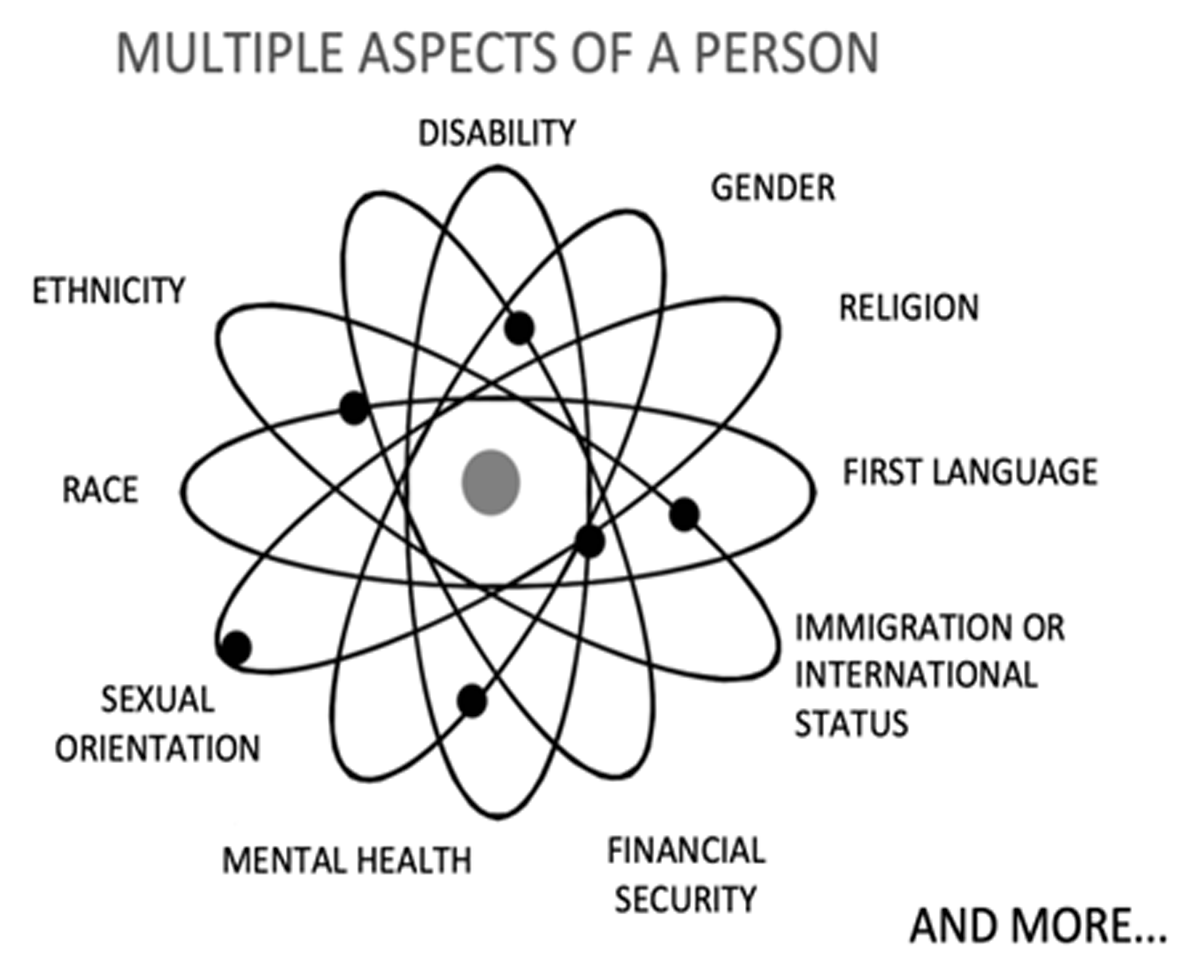
Have the student discuss identities that come to mind while looking at it.
Are there Identities that influence how you navigate daily life? If so, what are they?
Follow Up:
Would you like to share the story behind the formation of [this identity]?
When did [this identity] become salient [meaningful] in your daily life?
How did [this identity] become so important?
Identity and Experience
This will give student agencies to identify in ways that are meaningful to them and matter to engineering.
So, think about yourself in the present day. How has [insert identities, or “identities” or “sense of self”] led you to what you are doing now?
Students can take the “sense of themselves” in an identity direction, childhood experience direction, inspiration, etc. We could direct people to focus “what you are doing now” on why they are studying engineering, how they go through engineering school, what their plans are in the future, etc.
[if haven’t gotten to question 3 by 30 minutes skip to here]
Perceptions and Hidden Identities in Engineering
Here we are going deeper on engineering contexts, learning about some specific experiences and aspects of how that identity interacts. Here we try to connect hidden identities to experience in classroom culture.
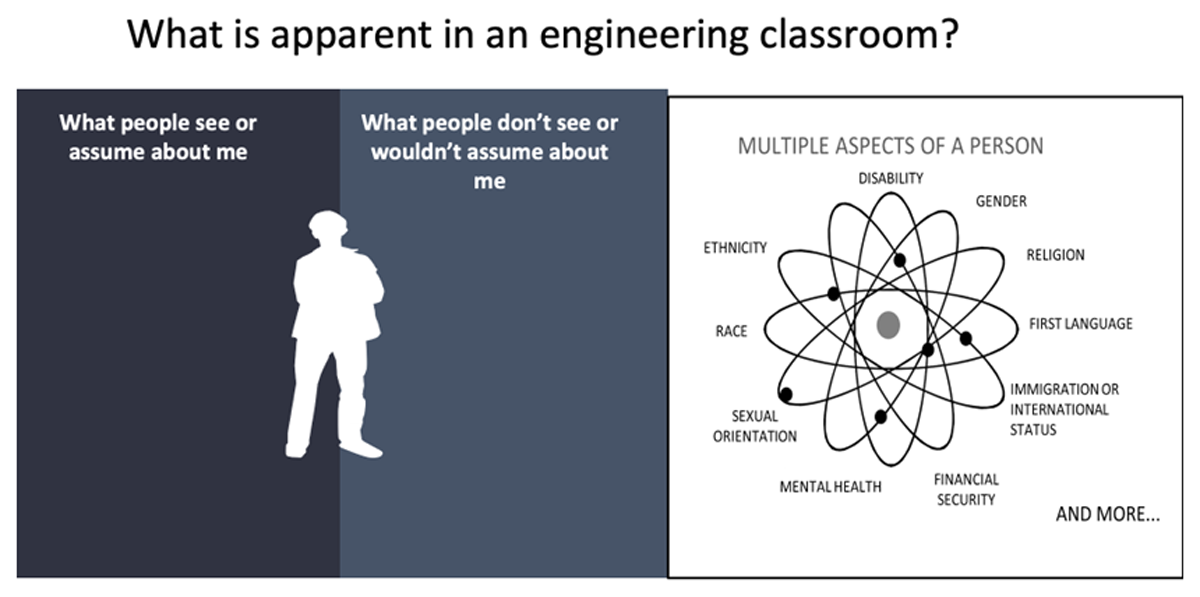
Think about your daily interactions with your engineering and computing professors and peers.
How do you think others perceive you? You can draw experience from your class or outside class.
What’s something about yourself that you think is important but hidden in an engineering class?
Students can take this “something” in an identity direction, disability/ability, personality, etc.
<insert if hidden identity is mentioned
How do you feel about disclosing your hidden identity to others?
Do you choose to disclose? Can you elaborate on this?
Do you feel not to choose to disclose your hidden identity to others? Care to explain why?
Critical Awareness of Engineering Culture
Here we are trying to connect to critical awareness about the engineering contexts/culture.
This could turn as the commentary on engineering educational culture through the voice of a typically, unheard constituent.
Drawing from your own experience, what’s one thing you find challenging about the ways engineering is taught?
What’s one thing you wish were different about engineering education?
Lessons Learned and Resilience
This will be an opportunity to give students agency to share lessons learned from their experience. Providing meaning for challenging circumstances.
What’s one piece of advice you would give someone like you in engineering?
Think about your first day on campus. If you could go back in time and give yourself advice for navigating your college experience, what would that advice be and why?
What’s one thing you would tell your professors now if you could?
Notes
[1] Henning and colleagues (2019) define hidden identity as “any personal, invisible descriptors of a person’s identity that are not apparent—accurately or not—from outward appearance” (p. 2).
[2] Foundational work on figured worlds defined a figured world of college romance which overlapped with the figured world of STEM education (Holland & Eisenhart, 1990). In engineering education, a figured world of campus identities (nerds, academic achievers, socialites) overlapped and embedded within the figured world of engineering design classes (Tonso, 2006a).
Ethics and Consent
This study is approved by and adheres to the procedures of the university Institutional Review Boards relevant to the project personnel.
Author Contributions
Secules drafted most sections of the paper. Kali and Van Dyke conducted the primary data collection and data analysis on the project. McCall gave critical feedback and strategic suggestions. Secules and McCall collaboratively originated the study and are the lead investigators on it.