
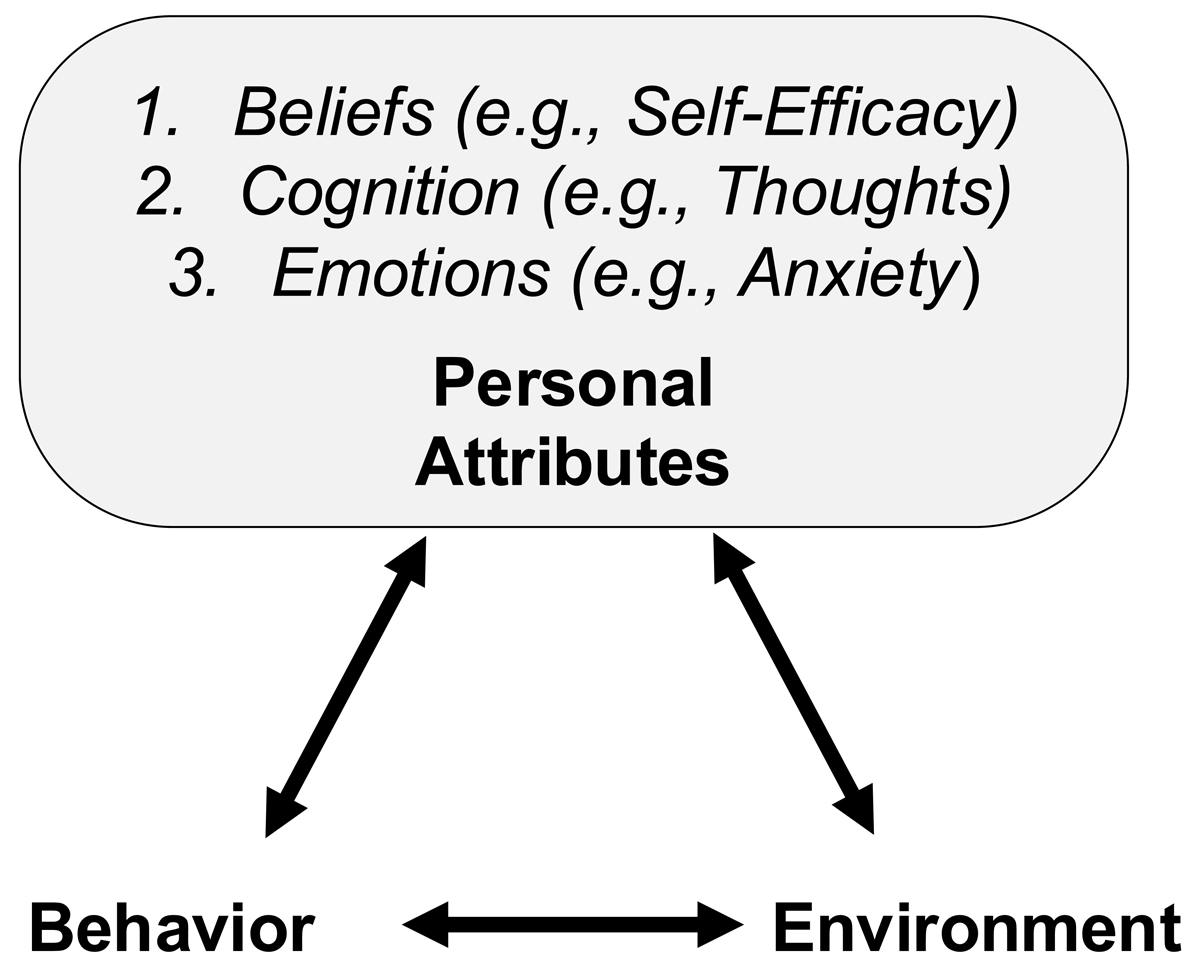
Figure 1
Bandura’s Social Cognitive Theory.
Table 1
Relevant Quality Considerations.
| VALIDATION PROCESS | MAKING THE DATA | HANDLING THE DATA |
|---|---|---|
| Theoretical validation | We diversified the social reality under investigation (to the extent possible) by recruiting students from different cohorts, with varied course and extracurricular experiences and diverse social identities. | We used the SCCT framework to define and relate the theoretical constructs. We included contradicting cases to offer a deeper, more nuanced interpretation of the social reality under investigation. |
| Procedural validation | We did not triangulate interview data with other participant data. | We repeatedly confirmed the patterns in the data across interviews and with the theoretical framework. We acknowledged how our biases and assumptions may have influenced the data analysis in the positionality statement. |
| Communicative validation | We conducted extensive member checking with one participant (Kavi). | We used in-vivo coding during the first round of coding to preserve participants’ voices as much as possible We frequently met to discuss data analysis and results. |
| Process reliability | We developed an interview protocol that we applied uniformly across all interviews. The first author conducted all the interviews. The first author recorded, transcribed, and checked the data. | We documented interview reflections and data analysis decisions using memos. We discussed coding categories within the research team. |
Table 2
Demographics of students enrolled in the MEB course in Fall 2019 (N = 149), 2020 (N = 130), and 2021 (N = 164).
| IDENTITY | FALL 2019 (%) | FALL 2020 (%) | FALL 2021 (%) |
|---|---|---|---|
| Racial, Ethnic Identity | |||
| Two or more races | 6 | 6 | 3 |
| Asian | 9 | 17 | 11 |
| Black or African American | 4 | 2 | 2 |
| Latina/o/x | 5 | 4 | 8 |
| Native Hawaiian or Pacific Islander | 0 | 1 | 0 |
| International | 7 | 8 | 8 |
| White | 68 | 61 | 61 |
| Unknown | 0 | 1 | 4 |
| Gender Identity | |||
| Men | 56 | 53 | 63 |
| Women | 44 | 47 | 37 |
[i] Note: Historically, ~80 students enroll in the spring and ~20 in the summer.
Table 3
Demographics of the chemical engineering students selected for the interviews.
| PSEUDONYMS | TERM | ENGINEERING EXPERIENCES AND CONTEXTUAL INFORMATION |
|---|---|---|
| Shaan | Fall 2019 |
|
| Maya | Summer 2020 |
|
| Kavi | Fall 2020 |
|
| Eleanor | Fall 2020 |
|
| Carol | Fall 2020 |
|
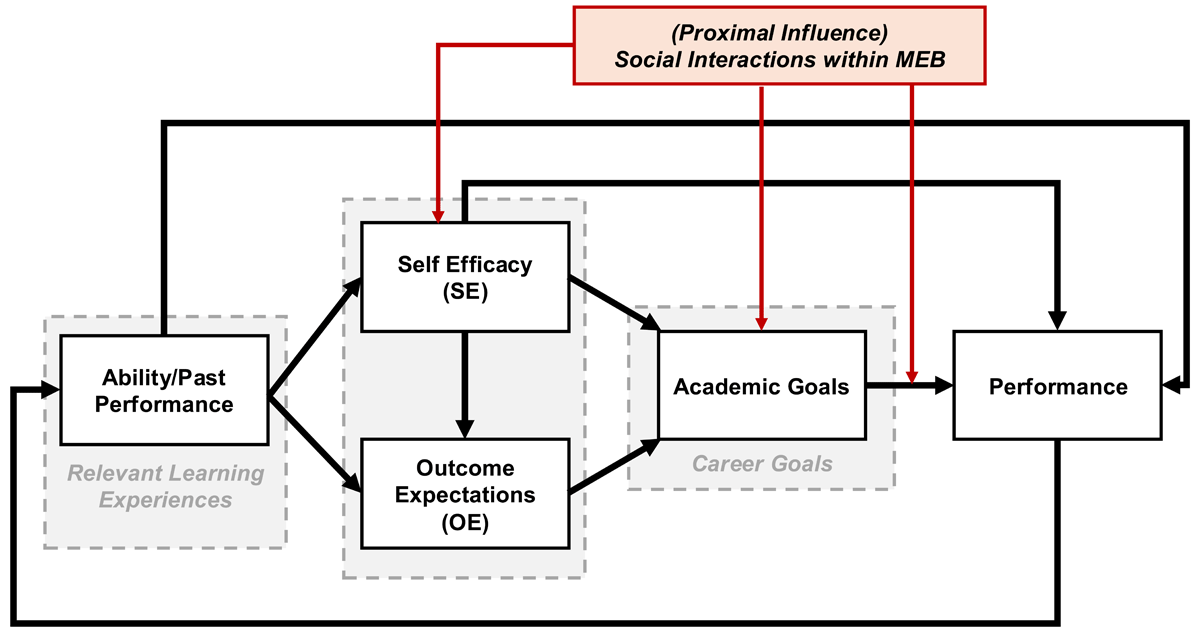
Figure 2
The social cognitive model of task performance in an MEB course. Italicized text denotes our adaptations to Lent et al.’s 1994 model.
Table 4
Summary of themes and subthemes.
| THEMES | EXEMPLAR QUOTE(S) |
|---|---|
| RQ1: How do social interactions within the MEB course impact students? | |
| 1.1 Proximal social interactions fostered students’ self-efficacy beliefs by enhancing their knowledge and problem-solving skills, normalizing challenging experiences, and increasing their sense of belonging. | (Online, Summer 2020) Maya: We (had) office hours. I would use it from time to time. It was nice cuz we could ask about a homework problem, and the professor would give us guidance on how to start because that was the biggest part (of) that class, figuring out how to start after you had all your equations in place… It was pretty easy from there. So, it was helpful after the professor showed us how to start off. That equipped me well for when we didn’t have time (for) exams. So, I didn’t waste as much time trying to figure out what the heck to do. |
| 1.2 Perceived differences between students, resulting from social interactions in the MEB course, isolated them from their peers and eroded their self-efficacy beliefs. | (In-person, Fall 2019) Shaan: Early on, I was like, “This (chemical engineering) is really cool.” I could see myself being a chemical engineer. Where was the turning point? It was after talking to other people who (looked) like they knew what they were doing. They were going to office hours, or not going to office hours and still doing better than I was, and I was like, “I don’t belong here because I’m struggling. I’m working my ass off to get worse scores than other people who I don’t think were struggling.” |
| 1.3 Social interactions informed students’ academic goals and behaviors but sometimes hindered learning. | (Online, Fall 2020) Kavi: …I think it’s like if I was doing (homework) and I was like, “I don’t really care if I don’t understand this.” And my friend thought out the way to do it before I did, and I was like, “I don’t really know how to do this, but you did it already. So, I’ll just copy it down.” But then she was like, “No, wait. I can teach you how I did this.” Then I was like, “Okay, fine. You can explain it to me.” This (was) more helpful (for me) than just writing it down and moving on. |
| RQ 2: How do beliefs influence students’ goals in the MEB course? | |
| 2.1 Students used their self-efficacy beliefs and outcome expectations to interpret their learning experiences in the MEB course and reevaluate their goals. | (Online, Fall 2020) Carol: … (The course) reaffirmed that I wanted to do chemical engineering. I thought what we were learning was interesting, and that I didn’t want to drop it or my co-op or switch majors like some people do after their first class. So, I think the positive experience helped me validate that what I decided to go to college for … was indeed what I wanted to do… I was like, “Oh, I get to actually be a chemical engineer now.” |
| RQ 3: How do students regulate their academic performance in the MEB course? | |
| 3.1 Students balanced their efforts across competing interests, incorporated feedback, and practiced regularly to achieve their desired performance. | (Online, Fall 2020) Maya: … I even set boundaries with my academics. If I’m working on homework, and it’s like 2 (or) 3 AM but I’m not done (and) I need to go to sleep, I’m not afraid to call it quits and then learn afterward from the (solution) for the homework. Especially cuz I know that homework tends not to count for as much as exams. And so, I just try my best to understand before the exams, and it usually turns out decently for me. |
[i] Note: Parentheses indicate words that were added for clarity’s sake, while ellipses indicate natural pauses or text that was omitted. See Table S2 in the Supplementary Information for the extended version.