
Introduction
Across engineering disciplines, introductory courses are notorious for “weeding out” students (Geisinger & Raman, 2013; Koch, 2017; Seymour & Hunter, 2019). This reputation communicates to students that the ability to succeed in engineering is fixed; they either have it or they don’t. To pass these courses, students must identify, integrate, and apply appropriate engineering principles to solve problems, which requires a deeper level of understanding compared to the rote algorithms they are familiar with from previous classes (Amos et al., 2018; Arena & Davis, 2021; Felder, 1990; Geisinger & Raman, 2013). Unsurprisingly, some students who fail or struggle in these courses eventually drop out of the engineering program. This phenomenon is most concerning as engineering students are most likely to lose interest and leave engineering at the point of entry into their academic engineering disciplines (Geisinger & Raman, 2013; Lent et al., 2013; Seymour, 1997; Seymour & Hunter, 2019).
Self-Efficacy in Engineering Education Research
In addressing issues of persistence in engineering, a number of scholars have used the construct of self-efficacy judgments to understand how students achieve their educational goals across different student populations and contexts (Concannon & Barrow, 2009; Lent et al., 2008; Seymour & Hunter, 2019). A person’s self-efficacy judgment is their perceived likelihood of success on a specific task (Bandura, 1986; Lent et al., 1994). In addition to persistence, self-efficacy judgments have also been associated with student outcomes like academic performance (Hunsu et al., 2021; Lent et al., 2008; Power et al., 2025; Won et al., 2024), academic major satisfaction (Gerçek & Elmas-Atay, 2024), and a sense of belonging (Won et al., 2024) in engineering student populations. Self-efficacy beliefs are not necessarily accurate measures of ability; therefore, people can over- or underestimate their ability based on prior learning experiences (Bandura, 1986; Lent et al., 1994). Slightly overestimating one’s capacity can allow learners to challenge themselves and develop new skills. However, a gross miscalculation may lead to discouragement and even abandonment of goals if students cannot achieve their desired results. Therefore, without moderate to high self-efficacy, learners are unlikely to attempt a task, even when they possess the necessary skills, thereby excluding otherwise competent individuals from consequential opportunities.
Purpose and Research Questions
Many studies in engineering education have examined self-efficacy in relation to persistence across different engineering majors. However, several scholars have highlighted the differences between engineering disciplines (Potvin et al., 2013) and have argued for more discipline-based education research (Reinholz et al., 2019; Singer & Smith, 2013). Within self-efficacy research, in particular, Marra et al. (2009) cite the multidisciplinary nature of their study of self-efficacy among women engineering students as a limitation and argue that self-efficacy should be studied in more specific contexts. While some scholars have adopted a discipline-based approach (e.g., Lewis & Matusovich, 2020), such work remains limited. Thus, this study examines the impact of the social learning environment on students’ learning experiences in an introductory chemical engineering course. We conducted five interviews, exploring the relationship between students’ learning experiences, motivation (e.g., self-efficacy judgements and goals), and performance in a chemical engineering materials and energy balances (MEB) course using the following research questions:
RQ 1 How do social interactions within the MEB course impact students?
RQ 2 How do beliefs (e.g., self-efficacy judgements) influence students’ goals in the MEB course?
RQ 3 How do students regulate their academic performance in the MEB course?
Social Cognitive Career Theory (SCCT)
Bandura’s Social Cognitive Theory (SCT)
Bandura’s Social Cognitive Theory (SCT) views learning as a dynamic, reciprocal interaction between a person’s attributes, behavior, and environment (Bandura, 1986; Lent et al., 1994) (Figure 1). Two complementary concepts from SCT are human agency and self-regulated learning (Boekaerts et al., 2000; Panadero, 2017; Pintrich, 2000; Schunk & Greene, 2017; Schunk & Zimmerman, 2008). Together, they explain how individuals exert control over themselves and their environment to achieve desired outcomes.
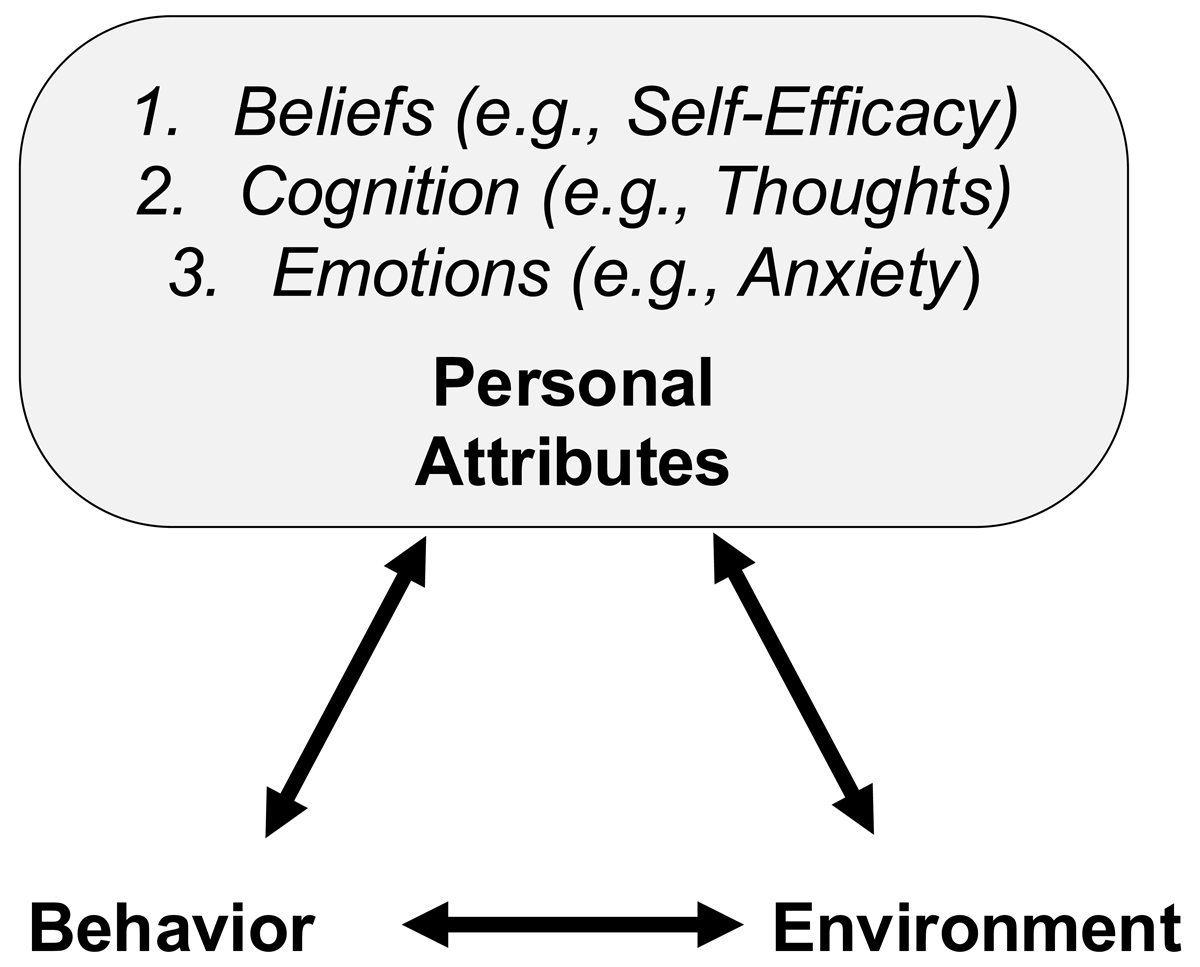
Figure 1
Bandura’s Social Cognitive Theory.
Social Cognitive Career Theory (SCCT)
Social Cognitive Career Theory (SCCT) extends Bandura’s Social Cognitive Theory (SCT) to career development: developing career and academic interests, making career-relevant choices, and achieving success in career-relevant tasks (Lent et al., 1994, 2000). We focused on the task performance model, highlighting the continuous feedback between self-efficacy, outcome expectations, and academic performance for specific career and academic tasks (e.g., completing an introductory chemical engineering course) in this study. (Bandura, 1986; Lent et al., 1993, 1994; Lent & Brown, 2019). According to this model, students’ ability/past performance, self-efficacy judgements, and goals directly influence their academic performance.
Outcome expectations are an individual’s beliefs about the likely consequences of goal achievement (e.g., financial reward, recognition, and self-satisfaction) (Bandura, 1986). According to SCCT, students set academic and career goals to regulate their behavior and academic performance. These goals are informed by their self-efficacy judgements and outcome expectations. As a result, students are more likely to set, pursue, and attain their goals when they are confident in their ability to succeed and anticipate favorable outcomes. In addition to the direct relationships between constructs (e.g., the effect of self-efficacy on performance), SCCT also considers indirect relationships. For instance, students modify their goals based on their self-efficacy beliefs when interpreting their prior learning experiences (Lent et al., 1994). Finally, this model does not exist in a vacuum. Contextual factors, often beyond a student’s control, also inform career decisions and goals (Bandura, 1986; Lent et al., 1994, 2000). For example, engineering programs often use grades or other requirements (e.g., a GPA of 3.0 or higher) to screen incoming students.
SCCT in Engineering Education
Researchers have studied the career intentions and pathways of engineering student populations using SCCT at public and private institutions, Hispanic-Serving Institutions (HSIs), Predominantly White Institutions (PWIs), and Historically Black Colleges and Universities (HBCUs) (Flores et al., 2014; Lent et al., 2003, 2005, 2007, 2008, 2013). These prior research studies provide evidence that self-efficacy or engineering self-efficacy, self-efficacy judgments towards engineering tasks (Lent et al., 1984), are linked to outcome expectations (Lent et al., 2003, 2005, 2007, 2008), career-related interests (Lent et al., 2003), goals (Lent et al., 2003, 2005, 2007, 2008, 2010), and goal attainment and academic satisfaction (Flores et al., 2014; Lent et al., 2007, 2013). However, other studies have suggested additional or contrary findings. For instance, in a 2014 study of engineering students at an HSI, Flores and colleagues found strong evidence for a bidirectional relationship between students’ self-efficacy, outcome expectations, and interest. Thus, self-efficacy judgments can be directly influenced by students’ interest and favorable outcome expectations associated with specific engineering tasks. In summary, SCCT is a practical framework for understanding how students regulate their learning and navigate their careers in introductory engineering classes (Boekaerts et al., 2000; Panadero, 2017; Pintrich, 2000; Schunk & Greene, 2017; Schunk & Zimmerman, 2008).
Methods
We examined students’ experiences in an introductory chemical engineering MEB course through in-depth, semi-structured interviews. With this approach, all participants responded to the same initial questions, and the interviewer could explore responses further as needed. The goal of the qualitative analysis was to identify common themes in participants’ responses and accommodate participants whose experiences diverged from these themes. We applied the Quality Framework of Interpretative Research to address concerns regarding validation and process reliability during the research process (Walther et al., 2013, 2017). Table 1 describes the quality decisions we made in our research design and analysis procedures, while the final consideration, pragmatic validation, is addressed in the discussion and implications section. The institutional review board at Purdue University approved this study under IRB-2021-1176.
Table 1
Relevant Quality Considerations.
| VALIDATION PROCESS | MAKING THE DATA | HANDLING THE DATA |
|---|---|---|
| Theoretical validation | We diversified the social reality under investigation (to the extent possible) by recruiting students from different cohorts, with varied course and extracurricular experiences and diverse social identities. | We used the SCCT framework to define and relate the theoretical constructs. We included contradicting cases to offer a deeper, more nuanced interpretation of the social reality under investigation. |
| Procedural validation | We did not triangulate interview data with other participant data. | We repeatedly confirmed the patterns in the data across interviews and with the theoretical framework. We acknowledged how our biases and assumptions may have influenced the data analysis in the positionality statement. |
| Communicative validation | We conducted extensive member checking with one participant (Kavi). | We used in-vivo coding during the first round of coding to preserve participants’ voices as much as possible We frequently met to discuss data analysis and results. |
| Process reliability | We developed an interview protocol that we applied uniformly across all interviews. The first author conducted all the interviews. The first author recorded, transcribed, and checked the data. | We documented interview reflections and data analysis decisions using memos. We discussed coding categories within the research team. |
Researcher Positionality
First author: I am an engineering education researcher with a background in chemical engineering. My experiences with the MEB course as an undergraduate student, as a graduate teaching assistant (Fall 2020), and as an instructor inspired this research study. This familiarity with the course was an asset, for instance, in building rapport with students during the interviews. My view of learning as a dynamic, cognitive, social, and contextual process aligns with SCCT and informed my interpretation of the results.
Second author: I am an engineering education researcher and a professor of chemical and biomolecular engineering. In the past, I redesigned and taught the MEB course. My research focuses on how engineering environments shape students’ identities, motivations, and sense of belonging, and on the impact of these psychosocial factors on student outcomes, including recruitment, retention, academic success, and overall well-being. As a White ciswoman, I have some experiences of marginalization within chemical engineering, predominantly in peer-to-peer interactions and co-curricular learning experiences. In writing and making sense of data, I focused on portraying the complex nature of motivation and shaping forces in the engineering environment. I was not involved in data collection for this study.
Course Context
The institutional context for this research study is a large public research university in the Midwestern United States. All engineering students affiliate with their engineering discipline in the second year after a general first-year engineering (FYE) program.
The MEB course is the first required, discipline-specific course for chemical engineering majors at this institution. Most students enroll in the MEB course during the first (Fall) semester of their second year. However, this four-credit course is offered in the Spring and Summer semesters for off-cycle students (e.g., students who want to get ahead over the summer, need to retake the course, or were absent in the Fall due to an internship or cooperative education (co-op) during the semester). Thus, in these semesters, students’ academic experiences are more heterogeneous relative to the Fall semester. To pass the course and progress through the chemical engineering program, students must earn a grade of “C” or higher. The demographic trends of MEB students from Fall 2019 to Fall 2021 are presented in Table 2.
Table 2
Demographics of students enrolled in the MEB course in Fall 2019 (N = 149), 2020 (N = 130), and 2021 (N = 164).
| IDENTITY | FALL 2019 (%) | FALL 2020 (%) | FALL 2021 (%) |
|---|---|---|---|
| Racial, Ethnic Identity | |||
| Two or more races | 6 | 6 | 3 |
| Asian | 9 | 17 | 11 |
| Black or African American | 4 | 2 | 2 |
| Latina/o/x | 5 | 4 | 8 |
| Native Hawaiian or Pacific Islander | 0 | 1 | 0 |
| International | 7 | 8 | 8 |
| White | 68 | 61 | 61 |
| Unknown | 0 | 1 | 4 |
| Gender Identity | |||
| Men | 56 | 53 | 63 |
| Women | 44 | 47 | 37 |
[i] Note: Historically, ~80 students enroll in the spring and ~20 in the summer.
This course covers the principles of mass and energy conservation and the first law of thermodynamics. In most semesters, the course is co-taught by two instructors with support from two or three graduate teaching assistants. One notable exception occurred during the COVID-19 pandemic when there was only one course instructor. Historically, the course instructors delivered the course content through lectures, while students practiced problems during the recitation sessions. However, in Spring 2019, the course was redesigned as a flipped class to support students by allocating more class time to solving mass and energy balance problems (Godwin & Boudouris, 2020). In this course, students are primarily assessed through homework assignments, summative midterm exams, and a final comprehensive exam at the end of the semester; however, the percentage assigned to each category varies depending on the instructor (Godwin & Boudouris, 2020). Most departments expect students to have taken a minimum of General Chemistry and Calculus courses before enrolling in the MEB course (Ford et al., 2022). The MEB course’s gatekeeping role, course content, and assessment structure at this institution are typical of those in most chemical engineering programs in Canada and the United States (Ford et al., 2022).
In response to restrictions on face-to-face interactions due to the COVID-19 pandemic, the MEB course was temporarily delivered online in the Spring, Summer, and Fall semesters in 2020. The Summer semester was fully online, and students were not assigned homework groups. Then, in Fall 2020, the course was delivered asynchronously online (Adaramola et al., 2022). Many students were on campus, but some were at home. The course instructor assigned students to homework groups and encouraged them to meet as often as they were comfortable, either in person (with masks) or virtually. The course instructor assigned online homework, released weekly pre-recorded lessons, and recorded virtual office hours for students who could not attend the live sessions. Despite the instructional team’s efforts to support the students, many struggled with the absence of in-person interactions and managing their learning independently (Adaramola et al., 2022).
Research Participants
In Spring 2022, we recruited research participants from the population of students who had completed the course by emailing students and student organizations and posting flyers in the chemical engineering building. Then we used a survey to screen chemical engineering majors who were at least 18 years old. Six of the ten responses we received were eligible, and five students consented to participate in the study. One student was enrolled in this course during the Fall 2019 semester, while the other students were enrolled during the initial response to the COVID-19 pandemic and subsequent restrictions on in-person meetings: one in the Summer 2020 semester and the remaining three in the Fall 2020 semester. The Fall 2019 course was in person, while the other two were online.
Despite the low response rate from our recruitment efforts, we captured a variety of different perspectives within the social reality of interest (i.e., students’ experience in the MEB course). Table 3 presents the participants’ pseudonyms, term enrolled in the MEB course, and additional information about the participants (Table 3). To protect the identity of our participants, we present students’ self-identified demographic information in aggregate. The research participants included four women and one man—two participants identified as White, two as Asian, and one as Black. There were no international students in the sample. For Shaan, Kavi, and Carol, their involvement in a chemical engineering student organization was essential to their chemical engineering journey. Finally, all participants completed the course on their first attempt.
Table 3
Demographics of the chemical engineering students selected for the interviews.
| PSEUDONYMS | TERM | ENGINEERING EXPERIENCES AND CONTEXTUAL INFORMATION |
|---|---|---|
| Shaan | Fall 2019 |
|
| Maya | Summer 2020 |
|
| Kavi | Fall 2020 |
|
| Eleanor | Fall 2020 |
|
| Carol | Fall 2020 |
|
Data Collection
We used a semi-structured interview protocol to collect data from the research participants (Supplementary Information, S2). The interview questions were developed based on the Self-Regulated Learning Theory (Boekaerts et al., 2000; Panadero, 2017; Pintrich, 2000; Schunk & Greene, 2017; Schunk & Zimmerman, 2008). We asked participants about their learning experiences using questions such as “What do you consider to be the most important part of your learning experience in this course?” “What was particularly helpful for your learning experience in this course?” “Did you feel motivated towards your goal of earning a chemical engineering degree in this course?” and “Did you feel supported to succeed in this course?” At the end of the interviews, we transcribed the audio recordings using a transcription software (Otter.AI). We checked the transcripts for accuracy and deidentified the data to protect the participants’ identities.
One often-mentioned limitation of interviews is the overreliance on participants’ retellings of events, which can introduce errors and biases that affect the accuracy of the information (Morris, 2015; Walther et al., 2013). The interview methodology we used in this study was appropriate because we were interested in the research participants’ perceptions of their experiences in the MEB courses and chemical engineering. In addition, using the same interviewer and interview protocol ensured relative consistency across all interviews. All interviews were conducted via Zoom, lasted approximately 30 to 90 minutes, and took place during the spring and summer semesters.
Data Analysis
We analyzed the interview transcripts using deductive thematic analysis. Braun and Clarke (2006) define thematic analysis as “a method for identifying, analyzing, and reporting themes within the data” (Braun & Clarke, 2006, p. 79). After familiarizing ourselves with the data, we primarily used in vivo coding, drawing on participants’ words (verbatim quotes) and descriptions, to identify and label salient information from the participants’ perspective (Saldaña, 2016). Next, we leveraged SCCT to refine and group the codes, focusing on the constructs and relationships outlined in the research questions. Finally, we collapsed the codes into broader categories to arrive at the final themes, sentences that organize patterns and relationships specified by the researchers into a theoretical claim about the population of interest (Saldaña, 2016). The coding process was conducted in NVivo.
Results
We present the following model of task performance in an MEB course (Figure 2), grounded in the SCCT framework and supported by evidence from the interviews, that illustrates how social interactions and other social cognitive variables (e.g., self-efficacy judgements) collectively influence students’ academic performance in this MEB course context. We observed how social interactions within the MEB course directly influenced students’ self-efficacy beliefs, academic goals, and behavior. Using the research questions to guide our study, we organized our observations into five themes, which are presented in Table 4.
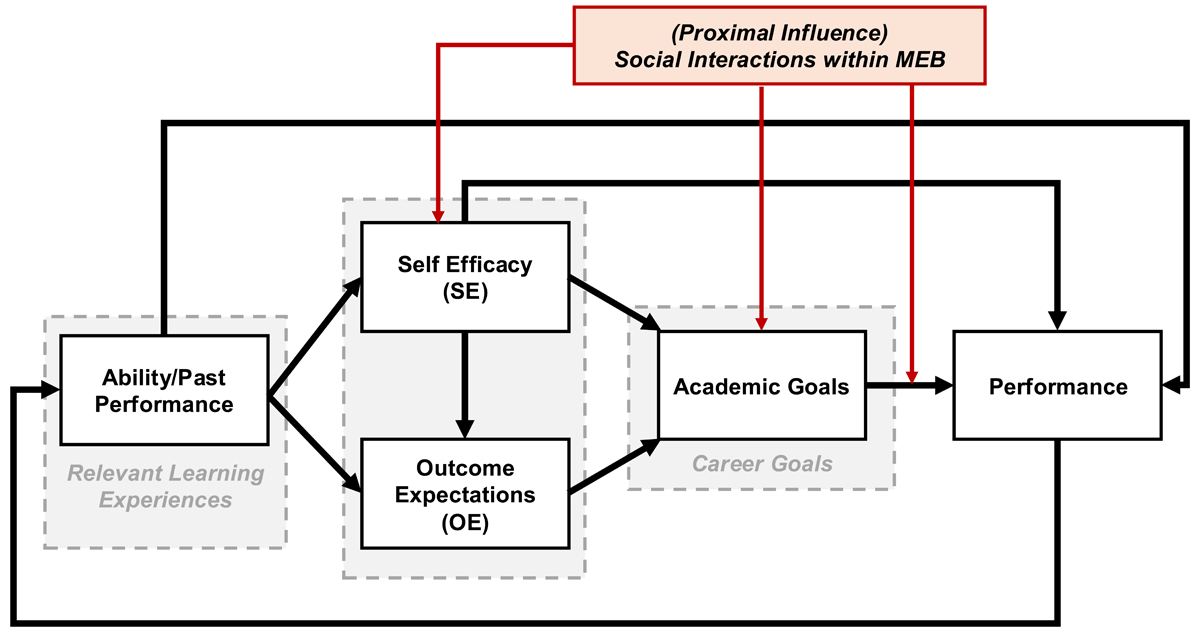
Figure 2
The social cognitive model of task performance in an MEB course. Italicized text denotes our adaptations to Lent et al.’s 1994 model.
Table 4
Summary of themes and subthemes.
| THEMES | EXEMPLAR QUOTE(S) |
|---|---|
| RQ1: How do social interactions within the MEB course impact students? | |
| 1.1 Proximal social interactions fostered students’ self-efficacy beliefs by enhancing their knowledge and problem-solving skills, normalizing challenging experiences, and increasing their sense of belonging. | (Online, Summer 2020) Maya: We (had) office hours. I would use it from time to time. It was nice cuz we could ask about a homework problem, and the professor would give us guidance on how to start because that was the biggest part (of) that class, figuring out how to start after you had all your equations in place… It was pretty easy from there. So, it was helpful after the professor showed us how to start off. That equipped me well for when we didn’t have time (for) exams. So, I didn’t waste as much time trying to figure out what the heck to do. |
| 1.2 Perceived differences between students, resulting from social interactions in the MEB course, isolated them from their peers and eroded their self-efficacy beliefs. | (In-person, Fall 2019) Shaan: Early on, I was like, “This (chemical engineering) is really cool.” I could see myself being a chemical engineer. Where was the turning point? It was after talking to other people who (looked) like they knew what they were doing. They were going to office hours, or not going to office hours and still doing better than I was, and I was like, “I don’t belong here because I’m struggling. I’m working my ass off to get worse scores than other people who I don’t think were struggling.” |
| 1.3 Social interactions informed students’ academic goals and behaviors but sometimes hindered learning. | (Online, Fall 2020) Kavi: …I think it’s like if I was doing (homework) and I was like, “I don’t really care if I don’t understand this.” And my friend thought out the way to do it before I did, and I was like, “I don’t really know how to do this, but you did it already. So, I’ll just copy it down.” But then she was like, “No, wait. I can teach you how I did this.” Then I was like, “Okay, fine. You can explain it to me.” This (was) more helpful (for me) than just writing it down and moving on. |
| RQ 2: How do beliefs influence students’ goals in the MEB course? | |
| 2.1 Students used their self-efficacy beliefs and outcome expectations to interpret their learning experiences in the MEB course and reevaluate their goals. | (Online, Fall 2020) Carol: … (The course) reaffirmed that I wanted to do chemical engineering. I thought what we were learning was interesting, and that I didn’t want to drop it or my co-op or switch majors like some people do after their first class. So, I think the positive experience helped me validate that what I decided to go to college for … was indeed what I wanted to do… I was like, “Oh, I get to actually be a chemical engineer now.” |
| RQ 3: How do students regulate their academic performance in the MEB course? | |
| 3.1 Students balanced their efforts across competing interests, incorporated feedback, and practiced regularly to achieve their desired performance. | (Online, Fall 2020) Maya: … I even set boundaries with my academics. If I’m working on homework, and it’s like 2 (or) 3 AM but I’m not done (and) I need to go to sleep, I’m not afraid to call it quits and then learn afterward from the (solution) for the homework. Especially cuz I know that homework tends not to count for as much as exams. And so, I just try my best to understand before the exams, and it usually turns out decently for me. |
[i] Note: Parentheses indicate words that were added for clarity’s sake, while ellipses indicate natural pauses or text that was omitted. See Table S2 in the Supplementary Information for the extended version.
(Theme 1.1) Proximal Social Interactions Fostered Students’ Self-Efficacy Beliefs by Enhancing Their Knowledge and Problem-Solving Skills, Normalizing Challenging Experiences, and Increasing Their Sense of Belonging.
This theme includes students’ descriptions of instances where proximal social interactions (i.e., within the MEB course) improved their self-efficacy beliefs.
1.1.1 Social Interactions Fostered Students’ Self-Efficacy Beliefs by Enhancing Their Knowledge and Problem-Solving Skills. The students described how faculty and their peers supported their learning in the MEB course by addressing their concerns when they encountered difficulties, such as asking questions, providing hints, confirming answers, and modeling how to structure and solve problems. These interactions equipped students with the tools to solve problems effectively in the MEB course, increasing their perceived competence and confidence in their ability to succeed in the class.
1.1.2 Social Interactions Fostered Students’ Self-Efficacy Beliefs by Normalizing Challenging Experiences. The students described how interacting with peer groups (e.g., homework groups) allowed them to normalize challenging experiences (e.g., a challenging exam).
1.1.3 Social Interactions Fostered Students’ Self-Efficacy Beliefs by Increasing Their Sense of Belonging. Students described how interacting with peers and faculty who shared their identities helped them feel less isolated and increased their sense of belonging in the MEB course. A sense of belonging, particularly at the classroom level (Wilson et al., 2015), refers to feeling socially connected and included within a class. For instance, both Maya (Online, Summer 2020) and Kavi (Online, Fall 2020) were excited to be taught by a Black male professor and an Asian female professor, despite the lack of diverse representation among the university’s Chemical Engineering faculty. Similarly, being a co-op student enabled Carol (Online, Fall 2020) to form close connections with the other co-op students in the MEB course, despite the course being online in the Fall 2020 semester. In this way, these shared identities fostered a sense of belonging among students in the MEB course, which, in turn, led to positive self-efficacy beliefs.
(Theme 1.2) Perceived Differences Between Students, Resulting from Social Interactions in the MEB Course, Isolated Them from Their Peers and Eroded Their Self-Efficacy Beliefs.
This theme encompasses instances of social interactions that led students to compare themselves unfavorably to their peers. Students expressed how they felt separated from their peers after specific observations and interactions in the MEB course based on students’ performance on course assessments (e.g., exam grades), identity (race or gender), the relative amounts of effort they put into the course, and their prior level of preparation before the course. Notably, in Fall 2020, the first exam was administered online via third-party software. Students were randomly assigned to different versions of the exam problems to enhance exam integrity, and they felt that one version (of the two exams) was more challenging and led to biased exam grades. In general, these perceived differences led students to feel isolated and frustrated, despite their best efforts to improve their academic performance in the MEB course.
(Theme 1.3) Social Interactions Informed Students’ Academic Goals and Behaviors but Sometimes Hindered Learning.
This theme describes the direct effects of proximal social interaction on students’ academic goals and behavior in the MEB course.
1.3.1. Social Interactions Informed Students’ Academic Goals and Behavior in the MEB Course. Social interactions within the classroom directly influenced students’ academic goals by exemplifying acceptable performance levels through quantitative metrics, such as average exam grades, and more subjective metrics, such as providing suitable answers to class questions. By interacting with their peer groups—whether in office hours, homework groups, or group chats —students were exposed to and developed the competencies needed to succeed in the MEB course. Even during the COVID-19 pandemic, when interactions were limited for students on campus or impossible for those at home, most participants still made time to attend office hours, work with peers on homework, and form study groups. Through these interactions, the students were encouraged to start their homework assignments early and overcome difficulties. Furthermore, positive feedback from social interactions with others in their learning environment encouraged students to persist in reaching out and asking for help, despite any initial reservations (e.g., fear of being judged or intimidated by peers and the instructor). In particular, Maya and Carol (Online Fall 2020) both described how they appreciated the relative anonymity and ease of asking questions in the online classroom environment.
1.3.2. Sometimes, Social Interactions Hindered Learning. Students discussed instances where interacting with their peers, teaching assistants, and professors hindered their learning. For example, Eleanor (Online, Fall 2020) mentioned that she found the office hours unhelpful because she felt there was a consistent miscommunication about her ability to ask questions and get help. Additionally, students were assigned to groups to complete their homework assignments. At the same time, students reported varying levels of compliance with their assigned homework group. Some of the issues they faced with groupwork included managing gender dynamics, conflicting schedules, and the desire to work on their own. Finally, both Kavi (Online, Fall 2020) and Shaan (In-person, Fall 20219) expressed a desire for more verbal encouragement from the professor. Interestingly, Kavi attributed this observance to the nature of the online course.
(Theme 2.1) Students Used Their Self-Efficacy Beliefs and Outcome Expectations to Interpret Their Learning Experiences in the MEB Course and Reevaluate Their Goals.
This theme describes how students used their beliefs to interpret their learning experiences and reevaluate their goals. Students discussed two distinct but related goals in their interviews: academic goals and career goals. They sought to gain a deep understanding of fundamental chemical engineering concepts, demonstrate their competence, and pass the course, as evidenced by their grades on course assessments. In addition, they expressed interest in strengthening their connection to the chemical engineering program by forming friendships and nurturing their career-related interests.
When their performance and experiences in MEB did not align with their self-assessments, they questioned their initial goals and considered alternative pathways, including other engineering disciplines and academic majors. For example, Eleanor (Online, Fall 2020) felt like “I have no idea what I’m doing, and I don’t belong” while managing her learning. She eventually passed the class but mentioned that she had considered changing majors if she had failed. In contrast, Carol’s (Online, Fall 2020) overall positive experience in the MEB course reinforced her goal to become a chemical engineer.
(Theme 3.1) Students Balanced Their Efforts Across Competing Interests, Incorporated Feedback, and Practiced Regularly to Achieve Their Desired Performance.
This theme presents contextualized examples of how students regulated their learning experience and academic performance in the MEB course.
3.1.1 Students Balanced Their Efforts Across Competing Interests to Achieve Their Desired Performance. Other classes, personal circumstances, and extracurricular responsibilities influenced the amount of attention the students allocated to the MEB course. As a result, they constantly switched between prioritizing this course and falling behind due to external factors. For example, Kavi (Online, Fall 2020) mentioned that she struggled to keep up in the MEB classes when she had to focus on other classes, especially notable given that this version of the class was more self-directed. In addition, Maya (Online, Summer 2020), a student-athlete, talked about how she balanced her student-athlete responsibilities with the demands of the chemical engineering program by setting boundaries and focusing on what was important (i.e., prioritizing rest and her exam grades). Some essential components of effective self-management are time management (e.g., starting homework early) and selecting appropriate study environments.
3.1.2 Students Incorporated Feedback and Practiced Regularly to Achieve Their Desired Performance. Following each performance task (e.g., an exam), students evaluated their performance and revised (or repeated) their strategy. They repeatedly reviewed learning materials and practiced regularly to pass the course. Kavi, Carol (Online, Fall 2020), and Shaan (In-person, Fall 2019) discussed how they ultimately passed the MEB course despite the initial struggles they faced. However, when students did not receive helpful feedback on their performance in the class, they felt confused or discouraged.
Discussion
We investigated students’ learning experiences in an introductory chemical engineering class, focusing on how social interactions and social cognitive variables influenced students’ academic development and performance. Our proposed social cognitive model of task performance in an MEB course emphasizes the role of proximal social interactions in shaping students’ self-efficacy beliefs, academic goals, and behavior. Our results also provide contextualized descriptions of some active social cognitive mechanisms (i.e., belief-goal relationships and self-regulatory mechanisms) in this course context. These findings contribute to the literature on SCCT and the learning experiences of chemical engineering students in the early years.
The Social Cognitive Model of Task Performance in an Introductory Chemical Engineering Course
Our social cognitive model of task performance (Figure 2) proposes that proximal social interactions within the course learning environment directly inform students’ self-efficacy beliefs, academic goals, and behavior. The direct influence of proximal contextual factors (e.g., supports, opportunities, and barriers) on choice goals and the relationship between choice goals and performance, as they apply to career choice behaviors, is well documented in the SCCT literature (Lent et al., 1994; Lent & Brown, 2019). However, less attention has been paid in the SCCT literature to their effects on task performance through peer networks and student-faculty interactions within the classroom environment, as we do in this study. For both the in-person and online versions of the MEB course, students described how academic standards, such as an acceptable course grade, and behaviors, like participating in a homework group, were socially propagated through peer networks. At the same time, social experiences within the MEB course environment that students perceived as being unhelpful for their learning led them to minimize or completely abandon these potentially valuable resources.
In addition, the primary source of self-efficacy information is past performance, except when a learner has limited relevant prior experience (Bandura, 1977; Bong & Clark, 1999; Lent et al., 1994). Our results illustrate that proximal social interactions were a source of self-efficacy beliefs for students in the MEB course, enabling learning and fostering a sense of community. In the interviews, the students discussed how their peer groups and professors provided timely feedback and support, which bolstered their confidence in their abilities, guided their efforts toward the appropriate problem-solving approach, and encouraged them to persist when facing challenges. In particular, students mentioned faculty members and peers with shared visible identities in the classroom who encouraged and inspired them to succeed, promoting positive self-efficacy beliefs. In contrast, learning experiences that diminished students’ perceived self-efficacy beliefs and hindered their academic development were detrimental. Students felt isolated from their peers when they unfavorably compared themselves to their peers, which negatively affected their self-efficacy beliefs. These results suggest that students’ prior academic experiences were less relevant for initially forming self-efficacy judgements in the MEB context. Instead, they relied more on feedback from and observing others. Hutchison-Green et al. (2008) observed similar results in first-year engineering students who focused on performance comparisons with their classmates as a source of their self-efficacy beliefs.
We also found that students expected to form deep connections with their peers and professors in the MEB course context. The only social dimension of students’ academic development that the SCCT model of task performance considers is social rewards one can expect from completing academic tasks (Lent et al., 1994). However, engineering students’ desire to make friends in their classes, collaborate with peers, and receive support from faculty is well documented among undergraduate STEM students (Geisinger & Raman, 2013; Seymour & Hunter, 2019). Recent studies have provided evidence that positive support from faculty and peers positively influences the development of engineering students’ self-efficacy beliefs and outcome expectations (Buckley et al., 2023; Chen et al., 2023; Hsu et al., 2021). On the other hand, social interactions can lead to unhelpful comparisons that undermine learning. We observed how the decision to randomize exam questions and use third-party software for an online exam exacerbated the perceived division between students and their peers in Fall 2020. From Shaan’s interview, we see that this perception existed in the in-person version of the course due to what he described as a lack of preparation in previous classes and interacting with “people who (looked) like they knew what they were doing”. Notably, the source of the difference is not the issue; rather, it is how students interpret its impact on their learning experiences and performance. Canning et al. (2020) demonstrated that first- and second-year STEM students who view their classroom climate as competitive are more likely to have lower confidence in their abilities to succeed (and feel like an imposter), compared to the same students in the same class who view the climate as less competitive, especially for first-generation STEM students. One of the reasons students leave engineering programs is the perceived lack of support, especially from professors, a lack of personal encouragement, and competitive classroom environments (Geisinger & Raman, 2013; Seymour & Hunter, 2019).
Finally, as mentioned in the interviews, technological tools can unintentionally exacerbate some unfavorable social comparisons that some students are already experiencing in a classroom environment, such as the MEB course. As we observe with Eleanor, the detrimental effects of social comparison on efficacy judgments can last long after the course is completed.
Our findings from the MEB course context align with prior literature on students’ academic development in introductory engineering courses. As students continually evaluated their performance against their set goals, they adjusted their goals as needed, illustrating the triadic reciprocal relationships among a person, their behavior, and their context, as proposed by Social Cognitive Theory.
The Impact of the COVID-19 Pandemic
This study contributes to the extensive literature on the pandemic’s impact on students’ learning by providing detailed descriptions of how students navigated an online chemical engineering course. Four of the five participants were enrolled in the MEB course during the COVID-19 pandemic: Kavi (Online, Fall 2020) and Maya (Online, Summer 2020), while Eleanor and Carol (Online, Fall 2020) were on campus, where social distancing was heavily encouraged. As a result, they experienced varying levels of success in adapting to and navigating different obstacles in the online learning environment. The widespread restrictions on face-to-face interactions forced an unprecedented, rapid transition to online and socially distanced learning, which exacerbated existing inequalities in higher education systems (Arday, 2022; Bartolic et al., 2022; Faura-Martínez et al., 2022; Khawaja et al., 2023; McClure et al., 2023). Especially in the online learning environments, students had to adjust to less interactions with their peers and instructors, lower academic motivation, more stress, increased workload, technical difficulties (e.g., poor internet connection), unconducive home learning environments, and online assessments (Buckley et al., 2023; Clark et al., 2023; Iqbal et al., 2022; McIntyre et al., 2023; Misra et al., 2023). At the same time, students found the online nature of classes and office hours more convenient, accessible, and less intimidating for asking questions, and they could learn at their own pace (e.g., rewatching videos if needed) (Iqbal et al., 2022; Misra et al., 2023).
In our study, some students described the challenges they faced in advocating for their needs and receiving support from the instructor, especially during the asynchronous version of the MEB course in Fall 2020. Additionally, the lack of in-person class meetings made it more challenging for them to meet with their group, manage group dynamics, and receive feedback on their performance. They were able to overcome these obstacles by heavily relying on their existing peer network. Further, the changes resulting from the pandemic were not all negative. The virtual learning environment provided anonymity, reducing barriers to initiating conversations with professors. The educational changes made during the pandemic reminded us that education is ultimately a human activity, revealing the relational gaps in the engineering classroom environment and opportunities to leverage technological tools to support learning.
Implications
Our research builds on SCCT literature by describing how social interactions in introductory engineering courses impact students’ learning experience and ultimately influence their academic performance. We discussed how students in the MEB course relied on social interactions, particularly in forming their self-efficacy judgments. Therefore, we suggest that engineering faculty and departments collaborate to create a community of learners, especially in introductory engineering courses, where students are new to the discipline and seek to form lasting connections. By verbally encouraging and supporting students, instructors can positively influence their self-efficacy beliefs and help them develop into more independent learners. Further, communication is a two-way street, and students also need avenues to ask questions, provide or receive feedback, and advocate for themselves. Instructors can create opportunities for students to practice communication skills (Won et al., 2024), collaborative learning experiences in class (Iqbal et al., 2022; McIntyre et al., 2023; Power et al., 2025), and for students to communicate and connect either in-class or offline (Buckley et al., 2023). Finally, unhealthy classroom competition undermines the ethos of a learning community. Instead, faculty can design classroom assessments and grading practices to minimize unfavorable comparisons and encourage students to support one another (Buckley et al., 2023; Hutchison-Green et al., 2008; Seymour & Hunter, 2019). Fostering a positive classroom climate where students are supported and comfortable asking questions will help address some of the isolation students experience in introductory engineering classes.
Our results also have significant implications for thinking about how we design and transform engineering classrooms to achieve higher levels of student success. As students’ self-efficacy judgments about their abilities to succeed on engineering tasks ultimately influence their goals and performance, they must accurately assess their abilities to interpret events and experiences in their learning environments correctly. Therefore, one way to practically support students’ academic development is to provide them with more accurate appraisals of their abilities by implementing more reflective and formative assessments (Hutchison-Green et al., 2008; Chen et al., 2023). Self-reflections provide students with an opportunity to reflect on their performance and have been shown to develop their metacognitive abilities, thereby improving their performance (Alt & Raichel, 2020; Pintrich et al., 2000; Schraw & Dennison, 1994). While formative assessments are diagnostic tools that identify gaps in students’ knowledge and problem-solving abilities (Black & Wiliam, 2003; Sadler, 1989), they are most effective before high-stakes summative assessments. In addition to effective assessments, students need to understand what to do after completing a task. A recurring subtheme in the interviews was the role of peer and instructor feedback in facilitating students’ goal pursuit. Good-quality, timely feedback provides students with knowledge of their strengths and weaknesses, as well as the steps they need to take to achieve their goals (He et al., 2024; McDowell et al., 2004). Therefore, it is necessary to incorporate structured, high-quality feedback for students in these introductory courses to minimize wasted effort on less helpful endeavors and positively influence their self-efficacy beliefs. Another potentially powerful pedagogical tool that can be easily incorporated into the engineering classroom is goal setting, which helps learners reflect, set goals, and monitor their progress toward their intended objectives. Finally, normalizing the nonlinear learning process for students will help them develop academic resilience —the ability to handle unplanned, devastating events (Dweck & Yeager, 2021; Martin & Marsh, 2006). Resilience is desired because it helps students to persist in the face of disappointing academic results, learn from their mistakes, adapt to disruptions (e.g., the COVID-19 pandemic), and manage stressful situations (Hunsu et al., 2021; Winkens & Leicht-Scholten, 2023; Wint & Direito, 2024; Yeager & Dweck, 2012). In addition to the challenging nature of introductory engineering classes, external events (e.g., personal loss) that impact students’ health and well-being and socially isolating occurrences (e.g., stereotypes and micro-aggressions) can undermine students’ ability to be resilient towards their academic goals in these classroom environments (Hunsu et al., 2021; Wint & Direito, 2024; Yeager & Dweck, 2012). At the same time, social networks and community help students to build resilience (Washington & Mondisa, 2021). Together, these recommendations will enable engineering instructors to create an environment that fosters student persistence and the development of the skills necessary for independent and lifelong learning.
Engineering education researchers and practitioners need to thoroughly understand the lasting effects of the pandemic’s disruption on future learners and work to address these effects. At the same time, the pandemic exposed many more students and instructors to online learning and educational technology than ever before. Future work in engineering education should continue to examine how online learning and technology, including the current proliferation of artificial intelligence (AI) tools, can be effectively harnessed in the classroom to benefit teaching and learning. Based on the results of this study, some recommended research areas include building human connection, incorporating timely two-way feedback for students and their instructors, and developing students’ agency in online learning environments. This study provides examples of how COVID-19 pandemic restrictions on in-person gatherings affected students’ social outcome expectations, which were critical to their academic and social well-being in the MEB course. Ultimately, the pandemic forces us to reconsider how we can design educational systems to equip engineering students with the knowledge and skills they need to thrive in a rapidly evolving world. For example, Misra et al. (2023) recommend that virtual office hours, a by-product of the pandemic, should be continued. We urge engineering educators and practitioners to continue reflecting on the lessons learned and proactively work towards building resilient, equitable educational systems that meet the diverse needs of students.
Limitations
While the current study enhances our understanding of how social interactions impact students’ academic development in an introductory chemical engineering class, it is important to acknowledge its limitations. First, we interviewed five participants from the same institution, and four of them took the course during the COVID-19 pandemic. Therefore, the results may not be generalizable to other introductory engineering contexts. Additionally, due to our limited sample size, we were unable to examine differences between student groups (e.g., gender). For instance, prior studies have documented gendered differences in self-efficacy beliefs (Chen et al., 2023; Concannon & Barrow, 2009; Power et al., 2025; Seymour & Hunter, 2019).
For this study, we recruited students who had already completed the course rather than those currently enrolled. Also, we did not triangulate the interview data with other data sources (e.g., exam scores). As a result, we relied on students’ reflections of their past experiences, which could have introduced some bias and inaccuracies into this study. We obtained similar results to those of an earlier pilot study of students who took this course in Fall 2021 (Adaramola & Godwin, 2022). Additionally, because we focused on students who had completed the course and were in the chemical engineering program, we missed the perspective of students who left the major after taking the MEB course. Further, we did not consider the role of power dynamics in influencing students’ social interactions in the MEB course. Future work can address these limitations.
Future Work
Future studies can further examine the intersection of career development and academic performance in introductory engineering classes across a broader sample of chemical engineering programs and other engineering disciplines, to refine and expand the relationships proposed by our model and to explore potential differences and similarities across disciplines. We hope that the results from this study and future research on engineering students’ experiences in introductory classes will inform the development of interventions that target their self-efficacy judgments and goal-setting abilities.
Conclusion
This qualitative study of student experiences in an introductory chemical engineering course examines how learning environments shape students’ beliefs and subsequent outcomes, offering a richer, more nuanced understanding of how to support students in introductory courses. First, we proposed a social cognitive model of task performance in an MEB course, outlining how proximal social interactions in the course influenced students’ self-efficacy beliefs, goals, and behavior. SCCT emphasizes the role of efficacy appraisals in enabling students to succeed in specific academic tasks. This study aims to bridge the gap between the SCCT framework and empirical research on the experiences of engineering students at a critical juncture in their educational journeys, when they are most at risk of abandoning their majors. As most of the research participants were impacted by COVID-19 when they enrolled in this course, we also observed the disruptive effects of pandemic restrictions on students’ learning experiences. Future research will continue to explore the proposed theoretical relationships in different engineering contexts. One significant practical implication of this study is the need to continue critically reflecting on current educational systems and practices to design engineering courses that are appropriately challenging, transformative, engaging, and accessible to diverse students.
Additional File
The additional file for this article can be found as follows:
Acknowledgements
The National Science Foundation supported this work under grant 1915574. However, any opinions, findings, and conclusions or recommendations expressed in this material are those of the author(s) and do not necessarily reflect the views of the National Science Foundation. An earlier version of this research article appeared in the first author’s doctoral thesis.
Adaramola, A. (2024). Investigating chemical engineering students’ learning experiences and outcomes in a gateway Course. [Doctoral dissertation, Purdue University] Proquest Dissertations Publishing. https://doi.org/10.25394/PGS.26367124