
Introduction
Engineering design, both in educational settings and professional practice, is a sociotechnical process that requires engineers to engage in interactional social dynamics to discuss, negotiate, and select ideas, allocate tasks, and make engineering judgements in teams collaboratively (Dinar et al., 2015; Francis et al., 2022; Mostafapour & Hurst, 2020; Henderson, 2023). However, unlike engineering design in professional settings, the central outcome of engineering design teams in educational contexts is not necessarily the artifacts students produce or the “correctness” and functionality of design solutions (Dym et al., 2005). Instead, instructors are often equally, if not more concerned that students (a) learn about applications of knowledge from the engineering sciences, (b) develop teamwork competencies related to interactional dynamics in engineering, and (c) develop technical communication skills such as technical report writing (Dym et al., 2005; Henderson, 2023; Rodriguez-Simmonds et al., 2023). However, the degree to which students accomplish these goals is often a function of the degree to which they are afforded opportunities for full participation in their teams (Fowler & Su, 2018; Seron et al., 2016).
Recently, scholars have focused on the need for instructors to monitor student interactions, as well as the need to teach students practices for equitable participation, in team-based, project-based learning environments to ensure equitable access to learning opportunities (Matz et al., 2022). Unfortunately, decades of research on students’ interactional dynamics in team-based learning environments has described inequities in students’ access to learning opportunities in team-based, project-based learning for students from historically excluded backgrounds—women, racial/ethnic minoritized students—in engineering, with implications for their learning and long-term outcomes in the discipline (Henderson, 2023, 2024; Hirshfield & Chachra, 2015). That is, the negotiated opportunities for learning may reflect racialized and gendered patterns of exclusion, limiting opportunities afforded to historically excluded students (Beddoes & Panther, 2018; Macke et al., 2019; Wolfe et al., 2016). While research frequently captures overt, flagrant examples of marginalization, such as racist or sexist comments or microaggressions (e.g., Dickerson et al., 2024), patterns of marginalization and exclusion can be manifested in more subtle ways, such as differential access to tasks, disproportionate scrutiny of one’s ideas and contributions, and so on (Henderson, 2023). Thus, understanding the interactional and conversational dynamics by which students converge on ideas, allocate tasks, and make engineering judgments, is key to understanding how students participate in specific learning activities in team-based engineering design coursework.
This research examines the ways students use questions in design teamwork settings as a rhetorical tactic to exert implicit or explicit influence over teammates, design decisions, task allocation, and broader engineering judgements, which are often absent from research on interactional dynamics in engineering judgment (Fowler, 2014; Weedon, 2019). Both organizational and education research have captured the ways individuals can use dialogue broadly, and questions specifically, to (a) position themselves, their ideas, or their contributions, or those of others, as authorities in team settings, or (b) undermine the ideas, contributions, and authority of others (e.g., Fowler, 2014; Hirvonen, 2016). Yet, such analyses are often absent in engineering education research examining team-based, project-based learning. This research presupposes that the questions students ask as they engage in dialogue with each other during team negotiation processes can act as powerful mechanisms of influence that shape patterns of participation in student teams.
Huddleston (1994) distinguishes questions, “a category of meaning” (p. 411) whose function is a product, in part, of social context, broadly, and, in engineering teams, of sociotechnical context, from interrogatives, “a category of grammatical form.” This research focuses on the nature and use of questions by examining the meaning students made of questions based on their responses in situ and post-experience reflections. While existing engineering education research usually assumes that the questions students ask, of themselves, teammates, instructors, or other stakeholders, in ill-structured, complex problem-solving settings are earnest attempts to gather useful information that clarifies ideas and supports engineering judgment (Francis et al., 2022), other scholars have acknowledged that not all questions are created equally, and the nature and use of questions in student teams can reflect students’ relative influence and social power in their teams, serving as an important antecedent to their access and participation in various learning opportunity structures in team-based, problem-based learning. Thus, the goal of this research was to examine the nature and use of questions in student teams to answer the following research questions:
What is the meaning that students ascribe to the various types of questions students ask in team-based engineering design problem solving?
How do various types of questions shape patterns of influence in student-led engineering design teams?
How are social power dynamics manifested in the nature and use of students’ questions in the context of engineering design problem solving?
Literature Review
Manifestations of Social Power in Student Engineering Teams
The notion that status characteristics, such as race/ethnicity and gender, shape interactional outcomes (e.g., participation, influence) in small teams has been studied for decades (Berger et al., 1972). While applications to engineering student teamwork are relatively new, existing literature consistently demonstrates that teamwork in engineering is imbued with social power dynamics that legitimize some students while marginalizing others (Fowler & Su, 2018; Meadows & Sekaquaptewa, 2013; Seron et al., 2016; Tonso, 2007). For example, decades of research have found that women in engineering teams experience hostility in conversational dynamics, such as patterns of interruption, exclusion from access to the conversational floor, and even inequitable task allocation (Smith-Doerr et al., 2017). Similarly, existing research has demonstrated how racial/ethnic minoritized students often experience engineering teamwork as hostile, noting patterns by which their work and contributions are maligned because of perceptions about competence (Henderson, 2024a; McGee, 2021).
Importantly, in educational contexts, some social power dynamics escape the view of instructors both because their manifestations are internal to students, as well as because these interactional dynamics might occur outside of the classroom. For example, Fowler and Su (2018) described students’ academic orientations–students’ motivations for learning–as an underlying social power dynamic shaping students’ access to various learning opportunities. Students might exhibit performance avoidance orientations, wherein they avoid participating in classroom activities due to feelings of imposterism or out of fear of the social consequences of being wrong in front of classmates (Fowler & Su, 2018; Henderson, 2023). Women, in their view, might be more likely to report a performance-avoidance orientation. Still, this research views such dynamics as an issue of status—whereas some students have the space and opportunity to tinker and fail without social consequences (e.g., their teammates believing they are incompetent), others must navigate the sociotechnical interactions in design teams by actively avoiding such perceptions.
Other forms of social inequalities in student teamwork are also reported in the scholarly literature on team-based, project-based learning in engineering education. For example, Henderson (2024b) found that while racial/ethnic minoritized students contributed ideas at equal rates as their White counterparts, White students were more likely to be reported as having their ideas selected and enacted in engineering design teams. However, Henderson left open the question of whether enactment gaps were one of contribution (i.e., Black students’ ideas are used less often because they contribute fewer ideas), attribution (i.e., Black students’ ideas were used at equal rates, but that other students received credit for their ideas), or something else. Indeed, similar work on the experiences of women in teamwork settings has consistently found that women feel that their ideas are ignored or credited to men in their teams (Correll & Ridgeway, 2003).
Taken collectively, these findings suggest that reframing research on teamwork dynamics from deficit-based assumptions about students’ behaviors to an analysis of status and social power dynamics may be more informative for pedagogical decision making in student teams. For example, while there has been several decades of empirical research on “social loafing,” defined as scenarios in which students who are presumed to be slackers or free-loaders work less diligently in teams than they would had they been working alone (Barr & De Clerck, 2018; Moffat et al., 2024; Moffat et al., 2025; Pieterse & Thompson, 2010), this work begins from the assumption that students’ participation in teams is informed, in part, by the social construction of the learning environment, including social power dynamics in the complex interactions by which students negotiate ideation, task allocation, and engineering judgments.
Question Asking in Situated Contexts
Research characterizing the nature and use of questions across contexts variously describes how the constructions of interrogative sentences shape, and are shaped by, various elements of social context, with implications for interactional dynamics in teams. Yap and colleagues (2023) noted that questions function in interactional dynamics beyond information-seeking and confirming functions. Instead, questions can signal the question-asker’s (dis)affiliative stance. For example, in engineering teams, the question, “Did you change the length from 8 inches to 10 inches?” may be an earnest, yes-no interrogative seeking clarity about an unexplained change, a rhetorical question acknowledging a design change, or a disaffiliative move signaling disapproval of a change. Similarly, questions can signal an affiliative stance that de-escalate confrontations or threats. For example, in engineering teams, the question, “Do you think I should change the length from 8 inches to 10 inches?” may be an earnest, yes-no interrogative seeking feedback on a design change, a rhetorical question simply announcing one’s intentions to make a design change, or an affiliative move seeking to avoid conflict from making a contentious change. Interpretations of these questions must necessarily be couched in the sociotechnical context in which they occur.
To understand my interest in question asking as a status organizing process, I draw on two studies examining negative interrogatives in various contexts. Theorizing about the nature and function of various types of questions often points to the ways that social context shapes both when particular types of questions appear, as well as how those types of questions shape interactional dynamics. For example, Heritage (2002) described negative interrogatives—“questions beginning with such frames as ‘Isn’t it’, ‘Don’t you’, ‘Shouldn’t you’ etc.”—and examined the role of these types of negatively framed questions in news interviews. Heritage argued that negative interrogatives in the context of news interviews often functioned as assertions, allowing the interviewer to speak for the interviewee. Conversely, Aronsson (2018) studied negative interrogatives in the context of child custody hearings in courtrooms. Negative interrogatives in this context featured more heavily during cross-examination (i.e., the examination by the opponent attorney), functioning to establish what Aronsson called blame-account sequences.
While both Heritage (2002) and Aronsson (2018) acknowledge that negative interrogatives are argumentative, challenging, and potentially hostile in their nature, their findings suggest that the social context in which the negative interrogative is deployed shapes interactional dynamics and responses from the respondent. Whereas journalists are framed as acting ideologically neutral, opponent attorneys are designedly adversarial (Aronsson, 2018; Heritage, 2002). As such, negative interrogatives in news interviews often result in responses that are “couched in terms of agreement or disagreement with the interviewer” (Heritage, 2002, p. 1436), while responses in the child custody cases resulted in “an array of other devices, such as extreme case formulations, (ironic) rhetorical moves, and metacommunication that are all deployed for building up confrontations and hostility” (Aronsson, 2018, p. 49).
These research studies on the nature and function of interrogatives indicate that it is not the grammatical construction of interrogatives that shapes interactional dynamics, but how interrogatives are understood in situated contexts. Here, I return to Aronsson’s (2018) study of negative interrogatives in child custody examinations. Aronsson notes that “negative interrogatives might appear as a type of ‘neutral’ question,” and can be constructed as a polar yes-no question. However, the social context in which the question was delivered, combined with the inherently adversarial nature of the question asker (i.e., the opponent attorney), means that “respondents might still orient to the implicit hostile packaging” (p. 42). In such cases, whereas the question called for a single word answer (i.e., yes-no), the respondent might take up various defensive responses, such as excuse making or justification (Aronsson, 2018; Heinemann, 2008). These findings suggest that examining the grammatical form of the question alone, as documented in transcripts, may not capture the socially constructed interactional dynamics by which various types of questions function, and the meaning respondents make of questions in situated contexts, as captured in their verbal and behavioral responses. Thus, this research focuses on three types of questions that appeared in the data described herein: negative interrogatives, yes-no interrogatives (i.e., polar interrogatives that can be answered with yes or no), and, to a lesser extent, wh-interrogatives (i.e., those that begin with who, what, when, where, why, etc. that ask for specific information about a focal element) (Bocci et al., 2021; Heinemann, 2008; Huddleston, 1994; Raymond, 2003).
In educational contexts, research examining the nature and use of questions in the classroom suggests that the types of questions teachers ask students can impact the level and nature of students’ participation, thereby shaping important learning outcomes (Farahian & Rezaee, 2012; Koufetta-Menicou & Scaife, 2000). Importantly, the literature on question-asking in classroom contexts is often teacher-centered, focusing on the nature and use of the questions that instructors ask of students and the sociocognitive elements required of students to participate productively in the classroom (e.g., Eshach et al., 2013; Koufetta-Menicou & Scaife, 2000). However, this research was concerned with the social function of students’ questions in the context of design problem solving in student teams, where the process of communicating, negotiating, and selecting ideas is informed by social interactions, which themselves are imbued with racialized and gendered social power dynamics. These studies suggest a need to examine the nature and use of questions in student teams to understand how these questions function in the context of engineering design decision making, how they motivate individual and collective behaviors, and how they shape students’ access to specific learning opportunity structures in engineering team-based, project-based learning environments.
Theoretical Framework and Sensitizing Concepts
I drew on sensitizing concepts from status characteristics theory (SCT), which is a subtheory of expectation states theory (EST) (Correll & Ridgeway, 2003), for the theoretical framework in this study. Broadly, expectation states theory “was formulated to explain the emergence of differential power and prestige in task-oriented groups” (Fox & Moore, Jr., 1979, p. 126). Such power and prestige hierarchies are characterized by four observable, measurable individual team behaviors—the negotiated opportunities to participate in group activities (action opportunities), the opportunities for problem solving that result from action opportunities (performance outputs), communicated evaluations of one’s contributions (performance evaluations), and differences in one’s ability to utilize conscious or unconscious social pressures to change opinions, expectations, decisions, or behaviors (influence) (Fox & Moore, Jr., 1979; Simpson et al., 2012).
SCT extends expectation states theory by centering the role of diffuse and specific status characteristics possessed by team members in status organizing processes, here defined as the process by which evaluations of beliefs about diffuse and specific status characteristics become the bases of inequalities in social interactions (Berger et al., 1980; Fox & Moore, Jr., 1979). Whereas diffuse status characteristics (e.g., race/ethnicity, gender) reflect broader societal beliefs about performance expectations, such as the generally held belief that Whites and men are more competent engineers than Blacks and women (Dringenberg et al., 2022; Kant & Kerr, 2018), specific status characteristics (e.g., perceptions of one’s programming ability, mathematics ability) reflect traits germane to a limited, domain specific setting (Simpson et al., 2012).
Berger and Fisek (2006) note that the original SCT “was formulated to provide an account of how individuals use status information, such as gender, race, and occupational position to form expectations for each other” (p. 1038), which in turn shaped patterns of behaviors in teams and organizations. For example, in this view, diffuse status characteristics consist of four significant features: (a) a socially significant characteristic, such as race/ethnicity and/or gender, (b) varying states of the characteristic (e.g., male-female, White-Black-Latinx), (c) varying status evaluations related to social worth across contexts (e.g., that men are inherently more competent engineers than women), and (d) high and low conceptions of the capacities of the people who possess the different states (Berger & Fisek, 2006). The general premise of SCT is that status beliefs related to diffuse and specific status characteristics often translate into the individual and team-level behaviors of the group, namely, patterns of action opportunities, performance outputs, performance evaluations, and influence over interactional dynamics and team decision making (Bowman, 2013; Bianchi, 2010).
For example, Miles and Clenney (2010) depict one mechanism by which diffuse status characteristics can shape interactional dynamics, as well as team-level behaviors and outcomes (Figure 1). In their depiction, diffuse status characteristics, such as race/ethnicity or gender, inform perceptions of one’s status relative to others, which in turn shape perceptions of socially situated competence. That is, those who are perceived to have greater status due, in part, to socially held beliefs related to race and gender, are also likely to be perceived as more competent during team-based learning activities. Moreover, perceptions of status also influence the degree to which one’s efforts to exert influence, make assertive decisions, or perform other actions that reinforce status, are perceived as legitimate. For example, team members might respond differently to a higher status student who challenges ideas than they would a lower status member due to perceptions that the higher status member’s concerns are more legitimate. Finally, perceptions of competence and perceived legitimacy leads higher status members to “have more success and less resistance when they apply a broader gamut of tactics and strategies” (Miles & Clenney, 2010, p. 139), leading higher-status students to better balance competition and cooperation. That is, male students who are perceived as competent can employ strategies, such as assertively questioning and challenging teammates’ ideas, that position their own ideas as more favorable—strategies that women might be punished for should they attempt to employ similar tactics—leading to more effective team negotiation outcomes for men.
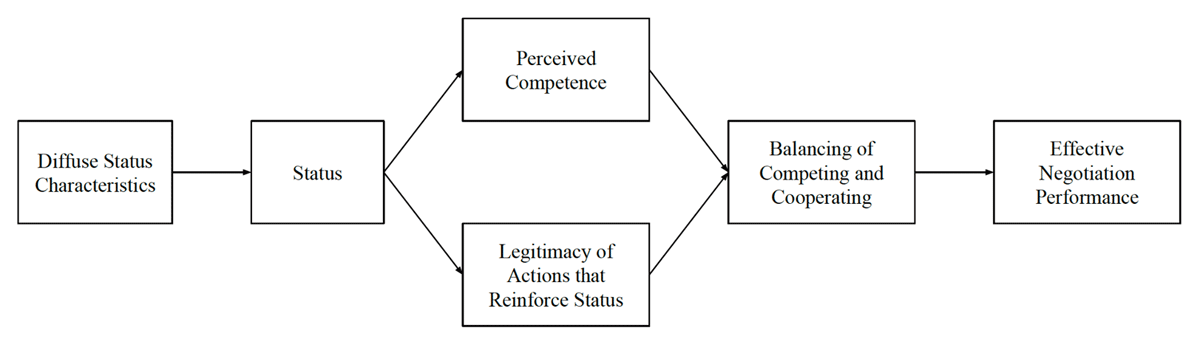
Figure 1
Relationship of status to effective negotiation performance proposed by Miles & Clenney (2010).
In engineering education research, explanations of racial/ethnic, gender, and race-gender differences in students’ learning experiences are explained using pathological terms (e.g., “Women are more likely to prioritize avoiding conflict, and thus defer to male counterparts”) rather than critiques of the social construction of the learning environment. For example, Bear and Woolley (2011) described a meta-analysis of gender differences in interpersonal communication in teams, arguing that such differences were attributable, in part, to interpersonal styles. They explain that whereas men were more authoritative, exhibiting behaviors such as giving orders, women were more democratic, focusing their attention on full participation (Bear & Woolley, 2011, p. 148). Such a description ignores the role that the social construction of status differences plays in shaping individual behaviors and interactional dynamics.
Instead, Miles and Clenney (2010) describe status, and the social power dynamics that status differences entail, as the key antecedent of the social inequities (e.g., racial/ethnic and gender differences) often visited in research on teamwork. Here, I note that status, power, authority, and influence are related, but different, concepts in the context of examining team working dynamics (Table 1). According to EST and SCT, differences in status characteristics result in differential status (i.e. the antecedent), which is manifested in differential power, authority, and influence (i.e., the consequences) via status organizing processes. In engineering teams, diffuse status characteristics, such as whether one is White and/or male, might result in normative beliefs about competence, resulting in the ability of the White, male student to exert more power and authority over team decisions, such as task allocation and decision making.
Table 1
Definitions Distinguishing Status, Power, Influence and Authority.
| TERM | DEFINITION |
|---|---|
| Status | A student’s position relative to other students in the power and prestige order of the team, characterized by the degree to which the student is respected or admired by other teammates (Magee & Galinsky, 2008), which results in differences in action opportunities, performance outputs, evaluations, and patterns of influence in teams (Simpson et al., 2012). |
| Power | The “asymmetric control over valued resources” (Magee & Galinsky, 2008), such as access to the conversational floor or access to learning activities, in student teams. |
| Influence | The ability of individuals to utilize conscious or unconscious social pressures to modify opinions, expectations, decisions, or behaviors in team setting (Simpson et al., 2012). |
| Authority | The expectation of influence (Karpowitz & Mendelberg, 2014) or the “legitimized right to means-end control” (Bennis et al., 1958, p. 144) derived from normative rules or established beliefs in a team setting. |
Finally, status, and the patterns of influence and authority that descend from one’s relative status, is not a static characteristic of individuals, but rather a dynamic interactional component of team working relationships. That is, individuals enter teams with expectations for status and related authority and influence, but one’s status, power, authority, and influence over team interactions and decisions can be influenced by one’s own, and others’, behaviors (Karpowitz & Mendelberg, 2014; Miles & Clenney, 2010). For example, Henderson (2024b) described patterns of gender homophilythe tendency for women to choose other women as working partners—as a strategic behavior women adopted to gain authority and influence over various project components. These behaviors included clearing the conversational floor for other women, as well as communicating outside of the formal teamwork environment to garner support for ideas (Henderson, 2023, 2024b), with the effect of elevating other women’s influence over teamwork processes. This research examined patterns of question-asking as one mechanism by which students sought to enhance their own, or detract from others’, patterns of authority and influence in engineering teams.
Methodology
This work explores students’ interactional dynamics in three focal engineering design teams in a first-year engineering cornerstone design course. While this work is part of a larger mixed-`` design, data in this work includes ethnographic observations and post-semester interviews with students in the focal teams.
Positionality
My interest in studying power dynamics in engineering teams stems from both my own experiences navigating engineering design team discussions, as well as my experiences teaching engineering design courses. As a Black, male student, I found myself organizing my behaviors around anticipating the types of questions that might be weaponized to delegitimize my contributions to engineering teams. That is, I recognized that some questions were not earnest attempts to understand my work, but hostile attempts to undermine my ideas and contributions. As an instructor, I began to notice similar patterns, but I also recognized that my undergraduate students, like my younger self, likely lacked the language to explain the patterns of exclusion and marginalization they experienced in teams. For example, one student, a man of color, articulated the seemingly unfair scrutiny his ideas received as an issue of accountability—while some students are accountable to their ideas, requiring them to develop ideas and respond to questions adequately to be heard in their teams, other students were unaccountable, free to “throw ideas against the wall” during team discussions. In my work, I came to understand this dynamic as an issue of social power that, like other issues of social power, was associated with race/ethnicity, gender, and other dimensions of the social identity. This work began from the premise that one’s ability to ask questions, as well as the types of questions one asks of others, is informed by one’s relative status in collaborative social environments.
Setting
The setting for this study was a cornerstone design course (Design1) delivered to first-year engineering students at a large, public, Midwestern university. In full, the course consisted of three components: a lecture component during which students learned about concepts from the engineering sciences that would support their design decision making, a technical communications session during which students learned principles of engineering communication, and a laboratory session during which students implemented their design concepts.
Team Selection
The course consisted of 12 teams of four or five students. While the 12 teams all participated in the two lecture sections together, the teams were divided across three technical communications and laboratory sections. As a result, I selected one focal team from each section of the course for inclusion in the study. Team selection for this research was guided, in part, by Harrington’s (2003) discussion of access, entry, and rapport in ethnographic research. That is, while I was not an instructor in the course, I recognized that students may interpret my presence in the classroom, as well as my relationships with course instructors, through an instructor-student prism. As a result, I informed students that I would have no effect on their course grades and that nothing they said or did in my presence would be reported to course instructors prior to grade submissions. Additionally, I informed students that only teams for which all team members agreed to participate would be considered for inclusion in the study. After eight of the 12 teams agreed to participate, I selected teams based on racial/ethnic and gender diversity, amongst other factors discussed elsewhere.
Participants
Below, I describe each team (Table 2), drawing on episodes from my fieldnotes, as well as students’ characterizations of their teammates during interviews. While readers might use these characteristics to label students “high status” or “low status,” I draw on my theoretical framework, which describes status as dynamic and evolving, and avoid such labels. As such, my descriptions of students that refer to status reflect in situ perceptions rather than static, immutable characteristics of the students.
Table 2
Demographic Characteristics of Focal Teams.
| RACE/ETHNICITY | SEX | |
|---|---|---|
| Team Mobula | ||
| Matt | White | Male |
| Chelsea | White | Female |
| Max | Asian | Male |
| Addy | Black | Female |
| Kevin | Asian | Male |
| Team Surge | ||
| Danish | Asian | Male |
| Lauren | White | Female |
| Stephanie | White | Female |
| Ryan | White | Male |
| Rehman | Asian | Male |
| The Yachtsmen | ||
| Kyle | White | Male |
| Paul | White | Male |
| John | White | Male |
| Seth | White | Male |
| Cam | White | Male |
Below, I characterize each team by describing the role of diffuse and specific status characteristics in each team’s interactional dynamics, task allocation, and decision making.
The Yachtsmen
The Yachtsmen was one of several all-White-male student teams in Design1. However, their homogeneity along the diffuse status characteristics under examination in this study (i.e., race/ethnicity and gender) elevated the role of specific status characteristics in organizing team hierarchies, interactional dynamics, task delegation, and engineering judgments. For example, Seth, who recalled struggling with a CAD modeling assignment, acknowledged ceding CAD modeling tasks to other students (e.g., Cam, John) who he perceived as more knowledgeable and skilled at CAD modeling (Henderson, 2023). This allowed Cam, whose prior CAD modeling experiences garnered him significant status and influence, to serve as a gatekeeper, determining the ideas that moved forward, as well as how particular ideas were represented in the team’s documentation (Henderson, 2023).
These specific status characteristics were articulated at various points throughout the semester and across design tasks, offering students opportunities to exert influence over teamwork processes. For example, Cam, who had struggled to participate in team activities early in the project, acknowledged that he had done “a fair bit of CAD in high school,” which led to his teammates delegating CAD modeling tasks to him to support his participation in team discussions (Kyle’s words, see Henderson, 2023). Similarly, Paul and Kyle acknowledged strong fabrication and building experiences due to their rural upbringings and, as a result, exerted influence over design decisions related to fabrication tasks, and John who indicated that he intended to major in computer science, made clear to his teammates that his computer programming skills would be his primary contribution to the team leading to moments during which he “took a lot of the roles” for himself.
Team Mobula
The diverse set of racial/ethnic and gender identities represented in Team Mobula allowed for a focus on the role of diffuse status characteristics in shaping teamwork interactions and communication. However, interpretations of the roles of race/ethnicity and gender differed across the students (see: Henderson, 2023), and the role of diffuse and specific status characteristics, as well as the ways diffuse status characteristics can shape how one’s specific status characteristics are perceived, became apparent in Team Mobula. For example, while I documented moments during which Addy appeared to be excluded, at times physically, from team discussions and decisions, Addy resisted the idea that race had shaped her interactions with teams, adding that “they just treat me like how they would treat any of the regular teammates.” Other students, however, acknowledged a general distrust of Addy’s work, as well as patterns by which the team failed to fully include Addy in team activities. Conversely, team members acknowledge their trust in Kevin’s work as “implicit” adding that “you can tell that he (Kevin) knew what he was doing.” Still, it was Matt (White, male), who was described by another teammate as a “de facto leader,” who appeared to exert the most influence over the team’s work. For example, I documented Matt’s influence over task delegation, and how these patterns of influence resulted in several instances in which Matt made decisions about the team’s work without the consent of his teammates (see: Henderson, 2023), including reviewing and changing the work and contributions of other teammates without their knowledge, which I discuss in later sections.
Other aspects of the team’s working and communication dynamics made clear the role of diffuse and specific status characteristics. For example, Matt voiced frustration at times during which he spoke with Kevin “behind the scenes” rather than collectively in view of the rest of the team, appearing to leverage Matt’s role as the “de facto leader” to exert influence over team decisions. Similarly, after discussing his relative lack of technical knowledge for supporting his design ideas, Max described deferring to others, particularly Kevin, establishing both Kevin and Matt as high-status members of their team.
Team Surge
Like Team Mobula, Team Surge’s reflections on the role of diffuse and specific status characteristics varied across the team members. For example, several team members in Team Surge resisted the idea that racial identity had been a salient factor in their team’s interactions and communication dynamics. However, nearly all the students in Team Surge acknowledged the role of gender in shaping team interactional dynamics and task delegation during the project. For example, Lauren acknowledged that there were moments during which she did not feel heard, and Ryan reflected on contentious interactions when he was criticized for speaking over the women, notably Stephanie, during team meetings. Both Rehman and Ryan recalled moments in which the women on their team openly commented about patterns of marginalization both during team meetings and in private discussions. Moreover, the team noted that there was a tendency for communication and tasks allocation to exhibit a “gender divide,” in team Surge. Indeed, the students in Team Surge acknowledged that the source of their contentious discussions was often a response to perceived gendered marginalization. For example, Lauren discussed moments during she felt as though “she wasn’t really being heard” with some of the team’s decisions because she was a woman, and Stephanie similarly noted the ways that gender (i.e., a diffuse status characteristic) shaped the ways she described her engineering skills (i.e., specific status characteristic), underscoring the role of status characteristics in Team Surge’s communication dynamics and decision-making processes.
While these team descriptions point generally to the role of status characteristics, in shaping patterns of influence and hierarchy in the student teams, this research focuses specifically on the nature and use of questions in students’ interactions and how these questions were both a reflection of, and reinforcer, of status, influence, and hierarchy.
Data Sources
This work draws on two data sources: ongoing observations of the three focal design teams that were documented in fieldnotes and post-experience interviews with the members of each of the design teams. Specifically, I used an open-ended observation protocol, which was designed around the four behavioral sequences (i.e., action opportunities, performance outputs, performance evaluations, and influence) in SCT. For example, the section of the observation protocol that captured action opportunities asked, “In what ways does the team delegate action opportunities?” and “In what ways do students try to appropriate or avoid action opportunities on the team?” Similarly, the section on influence asked, “In what ways do students exert influence over individual and team behaviors? Are they successful?” and “In what ways do students seem to control information flows on the team (e.g., who asks what questions and how)? As I observed teams during my observations, I documented the questions students asked (e.g., of themselves, of their teammates, of authority figures) in their design process, as well as how other team members responded to various question types. From these questions and responses, I developed suppositions about students’ intentions, the effects of various question types, and the role of status. I documented these suppositions in reflective memos, which I returned to during the data analysis process described below.
In this research, as a matter of both reflexive practice (i.e., following up on my presuppositions, assumptions, and speculations) and trustworthiness (i.e., engaging in a form of member checking), I returned to my speculations and deductions about intentions and results during individual interviews to ascertain the degree to which my speculations and deductions aligned with participants in the study. During one-on-one interviews, I returned to specific incidents over the course of the project, asking students to recall how events unfolded, their intentions, and any resulting events that might have occurred out of my view. In later sections of this document, I discuss how specific events unfold and the role of various question types in how those events unfolded, students’ recollections about intentions and effects, as well as findings about the nature and use of questions and their effects on interaction dynamics in student teams.
Data Analysis
Data analysis proceeded in three stages. First, while interviews were professionally transcribed, I transcribed my handwritten fieldnotes into an electronic format for coding purposes. While transcribing fieldnotes, I returned to incidents and episodes that I documented in my reflective memos, as well as data from interviews, to clarify episodes by drawing on what I learned from later observations. If, for example, a student clarified their intentions during their interview, I documented their clarification in my fieldnotes during the transcription process.
Next, I began an iterative process of coding my fieldnotes and interviews. Codes for this portion of the research focused on the nature and use of questions and were developed inductively. Initially, codes were named and characterized by the social function I perceived in situ during observations. For example, I described “attacking questions” as those questions that appeared to function socially to signal opposition to a teammate’s ideas or contributions, and “elaborating questions” as those questions that appeared to be earnest requests for clarifying information. However, upon engaging in intertextual reflexivity, consulting with other scholars, and coding for other interactional dynamics in the student teams (see: Henderson, 2023), I began to recognize that linguistics literature offered richer characterizations of question types. Additionally, I began to recognize that two students might ask a question of the same type (e.g., a negative interrogative), but teammate responses to such questions varied. Whereas one negative interrogative was met with detailed explanations of one’s ideas and ended with an idea being discarded, other negative interrogatives resulted in animated defensiveness, elevating the idea, and leading to idea uptake. As such, I clarified the question types in the codebook. Example codes can be found in Table 3 below.
Table 3
Example Codes and Definitions.
| PARENT CODE | CHILD CODE | DEFINITION | EXAMPLE EXCERPT FROM FIELDNOTES AND INTERVIEWS |
|---|---|---|---|
| Interrogatives | NegativeInterrogative | A student utters a negative interrogative sentence during a design discussion. | [Fieldnotes]: At that moment, Seth interjected with a negative interrogative—“Aren’t we putting the thrusters on the outside?” |
| Yes-NoInterrogative | A student utters a yes-no interrogative sentence during a design discussion. | [Fieldnotes]: I recall this was a discussion that occurred during the last team meeting that is being raised again by Seth (“Do you think we should move the thrusters back since we are flipping the payload?”). | |
| Influence | Idea Uptake | A student discusses an individual or team idea that was taken up (e.g., further discussed, utilized in the design process). | [Student Interview]: So, we had some questions, some back and forth, getting him to fully explain the idea to us. Then after that, we were like okay yeah, that sounds great. Let’s do that. |
| Idea is Discarded | A student discusses an individual or team idea that was discarded (e.g., rejected by a teammate, never considered). | [Fieldnotes]: Stephanie began to challenge the “trapezoid” frame and questioned the benefits of the frame. At one point, she proposed a “fish” shaped frame and began to sketch the idea on the board. This idea was immediately rejected. Ravi: Whaaat!? WHAAAT!? Cooper: Nooooooo! | |
| Pushback | A student discusses an idea that it not taken up by the team but is also not summarily discarded. | [Fieldnotes] Kevin says “Let’s say we choose ROV 1. What would be our innovation?” Max responded suggesting the servo would be the innovation, and Matt pushed back— “That wouldn’t be worth that many points.” | |
| Influence by Questioning | A student exerts influence (e.g., re-directs discussion, expresses disagreement) through the use of questions. | [Fieldnotes] As Chelsea was typing in tasks, Max used a question to redirect the conversation and organize the team’s work: “Do we want to put in the build tasks?” [Read: We should add the build tasks.] |
[i] Note: The “Interrogatives” codes represent the second-wave data analysis. Whereas interrogatives were labeled “attacking questions,” “elaborating questions,” or “leading questions” in the preliminary analysis, the second-wave analysis reclassified codes by their type of interrogative.
This full process was essential to developing the findings described below. In this study, rather than rely solely on the linguistic forms of questions, which can be interpreted in various ways by different recipients of the questions and observers, I relied on behavioral reactions (i.e., how the recipient responded in situ), which I documented in my fieldnotes, as well as student reflections, as captured in post-experience interviews. As such, the analysis process entailed integrating data sources (e.g., fieldnotes, interviews) to fully interpret the meaning students made of questions in situ, as well as the influence of questions on status and hierarchy more broadly.
Trustworthiness
I engaged in three broad strategies to ensure trustworthiness of the findings. First, I engaged in data triangulation by collecting and analyzing multiple forms of data (Denzin, 2017), including observations and interview data. I engaged in a process of member checking during the interview process (Maxwell, 2013), where I asked students to review my descriptions of them, including their relative contributions to their team. Finally, as the data collection, analysis, and interpretation of findings entailed a single researcher, I engaged in several strategies for reflexive engagement by documenting the data collection and analysis process in reflective memos, as well as soliciting feedback from scholars across disciplines about my analysis interpretations of findings.
Findings
In what follows, I argue that status is an appropriate lens for understanding how interrogative sentences function differently in the interpersonal dynamics of engineering design teams, shaping conversational dynamics, enhancing or diminishing individual influence, and informing individual and collective engineering judgments. In each section, I posit that status characteristics and hierarchies shaped the sociotechnical function of each question, thereby shaping teammate responses and engineering judgments in student teams. I conclude with implications for students’ learning in engineering design education.
Eliciting Elaboration: Indicator of Status or “Good Engineering Teamwork”?
While the focus of this research was examining how questions functioned as a mechanism for exerting influence over team discussions and decisions, I begin by acknowledging that many questions served a straightforward social function of eliciting information, affirmation, or context-sensitive responses from referent others. Throughout my observations, I documented how these questions were a form of idea uptake that both signaled at least initial support for an idea, as well as granted teammates an opportunity to clarify or elaborate on ideas. For example, I documented a meeting of The Yachtsmen during which the team began to finalize their ROV design:
Kyle began to sketch the team’s key decisions at the white board. As Kyle sketched, I documented the interrogative sentences uttered by John and Paul—“How tall is the payload? So, then we need at least 6 inches, right? Did you guys take into account space for the cords?” As Kyle continued to receive questions about the dimensions, he began to consistently label the sketch with dimensions. The effect of these questions was such that, from that point forward, Kyle consistently labeled his sketch with dimensions to satisfy Paul and John until the entire design was developed.
While the questions Kyle (White, male) received are, by definition, forms of influence over his behaviors—he changed his process for sketching dimensions after the series of questions—the questions themselves were earnest requests for information and clarification. This process ensured the team had a shared understanding and model of their design during their discussion. The questions students asked also appeared to play an important role in students’ learning as they co-constructed knowledge in their teams. For example, as students allocated tasks on their teams, it was often the case that others might review their work, probing for accuracy or clarification:
Lauren: If you get about .4 on your velocity, that’s about right.
Ryan: How’d you get that number, though?
Lauren: They did example calculations, and one thruster was about .486. Ours has one thruster, so ours should be about the same.
Students described these types of interactions as indicators of good teamwork, suggesting that opportunities to elaborate on ideas ensured all their decisions were rational and not based on “random speculation” (Addy, Black female, Team Mobula), thereby avoiding stubborn “buckling down” (John, White, male, The Yachtsmen) on one’s ideas (Henderson, 2023). Still, elsewhere (Henderson, 2023), I critique the underlying assumption that these types of questions are inherently indicators of good engineering teamwork. For example, I argue that one’s ability to ask for, even demand, justifications for another’s ideas is informed by social power. This was evident during one contentious meeting of Team Surge. As the team discussed their ROV frame design, a dispute over the placement of joints emerged regarding the placement of the team’s limited “hollowed-out” joints, which I documented in my fieldnotes.
The team is limited to 4 hollowed-out joints, but their initial design requires 8. They must decide where they will use these 4 joints. Rehman offered that he is worried the design won’t be sturdy enough if they don’t use the hollowed-out joints in the center-back position. Stephanie dismissed this idea—“That won’t matter because we’ll have glue.” Rehman responded, “How do you even know that (it will be sturdy enough)!?” As the argument continued, Rehman became incredulous about Stephanie’s claim—“It’s not going to be sturdy. It’s not going to be sturdy!” When Stephanie responded to his frustration—“It won’t matter there!”—Rehman again demanded an explanation. “Why!? WHY!?” [Note: The capitalization of the second “WHY” is meant to denote increased volume.]
Decades of research have established how linguistic modifiers can shape the social impact of statements and questions, as well as the ways modifiers can serve dual functions in dyadic interactions (Blumm-Kulka, 1985). For example, Hyland (2000) notes that “hedges such as might, probably, and seem can both signal a tentative assessment” as well as “convey collegial respect for the views of colleagues” (p. 179). Rehman’s (Asian, male) use of the modifier “even” in the question, “How do you even know that?” marked it as different from Ryan’s (White, male) question, “How did you get that number, though?” above. That is, Ryan’s use of the modifier “even” served the dual function of indicating disapproval, as well as undermining Stephanie’s (White, female) ideas during the team discussion.
Still, this exchange underscores the need to understand questions in situated contexts beyond their grammatical form, as well as the role of diffuse status characteristics in the ways these modifiers are understood in social context. Rehman’s demand for a response from Stephanie was both an earnest question in search for a legitimate answer, as well as a mechanism for signaling disapproval and disagreement. Moreover, when I asked students to reflect on these heated exchanges, as well as the role of diffuse status characteristics such as gender, students acknowledged the role of gender in these interactional dynamics (Henderson, 2023). Rehman acknowledged that he felt like “the woman thing definitely played a role in our team’s dynamics,” including the ways project goals and design decisions were communicated between team members.
I point to this episode to suggest that even earnest questions are imbued with social power that are informed by diffuse and specific status characteristics. Who is afforded opportunities to ask questions, the types of questions they ask, and how others respond reflects both the nature of social context, as well as the nature of the activities in which students are engaged. Rehman’s demand for justification from Stephanie reflected the ambiguous, ill-defined nature of engineering design activities, as well as his and Stephanie’s social position in his team.
Status Influences on the Role of Yes-No Interrogatives
Raymond (2003) described yes-no interrogatives as perhaps the most pervasive practice in social interactions. Indeed, yes-no interrogatives featured heavily in team discussions, setting a wide range of sociotechnical behaviors in motion during team interactions. At their most basic level, yes-no interrogatives served the simple social function of eliciting affirmation, approval, refutation, or disapproval, thereby distributing knowledge during team discussions.
Still, other incidents pointed to the social functioning of yes-no interrogatives and the role of status. For example, during his interview, Matt, a White, male student who was described as Team Mobula’s “de facto team leader,” discussed how Kevin, his Asian, male teammate, would avoid voicing disapproval in the team, opting instead to send Matt private messages seeking to win Matt’s support for making changes to the team’s work. When I asked Matt for an example of such a message, he recalled:
Yeah. I think it was mainly about that sway thruster. I don’t know why he didn’t say anything, but it was the sway thruster and then something about Addy not doing the center of gravity and buoyancy [calculations] right. And then just like random screenshots of our presentation saying like, “Do we really need this?” And I was like, you can change it if you want. No one’s going to get mad at you. So, those are a couple of things I guess that would happen. Not necessarily during the meeting, but just otherwise.
Just as the modifier “even” altered the social impact of the question Rehman asked of Stephanie, the modifier “really” in Kevin’s question similarly modified Matt’s understanding of the nature of Kevin’s question. Kevin’s question functioned to signal his (dis)affiliative stance on his team’s presentation. Moreover, the context of the question also helps underscore the function of the question in the team. Importantly, Kevin chose to voice his disapproval to the team’s “de facto leader” in an effort to exert influence over the team’s presentation. Moreover, the meaning Matt (White, male) made of the exchange–that Kevin was seeking to avoid conflict by winning his support– suggests Matt understood that the question demanded more than a yes-no response. In this description, a relatively lower status student used a yes-no interrogative towards a higher status member as a social resource to exert influence over a team assignment, in part, by enlisting a higher status member in support of their ideas. Again, the grammatical form and content of the question, as well as the social context of the question, helps illuminate the meaning and impact of the question in the team’s communication dynamics.
In my fieldnotes, I regularly documented moments in which students used yes-no interrogatives to (re)direct conversations, signal support, opposition, or disapproval, thereby precipitating the uptake or discarding of ideas. For example, prior to one laboratory activity, each student was asked to complete a “pre-lab” assignment in which they prepared a “concept vessel” –an example frame that teams would construct to gain practice using laboratory equipment. I documented Team Mobula’s process for choosing a concept vessel in my fieldnotes:
The process of reviewing concept vessels began with Addy opening her laptop and presenting the images to the team. Chelsea immediately asked if the design met the specifications in the assignment. [paraphrased in fieldnotes] Addy expressed that she believed her concept vessel did meet the requirements. Matt decided to take a closer look and concluded that the vessel did not meet the requirements.
Addy’s “presentation” was followed by Kevin. Like Addy, Kevin showed images of his concept vessel to the team. Matt immediately responded with “Oh! That looks good!” Max followed Matt by noting that Kevin’s concept vessel looked similar to his own. No one bothered to ask about the dimensions until the teaching assistant joined the team to review the vessel.
This incident underscores the difference between grammatical form and the social meaning and function of interrogatives. Clearly, Addy understood the initial interrogative sentence as one seeking affirmation and perhaps expected that her affirmative response would assuage concerns about her concept vessel. However, as I observed the interaction between Team Mobula, I began to understand the initial yes-no interrogative beyond its grammatical form that suggested a desire for an affirmative response, instead understanding the question to be the beginning of a process of discarding Addy’s concept vessel. While the teaching assistant had encouraged the students to consider workshopping their concept vessels, even setting aside class time for students to refine or combine a vessel for the laboratory session, the team’s time spent on Addy’s vessel was instead entirely criticism, leading Team Mobula to discard the idea.
Second, this incident points to the interaction of social power and question asking. I asked: Who gets to ask questions? Who is required to answer them? Whose ideas are scrutinized? And whose ideas escape scrutiny? I returned to these types of incidents during interviews with members of Team Mobula in questions about their trust in other teammates, as well as their reflections on this specific incident. Elsewhere (see: Henderson, 2023), I reported on the team’s “implicit trust” of Kevin due to their perceptions of his competence. Consequently, Kevin’s concept vessel appeared to escape the scrutiny Addy received—I documented no questions related to Kevin’s concept vessel prior to the laboratory teaching assistant’s intervention. Conversely, teammates acknowledged that others “did not have a lot of trust in Addy” (Matt’s words, speaking of interactions with Kevin, which Kevin confirmed), even early in the project. Thus, the yes-no interrogative became a manifestation of that distrust in Addy’s competence and work, as well as the implicit trust in Kevin’s work, that precipitated the discarding of Addy’s ideas. Max, for example, shared of the team’s lack of scrutiny for Kevin’s concept vessel:
Yeah. It was probably just an implicit decision to go with Kevin, honestly, because I don’t know. It was probably the trust that I was talking about with Kevin from before. We just kind of knew that he knew what he was doing, I guess. And so we just went with it. We were like, “All right. We’ll just go with Kevin’s.” I think all five of us had made perfectly valid designs. But at the end of the day, it wasn’t really a big deal whose design we went with, because it was just a practice exercise.
In this research, I suggest that questions were one way that assumptions related to performance expectations were manifested in students’ teams. Low-status students, whose work was less trusted than that of others, fielded and responded to yes-no interrogatives that scrutinized their work. Conversely, high-status students were less scrutinized. Such discrepancies in scrutiny have implications for students’ learning. For example, while it may have been true that Addy’s design failed to meet some constraint, opportunities to respond to scrutiny, review, and revise the design might have been an excellent learning opportunity for the entire team. Moreover, the additional scrutiny of Kevin’s design might also have been an excellent learning opportunity. Instead, students missed both potential learning opportunities.
While the previous incident pointed at the role of diffuse status characteristics, importantly, diffuse status characteristics, such as race and gender, were not always the distinguishing feature of high and low status. Specific status characteristics related to technical skills gained from prior experiences also appeared to shape status hierarchies in teams. For example, members of the Yachtsmen, the all-White, male team in the study, acknowledged awareness of their own and others’ skills from prior experiences, such as Cam’s extensive skills with CAD modeling, Kyle and Paul’s prior fabrication experiences, and John’s coding skills. Seth, however, acknowledged that his lack of technical skills relative to his teammates left him avoiding some tasks and deferring to other teammates, particularly in tasks related to developing the team’s CAD model. As such, during design discussions, I noted Seth’s tendency to use less authoritative language, instead using yes-no interrogatives and negative interrogatives, which I discuss in the next section, to insert ideas, redirect conversations, and exert influence over team decisions.
For example, during a team meeting of the Yachtsmen, I documented how Seth used yes-no interrogatives to insert, then reassert, ideas about thruster placement that had been discussed, but discarded, during a prior meeting. In my fieldnotes, I wrote:
The team is still discussing implications of their changes related to their decision to flip the payload. Seth asked if the team should reconsider thruster placement given this decision. I recall this was a discussion that occurred during the last team meeting that is being raised again by Seth (“Do you think we should move the thrusters back since we are flipping the payload?”).
Initially, I called these types of yes-no interrogatives “questioning for approval” and documented how they tended to originate from lower status members of the teams. I asked: Who has to ask these questions? Whose response is necessary for the team to proceed? How does the social function of these questions reflect power dynamics in the team? In a similar incident during a team meeting in which The Yachtsmen were completing a team presentation, I documented how Kyle, who I viewed as a high-status member of the team, made changes to team’s slides unilaterally, while Seth repeatedly asked yes-no interrogatives that sought approval to proceed:
Whereas Kyle conducted work at times without the input of the team, Seth often navigated the decision-making process by deferring to other teammates, constantly seeking approval from at least one teammate before making even trivial decisions. For example, as he worked on the text in the slides, Seth would ask, “Should I put this in this slide?” Interestingly, this questioning-for-approval also served as a way for Seth to direct the conversation. For example, at one point, Seth sought the approval of the team to begin working on other slides in the presentation (i.e., “Should we work on this?”). This questioning-for-approval is a pattern for Seth so far and, on reflection, I wonder if this “should we do X?” style of questioning really means “I think we should do X.”
Seth’s use of yes-no interrogatives appeared to direct and redirect team discussions at times when his ideas were not necessarily under threat but not fully being acknowledged. Thus, Seth’s use of yes-no interrogatives directed at higher status members of the team appeared to be a mechanism for him to exert influence over team discussions, behaviors, and decisions during team meetings and activities.
The source of yes-no interrogatives appeared to shape the social function of these types of questions in engineering teams. When directed from high status members to low status members in situ, yes-no interrogatives often served a delegitimizing social function, signaling opposition to an idea and precipitating the discarding of that idea. Conversely, when directed from low status members to high status members in situ, yes-no interrogatives signaled support for an idea or behavior, as well as a desire for approval from higher status members. That is, yes-no interrogatives allowed relatively low-status members to insert, and reassert, previously discarded ideas, thereby exerting influence over team behaviors and decisions.
Conversely, when relatively high-status members used yes-no interrogatives, their questions appeared to precipitate challenges and the discarding of ideas and contributions more directly. Team members appeared to interpret yes-no interrogatives from high-status members as authoritative suggestions or demands that signaled disapproval. These moments constituted more direct, authoritative influences over team contributions and engineering decisions than when low-status members used yes-no interrogatives. For example, I documented an exchange between Kyle (The Yachtsmen) and John regarding John’s contributions to a technical communication assignment:
Prior to the meeting, Kyle reviewed the document, adding comments to particular sections. For example, in one section, John decided to use a bulleted list. Kyle was perturbed by this approach, asking, “John, what is this?” Kyle asked what John intended to do with the list, asking, “Are you going to type that into a paragraph or leave it like that?” John responded, “I can make it a paragraph if that makes sense.” Kyle: I think that makes more sense as a paragraph. Seth added that he was not sure it if was a big deal or not, but Trent insisted, and ultimately, the section was rewritten.
Kyle’s question was clearly not an earnest question for an explanation of John’s writing choices. Indeed, John clearly understood the question to be a command to revise his writing, as his immediate response indicated his awareness of the social meaning of Kyle’s question. This was laid bare when, after Seth’s suggestion that Kyle’s pointed suggestion was “not a big deal,” Kyle turned his authoritative, but suggestive, question into a more direct suggestion that the bullet points be written into a paragraph. These incidents demonstrate how similar interrogative sentences can be interpreted differently based on the speaker’s status and the social context in which the sentences were uttered.
Status Implications for the Use of Negative Interrogatives in Student Teams
Heritage (2002) noted that negative interrogatives–questions that begin with frames such as “Isn’t it…,” “Doesn’t this…,” and “Don’t you…”—are “not always understood as questioning in the information seeking sense” (p. 1428). Instead, negative interrogatives can function to signal the speaker’s (dis)affiliative stance (Yap et al., 2023). However, this research extends those findings by analyzing the nature and use of negative interrogatives as a reflection of students’ relative status in teams. That is, just as status appeared to inform when, and to what effect, students used yes-no interrogatives, findings indicated that students’ relative status may shape when they deploy negative interrogatives in collaborative teams, as well as how referent others make meaning of and respond to those questions, thereby shaping interactional dynamics in student teams.
For example, during one team meeting of Team Mobula, Chelsea (White, female) and Addy (Black, female) noticed Matt (White, male) had changed their work on the team’s upcoming presentation without their knowledge. As the team reviewed Addy’s slides, Addy noticed small changes, interjecting with, “Wait. Who keeps changing my slides?” While the team acknowledged that small changes (e.g., to the colors, the bullet points) were trivial, as the meeting continued and it became clearer that more substantive changes had been made to the slides, Chelsea decried the changes in an exchange I documented in my fieldnotes:
Later Team Mobula began to review images of the control box, which was assigned to Chelsea. Chelsea was immediately perturbed. “Wait. Is this different?” Matt responded that it does the same thing, he’s just moved some things to make it easier. Matt also changed the color to a scarlet and gray scheme, which upset Chelsea.
Matt: I changed the contrast to a redder red and gray to make it clearer.
Chelsea: Isn’t the box black (i.e., in real life)? I don’t know…It’s just all of my work is changed. I worked really hard on that.
Chelsea’s negative interrogative served at least two purposes related to the interactional dynamics in Team Mobula. First, Chelsea was expressing disapproval of the inaccuracy of Matt’s changes. While Matt had made changes that he thought would make the slides more legible, Chelsea believed the control box in the slides did not accurately reflect the control box in real life. Second, Chelsea’s negative interrogative expressed disapproval of Matt’s behaviors without directly challenging Matt explicitly. During her interview, Chelsea reflected on this pattern of behaviors from Matt, her frustration at the implication of Matt’s behavior on her perceived competence, noting that “being a girl in engineering, it’s really irritating when men just do my work for me” (Henderson, 2023).
In my analysis, I documented how the avoidance of authoritative language appeared to be a pattern amongst students who held lower relative status in team discussions, as well as a general tendency to use negative interrogatives to express disapproval. For example, in my fieldnotes, I documented Seth’s tendency to avoid authoritative language, turning instead to negative interrogatives to insert ideas, offer feedback, or redirect team conversations. For example, during one team meeting, The Yachtsmen, led by Kyle, began to sketch preliminary ideas about the team’s ROV on a wall-mounted, erasable white board. As Kyle began to discuss dimensions of the team’s frame, he sketched the placement of the team’s thrusters inside the frame. At that moment, Seth interjected with a negative interrogative–“Aren’t we putting the thrusters on the outside?”
In my fieldnotes, I documented how this was at least the third time Seth had urged the team to mount the thrusters on the outside of the frame. However, I was perturbed by the way that he moved the team’s discussion; rather than make an authoritative suggestion to the team about his position on thruster placement, as his teammate Kyle routinely did, Seth asked a negative interrogative. During his interview, Seth acknowledged his tendency to show deference around idea sharing, offering that, while he was comfortable sharing ideas, he preferred to defer in moments during which other team members appeared settled on ideas:
I didn’t even try convincing the team, it was more like, if we have a problem with our current thruster placement, then this is a solution we could do. That’s sort of how I approached selling it to the team and that was what I thought of it as well. It wasn’t like I was exactly trying to convince them of it…And a couple of members did agree with it, but it was in a lab session, and I sort of presented just to a couple of people at a time…I guess I didn’t want to throw out ideas sometimes if I felt like the group was like set on one idea. And it wasn’t like, I was uncomfortable sharing it. It was just like I didn’t want to move our team away from a direction that it seemed like a lot of people wanted to have the design in.
While both high- and low-status members of the teams utilized negative interrogatives, their effects on team interactional dynamics differed starkly. When relatively low-status members utilized negative interrogatives, the social function of the negative interrogative left space for high-status members to disagree. Students who acknowledged relatively lower status on their teams appeared to turn to negative interrogatives to navigate their team’s interactional dynamics, positioning their questions in ways that minimized the opportunity for direct conflict. These moments constituted passive mechanisms by which low-status members appeared to exert influence over team discussions and engineering decisions.
The use of negative interrogatives in engineering teams, and the social meaning and function of those sentences in situ, appeared to be related to the status of both the speaker and subject of the sentence. Like other forms of interrogative sentences, the relative status of individuals in the team shaped how the question functioned in the team. However, while both high- and low-status students used negative interrogatives to make statements about their (dis)affiliative stances on team contributions and decisions, negative interrogative sentences were understood to be authoritative suggestions when spoken by high-status students. Conversely, negative interrogatives were understood to be less authoritative suggestions when spoken by relatively lower-status students.
Discussion
Distinguishing Good Teamwork from Acts of Social Power: A Distinction without a Cause?
The goal of this research was to examine how questions functioned as a mechanism for exerting influence over team discussions and decisions, which I presupposed has implications for students’ access to learning opportunities in engineering design teams, as well as to characterize the influences of diffuse and specific status characteristics on interactional dynamics in student teams. As a matter of reflexive practice (i.e., subjectivist, intertextual reflexivity, Denzin, 1997), I discussed the findings from this research with other engineering education research scholars. Two alternative explanations emerged from these discussions, both of which were exhibited in the qualitative, interview data discussed above. On one hand, colleagues and collaborators argued that the patterns of questioning that I documented might be signs of good engineering teamwork. After all, collaborative and cooperative learning activities are designed to position students to co-construct knowledge, making question asking and collaborative reasoning important learning activities (van Boxtel et al., 2000). On the other hand, colleagues argued that assessing design ideas and other contributions for correctness is also a key learning experience, and moments of scrutiny may themselves be excellent learning opportunities. As Addy (Black, female, Team Mobula) noted, at times, scrutiny helped identify mistakes that she might have missed, meaning that moments of scrutiny may have supported, not hindered, Addy’s learning.
As I engaged in these reflexive discussions with students, colleagues, and collaborators, I began to notice a throughline in these alternative explanations. My use of terms like “social power,” as well as my association of social power with diffuse status characteristics like man-ness and Whiteness, elicited assumptions of intentional identity-based malice or (un)intentional harm on the part of those who possess and deploy social power over those who are subject to that power. Thus, I wish to caution the reader—it is not my intention to assign any value judgments to the students participating in this research, nor do I contend that the acts of social power I documented necessarily caused discernible harm to other students. Indeed, while students pointed to moments of frustration and conflict, all of the students in the study described their experiences as generally positive and spoke about the knowledge and skills they gained–both technical engineering knowledge and sociotechnical knowledge such as how to communicate and work in teams–from their participation in the project.
Instead, my discussion of social power is intended to describe how diffuse and specific status characteristics, the performance expectations associated with those characteristics, and the behavioral sequences that result from those characteristics and expectations, underlie the “rules of engagement” for each student, and how those rules differ for each of the students in ways that have material consequences for their participation in teams. Findings from this research suggest these dynamics shape who asks questions, when students ask questions, the manner in which they ask questions, and the effects of one’s questions on the team’s discussions and decision making. For example, while it might be true that Kevin’s scrutiny of Addy’s work might have afforded Addy opportunities to review, describe, and refine her work, that Addy was not positioned to scrutinize Kevin’s work in the same way inherently means that equitable learning opportunities are missed in student teams, even when malice, hostility, and harm are absent in the interactional dynamics.
This might be why research typically documents only the most jarring examples of racialized and gendered hostilities in teams (e.g., racialized and gendered microaggressions, differential rates of access to the conversational floor) (Dickerson et al., 2021). By extension, interventions to support equitable learning opportunities for historically excluded students tend to focus on identifying and mitigating the overt hostilities commonly visited in the literature (Dickerson et al., 2021; Isaac et al., 2023). Results from this research should extend the definitions of social power beyond those examples of overt, malicious social bias to other, more covert manifestations of social power that still shape students’ participation in team-based learning activities. Indeed, while students in this study pointed to moments in which women were interrupted, other teammates were excluded, or ideas were not taken up, explicit acts of social power were less frequently discussed. Less visited are the more subtle mechanisms of social power that shape interactional and communication dynamics, task allocation, idea contributions, and idea selection in student teams.
Questions and Patterns of Influence in Student Teams
Findings from this research extend findings from other studies examining interactions in science and engineering learning environments in two ways. First, this research describes how one specific element of students’ interactions—questions—shape patterns of influence in student teams. Second, this research describes how socially significant elements of identity (e.g., race/ethnicity, gender) might shape the form and function of students’ questions in their teamwork experiences in engineering.
Engle and colleagues (2014) described influence as “the dynamic outcome of social negotiations” and, in line with the definition of influence provided by Simpson and colleagues (2012), described mechanisms by which students might “convince others to adopt, weaken, strengthen, or change their position on the primary issue being discussed” (p. 250). They posit that four components underlie the mechanisms by which students exert influence over team discussions—the negotiated merit of each student’s argument, each student’s intellectual authority, each student’s access to the conversational floor, and each student’s degree of spatial privilege. Such a framework might help explain why, for example, some students gain undue influence over team decisions despite a relative lack of scrutiny of their ideas when compared to other students in their team (see: Kevin, Team Mobula).
Chindanon and Koretsky (2023) drew on Engle and colleagues’ (2014) framework to study patterns of influence in the specific context of engineering team meetings in an industrially situated virtual laboratory. Importantly, Chindanon and Koretsky described a “problematize” code as moments in which students “create awareness of the situation by raising questions such as ‘Why do you think that?’” (p. 153), pointing to question asking as an important element of students’ interactions in their teams. However, this research extends Chindanon and Koretsky’s analysis by examining how different types of questions function in the context of student teams, as well as how that functioning is shaped by the social positioning of the specific question asker.
Initially, as I documented the types of questions students asked during their team meetings, I assumed that students with different levels of status might ask different types of questions. For example, I posited that high-status students might be more likely to ask negative interrogatives that signaled their disapproval of a lower-status teammate’s ideas. However, I found that it was not that students with different levels of status asked different types of questions—high-status students appeared as likely to ask negative interrogatives as their lower status teammates. Rather, the effect of the question on interactional and communication dynamics appeared to be related to the relative status of the question asker and respondent. That is, students position themselves as agents within design teams based on their knowledge, skills, beliefs, and learning goals relative to other students in their teams. Here, I draw on Harré and Van Langenhove’s (1991) definition of position/positioning as “the discursive construction of personal stories that make a person’s action’s intelligible and relatively determinate as social acts.” They note that one can “position themselves or be positioned as e.g., powerful or powerless, confident or apologetic, confident or submissive, definitive or tentative” (p. 395).
Findings from this research suggest that questions in situated contexts are one mechanism by which students position themselves, or are positioned, as agents within teams. When positioned as “de facto leaders” in student teams, yes-no interrogatives can be interpreted as demands, while similar yes-no interrogatives are interpreted as suggestions or requests for affirmation from those positioned as lower status team members. Similarly, negative interrogatives, when uttered by students positioned as lower status team members might be interpreted as passive criticisms or requests for clarification, while negative interrogatives uttered by those positioned as high-status team members might be interpreted as demands. Indeed, in this study, when high-status students asked negative interrogative questions of relatively lower-status teammates, others often understood the question as a signal of disapproval, initiating a sequence of interactions that frequently ended with ideas being discarded. Conversely, when lower-status students asked negative interrogatives of their higher status teammates, responses were more likely to include clarification, defensiveness, and idea uptake.
Additionally, while Engle and colleagues (2014) and Chindanon and Koretsky (2023) point to the role of elements such as gender, this research extends these studies by considering how socially significant elements of students’ identities might shape the interactional dynamics of the team. Research has long acknowledged that elements such as individual intellectual authority and access to the conversational floor are shaped by diffuse status characteristics such as race, gender, socioeconomic status, and so on (Karpowitz & Mendelberg, 2014). Such research has documented differential rates of participation, often measured in the number of utterances afforded to individuals during team discussions. However, while existing studies have focussed on the content of utterances during team meetings (Casakin et al., 2015; Hirshfield & Koretsky, 2018), this research focuses attention on the differential impact of those utterances on teamwork dynamics in situ.
Finally, while scholars have paid some attention to diffuse status characteristics, such as race and gender, in engineering education scholarship on teamwork dynamics (Fowler & Su, 2018; Henderson, 2023, 2024a, 2024b; Hirshfield & Koretsky, 2018; Joshi, 2014; Rodriguez-Simmonds, 2023), this research suggests students also make social meaning of their perceptions of their and their teammates’ prior engineering experiences as important social indicators of competence and performance expectations. Elsewhere, I describe how these perceptions resulted in patterns of task allocation, where students who were perceived to be experts in a particular task might be more likely to be allocated that task during team negotiations (Henderson, 2024b; Joshi, 2014). Moreover, I described how those perceptions are themselves imbued with gendered performance expectations, where, for example, women might be more likely to underrate their technical skills relative to men on their teams, thereby decreasing the likelihood that they will be allocated technical tasks. Findings from research suggest that perceptions of skills also shape interactional dynamics, including the types of questions students ask and are asked during the process of scrutinizing ideas, how responses to questions are manifested, and the effects of questions on team interactions and decisions.
This research offers support for the model posited by Engle and colleagues (2014), with specific applications to engineering teamwork. Students’ abilities to exert influence over interactions, communication, team thinking, and decision making is informed by their social position in the team. This research extends Engle and colleagues’ model by offering that diffuse (e.g., race/ethnicity, gender) and specific (e.g., perceptions of one’s and others’ prior engineering experience and expertise) status characteristics inform students’ socially negotiated influence, which are manifested in the nature and use of the questions they ask, and the impact of those questions on the interactional dynamics of the team.
Implications for Teaching and Learning in Engineering Design Education
The findings in this study have important implications for teaching and learning in teamwork pedagogies in engineering design education. Recently, engineering education researchers, accreditation agencies, practitioners, and industry leaders have called on engineering educators to center teamwork skills as a key educational outcome in undergraduate engineering education (Beddoes, 2020; Chowdhury & Murzi, 2019; Ercan & Khan, 2017), making the task of implementing equitable teamwork learning environments paramount for supporting students’ learning.
But what makes teamwork equitable? And how can instructors’ pedagogical strategies support equitable participation and outcomes? Efforts to understand the mechanisms of marginalization abound in the engineering education research literature. For example, researchers frequently draw on survey and rate-the-teammate style data collection to identify inequities and patterns of influence in student teams (Li et al., 2024; Novoselich & Knight, 2018). Often, the goal for both educators and researchers is to develop robust methods of identifying the inequities by, for example, capturing different rates of access to the conversational floor, task allocation, or utterances in student teams. However, the mechanisms of marginalization are not always overt. For example, Grant and colleagues (2022) conducted a diary study of Black and Brown students’ experiences in engineering teams and found that, even when social identities like race and gender were not explicitly referenced, they “sensed that implicit bias and discrimination were affecting their experience” (np). Indeed, educators reading these accounts will likely recall moments during student discussions when marginalization was not explicit, but felt and implicit, such as a question that feels like a demand or a compliment that feels like an insult.
While instructors’ abilities to identify these moments when they occur are important, across these studies, scholars often note that many engineering faculty are ill-prepared to identify even overt forms of marginalization (e.g., racialized and gendered microaggressions), much less the more subtle forms of marginalization depicted in this study. Here, again, I suggest that this might be why the literature so frequently points to only the most overt and jarring forms of marginalization. Instead, researchers and educators should examine those taken-for-granted assumptions of the discipline that often conceal the mechanisms of inequity that appear in students’ learning experiences. In this study, it might be easy to dismiss the nature and use of questions as a normal, even positive, aspect of student teamwork. Instead, educators might turn their attention to those interactions that may appear normal and examine how they might afford some students learning opportunities while limiting learning opportunities for others.
This research points to questions in student teams as one such mechanism. Others have described task allocation, access to the conversational floor, epistemic exclusion, and so on (Fowler & Su, 2018; Henderson, 2024a; Moffat et al., 2022). While educators and researchers are often concerned with differential rates of, for example, access to the conversational floor, I suggest these differential rates might simply be manifestations of taken-for-granted aspects of the learning environment that produce and reify inequities. In this research students’ questions, whether consciously or unconsciously, exerted influence that resulted in some ideas and perspectives being systematically marginalized. Educators might respond to these findings by building in explicit opportunities for student teams to pursue, implement, examine, and discuss previously discarded ideas, which might afford those students on the margins learning opportunities they might otherwise miss.
Implications for Research on Student Teamwork
Beddoes (2020) acknowledges that, despite the fact that ethnographic research is “designed to produce rich, deep understandings about a particular group or context through the use of long-term, in-depth observations,” ethnography remains underutilized in engineering education research (p. 135). While in other parts of this research, I draw on post-experience interviews and retrospective student survey data, Beddoes argues that ethnographic methods have methodological benefits over such approaches due, in part, to their ability to capture social dynamics in situ that are often unobserved in survey data and unrecalled in interviews. That is, in order for students to be able to recall social dynamics in surveys and interviews, they must be aware of, and capable of explaining, the social dynamics under examination (Beddoes, 2020).
Moreover, one of the key features of ethnographic research—close, continuous, ongoing observations (Emerson et al., 2011)—allows researchers to see interactional dynamics unfold over time. That is, team interactions, communication, and decisions occurring on Day 10 of a collaborative project are informed by interactional and communication dynamics from Days 1–9, and the socially negotiated meaning individuals make of those interactions over time. For example, students in this study described their socially negotiated understanding of each other’s prior experience and levels of proficiency with specific tasks as important specific status characteristics that afforded some students outsized influence over task allocation, team discussions, and design decisions. While this is by no means the first ethnographic research study of student engineering design teams (e.g., Baird et al., 2000; Downey & Lucena, 2003; Tonso, 2007; Wixom et al., 2022), one key implication for researchers examining teamwork dynamics is a pressing need to study student teams across the various activities that occur over the course of project lifecycles rather than in individual teamwork sessions.
Second, other studies have pointed to the use of questions as an important predictor of teamwork performance outcomes (Cash et al., 2017; Mabogunje, 2003). Question asking is particularly important in engineering design project teams, where ideas, solution paths, and engineering judgments are ill-structured, ambiguous, competing, and negotiated between team members (Jonassen, 2000, 2015). As such, “getting on the same page” in engineering teams through systematic questioning, scrutiny, and clarification is an important aspect of teamwork interactions. However, this research suggests that not all questions are made the same, and even two identical questions, when asked by two different teammates with different levels of influence over their team, may elicit different responses. Thus, characterizing the interconnectedness of student characteristics, question types, and patterns of influence is an important area for future research, particularly as it relates to the ways these patterns shape students’ access to, participation in, and outcomes from important learning opportunities in teamwork pedagogies.
Limitations
This study has several limitations related to the data collection procedures that should inform the reader’s interpretations of these findings. First, while scholars suggest discourse analysis is ideal for studying the way language is used, as well as the “nexus between language, knowledge, and power” (Zajda, 2020, p. 8), this study did not utilize discourse analysis for two reasons. First, unlike other studies of student design teams, I did not audio and video record team interactions due, in part, to the variable, unpredictable nature of student movements and activities. For example, while Chindanon and Koretsky’s (2023) study focused on in-person team meetings of students working in a virtual laboratory, this research captured students working across contexts, including machine shops with heavy machinery, makerspaces, classroom spaces, and so on. Moreover, at times, students delegated tasks that required them to work across multiple spaces. As such, during the pilot phase of the research, I made the determination that moving recording equipment from space to space was not only onerous, but it also often disrupted teamwork dynamics (e.g., students were afraid to begin discussions until my devices were prepared). As a result, this study lacked the types of textual and audiovisual data typical of discourse analysis (Neumann, 2008), and the discourse analysis conducted by Chindanon and Koretsky (2023), which drew on transcripts and the intonational conventions described by Pickering (2001 as cited in Chindanon & Koretsky, 2023), was not possible in this study.
Second, there exists a long-standing debate about the limitations of both ethnography and discourse analysis for capturing and analyzing context-sensitive linguistic patterns and, as a result, a large body of literature has emerged that combines elements of each methodology in complementary ways (Atkinson et al., 2011; Neumann, 2008). However, in the absence of verbatim quotes and transcripts, I captured students’ tone, timbre, and responses in ethnographic fieldnotes, and I returned to specific moments during retrospective interviews to confirm or refute my understanding of the interactional and communication dynamics I documented in my fieldnotes.
Conclusion and Future Directions
Understanding the interactional and communication dynamics that govern students’ behaviors and shape students’ learning is an important area for research, particularly in engineering design education. While research has consistently documented the ways that diffuse status characteristics, such as race/ethnicity and sex/gender, shape students’ participation in collaborative learning activities via overt marginalizing behaviors (e.g., hostile comments, microaggressions), this research posits that teamwork behaviors that might appear to be normal and positive can still reflect power dynamics that undermine students’ access to important learning opportunities in teamwork pedagogies.
Our future research and pedagogical intervention work will seek to leverage these findings to support faculty development towards more equitable teamwork pedagogies. Helping faculty identify mechanisms of marginalization, particularly those that often escape the view of even the most observant faculty members, is a key step in building equitable learning experiences for all engineering students. As such, this research is a “first step” towards identifying the taken-for-granted assumptions of teamwork pedagogies that reify mechanisms of inequity and undermine student learning.
Additionally, future research will seek to leverage these findings to further analyze discursive practices students use in student-led teams. As I discuss in the limitations section, this study did not entail quotes, recordings, and transcripts of student interactions and instead utilized ongoing observations and student reflections from one-on-one interviews, reflecting an important distinction between ethnographic and discourse analysis. On one hand, discourse analysts have critiqued ethnographers because “they (1) depend on a priori categories and assumed contextual influences—such as cultural norms, socio-institutional identities (e.g., doctor, female, working class) and local factors (e.g., past relationships among individuals) to explain social behavior, instead of basing their explanation directly on interactional data” (Atkinson et al., 2011, p. 88). On the other hand, ethnographers have critiqued discourse analysts, arguing that “conversational transcripts provide only partial information regarding the identities, social relationships and contextual background needed to understand social behavior” (Atkinson et al., 2011, p. 88). Atkinson and colleagues suggest the focus of ethnography is meaning, while the focus of discourse analysis is grammatical form. While this study elevates grammatical form, this was an ethnographic study, and the focus of the study is the meaning I and student participants made of interactional dynamics in student teams. Future research will focus more directly on the analysis of grammatical form to better understand power dynamics in student teams.
Acknowledgements
I would like to thank the many scholars whose feedback shaped this manuscript. Drs. Robin Fowler, Lisa Lattuca, Erin Cech, and Cindy Finelli, whose methodological guidance and feedback on the analysis and findings shaped this document. I also wish to thank Katie Shoemaker and the Engineering Education Research community at Tufts University whose feedback on early drafts of this manuscript shaped my thinking and writing in the document. Finally, I wish to thank the 15 students who participated in this research.
Competing Interests
The author has no competing interests to declare.