
Table 1
Characteristics of early-career engineering faculty participants.
| PARTICIPANT PSEUDONYM | GENDER | FAMILY STATUS | START YEAR |
|---|---|---|---|
| Gopal | Male | Partner; children | 2016 |
| Chester | Male | Partner; no children | 2017 |
| Esme | Female | Partner; no children | 2017 |
| Jane | Female | Single; no children | 2017 |
| Megan | Female | Partner; children | 2017 |
| Simon | Male | Partner; children | 2017 |
| Anita | Female | Partner; no children | 2018 |
| Lisa | Female | Partner; children | 2018 |
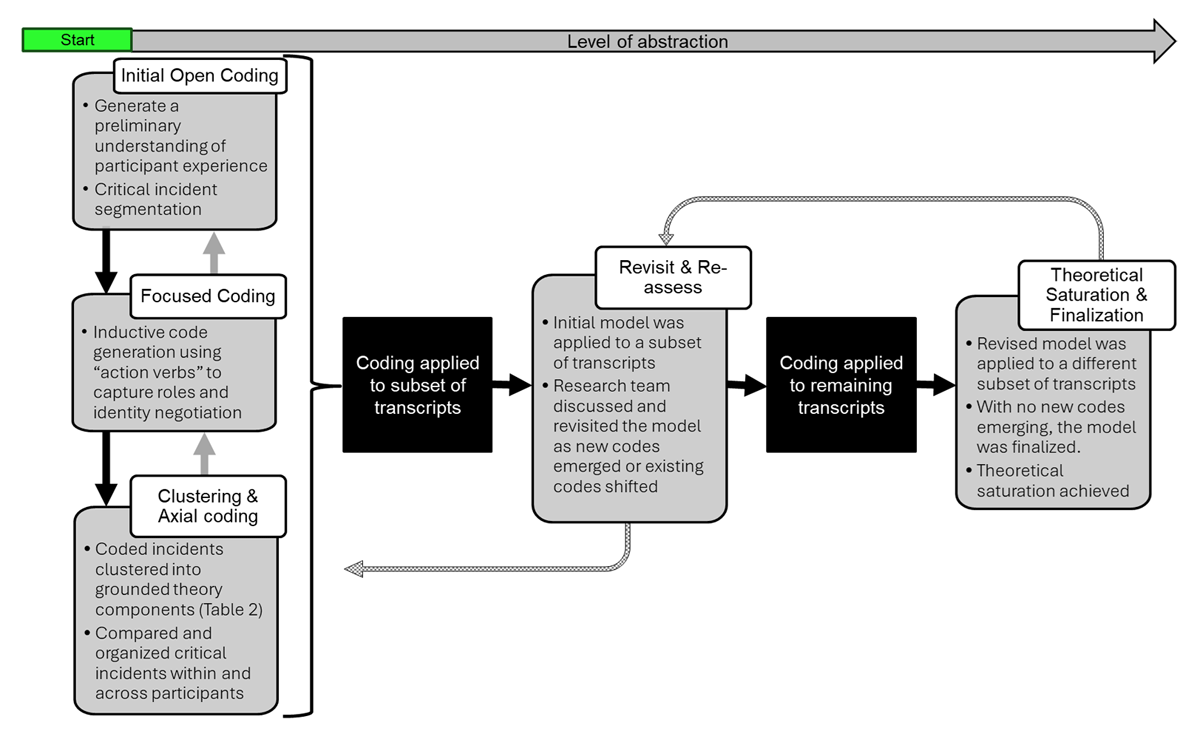
Figure 1
Grounded theory coding analysis process.
Table 2
List of grounded theory (GT) components and corresponding definitions.
| GT COMPONENT | DEFINITION |
|---|---|
| Context | The context in which the core phenomenon takes place (Glaser & Strauss 1967; Charmaz 2014) |
| Core Phenomenon | The central concept or phenomenon of the process under study (Hachtmann 2012) |
| Strategies | Actions taken in response to the core phenomenon (Charmaz 2014) |
| Causal Condition | Factors that cause the core phenomenon (Charmaz 2014) |
| Intervening Conditions | Broad and specific situational factors that influence the strategies (Charmaz 2014) |
| Outcomes | Consequences that result from the strategies (Charmaz 2014) |
Table 3
Grounded theory of Negotiating and Re-negotiating the Professional Identity Boundaries of Early-Career Engineering Faculty (NPIB).
| THEORY COMPONENT | DESCRIPTION |
|---|---|
| CONTEXT | Institution |
| CORE PHENOMENON |
|
| CAUSAL CONDITIONS | Misalignment of expectations and reality of the job |
| Institutional policy changes that prompt realignment | |
| INTERVENING CONDITIONS | Reflecting on past experiences to inform current practices and strategies |
| Taking stock of mental and physical health | |
| MAJOR STRATEGIES | Defining boundaries of the profession Redefining boundaries of the profession |
| SUPPORTING STRATEGIES | Scoping what is and is not part of being a faculty member Coping by sharing and laughing with colleagues Moving forward from challenges Persevering by learning from failure |
| OUTCOMES | Increased stress and reduced mental and physical health |
| Blurred boundaries between personal and professional identities |
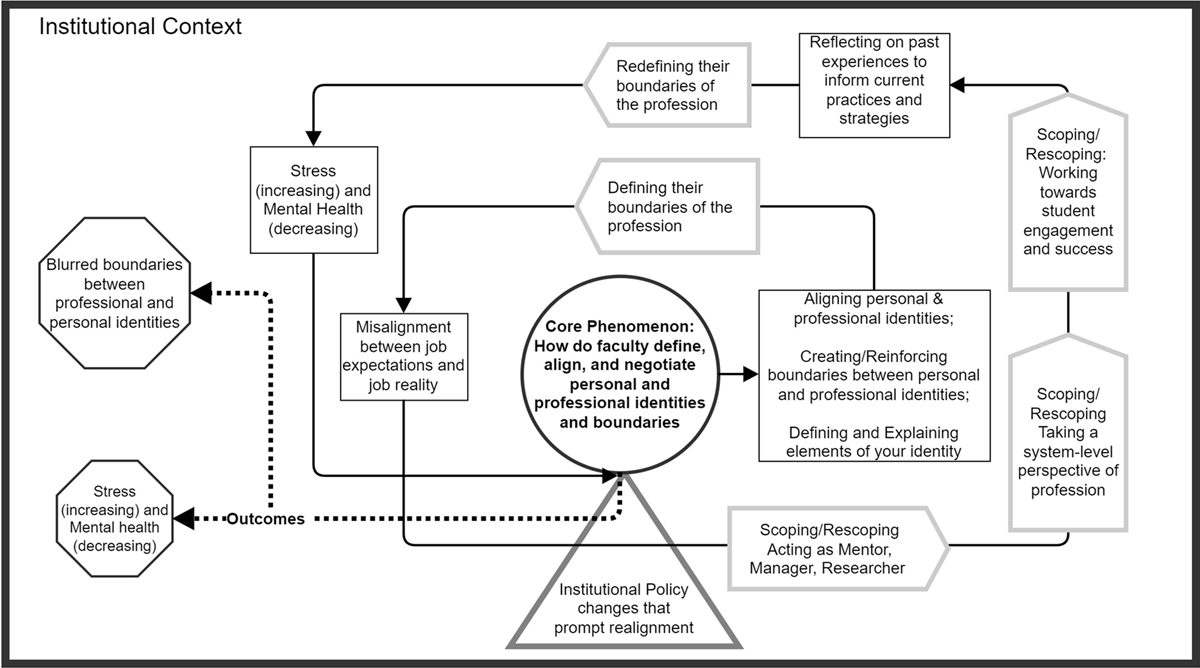
Figure 2
Visualization of the resulting grounded theory NPIB as an iterative process.
Table 4
Summary of scoping strategies and associated actions.
| SCOPING STRATEGY CATEGORY | ASSOCIATED ACTIONS |
|---|---|
| Integrating role as manager, researcher, and mentor |
|
| Taking a system-level perspective |
|
| Promoting student engagement and success |
|
Table 5
Summary of supporting strategies with example quotes.
| STRATEGY | DESCRIPTION | EXAMPLE QUOTE |
|---|---|---|
| Coping by sharing and laughing with colleagues | Using humor to cope with events outside of one’s control | “So, a third person could see my account, I heard that through a friend without even getting notified about this from them directly. It was just so – we were just laughing about this, like hysteric laughing about [the system] and how it happened.” (Esme) |
| Moving forward from challenges | Recognizing and accepting variation and flexibility to overcome challenges | “…that you realize that there’s not one way to do this job, that there are many ways to do this job. And I hope that’s kind of the big picture lesson that we can take with us, that it doesn’t have to look like 9:00 to 5:00 in the office and then writing grants online every weekend.” (Lisa) |
| Persevering by learning from failure | Learning from failure to be better prepared for future | “I’ve been lucky in the sense that I’ve never had to abandon an idea. At some point on the 20th submission, I get a grant. And so maybe…at the end of the day, it worked out, right? But the process, I don’t know if I have a good way of managing the emotions through the process. I just kind of keep pushing, basically.” (Simon) |