
What does it mean to be a faculty member? While a typical faculty position includes elements common across institutions, the true defining element of faculty life is the agency to scope and flexibly fulfill specific responsibilities. This flexibility can lead to ambiguous expectations, increased stress, and decreased wellbeing, especially for new faculty members. As they enter institutional roles, early-career faculty members must establish their identities within a new university landscape and do so by navigating and articulating personal, professional, and academic identities. This journey is marked by several challenges as well as the identification of necessary resources and relationships to overcome them (Amundsen & McAlpine 2011; Greene et al. 2008; Sorcinelli 2000; Stupnisky et al. 2016). Such challenges include finding one’s place and establishing a sense of belonging within the department, institution, and scholarly community; balancing the multiple responsibilities associated with a new faculty role (Amundsen & McAlpine 2011; Stupnisky et al. 2016; Stupnisky et al. 2015); experiencing feelings of inauthenticity (Archer 2008); and defining the field and what constitutes success in it (Gonzales & Terosky 2016; Runyan et al. 2013; Stupnisky et al. 2017; Stupnisky et al. 2015; Sutherland 2017). Because of the strong connection among one’s personal, professional, and academic identities (Clegg 2008; Lamont & Nordberg 2014), these identities can become highly interrelated and challenging to decipher and potentially negatively impact one’s work life, personal life, or both. As a result, examining identity formation in early-career faculty is complex and necessitates multiple considerations and approaches for exploration (Barrow et al. 2022).
Discussions related to faculty career development have focused on metrics such as workload, productivity, or satisfaction (Bozeman & Gaughan 2011; Fairweather 2002; McGovern et al. 2013; Rosser & Tabata 2010; Runyan et al. 2013) with little work focused on the formation of faculty members’ identities. Success is generally defined as achieving tenure (Stupnisky et al. 2017; Sutherland 2017) or excelling at a specific component related to the traditional tenure package, such as teaching (Borrego et al. 2013), research and publishing (McGovern et al. 2013; Runyan et al. 2013), or service and leadership (O’Meara 2016). Defining success through the constraints of localized promotion and tenure (P&T) overlooks broader contexts of academic success that include personal and professional growth, fulfillment, and connection to the academic profession (Clegg 2008; Stupnisky et al. 2017; Sutherland 2017).
Within engineering education, studies have explored a variety of topics related to engineering faculty, including agency development among engineering educators (Coso Strong et al. 2023), definitions faculty ascribe to the engineering field (Pawley 2009), motivations for teaching (Matusovich et al. 2014), and faculty-identified needs for support (Cutler et al. 2022). While this body of work has provided a solid foundation for faculty development research, a consensus is emerging that “engineering faculty are largely overlooked within engineering education literature” (Cutler & Coso Strong 2023, p. 286), meaning that few resources exist for defining and negotiating what it means to be a faculty member in engineering higher education.
The paucity of research related to engineering faculty identity formation necessitates exploratory methodologies such as Grounded Theory (e.g., Charmaz 2014) to deepen our understanding of this developmental process (Archer 2008; Vican et al. 2021). We define professional identity as a social identity where individuals internalize a professional group’s values, norms, and attitudes by ascribing to expected knowledge and roles through interpersonal relationships and self-interpretation; this professional identity is then used by individuals to differentiate themselves from members of other professional groups (Forenza & Eckert 2018; MacIntosh 2003; Neishabouri et al. 2017; Sun et al. 2016).
In this paper, we explore how early-career faculty members navigate ambiguity to establish themselves within the academy through a lens of identity formation and introduce a model of early-career engineering faculty identity formation that focuses on how individuals navigate traditional promotion and tenure elements (i.e., teaching, research, and service); disciplinary norms, values, and practices; and more personal elements such as family roles and responsibilities. Providing a holistic understanding of the faculty identity formation process allows the definitions of and the roles, successes, and failures associated with faculty positions to be articulated by faculty members themselves. This information can then be used to inform and guide university support structures as they facilitate the interpretation and adaptation of these characteristics to individuals’ personal and professional contexts. Such support can play a critical role in recruiting and retaining a diverse group of faculty members in higher education.
Overall, this framework exhibits a flexibility in which early-career engineering faculty iteratively move between seeing themselves as academics (i.e., university faculty members) and non-academics throughout the identity formation process (Colley et al. 2007), which we collectively refer to as identity work.
A Note on Context
This study was conducted during the COVID-19 pandemic, which widely impacted various aspects of faculty life (Vican et al. 2021). As demonstrated throughout this study, the pandemic prompted significant and articulate reflection among our participants, particularly regarding drastically changing policies, the rapidly evolving nature of the faculty experience, and associated challenges (Xia et al. 2022). Therefore, we acknowledge the pandemic as an event that prompted faculty members to articulate aspects of their roles and identities in ways that may not have been identified otherwise. Aspects of professional and personal identity navigation, such as balancing childcare and working from home, we argue have long been present in faculty lives; however, the pandemic amplified the impacts of this negotiation in concrete and relatable ways. Hence, our model offers valuable insights for supporting early-career faculty members during times of rapid change, whether in the form of institutional transition or within the context of rapid policy changes, which extend beyond difficulties posed by the pandemic.
Researcher Positionality
The inspiration for this study came from our experiences as faculty members at our respective institutions during the COVID-19 pandemic. The stressors and tensions we felt were being echoed by our colleagues across our scholarly communities and social circles. We experienced stressors and tensions, such as changing institutional policies and protocols, especially those related to interpersonal interactions. We learned about Zoom fatigue, experienced slowed research progress, and had the recurring thought of “this isn’t what I signed up for when I said I wanted to be a university professor.” We experienced these together and separately all at once, and we found it challenging to neatly compartmentalize or bin different aspects of our lives. We thus saw the need to develop a model to help make sense of the identity negotiation process for ourselves and others.
As we moved and iterated through the collection and analysis of our data, the world continued to change. We slowly returned to the office (i.e., new universities/positions for two of our author team) and readied for a presumed return to “normal.” Since then, we have experienced what has felt like a state of continuous change with a looming “enrollment cliff” (Bauman 2024), the whirlwind emergence of generative AI (e.g., ChatGPT), budget crises at multiple institutions, and leadership changes at all levels. Each of these new societal and institutional changes impacted us and informed the development of our model by highlighting broader implications of many of the strategies and experiences described by our participants, which moved us away from focusing on the impacts of COVID-19 on faculty identity and towards a more holistic interpretation of it.
The first author began this manuscript as a graduate student and is now an early-career assistant professor. The second and third authors transitioned from early-career to mid-career faculty members. Collectively, our experiences span from pre-faculty to mid-career faculty, and we found that our experiences aligned with the model. Our motivation to conduct this study not only includes contributing to the paucity of identity formation research among engineering faculty but also promoting a broader awareness of and potential healing from what we have collectively experienced over the past several years.
Methods
In this study, we sought to gain a holistic understanding of the personal and professional identity negotiations of engineering faculty by asking the research question: How do early-career engineering faculty engage in identity work (i.e., the navigation of personal and professional identities) as they enter their institutional roles? Given the dearth of research related to engineering faculty identity formation, we employed a constructivist grounded theory approach (McCall et al. 2021) to address this question. Grounded theory is typically used when a theory is not available to explain or understand a social process. When potential models are available, grounded theory also provides a means to further develop the theory for a particular sample population that possesses potentially valuable variables and characteristics (Creswell & Poth 2012; McCall & Edwards 2021). Due to the methodology’s reliance on participant experience and engagement, it also allows researchers to account for changing sociocultural and technological norms that shape the process under study but may be missing from extant literature (McCall & Edwards 2021). In this study, we applied constructivist grounded theory to develop a model that captures the dynamic relationships between experiences and challenges faced by early-career engineering faculty and how they shape academic identity formation.
Sensitizing Concepts
The sensitizing concept employed in this study is the Advancing from Outsider to Insider (AOI) model (McCall et al. 2021). We chose this model as a sensitizing concept to conceptualize the personal and professional identities that faculty members hold and how they evolve over time. The initial AOI model, developed with undergraduate civil engineering students, positions identity as individual definitions of self and of their profession that continuously and iteratively shift due to lived experiences, gained knowledge and skills, and evolving career goals. As individuals gain a more sophisticated understanding of their profession, they begin to shape themselves as a part of that profession and move from being an outsider to an insider of that group. In the context of this study, the AOI model gave us a starting point for understanding how faculty shift their own definitions of self and profession as they become engineering faculty members, recognizing that their personal and professional identities intersect and interact in myriad ways.
Recruitment and Description of Participants
Recruitment was conducted electronically via email invitation to faculty members from the College of Engineering at a large R1 institute in the Mid-Atlantic region of the US. Participants were purposefully sampled based on gender, race/ethnicity, tenure rank, and family composition (i.e., with or without immediate family members and/or young children) to gather a wide variety of perspectives (see Table 1). Start date was also considered during interview sampling because we wanted to speak to faculty who started their tenure-track position at least one year before the pandemic but were not yet promoted. This sampling criteria meant participants could speak to the nuances of their identity formation under changing institutional and contextual factors. Overall, eight early-career engineering faculty (i.e., pre-tenured faculty at the rank of Assistant Professor) participated in the study. At the time of the interviews, five of the eight faculty (62.5%) were female, four had newborn or young children (50%), and two (25%) had family members who lived abroad in another country, indicating that participants were balancing significant roles and responsibilities outside of their academic roles.
Table 1
Characteristics of early-career engineering faculty participants.
| PARTICIPANT PSEUDONYM | GENDER | FAMILY STATUS | START YEAR |
|---|---|---|---|
| Gopal | Male | Partner; children | 2016 |
| Chester | Male | Partner; no children | 2017 |
| Esme | Female | Partner; no children | 2017 |
| Jane | Female | Single; no children | 2017 |
| Megan | Female | Partner; children | 2017 |
| Simon | Male | Partner; children | 2017 |
| Anita | Female | Partner; no children | 2018 |
| Lisa | Female | Partner; children | 2018 |
Data Collection
A semi-structured interview protocol was adapted from McCall et al. (2021) to suit the aims of the study. To test the length and clarity of the interview protocol, the first author conducted a pilot interview with a volunteer colleague via Zoom. Upon completion of the pilot interview, the research team conducted a peer debrief with that colleague to gather feedback and identify revisions for protocol improvement. Once the interview protocol was finalized and approved by the research team and the Institutional Review Board (IRB), the first author conducted interviews with participants via Zoom. Each interview lasted approximately 60 to 90 minutes.
The goal of the interview was to facilitate a conversation that captured changes in the ways participants navigated faculty life as they transitioned into their faculty roles. Interview questions were designed to get participants talking by describing their position (e.g., “What helped you decide to go into academia?”). The remaining questions asked participants to reflect on and describe the skills, events, activities, interests, and people they felt were influential in shaping their identities as engineering faculty members. Because the interviews were conducted during the COVID-19 pandemic in the Spring and Summer in 2021, the conversation was ordered chronologically and focused on three points throughout their careers: (1) prior to becoming a faculty member, (2) after becoming a faculty member pre-pandemic, and (3) as a faculty member during the pandemic. Ordering the protocol questions in this way provided a timeframe that enabled faculty to compare past and present changes, challenges, and adaptations to their faculty roles. Lastly, participants were asked to reflect on their responses to the previous questions and provide additional insights that they felt were important to understanding their overall experiences (e.g., “As you reflect on this interview, how are the items you discussed for moving forward consistent or inconsistent with how you see yourself now?”). Interviews were conducted using intensive interview techniques (Charmaz 2014), in which follow-up questions are generated using participant language to gain a greater understanding of and rationale for their responses. All interviews were recorded and transcribed for analysis.
Data Analysis
Data analysis was guided by constructivist grounded theory analytical approaches, including constant comparative techniques and several levels of coding that increase in meaning abstraction until a theoretical model is generated (Charmaz 2014; Strauss & Corbin 1998). A summary of this process is shown in Figure 1.
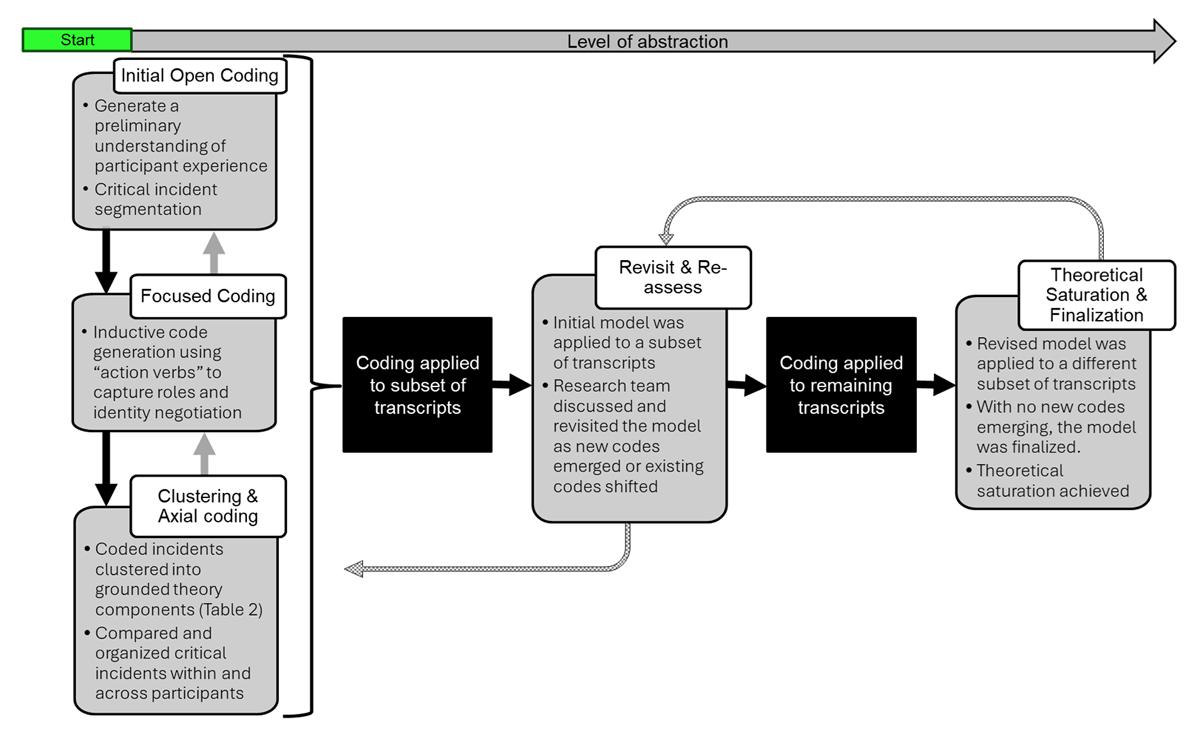
Figure 1
Grounded theory coding analysis process.
We began analysis by conducting initial, open coding on four of the eight (n = 50%) faculty transcripts to get a preliminary understanding of participants’ experiences and stories. During this phase, interview transcripts were segmented into critical incidents (Gremler 2004; McCall et al. 2021), which were identified as aspects or events in a participant’s personal or professional life that shaped their identity formation as a faculty member. A focused coding procedure was then conducted on each critical incident using inductively generated gerunds (i.e., action verbs ending in “ing”) (Charmaz 2014) to capture underlying roles and identity shifts enacted by participants. Coded incidents were then clustered into one of six grounded theory components: (1) context, (2) core phenomenon, (3) strategies, (4) causal conditions, (5) intervening conditions, and (6) outcomes. Table 2 includes a summary of these components and their definitions. Clustering was conducted using an axial coding process (Charmaz 2014; Saldaña, 2021) in which we considered the descriptors and actions captured within each incident in relation to each participant’s overall story. This allowed us to identify and order incidents within and across participants to form an initial model of the developing grounded theory.
Table 2
List of grounded theory (GT) components and corresponding definitions.
| GT COMPONENT | DEFINITION |
|---|---|
| Context | The context in which the core phenomenon takes place (Glaser & Strauss 1967; Charmaz 2014) |
| Core Phenomenon | The central concept or phenomenon of the process under study (Hachtmann 2012) |
| Strategies | Actions taken in response to the core phenomenon (Charmaz 2014) |
| Causal Condition | Factors that cause the core phenomenon (Charmaz 2014) |
| Intervening Conditions | Broad and specific situational factors that influence the strategies (Charmaz 2014) |
| Outcomes | Consequences that result from the strategies (Charmaz 2014) |
To test the explanatory power of the initial model, we applied it to cleaned versions of the four initially coded participant transcripts. As a research team, we met frequently to adjust code definitions and categories and refine relationships among grounded theory components. New instances and codes not previously identified in prior analysis iterations were compared to and integrated into the developing model. During this process, we relied on our gerund codes to abstract a deeper meaning across participant contexts that captured the identity formation of early-career faculty in engineering. The final theoretical model was tested against the remaining four transcripts, and revisions were made until theoretical saturation was achieved and no new codes emerged. The resulting grounded theory model is discussed in further detail in the next section.
Results: A Grounded Theory of Negotiating and Re-Negotiating the Professional Identity Boundaries of Early-Career Engineering Faculty
Faculty roles are inherently fluid; the profession in higher education is marked by ambiguity, and expectations differ across institutions and departments. Without a standardized understanding of what the role entails, the definition of being a faculty member can vary widely, shaped not only by the unique roles, values, and norms specific to each university and department but also by an individual’s personal experiences and professional journey. Faculty members use various strategies to align their personal and professional identities while continually redefining their roles. Currently, no model exists to guide them in balancing these identities in ways that acknowledge the individualized and varied nature of the profession.
This study presents a grounded theory model that captures the continuous, iterative process of identity work by early-career faculty members in engineering: Negotiating and Re-negotiating the Professional Identity Boundaries of Early-Career Engineering Faculty (NPIB). This model highlights strategies faculty members employ to be successful, including promoting well-being and organizing priorities. Components of the NPIB model are summarized in Table 3.
Table 3
Grounded theory of Negotiating and Re-negotiating the Professional Identity Boundaries of Early-Career Engineering Faculty (NPIB).
| THEORY COMPONENT | DESCRIPTION |
|---|---|
| CONTEXT | Institution |
| CORE PHENOMENON |
|
| CAUSAL CONDITIONS | Misalignment of expectations and reality of the job |
| Institutional policy changes that prompt realignment | |
| INTERVENING CONDITIONS | Reflecting on past experiences to inform current practices and strategies |
| Taking stock of mental and physical health | |
| MAJOR STRATEGIES | Defining boundaries of the profession Redefining boundaries of the profession |
| SUPPORTING STRATEGIES | Scoping what is and is not part of being a faculty member Coping by sharing and laughing with colleagues Moving forward from challenges Persevering by learning from failure |
| OUTCOMES | Increased stress and reduced mental and physical health |
| Blurred boundaries between personal and professional identities |
Figure 2 provides a visual representation of the NPIB model as an iterative process. The core phenomenon is located at the center of the figure to show that the alignment and negotiation of one’s professional and personal identities is the core element that all other grounded theory components circle around and contribute to. To the right of the core phenomenon, the first box outlines the descriptive characteristics of the core phenomenon as the starting point for many faculty members. As the reader traces the cycle, the black rectangles represent causal and intervening conditions surrounding the core phenomenon that impact the strategies (major and support) employed, represented by the gray pentagon, arrow boxes. The strategies and conditions within the cycle may appear in different orders or magnitudes for different faculty members. At the bottom of the figure, the causal condition impacted by the context is represented by a dark gray triangle because we felt this condition intersects and potentially interrupts the identity negotiation process, prompting faculty members to revisit the core phenomenon. As a result, we wanted to represent this condition differently from the others. The entire process is housed within the context of the institution. The outcomes are represented as octagons on the left of the figure connected to the process using dotted lines. Figure 2 illustrates the iterative nature of the process and highlights how multiple facets of the model impact and inform faculty professional identity development.
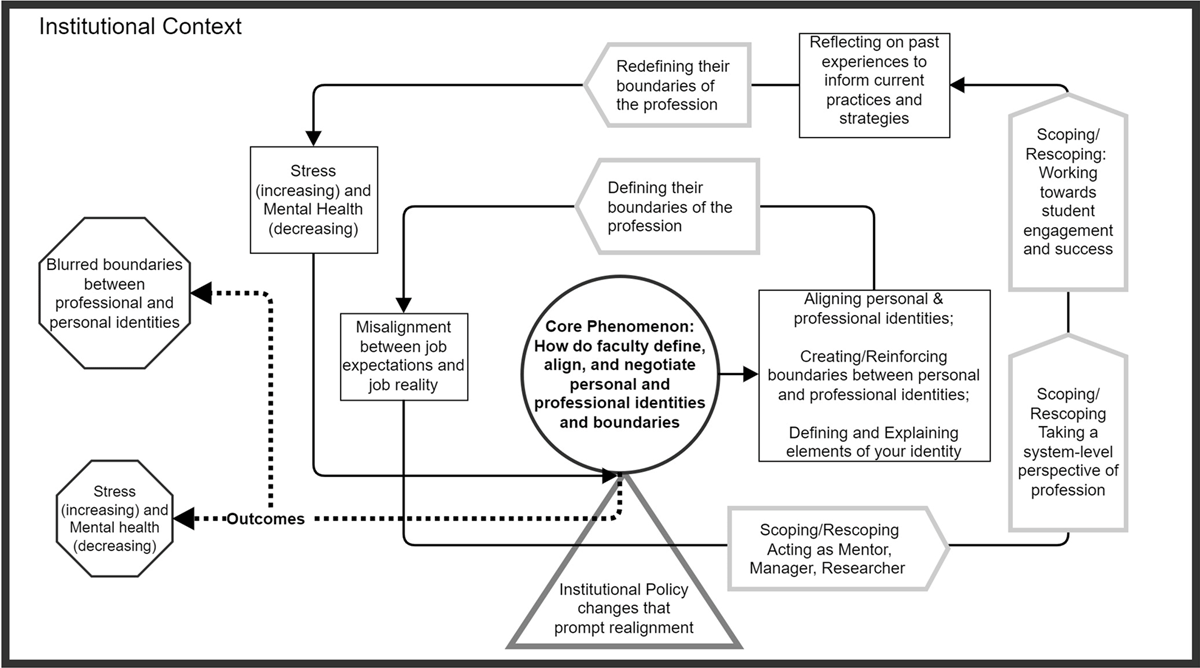
Figure 2
Visualization of the resulting grounded theory NPIB as an iterative process.
Core Phenomenon: Defining, Aligning, and Negotiating Personal and Professional Identities and Boundaries
For pre-tenure assistant professors at an R1 Mid-Atlantic University (context), the NPIB model captures the iterative processes by which early-career faculty in engineering define, align, and negotiate their personal and professional identities and boundaries (core phenomenon). This phenomenon was characterized by participants in three ways: (1) aligning personal, internal identities (e.g., problem solver or innovator) with their professional identities (e.g., engineer/scientist, researcher, mentor, teacher, etc.); (2) creating and reinforcing the boundaries of both personal and professional identities to create time and space for both; and (3) defining and articulating their conceptions of these identities. These components are interconnected and relate to one another; the ways a faculty member defines different identity dimensions impact how they are interpreted, aligned, and bounded.
Several commonalities were identified across participant descriptions of their faculty identities, particularly as they related to being an early-career tenure-track faculty member at a research-intensive university. Commonalities included commitments to research, teaching, and service with significant flexibility for navigating these areas. This flexibility reinforced the importance of boundaries among these areas while also strategically allowing them to overlap. With respect to teaching and mentoring, often described as a part of research by participants, Megan noted:
I’ve realized that mentoring and teaching are two very different skillsets… I thought that I would be good at classroom teaching… And I thought that that meant that I would be good at mentoring. And that has not been true.
While some faculty worked to establish overlap between the areas of teaching and mentoring, others drew distinct boundaries to delineate these as different roles. For some participants, this delineation was influenced by their age, and they made conscious efforts to separate themselves from graduate students, especially when the age difference was small.
As we explored how faculty defined their different identity dimensions throughout the interview process, participants, to more or less extents, actively constructed their professional identities by aligning their personal interests and identities to the institutional expectations of being a faculty member. For example, some participants felt that a key element of their identity was that of a problem solver, which they aligned with their professional role of researcher. These participants described these elements as exciting and important. Simon stated, “It can be really exciting, and you have this new idea and it’s actually super exciting.” Jane echoed his sentiments when she stated, “I’m drawn to the seeking of discovery.” A typical perspective from this group of faculty members was ‘what I do is who I am.’ That is, their work is a core component of their personal identity as they interact with the world. Gopal remembered advice from their doctoral advisor, who said, “You’re only as good a teacher as the last course you ever teach. You’re only as good an adviser as the last student you graduate, and you’ll only be as creative a researcher as the last proposal you submit.” Such comments placed a large emphasis on a faculty member’s identity as reflected through their success in different roles in their professional life. Anita discussed that she, along with her spouse, decided to integrate their personal and professional lives, saying:
My husband and I met in grad school, and we’ve worked together pretty much since we’ve known each other in the same areas, and so we have a lot of conversations about work. The reason I bring that up is because I think that has really played into the fact that my personal and professional lives are so intertwined and kind of just connected, and that has really helped kind of—my identities, even as a spouse, those have always kind of been tied together professionally.
While Anita described an integration of her personal and professional identities, others described the opposite. Megan demonstrates this contrast in her statement, “My identity has never been in what I can accomplish.” This quote establishes a differentiation between her personal and professional identities.
Additionally, participants explicated what was not part of their faculty role, articulating the boundary of their professional identity. A common boundary that prompted identity negotiation was when participants’ career expectations prior to taking on their faculty role differed from what their lives were currently like. For example, several participants discussed whether they did not foresee engaging in such a significant amount of administrative work or that being a PI involved more management and less time in the lab. This reality conflicted with their professional identities because these tasks were not considered as core values or norms for faculty members. Megan highlighted this tension:
I log what amount of time I spend on a task. And it’s not uncommon for me to get to the end of a 40-hour work week and have more than a quarter of those hours spent on replying to emails… I have a student who’s on a fellowship, but the fellowship doesn’t cover all of his wages, so we have to supplement them. But the financial office doesn’t recognize his fellowship. Just the sheer amount of time dealing with stuff like that – that I feel like has very little to do with my core mission…I think it’s a colossal waste of time.
As participants identified instances of misalignment, they described increased stress, stating these aspects of their positions took valuable time that negatively influenced their personal lives. Esme noted:
I have to run the budgets, the numbers, and things like that. It shouldn’t be really my job, but that is kind of the story of my life. And it takes a lot of my time, obviously, because I have to take [it] out of my personal time.
Megan echoed this by saying being a faculty member “will take everything you give it,” reinforcing the need to create, enact, and maintain personal and professional boundaries.
Overall, this core phenomenon captures the similarities and differences in how faculty define personal and professional identities. While some aspects of their work could be flexibly navigated in relation to their personal identities and professional expectations, others were more challenging to negotiate and required a complete separation of these identities, thus sparking their re-negotiation or re-definition.
Causal Conditions: Misalignment of Expectations and Institutional Policy Changes
Two causal conditions were identified: (1) misalignment of expectations and the reality of the job and (2) institutional policy changes. Misalignments between expectations and reality of the job caused participants to re-evaluate their identities as early-career tenure-track faculty members, re-define what that role meant, and see how it was bounded from the personal aspects of their lives. For this reason, these misalignments were designated as causal conditions. Due to the structure of higher education, graduate-level and post-doctoral training provides opportunities for professional socialization into the academy in which expectations for faculty life are established (Baker & Lattuca 2010). As a result, when graduate students and post-doctoral researchers transition into a tenure-track faculty position, their expectations may conflict with the realities of their position, prompting them to reflect and identify ways to cope with these misalignments. While we anticipate this causal condition is not new, we posit that the pandemic exacerbated the number and significance of these misalignments in ways that allowed us to explicitly identify these otherwise hidden misalignments.
In later analytical phases of the study, a second causal condition was identified, focused on the role of institutional policy changes. During their interviews, participants highlighted how multiple policy implementations and changes required them to re-evaluate what it meant to be a faculty member and what was included as part of their responsibilities. Social distancing and shelter-in-place policies implemented during the pandemic significantly impacted how, when, and where faculty could be in direct contact with colleagues and students. For many, this meant slowed research progress and increased administrative responsibilities, such as those related to flexible grading practices (e.g., allowing students to apply for a grade deferment for a course). At the same time, policies not related to the pandemic, like the adoption of a new university-wide financial management system, also exacerbated faculty members’ administrative responsibilities. When combined with social distancing policies, such administrative work required more time to complete because faculty experienced more challenges when accessing campus support personnel. These examples highlight how faculty are required to quickly adapt, redefine, and shift various aspects of their faculty identities, including teaching, mentoring, and administrative roles, in response to these policies.
Strategies for Maintaining Alignment between Personal and Professional Identities
Strategies are the actions faculty used to maintain alignment across their personal and professional identities. Overall, two major strategies were identified: (1) defining professional boundaries and (2) redefining professional boundaries. These strategies were then further delineated into four supporting strategies: (1) scoping what is and is not part of being a faculty member, (2) coping by sharing and laughing with colleagues, (3) moving forward from challenges, and (4) persevering by learning from failure.
The first supporting strategy of scoping was associated with identifying what is and is not part of one’s faculty role. Implementation of scoping strategies was based on the specific facets of the faculty roles participants were navigating. These include research and teaching responsibilities, integrating into broader sociocultural systems (i.e., department, college, university, and discipline), and fostering student engagement and success. As a result, we further delineated scoping strategies into three groups: (1) integrating role as mentor, manager, and researcher, (2) taking a systems-level perspective, and (3) promoting student engagement and success. These strategies and their associated actions are summarized in Table 4.
Table 4
Summary of scoping strategies and associated actions.
| SCOPING STRATEGY CATEGORY | ASSOCIATED ACTIONS |
|---|---|
| Integrating role as manager, researcher, and mentor |
|
| Taking a system-level perspective |
|
| Promoting student engagement and success |
|
Scoping Strategy 1: Integrating role as mentor, manager, researcher
Participants described research as a core responsibility that was valued most in tenure dossiers at highly active research universities. All participants clearly identified research productivity as a key component of their professional life and highlighted several strategies for scoping how they viewed and engaged in their research as a mentor, manager, and/or researcher.
Managing a research lab. Many participants described scoping strategies related to the shift from being a member of a research lab during graduate school to running a research lab as faculty. To navigate this shift, some participants adopted a management approach and conceptualized their lab as a start-up business. Their responsibilities shifted from conducting day-to-day research activities to recruiting, training, and funding graduate students and attending to the logistical needs of the lab. Participants discussed the need to develop a community among lab members, which was significantly impacted by social-distancing policies mandated by the institution during the pandemic. Many engineering faculty whose research depended on physical equipment or lab space were kept out of these spaces for several months, thus stagnating research productivity. Once labs re-opened, social distancing requirements limited the number of students who could occupy the lab at a given time, disrupting established cultures of student-to-student mentoring. As a result, the mentoring interactions necessary for lab management were shifted solely to faculty members. These increased mentoring responsibilities highlighted misalignments between participants’ expectations of student mentorship and the lack of it, underscoring the importance of a lab community and student peer mentoring.
Recognizing the impact of students’ lives on research productivity. The transition into a management role required engineering faculty to recognize and navigate the impacts of students’ personal lives on their research productivity. Faculty participants described students facing challenges such as illness and anxieties, particularly among international graduate students who required more time and money to visit their loved ones in their home countries. Maintaining consistent research output despite students’ personal difficulties was an ongoing challenge. These issues became particularly poignant during the pandemic as faculty noticed significant decreases in research output. This prompted many faculty to spend more time in one-on-one meetings with students that focused on their experiences and states of wellbeing in addition to research progress.
Providing support to develop student mentees as professionals. Throughout their interviews, faculty participants emphasized the continued importance of maintaining a focus on students’ professional development and career trajectories. Faculty learned new strategies for navigating and maintaining these mentoring relationships. For example, Lisa made instructional videos to show technical steps and video-conferenced with students working in lab. Gopal discussed potentially funding alternative opportunities to enhance student professional development:
[…] it’s a very short online course that they can take on data visualization and on statistical modeling using Python – things that are very helpful no matter what your research topic is. And I offer the students, ‘if you take the full course and if you complete it and you want to get a certificate for it, I’ll sponsor that.’
Faculty leveraged these new opportunities for advancing students’ research skills while providing the necessary flexibility to accommodate institutional policy mandates while fulfilling expectations for their own professional identity as mentors.
Pivoting research approach and/or areas. Another scoping strategy employed by participants was to adjust their research plans due to regulatory changes, societal shifts, and changes in national, state, and local funding priorities. Technological advancements in software capabilities and computing opened new research areas for faculty that did not rely on physical lab spaces. Transitions to new research areas meant redefining and reshaping how students were trained remotely within and across research groups. Faculty members began utilizing online bootcamp courses and virtual meeting platforms, in lieu of organizing face-to-face meetings and lab simulations, to continue developing students’ scholarly engagement skills.
Finding a research mentor and/or collaborator. Shifting research areas and student-mentoring approaches also meant early-career faculty needed more support and guidance from their more experienced counterparts. Many participants described actively seeking out a research mentor or new collaborator. These individuals not only provided research support but also offered alternative perspectives and insights for managing the drastic and sudden shifts to faculty life. Although policies differed nationally, such variation provided rich spaces for faculty to brainstorm with their mentors and collaborators from other institutions on how to navigate and negotiate various aspects of their faculty roles, thus supporting long-term faculty development.
Scoping Strategy 2: Taking a system-level perspective
Participants utilized systems-level scoping strategies to position themselves within broader sociocultural systems. This scoping strategy involved identifying and describing their roles within the institution while acknowledging the influence and authority associated with these roles at both local (i.e., institutional) and global (i.e., scholarly community) scales. Adopting this viewpoint empowered faculty to discern and adjust different aspects of their faculty identities.
Recognizing one’s agency: Position within the institution. When negotiating professional boundaries, early-career engineering faculty examined and reflected on their roles within the institution. They drew insights from their observations of colleagues to understand the day-to-day expectations being placed on them and how those expectations were continuously evolving due to changing organizational infrastructure and institutional policies. These observations helped faculty make sense of their misaligned expectations and reinforce boundaries.
One misalignment observed by faculty participants was the increased amount of administrative work resulting from the frequent turnover of support staff. Anita shared, “…because of the staff structure—that they can’t advance professionally unless they move departments or move to a different program altogether—causes this extra admin load…we have crazy turnover of staff.” In this instance, Anit embraced a systems-level viewpoint, highlighting how institutional structures and policy related to staff advancement and promotion—unrelated to faculty—can have significant impacts on faculty members’ administrative responsibilities.
Faculty participants also linked increased administrative responsibilities to the institution’s growing reliance on technology. Megan explained, “…now we’re expected to do [our travel paperwork]. And it is faster to book travel than it was 60 years ago, but it takes time. All of that adds up.” Rather than contacting administrative staff to complete such tasks (e.g., booking travel arrangements, processing reimbursements, submitting travel authorizations, purchasing equipment, managing finances, etc.), faculty were now expected to complete them on their own using online forms. Participants also described significant time sinks when accessing and learning new software that they would otherwise not be required to learn to complete these tasks. Faculty also experienced disruptions in time management as departments implemented more lenient grading policies to better accommodate students. This included an example offered by Jane, who described that she “had to still be working on last semester’s stuff while [she] was teaching for the following semester…it add[ed] to the faculty load.” These types of tasks, when considered cumulatively, significantly shaped the amount and type of work faculty managed daily.
Overall, taking a systems-level perspective provided a space for faculty to identify where and how their time was being spent and enabled them to determine a rationale that could account for their shortcomings in other areas of responsibility such as research, teaching, and mentoring. As a result, faculty could acknowledge the changing dynamics of their professional identities to maintain alignment with their personal identities and non-career-related responsibilities.
Recognizing one’s agency: Position within disciplinary field. Apart from their institutional roles, faculty participants contemplated their positions within their respective engineering disciplines, research communities, the academy, and society. A standard evaluation metric for tenure-track faculty nationwide is the extent to which they participate in global engagement and garner international influence. Due to pandemic-related policies, academic meetings and large gatherings were hosted virtually, which in turn increased access to international colleagues and conferences, as Chester explains, “We’ve seen a lot more [participants who identify as] Pacific Islander, African [beyond North America and European decent]. It’s truly becoming a much more global conference because you don’t have to travel.” Such moves afforded flexible attendance and removed the need for costly travel, lodging, and family care (e.g., childcare) expenses, thus allowing faculty to engage with more diverse groups of academics. Participants were able to expand their professional networks beyond national boundaries and more efficiently achieve this component of their tenure and promotion requirements, all while still meeting the needs of their home and personal lives. This flexibility strengthened the alignment between one’s personal and professional identities by making space for one to attend to both identity dimensions simultaneously.
Scoping Strategy 3: Promoting student engagement and success
Most participants did not have formal education in pedagogy, except for one who mentioned taking one class on the topic. Faculty found themselves often reflecting on their roles as educators and redefining what this role meant. While transitions into teaching were challenging for participants (e.g., prepping a new course, holding office hours for students, etc.), many worked to create learning experiences centered on student development, learning, and success, employing two strategies related to student interests and student needs.
Employing student-centered instructional practices with a focus on student interests. Faculty participants described the need to actively learn about and consider students’ diverse interests and backgrounds, especially as courses shifted online. They emphasized the need to teach students how to engage in course content as agential and independent learners and adjusted course assessments and instructional activities to promote these skills. Many participants reflected on how they made meaning of course material when they were students and leveraged these reflections to link course content to students’ interests and perceived utility. Simon noted how important he felt it was to help students find value and interest in his field by saying:
… getting students excited about the material that I’m excited about, whether it’s biomechanics or mechanobiology. [It’s] not just teaching them the material they need to know but creating an internal interest on their own in the material, and making it fun, and trying to connect it to something that they would find interesting.
As they gained experience, faculty conceptions of teaching expanded from content delivery to skill development that could be applied to a variety of contexts. Chester reflected, “It’s nice… setting them on a good trajectory initially and then helping them bridge into their next step, whether that’s graduate school or industry or whatever comes next for them.” In these instances, faculty members’ professional boundaries became blurred as their teacher, mentor, and supporter identities melded together.
Adapting teaching practices for more effective, efficient, and inclusive instruction with a focus on student needs. Faculty also adopted approaches to create more inclusive learning environments responsive to students’ needs. As faculty gained experience with teaching, they recognized different challenges from their students and worked to adapt their teaching to address these concerns (Bouwma-Gearhart 2012). For example, the early periods of the pandemic were marked by many students experiencing Zoom fatigue, prompting faculty to dedicate extra effort toward identifying techniques for increasing student interaction and promoting student engagement during online lectures.
Participants also had opportunities to explore new or different instructional approaches or to establish more sustainable teaching practices. For Anita, this meant learning how to integrate the tablet into her teaching, “something that I don’t know that I’ve ever would have taken the time to explore if it wasn’t for the circumstances, just because it’s intimidating to figure out how something new is going to work and all of those things… So that’s been a huge positive for me.”
Gopal described a similar example: “So that was a good opportunity to literally teach lab virtually. That was a good exercise in engineering education, do a little bit by getting GoPro cameras for the lab technicians, working with them on creating virtual machine models.” The examples provided by Anita and Gopal highlight that many of the teaching changes made space for faculty to test and hone their teaching skills and develop new capacities for technological integration. For many participants, these changes became sustainable practices that permanently altered how faculty defined and enacted their teaching identities then and into the future.
Together, the strategies described in this section enabled faculty to continuously adjust their definitions of their professional identities by prioritizing and deprioritizing various aspects of their faculty roles and responsibilities. Through scoping strategies, faculty could navigate the shift from maintaining more traditional and standard definitions and expectations to new, flexibly constructed ones that could be tailored to their individual needs and relationships with their students.
In addition to the scoping strategies discussed thus far, participants adopted three other supporting strategies to help negotiate their professional identities. Notably, these strategies were experienced similarly with little variation across all participants. Therefore, we provide descriptions of these strategies and sample quotes in Table 5.
Table 5
Summary of supporting strategies with example quotes.
| STRATEGY | DESCRIPTION | EXAMPLE QUOTE |
|---|---|---|
| Coping by sharing and laughing with colleagues | Using humor to cope with events outside of one’s control | “So, a third person could see my account, I heard that through a friend without even getting notified about this from them directly. It was just so – we were just laughing about this, like hysteric laughing about [the system] and how it happened.” (Esme) |
| Moving forward from challenges | Recognizing and accepting variation and flexibility to overcome challenges | “…that you realize that there’s not one way to do this job, that there are many ways to do this job. And I hope that’s kind of the big picture lesson that we can take with us, that it doesn’t have to look like 9:00 to 5:00 in the office and then writing grants online every weekend.” (Lisa) |
| Persevering by learning from failure | Learning from failure to be better prepared for future | “I’ve been lucky in the sense that I’ve never had to abandon an idea. At some point on the 20th submission, I get a grant. And so maybe…at the end of the day, it worked out, right? But the process, I don’t know if I have a good way of managing the emotions through the process. I just kind of keep pushing, basically.” (Simon) |
Intervening conditions: Reflecting on past experiences to inform current practices and strategies and taking stock of mental and physical health
In grounded theory research, the situational factors that shape how participants employ strategies in response to the causal condition(s) are known as intervening conditions. Within the context of the NPIB model, two intervening conditions were identified: (1) reflecting on past experiences to inform current practices and strategies, and (2) taking stock of mental and physical health. In the first intervening condition, faculty participants reflected on their past experiences to inform when and how they would engage certain strategies to define or negotiate different aspects of their professional identities. Student mentoring was a common scenario that was uniquely managed based on each participant’s past experiences. Esme reflected on her experiences as an independent and autonomous graduate student to inform how she set expectations for her graduate students. “[I tell my students,] ‘Here is a problem that I want you to solve. Okay? Now how you approach it, what you want to do, it’s on you. Go, try to find a solution…. If you have a question, fine. Come back and we can talk about it.’” Megan reflected on her graduate student and prior industry experience to find a balance between two extreme management styles: “…my grad school advisor was very hands-off, forcing independence, but my prior boss…was very much a micromanager…I think that that balance, those opposites, actually helped me find the right direction for myself and for my own mentoring style.” Megan developed as a faculty member by identifying her own mentoring style and leveraging management techniques she favored in each relationship to create a more balanced experience for her graduate students.
In the second intervening condition, faculty took stock of their mental and physical health to shape the strategies used to continuously negotiate between their professional and personal identities. Several participants in our study described developing a sense of overwhelming inadequacy in which they could never “check off everything.” Lisa succinctly described, “There’s too many balls to juggle, you get to drop some. There’s no single person that really can do it and do it well… I realized that no matter how hard I work, no matter how many hours I put in, I was never going to check off everything on my to-do list(s).” As exhibited by Lisa’s comment, stress and mental health impacted how participants formulated or altered the strategies of prioritization to preserve their professional identities.
Outcome: Increased stress and reduced mental and physical health and blurred boundaries between personal and professional identities
We identified two outcomes of the NPIB model: (1) increased stress and reduced mental and physical health, and (2) blurred boundaries between personal and professional identities. The first outcome, related to stress and mental health, is described in the previous section as an intervening condition due to its impact on how faculty navigate and align their personal and professional identities. We also include it as an outcome of this formative process because it also manifested as an outcome that faculty had not yet resolved at the time of the interview. Similar trends were seen across higher education (Melnyk et al. 2023). Several participants described feeling a heightened sense of stress and a decline in mental and physical health upon quickly realizing a profound absence of interpersonal interactions both professionally and personally. Due to pandemic-era institutional policy, faculty members were not permitted to be physically present in classes, meetings, or their offices, which removed opportunities for exercise and physical movement. As a result, participants described leading more sedentary lives, which exacerbated overall increases in stress and decreases in mental health. Chester described,
A simple question that I might have had that would have been a 30 second walk down the hallway to just poke my head into somebody’s office now became an email that I’d have to wait on them to respond or we’d have to schedule a meeting… we were previously really privileged to have this hallway because we’d just run into colleagues.
As demonstrated by Chester’s quote, opportunities for informal conversation were taken for granted, and seemingly simple conversations became long and drawn out over email. Participants experienced a similar disconnect when attempting to participate in informal conversations with colleagues and mentors, which often served as critical sites for professional identity formation and faculty development. The iterative and cyclical nature of this identity negotiation process was underscored by the dual role of mental and physical health as both an intervening condition and as an outcome. In the years since the pandemic, mental health across higher education (Melnuk et al. 2021) and engineering education has remained a focus with respect to students and faculty (Dinibutun et al. 2020; Jensen & Cross 2021).
The second outcome of the NPIB model is the blurring of personal and professional boundaries; that is, faculty participants described situations and scenarios where one’s personal and professional identities were iteratively, and in some instances simultaneously, enacted. The flexibility of faculty life inherently affords this outcome. This blurring happens during the early years in one’s career, in which faculty tend to work in the evenings and on weekends to secure and initiate research projects and prepare for teaching courses for the first time. Such blurring is common across faculty members; yet, they often remained abstractly defined until the pandemic. With pandemic-related institutional policies, such as quarantine and stay-at-home orders, the physical boundaries that previously existed between work and home were removed. With this change, faculty lost the agency to choose where work was conducted, which amplified the tensions in blurring boundaries. This forced faculty members to make conscious and careful decisions about how to separate, establish, or blur the boundaries between their professional and personal identities. While this blurring continues post-pandemic (e.g., reading through a manuscript while watching a movie with family), we found this lack of agency to be a characteristic that points to the contextual nature of this outcome and the NPIB model; however, more work is needed to explicitly examine the relationship between individual agency and the blurring of identity boundaries.
Discussion
Throughout the interviews, participants indicated a hesitancy to revert to norms and identity expectations from ‘the before [pandemic] times’ and highlighted several opportunities for the academic community—and society in general—to pause and rethink traditionally-established norms of work and personal life. Therefore, the future work and implications generated from this work reflect an embracing of a ‘new normal,’ and they are derived from identity negotiations that, up until the pandemic, were only discussed anecdotally or using piecewise approaches. To frame this section, we begin with a holistic discussion of implications and future work for the overall model, followed by identifying the specific implications, limitations, and future work associated with each.
Summary of the NPIB Model and Future Work
The NPIB model highlights the interrelationships among key components of faculty professional identity work and their positions within a multilevel system that includes the academic department, college or school, the university broadly, and beyond. By explicitly showing how each faculty member is nested within and impacted by people, policy, and resources at various levels of these systems, it becomes evident that identity work is never limited solely to the individual but is impacted by institutional authorizations and associated discursive practices (Gee 2000). Thus, the NPIB model provides a systemic view in examining the institutional ascription of faculty identity, including the values and norms of this professional group and the explicit and implicit recognitions of such identity work. Implications of this support entail an institutional reexamination of faculty responsibilities, how they are recognized, and how they can be leveraged to better engage faculty in their core missions and contributions to departmental, collegiate, institutional, and research community goals. Previous research related to the impact of institutional policies and practices on faculty identity work has been limited (Lester 2016), thus creating a new contribution of the NPIB model.
The NPIB model provides a compass for groups and individuals interested in faculty identity work and negotiation. These include, but are not limited to, faculty themselves (e.g., reflecting on past experiences within the holistic context of faculty life), faculty professional development teams (e.g., in thinking about how to best support faculty and encourage successful strategies for positive identity negotiation), researchers interested in faculty identity formation (e.g., a new model for deep exploration), administration in higher education, policy makers, and a larger audience interested in knowing about faculty life (e.g., to best encourage positive identity negotiations within an institution; promoting the retention of talent). We encourage faculty professional development teams and university administrations to reexamine the core values of faculty positions and their daily lived experiences in the position to identify misalignments (such as the administrative work faculty do not see as the best use of their time) and to remember faculty members are working to balance their whole selves to be successful, including finding balance with their personal responsibilities. Providing support for community building, mental health and wellness, and administrative tasks can serve as promising places to start to create a stronger professional identity and support improved wellbeing, especially among early-career faculty.
Institutional context
The context for our model is framed around the faculty member’s institution; therefore, the specific misaligned expectations and strategies might vary given different institutional contexts. One limitation of the current study is that all participants were contextualized at the same university and were in similar roles (i.e., tenure-track assistant professors). However, higher education is constituted by a wide variety of institutional types, faculty roles, and other factors that impact and contextualize faculty identity negotiation, many of which have yet to be captured by the NPIB model. Future work exploring the impact of institutional characteristics (e.g., located in different geographic settings, different classification types, etc.), type of faculty roles (i.e., professional-track vs. tenure-track vs. tenured), career stage, and more will impact the strategies used by engineering faculty during identity negotiations. Having recognized the variances in institutional context, we maintain that it is critical to address the misalignment of institutionally ascribed values and norms, individual faculty members’ understandings of those expectations, and their daily experiences.
Misalignment of expectations and reality
The NPIB model provides a guiding framework for the identity work of all faculty members with a clear starting point around misalignment of expectations. Because of this, an area for future work could focus on model implementation while working with graduate students interested in academic careers. The NPIB model can be used to help graduate students set more realistic expectations for their own faculty journeys and provide a list of initial strategies to help facilitate that transition (Buswell 2021; Jazvac-Martek, M. (2009)). Setting better expectations early in the transition may allow for a more productive initial definition and re-negotiation of identity (Lamont & Nordberg 2014). For example, we recommend helping graduate students learn about how to make research progress while running a successful research lab, which can be achieved by setting expectations as part of mentoring and project management skill development. In turn, helping future/new faculty to take proactive actions in creating lab communities and growing mentorship skills may significantly impact initial research productivity and outcomes in their new faculty roles. Additionally, having a personal, professional mentor network would help new faculty to create connections in the research community, set more manageable expectations for faculty life, and create support for establishing boundaries between personal and professional lives.
Institutional policy changes
While this study initially focused on faculty identity negotiations prompted by the pandemic, our final model highlights the broader impact of institutional policies in reaction to large-scale societal events. The values, norms, and technologies that shape society are constantly changing, thus impacting how higher education institutions operate and enact policy. Due to the primary societal impact occurring at the time of data collection for the present study (i.e., the COVID-19 pandemic), several of the strategies and identity renegotiations discussed by participants were fueled by institutional policies implemented during that time. It was also observed that other institutional changes, such as the adoption of a new financial management system, had a significant impact on faculty negotiation by increasing the administrative workload.
Moving forward, we propose that similar negotiations will take place with future policy changes prompted by other social and/or technological events, such as the more recent emergence of Generative Artificial Intelligence (GAI). With the latest version of ChatGPT (ChatGPT-4o) having been released in May 2024, faculty will need to start thinking about how AI impacts their teaching and research while renegotiating what it means to be a teacher and a researcher in a world with GAI. Additionally, university enrollment, especially among four-year universities, is predicted to decline after 2025 due to declining birth rates (Bauman 2024). Discussions of revising tenure and promotion policies have been occurring across higher education (Cohan 2023); however, significant changes have yet to be made. For these reasons, future concepts of what it means to be a faculty member in higher education have yet to unfold as potential for prompting other forms of identity negotiation among faculty members. As societal priorities continue to shift, future work exploring the impact of policy changes in response to these shifts should be explored and accounted for within the NPIB model.
Furthermore, there are implications for administrators to recognize the impact of institutional policy on faculty identity negotiation and to create communication/dissemination strategies that spark positive renegotiation of faculty identity in place of negative or resentful responses. Our participants specifically highlighted pandemic-era mandates and the institution-wide adoption of a new budget software as a policy implementation that significantly impacted how they were defining their identities as faculty members. However, it is likely that other new policies were simultaneously implemented but not discussed by participants. Research delineating types of policy changes that alter or do not alter how faculty negotiate their identities could prove useful in promoting the overall organizational health of institutions.
Reflecting on past experiences
Early-career faculty bring with them a multitude of past experiences that inform their initial approaches to faculty identity development and negotiation. As they evolve in their careers, they will gain additional experiences that inform and spark re-negotiation of their faculty identities. Providing space and opportunities for early-career faculty to reflect on their experiences could provide an effective tool for supporting sustained faculty identity development long-term. Creating professional development experiences (e.g., relating to all faculty roles and responsibilities) that incorporate a reflective element to help faculty tie what they have learned to their current or future practice is supported by the NPIB model and other scholars (e.g., McKenna et al. 2009). This type of reflection can also be carried out among a group of faculty members so that each participant can leverage others’ experiences in their own negotiation. Future work exploring how faculty integrate their previous experiences into their current practice can offer unique insight into designing professional development programs to support faculty members’ personal and professional growth.
Mental and physical health
Faculty work is often accompanied by stress from promotion and tenure, and an outcome is decreased physical and mental health. Exacerbated by the pandemic, faculty members adopted new strategies to deal with increased stress and decreased mental and physical health that negatively impacted both their personal and professional lives. Other literature focusing on faculty wellbeing in higher education (e.g., Gutman et al. 2023) also considered the intersections of various identities of faculty members and called for institutional support. Aligning with this prior research, stress, mental health, and burnout were highlighted as an intervening condition within the NPIB model. Future work exploring supports to aid faculty in decreasing stress, improving mental health, and limiting burnout is needed to further support the success of early-career faculty. Additionally, we encourage departments, colleges, and universities to consider programs that help to address these concerns and aid faculty in navigating these challenges (Kennedy et al. 2022; Melnyk et al. 2023; Roos & Borkoski 2021).
Conclusion
While the pandemic served as the initial focus of our research due to its profound and lasting impacts on higher education, we discovered that the causal condition driving faculty to employ various strategies was related to the policies implemented by their institutions. As a result, our NPIB model not only offers valuable guidance for prospective engineering faculty navigating their identity negotiation in a post-pandemic world but also has broader implications for supporting faculty during different university policy implementations. As higher education in general is struggling to begin a new paradigm shift with teaching and learning becoming more hybrid and technologically advanced, our study is among the first of many that shed light on the complexities of personal and professional identity negotiation as early-career faculty progress into this new era of normal and that highlight faculty’s voice in changing institutional policies and the landscape of higher education.
Competing Interests
The authors have no competing interests to declare.