
Introduction
In STEM fields, training and practice have historically emphasized the development of technical expertise at the level of the individual (Boucher et al., 2017). However, having a social support system is of particular benefit to students who are underserved and underrepresented in STEM fields (Boucher et al., 2017; Tuladhar et al., 2021). Moreover, finding and developing a community can help students feel a sense of belonging (Kuh et al., 2005) and learn career-relevant skills (e.g., collaboration, leadership). Finally, involvement, or engagement in the array of learning and growth opportunities available to undergraduate college students, has provided an essential and multifaceted influence on their experience (Astin, 1984; Terenzini & Pascarella, 1977). Mentoring programs have provided pathways to student involvement, both in the program itself as well as in the wider campus community. In this paper, we examined two mentoring programs (referred to as scholar programs) through the social community model for STEM mentoring programs (Mondisa & McComb, 2015) to explain how these programs generated beneficial outcomes for participants. The paper begins with an overview of the social community model and literature to situate communities of practice within undergraduate STEM education. The paper proceeds to describe the research study and survey and interview findings before concluding with a discussion of implications for conceptualizing, implementing, and researching mentoring programs.
Expanding on Communities of Practice in the Social Community Mentoring Program Model
Social community model for STEM mentoring programs
Mondisa and McComb (2015) have theorized that social community, defined as an environment where like-minded individuals engage in dynamic, multidirectional interactions that facilitate social support, explains why STEM mentoring programs are successful. These mentoring programs provide participants with a network of new relationships, and focusing on these social interactions can provide insights into how the programs function. While recent studies using a social community framework have focused on how mentoring programs impact different demographic groups (Mondisa & McComb, 2018; Washington & Mondisa, 2021), fewer empirical studies have examined the conceptual model itself (see Figure 1), including the relationship between program elements, social support, and participant outcomes. Further examining these relationships has particular value for STEM education researchers and practitioners. Within STEM and engineering education, many administrators and practitioners have not been able to articulate how programs are expected to yield desired changes or student outcomes (Lee & Matusovich, 2016; Kezar et al., 2015), even though such articulation is key to both designing and operationalizing effective initiatives (Pope et al., 2019).
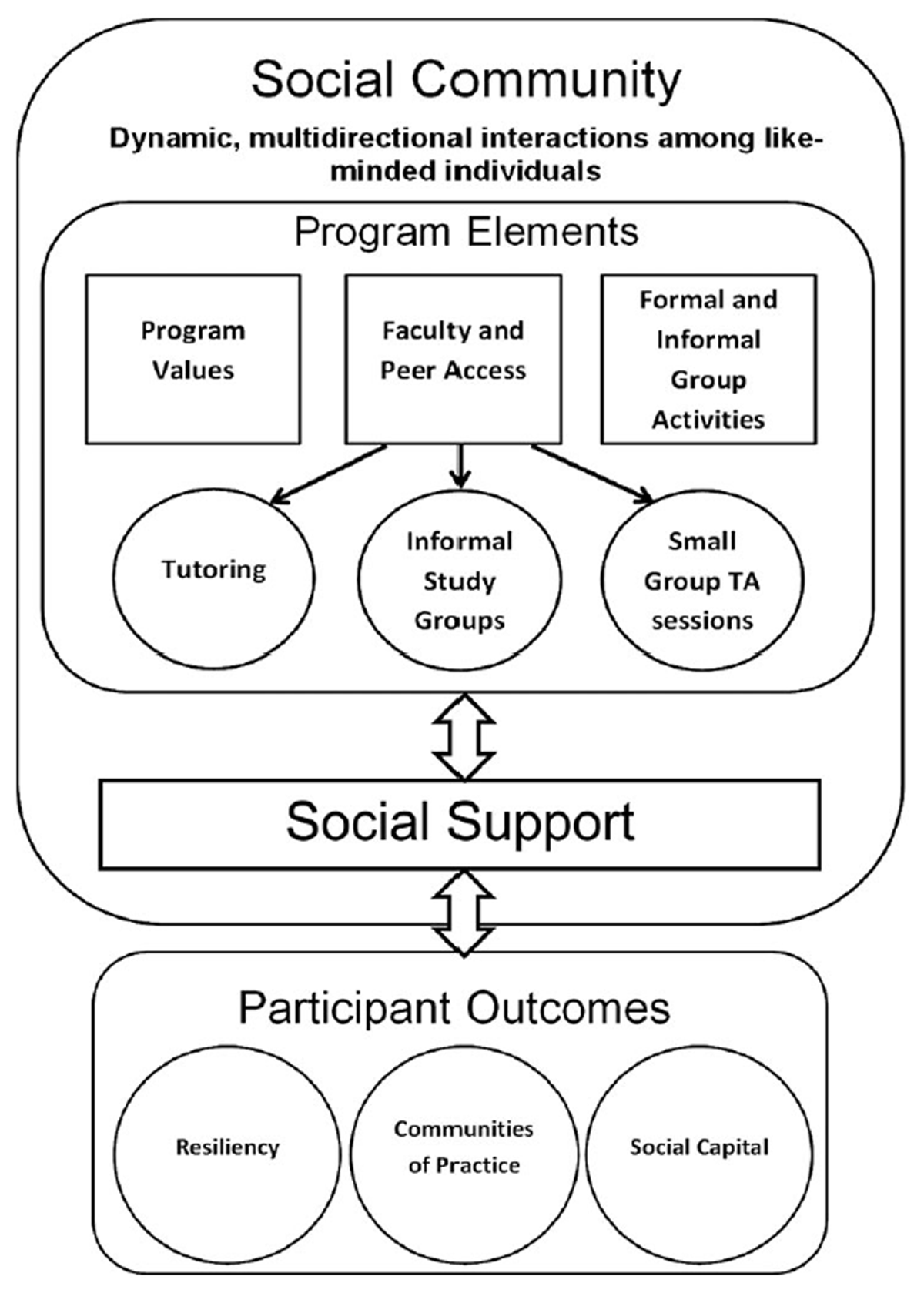
Figure 1
Social Community Framework from Mondisa & McComb (2015, reprinted with permission).
Mondisa and McComb (2015), drawing on the history of STEM mentoring programs, outlined a framework to explain (1) what elements are needed for social community to flourish and (2) what beneficial outcomes result from mentoring programs with strong social community. While much previous work solely focused on measuring the outcomes of mentoring programs, Mondisa and McComb focused on the “human elements that form a social community” to explain how “members’ interactions…may contribute to the creation of a social community and the manifestation of beneficial outcomes for community members” (Mondisa & McComb, 2015, p. 150). They defined social community as an “environment where like-minded individuals engage in dynamic, multi-directional interactions that facilitate social support” (Mondisa & McComb, 2015, p. 152, emphasis in original). In their definition, like-minded referred to having a “shared mind-set towards goals,” rather than shared demographic characteristics (Mondisa & McComb, 2015, p. 154). When participants both “contribute to and benefit from group membership” in various contexts, their interactions were multidirectional and dynamic (Mondisa & McComb, 2015, p. 154). Through these interactions, students received and provided each other with social support. Social community, in their conceptualization, was both a means to beneficial participant outcomes and an end in itself (e.g., a defining feature of a successful program). The three social community outcomes described in the 2015 paper were resiliency, involvement in communities of practice, and social capital development. Figure 1 shows the Social Community Framework as conceptualized by Mondisa and McComb.
Communities of practice in undergraduate STEM education
Mondisa and McComb identified involvement in communities of practice as one of the participant outcomes of the social community framework. As the focus of this paper, involvement in communities of practice, refers to becoming engaged in shared interest groups where students can develop specific skills and knowledge (e.g., students engaging with one another around a particular interest or activity such as research), which can be key for professional preparation in engineering (Johnson & Main, 2020; Olewnik et al., 2023). While there has been some discussion of STEM communities of practice in higher education, there may have been more focus on graduate students or faculty (Bottoms et al., 2020; McDonald & Cater-Steel, 2016), with some examination of undergraduate communities of practice in research (Feldman et al., 2013; Villa et al., 2013), classrooms (Tomkin et al., 2019), and mentoring programs (Dancz et al., 2021). The following section provides additional theoretical context for discussion of communities of practice.
Wenger at al. (2002) described communities of practice as having three characteristics: domain, community, and practice. The domain outlines the boundaries and common ground that defines members and non-members. Community is the social structure and interactions that facilitate learning. Practice includes the ideas and experiences shared among the group. Wenger (2010) also discussed communities of practice as, and in, social learning systems. He postulated that learning produces social structure by generating ideas and physical artifacts that build a shared experience, and ultimately establishes criteria for membership. Research and practice have found that mentorship from more experienced members of the community of practice is vital for socializing newcomers into the community (Bottoms et al., 2020).
Wenger et al. (2002) described the essential roles of leaders and facilitators to manage and sustain a community of practice. For example, a leader or champion provides overall management for the group, including recruitment and providing resources. Facilitators oversee daily activities. Others have emphasized that the configuration of these roles varies across contexts (Li et al., 2009). For example, sometimes the roles may be distinct from one another or be merged into a single role. Despite this variation, the facilitator role has been viewed as essential to the success of communities of practice.
Taking a broader view, communities of practice do not occur in isolation, rather they occur alongside multiple communities of practice. For example, in a mentoring program, participants belong to the mentee community of practice as well as the broader disciplinary academic community of practice, both of which exist within a landscape that includes additional communities such as student organizations or research. Within these landscapes of practice, there are boundaries between different communities that need to be navigated as one fully engages in a professional field (Wenger, 2010). Wenger described how individuals can identify with different layers of their membership within communities of practice (i.e., multi-scale) as well as participate in multiple communities simultaneously or over time (i.e., multimembership). The intersection of communities present challenges such as misunderstanding but also create opportunities for learning across different perspectives (Putnam, 2000). Students, for example, could become members of multiple communities of practice simultaneously, which may generate beneficial spillover effects for their different communities (Phelps et al., 2012).
Communities of practice have the potential to strengthen belonging and community amongst participants because learning in a community of practice is “social becoming” that contributes to identity development as individuals move from peripheral participant “newcomers” to full members or experts (Dancz et al., 2021; Wenger, 2010). Yet, in the context of higher education, there are risks as to whether boundaries within and between communities of practice may reinforce existing opportunity gaps present in STEM. For example, previous studies have found that men (Washington & Mondisa, 2021) were more likely to engage in communities of practice than women. While the initial research on communities of practice through the social community mentoring model identified opportunity gaps in involvement, this paper describes how mentoring programs can effectively encourage underrepresented or underserved students to become involved in STEM communities of practice at the undergraduate level. In this paper, we look at scholars’ involvement in three student communities of practice—engineering diversity organizations, peer leaders within the scholar community, and undergraduate research—to understand how students became involved.
Study Overview
This study was conceived by the program assessment team at UC San Diego’s IDEA Engineering Student Center, with input from IDEA Center leadership, staff, and educational research partners, to evaluate the extent to which the scholar programs, including the required kickoff Summer Engineering Institute, supported the academic and social integration of students, as well as their subsequent success. It was approved by the UC San Diego Institutional Review Board in March 2021 (study #210233), with the Faculty Director of the IDEA Center serving as Principal Investigator.
Researchers’ positionality
Trahan has a background in anthropology and studying informal learning experiences within STEM and inquiry-based museum exhibits, out-of-school programs, and professional learning. This shapes her concept of learning to emphasize guided inquiry, social experience and interactions with the environment, and group culture. With experience in program evaluation as well as research, her thinking often looks for the connections between program goals, design, and outcomes while acknowledging that unanticipated experiences and outcomes can be key to understanding impact. Her interest in equity in STEM education was sparked by her abrupt, fear-of-failure decision to drop college calculus and physics before the first lecture and abandon the possibility of a science major. She instead pursued interests in learning how to create engaging, inclusive, and effective STEM learning experiences for others, especially for those who experience doubts in their abilities or belonging in STEM because of signals from the world around them. During the study, Trahan was a colleague of the coordinators of the programs described in this paper, with responsibilities to conduct assessment of the programs to improve the scholar experience. In this capacity she periodically interacted with program participants to invite their feedback about the program or to socialize at the IDEA Center and IDEA Center events. As a White woman, she works to reflect on her many privileges and listen closely to the voices of people from other backgrounds to better understand how to work towards creating programs and systems that yield equitable opportunities and outcomes and foster belonging and inclusion. She believes that this work is an ongoing process of learning (and unlearning) how to do better.
Rockwell has a doctorate in Educational Leadership and a background working in and studying educational organizations. He has spent his career working with diverse students in higher education, whether it be through advising at the community college level or teaching adult learners. For his recent research, he has focused on how social class background shapes perceptions of stress in the transition to college. His ideas have been informed by literature in cultural psychology and the sociology of social class, which partially shaped the framing of this paper. He recognizes that his intersecting identities as a White male born into a well-resourced household in the United States and a continuing-generation student likely influenced this research project, from the responses of interviewees to the salience of certain themes identified during the coding process. Rockwell worked closely with Trahan on the data analysis and synthesis of the findings, which served as one check against potential bias.
Lipomi is a professor of nanoengineering, chemical engineering, and materials science at UC San Diego. He also serves as Associate Dean for Students in the School of Engineering. As Associate Dean, he oversees the IDEA Center. In this role, he is responsible for coordinating programs for the retention and success of undergraduate and graduate students, supporting communities of diverse students, supporting an academic climate of inclusion, trust, and openness, and playing a role in the development of new educational initiatives. He is widely known in the communities of chemical and materials engineering education through multiple YouTube and podcast channels, with more than half of the 1.2 million views originating in the Global South. His motivation for this work stems from the substantial support he received during his training and development, including from need-based grants, the undergraduate research opportunities program office, and summer research programs. While his gender identity and ethnicity (i.e., White) put him in a position of privilege, his upbringing just a notch above the poverty line with attendant stress and anxiety has sensitized him to many of the challenges faced by students from a diverse range of backgrounds.
Research setting
UC San Diego’s Jacobs School of Engineering is the largest engineering school in California, with a total student population of nearly 10,000. Located about thirty miles north of the US-Mexican border, UC San Diego is an Asian American and Native American Pacific Islander-Serving Institution and an emerging Hispanic Serving Institution. The IDEA Engineering Student Center, which stands for Inclusion-Diversity-Excellence-Achievement, provides student-centered services and programs based on high-impact practices that promote community and academic success. Established in 2011, the Center has worked for more than a decade on engineering student diversity initiatives, including scholar cohort programs and supporting engineering diversity organizations (Trahan et al., 2021). Today the Center offers 20+ programs and events per year. One of the Center’s longest-standing activities is supporting UC San Diego’s engineering student diversity organizations, which today includes six organizations: Society of Hispanic Professional Engineers (SHPE), National Society of Black Engineers (NSBE), Society of Women Engineers (SWE), Out in STEM (oSTEM), Society of Asian Scientists and Engineers (SASE), and Women in Computing (WIC). Two of the Center’s scholar programs are the focus of this paper. As described later in the findings section, our study sample includes high proportions of Latinx, first-generation, and Pell Grant eligible students compared to the total engineering student population and our study Comparison group. Understanding and serving the unique needs of these audiences are priorities for UC San Diego, the IDEA Center, and the scholar programs, so an in depth look at their program experiences has great value for understanding effective practices that may contribute to educational equity at UC San Diego and beyond.
Scholar programs overview
The IDEA Scholars and ACES Scholars programs each begin with the Summer Engineering Institute (SEI), a five-week, residential, credit-bearing summer transition program for incoming first-year students in an engineering major to foster community and prepare students for the rigors of university study. SEI is open to all incoming first years. Incoming first-year engineering students may apply for the scholar programs as part of the Summer Engineering Institute application. Information about the scholar programs is sent to students from underrepresented backgrounds, including women, students from underrepresented minority groups, and those who are the first generation in their family to attend college. A subset of SEI participants joins the IDEA Scholars or ACES (Academic Community for Engineering Success) Scholars program, which provide ongoing advising and academic enrichment to further support persistence and success in engineering. The scholar programs build on the foundation set by SEI. Both scholar programs serve high numbers of first-generation and low-income students, with ACES Scholars serving almost exclusively low-income students who are Pell Grant eligible. IDEA Scholars is an ongoing program while ACES Scholars was funded by a National Science Foundation S-STEM grant that ran from 2016–2022. The programs share many features, including SEI, weekly discussions during the first Fall quarter, one-on-one advising with program coordinators, and various professional development opportunities. IDEA Scholars receive a partial scholarship from various corporate and individual donors that covers 20–30% of the tuition and housing cost, while ACES Scholars receive a grant-funded scholarship to attend SEI at no cost. The IDEA Scholars program is expanding and seeking additional financial support to continue providing support and scholarships at a similar capacity beyond the term of the ACES Scholars grant funding.
According to Mondisa and McComb (2015), the three key program elements for STEM mentoring programs include program values, access to faculty and peers, and formal and informal group activities. Each of these elements are part of the undergraduate engineering scholar programs described in this paper. The first part of the scholar program participants’ experience is the Summer Engineering Institute, which happens before the start of the academic year. Within the Summer Engineering Institute, program values such as community building, academic success, and getting involved with research, student organizations, and other opportunities are emphasized. Community building is facilitated through residential hall suites and formal social activities overseen by SEI peer leaders and informal activities between peers. Academic success is emphasized in courses, taught by faculty and graduate students. Finally, workshops and student panels curated by peer leaders and program staff as well as informal conversations between peer leaders and participants introduce academic resources, undergraduate research, involvement in engineering student organizations and project teams, internships, and other opportunities.
Additionally, the scholar programs instill and expand on program values through weekly group discussions during the first Fall quarter that focus on preparing resumes and other professional academic topics. The discussions are led by the program coordinators and often include invited peer scholars from previous cohorts. Peers stay connected through social or professional development events and peer mentoring opportunities such as a Big-Little matching program as well as informal interactions that evolve over time. Finally, Scholars are invited to meet quarterly with the program coordinator to discuss their academic or professional development and are welcome to meet more frequently for advice or support.
Research questions
While mentoring programs often seek to provide participants with social support, build social community, and encourage involvement, there are myriad ways for students not in formal mentoring programs to gain similar experiences, which raises the question: do students in mentoring programs experience greater involvement in communities of practice (i.e., a social community outcome) than those students who do not participate in these programs? We expected that they would, but according to Washington and Mondisa (2021), “no existing studies indicate whether students’ social community outcomes are stronger with a mentoring program than without it” (p. 920).
In developing this study, the IDEA Center staff and leadership wanted to understand what the most impactful elements of the program were from the scholars’ perspectives. And, more specifically, staff and leadership were curious about what drives scholars to become involved with various opportunities. Encouraging scholars to get involved in additional communities and programs is emphasized by the program to promote academic and social integration as well as career preparation. Anecdotally, we suspected that peer influence, in particular, would be a strong motivator for involvement, more so than other forms of social support (e.g., staff and faculty). Understanding how the program influences scholars’ decisions to get involved in communities of practice will help other similar programs curate and sustain the most impactful strategies.
This study presents two scholar programs as case studies (Case & Light, 2011; Flyvbjerg, 2011) to be examined using the social community framework. Using survey data, we sought to answer these questions:
RQ1: From the scholars’ perspectives, what elements of the IDEA and ACES Scholars programs support their success the most?
RQ2: Which scholar populations, if any, are more involved in communities of practice than their peers who are not in scholar programs?
Additionally, we conducted interviews with the scholar program participants to explore the question:
RQ3: How do program elements and social support influence engineering scholars to become involved in communities of practice?
Methods
Data collection
All 383 SEI participants from summers 2016–2019, including scholars and non-scholars, were invited to participate in the study by email from the IDEA Center leadership. Additionally, a random sample of 986 peer non-participants from the 4,000+ undergraduate first-time engineering students in the 2016–2019 cohorts were invited to participate. The survey received 256 responses, a 19% response rate. All survey respondents were provided with a $5 gift card incentive for completing the survey. The SEI participants and non-participants were also invited to complete an interview screening form, which asked about their cohort year and involvement in various activities to help gather a balance of perspectives from SEI participants, scholar program participants, and non-participants. Sixty-three (63) of 69 students who completed the screening form were invited to participate in an interview. Ultimately 29 students were interviewed, with this paper focusing on interviews with the 16 scholar program participants, referred to as scholars. Interviews were conducted by the first and second authors via Zoom. Interviews were recorded and later transcribed by research assistants.
Survey and analysis
A 60-question survey was developed and administered, with a subset of 28 questions relevant to the analyses presented in this paper (Appendix A). Several survey questions were modified from the Assessing Women in Engineering (AWE) Retention Surveys developed by Pennsylvania State University and University of Missouri and funded by the National Science Foundation (e.g., Marra et al., 2009). In addition, customized questions were developed with input from program coordinators to understand scholars’ participation in and perceived value of different elements of the scholar programs. Two key questions from the survey on program elements and student involvement guided investigation of our first two research questions (RQ1 and RQ2).
The first survey question featured in this paper asks scholars to choose three aspects of the scholar programs that supported their success the most to date. The answer choices included: Summer Engineering Institute, weekly scholar discussions (Fall), cohort of peer scholars, IDEA Center advising/staff, peer mentoring (ACES)/Big-Little (IDEA), faculty mentoring (ACES only), professional development workshops, and something else not listed (please specify). The number of times each program element was selected was tallied to compare frequencies.
The second key question, modified from the AWE retention survey, asked students to indicate their level of involvement in each of the following co-curricular and academic engineering activities in the past academic year: an engineering society, engineering fraternity or sorority, professional or student group for women or minority engineers, IDEA Center sponsored activities, activities (social or academic) sponsored by your department or major, design competition teams, other engineering student organization, undergraduate research experiences, and co-op or professional internship position. Response options included: Not involved, 1–2 times per year, 3–5 times per year, or More than 5 times per year. During analysis, responses were re-coded to the binary Not involved or Involved, with Involved meaning at least one time per year. Findings were reported for students who persisted in engineering to focus this paper on successful strategies for engagement. A Chi square analysis was used for two categorical variables (program and binary involvement) at significance levels of p<0.05 to identify whether there are significant differences between groups. Frequencies were used to describe the relative differences between the groups.
Interviews and analysis
An hour-long interview protocol (Appendix B) was developed to better understand students’ experience as an engineering student, including definitions of success, development of community and sense of belonging, challenges and motivations for persistence, career aspirations, and experiences in SEI and the scholar programs (as applicable). The survey results guided development of our final research question (RQ3) and the process for the interview analysis.
We analyzed all 16 transcribed interviews conducted with scholars to help explain how scholars became involved in engineering diversity organizations, IDEA Center sponsored activities, and undergraduate research. To do this, we looked for specific mentions of the program elements that participants had named as most impactful on the survey (i.e., SEI, peer cohort of scholars, and advising) in relation to the three communities of practice uncovered by the significant survey findings. The purpose was to better understand how the program features contributed to scholars’ involvement in these areas. Three coders reviewed a subset of the 16 interviews and populated a matrix chart with relevant instances or quotes. Two reviewers subsequently reviewed all transcripts to verify agreement and any missed mentions of the focal topics.
Survey Findings: Identifying Salient Program Elements and Communities of Practice
Demographics
In our survey analyses, we compared four groups of respondents: ACES Scholars, IDEA Scholars, Summer Engineering Institute Only participants (students who participated in the summer program but not the scholar programs), and Comparison (students who participated in neither the summer program nor the scholar programs).
In our study sample, as shown in Table 1, ACES and IDEA Scholars both included a higher proportion of Latinx students (48% and 45%, respectively) compared to the comparison group (13%). As shown in Table 2, they also included a higher proportion of first-generation students (71% and 48%, respectively) and Pell Grant recipients (92% and 43%, respectively) compared to the comparison group, which was 25% first-generation and 27% Pell Grant eligible. ACES and IDEA Scholars included a higher proportion of women (52% and 61% respectively) than the comparison group (41%), as shown in Table 3. The SEI Only group was similar to the comparison group on race/ethnicity, but included a lower proportion of first-generation, Pell eligible, and women students. This can be explained by the fact that SEI attendees who are first-generation, Pell Grant eligible, and women were more likely to become part of the scholar programs. The Comparison group for this study overrepresented women, underrepresented Pell Grant eligible students and students from underrepresented minority groups, and was representative of first-generation students compared to the overall engineering student population at UC San Diego.
Table 1
Race/Ethnicity: Survey Respondents from 2016–2019 Cohorts.
| ASIAN | LATINX/HISPANIC | WHITE | AMERICAN INDIAN/ALASKAN NATIVE | BLACK/AFRICAN AMERICAN | |
|---|---|---|---|---|---|
| ACES (n = 24) | 44% | 48% | 4% | 0% | 0% |
| IDEA (n = 56) | 45% | 45% | 25% | 2% | 2% |
| SEI Only (n = 24) | 68% | 4% | 24% | 0% | 0% |
| Comparison (n = 150) | 71% | 13% | 23% | 0% | 0% |
[i] Note: Totals may exceed 100% because multiple categories selected.
Scholar perspectives on impactful program elements
In order to better understand scholars’ perspectives on the program experience, the survey asked them to name the top three elements of the program that had the greatest impact on their success. These responses guided subsequent interview analysis.
ACES and IDEA Scholars rated SEI (88% ACES, 98% IDEA) and cohort of peer scholars (60% ACES, 61% IDEA) as two aspects of the program that supported their success the most. IDEA Scholars also highly rated the IDEA Center advising/staff (64%).
Table 4 is a summary of all responses showing the frequency of scholars who mentioned these program elements in their top three. Program elements mentioned by at least 60% of respondents in either of the scholar programs are indicated with an asterisk below.
Table 4
Which aspects of the Scholars program supported your success the MOST? Top 3 ranking.
| ACES (n = 25) | IDEA (n = 56) | |
|---|---|---|
| Summer Engineering Institute* | 88% | 98% |
| Weekly Scholar Discussions | 16% | 20% |
| Cohort of Peer Scholars* | 60% | 61% |
| IDEA Center Advising/Staff* | 28% | 64% |
| Peer Mentoring (ACES)/Big-Little (IDEA) | 4% | 25% |
| Faculty Mentoring (ACES Only) | 32% | n/a |
| Professional Development Workshops | 16% | 14% |
| Other | 8% | 13% |
[i] * Aspects of the program that were mentioned by at least 60% of respondents in either of the scholar programs.
SEI establishes a cohort of peer scholars
When scholars were asked an open-ended question on the survey about how SEI supported their success as an engineering student, the most common response was that SEI exposed them to their fellow peers in engineering. The top 60 key words mentioned in responses to this survey question are shown in Figure 2. The most common words were friends and helped (or help), with 36% of 83 respondents highlighting these benefits. Other similar words related to their peers included engineering, people, network, classes, met, support, community, and more.
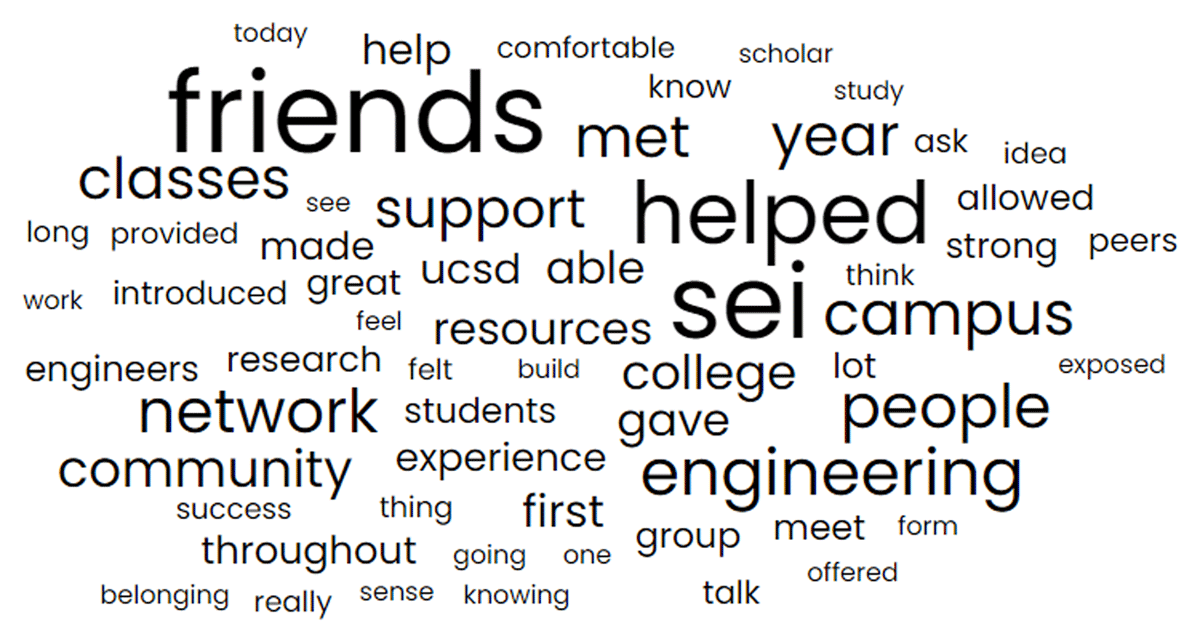
Figure 2
In what ways (if any) did participating in SEI support your success as an engineering student at UC San Diego?
Notably, a cohort of peer scholars was one of the other named impactful elements of the scholar programs on the question depicted in Table 4. Scholars consistently described how they made friends in SEI that helped them throughout college. Some of the benefits that came with these new friends included: (1) they helped prevent scholars from feeling lonely and lost when they came to the university, (2) they provided comfort and emotional support through stresses and challenges, and (3) they enabled scholars to form study groups (i.e., academic support). As one scholar explained,
SEI was where I formed the key friendships and relationships with people of similar major/interest. These people are still among my closest UCSD friends and have offered a lot of support throughout my academic and personal life.
SEI introduces resources and opportunities
Another benefit of SEI mentioned in the open-ended survey question was being introduced to campus resources such as tutoring, Engineering Learning Communities and the IDEA Center. Knowing about these resources helped scholars to feel more comfortable on campus. SEI also introduced scholars to research opportunities and gave them the chance to meet faculty. These early rewards led to positive feedback loops, where social benefits created the conditions for academic benefits and, similarly, awareness of resources created the conditions for more opportunities to develop as an engineer. For one scholar, SEI introduced them to academic support programs:
SEI…introduced me to the Engineering Learning Communities that helped me significantly in getting satisfactory grades in chemistry and physics.
For another scholar, SEI “Exposed me to research and greatly made me interested in pursuing a research position.”
Advising
As shown in Table 4, IDEA Scholars appreciated the one-on-one advising provided to scholars, explaining that program staff were helpful and provided a range of support. IDEA Scholars described using one-on-one meetings as a chance to get emotional support, share goals and plan for the future. Sometimes, as a result of these meetings, specific tasks were accomplished, such as writing a resume or statement of purpose. Other times, scholars did not have a specific agenda, but the advising helped them to stay on track or feel more confident. Similarly, ACES Scholars described receiving a range of benefits including emotional support, academic planning, and career planning. These sessions gave scholars a chance to stop and reflect, and advising boosted their confidence and reassured them that they were doing okay. One scholar summed up their experience with one-on-one advising, saying,
The one-on-ones usually give me a lot of confidence. The times I have gone to them I have received a lot of positive feedback as well about my future moves and plans. I am thankful to have these available to me because otherwise, I wouldn’t have the perspective from an adult mentor, as my own parents and most of my family members do not know the 4-year experience of a university.
Involvement in communities of practice
The survey asked students about their involvement in various co-curricular and extracurricular engineering activities, referred to as communities of practice in this paper, to help us understand how students engage with different opportunities and communities.
ACES and IDEA Scholars were more likely to be involved with a professional or student group for women or minority engineers, IDEA Center sponsored activities, and undergraduate research experiences compared to students who did SEI only and students in the Comparison group. Later interviews defined IDEA Center sponsored activities as primarily referring to peer leader roles related to the scholar programs or other IDEA Center programs.
More specifically, a higher percentage of ACES Scholars (61%) and IDEA Scholars (63%) mentioned being involved with a professional or student group for women or minority engineers compared to SEI Only (9%) and the Comparison group (24%). A higher percentage of ACES Scholars (74%) and IDEA Scholars (86%) mentioned being involved with IDEA Center sponsored activities compared to SEI Only (26%) and the Comparison group (35%). A higher percentage of ACES Scholars (70%) and IDEA Scholars (60%) mentioned being involved with undergraduate research experiences compared to SEI Only (38%) and the Comparison group (31%). Table 5 summarizes these significant findings.
Table 5
Student Involvement by Program.
| ACES SCHOLARS | IDEA SCHOLARS | SEI ONLY | COMPARISON | CHI SQUARE TESTS OF INDEPENDENCE | |
|---|---|---|---|---|---|
| Diversity Org* | 61% | 63% | 9% | 24% | X2(3, N = 228) = 38.59, p < .001 |
| IDEA Center* | 74% | 86% | 26% | 35% | X2(3, N = 228) = 48.96, p < .001 |
| Research* | 70% | 60% | 38% | 31% | X2(3, N = 229) = 20.52, p < .001 |
[i] Note: Abbreviations: X2, chi-square test statistic.
*Significance at p = 0.05.
Notably, when looking at involvement in these communities of practice among first-generation, Pell Grant eligible, and Latinx scholars specifically, this subset of scholars were more likely than demographically similar non-scholars to participate in these three communities of practice: 1) professional or student groups for women or minority engineers (i.e., engineering student diversity organizations), 2) IDEA Center sponsored activities, and 3) undergraduate research experiences. Group-level analyses were conducted for these groups because they are the largest of the traditionally underserved groups within the scholar programs. This finding is important because the program groups (e.g., scholars versus Comparison group) are demographically different and participation in the communities of practice may be influenced by these demographics. Yet, when looking within these subgroups (i.e., first-generation scholars compared to first-generation non-scholars in the Comparison group), the findings showed that first-generation, Pell Grant eligible, and Latinx scholars were significantly more likely than their demographically similar non-scholar peers to become involved in these communities of practice. SEI Only was excluded from the subgroup Chi square analysis because counts were too small. This demonstrates that for scholars from these subgroups, membership in a mentor program provided experience and connections that led to involvement in communities of practice that their non-participant peers did not gain. There were no significant differences between program groups on involvement items by gender.
Tables 6 7 8 summarize these significant findings for first-generation, Pell Grant eligible, and Latinx scholars. Among first-generation students (Table 6), ACES Scholars were most likely to participate in undergraduate research (73%) or IDEA Center sponsored activities (67%), with about half participating in a diversity organization (53%). First-generation IDEA Scholars were most likely to participate in the IDEA Center sponsored activities (91%) with more than half participating in a diversity organization (61%) and undergraduate research (55%). By contrast, a much lower proportion of first-generation students in the Comparison group participated in diversity organizations (28%), IDEA Center sponsored activities (41%), or undergraduate research (10%).
Table 6
First-Generation Student Involvement.
| ACES (n = 15) | IDEA (n = 23) | COMPARISON (n = 29) | CHI SQUARE TESTS OF INDEPENDENCE | |
|---|---|---|---|---|
| Diversity Org* | 53% | 61% | 28% | X2(2, N = 67) = 6.32, p = .042 |
| IDEA Center* | 67% | 91% | 41% | X2(2, N = 67) = 13.96, p < .001 |
| Research* | 73% | 55% | 10% | X2(2, N = 66) = 19.60, p < .001 |
[i] Note: Abbreviations: X2, chi-square test statistic.
*Significance at p = 0.05.
Table 7
Latinx Student Involvement.
| ACES (n = 10) | IDEA (n = 21) | COMPARISON (n = 16) | CHI SQUARE TESTS OF INDEPENDENCE | |
|---|---|---|---|---|
| Diversity Org* | 60% | 86% | 19% | X2(2, N = 47) = 16.69, p < .001 |
| IDEA Center | 70% | 100% | 36% | Cell counts too low |
| Research* | 80% | 50% | 13% | X2(2, N = 46) = 12.02, p = .002 |
[i] Note: Abbreviations: X2, chi-square test statistic.
*Significance at p = 0.05.
Table 8
Pell Grant Eligible Student Involvement.
| ACES (n = 20) | IDEA (n = 19) | COMPARISON (n = 31) | CHI SQUARE TESTS OF INDEPENDENCE | |
|---|---|---|---|---|
| Diversity Org* | 55% | 79% | 36% | X2(2, N = 70) = 8.98, p = .011 |
| IDEA Center* | 75% | 90% | 32% | X2(2, N = 70) = 18.69, p < .001 |
| Research* | 70% | 58% | 13% | X2(2, N = 70) = 19.25, p < .001 |
[i] Note: Abbreviations: X2, chi-square test statistic.
*Significance at p = 0.05.
Among Latinx students (Table 7), ACES Scholars were most likely to participate in undergraduate research (80%) or IDEA Center sponsored activities (70%), with more than half participating in a diversity organization (60%). IDEA Scholars were most likely to participate in IDEA Center sponsored activities (100%) or diversity organizations (86%), with half participating in undergraduate research (50%). By contrast, a much lower proportion of Latinx students in the comparison group participated in diversity organizations (19%), IDEA Center sponsored activities (36%), or undergraduate research (13%).
Cell counts were too low to compute Chi square for IDEA Center sponsored activities for Latinx students.
Among Pell Grant eligible students (Table 8), ACES Scholars were most likely to participate in the IDEA Center sponsored activities (75%) and undergraduate research (70%), with more than half participating in a diversity organization (55%). IDEA Scholars were most likely to participate in IDEA Center sponsored activities (90%) or diversity organizations (79%), with more than half participating in undergraduate research (58%). By contrast, a much lower proportion of Pell Grant eligible students in the comparison group participated in diversity organizations (36%), the IDEA Center sponsored activities (32%), or undergraduate research (13%).
The survey asked about several communities of practice, including an engineering society (e.g., American Society of Mechanical Engineers), engineering fraternity/sorority, professional or student group for women or minority engineers, IDEA Center sponsored activities, activities (social or academic) sponsored by your department or major, design competition teams, other engineering student organization, undergraduate research experiences, and co-op or professional internship position. As described above, diversity organizations, IDEA Center sponsored activities, and undergraduate research were significant for all scholars as well as specific underserved or underrepresented communities compared to similar non-participants. Additionally, a higher percentage of ACES Scholars (44%), IDEA Scholars (48%) and SEI Only (57%) participants mentioned being involved with an engineering society compared to the comparison group (32%), X2(3, N = 229) = 7.95, p = .047. However, the difference was not significant for the first-generation, Pell Grant eligible, or Latinx groups. Similarly, a higher percentage of IDEA Scholars (51%) mentioned being involved with design competitions compared to the other groups: ACES Scholars (30%), SEI Only (17%) and the Comparison group (30%), X2(3, N = 231) = 19.25, p < .001. Yet there was no significant difference for first-generation, Pell Grant eligible, or Latinx groups. There were no significant differences for the remaining communities of practice, which included engineering fraternities or sororities, activities sponsored by your department or major, other engineering student organizations, and co-op or professional internship positions.
This evidence for greater involvement in select communities of practice among key communities within the scholar population was a meaningful finding that inspired the subsequent interview analysis.
Interview Findings: Describing How Mentors’ Social Support Roles Promoted Involvement in Communities of Practice
From the survey we learned that scholars reported SEI, a cohort of peer scholars, and advising as the most impactful elements of the programs. We also learned from the survey that scholars from diverse groups were more likely to engage in engineering student diversity organizations, IDEA Center activities, and undergraduate research experiences. Given these findings, we posed the following question: How do the impactful program elements of the scholar programs relate to scholar involvement in communities of practice?
The mentors
We found that three distinct types of mentors linked program elements to scholars’ involvement in communities of practice, each with different and multiple approaches to providing this support. These mentors were: (1) peer leaders, (2) program coordinators and (3) faculty. Here we describe the roles that scholars attributed to each.
Peer leaders
Peer leaders, defined as peer leaders in the Summer Engineering Institute and Bigs in the Big-Little mentoring program as well as older scholars in the programs generally, made the greatest impact of the three types of mentors in encouraging scholars to join communities of practice. Peer leaders, acting as role models, showed students the benefits of getting involved on campus: in diversity organizations, IDEA Center sponsored activities (i.e., becoming a peer leader in the scholar community) and undergraduate research. This would often happen during SEI, when incoming students were looking for examples of how to be a successful college student. The peer leaders of SEI were continuing students and often had participated in SEI themselves. The incoming scholars described how the SEI peer leaders were often the first friends they made in college, and how this initial relationship led to a steady expansion of their network throughout their college experience.
Program coordinators
Two program coordinators supported the scholar programs. These staff members gave workshops on student involvement, provided advising to students and coordinated programming that benefited students socially and academically. The program coordinators first met incoming scholars in SEI, where they built relationships with students and made resources known to them. They quickly established themselves as sources of support that could help students get involved and accomplish their goals. Through the advising element of the program, they encouraged student involvement. While they directly connected students to peer leader opportunities and undergraduate research, they also indirectly connected them to diversity organizations through the peer-to-peer relationships they cultivated.
Faculty
Faculty participated in the scholar programs by teaching engineering major courses in SEI and by serving as either assigned or informal faculty mentors to scholars. They were often cited as helping scholars secure research opportunities, either through their own labs or by connecting scholars to the labs of their colleagues. Faculty who were well connected to the IDEA Center or engineering student diversity organizations were even more valuable to scholars as there were more opportunities for scholars to access them.
Mentor roles promoting involvement in three communities of practice
The scholar programs survey revealed that scholars were significantly more likely than their non-scholar peers to get involved in three communities of practice (e.g., diversity organizations, IDEA Center sponsored activities, and undergraduate research). Interviews revealed that IDEA Center sponsored activities primarily referred to peer leader roles in the scholar programs or other IDEA Center programs. Here we describe some of the ways that peer leaders, program coordinators, and faculty helped scholars get involved in each of the communities of practice.
Engineering student diversity organizations
When it came to involvement in diversity organizations, the peer leaders of SEI exerted a strong influence. Peer leaders were often involved in engineering student diversity organizations, and some had leadership positions within these organizations. As one scholar programs participant put it:
My peer facilitators were Hispanic as well and so they brought us into the Society of Hispanic Engineers [SHPE] general body meetings [during the] Fall quarter and the first general body meeting I got to go…there weren’t many other freshmen outside of SEI freshmen there. So, I felt very lucky to have met those people…I deem [it] as…one of the most important parts of my undergraduate degree is getting involved in SHPE.
These initial relationships with peer leaders helped to make it a comfortable transition into a diversity organization, such as the Society of Hispanic Professional Engineers (SHPE), especially when the peer facilitator was a part of that organization. As one student described:
I only went to SHPE [Society of Hispanic Professional Engineers] because I was friends with the SEI peer facilitator, not because I just met them one day…Say I met the president of SHPE at the time for one day, I don’t think I would have a certain draw to it compared to like knowing the peer facilitators for five weeks…
These initial relationships with peer leaders in the Summer Engineering Institute created the conditions for a smooth transition into a diversity organization, and, therefore, into a new supportive community.
The program coordinators played a role in this involvement process as well, as they hired and coached the SEI peer leaders. One of the program coordinators also advised all of the diversity organizations, including the Society for Hispanic Professional Engineers (SHPE), making their formal role a natural bridge between the scholar program, the SEI peer leaders and diversity organizations. While scholars emphasized the influence of peer leaders in their decision to join SHPE, it was notable that they did not emphasize the role of the program coordinator in doing so. This may be because of the more backstage work of the program coordinators, in comparison to the more frontstage work of the peer facilitators.
Peer leaders within the scholar community
The primary example of the IDEA Center sponsored activities that participants discussed during the interviews was taking on a formal peer leader role within the scholar community. Scholars participated in leadership roles in IDEA Center programs such as SEI peer leaders, a paid position. Peer leaders modeled becoming involved in leadership roles (e.g., becoming an SEI peer leader or a mentor in the scholar program) and inspired many scholars to give back and become peer leaders for future scholars, setting off a cycle of service. One scholar described the value of getting help from peer leaders as breaking down barriers between scholars in different cohort years:
…Being a participant myself and seeing students being in charge of other students was actually pretty helpful because you kind of teach yourself that I don’t know, that you are more on equal playing field to be honest with anybody, whether they be a fifth year and you’re a freshmen or you’re a fifth year and they’re a freshmen…you’re all adults at the end of the day and I think it’s super helpful in terms of treating other people with respect…I think it just taught a valuable lesson about not being afraid of people older than you and also being super respectful to people.
Peer leaders also benefited from their involvement with the IDEA Center, as it could strengthen their network and lead to additional leadership opportunities. Most of all, students described how much they valued sharing their knowledge and skills with first year students.
Program coordinators served as a bridge between the elements of the scholar programs and scholars getting involved in peer leadership roles within the scholar community. For example, program coordinators played a central role in hiring and coaching the SEI peer leaders. Scholars would seek advice and assistance from the program coordinators about applying to be a peer leader. Program coordinators played an important role in making scholars feel comfortable with the idea of becoming SEI peer leaders and followed up with them to make sure they applied. With behind the scenes support from the program coordinator, peer leaders lead the foundational Summer Engineering Institute experience that sets social community in motion for incoming scholars and become key connectors between scholars and additional communities of practice.
Undergraduate research
Gaining experience in research is a key component of undergraduate engineering education because it deepens students’ competence in key skills and prepares them to pursue graduate school. Both IDEA and ACES Scholars were significantly more likely to gain undergraduate research experience than their non-scholar peers. Peer leaders, program coordinators and faculty all provided different entry points for scholars to pursue research experiences.
Peer leaders introduced students to undergraduate research by providing examples of possible paths to follow. One scholar described a peer leader (i.e., their Big in the Big-Little program) as “doing research, doing amazing stuff…he knew a lot of other people behind the scenes, so that’s kind of where, for me, the community started.” Another scholar who went on to pursue their PhD reported that peer leaders “always told me their personal academic struggles but…I still saw them in internships, I saw them in research, I saw them getting scholarships.” Gaining early access to peer leaders (e.g., via the Summer Engineering Institute) helped scholars to envision themselves in those positions even when they encountered personal or academic challenges. Once they formed deeper relationships, they could directly ask these peers about research positions.
The program coordinators helped scholars apply for research opportunities by notifying them of opportunities and in some cases working with them to complete their applications. Program coordinators drew on their existing network to help scholars become aware of opportunities. One scholar described the connection from the program coordinator to a faculty member to a research opportunity like this:
I mentioned the research lab and that I wanted to get involved with research. And [program coordinator] asked me what lab it was and…she was like “Oh, he’s actually one of…the IDEA Center [faculty board members]”… So she put me into contact with him – she put us on an email thread together. And he was like, “Yeah, I would love for you to join my lab.” Here’s [a graduate student] and you’ll…work with him and learn from him.
Program coordinators, in the advising function of their roles, served as a way to connect scholars to potential positions in faculty research labs.
Faculty who participated in the scholar programs (e.g., as an assigned faculty mentor or as an instructor in SEI) helped connect scholars to research experiences. Two scholars described how their faculty mentors connected them to research: one was offered a position in the faculty mentor’s lab and another, with their mentor’s help, secured a research position in another lab. A third scholar built a relationship with a faculty member teaching their Summer Engineering Institute course and later got involved in their research lab.
Scholars could also connect with faculty in more indirect ways, such as through an engineering student diversity organization. One scholar got involved in research through their diversity organization by getting to know the faculty advisor for the organization. The scholar collaborated with the faculty member on some events for the diversity organization and was asked by the faculty member to work in their lab over the summer. This was an indirect connection from the scholar program to undergraduate research as it was the scholars’ experience in SEI that led them to join the diversity organization, which, in turn, led them to the research opportunity. This example illustrates that scholars often took different pathways to research, but what was consistent was the opportunity to form supportive mentor relationships across multiple program elements and communities of practice.
Discussion and Implications
This paper examined two undergraduate engineering scholar programs, which begin with the Summer Engineering Institute (SEI) bridge program, as case studies of the social community model for STEM mentoring programs. First, we found that the most supportive program elements for scholars were the Summer Engineering Institute, a cohort of peer scholars, and staff advising. Next, we found that Latinx, first-generation, and Pell Grant eligible program participants were more likely to be involved in three communities of practice (e.g., engineering student diversity organizations, peer leader roles connected to the IDEA Center, and undergraduate research) than demographically similar non-program participants. Finally, in asking how the program elements relate to involvement in communities of practice, we found that mentors (e.g., peer leaders, program coordinators, and faculty) provided the necessary social support to encourage participants’ involvement. This study’s findings extend the initial work on social community in mentoring programs by offering case studies to examine the theory and practice of the model. We believe the communities of practice literature can expand research on social community and provide additional theoretical support for the framework beyond social exchange theory (Mondisa & McComb, 2015).
Applying the mentoring program model
Figure 3 below is a visualization that applies details specific to the engineering scholar programs described in this paper to Mondisa and McComb’s (2015) mentoring program model (Figure 1). Figure 3 indicates our additions with bold borders. First, a summer transition program such as the Summer Engineering Institute and advising with program staff were incorporated into Program Elements, which were not represented in the original social community framework (Mondisa & McComb, 2015). STEM bridge programs have a long history and some evaluation and research on their impacts (Ashley et al., 2017), including as part of long-term mentoring programs (Stolle-McAllister, 2011). Second, the Social Support box now explicates three types of mentors who provide social support. Third, within Participant Outcomes, the visual specifies three Communities of Practice that were the focus of this paper. Of note, the Peer Leader community of practice plays an instrumental role in several Program Elements and Communities of Practice. Each of the aspects that are strongly influenced by the Peer Leader community of practice in this study are indicated with an asterisk (*).
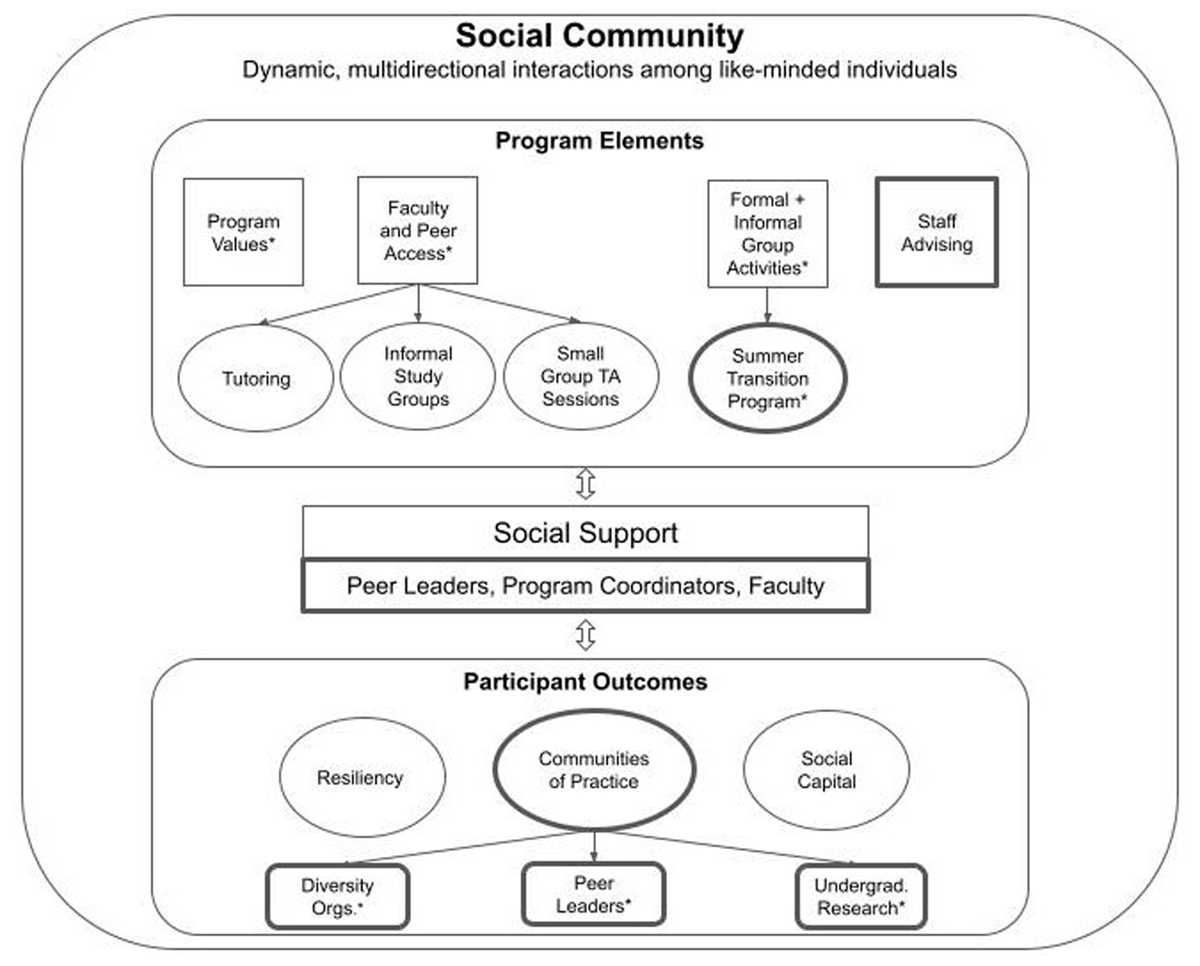
Figure 3
Social Community Model Applied to Engineering Scholar Programs (Mondisa & McComb 2015, adapted with permission).
* Aspects that are strongly influenced by the Peer Leader community of practice in this study.
Demonstrating involvement in communities of practice as a benefit of mentoring programs
Our survey findings on involvement in communities of practice provides evidence that mentoring programs benefit participants compared to non-participants, including participants and non-participants from similar demographic groups. This finding provides justification for the hypothesis that “students’ social community outcomes are stronger with a mentoring program than without it” (Washington & Mondisa, 2021, p. 920) and provides examples of how mentors successfully encouraged involvement in communities of practice, building upon studies with preliminary findings in this vein (Ahmed et al., 2021). Furthermore, the study provides evidence that the scholar programs, including mentor social support, benefited particular groups by effectively encouraging involvement in communities of practice for first-generation, Pell Grant eligible (i.e., low-income), and Latinx students. Students from these groups carry assets with them to navigate complex educational experiences and may draw upon their intersecting identities throughout this process (Ives & Castillo-Montoya, 2020; Ong et al., 2020; Smith & Lucena, 2016). While much previous work with these audiences has taken a deficit perspective, asset-based perspectives are growing (Ives & Castillo-Montoya, 2020; Smith & Lucena, 2016). For example, communities and networks are important tools for first-generation and other underrepresented students to navigate higher education, which leverage their existing social capital to create value, rather than to impart social capital that students lack (Martin et al., 2020). Ives and Castillo-Montoya (2020) propose reframing learning for first-generation and other underserved students as interconnected and multidirectional to leverage students’ assets, consider multiple pathways for learning, and define success more equitably. Communities of practice and the social community model show synergies with this framing and may offer opportunities to develop this within engineering education.
Expanding on mentor roles that facilitate development of and involvement in communities of practice
Our final finding, revealed through interviews with program participants, highlighted the importance of mentors, who provided the social support that encouraged involvement in communities of practice. Key implications of this finding are related to the instrumental roles provided by (1) peer leaders and by (2) program coordinators, which were not fully represented in the social community model, which emphasizes faculty and peer access, rather than staff and peer leadership (Mondisa & McComb, 2015).
In the case of peer leaders in this study, they sustained social community by transmitting the values of the program, energizing students to become involved, and being a direct personal link to additional communities of practice. This critical role inspired scholars to give back and to continue the cycle of student-led support. As described by Mondisa and McComb (2015), “the social communities” themselves “are examples of communities of practice” (p. 157), implying the importance of understanding a mentoring program as a community of practice in itself. We further develop this idea, namely, that the concept of communities of practice is relevant to the model not just as an outcome but also as an important mechanism for initiating and sustaining social community within STEM mentoring programs for underrepresented and underserved students. Interviews with scholars in this study revealed that becoming a peer leader was a community of practice outcome for a subset of scholars as well as an essential element of the program. This process began with the Summer Engineering Institute, where peer leaders were paid and trained, and then extended through subsequent interactions and via peer support, where peer leaders were often not paid. Interviews with scholars in this study also supported the idea that the benefits of membership in the community inspired scholars to “pay it forward” by becoming a peer leader, and thus sustaining essential elements of the program experience. Peer leaders may hold multi-scale, multimembership in communities of practice (Wenger, 2010) as cohort program participants, cohort peer leaders, research assistants, engineering diversity organization members and other roles.
Our findings suggest that the importance of these peer leaders may be an undertheorized or underdeveloped aspect of mentoring programs in STEM and engineering education (e.g., some roles are unpaid and not professionalized), which is in conflict with the essential need for peer mentors to generate and sustain social community to make mentoring programs successful. Wenger, McDermott, and Snyder (2002) described the core members of a community of practice, about 10–15% of the group, working in close partnership with the community coordinator to design and facilitate the community for other active and peripheral members. For STEM administrators and practitioners developing mentoring programs, we recommend making the role of peer leaders explicit, and, whenever possible, professionalizing this role to include training and coaching, and compensating peer leaders accordingly (Bowling, 2015). Beyond mere access to peers, as Mondisa and McComb describe it, the peer leader community and role can be designed to have explicit structure and achieve particular outcomes within mentoring program models, which can improve the consistency and outcomes of programs. Professionalization of peer leaders has the additional potential to support underrepresented students, who may, similar to underrepresented faculty, be paying a “minority tax” for their co-curricular and extracurricular service (Rodríguez et al., 2015) and low-income students who face unique challenges as working learners (Carnevale & Smith, 2018).
In the case of program coordinators, interviews highlighted the backstage role taken by staff and how the synergistic roles they play impacted the success of the program. For example, one of the scholar program coordinators coordinated SEI, the IDEA Scholars program, and advised the engineering diversity organizations, which enabled them to facilitate a smooth transition between these experiences for scholars. This central network position allowed the program coordinator to successfully manage the flow of information and resources to scholars. They also mentored the peer leaders, which enabled the peer leaders to be successful in what they do. Finally, one of the program coordinators, in particular, provided direct assistance to scholars working on research and job applications to help them successfully secure these opportunities.
While the advising and support roles of program coordinators were not explicitly referenced in the social community framework by Mondisa and McComb (2015), this study suggests that the synergistic alignment of program coordinator roles and the guidance they provide to peer leaders behind the scenes can have an outsized effect on the scholar experience and the impact of the program. The role of the program coordinator can be viewed as a facilitator of a community of practice who guides peer leaders, choreographs resources, architects relationships and provides direct support to scholars to promote community building, visions of future success, and pathways to further learning. Further attention to the essential role facilitators play in creating and maintaining successful communities of practice (Wenger, 2002) would enhance mentoring program models. The field may benefit from further explicit discussion of the specific roles and effective practices of mentor program coordinators to codify them as essential to implementing impactful programs, as has been done for effective academic and student affairs partnerships (Whitt et al., 2008). When considered to be community of practice facilitators, the role of mentor program coordinators includes varying facilitation tasks at different stages of the community’s development (Tarmizi & de Vreede, 2005). Additionally, examining the ecosystem of support provided by the IDEA Center illuminated the interconnectedness of activities, which would have been lost examining programs individually (Lee & Matusovich, 2016), and suggests there is opportunity to further examine how staff roles can be optimally designed to connect different support networks.
Limitations and Future Research
This study was not without limitations. First, the study was not intended to be an exhaustive validation of the social community model for mentoring programs nor an exhaustive review of the communities of practice literature. Rather, the social community model provided a useful study framework, and our findings yielded emergent interests to expand our understanding of communities of practice as they relate to the social community model. We did not fully examine the social community framework in this study, as we did not collect sufficient data on the participant outcomes of connectedness, resiliency, and social capital. We encourage future research specifically designed to measure and qualitatively explore how mentoring program elements, social support, and resulting participation in communities of practice facilitate the development of these outcomes.
Second, while we distributed our survey to all past Summer Engineering Institute participants, there may have been a self-selection bias where those who filled out the survey may have been more involved in communities of practice than those who did not. Although we tried to mitigate this bias by comparing specific demographic subgroups, we do not know whether any self-selection bias in the comparison group limits the generalizability of our findings.
Finally, while survey and interview data helped to triangulate our findings, social network analysis may provide novel insights into how social community is formed and evolves. For example, our findings suggest that connections with peers may play a more impactful role in contributing to involvement with particular communities of practice than connections with staff or faculty. Social network analysis would contribute greater detail to investigating this observation. We encourage researchers to incorporate social network analysis into their research to better understand how the connections between specific people evolve and contribute to different outcomes. Additionally, better understanding the nuance of connections, such as features of or attitudes about a relationship, would enhance the frameworks for developing cohort programs to successfully build social community. Finally, further examination of the practices and roles of program coordinators that lead to successful facilitation and management of the peer leader community of practice could lend further insight into essential program features that often go under analyzed when studying such programs.
Conclusion
The social community framework described the mechanisms that enable success in mentoring programs. This study, using the social community framework, described how two engineering scholar programs facilitated involvement in communities of practice. Through a large survey and targeted interviews, we found that Latinx, first-generation, and Pell Grant eligible program participants were more likely to be involved in three communities of practice (e.g., engineering student diversity organizations, peer leader roles connected to the IDEA Center, and undergraduate research) than demographically similar non-program participants. Furthermore, we found that mentors (e.g., peer leaders, program coordinators, and faculty) provided the necessary social support to encourage participants’ involvement. In particular, we identified the peer leader community of practice, with guidance from the program coordinator, as essential to initiating and sustaining the social community that is essential to the success of the programs. This study has implications for researchers and practitioners interested in understanding how to facilitate social community and involvement in communities of practice within mentoring programs.
Additional Files
The additional files for this article can be found as follows:
Appendix A
Undergraduate Engineering Student Success Survey. DOI: https://doi.org/10.21061/see.133.s1
Acknowledgements
Thank you to Professor Olivia Graeve and Gennie Miranda for their leadership of the IDEA Center during the study, as well as the scholar program coordinators for their partnership. The IDEA Center and its programs are supported by the Jacobs School of Engineering Dean’s Office.
Funding Information
The ACES Scholars program was funded by National Science Foundation S-STEM Award 1564648 (PI: Pamela Cosman) and administered by the IDEA Center. Involvement of D.J.L. was supported by the broader impact goals of National Science Foundation Award CMMI-2135428.
Competing Interests
The authors have no competing interests to declare.
Author Contributions
The first author developed the study plan with input from the IDEA Center and a study committee. Meeting weekly, the first and second authors worked closely together on data collection, analysis, and writing. After the completion of data collection, the third author became study PI following a leadership change and provided oversight for the study and valuable input and review that guided analysis, interpretation, and presentation of findings.