
1 Introduction
The social and technical challenges that face science, technology, engineering, and mathematics (STEM) students, particularly engineering students, call them to empathize with numerous stakeholders (Karimi & Pina, 2021; Society for Human Resource Management, 2019); indeed, engineering students are being asked more and more to empathize in their problem-solving pursuits, especially as we consider the global and grand challenges that humanity broadly will face, requiring the teamwork of various stakeholders to solve (Hess, Strobel & Pan, 2016; Strobel et al., 2013; Walther, Miller & Sochacka, 2017). Further, developing empathy within students is important for a variety of reasons, as it is tied to critical thinking skills (Ahern et al., 2019; Paul & Elder, 2005), design and solution-based thinking (Lloyd & Busby, 2003) and the ethics and morality of one’s decisions outside the classroom (Bairaktarova & Woodcock, 2017; Lloyd & Busby 2003; Roeser, 2012; Schmidt, 2014). Yet, many (e.g. Adams et al., 2011; Sochacka et al. 2016; Strobel et al., 2013) have argued that traditional engineering curricula fail to teach this important concept. Prior research indicates interdisciplinary and holistic engineering approaches may be more effective than traditional engineering programs in developing engineering empathy (Baillie & Catalano, 2009; Zoltowski, Oakes & Cardella, 2012). This paper relates to a teaching modality coined Humanities-Driven STEM (HDSTEM) that contextualizes engineering problem-solving as developing student empathy. Student empathy is examined using content and discourse analysis on student assignments and is assessed through the American Association of Colleges and Universities (AAC&U) intercultural knowledge VALUE rubric (AAC&U, 2009).
Humanities-Driven STEM expands upon current interdisciplinary approaches by introducing STEM problem-solving skills and methods within a humanities framework. More specifically, students are provided a context of where and why problems arise from the humanities portion and are asked to use a typical STEM problem-solving approach to solve these problems. Along with this problem-solving process, students were asked to empathize with those impacted by the problem and those needed to solve the problem. The Texas Tech Honors College has piloted a course titled “War, Machine, Culture, and Society: History and Engineering in the Second World War,” which integrates engineering problem-solving within a Second World War (WWII) history course. During the semester, students learned about the “total war approach,” in which the home front and war front became interchangeable. Advances in technology and warfare were used to illustrate how engineering can alter the physical and chemical landscape and show how such advances can arise from and lead to affective changes across history. Students learned how society grappled with difficult engineering decisions, such as the ethics of applying knowledge gained from unethical, immoral beliefs and practices or considering the impact of scientific/engineering discoveries applied in unconventional or unintended ways. In the course, students examined the combined historical, environmental, and technological factors of the preconditions of WWII, including contextualizing the First World War and the interwar period. Throughout the course, students are tasked with linking these engineering problems with the socioeconomic, cultural, ecological, and political consequences of WWII. Given that WWII pushed humans to their extremes, from their most courageous and hopeful to their most destructive and hateful, this historical backdrop provides a framework to assess students as they negotiated engineering problem-solving and empathy.
2 Background
This section provides brief overviews of empathy and how it has related to STEM education, interdisciplinary approaches, where arts and humanities have been combined with STEM, and how empathy has been analyzed in STEM curriculum.
2.1 Defining empathy and its importance
Empathy may be one of the most important of the so-called “soft-skills,” especially with the continued emphasis on human-centered design and social justice. Empathy, simply put, is the ability to relate to another’s feelings, emotions, decisions, and understandings. The adage “put yourself in their shoes” is a common conception for empathy (Bennett, 1998). It is one of the human skills that helps understand each other; as such, empathy is essential in an ever-growing diverse society. This is particularly true in the STEM fields, where scientific and engineering discoveries help advance our entire society. Empathy, however, is a concept that is not readily emphasized in STEM curriculum, where scientific and technical skills are at the forefront of learning (Barton et al., 2021), and is considered an afterthought by many STEM students (Bielefeldt & Rulifson, 2016). The ability to understand and emotionally feel another’s situation can lead to more thoughtful consideration and understanding for solving problems, decision making, and design. In turn, these abilities to act ethically, think critically, and empathize are essential skills for success in the workplace (Hart Research Associates, 2015).
The nature of STEM requires students to develop strong critical thinking skills (Ahern et al., 2019), and critical thinking itself has been tied to one’s ability to empathize. Paul and Elder (2005) suggest that “to reason justifiably through an issue, you [sic] must identify points of view relevant to the issue and enter them empathically” (p. 28). The argument is that with the development of what Paul and Elder (2005) call “intellectual empathy,” students can move beyond the narrow scope of their own thinking and weigh more possibilities as they consider others’ dispositions and beliefs when solving a problem. Hess, Strobel, and Brightman (2017) include the concept of perspective-taking to aid in problem-solving while developing ethical reasoning. Similarly, Haag and Marsden (2019) discuss a method of persona development and analysis to develop empathy and problem awareness. Lloyd and Busby (2003) offer a similar sentiment, suggesting that students often consider problems as having a finite number of solutions. They argue that the number of possibilities is expanded when students are taught to empathize or view the problem from another’s point of view, asking, “what if?” Empathy is thus related to critical thinking in problem-solving because it allows students to consider more approaches when solving a problem.
Lloyd and Busby (2003) further argue that the question, “what if,” is also tied to ethical decision-making. “What if” leads students to think about the consequences of their choices. Within STEM literature, there is little consensus on what, precisely, constitutes ethical consideration. Bairaktarova and Woodcock (2017) suggest it ties to Kohlberg’s stages of moral reasoning, whereas Harris Jr, Davis, Pritchard, and Rabins (1996) claim ethics is separate from morality in that ethics is not a universal concept like morality as it refers to standards of specific fields or disciplines. Some have argued ethical considerations must include emotional consideration, especially related to others or a general public (Lloyd & Busby, 2003; Roeser, 2012; Schmidt, 2014). Emotional consideration of others, as well as the desire to reach an agreement with others, constitute what might be considered the basis of ethical decision making. Roeser (2012) explains determining what is agreeable to groups of individuals cannot exist without a mixture of critical and empathetic reasoning: “rational reflection would not be able to provide us with the imaginary power that we need to envisage future scenarios and to take part in other people’s perspectives and to evaluate their destinies” (p. 106). Even if it is difficult to reach a consensus on what is considered “ethical,” there is a kind of ethical reasoning that occurs through emotional reflection, as STEM professionals come to decisions about how their choices affect individuals beyond themselves.
2.2 STEM and the humanities
Empathy is more often emphasized in the humanities fields that look to understand and develop the human condition (Edmondson, Formica & Mitra, 2020). The humanities have previously been used to aid STEM students in developing creativity, innovative thinking, and communication skills (Bequette & Bequette, 2012; Henriksen, 2014). Typically, humanities modules are embedded into STEM coursework (Cohen, Rossmann & Bernhardt, 2014). This approach has given STEM students a better understanding of how science and engineering carry social impacts more so than traditional courses (Singer et al. 2015). These impacts are seen in the design process (Mikic & Grasso, 2002; Stengel, 2001) and other contexts (DiBiasio et al., 2017; Dubreta, 2014; Fisher & Mahajan, 2010; Shankar et al., 2017). Embedding can occur with a single instructor with cursory humanities knowledge or via team-teaching. Team-teaching allows a humanities instructor to support a STEM instructor, reducing the pedagogical demands of embedding ethics and empathy into a STEM course. Prior research (e.g., Anderson & Speck, 1998; Letterman & Dugan, 2004) addressing team-teaching indicates that students value diverse perspectives when solving problems. The level of collaboration amongst instructors in team-teaching varies. Plank (2013) described the ranges of team-teaching from weak (a course planned by one person, with weekly classes led by a different instructor) to strong (two or more faculty plan the course collaboratively, attend every class session, jointly grade students’ work, and so on). The strong model has been found to offer multiple benefits: Faculty diversifies their teaching skills, increases their interdisciplinary knowledge, and builds connections amongst discipline communities, and students develop deeper analytic abilities, respect for other disciplines and their contributions, and a sense of academic community.
2.3 Analyzing empathy in STEM
Emotional reflection leads to “empathic design” and “empathic engineering,” linking scientific and logical discovery with outreaching effects to those served while promoting increases in communication skills and knowledge (Xiaofeng, 2018). Practical education application of developing these skills has been made in multiple avenues. Many have explored the idea of introducing empathy to engineers in freshman and sophomore college years (e.g., James et al., 2018; Lexie & Leslie, 2018; Walther et al., 2020). Early intervention from these studies shows the discussion and role of empathy plays a vital role in how students perceive STEM fields and majors (Eddie et al., 2019). Furthermore, Gunckel and Tolbert (2018) argue that earlier intervention in the K12 curriculum through Next Generation Science Standards can help students preface problems in a socio-political context with a central goal of justice. All in, these institutions of “empathetic engineering” have possible effects of increasing equity and social outcomes (Napham-Kingery et al., 2019).
There have been various approaches to introduce empathy into the engineering curriculum. For instance, Interdisciplinary instruction (Walther et al., 2012), experiential learning (Joslyn, 2017), and empathy-based lessons (Hess et al., 2017; Walther et al., 2020) have been employed in engineering curricula to increase empathy. Across these studies, surveys and reflections are the predominant mode of empathy analysis. Building from this research, HDSTEM expands approaches where humanities framework and empathy modules are used to understand and analyze STEM students’ empathetic dispositions. Further, this work uses content and discourse analysis of written work and assignments to directly investigate changes and increases in empathy of STEM students.
3 Methodology and Theoretical Orientations
This study, a combination of content and discourse analyses, was carried out with first-year engineering students that were a part of the HDSTEM course “War, Machine, Culture, and Society.” From analysis of assignments completed in the course, this study is guided by two questions:
When asked to think empathetically, how do engineering students in the context of an HDSTEM course show evidence of this thinking in their coursework?
Over the trajectory of our HDSTEM course, how does engineering students’ empathetic positioning within their coursework change?
A mix of content and discourse analysis on written student work was performed to answer the first question. Students’ degree of empathy was rated based on the AAC&U intercultural knowledge VALUE rubric to answer the second question. A Pearson’s correlation was run to determine inter-rater agreement. Each step in our method is described in greater detail below.
Our questions, we argue, are questions of subject position and identity. Subject positions are individual identities that are shaped both by personal motivations and desires as well as social and political forces that exist externally to an individual (Norton & Toohey, 2011). As Szanto and Krueger (2019) suggest, empathy is deeply tied to such social and political forces: “empathy is a robustly situated practice, one that is bound up with a rich array of processes that encompass not only the dynamics of our face-to-face engagements but also the complex environments in which these engagements develop and take shape” (p. 153). This being the case, displays of empathy do not come from an autonomous self, but they come from socially mediated messages about when and how it is appropriate to show empathy.
Moreover, such positions are necessarily tied to the discourses, or languages, values, and ideologies, that surround a person at a given point in time (Blair et al. 2017). The socially mediated messages that provide us the proper contexts under which to enact, display or even feel empathy are discursive in nature, and empathetic responses are “expressed in some discursive form” (Szanto & Krueger, 2019, p. 158). The way we choose to display empathy are expressions of the discourses, or social rules, values, etc., that we have chosen to include as part of our identities. In our case, we hoped that the blending of STEM and the humanities, as well as assignments that asked students explicitly to empathize with the subject material, would help to foster more empathetic positions in students. In short, HDSTEM, we hoped, would create a discursive space under which students could enact a more empathetic subject position. Given these theoretical positions, we feel that discourse analysis as informed by Gee (2000; 2014) is a particularly useful way of answering our research questions.
Discourse analysis is the study of language in use. Gee (2014) claims that individuals use language to build and perform an identity. Linguistically, the choices one makes are not always entirely conscious, but these choices can still tell how a person wishes to be seen (2000). Using discourse analysis, researchers ask questions such as: Why has someone used this word rather than a similar word? How do a person’s contexts affect the kinds of language he or she uses? What kind of an identity is this person hoping to convey by choosing certain linguistic structures? Johnstone (2018) echoes this sentiment, suggesting such questions are the “analysis” of discourse analysis. They allow researchers to break apart individual instances of language and determine how language users construct/imply meanings within the language they use. Discourse analysis rests on the assumption that language users are strategic in their use of language (consciously or unconsciously) and can help determine how meaning is negotiated as language is transmitted to an audience. In short, discourse analysis helps us to understand how individuals perform their subject positions/identities through language. It is worth noting that discourse analysis has been used previously in STEM education studies to determine STEM teacher beliefs (Blair et al., 2017), student dispositions and thought patterns (Cruz et al., 2021; Castillo-Sepúlveda & Pasmanik, 2021), and empathy (Barton et al., 2021). While we recognize that the texts we are analyzing in this study do not offer direction translation of identity and beliefs, the study of language uncovers identifiable patterns (Potter, 2012) where developing identity interacts with social context and shared realities. From this place, empathy as an identification with others builds upon this intersubjectivity where human-centered understanding affects social practices and decision-making processes of students.
3.1 Data collection
The basis of the analysis comes from assignments that ask students to reverse engineer solutions contextualized from problems seen during WWII. Students were asked to format solutions using the Six Sigma problem-solving methodology: Define, Measure, Analyze, Implement, and Control (DMAIC). DMAIC provides a step-by-step process for problem-solving where students are asked to: Define the problem, Measure the process, Analyze root causes and potential solutions, Improve by implementing a solution, and Control the solution.
In reverse engineering solutions from WWII using DMAIC, students know the solutions taken and are given context on why and how certain solutions were implemented. Some examples include the invention of gas masks, more efficient air combat/travel, and the atomic bomb. This historic contextualization means students must indirectly understand the social and historic constraints in solving a problem, which is a part of empathizing with the feelings and fears of countries, societies, leadership, civilians, soldiers, scientists, and engineers of the time. A modified (E)DMAIC method was created to directly have students empathize within the assignment, where “Empathize” was the first step. The “Empathize” step asked students to specifically consider the people involved in the problem and problem-solving venture. The additional empathize step with the DMAIC problem-solving methodology is similar to other approaches, namely Empathize, Define, Ideate, Prototype, and Test design process from The Institute of Design at Stanford (2013) and Vortherms (2016).
In total, four problem-solving assignments were assigned throughout the semester. Students were assigned a DMAIC for WWI, an (E)DMAIC for the Interwar period, an (E)DMAIC for Pearl Harbor or the Invasion of Normandy, and a DMAIC for the end of WWII with the dropping of the atomic bomb. Based on this structure, empathy gains can be determined based on the interdisciplinary team-taught learning environment throughout the semester. By bookending (E)DMAIC assignments with typical DMAIC assignments, empathy effects can also be determined due to the added “Empathize” step.
3.2 Participants
Texas Tech Honors College is an undergraduate serving college. Of the over 1,500 Honors students, a majority of students are enrolled in disciplinary colleges, including the College of Arts and Sciences (45%) and the Whitacre College of Engineering (21%). Almost 79% of Honors students would fall into a STEM discipline. The Honors College has a multidisciplinary faculty who specialize in history, engineering, philosophy, and science. The setup of the Honors College with its multidisciplinary faculty and STEM students provides a proper testbed for HDSTEM and this analysis.
Five, first-year engineering students’ works were analyzed. Four of the engineering students were male and one was female. Student #1 – Paul, is a male studying Civil Engineering, Student #2 – Stuart, is a male studying Civil Engineering, Student #3 – Kyrie, is a female studying Environmental Engineering, Student #4 – Chandler, is a male studying Mechanical Engineering, and Student #5 – Gustav, is a male studying Chemical Engineering. From a gendered standpoint, this is representative of the students in the College of Engineering at Texas Tech, wherein females make up 18% of the student population.
Two potential limitations in this group of participants are present. First, the fact that only five students would be problematic by many standards, however, discourse analysis of a small group is useful for transferability, rather than generalizability (Shenton, 2004). In the case of transferability, it is incumbent upon authors to provide enough context and deep analysis so that other readers may extrapolate useful information for their respective contexts. Further, it is common to have a smaller group of participants due to the lengthy nature of discourse analysis (Cruz et al., 2021). The other entailed limitation is that the sample is comprised only of engineering students. As a point of emphasis for this study, participants from the first-year course “War, Machine, Culture, and Society: History and Engineering in the Second World War” were specifically chosen. Among STEM fields, engineering may have the lowest scores per empathy questionnaires (Suzuki, 2013) and the lowest perception of empathy in major choice (Xu et al., 2021). Accordingly, by choosing first-year engineering students, a baseline for an underperforming group regarding empathy and subsequent gains with HDSTEM treatment can be made. Furthermore, while participants represent only the E of STEM, this study can show how some groups of students might be disposed to empathy if they are provided a space to feel and exercise it. This is in the interest of the entire STEM field to consider the development of empathy within students. Below, a greater description of the ways empathy development in students is presented, and potential implications of this are discussed.
3.3 Content analysis
Content analysis systematically compresses large quantities of material, such as a series of text-based assignments, for ease of analysis. Using content analysis, researchers look for keywords or phrases within a piece of text and attempt to make various assertions based on the kinds of words (content) they find. While content analysis typically involves identifying recurring words within texts, Stemler (2000) suggests paying close attention to the contexts within such words and phrases are expressed and looking at the “kinds” of words and phrases across texts. Mayring (2014) echoes this sentiment, suggesting that while content analysis may help organize information in textual data, researchers should orient themselves to the material to determine how specific concepts arise within the content of the data, examining deeper meanings behind words or phrases. This orientation toward data also allows researchers to inductively find new and recurring concepts that may have been missed by focusing on only a discrete set of words.
In this study, six indicators to probe in the student assignments were developed. To begin this development of indicators, the authors (Josh and John) started with an “orientational” reading of each assignment. During this orientation, the authors noted instances where students may have been attempting to relate to the subjects of their writing topics were made. They met to discuss their findings and ultimately agreed that there were six recurring categories that might indicate empathetic dispositions in students’ work:
Human(s) as subjects of a sentence. Students occasionally used passive sentence constructions, which made objects rather than humans the subjects within sentences. The inverse of this type of sentence structure can be considered a factor in empathy because when humans are centered as the subjects of a sentence, students are also forced to consider their motivations and reasons.
Personal references such as, “I think/feel.” These types of statements offer perspective and insight into the authors’ own emotive states and thought processes.
Reference to affective states (e.g., happy, sad, horror, despair). In most cases, these affective words were used to describe different groups of people, such as soldiers’ or even countries’ attitudes. Such words suggest that students were considering how people felt about certain events during the world wars.
Descriptions of quality of life. These descriptions suggest that students were attuned to how people were living at a given time and understood the motivations of individuals from different time periods.
Who the students’ technical problem-solving analysis impacted (ranging from an individual person to all people in the world). These descriptions show how widespread students understood problems and solutions to be and who was affected by war technologies and how.
References to human needs/desires. References to desires and needs again suggested that students were attuned to the motivations of individuals during the world wars. In addition, such references suggest that students attempted to relate to the behaviors and actions of different individuals.
Overall word counts were also analyzed as a way of seeing whether students ultimately had more to say when asked to empathize. To perform the content analysis, Josh and John read through each students’ assignment. A table was developed with columns designated for each empathy indicator and rows for each sentence within the students’ assignments. Each indicator was then copied into the table and counted as an instance of empathy (see Table 1). Ultimately, content analysis provided a general idea of when students used potentially empathetic language and a numerical count for these instances.
Table 1
Example of content analysis coding.
| STUDENT | I THINK/FEEL | QUALITY OF LIFE | WHO IS AFFECTED? | NEEDS OR DESIRES | EMOTIONAL LANGUAGE | HUMAN SUBJECTS |
|---|---|---|---|---|---|---|
| Gustav Sentence 1 | X | “Weapons had a physical and psychological effect…” | Soldiers (personal level) | X | X | No (weapons is the subject) |
| Gustav Sentence 2 | X | “Life for creators was relatively easy…” | Film makers (personal level) | “But citizens needed an escape” | X | Yes (creators’ lives are the subjects) |
3.4 Discourse analysis
To begin a discourse analysis, assignments are broken into pieces of dialogue or text into what Gee calls stanzas (2014). Stanzas are “sets of lines devoted to a single topic, event, image, perspective, or theme” (p. 109) that can help manage larger blocks of textual data. Though creating stanzas is an interpretive act, they help determine where one topic begins and ends. Once stanzas are developed, researchers analyze individual lines, phrases, or words to understand how the speaker/writer orients themself to the topic being described. In doing so, the researcher may look at how deictic words are used (words that rely on context to derive meaning, such as “here” or “there”); how topics are linked or juxtaposed to one another (often using conjunctions); how writers describe themselves to others; how writers foreground certain information within their writing; who comprises the writer’s audience (as well as their desires and goals); and how the writer might benefit from making certain statements (Gee, 2014). By examining these various components of writing and describing the specific contexts around them, claims about how one constructs an identity through language can be made, and in this study, how one has developed ethical positions and empathy related to STEM practices. After asking such questions and analyzing each piece of writing, the (Josh and Erika) held six meetings of approximately one hour each to compare analyses and resolve any inconsistent findings.
A final consideration for discourse analysis is the depth to which such analysis should occur. Johnstone (2018) suggests that novice discourse analysts treat the method as a form of paraphrasing. Antaki, Billig, Edwards, and Potter (2003) similarly raise this concern and point to other common mistakes when performing discourse analysis, such as isolating words and phrases without considering their meaning concerning the rest of the text, which is prone to happen in a content analysis. By using stanzas as suggested by Gee (2014) and asking questions related to identity and social positioning (Gee, 2000; 2014; Johnstone, 2018), these issues can be avoided.
All research was approved by the Texas Tech University IRB (IRB2017-529) and was ultimately considered exempt as all data collection was non-invasive and related only to student coursework.
3.5 Rubric and interrater agreement
Finally, to understand how engineering students’ empathetic positioning changes through coursework and treatment of an HDSTEM course, the AAC&U measure on intercultural competence was used in concert with performed discourse analysis. One of the AAC&U measure dimensions is empathy. The same authors involved in discourse analysis used the description of empathy in the rubric to rank each of the twenty pieces of writing on a 4-point scale from not empathetic to very empathetic. Using Pearson’s correlation coefficient, answers were compared to determine the degree of agreement and resolve differences in scores.
4 Results
4.1 Content analysis
Content analysis was performed on each assignment for engineering students. The content analysis looked at the number of words used for the opening material of each assignment (the define or empathize step) (See Figure 1) as well as the number of words used specifically in the define section of all the assignments (Figure 2). Finally, and perhaps most importantly, specific instances of empathy based on subject of sentence, feelings and emotions vocabulary words, and first-person instances were also noted. (See Figure 3). For a better understanding of the progression of the treatment, a rolling average for instances of empathy, beginning words, and words in define step are given in each figure.
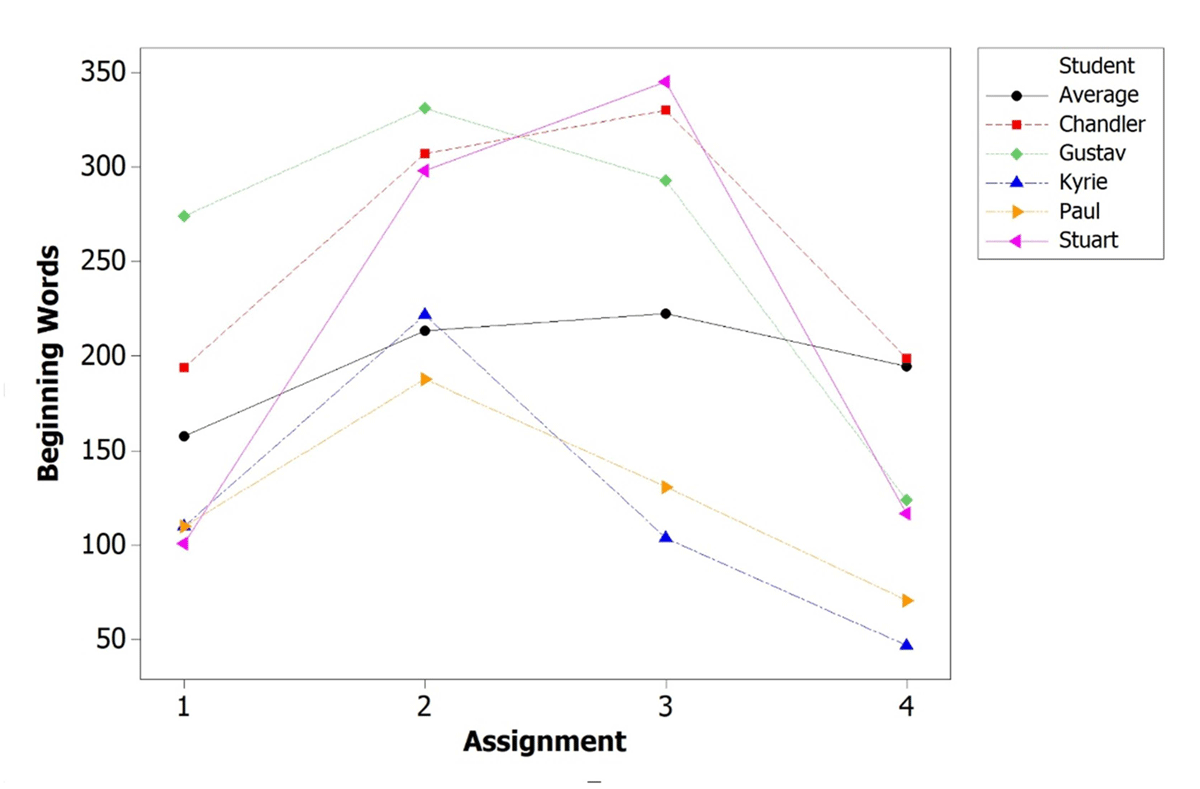
Figure 1
Beginning words.
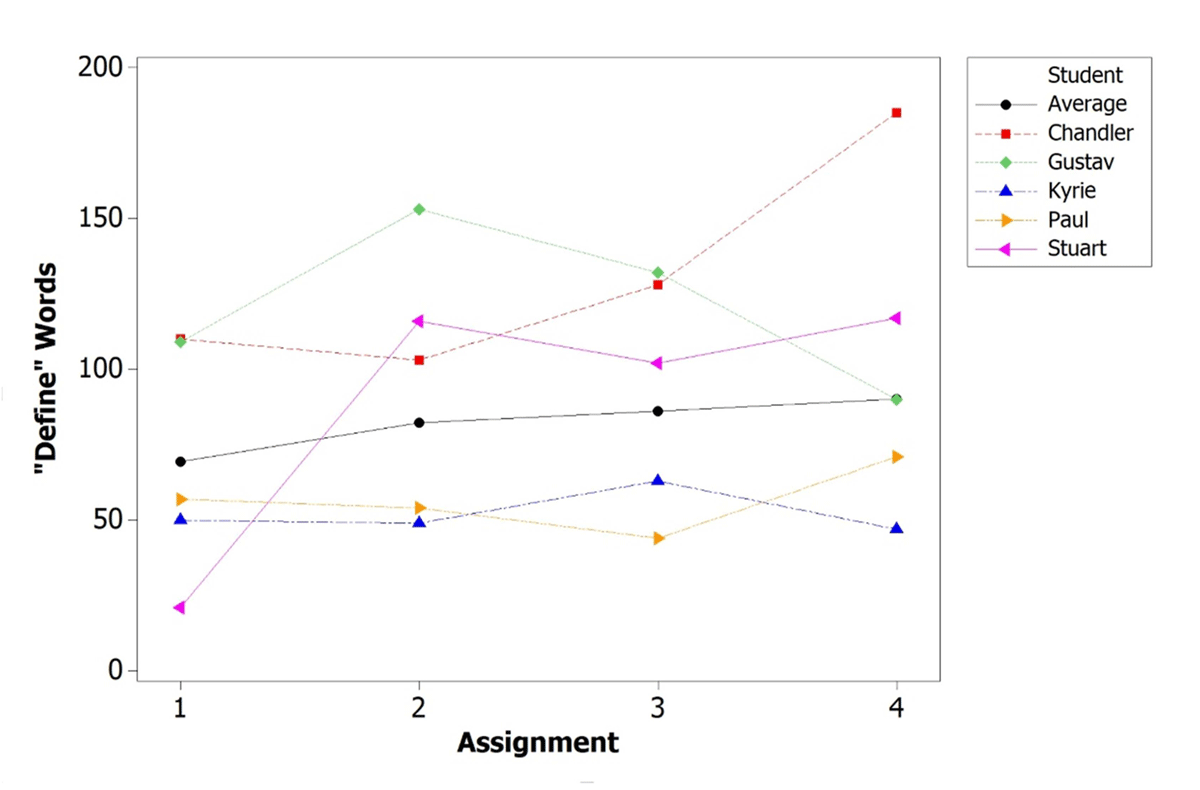
Figure 2
Define words.
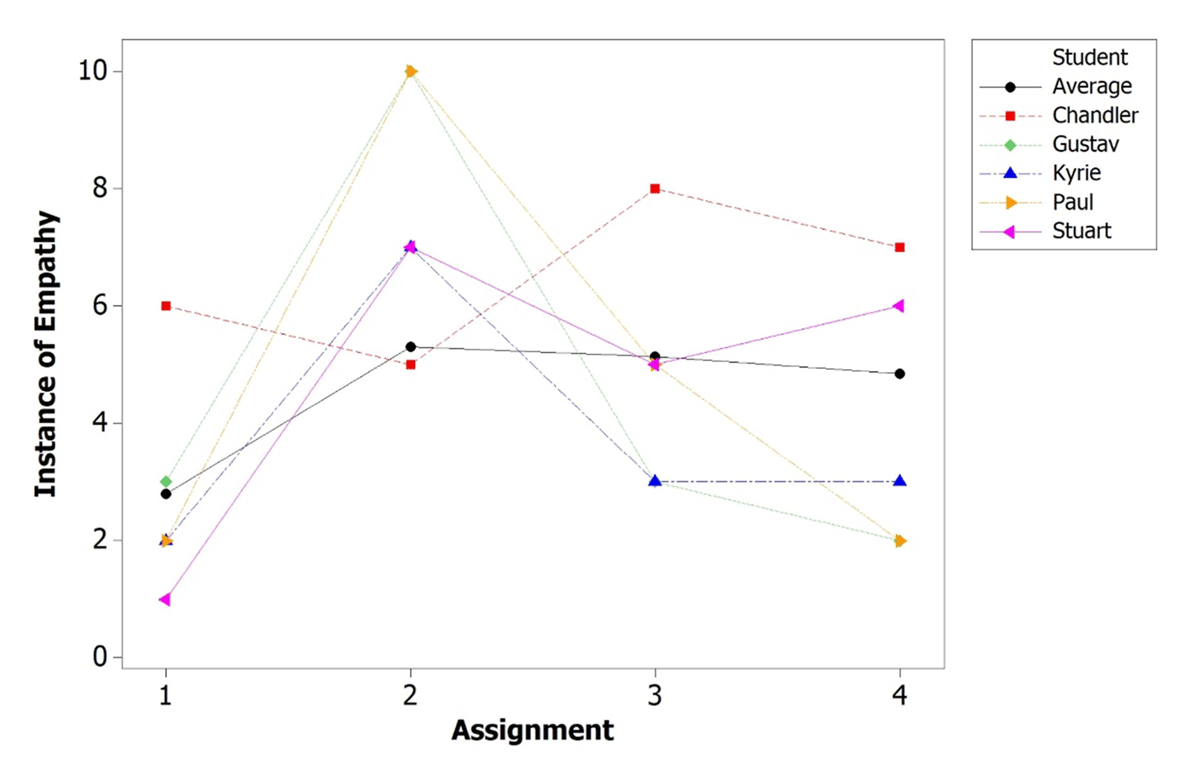
Figure 3
Instances of empathy.
For all students, the word count was increased in the EDMAIC assignments over the DMAIC assignments. This makes sense with an additional step. When considering just the “Define” step, there is either an increase in word count or no change. Comparison between Assignment 1 and Assignment 2, which first introduces the “Empathize” step, there is an increase in word count in the “Define” step for four of five students. This is also seen in comparing Assignment 1 and Assignment 3, which has the reiteration of the “Empathize” step. Pulling away the “Empathize” step in Assignment 4, there seems to be a minimal effect in regards to word count. Considering the DMAIC method of Assignment 1 and Assignment 4, beginning word count increases for two of the five students, and “Define” step word count increases for three of five students. The rolling averages from Assignment 1 and Assignment 4 show an increase in word count for both beginning words and defining step words. While the rolling average of the beginning words increases from assignment 1 to assignment 3 then decreases with assignment 4, the rolling average of the define step show an increase from assignment 1 to assignment 4.
Instances of empathy show similar results with words count. In comparing Assignment 1 and Assignment 2, which adds the “Empathize” step, instances of empathy appear to increase with four of the five students. In Assignment 3, which reiterates the “Empathize” step, there appears to be a decrease in instances of empathy with Assignment 2 and a subtle increase with Assignment 1. Comparing the standard DMAIC method of Assignment 1 and Assignment 4, there is a subtle increase in instances of empathy for three of the five students and with the average for all students.
Content analysis for such a small group cannot show any acceptable statistically significant differences from these treatments. However, there are a few points that can be made. First, there is an impact with the addition of the empathize to the DMAIC assignment. This is readily evident in comparison of Assignment 1 (DMAIC) and Assignment 2 ((E)DMAIC) where instances of empathy and word counts are increased for all students. These increases could be further characterized by the novelty of the assignment and early points of the semester. Assignment 2 was the first-time students were asked to empathize and was given prior to the midpoint of the early semester. Efforts of students may thus be inflated based on a desire to receive a good grade. Second, effort inflations can be further evidenced by comparing Assignment 2 ((E)DMAIC) and Assignment 3 ((E)DMAIC) where there is a slight decrease with the second iteration of the empathize step from the first. While this is disconcerting about the effects of adding the empathize step, it should be noted that there are increases in word counts and instances of empathy with Assignment 3 in comparison to the basic DMAIC assignments. This leads to a conclusion that initial effects may wear off between treatments of the empathize step, but there is a definite positive impact with the (E)DMAIC over the traditional DMAIC. Finally, after treatment with the two (E)DMAICs with Assignment 2 and Assignment 3, Assignment 4 (DMAIC) shows negligible differences in instances of empathy or word counts. This points to little quantitative impact from the empathy step. It is the belief of the authors, however, this is not the case. Issues of Assignment 4 being given late in the semester and a general tiredness of students is more of an indicator of why these quantitative metrics show little increase. Furthermore, the qualitative approach of discourse analysis points to more nuanced differences that would allude to a development of empathy by the students as they progressed.
4.2 Discourse analysis
Before describing the results of discourse analysis, it is important to note two assumptions: first, language is always contextually based, and second, it is always performative. We recognize that this data comes from a classroom assignment that students know will be read by a teacher. As such, certain forms of expression are automatically excluded, and students perform the role of a student in class responding to an assignment prompt. Some constraints on their expression include the fact that students were asked to empathize in some of their assignments. Second, they were also in a course where they were asked to think like engineers by reverse engineering historical, technological problems, and solutions. Finally, the very fact that they were in a course suggests that their writing should be well thought-out and scholarly. These all demand a particular kind of performance from the student.
With these considerations in mind, all participants displayed a growth in empathetic positioning/language from their first to their last define section, and all participants displayed especially strong empathetic positioning/language when asked to empathize. The rest of this section is designed to show how this conclusion is reached. Still, it is important to note that just because empathetic language was seen does not mean the students became more empathetic over the course of a semester. Rather, what this tells us is that students are able to perform and think more empathetically when a certain context calls for that performance. While this is a nuanced finding, it is nonetheless important to ascertain that even in an engineering context, when told that empathy is valuable, engineering students can exhibit the qualities of an empathetic individual.
Because discourse analysis is a lengthy process, it is impossible to show each full analysis in this paper. For transparency, however, infographics (See Figures 4, 8) were created to show students’ initial and final assignments, as well as the organization of them into stanzas and interpretations. Additionally, in prose, an overview of the analysis is provided and some of the most pertinent linguistic/discursive moves for each of the participants’ empathy assignments is given.
4.2.1 Student #1 – Paul
Paul represents a case where his first and last “Define” remain relatively short (55 words and 66 words) while his “Empathize” statements are relatively longer (132 words and 84 words). Though his final “Define” is short, Paul showed growth in empathetic positioning between his first and his last assignment (See Figure 4).
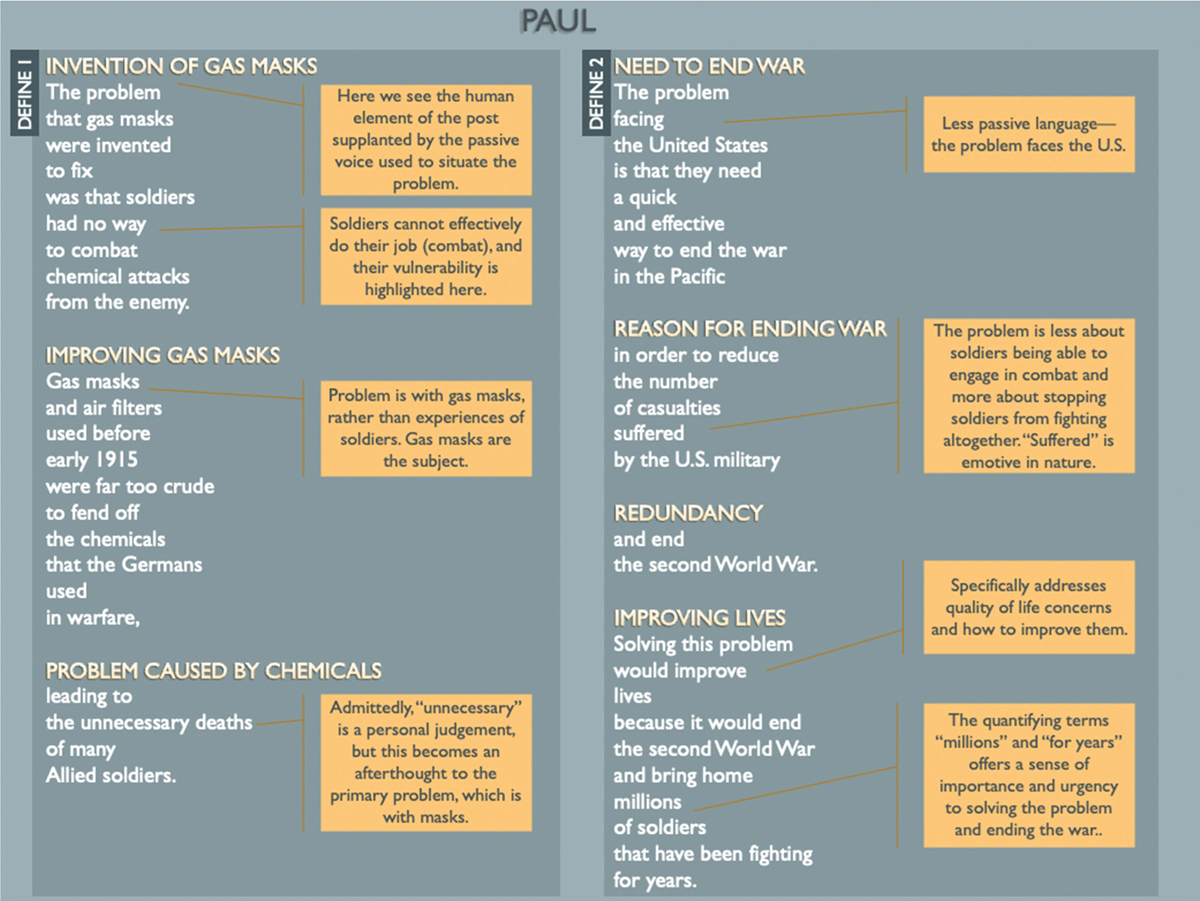
Figure 4
Paul’s first and last “Define” assignments.
Paul gets to this place of greater empathy in his second and third assignment. In his second assignment, Paul talks about the need for people to be entertained, and he considers the viewpoint of the general citizenry. He begins this assignment: “In the interwar period, citizens needed an escape from reality and the troubles of the world.” This is a stark contrast to the first assignment, as he now directly addresses people’s needs. Paul seems particularly attuned to individual experiences, as he describes needs, as an escape. There is still a degree of distance that Paul maintains as he talks about the “troubles” of the world in the capacity that although he acknowledges such troubles, he does not elaborate on them in any way; in fact, he seems to change the subject in his next sentence, which no longer involves a general public, but focuses on filmmakers and the film industry: “some constraints faced by filmmakers were censorship and limited cinematography equipment of the time.”
Although Paul does not orient his readership to the topic of filmmaking between the first and second sentence, the implication is that film acts as an escape, and filmmakers were a sort of solution to the problem of escaping reality. While Paul considers the difficulties and freedoms filmmakers encountered when creating film, he acknowledges that “Life for [the filmmakers] was relatively easy.” Here, the concept of relativity comes into play; Paul suggests varying degrees of difficulty in life, which suggests a strong level of empathy. To make this claim, Paul must consider the varieties of qualities of life that exist. In this way, it seems that Paul has certainly performed empathy as requested, to a greater degree than in his “Define” step of the first assignment.
In the next second assignment with the “Empathize” step, Paul discusses the need for detection of air raids. While this is similar to his first “Define” assignment in that it is a military necessity, his approach is qualitatively different. He discusses the lives of the soldiers in terms of how they are lived rather than as quantifiable units. He uses an unusual format (a future subjunctive) when considering the freedoms and limitations that better air raid detection equipment would bring: “The constraints would be privacy concerns… freedoms would be liberty…” This subjunctive mood indicates that Paul is imagining what it would be like to live in the scenario he describes. Empathy is often described as putting oneself in another’s shoes, and for that reason, his choice to use this mood may be the most empathetic strategy Paul employs in his assignments.
Paul’s “Define” step in the final assignment displays a positive shift toward an empathetic positioning. As shown in Figure 4, there is more assertive language that makes humans and nations subjects, rather than inanimate objects, a focus on struggles and suffering of soldiers, and general orientation toward making life better for them that is not present in the first assignment.
4.2.2 Student #2 – Stuart
At 21 words, Stuart’s “Define” step of the first assignment represents the shortest response out of any participant, and it coldly identifies a problem, as seen in Figure 5.
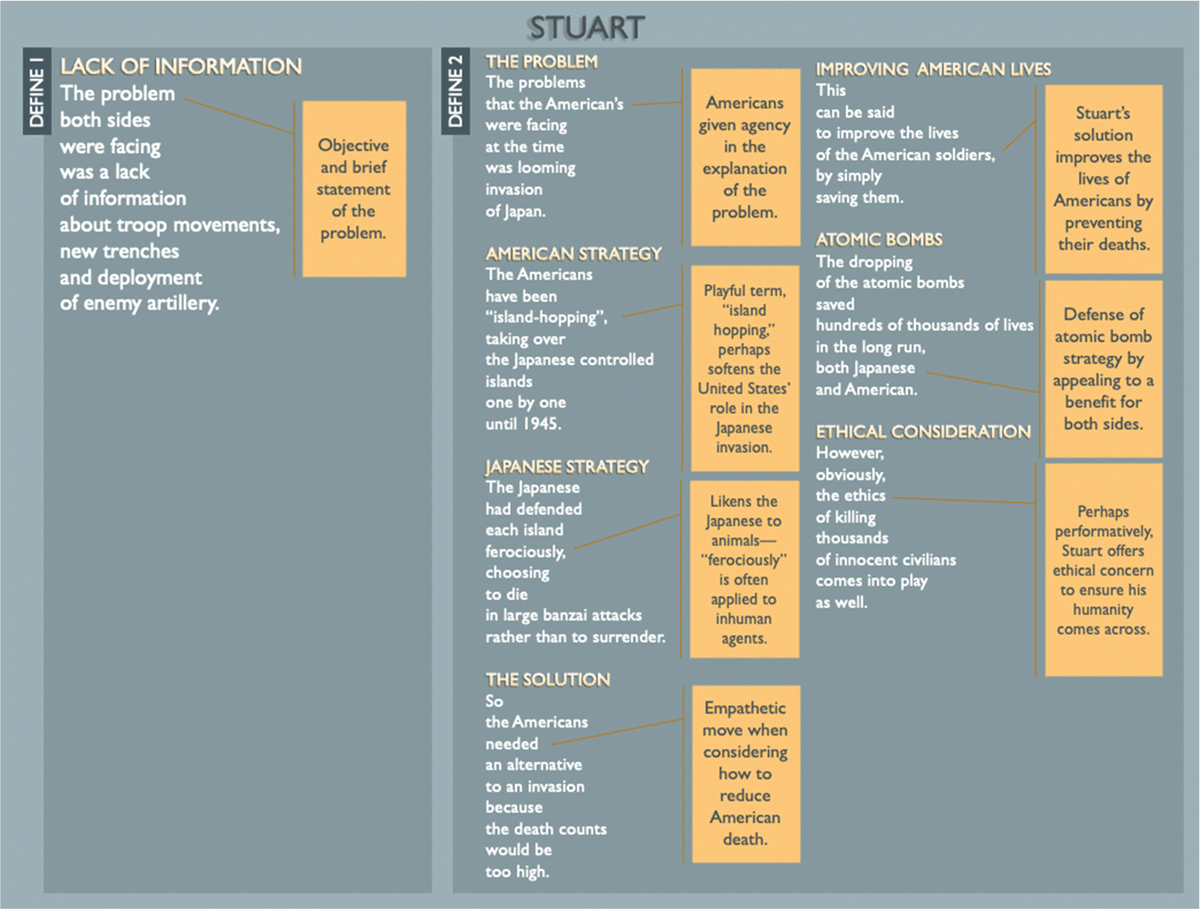
Figure 5
Stuart’s first and last “Define” assignments.
Stuart’s “Empathize” step in the second assignment shows he is capable of writing much more. In this assignment, Stuart writes about dive bombers and is specifically asked to consider the perspective of the Germans. Stuart begins his assignment by talking about two inventors of dive bomber planes, Ernst Udet, and Hugo Junkers, whom he associates with the Nazi Reich. One of the most interesting aspects of this assignment, however, is what appears to be a non-sequitur; he notes that the Junkers dive bomber was first tested in the Spanish Civil War. He further explains Germans used the planes for taking out enemy fortifications. Here, asked to empathize, he explains what a particular side was trying to accomplish through the use of this invention.
However, as his post progresses, he is not interested in empathizing with the Germans at all. His assignment shifts to address those affected by the German bombing, and it is here that he addresses others’ quality of life: “The people affected by this, the Spanish Republican fighters had to deal with the bombs and carnage the bomber brought with it.” While he has previously discussed the uses of dive bombers, he now talks about the effects of their use related to the Spanish Republican fighters who had to “deal with” the carnage. This idea of “dealing with” is a much more qualitative concern, and later, he even offers empathetic insight into the lives of the Spanish Republican fighters, noting that their average day was a “tough one.” Even the word “carnage” creates a strong image for readership, suggesting the suffering of Spanish Republican fighters. It seems, then, that Stuart is more interested in empathizing with the victims of Germany, rather than Germany itself.
In his third assignment, Stuart focuses on the Germans’ defensive fortifications. Nearly half of his assignment describes the wall that the Germans built to protect them from Western forces, including its impressive length and the number of materials used to build it. However, in the second half, he rather abruptly begins speaking about the other Allied forces and the invasion of Normandy. He addresses the kind of training that Allied soldiers had to go through to prepare for the Normandy invasion (including memorizing territory), but he further addresses a quality-of-life concern for the Allied soldiers, namely the stresses of waiting for the imminent invasion. If there is one group that Stuart seems to empathize with most, it is the Allied soldiers, as he elaborates on their affective states: “The soldiers, knowing an invasion was imminent, had to deal with the stresses of waiting for the day to come.” He further reminds the audience that such waiting was an “overlooked” aspect of stress in their lives, as though he understands an aspect of their lives that many do not, and he is here to remind his reader to consider this stressful knowledge that they had to “deal” with.
Stuart’s “Define” step in his final post, also displayed in Figure 5, is significantly longer than the first, and several empathetic moves in this post are seen, including agency given to human actors, considering the cost of lives, how to improve lives, descriptors of different humans, and consideration of the cost of using the atomic bomb.
4.2.3 Student #3 – Kyrie
Kyrie opens her “Define” step in the first assignment by stating that “The problem was to find a way to gain a military advantage through mass killings,” and the solution is the Maxim machine gun. Figure 6 displays how Kyrie uses a quotation from Maxim to make her point.
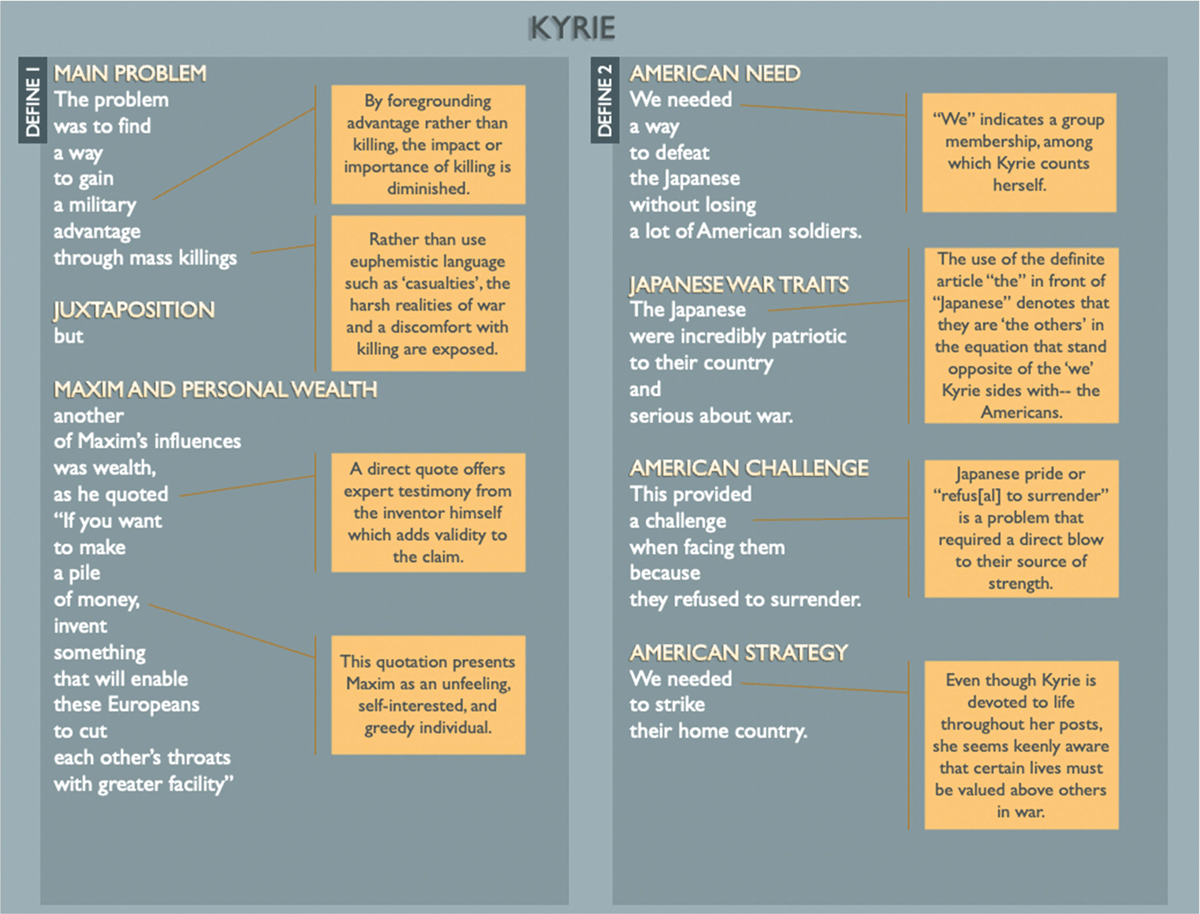
Figure 6
Kyrie’s first and last “Define” assignments.
She could easily have said that the problem was determining more efficient ways to kill people; however, she foregrounds military advantage as the problem and then follows up with the idea that this is achieved through mass killing. Why might she choose to do this? A tentative answer is that Kyrie is not entirely comfortable justifying the use of machine guns in war. By suggesting that the problem is a military advantage, she creates a much more neutral version of the problem at hand. By foregrounding advantage rather than killing (and explaining that killing just so happened to be a way to gain an advantage), it seems that Kyrie attempts to diminish the impact or importance of killing. However, other words, such as “pile,” and a quotation that presents the image of Europeans cutting each other’s throats, suggests that Kyrie wants us to think of killing as a bad thing, even if she attempts to remain neutral.
While it seems that Kyrie avoids judgmental or empathizing language in her first assignment, Kyrie’s second entry, wherein she is asked to empathize, allows her more room to explicitly state her thoughts about life and death. Indeed, her first line suggests that death is a problem, whereas it was the solution in her first post: “There is a societal need to stop death.” However, Kyrie hedges this statement by adding that it is “especially” important during the interwar period. She explains that lives counted “even more” during the interwar period. Here, it seems, Kyrie is suggesting the quantity of life is important. It is not that Kyrie does not value life at certain points in time, but that she seems to advocate for maximizing potential life. Phrases like “even more” and “especially” help to establish the idea of maximization, and in this way, they position Kyrie as an advocate for life in general.
Kyrie’s next assignment, like her last, aligns with a particular group, in this case, Japan. Whereas a standard define statement might only define the problem as “preventing America from entering the war,” via the bombing of Pearl Harbor, Kyrie provides the reasons Japan might see this as desirable. In this way, she helps her readers, presumably US citizens, to understand the general feelings of Japan shortly before WWII. While this is often seen as a major affront to US citizenry, Kyrie helps to empathize by explaining the positionality of Japan, especially their perspective of the US. Japan was fearful of the US’s “strong military, history of aiding Great Britain and victory in WWI.” If it is the case that Kyrie is attempting to empathize with Japan’s aims, she shies away from the result of their attack being death. Instead, the attack is aimed at “Americans’ spirit,” which downplays the potential problems associated with a pre-emptive bombing; in an attempt to empathize with Japan, she mitigates death by suggesting that the issue is emotional and psychological.
Figure 6 shows how in her final assignment, Kyrie aligns with American soldiers (use of the world “we”) and adopts a strong US perspective throughout, explaining their motivations. This is in contrast to the focus on Maxim, who simply wanted to kill people for money.
4.2.4 Student #4 – Chandler
As shown in Figure 7, Chandler wrote significantly more for his final assignment than his first. Humans are treated largely as objects in his first post, to be used efficiently in the contexts of war.
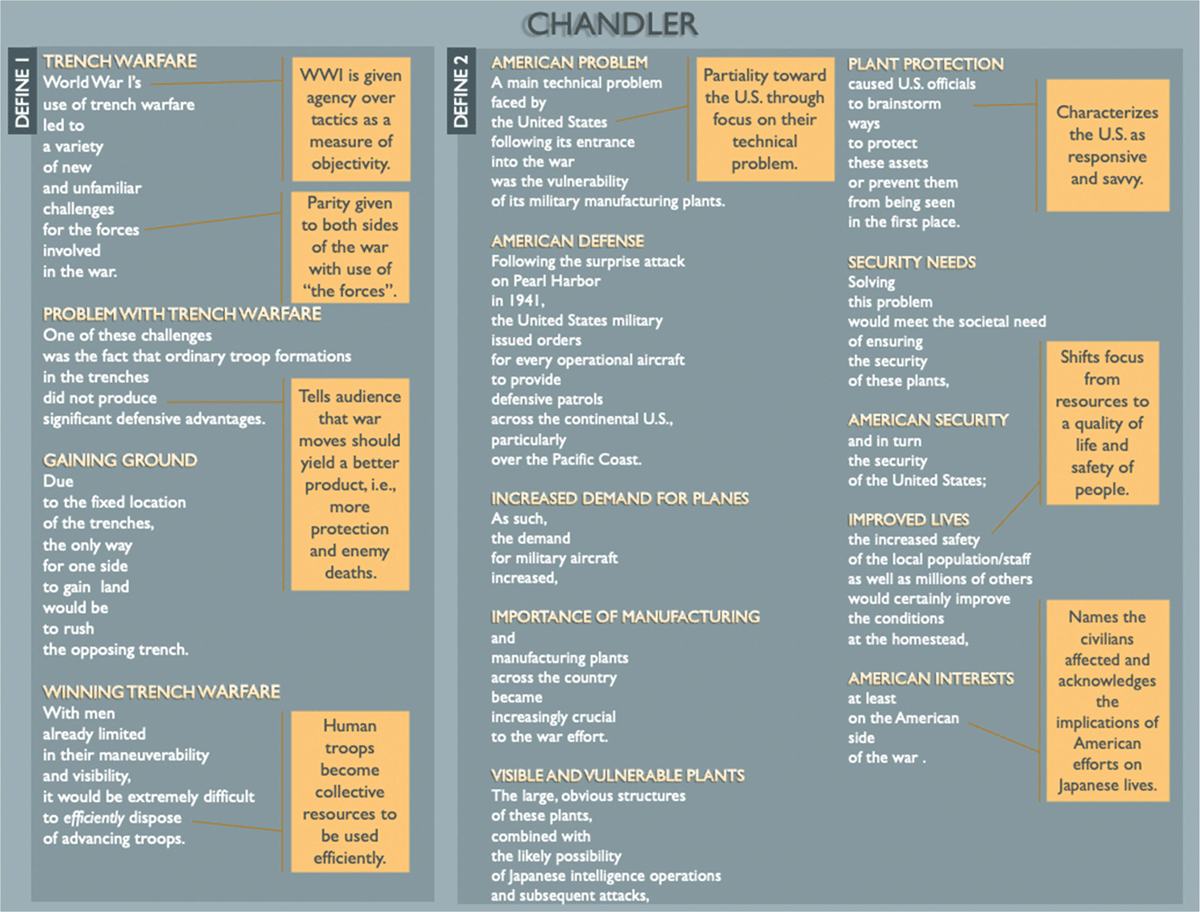
Figure 7
Chandler’s first and last “Define” assignments.
The second assignment begins in much the same way as the first. Chandler starts with a societal need, but he quickly makes it an issue of the war—each side needed a way to transport troops and supplies across vast distances. Here, troops are treated as a product, parallel to supplies created with the word “and,” that is, there was a need for “the quick transportation of troops and supplies.” However, we see a change in trajectory with the word “but,” which begins the next line. In his first sentence, the focus is still on efficiently dealing with troops (and supplies) as they act as resources in a war setting. “But” is used to show a contrast or a contradiction in ideas, and here, Chandler uses “but” to switch between the contexts of the war and home life: “but [wartime technological] impacts could also be implemented into everyday life.” While Chandler recognizes that technology serves to solve problems that emerge in the war, he also recognizes that such technology can be implemented in “everyday life.” Chandler does not define everyday life because it seems to go without saying; everyday life is the routine experienced by most individuals on any given day. In this case, there is an implicit connection made between Chandler and his readers—that Chandler’s understanding of everyday life is close enough to his readers’ understanding (and that of the average person in the early 1900s). “Everyday life” acts as a schematic or a conceptual anchor to relate to a kind of “every-person.”
In Chandler’s third assignment, one “societal need” is eliminating the United States’ fighting capability through the use of Japanese submarines. While he definitively aligns with the Japanese forces, we must ask how this serves a broad societal concern. This is certainly a concern of the Japanese emperor, perhaps, or of the military generally, but how it affects the individual in society is unclear. However, we see a change in Chandler’s trajectory with the words “despite,” indicating a shift in topic. Here, the topic shifts from the technology to the crews’ interactions with technology, focused on the discomfort and health of submarine crews: “despite this… submarine crews often endured less-than-desirable conditions.” Here, “endured” implies a direct experience with discomfort or difficulty, something that must be experienced at an individual level. The focus, then, has shifted to a more empathetic place, as he attempts to describe the way that individuals experienced a particular kind of hardship. Whereas in his first assignment, Chandler gave little consideration to the individual soldier experiences, Chandler now focuses on the quality of the lived experience that submarine crews faced.
In Chandler’s final assignment, displayed in Figure 7, he follows the same format as his (E)DMAIC assignments. While he begins with a technical problem, he ends by focusing on others’ sense of security and addresses the issue as a “societal need,” which is language that he reserved for the previous empathy assignments.
4.2.5 Student #5 – Gustav
Gustav begins his “Define” step in the first assignment with contextual information, and he contrasts the first World War to the Revolutionary War. While Gustav focuses on the experiences of soldiers in the first half of the assignment, it quickly becomes a technical problem, that of night fighting (see Figure 8).
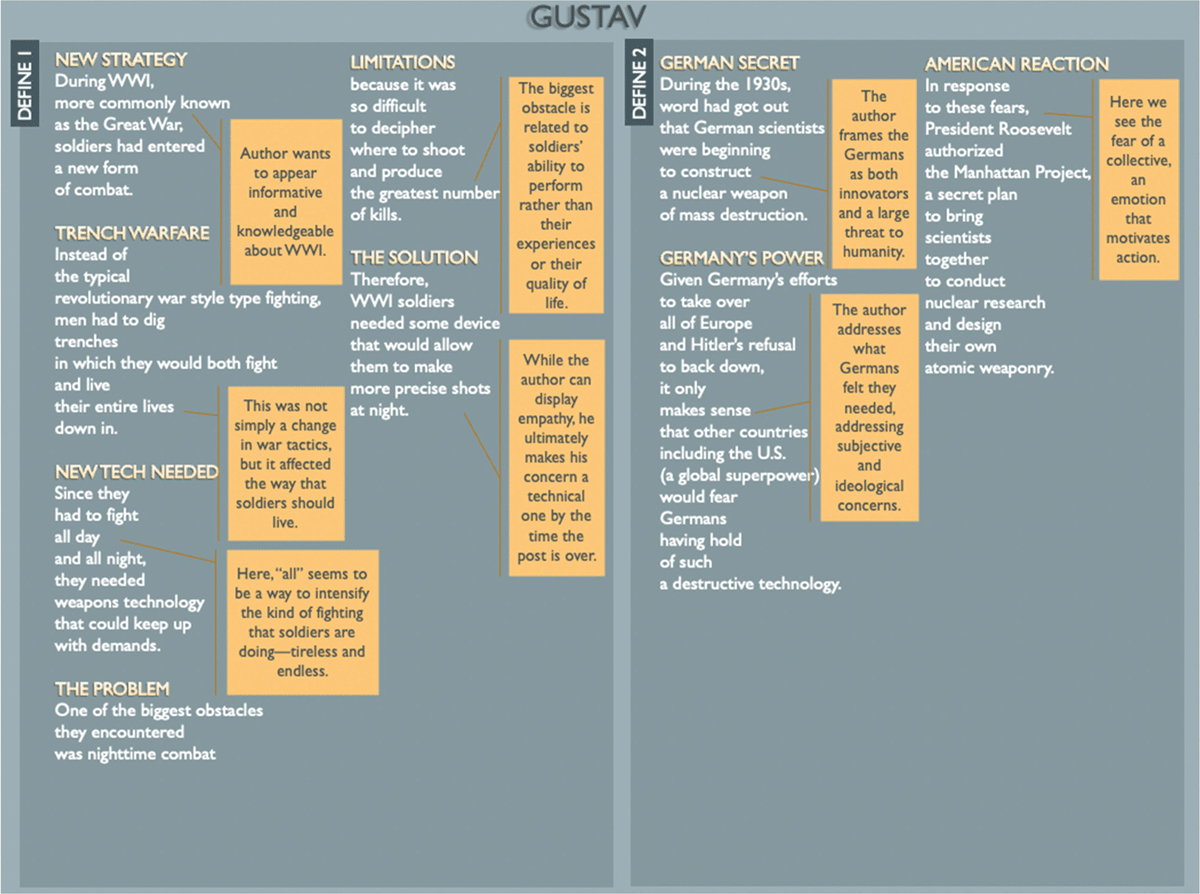
Figure 8
Gustav’s first and last “Define” assignments.
Gustav’s first (E)DMAIC assignment is about fighter planes; he acknowledges in the second line that fighter planes were primarily a military concern, but explains that without their use, citizens would have been more prone to enemy bombing raids. One potential reason he may address this is that he is attempting to engage a larger readership and to show that the issue of fighter planes was not strictly limited to combat. As the assignment was to empathize, he relates to a larger crowd. By bringing civilians into the conversation, he creates a deeper sympathy within his readership and further shows that fighter planes were not simply aggressive, but defensive. He thus softens the role of fighter planes while opening the conversation to a larger group. In his final line, he positions himself in the discussion using the first person. Here, he specifically addresses the lives of fighter pilots with “I would imagine.” Like Paul, there is a clear instance of Gustav trying to place himself in the shoes of others. It is also important to note that he is concerned here with the lives of fighter pilots, not as a biological concern, but as a qualitative concern: he suggests that these lives would have “improved” as a result of fighter pilot technology.
In his second (E)DMAIC assignment, Gustav immediately chooses a particular side for this post, namely Germans, discussing a societal need in Germany. There is a focus on the idea of protecting specific people (soldiers, civilians, and land), but Gustav also acknowledges protecting the Reich, suggesting that Germans are fighting for a particular ideology or lifestyle: “not only to protect German soldiers, civilians, and land, but to maintain the German Reich and its power.” Gustav highlights ideology as possibly the most important point given his “not only… but also” structure, where “but also” foregrounds the Reich, suggesting that the ways Germans were living, as well as the thoughts they held, are perhaps the most important item for preservation.
Throughout this assignment, Gustav casts the Allies as enemies, referring to the Allies’ Enigma machine as “a deception campaign” and a “plot against” the Germans. In this way, Gustav takes on the mental position of the Germans, using language to cast Allied forces as manipulative or almost evil. The final lines of Gustav’s post show another conscious attempt to empathize with the German forces. He again talks about “the lives” of a group of people, not as a biological concern but in terms of quality. We see strong affective terms like “scrambled,” “panic,” and “thrown off guard,” suggesting that Gustav is considering the affective states of German soldiers during this time in the war. Similar to Paul, the phrase “must have,” a subjunctive phrase, suggests he is thinking deeply about how Germans would have felt at the time.
In his final assignment, he is again asked only to define a problem. As Figure 8 shows, Gustav opens by discussing hearsay about Germans and considers how innovative the Germans were, but he also considers the affective states of the rest of the world regarding Germany. Because of these affective concerns, there is a stronger empathetic disposition in Gustav’s final assignment than his first.
4.3 Empathy rubric scores
Content analysis delivers some quantitative measure of the changes in empathy and rhetoric with the HDSTEM and assignment treatments. Discourse analysis can be used in conjunction with standard rubrics to give a quantitative grade per empathy for each assignment and student. Using the AAC&U intercultural knowledge VALUE rubric (See Table 2), Josh and Erika considered content from the performed discourse analysis to rate each assignment. The VALUE rubric considers empathy a skill and provides benchmark, milestone, and capstone evaluations skills. They examined factors such as students’ consideration of various viewpoints, whether or not they considered long-term ramifications of solutions, and whether or not they anticipated readers’ needs or reactions to their writing (See Figure 9). Across 20 assignments empathy scores (See Table 3), r = .72, and p < .01 suggests a strong and statistically significant degree of agreement between the two raters. Both reviewers saw an average increase of one between students’ first and last define posts, which suggests that by the end of the course, even when they were not required to, they had more/stronger empathetic indicators within their coursework.
Table 2
AAC&U VALUE rubric for empathy skill.
| CAPSTONE 4 | MILESTONES 3 | MILESTONES 2 | BENCHMARK 1 | |
|---|---|---|---|---|
| Skill Empathy | Interprets intercultural experience from the perspectives of own and more than one worldview and demonstrates ability to act in a supportive manner that recognizes the feelings of another cultural group. | Recognizes intellectual and emotional dimensions of more than one worldview and sometimes uses more than one worldview in interactions. | Identifies components of other cultural perspectives but responds in all situations with own worldview. | Views the experience of others but does so through own cultural worldview. |
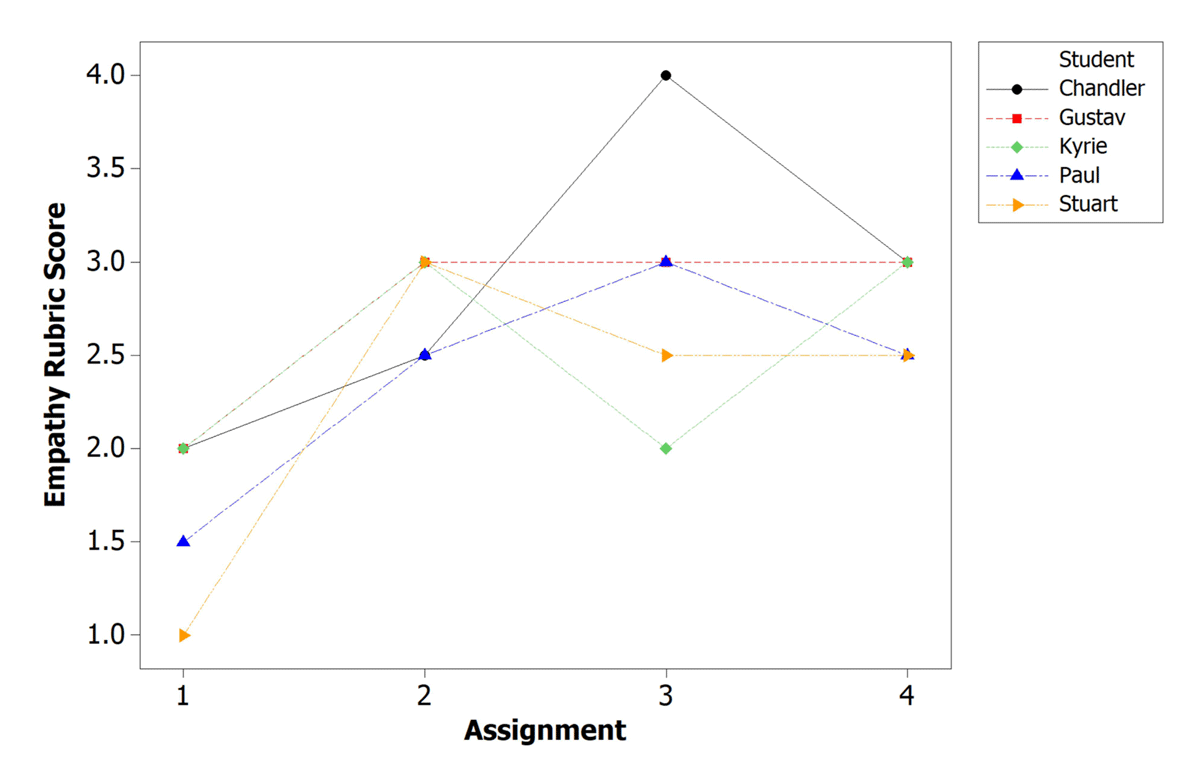
Figure 9
Average Empathy Rubric Scores between two reviewers.
5 Discussion
In this study, we sought to answer two questions:
When asked to think empathetically, how do engineering students in the context of an HDSTEM course show evidence of this thinking in their coursework?
Over the trajectory of a semester, how does engineering students’ empathetic positioning within their course work change?
We found that students employed a variety of approaches to display empathy within the coursework, especially considering larger needs/wants of society, considering particular individuals’ (or sides’) reasons for action, considering the quality of life experienced by others, and using emotionally charged language. Further, students have more to say about a situation when they are asked to empathize with a given topic. We further found that while students were more empathetic in those assignments that asked them to empathize, students’ final assignments generally showed more empathetic positioning than their first assignments. Given high, statistically significant interrater reliability based on a rubric used to score empathy, it is unlikely that these findings are coincidence. Further, discourse analysis explains the differences in empathy between students’ first and final assignments and shows how these numerical increases were reached.
Thus, while engineering students in this HDSTEM course were initially concerned with the technical and “hard science” aspects of their first assignments, asking them to empathize allowed them to think more deeply about the social, political, and ethical implications behind the invention of several technologies during WWII. We see this across all of the participants in some capacity, from Paul and Kyrie, who more deeply considered the experiences and qualities of life for soldiers in their later assignments, to Gustav and Chandler, who weighed the motivations of opposing forces in the war as their assignments went on. The fact that they had more to say in their empathetic responses (accounting for the fact that they had an extra section to write) we also find to be promising. While more writing does not necessarily equate to better writing, we know from our analysis that they began considering more facets of engineering both during and after they completed their EDMAIC assignments, which suggests that they were engaging in more critical thought about the social, political, and ethical implications of the technology they were reverse engineering.
While some argue that empathy might be difficult to teach, it can be fostered or developed under the right conditions (Bialystok & Kukar, 2018; Jeffrey & Downie, 2016). The use of humanities with a STEM context could be a proper condition to foster empathetic disposition and is an assumption made from this work. It is impossible to know the degree to which the contexts of this study affected students’ potential to exhibit empathetic thinking because the humanities factored so prominently in this course. It is possible that students were more readily willing to consider empathetic approaches to problem-solving as opposed to more technical, engineering-based courses. Regardless of whether this is the case, it suggests that if empathetic dispositions are encouraged and asked for engineering students are entirely capable of doing it. Coursework is one place where students can reflect, considering the situated historical, ethical, and political implications of innovation. It may thus be prudent in STEM coursework to touch on these subjects, explaining when and why certain developments have been made within the field.
While this study has only five participants, the depth of content and discourse analysis provides great insights into the empathetic dispositions of students in their rhetorical choices in assignments. Further, because of the depth of investigation, it is unusual to have more participants in a typical discourse analysis. However, the potential insights from this study would be strengthened with more participants. In future studies with larger numbers of engineering students, it may be possible to use the AAC&U VALUE rubric to a greater degree, assessing a larger number of students and their assignments to determine the degrees to which they increase in empathy with abbreviated content and discourse analysis. In such a study, without a team of devoted analysts, content analysis using software tools and word analysis could be used to analyze all participants, and discourse analysis would have to be done on only a subset of participants because of its rigorous nature. Further, given the degree of planning required to implement strong team teaching (Plank, 2013), future studies might consider integrating empathy interventions within engineering courses to determine the degree to which the context of the course (humanities vs. non-humanities) might affect empathy growth outcomes.
6 Conclusion
As Walther et al. (2020) note, in line with guidelines put forth by the Accreditation Board for Engineering and Technology (ABET, 2022), it is especially important for engineering students to learn skills that promote teamwork, effective communication, and reflection on the role that engineering plays in society, each of which requires an empathetic disposition. Ending nuclear terror, providing clean water to the world, and many solutions to other grand challenges will be determined by decisions made by engineers in coming years (Walther et al., 2017). During this HDSTEM course, students had to grapple with some of these challenges, including the atomic bomb. Such grand challenges require not simply technological know-how, but empathetic reflection to solve them in an equitable manner. Understanding the motivations and needs of others can lead STEM students to consider the long-lasting effects of the projects that they choose to take on, as well as consider various solutions to the problems posed that may, ultimately, have better or worse ramifications for others. Many engineering programs focus only on developing scientific, mathematical, and engineering content knowledge, divorcing these topics from emotional and social contexts from which they might arise or which they may affect (Hoople & Choi-Fitzpatrick, 2017; McCurdy et al., 2020). Intentionally addressing soft skills, or students’ empathy, within the contexts of a humanities-based STEM course encouraged students to engage in empathetic considerations. This is seen explicitly with engineering students in this study but can be carried over to all STEM students based on similar concerns regarding empathy.
The development of empathy within STEM education will be key with ever complicated and complex grand challenges that involve numerous people and cultures. A beginning of empathy development and assessment that considers the work products of students as with this study illustrates how problem solving in complex situations can tie together the technical details and solutions of a problem while maintaining the autonomy and well-being of the people being served with the solution. Approaches like HDSTEM thus have potential implications to be more engaging to students based on asking them to be more emotionally invested in the problem they are solving (Kellam et al., 2018). This in turn has the possibility to change and soften the perception of STEM disciplines effecting major choice for students (Eddie et al., 2019; Xu et al., 2021) and increasing participation and belonging of women in STEM (Eddie et al., 2019).
Appendices
Appendix
Table 3
Scores used to calculate ρ.
| STUDENT WRITING | ASSIGN. | REVIEWER 1 | S REVIEWER 1 | S2 REVIEWER 1 | REVIEWER 2 | S REVIEWER 2 | S2 REVIEWER 2 | CROSS PRODUCT |
|---|---|---|---|---|---|---|---|---|
| Stuart | 1 | 1 | –1.6 | 2.56 | 1 | –1.5 | 2.25 | 2.4 |
| Stuart | 2 | 3 | .4 | .16 | 3 | .5 | .25 | .1 |
| Stuart | 3 | 2 | –.6 | .36 | 3 | .5 | .25 | –.3 |
| Stuart | 4 | 3 | .4 | .16 | 2 | –.5 | .25 | –.2 |
| Gustav | 1 | 2 | –.6 | .36 | 2 | –.5 | .25 | .3 |
| Gustav | 2 | 3 | .4 | .16 | 3 | .5 | .25 | .2 |
| Gustav | 3 | 3 | .4 | .16 | 3 | .5 | .25 | .2 |
| Gustav | 4 | 3 | .4 | .16 | 3 | .5 | .25 | .2 |
| Kyrie | 1 | 2 | –.6 | .36 | 2 | –.5 | .25 | .3 |
| Kyrie | 2 | 3 | .4 | .16 | 3 | .5 | .25 | .2 |
| Kyrie | 3 | 2 | –.6 | .36 | 2 | –.5 | .25 | .3 |
| Kyrie | 4 | 3 | .4 | .16 | 3 | .5 | .25 | 1 |
| Paul | 1 | 2 | –.6 | .36 | 1 | –1.5 | 2.25 | .9 |
| Paul | 2 | 3 | .4 | .16 | 2 | .5 | .25 | .2 |
| Paul | 3 | 3 | .4 | .16 | 3 | .5 | .25 | .2 |
| Paul | 4 | 3 | .4 | .16 | 2 | –.5 | .25 | –.2 |
| Chandler | 1 | 2 | –.6 | .36 | 2 | –.5 | .25 | .3 |
| Chandler | 2 | 2 | –.6 | .36 | 3 | .5 | .25 | –.3 |
| Chandler | 3 | 4 | 1.4 | 1.96 | 4 | 1.5 | 2.25 | 3.15 |
| Chandler | 4 | 3 | .4 | .16 | 3 | .5 | .25 | 1 |
| Avg: 2.6 | Sum: 8.8 | Avg: 2.5 | Sum: 11 | Sum: 8.25 |
Competing Interests
The authors have no competing interests to declare.
Author Contributions
Josh and Erika Contributed to the planning and implementation of the methods and engaged in the discourse analysis and interrater reliability. Josh further guided the other researchers and led meetings related to the content analysis portion of this study. He also wrote most of sections 3 and 5. John developed the course and collected the student assignments, and sections 1 and 2, as well as the findings related to content analysis.