
Table 1
Seven building tasks of language and their definitions and paraphrased questions for analyzing discourse as prescribed by Gee (2014).
| Building Tasks | Given what the speaker has said and how it has been said… |
| Significance: language used to render someone or something significant (or not) | …what things and which people in this context are relevant and significant and in what ways are they significant? How is the speaker trying to indicate significance? |
| Practices (Activities): language used to get recognized (or recognize others) as engaging in socially recognized and institutionally or culturally supported endeavors | …what practices (activities) are relevant in this context and how are they being enacted? |
| Identities: language used to get recognized (or recognize others) as having a certain role or identity | …what identity or identities (for the speaker, the listener/hearer, and in terms of how others are depicted) are relevant in this context? |
| Relationships: language used to indicate a relationship we have or want to have with listeners, groups, institutions, etc. | …what relationships are relevant in this context and how are they being enacted, recruited, and used? |
| Politics: language used to signal one’s view on social goods and their distribution | …what social goods are relevant and at stake in this context and how are they being distributed or how is their distribution being viewed? |
| Connections: language used to establish connections (or lack of) and relevance (irrelevance) between things | …what are the relevant connections and disconnections between things and people in this context and how are these connections or disconnections being made or implied? |
| Sign Systems and Knowledge: language used to legitimize (or delegitimize) certain sign systems (e.g., technical language vs. everyday language, words vs. equations) and epistemologies | …what are the relevant sign systems (e.g., languages or social languages) and forms of knowledge (ways of knowing) that are relevant in this context and how are they used and privileged or disprivileged? |
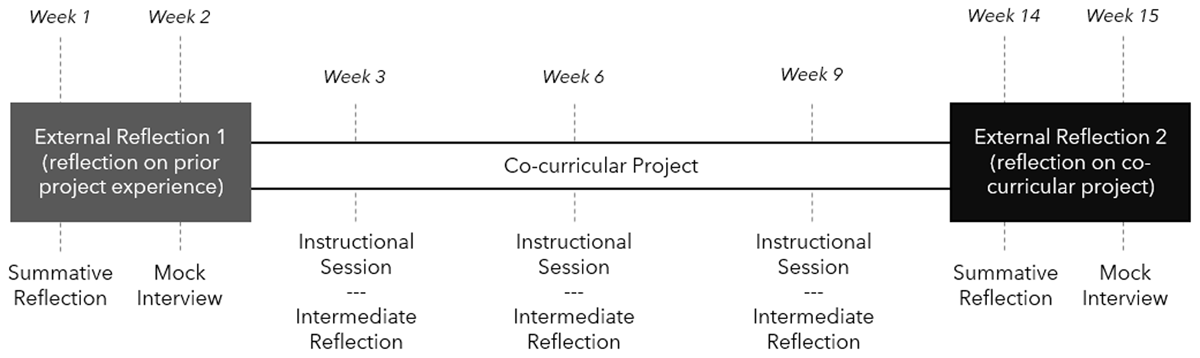
Figure 1
Timeline of study data collection and project participation.
Table 2
Overview of research participants.
| STUDENT PSEUDONYM | FIRST EXPERIENCE | SECOND (CO-CURRICULAR) EXPERIENCE |
|---|---|---|
| Amelia (sophomore, biomedical engineering) | Concept design of fluorescent sensor to detect opioid levels in blood (course project) | Engineering testing of 3D printed prosthetics |
| Brody (junior, mechanical engineering) | Design of airduct car cooling system (undergraduate research) | Autonomous snowblower design project |
| Charles (senior, computer science) | Design of adventure videogame (course project) | Autonomous snowblower design project |
| Cody (sophomore, biomedical engineering) | Concept design of automated breathing CPR device (course project) | Design of 3D printed “pre-prosthetic” device |
| Cora (rising junior, civil engineering) | Physics group experiment (lab course) | Local bridge hit frequency analysis |
| David (rising junior, electrical engineering) | Design and build of a RC boat (course project) | Design of an IOT light switch |
| Kian (junior, biomedical engineering) | Concept design of biomedical device (course project) | Design of an IOT light switch |
| Madison (rising junior, industrial engineering) | 3D printer selection and commission (co-curricular project) | Compliant mechanism pump bottle design |
| Mike (rising junior, biomedical engineering) | Matlab computation project (course project) | Design of an IOT light switch |
| Rich (rising senior, chemical engineering) | Design of membrane system (course project) | Road salt use analysis on campus |
| Sam (rising junior, biomedical engineering) | Design of biomedical device (course project) | Compliant mechanism pump bottle design |
| Will (junior, mechanical engineering) | Design of 3D printed car (co-curricular project) | Design of 3D printed “pre-prosthetic” device |
Table 3
Codes from analysis of participant mock job interviews.
| GEE BUILDING TASK | CODE |
|---|---|
| Identity Identity can be conveyed through discourse that ascribes a certain identity or role to oneself or others; this can be direct or indirect through titles, actions, and reference to others (Gee 2014). The participant used language to enact an identity by assigning titles, affiliated roles, or actions that would be recognized as professional or academic identities. | Professional Title: Interviewee described themself or other project member by a professional title relevant to the project context: e.g., engineer, coder, computer scientist. (+1) |
| Student Title: Interviewee described themself in terms of an academic title, level, role, or a group of the same: e.g., “student,” “sophomore,” “computer science major.” (–1) | |
| Role by Engineering Affiliation: Interviewee indicated role by identifying oneself as a member of a group doing the same engineering activity, but does not give a professional title: e.g., “hardware team,” “coding group,” but NOT “We were a team of chemical engineers.” (+1) | |
| Role by Engineering Action: Interviewee indicated role by describing an action they took in the context of the engineering project. This can be a specific technical action (e.g., “my main role in the project was designing and building the air duct”) or a general professional action that does not require engineering training (e.g., “put us in touch with the … captain”). (+1) | |
| Role by Generic Action or Affiliation: Interviewee indicated role in a general action rather than an action specific to engineering or by giving self a professional title (e.g., “hardware team,” “coding group,” but not “We were a team of chemical engineers”). (–1) | |
| Practices (Activities) A practice is an institutionally or culturally recognized endeavor (Gee 2014), and language used in describing that practice includes clues indicative of how the speaker wishes the context of that practice to be perceived by the listener. The participant used language to enact a practice context that is only academic, has value as a product making task for a professional entity, or a combination of both. | Academic Context: Context cue given by interviewee that situates their project practices in ways recognizable to academic contexts but not professional contexts (e.g., “we got a good grade,” “my final project for BE201”); not codable as an identity. (–1) |
| Professional Context: Context cue given by interviewee indicating that their engaged practices are recognizable as professional situations (e.g., “commissioned this project,” “investors,” “stakeholders”); not codable as an identity. (+1) | |
| Non-specific Context: Context cue given by interviewee about the project practice that was too vague to indicate whether their engaged practices are recognizable in the project as an academic or professional situation (e.g., “recent project of mine”). (0) | |
| Significance Significance is reflected in language that suggests something is significant or to lessen significance (Gee 2014). The participant used language to minimize or inflate the importance of a role, contribution, or context. | Minimizing Role: Mitigating language used by the interviewee that downplay the significance of themself or their role in the project (e.g., “just one member of a group”). (–0.25) |
| Minimizing Contribution: Mitigating language used by the interviewee that downplays the significance of their action (e.g., “I kind of edited the code”). This can be downplaying their contribution to specific actions/tasks of the project or their contribution to the project as a whole. (–0.25) | |
| Minimizing Context: Mitigating language used by the interviewee that downplays the significance of the project’s context and is indicative of devaluing that context regardless of how it was portrayed by the interviewee. (–0.25) |
[i] Note: Numbers in parentheses are values used during Post-coding analysis.
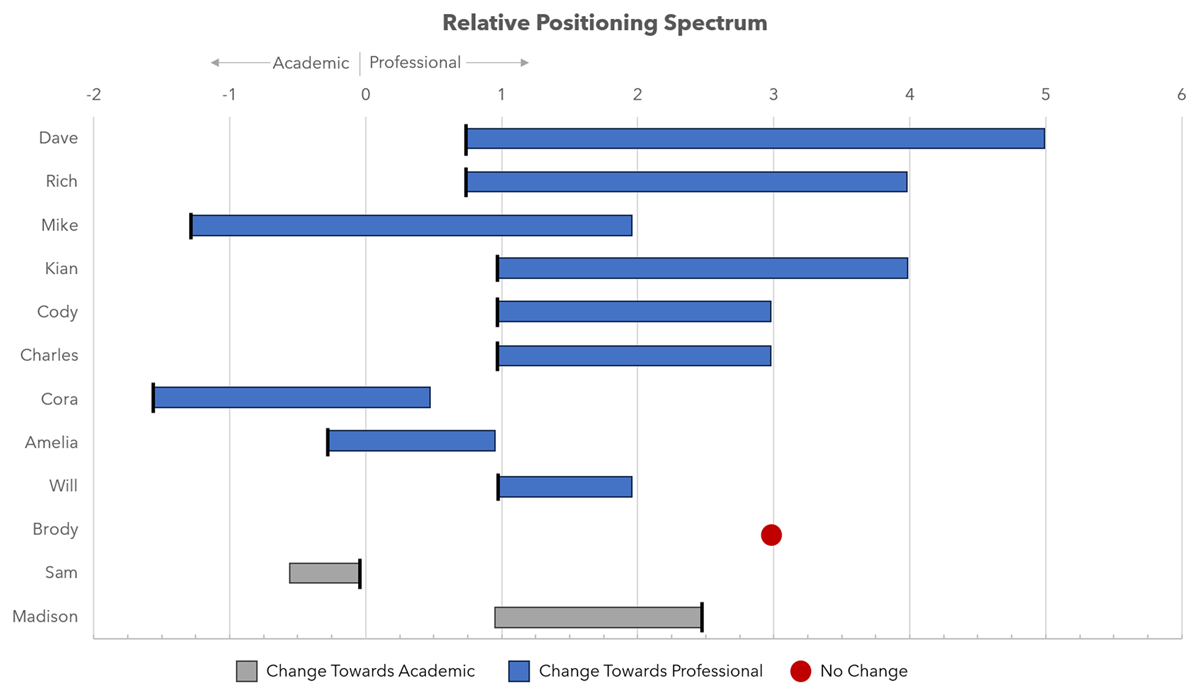
Figure 2
Relative positioning spectrum showing change in participant positioning of themselves as revealed through Discourse coding of Table 2.
Table 4
Summary of findings from mock job interview analysis and evaluator scores.
| STUDENT | PRE POSITIONING | POST POSITIONING |
|---|---|---|
| Amelia | Amelia presents her herself as an engineer by her engineering actions (i.e., Role by Engineering Action), and she also presents using Student Title and describes her projects in an Academic Context. | |
| Comparison to Others, Minimizing Context Overall: 23.7 Q1: 7.3 Q2: 6.7 | Engineering Affiliation Overall: 28.7 Q1: 8.7 Q2: 9.3 | |
| Brody | Brody presented his identity as an engineer (both via Professional Title and Role by Engineering Action) and the context of his group’s project as mixed (academic and professional). | |
| Overall: 38 Q1: 11.5 Q2: 12.5 | While he included an additional way of presenting himself as an engineer (i.e., Professional Title), he also presented using Student Title. Overall: 37.5 Q1: 12 Q2: 13 | |
| Charles | Charles presents his identity as engineer but in different ways. | |
| Engineering Action, Academic Context Overall: 42.3 Q1: 13.7 Q2: 14 | Professional Title, Role by Engineering Affiliation, Student Title, Non-specific Context Overall: 38.7 Q1: 10.7 Q2: 15 | |
| Cody | Cody presented his identify as an engineer by his engineering actions (i.e., Role by Engineering Action) and presents his projects in an Academic Context | |
| Overall: 35 Q1: 12 Q2: 11 | Professional Context, Role by Engineering Affiliation Overall: 31 Q1: 11.5 Q2: 9.5 | |
| Cora | Cora presents the context of her projects in an Academic Context and uses language of Minimizing Contribution. | |
| Role by Generic Action or Affiliation, Minimizing Role Overall: 21.5 Q1: 8 Q2: 7 | Role by Engineering Action, Student Title, Professional Context, Minimizing Context Overall: 39 Q1: 15 Q2: 11 | |
| David | David identifies himself as an engineer by describing his actions. | |
| Academic Context, Minimizing Context Overall: 28.7 Q1: 11 Q2: 8.3 | Professional Title, Role by Engineering Affiliation, Non-specific Context Overall: 32.3 Q1: 11.3 Q2: 12.7 | |
| Kian | Kian presents his identity himself as an engineer by his engineering actions (i.e., Role by Engineering Action). | |
| Academic Context Overall: 21 Q1: 7.5 Q2: 6.5 | Kian included an additional way to present his identity as an engineer (i.e., Role by Engineering Affiliation). Professional Context, Non-specific Context Overall: 34 Q1: 11 Q2: 11 | |
| Madison | Madison presents her identity as an engineer by her engineering actions (i.e., Role by Engineering Action), and she presents her projects in a Professional Context | |
| Minimizing Contribution, Minimizing Role Overall: 29.7 Q1: 9.7 Q2: 8.7 | Student Title, Academic Context, Non-specific Context Overall: 34.7 Q1: 12.7 Q2: 10.3 | |
| Mike | Mike presents his projects in an Academic Context. | |
| Role by Generic Action or Affiliation, Minimizing Context Overall: 34 Q1: 9.5 Q2: 9.5 | Role by Engineering Action, Role by Engineering Affiliation Overall: 38.5 Q1: 11.5 Q2: 14 | |
| Rich | Rich identifies himself as an engineer by through Role by Engineering Action. | |
| Academic Context, Minimizing Contribution Overall: 22.3 Q1: 8 Q2: 7.7 | While Rich included an additional way of presenting himself as an engineer (i.e., Professional Title), he also used Student Title. Professional Context Overall: 33.7 Q1: 12 Q2: 11.7 | |
| Sam | Sam presents his identity as an engineer through Role by Engineering Action, and he presents his projects in an Academic Content. | |
| Student Title Overall: 27 Q1: 9.5 Q2: 10 | Role by Generic Action or Affiliation, Minimizing Role, Minimizing Contribution Overall: 24.5 Q1: 6.5 Q2: 9.0 | |
| Will | Will presents his identity as an engineer through Role by Engineering Action. | |
| Academic Context Overall: 32 Q1: 10 Q2: 10 | Non-specific Context Overall: 38.5 Q1: 13.5 Q2: 13.5 | |
[i] Note: Evaluator scores are provided in italics.