
1 Introduction
Engineering programs increasingly embrace pedagogies intended to engender professional competencies valued and recognized in practice – e.g., “coordinate effort,” “devise process,” and “communicate effectively” (Passow & Passow 2017). This includes problem- and project-based learning experiences. For these experiences to be meaningful to professional formation, it is important that students not only have such experiences, but that they are also able to reflect on those experiences to “articulate a coherent engineering identity” (Morelock 2017). Thus, it is vital to understand how students position themselves within their experiences and the extent to which that positioning is recognized by others as an engineering identity (Stevens et al. 2008).
Supporting students in forming and articulating a coherent (professional) engineering identity is challenging for two reasons. First, the forms of accountable disciplinary knowledge (ADK – “actions that when performed are counted as engineering knowledge”) valued in educational settings (e.g., well-structured homework problems) are often not aligned with those of the profession (Stevens et al. 2008, p. 357). Second, student consideration of technical and professional competencies often occurs in disconnected contexts. Classroom experiences focus on building technical competency (Passow & Passow 2017) while consideration of professional competencies is attended to separately in preparation for career fairs and interviews. This disconnect may hide the integrated nature of technical and professional competencies that appear fundamental to constructing a professional identity in the process of “becoming an engineer” (Stevens et al. 2008).
Such challenges may lead to undergraduates confounding their “engineering student” and their developing “professional engineer” identities, such that they do not always articulate the identity that is most appropriate for the context. For example, a student identity may be partly rooted in performing well on exams, and while that may demonstrate understanding of technical knowledge, a focus on grades in a job interview does not reflect the ways in which knowledge will be applied in a professional context. In such a scenario, the interviewee may be identified more as student than as professional by the interviewer.
Toward exploring the potential confounding of identities, in this study, the mock job interview responses of 12 students were qualitatively explored using a discourse-identity framework. Each student participated in two mock interviews. In the first, they were asked to consider a prior curricular or co-curricular project-based experience, and most students discussed a classroom experience. The second mock interview took place after the students participated in a different co-curricular project-based experience, which included facilitated discussions and reflection sessions. In a prior study that considered the same mock interview data, professional engineers evaluated the students’ interview responses. That study found a statistically significant improvement in evaluator scores from first to second mock interviews (Olewnik et al. 2021). In our own informal post-hoc review of the original data, we perceived a fundamental change in how students presented themselves and that their responses somehow emphasized different identities, which were apparent to the professional engineers. In this study, we sought to understand, qualitatively, how students’ interview responses differed from first to second mock interview. The research question explored here is: How do undergraduate engineers position their engineering identities with respect to different project-based educational experiences?
A discourse framework model based on Gee (2000) was derived and used to analyze the ways in which students positioned themselves through their responses in their first and second interviews. That analysis revealed that study participants positioned themselves as more “engineering student” in the first interview and more “professional engineer” in the second interview. Based on this finding, we consider implications for the ways in which engineering education programs might better support professional engineering identity construction in undergraduate classrooms.
2 Literature Review
Engineering identity has received significant attention in recent years (Morelock 2017; Patrick & Borrego 2016; Rodriguez et al. 2018), reflecting a complex and holistic model for understanding individuals and their navigation of the world, but for which additional research and alignment of ideas is needed (Patrick & Borrego 2016). In this work, identity is defined as a “double-sided” construct representing both how one conceives of themself and how they are perceived by others (Holland et al. 1998; Stevens et al. 2008; Tonso 2006; Tonso 2014). Therefore, to have an engineering identity, one must recognize themselves as an engineer and be recognized by others as such.
In considering engineering identity, we recognize the role of social, cultural, technical, and professional dimensions and contexts that impact the formation of engineering identity (Tonso 2014). This study is primarily concerned with engineering identity formation stemming from technical and professional dimensions as experienced in education contexts, particularly as it pertains to being recognized as an engineer by professional peers through one’s discursive presentation of self. For that reason, we focus our consideration of prior literature on two areas. First, we consider literature that can help to differentiate “professional engineer” from “engineering student” identities, which at times, might be confounded within discursive practices of undergraduates. Second, we consider discourse identity as conceived by Gee (2000) because of its value as a framework for revealing these confounded identities among undergraduate engineers that can occur when they “bid” (Gee 2000, p. 109) – i.e., make an attempt through discourse – to be recognized as professionals.
2.1 Engineering identity: Being recognized in academic and professional contexts
Engineering identity production is likely to evolve over the course of an undergraduate’s career (Meyers et al. 2012) and understanding that evolution and the institution’s role in supporting it is critical to supporting undergraduates’ transition from student to professional. For instance, students’ engineering identity might be linked to an affinity for math and science that is also recognized by others (Godwin et al. 2016). Such affinity brings many students to engineering programs in the first place, where a focus on theory and well-structured problem solving (Jonassen 2014), especially in the middle years for many programs (Lord & Chen 2014), may reinforce a student-focused identity. Further, the accountable disciplinary knowledge (ADK) valued in academic contexts often takes form in artifacts and evaluations – like exams and grades – that resonate with an academic identity more than that of a professional one (Stevens et al. 2008).
This can make the transition to practice difficult, like the student whose engineering identity was so strongly tied to technical rationality and end-of-chapter problem solving that he “reported being rather at sea” when he learned those elements of his identity “had little practical value in the formal and informal evaluations of his new workplace community” (Stevens et al. 2014, p. 128). This reflects a confounding of “engineering student” and “professional engineering” identities that undergraduates often must contend with as they transition to practice. Other students have reported similar confounding of these identities, leading them to leave engineering programs. Like “collaborative ‘people person’” who Stevens et al. (2014, p. 128) concluded “the very aspects of her identity that caused her to opt out of engineering might have made her a very valuable and unique contributor to an engineering firm.” Similarly, “Jill” left engineering because she perceived her GPA as inadequate for an engineer (Stevens et al. 2008).
This is one reason why work-integrated learning experiences, like internships and co-ops, can be so valuable to students’ production and recognition of their professional engineering identity (Castillo et al. 2022). Such experiences may help students to resolve the confounding of engineering student and professional engineering identities, like “Simon,” who had similar GPA concerns to “Jill” but was able to resolve confounding of his student and professional engineering identity through his experience working in a testing lab while he was still a student (Stevens et al. 2008). This may also suggest that the context of an experience (i.e., curricular vs. co-curricular) impacts students’ beliefs about its value to the profession and thus what is worth talking about with professional engineers; co-curriculars are perceived to be more valuable in terms of students’ preparation for the profession (Jamison 2022; Olewnik et al. 2023) than class-based experiences (Kirn & Benson 2018).
In these work-integrated experiences, forms of ADK relevant to the profession – i.e., professional competencies (Passow & Passow 2017) – are practiced and perhaps more readily apparent than that of classroom experiences. For instance, coordinating efforts of self and others is critical to project success in practice and whether that coordination is successful is socially negotiated, rather than graded against a rubric as in a classroom (Trevelyan 2007; Trevelyan 2010; Passow & Passow 2017). Teaching and training related to professional competencies in educational settings are challenging and often limited in engineering curricula (Davis & Ulseth 2013; Gibbard et al. 2018; Hirsch & McKenna 2008; Hurst et al. 2016; Lingard & Barkataki 2011).
Despite greater adoption of team-based project experiences in engineering education within the US, important professional competencies, and particularly their integrated nature, are often not aligned with the learning outcomes of engineering curricula (Passow & Passow 2017). Rather, students engage in learning experiences that are intended to look and feel more like practice but are rewarded for individualized behaviors typical of educational contexts and less so for behaviors expected in practice. As a result, students may background relevant professional competencies leveraged in project experiences that occur in classroom contexts. Lack of an integrated perspective and practice with professional behaviors has led to reports from the field of new engineers being underprepared in important ways (Banik 2008; Kimble-Thom et al. 2005; Lang et al. 1999). In Bae et al. (2022), students themselves have reported an uncertainty regarding development of professional skills in the classroom.
The literature cited above reflects experiences reported from primarily US institutions, making them relevant touchpoints for our study. These cases resonate with observations at our own institution (a large R1 public in the Northeastern US), though we do not assume them to be generalizable to all students. We contend that the challenges associated with implementing professionally relevant experiences in the classroom also make it difficult for students to recognize and articulate the professionally relevant aspects of those experiences. As such, their identity may be more rooted in the experience as an engineering student rather than as a developing professional engineer. Important here is the idea that “often individuals project different parts of their identity as dependent on the environment and context” (Patrick & Borrego 2016, p. 11). There is potential for an individual to project parts of their identity recognized in one context (i.e., academic environments) in ways that are not recognized in another context (i.e., professional environments). Further, individuals may not be aware of this confounding, owing to a lack of experience within the other environment in which they hope to be recognized. In this study, we considered how that confounding of identities might be revealed through the discursive, reflective practice of a mock job interview.
2.2 Revealing engineering identity through discourse
Examining engineering identity through discursive practices has been used by multiple researchers to investigate and conceptualize a theoretical framework for engineering judgement (Francis et al. 2022), explore dimensions of engineering work in varied institutional and discursive contexts (Paretti & McNair 2012), investigate professional identities as enacted roles that can be gendered/stereotyped (Hatmaker 2013), and characterize problem solving practices among engineering students (Douglas et al. 2012). This is certainly not an exhaustive list but serves to demonstrate the value of a discourse framework as an analytic tool for investigating and understanding the positioning and recognition of engineering identity.
Gee’s (2000) discourse-identity framework conceives of identity as being negotiated through dialogic interactions. Rodriguez et al. (2018) summarize work on engineering identity research specifically influenced by Gee’s discourse frameworks. However, that extant research does not incorporate Gee’s (2014) building tasks of discourse. The negotiation of identity – i.e., whether a speaker’s verbally enacted identity is recognized by the listener – can be constructed through seven building tasks of language (Gee 2014). This forms the basis of the theoretical framework used in this study, described in the next section.
2.3 Theoretical framework
Given the mock job-interview context in this study, we grounded our analytical approach in Discourse-identity, employing Gee’s (2014) seven building tasks. These reflect elements or categories of language by which an individual can construct and portray an identity to be recognized by others. The building tasks as described by Gee (2014) are presented in Table 1. Important in these building tasks is the role of context (e.g., cultural context, physical location), and its influence on the choice of language one uses. Language is context specific and failure to use the expected language may make it such that the identity one is attempting to portray through their discourse is not fully recognized by other individuals from that context. Table 1 provides a definition for each building task as well as an associated question for conducting discourse analysis as prescribed by Gee (2014, p. 102).
Table 1
Seven building tasks of language and their definitions and paraphrased questions for analyzing discourse as prescribed by Gee (2014).
| Building Tasks | Given what the speaker has said and how it has been said… |
| Significance: language used to render someone or something significant (or not) | …what things and which people in this context are relevant and significant and in what ways are they significant? How is the speaker trying to indicate significance? |
| Practices (Activities): language used to get recognized (or recognize others) as engaging in socially recognized and institutionally or culturally supported endeavors | …what practices (activities) are relevant in this context and how are they being enacted? |
| Identities: language used to get recognized (or recognize others) as having a certain role or identity | …what identity or identities (for the speaker, the listener/hearer, and in terms of how others are depicted) are relevant in this context? |
| Relationships: language used to indicate a relationship we have or want to have with listeners, groups, institutions, etc. | …what relationships are relevant in this context and how are they being enacted, recruited, and used? |
| Politics: language used to signal one’s view on social goods and their distribution | …what social goods are relevant and at stake in this context and how are they being distributed or how is their distribution being viewed? |
| Connections: language used to establish connections (or lack of) and relevance (irrelevance) between things | …what are the relevant connections and disconnections between things and people in this context and how are these connections or disconnections being made or implied? |
| Sign Systems and Knowledge: language used to legitimize (or delegitimize) certain sign systems (e.g., technical language vs. everyday language, words vs. equations) and epistemologies | …what are the relevant sign systems (e.g., languages or social languages) and forms of knowledge (ways of knowing) that are relevant in this context and how are they used and privileged or disprivileged? |
We used these building tasks of language to explore the ways in which students make a “bid” (Gee 2000, p. 109) to be recognized as engineers through their mock interview responses. This foundation supported a coding process that considered which of the building tasks are relevant and the derivation of engineering context specific subcodes within those building tasks. This enabled a characterization of student reflections on their experiences, in the form of mock job interview responses, as explicit forms of their “authored” identity (Gee 2000; Holland et al. 1998; Skinner et al. 2001). Details related to the use of this theoretical framework are provided in the next section.
3 Methodolgy
This study follows a multi-case study research approach (Yin 2018), applying a within-subject comparative analysis of two different mock job interviews of undergraduate engineers (participants). The participant data analyzed in this study were collected at two points during a 15-week period (Figure 1). Participants considered in this work consisted of 12 undergraduate engineering students who worked on a co-curricular project team, facilitated by the first author. As part of the experience students completed External Reflections (ER) consisting of summative reflections and mock job interviews at two different points. ER1 reflection activities asked students to consider a prior team-based project. ER2 reflection activities asked students to consider the co-curricular project experience. The mock interviews are the focus in this study.
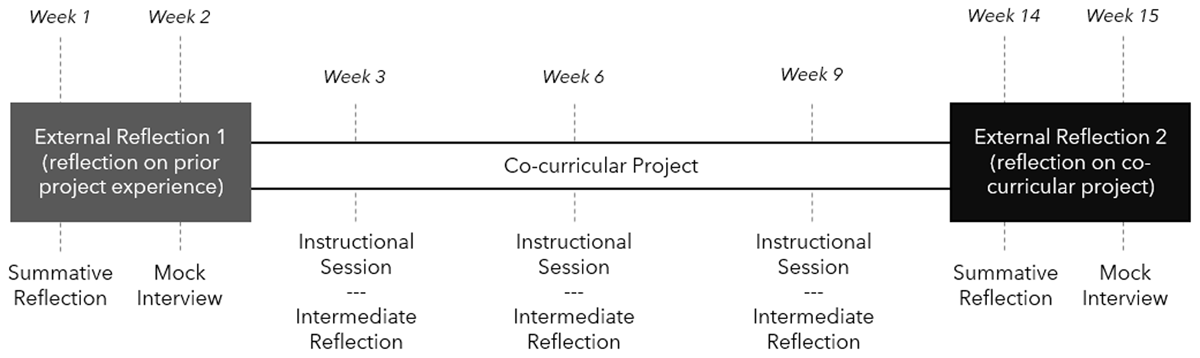
Figure 1
Timeline of study data collection and project participation.
3.1 Positionality
Author 1: I am a White cisgender male with a background in mechanical engineering and design. I am the director of experiential learning for the school of engineering and applied sciences, a role I have held for the past ten years. In that role, I have been working to develop curricular and co-curricular experiences that support students’ development as engineering professionals. My more recent appointment as a tenure track research faculty in engineering education has allowed me to consider those efforts from a research perspective, broadening my understanding of how my pedagogical efforts might be situated and informed by this work and that of others.
This study takes place within a co-curricular program that I have developed over an eight-year period, which continues to evolve. The development of that program and the research conducted around it is motivated, in part, by my own experiences as an undergraduate engineer. I recall the transition from student to professional as an engineering intern. Even after a full year, I never felt like I had my bearings as a professional. I struggled to engage with the openness and ambiguity of “real world” problems, did not fully appreciate the integrated nature of technical and professional competences, and generally did not really know myself in that setting. In mentoring students on both curricular and co-curricular projects, I have found this to be a common occurrence. I see a need to help students in navigating those experiences to make connections to course work, the profession, and themselves. In this way, I believe my work has been toward supporting students in developing their engineering identity before I even knew of that construct.
In the study presented here, I have multiple roles, responsibilities, and interests. I interacted with participants in the role of co-curricular project supervisor/mentor, instructional facilitator, and researcher collecting relevant data (e.g., interviewing students). I also oversaw the study design and data analysis. The use of qualitative methods was based on a desire to understand how this experience that I oversee might impact students on a deeper level that neither they nor the professional engineers who evaluated their interview responses are necessarily conscious of. To mitigate inherent bias, I designed this study collaboratively with a research mentor. Analysis was led by Author 2 as part of a collaborative process, inclusive of reviewing transcripts toward ensuring that I was consistent in how I interviewed students (i.e., that I did not lead them to “better” responses in the second mock job interview). In addition to informing educational practices at my own institution, I hope that dissemination of our findings also informs the practices of others.
Author 2: I am a White cisgender woman who became involved with this research project as a graduate student research assistant/aid in association with my PhD program in the Graduate School of Education. My work on this study has directly led to the successful completion of my qualifying requirements into PhD candidacy.
I am a science educator for regular education and special education adolescents, as well as an undergraduate science instructor. My experience with these populations motivates my desire to study individuals’ perceptions of their identities as learners and their related academic challenges. Through my preparation for qualitative dissertation research on the experience of test anxiety of STEM undergraduates, my PhD education in the science of learning and instruction has led me through literature of metacognition, cognitive psychology, and discourse analysis.
Data was collected prior to my engagement with the project, and I did not interact with any of the study’s participants. I took the lead role as analyst, working to develop and apply the coding scheme based on Gee’s discourse framework. This work was done in collaboration with Author 1.
3.2 Co-curricular project instructional context
Students worked on a project team as part of a co-curricular program managed by the first author (facilitator). At three points during the project period (see Figure 1), participants came to instructional sessions where the facilitator engaged students in discussions about the different types of problems (e.g., design and case analysis) that engineers solve (Jonassen 2014). Discussions foregrounded features that differentiate problem types and potential strategies for scoping and solving them. Additionally, discussion on specific professional competencies and how they might integrate with technical problem solving (Passow & Passow 2017) was facilitated.
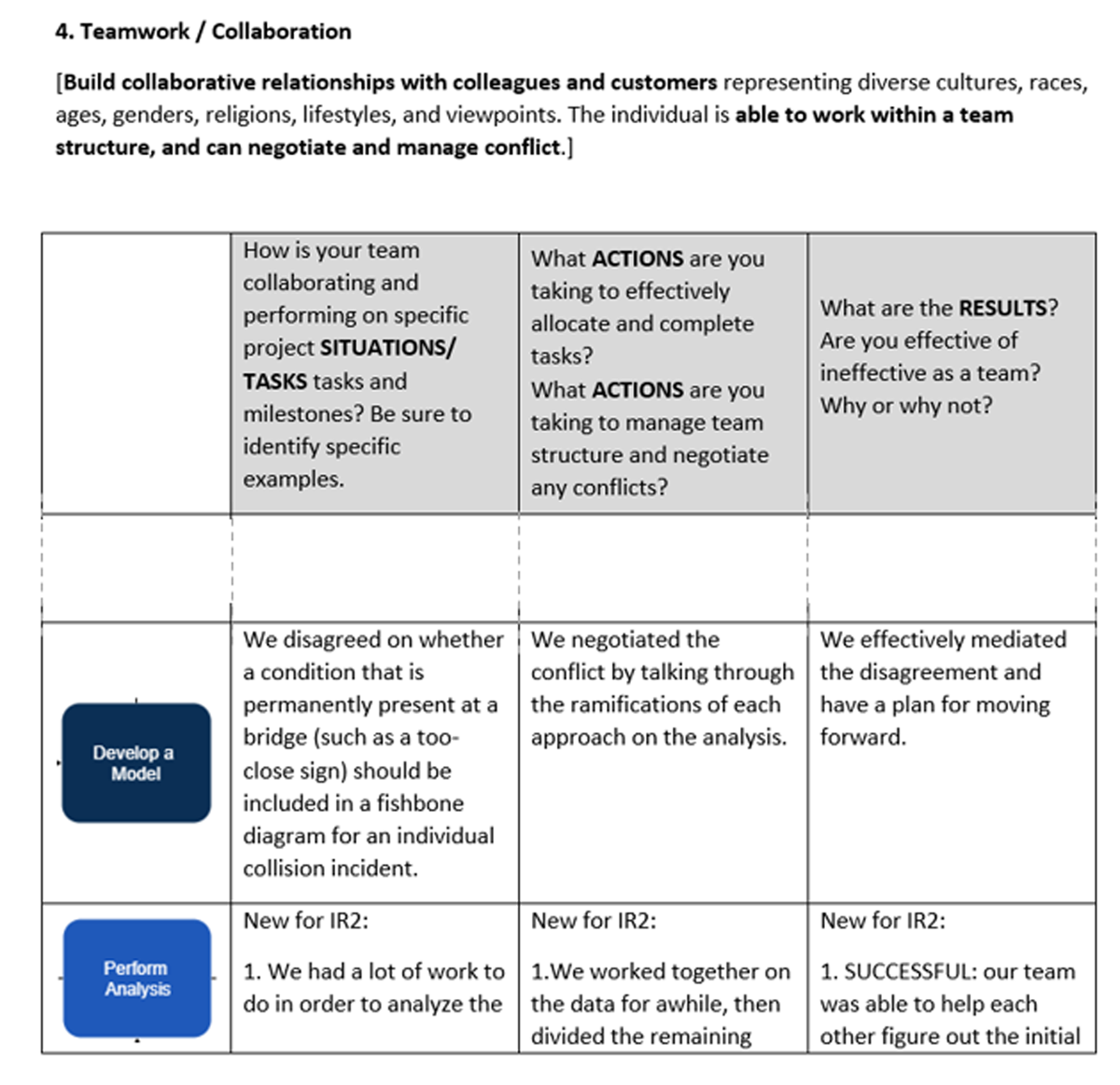
At the conclusion of each session, participants completed written reflections on their ongoing co-curricular project using a reflection template. It was designed to intersect problem typology stages and professional competencies as an explicit representation of the integrated nature of professional and technical competency coordination (Passow & Passow 2017). Five professional competencies (professionalism/work ethic, critical thinking, teamwork/collaboration, written and verbal communication, and leadership initiative) were considered. A segment of an intermediate reflection is shown in Appendix A.
3.3 Data collection and participant selection
We considered the mock job interview as an externalized reflection through which participants positioned themselves, through discourse (Gee 2000), as a potential professional engineer. Participants took part in two (mock) job interviews for which the first author was the interviewer. For the first mock interview, each participant was instructed to select a prior team-based engineering experience for which they were asked five behavior-based interview questions (Hoevemeyer 2006). Students could talk about any experience of their choosing, though we anticipated that many students might discuss class-based experiences because of limited opportunities for out of class experiences. For the second mock interview, participants were instructed to use their co-curricular project experience when answering the same five questions. The potential for contextual differences to influence their discourse about those experiences is taken up in this study.
In preparation for each interview, participants completed a summative reflection that was aligned with the interview questions and intended to support participants’ recall of their prior experience; an effort to mitigate differences in the nature of their interview responses that could be attributed to the recency of their experiences. A total of 42 students participated in the research project over four semesters (spring, summer, and fall 2019, and spring 2020). The 12 students (Table 2) considered in this study were included because they fully completed all three phases of data collection, had similar experiences (co-curricular project with integrated reflection activities), engaged teammates, had committed project sponsors, and were native English speakers. All were students at a large public, research intensive institution in the Northeastern United States. The research protocol governing data collection, analysis, and dissemination was reviewed and approved by the university’s institutional review board. All students were informed about the nature of the study and signed consent forms before participating.
Table 2
Overview of research participants.
| STUDENT PSEUDONYM | FIRST EXPERIENCE | SECOND (CO-CURRICULAR) EXPERIENCE |
|---|---|---|
| Amelia (sophomore, biomedical engineering) | Concept design of fluorescent sensor to detect opioid levels in blood (course project) | Engineering testing of 3D printed prosthetics |
| Brody (junior, mechanical engineering) | Design of airduct car cooling system (undergraduate research) | Autonomous snowblower design project |
| Charles (senior, computer science) | Design of adventure videogame (course project) | Autonomous snowblower design project |
| Cody (sophomore, biomedical engineering) | Concept design of automated breathing CPR device (course project) | Design of 3D printed “pre-prosthetic” device |
| Cora (rising junior, civil engineering) | Physics group experiment (lab course) | Local bridge hit frequency analysis |
| David (rising junior, electrical engineering) | Design and build of a RC boat (course project) | Design of an IOT light switch |
| Kian (junior, biomedical engineering) | Concept design of biomedical device (course project) | Design of an IOT light switch |
| Madison (rising junior, industrial engineering) | 3D printer selection and commission (co-curricular project) | Compliant mechanism pump bottle design |
| Mike (rising junior, biomedical engineering) | Matlab computation project (course project) | Design of an IOT light switch |
| Rich (rising senior, chemical engineering) | Design of membrane system (course project) | Road salt use analysis on campus |
| Sam (rising junior, biomedical engineering) | Design of biomedical device (course project) | Compliant mechanism pump bottle design |
| Will (junior, mechanical engineering) | Design of 3D printed car (co-curricular project) | Design of 3D printed “pre-prosthetic” device |
3.4 Data analysis
In this study, we focused on participant responses to two mock interview questions: Q1 (Tell me about a project that you recently completed. What were the primary objectives? What was your role? Were you/your team successful in meeting the objectives?) and Q2 (How did your team perform throughout the project? Are there any specific positive or negative aspects of your team experience? What role did they play in the project outcome?). The full set of questions are described in (Olewnik et al. 2021). We limited our analysis to two questions for two reasons. First, the evaluator assessment of Q1 and Q2 had a statistically significant increase between first and second interviews, as detailed in the prior study that motivated this study (Olewnik et al. 2021). Second, based on Gee’s discourse-identity framework described in Section 2.3, we reasoned that because participants were prompted to describe their project and role via Q1 and their interactions with others in the group via Q2, these two questions would be sufficient in informing us how students positioned themselves in terms of their engineering identities and contextualization of their projects. In exploring how discourse differed between first and second mock interviews, we used a discourse identity framework that offers a potential explanation for the increased evaluator scores.
We conducted a qualitative analysis of each participant’s first and second interview transcripts. We coded the transcripts in a series of phases using NVivo software. We started with Gee’s building tasks (2014) and through multiple iterations of coding, we identified the relevant subset of building tasks and developed engineering specific codes aligned with those building tasks. During each coding phase, we wrote analytic memos (Saldaña 2021) to assist with coding scheme development, to maintain an audit trail of our process, and to capture quotes of participants that were notable representational summaries of participant presentation. This process was intentional and toward ensuring research quality in terms of credibility and consistency (Merriam & Tisdell 2015). The analysis process and derivation of a coding scheme (Table 3) comprised three stages:
Exploratory coding (Saldaña 2021) of transcripts was applied by the first coder and noted participant phrases related to their identity (e.g., only a student, a specific engineering role) in the project and clues related to perceptions of project context (e.g., academic exercise, engineering endeavor).
Initial coding (Saldaña, 2021) was performed based upon a coding process that considered Gee’s building tasks (Gee 2014), and the concept of discourse identity (D-Identity; Gee 2000). Through this initial coding process, we concluded that themes representing five of the seven building tasks of language (Gee 2014) were well matched for our coding purposes: Identity, Practice, Relationship, Significance, and Sign System and Knowledge. After applying this coding process, we noted that, Identity, Practice, and Significance were the only building tasks from the theoretical framework (Section 2.3) that were useful in characterizing and understanding how language shifted (i.e., differences) from first to second mock interview.
Through iterative coding (Saldaña 2021), subcodes were created and applied to the data corpus by the second author. They were refined through collaborative coding with the first author (Saldaña 2021) that included interrater reliability (IRR) scoring of more than half of the transcripts, as calculated by NVivo. In this process, the second coder applied the coding scheme independently and for any IRR less than 0.7, the two coders worked to resolve disagreement. After consensus was achieved through three cycles of iterative coding on half of the transcripts, the first coder completed analysis of the remaining transcripts.
Table 3
Codes from analysis of participant mock job interviews.
| GEE BUILDING TASK | CODE |
|---|---|
| Identity Identity can be conveyed through discourse that ascribes a certain identity or role to oneself or others; this can be direct or indirect through titles, actions, and reference to others (Gee 2014). The participant used language to enact an identity by assigning titles, affiliated roles, or actions that would be recognized as professional or academic identities. | Professional Title: Interviewee described themself or other project member by a professional title relevant to the project context: e.g., engineer, coder, computer scientist. (+1) |
| Student Title: Interviewee described themself in terms of an academic title, level, role, or a group of the same: e.g., “student,” “sophomore,” “computer science major.” (–1) | |
| Role by Engineering Affiliation: Interviewee indicated role by identifying oneself as a member of a group doing the same engineering activity, but does not give a professional title: e.g., “hardware team,” “coding group,” but NOT “We were a team of chemical engineers.” (+1) | |
| Role by Engineering Action: Interviewee indicated role by describing an action they took in the context of the engineering project. This can be a specific technical action (e.g., “my main role in the project was designing and building the air duct”) or a general professional action that does not require engineering training (e.g., “put us in touch with the … captain”). (+1) | |
| Role by Generic Action or Affiliation: Interviewee indicated role in a general action rather than an action specific to engineering or by giving self a professional title (e.g., “hardware team,” “coding group,” but not “We were a team of chemical engineers”). (–1) | |
| Practices (Activities) A practice is an institutionally or culturally recognized endeavor (Gee 2014), and language used in describing that practice includes clues indicative of how the speaker wishes the context of that practice to be perceived by the listener. The participant used language to enact a practice context that is only academic, has value as a product making task for a professional entity, or a combination of both. | Academic Context: Context cue given by interviewee that situates their project practices in ways recognizable to academic contexts but not professional contexts (e.g., “we got a good grade,” “my final project for BE201”); not codable as an identity. (–1) |
| Professional Context: Context cue given by interviewee indicating that their engaged practices are recognizable as professional situations (e.g., “commissioned this project,” “investors,” “stakeholders”); not codable as an identity. (+1) | |
| Non-specific Context: Context cue given by interviewee about the project practice that was too vague to indicate whether their engaged practices are recognizable in the project as an academic or professional situation (e.g., “recent project of mine”). (0) | |
| Significance Significance is reflected in language that suggests something is significant or to lessen significance (Gee 2014). The participant used language to minimize or inflate the importance of a role, contribution, or context. | Minimizing Role: Mitigating language used by the interviewee that downplay the significance of themself or their role in the project (e.g., “just one member of a group”). (–0.25) |
| Minimizing Contribution: Mitigating language used by the interviewee that downplays the significance of their action (e.g., “I kind of edited the code”). This can be downplaying their contribution to specific actions/tasks of the project or their contribution to the project as a whole. (–0.25) | |
| Minimizing Context: Mitigating language used by the interviewee that downplays the significance of the project’s context and is indicative of devaluing that context regardless of how it was portrayed by the interviewee. (–0.25) |
[i] Note: Numbers in parentheses are values used during Post-coding analysis.
In developing the coding scheme, the use of IRR as part of an independent coding process was toward ensuring credibility (Merriam & Tisdell 2015). For reliability, we sought to ensure that “results are consistent with the data collected” (Merriam & Tisdell 2015, p. 251) and therefore, we incorporated specific comments from evaluators from the prior study in the Results and Discussion sections as a form of triangulation that shows our interpretation through the coding scheme to be consistent with the feedback from industry evaluators who considered students’ interview responses.
The resulting coding scheme, including code definitions and examples, is presented in Table 3. From the table we see a summary of our data derived codes and brief examples of each. We coded five different ways that students enacted their identity by invoking titles and/or affiliations, or through reference to actions (i.e., Identity building task). They used language to enact a practice context that was only academic, had value as a product making task for a professional identity, or a combination of both (i.e., Practices (Activities) building task). We also coded instances of students using language that minimized their role, contribution, and context (i.e., Significance building task). We note that students only seemed to bring a deficit view when expressing significance (e.g., they minimized the value of a contribution). While students expressed pride or satisfaction, there were no instances where they inflated the significance of something.
3.4.1 Post-coding comparative analysis
For comparative analysis, our post-coding transition (Saldaña 2021) focused on the creation of a visual artifact to demonstrate the observed differences in students’ discourse identity between their first and second interview. We associated simple quantitative indicators representing the presence (i.e., not frequency) of codes as indicated in Table 3. Identity and Practice codes that built toward a discourse-identity of “professional engineer” were assigned a +1 while those associated with “engineering student” were assigned –1. Discourse that was ambiguous was assigned a 0. Similarly, for each of the three Significance codes we attributed a value of –0.25, reasoning that such minimizing language is indicative of a devaluing of role, contribution, or project activity. The use of these indicators allowed for the creation of a visualization (i.e., Relative Positioning Spectrum) that demonstrates how individual discourse-identity shifted between their first and second interview. It also supports a cross-case comparison (Yin 2018) among the 12 students.
4 Findings
The Relative Positioning Spectrum (RPS, Figure 2) shows how each participant’s discourse-identity shifted from first to second interview. For most participants, relative positioning shifted to more professional (i.e., from a discourse-identity that was more “engineering student” to more “professional engineer”). In contrast, the two gray horizontal bars (i.e., Sam and Madison) each represent individuals that started with higher RPS values (more towards the professional end of the spectrum) in their first mock interviews relative to their second. The red dot (i.e., Brody) shows a RPS value that stayed constant. Table 4 in Appendix B presents a summary of all codes included to build each participant’s RPS. We note, the RPS does not reflect a frequency count of codes. Rather, it reflects the existence of codes within student responses to the interview questions. For example, a student could have used language that enacted a professional practice context five times in responding to a question, but in our analysis, we only counted professional practice context once. Thus, we conclude that most participants used discourse to position themselves more as professionals than as students in their second interview. The following subsections provide more details about the observed shift synthesized in Figure 2.
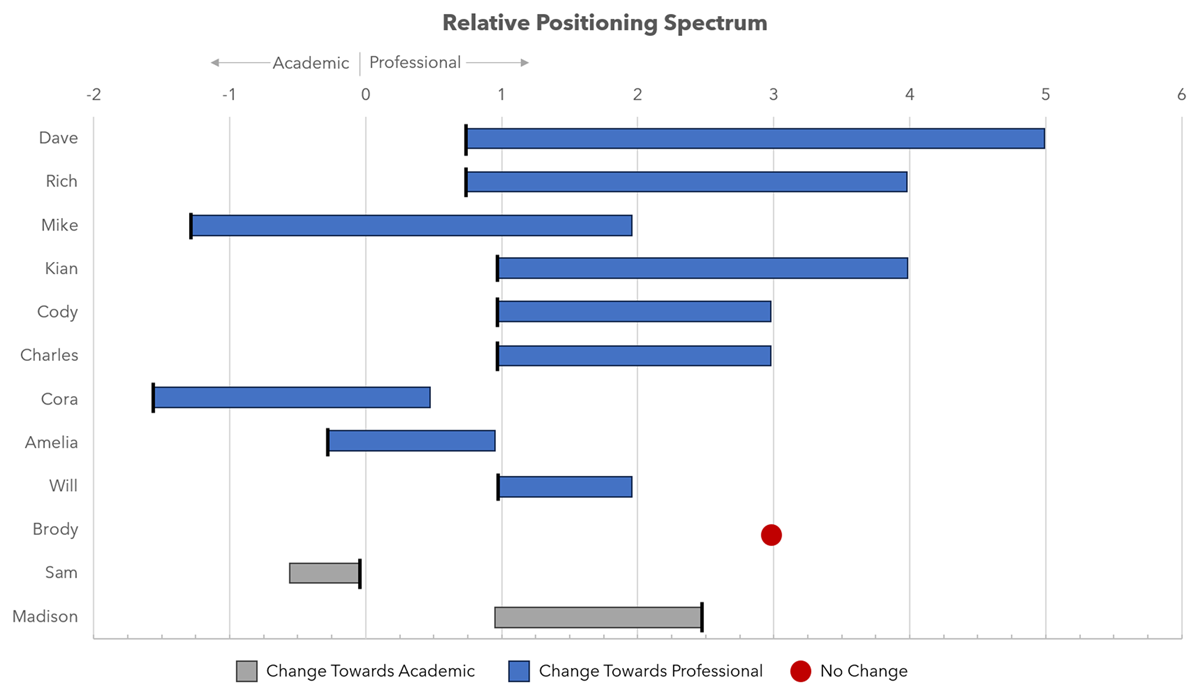
Figure 2
Relative positioning spectrum showing change in participant positioning of themselves as revealed through Discourse coding of Table 2.
4.1 Participant positioning by identity building task
We observed that participants bid for identities that were often not their Institution-identities (Gee 2000) of being students. In most interviews, participants did not position themselves as exclusively one Identity in either interview; they were mixed in their use of language that positioned them as students and professionals in both interviews. Within the 24 interview transcripts, 15 exhibited language that enacted an Identity that was only professional, seven exhibited language that enacted both professional and academic Identity, and the remaining two exhibited language that enacted neither professional nor academic Identity (both occurred during the first interviews of Mike and Cora).
For Identity, the notable differences between first and second interviews are as follows. For the first interview, language enacted to position oneself as a professional was done almost exclusively through Role by Engineering Action (one way of expressing professional forms of accountable disciplinary knowledge, ADK; Stevens et al. 2008). Positioning oneself as a professional in the first interview occurred only once by Professional Title Self or Other (Brody), and not by Role by Engineering Affiliation. In the second interview, there were four instances of a participant using a Professional Title (Brody, Charles, David, Rich) to refer to themself or another team member. Similarly, for Role by Engineering Affiliation, we observed zero instances in the first interview and six instances (Amelia, Charles, Cody, David, Kian, Mike) in the second. Thus, seven participants expanded their language to enact a professional Identity in the second interview.
Rich provides us with an example of this trend. In his first interview, he only identified himself as an engineer through his actions (e.g., “I also did the material balance on the membrane”). In the second, he enacted identity in three ways: 1) Role by Engineering Action: “So I created a basic model on MATLAB. …,” 2) Professional Title: “So we were a team of chemical engineers”, and 3) Student Title: “There were two seniors including me and one rising sophomore.” Similarly, Charles used language in his second interview that enacted identity in three ways: 1) Professional Title (e.g., “main coder”), 2) Role by Engineering Affiliation (e.g., “I was on the autonomous systems section”), and Student Title (e.g., “I was the CS major”). During his first, he only presented his professional identity through his actions (e.g., “made the skeleton for the code”).
The use of additional kinds of Identity codes in the second interview transcripts is also exemplified through Cora and Mike, albeit in a unique way. In contrast to presenting an academic, professional, or mixed identity, when Cora and Mike described their roles during their first interviews, they both used language that enacted an identity that was indistinguishable as being academic or professional (i.e., Role by Generic Action or Affiliation). For example, Mike only talked about actions of the group instead of what he, specifically, did: “…we didn’t really give each other roles.” However, both of their second interview transcripts revealed Identity being enacted in two ways (Cora, mixed; Mike, professional). Thus, Mike and Cora went from language enacting an ambiguous identity in the first interview to language that more clearly positioned them as student/professional (Cora) and professional (Mike).
4.2 Participant positioning by practice (activities) building task
Like Identity, most participants did not position themselves exclusively by one Practice (Activity) in either interview. We observed trends that aligned with our general finding of participants’ Relative Positioning shifting from more academic to more professional from first to second interview. Within the first 12 interviews, 11 participants enacted language indicating Academic Context. Only two participants (Brody, Madison) enacted language suggesting Professional Context, and none enacted a Non-specific Context. We found mixed use of language to enact academic and professional contexts in the second interviews. Seven participants enacted language coded as Academic Context. However, six participants (Brody, Cody, Cora, Kian, Madison, Rich) enacted Professional Context and five (Charles, David, Kian, Madison, Will) enacted Non-specific Context. Thus, seven participants expanded their language from first to second interview such that the context of their work was not strictly positioned as academic even though all projects took place in an academic setting.
As an example, consider Kian, who is representative of many participants who referenced academic agents or structures to enact an academic practice context. When asked to describe a recent project experience, he did so in the first interview by stating “We had a project in BE202” and later explaining that it included presenting “to our professor and our TA, like they were investors going to invest in our device.” In response to the same question during the second interview, his language enacted a non-specific context by stating “during this past summer, I did an engineering project,” a professional context by referring to the client as “a smart lab on campus,” and no instances of an academic context. Another common way in which students enacted an academic practice context was through reference to an academic exercise or grades. For example, in his first interview, Mike stated the purpose of the project “was to test our programming skills,” and he equated success on the project with its grade: “We were successful on the project. I got a perfect score on that project. I don’t know about what everybody else got.” However, in his second interview, his responses did not enact any context. Similarly, Cody, enacted academic practice context in his first interview by explaining project success as “we got, well, a 98 on the project … as far as a grade goes, pretty successful.” In the second interview, he still enacted an academic context when explaining that they were able to “make some simple mockups combining those ideas we got from models we had from other universities [italics added to indicate context cue]” but he also enacted professional context through a client: “we worked in conjunction with [redacted] County Medical Center.”
4.3 Significance building task
Of the 24 transcripts there were eight in which we found at least one kind of Significance code. These instances occurred in six of the first interviews and twice in the second. Cora was the only participant who used minimizing language of Significance in both interviews, and she did so in the greatest number of ways. Participants who enacted language related to Significance only did so in ways that minimized context. For example, David used context minimizing language in his first interview when describing the competitive aspect of their boat design project: “It that was just for fun.” There was also language that minimized a participant’s role as not individually significant (e.g., Cora: “My role wasn’t really unique”). Finally, students’ language sometimes signaled a diminished level of project engagement. For example, Sam enacted language that minimized his contribution at two points in his second interview. The first instance was explicit to what and when he engaged: “[I] did a lot of research in the beginning” and then “kind of like, hopped back in” at the end. The second was an explicit reference to what he did not do: “I really didn’t touch” the CAD model that was seemingly important to project success. There may be good reason for it, but both statements suggest that there was a period in which Sam did not offer effort that was consequential to project outcomes.
4.4 Cora: A representative case
We value the case of Cora for its ability to highlight our findings across the building tasks. Cora was a non-traditional undergraduate with a prior professional degree and a family. At the time of her participation, she was a rising junior pursuing a degree in civil engineering and had recently transferred from a community college. Of all 12 students, Cora had the largest first to second interview increase in overall professional evaluator score (Olewnik et al. 2021). She also had the lowest RPS value (Figure 2) for her first mock interview. The experience that she described in the first interview was a group lab experiment, guided by directions to empirically support accepted theories of physics. In her second interview, Cora described a project that was open ended and concerned with a real-world problem.
4.4.1 First mock interview positioning
Cora described her role in her first interview project as being “just one member of a group” who followed a procedure prescribed by her professor to “[c]omplete the task.” This phrase does not bid for an identity that is academic nor professional. Rather, it is one of Role by Generic Action or Affiliation. This was the only Identity code found in her first mock interview. Success of the project task was the group meeting an empirically derived value and satisfying their professor as being sufficiently accurate. When elaborating on this project success, Cora explained that it resulted from “just by working well together.” Rather than describing any particular competencies or knowledge employed by herself or others, this use of language minimized contribution through its overgeneralization. Likewise, the qualifier “just” in “just one member of a group” minimized her role to the point of it being indistinguishable from other team members.
We interpreted the language Cora used in her first interview to minimize her contribution and role, and the learning experience overall. She validated this by email before her first mock interview: “In the process of writing my summative reflection, I realized that I don’t have a good project to summarize…” One of the two professionals who evaluated Cora’s first mock interview (Olewnik et al. 2021) noted: “Student could provide more information about the impact of the project. In this case, it was about a lab project, so I would suggest answering this question with a project that has greater magnitude.”
4.4.2 Second mock interview positioning
The co-curricular project referenced in the second interview authentically invited unique ways for Cora to work towards project goals, and she presented numerous and diverse accounts of expressing herself as an engineer in action. Something that was obviously missing in her first interview. Still, she offered what appeared to be a mixed perception on the importance of her experience as it relates to doing professional engineering: “I recently completed a summer research project … initiated by … a retired structural engineer … he sort of commissioned this project…[analyzing] bridges in the region [that] were getting hit by trucks… and it was completed as an extracurricular, so it wasn’t for credit and it wasn’t for pay, just a learning experience.” We considered Cora’s minimizing language that the project was “just a learning experience” to be unusual or unexpected since her group participated in an atypical undergraduate experience. They interacted with a professional and Cora, directly, had contact with a local official who “kept very comprehensive records” and the group “used that data in a sort of novel way to really draw out every single characteristic of the collision and then see which characteristic, explain[ed the] frequency of bridge hits.”
Unlike the first interview, it was evident that Cora valued the experience: “I think it’s such a benefit… just like, wow, this is engineering” during a post interview member check. Thus, in this case, we suspect that Cora’s context minimizing phrase “just a learning experience” may be a personality or socialized trait (Holland et al. 1998, p. 131). For instance, even though she used language to position herself as relatively more professional, she minimized her contribution in a way that may be indicative of a persistent, trait-related speaking style: “And so my main contribution in this bridge project was, you know, just go nearly neck deep in data.” Here, we interpret her “just” to show modesty while describing her pronounced engagement in work that became significant to the project. This interpretation of modesty, rather than being an earnest devaluing of her contribution, overlaps with our interpretation of the contribution minimizing language in the following statement being associated with humility in character: “…there are so many times where, I would have a thought and it would just be like a little baby thought and then someone else would, you know, say, ‘Oh yeah, and if that then this.’… I just remember being struck by that so many times that, ‘Oh, if I were doing this at home on my own, I don’t think I would have had this whole progression of thought.’”
Cora’s second interview exemplified a participant who presented a bid that was, overall, more professional than in her first interview. She presented her experience as being a mix of academic and professional. While she did not have the most pronounced movement towards the professional end of the Relative Positioning Spectrum, she gained the highest overall scores from engineering professionals who evaluated interview responses (Olewnik et al. 2021). The same (blinded) evaluator who suggested she should have picked a different experience to talk about in her first interview, stated the following regarding Cora’s post interview response to Q1: “This is a prime example of what makes up a good answer. From describing the project, pitfalls, role, demonstrating thinking outside the box, demonstrating teamwork, demonstrating communication, etc.”
5 Discussion and Implications
We discuss our findings as it relates to the research question: How do engineering students position their engineering identities with respect to different project-based educational experiences? The contribution of this work is the ways in which a discourse framework allowed us to characterize different identities, and their confounding, among undergraduate engineers who are at a point in their academic lives when they are beginning the transition from student to professional. We contextualize findings through the building tasks of Identity, Practice (Activities), and Significance, though it is important to note that these building tasks are interrelated in discourse. We conclude by considering three implications: 1) the nature of engineering educational experiences, 2) broadening perspectives of engineering identity, and 3) assessment.
5.1 Participant positioning by identity building task
Regular use of Role by Engineering Action to discursively signal a professionally relevant engineering identity in both interviews suggests that students recognize forms of “accountable disciplinary knowledge” that are resonant with the profession (Stevens et al. 2008). However, this was not reinforced through use of Professional Titles or Engineering Affiliation discourse markers during the first interview.
Participants’ expansion of Identity discourse markers from first to second interview is representative of the notion that “people can construct and sustain identities through discourse and dialogue (D-Identities) without the overt sanction and support of ‘official’ institutions that come, in some sense, to ‘own’ those identities” (Gee 2000, p. 103). Participants were not assigned roles or titles, nor assigned any affiliation as part of the co-curricular project. Further, they would not be expected to be familiar with specific titles used in industry (none of the participants had prior industry experience) and professional titles were not a specific discussion point in the instructional sessions. However, participants drew on a broader lexicon associated with the engineering profession.
5.2 Participant positioning by practice (activities) building task
With respect to practices within a particular context, while all participant experiences occurred in an academic setting, some project experiences had an element of authenticity in the form of a client or external stakeholder (Rule 2006). Most, but not all, co-curricular projects referenced in the second interview engendered this element; Amelia, Brody, Charles, Madison, and Sam did not have external stakeholders. This feature was lacking in the experiences that most students referenced in their first interview, as course projects often do. For some participants, the existence of a real stakeholder may have had an amplified influence on their perceptions and the language they enacted.
Even where course projects attempt to promote authenticity through real-world problems – like the biomedical engineering course design projects referenced by Amelia, Cody, and Kian in their first interview – participants’ interview language focused on the academic elements of context rather than context elements resonant with the profession. This includes elements of authentic practice like ill-defined/structured problem scenarios, and multiple possible solutions and evaluation criteria (Jonassen et al. 2006), and a need to plan and regulate problem solving and coordination of effort (Passow & Passow 2017; Trevelyan 2007). However, our findings suggest that students may be less likely to foreground these facets of classroom-based experiences, signaling that they did not recognize the professional skills inherent to their team-based project efforts (Bae et al. 2022; Hirsche & McKenna 2008) or that those facets are made less memorable by the accountable disciplinary knowledge of the classroom (Stevens et al. 2008).
5.3 Participant positioning by significance building task
Multiple participants enacted language that in some way minimized significance of the experience, and this occurred more often in first interviews, most of which referenced course-based experiences. Intentionally or not, this imbued a negative sentiment that was also recognized by professional evaluators in the prior study (Olewnik et al. 2021). Discourse that downplays the significance of a project’s practice context might suggest that the participant devalues potential for learning or is uncertain of the utility of an experience as it relates to the profession. As noted by Kirn and Benson (2018) student persistence and learning is mediated by their belief that a task or experience is relevant to their future. There is evidence from the literature that students engage in co-curriculars because they believe it is valuable to their future career (Jamison 2020; Jamison 2022; Olewnik et al. 2023).
We speculate that even though both curricular and co-curricular project-based experiences can engender authentic learning relevant to the profession, it is possible that students view co-curricular experiences as implicitly more valuable than classroom experiences. Further, it is possible that the encouragement by institutions, industry, and alumni to “get involved” with co-curriculars like student clubs and makerspaces signals to students that those experiences are especially valuable.
In addition to minimizing context and the learning therein, language that minimizes contribution or role can signal disengagement. Such language can be detrimental to being recognized as an engineer as Sam’s expressions of diminished engagement were apparent to evaluators in the prior study (Olewnik et al. 2021). One evaluator commented, “Still not sure the interviewee told us their role? They need to be more confident, use less ‘kind of’ and ‘like’ … don’t talk about stuff you ‘didn’t’ do but focus on stuff you did do.” Another wrote, “don’t add language ‘which I didn’t really touch’…this is an interview for your job, the interviewer wants to hear what you did. Don’t highlight what you didn’t do…” Like minimizing context, this may be indicative of uncertainty about the relevance or value of an experience, or it may be avoidance of specific roles or tasks that do not align with one’s current and future identity as an engineer (Kirn & Benson 2018).
5.4 Implications
We feel it is important to highlight that we cannot attribute observed differences in students’ discourse identities from first to second interview to any specific factor. It is possible that the professional competency integrated discussions and reflection during the instructional sessions triggered participants to expand use of professionally resonant discourse markers in their second interview. It is also possible that working outside the boundaries of a classroom – i.e., differences between the classroom and co-curricular contexts – may have led participants to expand their use of those same discourse markers. As such, it is possible that observed differences are attributable to the instruction/integrated reflection activities, the context of the experience, the combination of those activities, and/or or other factors.
Regardless of the underlying reasons, as shown in this study, students may confound their “engineering student” and developing “professional engineer” identities in ways that undermine their bid to be seen as a professional. Thus, to support students in their professional formation, we recognize engineering educational experiences as engineering identity building ones that should: 1) foreground professionally relevant accountable disciplinary knowledge, 2) recognize and validate technical and non-technical attributes of a professional engineering identity, and 3) disrupt disengagement and downplaying of contributions.
As a first implication, our findings suggest a need for deliberate and intentional focus on elements of learning that reframes and reinforces learning in terms of professionally relevant accountable disciplinary knowledge (Stevens et al. 2008). For many engineering students, group project activities, like those in a lab course setting, are the only opportunities for such learning until a senior year capstone project. Consequentially, finding ways to maximize those earlier experiences by aligning learning objectives with practices and competencies essential to the profession is necessary but not the current norm (Passow & Passow 2017).
Second, it is important to recognize that the valued contributions of engineering practice are more than just technically rational ones (Passow & Passow 2017). This is important to validating that a range of technical and interpersonal competencies identify with the profession (Stevens et al. 2014). We view this as critical to broadening participation, because while engineering identity early in academic careers may be tied to proficiency and interest in math and science (Godwin et al. 2016), engineering practice is necessarily sociotechnical and identities that include facets like “people person” (Stevens et al. 2014, p. 128) are critical to the realization of technical success. Helping all students to recognize and situate non-technical skills alongside technical ones is a path toward broader participation because it broadens representations of what constitutes an engineering identity (Tonso 2014).
Third, the ability to detect minimizing language as a symptom of students’ disengagement has potential value in facilitation and assessment. This might be used to guide students’ consideration of their engagement and what it potentially reveals to themselves (and others) about their professional engineering identity. In this regard, there is a valued consequence of (dis-)engagement that extends beyond GPA to expressions of preparation for practice. This may help to replace the GPA-stick with a carrot in the form of improved recognition of one’s engineering identity as produced through sustained engagement in learning experiences.
Reflection, in combination with discourse frameworks, like that used in this study, is one potential path to pedagogical integration of these ideas. This aligns with Morelock’s (2017) recommendation that students be provided more opportunities to reflect on experiences in support of their engineering identity development. The integration of professionally focused reflective practices, like mock interviews, might complement other forms of reflection, like design journals and peer assessment (Marin-Garcia & Lloret 2008; Willey & Freeman 2006). This is aligned with findings related to reflection’s impact on how learners approach learning (Eyler 2009; Moon 2004). However, more research is needed to understand the ideal forms of reflection and their effect on engineering identity development.
5.5 Limitations
As discussed above, we cannot attribute the observed changes in student discourse to any specific factors. There are other important limitations of this work. First, is our assumption that participants treated their mock interviews like actual interviews for engineering positions inspiring them to highlight their technical skills and professional competencies. Of course, the stakes are not the same as a real interview, but given their voluntary involvement, we feel it is a reasonable assumption to expect that our participants were motivated to engage the mock interviews in a way that would help them prepare for future, real interviews. An additional limitation is the recency of experiences that participants considered in their interviews (i.e., the second mock interview refers to a project that was just completed while first interviews considered projects that occurred in previous semesters). We do not expect that this had significant impact on responses, and the summative reflection was intended to support recall of prior experience. However, there is no way to know for sure how recency may have impacted interview responses. Finally, our study only considers data from native English speakers. Future work should seek to include non-native English speakers in order that we develop knowledge that enables pedagogical change to support all students.
6 Conclusion
In this work we explored the enacted language of students in mock interviews that referenced different learning experiences. Through derivation of a coding scheme based on Gee’s (2000; 2014) discourse identity framework, we found evidence of students’ confounding their “engineering student” and “professional engineer” identities through their discursive practices. Through this study, we found support for additional research on how educational experiences within different environments (classrooms vs. co-curriculars) might impact engineering identity development. In line with Morelock’s (2017) recommendation, future work should include research on the impact of reflective activities to support students in distilling, translating, and discursively expressing professionally relevant aspects of their educational experiences to support their engineering identity development.
Appendices
Appendix A
A segment of an intermediate reflection shows data for one participant, Cora, for the teamwork/collaboration competency in the context of a case analysis problem. This reflection approach is intended to get students thinking about professional competencies at a granular level by describing instances of those competencies as they occur within the context and scope of different stages of the problem engagement process. These reflections were examined to ensure that students added to them at three points during the project period but were not analyzed as part of this study.
Appendix B
Summary of codes building the Relative Positioning Spectrum (Figure 2). A summary of codes from analysis of pre and post interviews of each participant are provided. The first row for each participant provides descriptions of how they were consistent across their pre and post positioning. The next row indicates differences presented during each of the two mock interviews, overall evaluator scores, and evaluator scores for Q1 and Q2. Overall, evaluator scores (italicized) increased from pre to post for the group. As the distributions are non-normal, we used a Wilcoxon signed-rank test and found support for rejecting the null hypothesis of equal medians at a significance level of 0.05 (alpha = 0.015). This suggests that there is a statistically significant difference in the overall evaluator scores from pre (N = 29 evaluations, mean = 29.7, sd = 7.97 to post) to post (N = 30, mean = 34.1, sd = 6.3) mock interviews. Details of the evaluation breakdown by question are reported in Olewnik et al. (2021).
Table 4
Summary of findings from mock job interview analysis and evaluator scores.
| STUDENT | PRE POSITIONING | POST POSITIONING |
|---|---|---|
| Amelia | Amelia presents her herself as an engineer by her engineering actions (i.e., Role by Engineering Action), and she also presents using Student Title and describes her projects in an Academic Context. | |
| Comparison to Others, Minimizing Context Overall: 23.7 Q1: 7.3 Q2: 6.7 | Engineering Affiliation Overall: 28.7 Q1: 8.7 Q2: 9.3 | |
| Brody | Brody presented his identity as an engineer (both via Professional Title and Role by Engineering Action) and the context of his group’s project as mixed (academic and professional). | |
| Overall: 38 Q1: 11.5 Q2: 12.5 | While he included an additional way of presenting himself as an engineer (i.e., Professional Title), he also presented using Student Title. Overall: 37.5 Q1: 12 Q2: 13 | |
| Charles | Charles presents his identity as engineer but in different ways. | |
| Engineering Action, Academic Context Overall: 42.3 Q1: 13.7 Q2: 14 | Professional Title, Role by Engineering Affiliation, Student Title, Non-specific Context Overall: 38.7 Q1: 10.7 Q2: 15 | |
| Cody | Cody presented his identify as an engineer by his engineering actions (i.e., Role by Engineering Action) and presents his projects in an Academic Context | |
| Overall: 35 Q1: 12 Q2: 11 | Professional Context, Role by Engineering Affiliation Overall: 31 Q1: 11.5 Q2: 9.5 | |
| Cora | Cora presents the context of her projects in an Academic Context and uses language of Minimizing Contribution. | |
| Role by Generic Action or Affiliation, Minimizing Role Overall: 21.5 Q1: 8 Q2: 7 | Role by Engineering Action, Student Title, Professional Context, Minimizing Context Overall: 39 Q1: 15 Q2: 11 | |
| David | David identifies himself as an engineer by describing his actions. | |
| Academic Context, Minimizing Context Overall: 28.7 Q1: 11 Q2: 8.3 | Professional Title, Role by Engineering Affiliation, Non-specific Context Overall: 32.3 Q1: 11.3 Q2: 12.7 | |
| Kian | Kian presents his identity himself as an engineer by his engineering actions (i.e., Role by Engineering Action). | |
| Academic Context Overall: 21 Q1: 7.5 Q2: 6.5 | Kian included an additional way to present his identity as an engineer (i.e., Role by Engineering Affiliation). Professional Context, Non-specific Context Overall: 34 Q1: 11 Q2: 11 | |
| Madison | Madison presents her identity as an engineer by her engineering actions (i.e., Role by Engineering Action), and she presents her projects in a Professional Context | |
| Minimizing Contribution, Minimizing Role Overall: 29.7 Q1: 9.7 Q2: 8.7 | Student Title, Academic Context, Non-specific Context Overall: 34.7 Q1: 12.7 Q2: 10.3 | |
| Mike | Mike presents his projects in an Academic Context. | |
| Role by Generic Action or Affiliation, Minimizing Context Overall: 34 Q1: 9.5 Q2: 9.5 | Role by Engineering Action, Role by Engineering Affiliation Overall: 38.5 Q1: 11.5 Q2: 14 | |
| Rich | Rich identifies himself as an engineer by through Role by Engineering Action. | |
| Academic Context, Minimizing Contribution Overall: 22.3 Q1: 8 Q2: 7.7 | While Rich included an additional way of presenting himself as an engineer (i.e., Professional Title), he also used Student Title. Professional Context Overall: 33.7 Q1: 12 Q2: 11.7 | |
| Sam | Sam presents his identity as an engineer through Role by Engineering Action, and he presents his projects in an Academic Content. | |
| Student Title Overall: 27 Q1: 9.5 Q2: 10 | Role by Generic Action or Affiliation, Minimizing Role, Minimizing Contribution Overall: 24.5 Q1: 6.5 Q2: 9.0 | |
| Will | Will presents his identity as an engineer through Role by Engineering Action. | |
| Academic Context Overall: 32 Q1: 10 Q2: 10 | Non-specific Context Overall: 38.5 Q1: 13.5 Q2: 13.5 | |
[i] Note: Evaluator scores are provided in italics.
Competing Interests
The authors have no competing interests to declare.
Author Contributions
Andrew Olewnik collected all data for the study, collaborated on analysis, and contributed to writing of the manuscript.
Kristin Muller led the derivation of the analytical framework and analysis of data. She also contributed to writing of the manuscript.