

Figure 1
Relating dimensions of productive interactions to aspects of disciplinary practice.

Figure 2
Meeting timeline for the group studied in this project with experimental runs (10XX), meetings with the supervisor (DMM), and final project presentation (P) shown.
Table 1
Productive Interaction codes for conceptual aspects of practice (epistemic dimension).
| CODE NAME | CODE DESCRIPTION | EXAMPLE |
|---|---|---|
| Problematize (PROB) | This includes instances when a group member questions the shared concepts, data, or other group members’ ideas. | Creating awareness of the situation by raising questions such as “Why do you think that?” |
| Generating ideas (G-IDEA) | Bringing in ideas that can contribute to creating or extending a shared understanding of the problem or the situation at hand. | Bring in physical reactor characteristics to help illustrate gas flow. |
| Elaborating ideas (EL-IDEA) | Clarifying and justifying ideas to other group members | Explain to other group members about the operating regime of the CVD reactor. |
| Evaluating ideas (EV-IDEA) | Assess the feasibility of the proposed ideas | Evaluate the direction of gas flow inside the reactor. |
| Perform calculations (CALC) | This code applies when group members perform calculations, regardless of the type of computational tool. | Calculate process parameters such as precursor flow rate. |
| Develop computational tool (DEV-tool) | Develop and modify computational tools (Excel sheet, JMP). | Generating excel spreadsheet. |
| Analyze results from computational tool (ANZ-tool) | Review, interpret and share results from computational tools and graphical representation. | Examine a graphical representation of results. |
Table 2
Productive Interaction codes for social aspects of practice (regulative dimension).
| CODE NAME | CODE DESCRIPTION | EXAMPLE |
|---|---|---|
| Coordinating process (COORD) | Organizing activities within the group (plan for next meeting, assign responsibilities, dividing tasks). | Regulate other group members’ activities. |
| Sharing Information (SHARE) | Sharing information from sources (internet, book, lecture note, in-class demonstration, or other groups) among group members. | Provide process parameters from literature. |
| Reflecting on individual and collective actions (REFLECT) | Discussing the progress of the group’s work. | Express satisfaction in collective accomplishment, i.e., “We’re doing well.” |
| Agreeing (AGREE) | Exhibiting agreement among group members. | Express “Yeah” or “Yes.” |
Table 3
Productive Interaction codes for material aspects of practice (experimental dimension).
| CODE NAME | CODE DESCRIPTION | EXAMPLE |
|---|---|---|
| Generating experimental strategy (G-EXP) | Develop an experimental strategy as a solution to the problem or to acquire a better understanding of the situation. | Choose process parameter to be explored in the next experiment. |
| Elaborate experimental strategy (EL-EXP) | Clarifying and justifying experimental strategy to other group members. | Tell the group why growth temperature should be decreased on the next run. |
| Evaluating experimental strategy (EV-EXP) | Assess the feasibility of experimental strategy. | Make a judgment on the value of a process parameter. |
| Generating measurement strategy (G-MEA) | Develop a measurement strategy. | Propose the number of measuring points on a wafer. |
| Elaborate measurement strategy (EL-MEA) | Clarifying and justifying measurement strategy to other group members. | Explain the reason behind the measuring pattern. |
| Evaluating measurement strategy (EV-MEA) | Assess the feasibility of measurement strategy. | Make a judgement on a measuring pattern. |
| // | represents the tone unit boundaries |
 | represents rising tone associated with the tone unit |
 | represents falling tone associated with the tone unit. |
| → | represents level tone associated with the tone unit. |
| UPPERCASE | represents prominent syllables indicating stressed or salient words. |
| UPPERCASE | represents tonic syllable carrying the tonal pitch movement associated with the tone unit. |
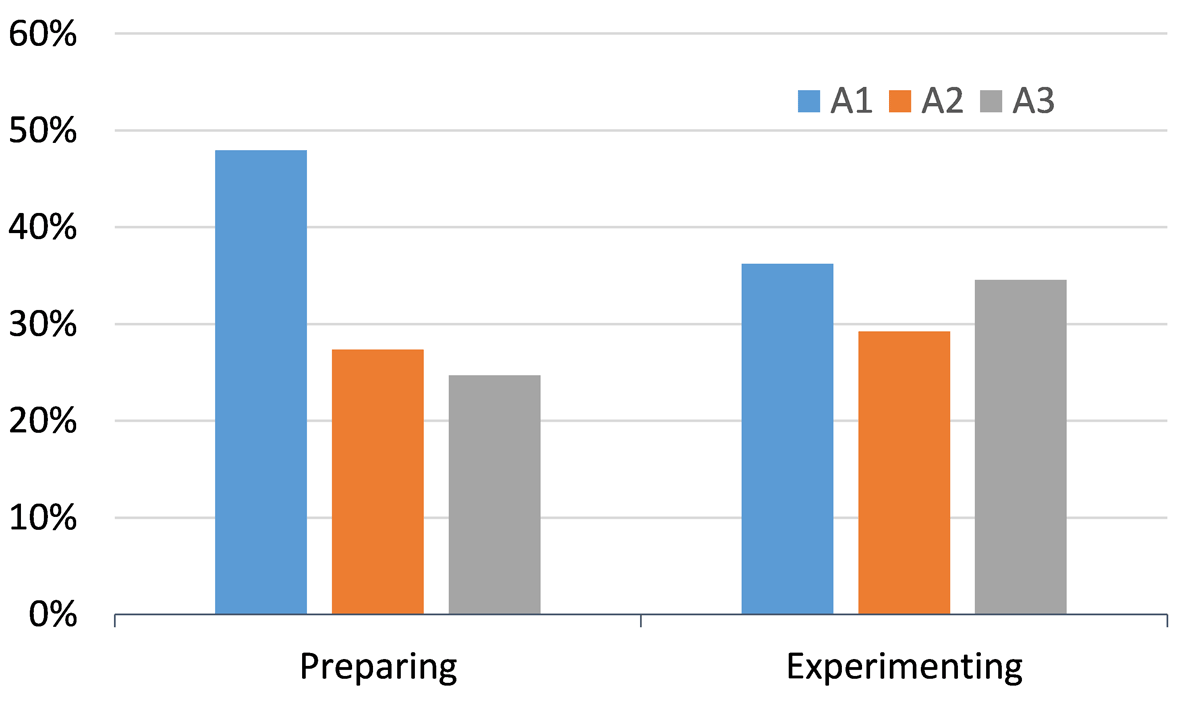
Figure 3
Overall percentage of productive interactions for group members A1, A2, and A3 for the preparing stage and the experimenting stage.

Figure 4
Percentage of productive interactions in the epistemic dimension. (a) Preparing stage. (b) Experimenting stage. Table 1 shows the code category definitions.
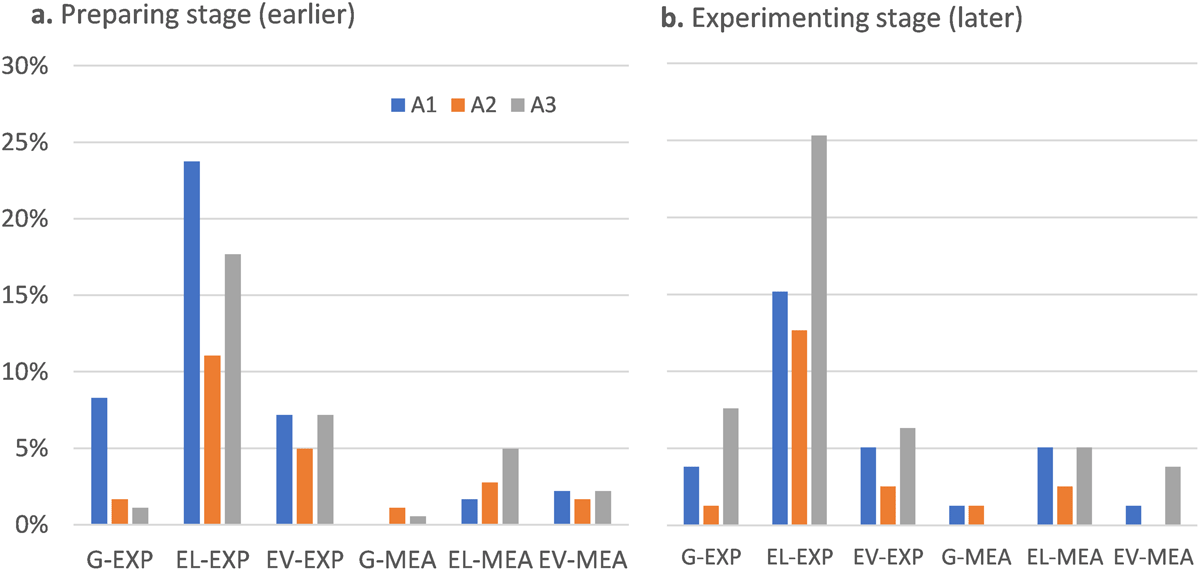
Figure 5
Percentage of productive interactions in the experimental dimension. (a) Preparing stage. (b) Experimenting stage. Table 3 shows the code category definitions.
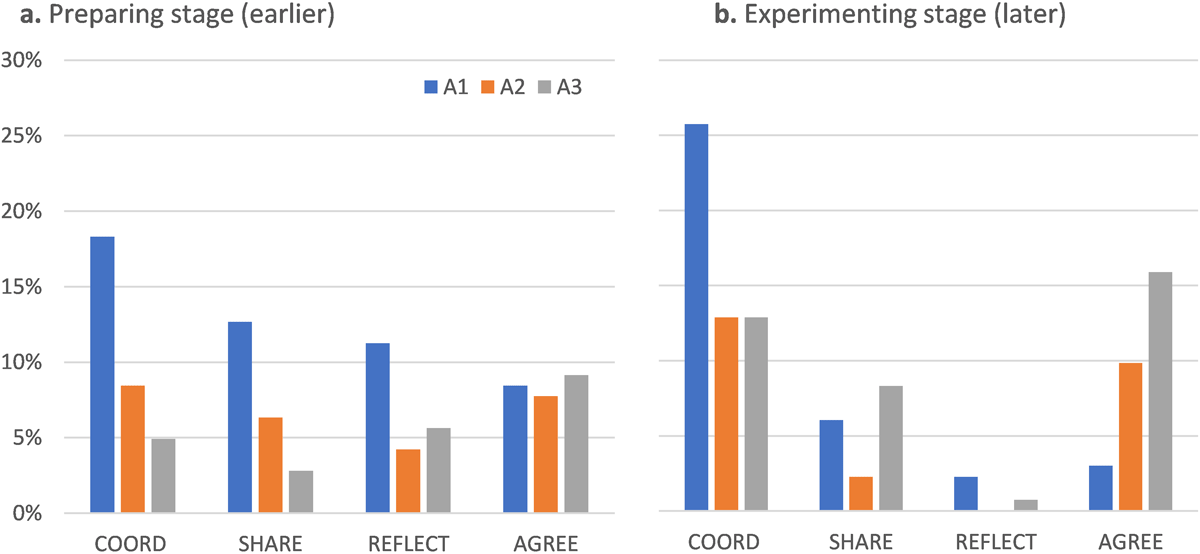
Figure 6
Percentage of productive interactions in the regulative dimension. (a) Preparing stage. (b) Experimenting stage. Table 2 shows the code category definitions.
Table 4
Discourse excerpts that illustrate shifting group practice.
| EXCERPT | TURN NUMBERS | STAGE | DYNAMIC |
|---|---|---|---|
| P1 | 91–98 | Preparing | A1 is influential through exhibiting the merit of an argument, authority, and access to the conversational floor. |
| P2 | 99–108 115–125 | Preparing | A1’s influence on other members continues |
| P3 | 126–134 | Preparing | A1 exercises authority to influence the group’s direction |
| D1 | 467–474 | Design Meeting | A1 accepts and takes on A3’s ideas |
| D2 | 494–500 | Design Meeting | A1 and A3 build on each other’s ideas |
| D3 | 534–538 568–569 | Design Meeting | Supervisor repositions A3 as author of an alternative perspective |
| E1 | 645–654 | Experimenting | A3 emerges as an influential member in the experimenting stage. |
| E2 | 656–665 | Experimenting | Accountability to nature bolsters A3’s degree of authority |
| E3 | 704–713 | Experimenting | Collaborative interactions between A1 and A3 ensue in the generation of experimental strategy |
| E4 | 597–609 | Experimenting | The access to tools foster A2’s authorship |
| 91 | A2: | // → you KNOW diffusion //n |
| 92 | A1: | // → OH okay // → that’s what we want [laugh] // ↘ LET’s consider the case diffusion is MUCH longer // → than the system size // → OH, that’s not what we want. |
| 93 | A2: | // [reading] ↘ The diffusion length [pause] system size // ↗ uhhhh NO // [reading] ↘ reaction is very insignificant NO // [reading] ↘ convection is very significant // |
| 94 | A1: | // ↗ No it’s not // → Uh uh Uh uh // |
| 95 | A2: | // ↗ is IT? // |
| 96 | A1: | // ↗ NO // |
| 97 | A3: | // → WAIT ah ah // |
| 98 | A1: | // ↗ HE [the supervisor during the class-wide demonstration] said // → HE WAS saying that you are going to have that flow. It is not going to influence what goes in at all // → it’s all diffusion that influences // → And IT’S NOT important unless it is on top of the wafer // → Anything on the sides of the wafer don’t matter // → IT’s WHAT gets diffused that’s important // |
| 99 | A2: | // ↘ do you do the reaction over there? // |
| 100 | A1: | // ↗ I don’t know // → my impression was that this was diffusive controlling, just like they’re saying // ↘ SEE, reactors behave like Thiele // ↘ which is saying that Thiele is diffusive // |
| 101 | A2: | // ↘ hmm // |
| 102 | A1: | // [A1 sigh] [pause] ↘ I’VE been wrong before // → but that was my impression // |
| 103 | A3: | // → um hmm // |
| 104 | A2: | // → It just doesn’t sound right // → it sounds kind of like saying you can // → JUST put this gas in the chamber and it will diffuse whether or not // → there is flow to it // |
| 105 | A1: | // → YEAH. that’s true // → you filled your reactor up, close it // |
| 106 | A2: | // → [Talking over A1] is that because of a low pressure sysTEM? // |
| 107 | A1: | // → YEAH // → IT’S, it’s, it’s just like if you // anything, there’s nothing there it’s in a vacuum it’s going to want to go over // → like // ↗ So THE FLOW the the the // the flow rate isn’t going to PUSH on it // → it’s the fact that it’s under VACuum // → Like REALLY low pressure // → that you get // → IF THIS IS EMPtiness HERE // → there’s there’s NO molecules there and this is full of molecules that go over // |
| 108 | A2: | // → um hmm // |
| 115 | A1: | // → YEAH that’s what I am saying // ↗ WE don’t need to solve for d right now // ↘ we want to figure out temperature dependence on d and that’s not here in the literature [pause] // [reading] ↗ RADIAL UNIFORMITY is almost AUTOMATIC |
| 116 | A3: | // ↗ REALLY? // |
| 117 | A1: | // → [reading] aXIal uniformity is achieved // → we have // ↗ so why WASN’T his [the supervisor during the demonstration] radially? // |
| 118 | A3: | // ↗ YEAH why // → um // |
| 119 | A2: | // → I DON’T agree with that // → ‘cause THAT’S the point of this experiment |
| 120 | A1: | // ↘ How? // |
| 121 | A2: | // → we have to change the parameters to make it work // |
| 122 | A3: | // ↗ Maybe // ↗ Maybe his wasn’t um // → radially as bad as // |
| 123 | A1: | // ↗ [Talking over A3] MAYBE it’s almost automatic // → maybe if you have something reasonable running [A2 giggles] like your normal settings // |
| 124 | A2: | // ↘ yeah // |
| 125 | A1: | // ↘ and his were just weird // |
| 126 | A3: | // → SO WE already have a good idea // → Ah ah ah a // ↘ ball-park idea of what temperature to try // |
| 127 | A2: | // → Right // |
| 128 | A3: | // ↘ Like // |
| 129 | A1: | // ↗ [Talking over A3] BUT we DON’T have a ball-park idea // → of the difference between 1 and 5 [A3 still speaking] |
| 130 | A3: | // ↗ OH // → yeah // → we don’t have a ball-park idea of the difference between 1 and 5 //→ we also don’t have a ball-park idea of um // ↘ of what the FLOW sHould be |
| 131 | A2: | // → NO // |
| 132 | A3: | // → we KNOW we know what they should be in relation to // |
| 133 | A1: | // ↗ [Talking over A3] OK // [reading] ↗ surface reaction rate is Slow // → and then we get radial uniformity // |
| 134 | A3: | // → HUH // |
| 467 | S: | // → so the MEAN free path is the distance a molecule travels on average before it hit // → bangs into another molecule |
| 468 | A1: | // → okay // |
| 469 | A3: | // → uh huh // |
| 470 | S: | // ↘ and as the pressure drops what do you think happens to the mean free path? // |
| 471 | A1: | // → It gets smaller // |
| 472 | A3: | // → it gets LONGER // |
| 473 | S: | // → smaller or longer? // |
| 474 | A1: | // → is there // → uh uh // → okay LONGER // → cause it hit // → sorry // |
| 494 | S: | // → temperature and what ELSE? // |
| 495 | A1: | // → ummm concentration? // |
| 496 | S: | // → CONCENTRATION // → so // ↘ what HAPPENS to concentration as pressure goes down // |
| 497 | A3: | // ↘ concentration goes down // |
| 498 | S: | // ↘ concentration goes down // |
| 499 | A3: | // → if the pressure goes down too much then it will limit how much // → how concentrated // |
| 500 | A1: | // → And the REACTION rate goes down // ↘ concentration goes down // |
| 534 | A1: | // ↘ we would um find the parameters you gave us and the size and then we would look at their parameters and their size // and um // ↗ YEAH // we we um // → I THINK one thing that we DON’T know a lot about is // → the flow rate and how it exactly affects the concentration profile within the reactor // |
| 535 | S: | // yeah so you’re thinking really complex [A1] // → you jumped in [A1 laughs] and you’re thinking about THIELE MODULI and how to model diffusion in the wafers // → really high level and you know um that’s where we aim the course // → that’s where your COURSE WORK is at right now // → so that’s not surprising // → LET just // |
| 536 | A1: | // → [A2 laughs] jump back |
| 537 | S: | // jump back // ↗ REAL simply // → what do you need? // → so you have a certain MOLE per time // → and you have a certain time RIGHT? 60 miNUTES // → so what does that give you? // |
| 538 | A1: | // ↘the mols that are // ↘ of each thing |
| 568 | S: | // → so that’s a good check for you to do [A3] // → is to say hey // → you know um [A1] likes to think about things on really HIGH levels // → is this getting too complex? // → Ok because the HIGHer level you think on things // → if you get it working // → that is GREAT // → but more likely you’ll end up with something that is not working // → alright so that is kind of // a useful thing about a team // and team dynamics // → everybody brings these inclinations and strengths // → and your ability to negotiate through those is // → is also going to be important in addition to making those decisions // ↘ Right? |
| 569 | Group: | [Agrees] |
| 645 | A1: | // → NOW // is there a WAY we can make a column that says concentration // do we do we know the concentration gradient is it linear? // |
| 646 | A3: | // → I DON’T know if it is linear // ↘ because of the way the temperature things are set up // ↘ and // ↘ it would depend on // |
| 647 | A1: | // ↗ The temperature things don’t matter // → I am talking about // → there’s no heat at all // → just you release that gas you have a gradient // |
| 648 | A3: | // → YEAH But the temperature is gonna affect that gradient because it will diffuse faster so // |
| 649 | A1: | // → WE we want a gradient that // when we are done with the temperatures // but it’s non-existent // ↘ at faster diffusion will match up WITH how thick it is |
| 650 | A3: | // → Uh huh // |
| 651 | A1: | // → can we assume it is zero at the TOP? // |
| 652 | A3: | // → No because // → we didn’t have partial utilization // → we can calculate the utilization based on how thick all of the wafers ARE // |
| 653 | A1: | // → uh huh // |
| 654 | A3: | // → and we can calculate that based on the thickness // → um the density // → we can calculate how many moles we deposited total // after adding up all of the wafers // |
| 656 | A3: | // ↗ OH // → oh sorry, that’s the reason why it’s different // → the reason why it’s different in HIS [the supervisor’s] system is because // → um if you have you know 5 mol per liter // → coming through a bottom // |
| 657 | A1: | // → uh huh // |
| 658 | A3: | // → and some of the wafers they SUCK it up and start using it to react. // |
| 659 | A1: | // → Ohhh // |
| 660 | A3: | // → By the time it reaches the top you won’t have 5mol per liter you’ll have 4 mol per liter // → We want to try to get it // →so that as it goes UP // → the heat increases // → to a // → CONTROLLED DEGREE // |
| 661 | A1: | // yeah // |
| 662 | A3: | // → that it keeps getting used up and used up and used up // → But at the same time whilst being used up faster // → because it’s getting thinner // → we’re not depositing // → like in our case overcompensated and then ended up that our TOP WAFER are thicker than our bottom wafers // → UM But that just means that um // ↘ we have way too much flow in there // |
| 663 | A1: | // ↗ We have way too much FLOW? // → It wasn’t necessarily as a function of our temperature being too much of a difference? // |
| 664 | A3: | // → I think we need to lower the flow and raise the time because at least for purposes of utilization because that is one of the things you need to look out for // |
| 665 | A1: | //→ Okay // |
| 704 | A1: | // ↗ Did you say that the last time we ran it, we were surface // limited // ↘ or mass transfer limited? // |
| 705 | A3: | // → We didn’t know that // → um // → we didn’t know what we were doing last time in terms of whether or not // → it was // → surface or reaction // → But I am pretty sure // → it always reaction rate limited // → based on the // → stuff like that // |
| 706 | A1: | // ↗ Based on? // |
| 707 | A2: | // ↗ Why do you think that? // |
| 708 | A3: | // → um // → It’s // → just // → a common feature of low pressure chemical vapor deposition // → tools // → that are // → run about the conditions that we are using // ↗ It’s because of the fact that // |
| 709 | A1: | // ↗ That’s a good thing that saves // it makes our utilization even better right? |
| 710 | A3: | // → It will if we do it right // |
| 711 | A1: | // → Because if we let the diffusion be in control // → basically the LIMITING REACTANT // → then we’re going to lose more DCS // → than we do DCS every time the DCS gets there it reacts then it splits and the diffusion sits there // |
| 712 | A3: | // → So we probably can have a lot less excess than we’ve been pumping in there // → but at the same time if we cut off that excess // → we’re going to have to um // |
| 713 | A1: | // ↗ Make sure it diffuses in quickly // |
| 597 | A1: | // ↗ It would have been easier to just type is it because you want to do it EVERY TIME? |
| 598 | A2: | // → yeah I wanna type it out so that so we just just plug it in // |
| 599 | A3: | // → Can you just type in the times that are relevant to that four // five points? // |
| 600 | A2: | // → the time? // |
| 601 | A3: | // → Yeah // → oh wait // → you want to do it over? |
| 602 | A2: | // → I just want to graph it so that we can have like // → at all of THE points // → at this location // → you know where this // → radius // → that’s what we have // |
| 603 | A3: | // ↗ OH I SEE // |
| 604 | A1: | // → I have an idea // → why don’t you// → set up |
| 605 | A2: | // → Um // |
| 606 | A1: | // → set up a graph where you added every other point to it and then you have 2 ones // → one is // |
| 607 | A2: | // → That’s what I am trying to do // → that’s what I WILL do // |
| 608 | A1: | // → But you, you will need to // |
| 609 | A2: | // →It will just be nice if every Excel sheet that we get we put like // → the next one right HERE // → and we already have this column set up // → you know so it is always gonna be // → at midpoint // |