
Introduction
Many undergraduate engineering programs foreground the development of technical knowledge and skills (Winberg et al., 2020). In practice, professional engineers also rely equally on social competencies, such as communication skills, project management, leadership, and teaming skills (Brunhaver et al., 2017; Cox et al., 2012; Deming, 2015; Hess, 2018; Passow & Passow, 2017; Trevelyan, 2019). However, less emphasis is placed in university engineering programs to cultivate, understand, or even recognize how students develop the social skills needed in professional practice, such as how they position themselves to contribute as a productive group member (Borrego et al., 2013; Sheppard et al., 2009). Being a productive group member means participating in effective social practices that facilitate negotiation and critique with others to enable progress, especially in the face of incomplete knowledge (Hess, 2018; Trevelyan, 2019; Vincenti,1990).
Here, we report an illustrative case study that investigates how social interactions change and roles develop as a group of students work to complete a realistic and challenging task in an engineering course. The motivation to characterize shifts in social positioning stems from a systematic curricular change initiative where we have sought to redesign activities so that students engage in sociotechnical practices, practices where the technical and social aspects of engineering work are interrelated and mutually constitutive (Koretsky et al., 2018). We shift the emphasis from covering a canon of abstract content (often through solving constrained single correct-answer problems) to emphasizing the development of conceptual, material, and social practices of engineering (Ford & Forman, 2006; Koretsky et al., 2023; Trevelyan, 2019). This shift is primarily achieved by situating student work in realistic open-ended problems and providing appropriate instructor framing and facilitation (Koretsky et al., 2018). These realistic problems have been incorporated into shorter studio settings in the middle years (lasting 1–2 hours) and longer projects, as the one described here, in the senior year (lasting several weeks). In both cases, groups follow “zig-zag paths” where uncertain ideas are proposed and then interrogated, modified, and sometimes even abandoned (Lampert, 1990; Pickering, 1995; Vincenti, 1990). This characteristic makes the problems “group-worthy” in that it enables learners with different perspectives to become a valued resource for the group (Lotan, 2003; Sengupta-Irving & Agarwal, 2017).
As we have changed the pedagogical emphasis to focus on realistic, group-worthy tasks, we have anecdotally noticed shifts in the social interactions of group members as they progress. While others have reported cases of imbalanced participation controlled by a dominant group member (Fowler & Su, 2018; Hirshfield & Koretsky, 2018; Meadows & Sekaquaptewa, 2013; Wieselmann et al., 2020), we have observed the opposite. In the microgenetic study presented here, we catalog, in detail, the interaction characteristics of one group where participation shifts over time towards more balanced participation. A microgenetic approach is appropriate since it focuses on characterizing changes in group behavior as it occurs (Luwel, 2012; Siegler & Crowley, 1991). We show how the students’ discourse practices change and relate the changes to elements of the learning activity in which the students participate, including characteristics of the task and the instructional facilitation. The goal of the paper is to identify and explicate ways that realistic, open-ended tasks can contribute to students’ participation in the types of sociotechnical practices that enable more effective and equitable interactions in engineering work.
Literature Review
Real-world engineering tasks are rarely accomplished by a sole engineer (Trevelyan, 2019). Rather, the work is group-based and sociotechnical in nature. In the broadest sense, being sociotechnical means that the engineered processes and products will integrate into the social world of communities and society, hopefully for better but sometimes for worse (Johnson, 2017; McGowan & Bell, 2020; Pawley, 2012). Sociotechnical also refers to how the engineering work itself is completed, namely, that status and authority relations influence the extent to which group members can participate and contribute and that the social practices of the group determine the solution path to the task at hand (Esmonde & Langer-Osuna, 2013; Horn, 2012; Wieselmann et al., 2020). In short, the engineering work benefits by productively drawing on the distributed expertise, multiple perspectives, and diverse ways of knowing of all group members.
Drawing on social practice theory, Medina and Stahl (2021) distinguish group practice, or thinking on the group level, as a construct distinct from individual practice. Group practice is the socially negotiated and shared ways that individuals interact to complete their work (Menekse et al., 2019; Oner, 2016). For example, a group might identify a leader who controls activity while the other group members follow along; alternatively, they might distribute the authority collectively attending to one another’s ideas (Lämsä et al., 2018). As such, productive work takes place through “intertwined levels of individual, small-group, and community processes” (Medina & Stahl, 2021, p. 201). Importantly, these small-group social practices are tacit, and the group members may not even be aware of their use or development. Thus, from a methodological perspective, self-reflection surveys might provide limited insight. On the other hand, group social processes are public and visible to an observer either directly or through recordings, as in this study.
As is the case for practicing engineers, the ability of students to make progress on realistic open-ended tasks in class depends strongly on the nature of the group’s social practices. Researchers have demonstrated the influence of social practice in pre-post designs where they compare outcomes of a treatment group relative to a control group (Hsiung, 2010, 2012; Kapur & Kinzer, 2009) or students’ perceived quality of their teammates’ contributions (Ott et al., 2018; Pazos et al., 2010). Fewer studies have characterized group practice as it unfolds. Barron (2003) found that more successful groups were able to discuss competing ideas and negotiate their resolution whereas less successful groups did not attend to one another’s ideas. Barron found these social practices played a greater role in supporting the group to develop high-quality solutions than other factors such as the prior achievement of the students in the group or the number of ideas generated. Similar findings were reported by Menekse et al. (2019) for first year engineering students. Jordan & McDaniel (2014) found that social practices also served a social need by allowing group members to manage uncertainty and providing support structures to proceed despite their incomplete knowledge. In a less productive case of group practice, Kittleson and Southerland (2004) describe groups that utilized a divide and conquer strategy; this approach did not accommodate social interactions between group members that could lead to the co-construction of knowledge. Students experience with schooling also plays a role; students who are accustomed to single-correct answer problems can experience frustration and attempt to control and direct their peers when confronted with more realistic open-ended engineering work (Wieselmann et al., 2020). The resulting competitive and controlling behaviors can exacerbate the gender divide in engineering (Hirshfield & Koretsky, 2018; Langer-Osuna et al., 2020; Wieselmann et al., 2020).
We contribute to this conversation by characterizing the mechanisms through which group practice shifts during a collaborative learning task in an upper-level engineering course. Often such microgenetic studies of small group collaborative learning have occurred in the K–12 mathematics (Bishop, 2012; Chan & Clarke, 2017; Langer-Osuna et al., 2020) and science (Osborne et al., 2004; Roth et al., 2011) classes. Thus, strategies towards equal-status interventions often focus on the role of the teacher as an omnipresent agent to facilitate shared participation (Langer-Osuna et al., 2020; Webb, 2009). Such strategies do not translate well to post-secondary engineering group work where the instructor has more limited interaction and often much of the work is completed outside the classroom. Here, we add to the literature of social practices in post-secondary engineering (Eggert et al., 2014; Menekse et al., 2019; Purzer, 2011) by elucidating how students, mostly working on their own, shift social practices and redistribute power while completing a realistic open-ended task.
This study examines the shifts in social practice for one group during a realistic, open-ended task, namely, the industrially situated virtual laboratory (ISVL) project (Koretsky et al., 2008, 2011a, 2011b). We seek to contribute to the extant knowledge in engineering education in two ways. First, we use the construct of productive interactions to interrogate the ways the group engages in conceptual, material, and social material practices and how those practices distribute across group members. Second, we examine the discourse between group members with one another and with the instructor to identify the salient features which characterize the observed shifts in group practice.
Conceptual Framework
In order to characterize group practice, we adopt a sociocultural orientation (Bourdieu, 1977, 1984; Engeström, 2001; Holland et al., 1998; Lave & Wenger, 1991; Vygotsky, 1978) to classify the interactions between group members informed by three constructs that are described in this section. The first construct, aspects of disciplinary practice (Ford & Forman, 2006; Koretsky et al., 2023), posits that conceptual, material, and social practices are all central to engineering work. The second construct, productive interactions (Damşa, 2014), provides a connection between the specific verbal interactions among the group members to each aspect of engineering practice. The third construct uses models of influence (Engle et al., 2014) to examine the influence from each group member on others.
Aspects of Disciplinary Practice
We are fundamentally interested in explicating how learning activities provide student teams the opportunities to engage in disciplinary practice. Disciplinary practice is a construct that describes the set of regular activities within a certain domain, in this case chemical engineering (Latour & Woolgar, 2013; Lave & Wenger, 1991). Participation in disciplinary practice entails “the activities of individual agents and group members that are necessary for a practice to achieve its aims” (Ford & Forman, 2006, p. 3). We categorize such participation according to conceptual, material, and social aspects (Koretsky et al., 2023) as briefly summarized in this section. As a launching point, we use scientific practices as they are articulated in the science studies literature, and then we connect each aspect to engineering practice.
The goal of scientific work is often framed as generating understanding of the behavior of nature. This goal requires scientists to make connections between their observations of phenomena to theory and fundamental knowledge to gain an understanding of the phenomena (Bogen & Woodward, 1988). In this sense, the conceptual aspect in scientific practice involves applying theory to understand a phenomenon. While they also need to make sense of phenomena to complete their work, the goals of engineers are different from scientists. Engineers apply their understanding to support their design goals, which is to develop a process or product to serve people’s needs (Bornasal et al., 2018; Vincenti, 1990). In the context of this study, conceptual practice refers to activities that connect theory and fundamental knowledge to make sense of phenomena to aid in designing products and/or processes.
Apedoe and Ford (2010) assert material aspects of practice are fundamental to the empiricism of science. Taking this further, Pickering’s (1995) posthumanist perspective describes material practice as related to “the omnipresence of machines, instruments, and experimental setups in scientific research” (p. 2). He elaborates that researchers “use the machine to accomplish tasks that are beyond the capacities of human minds and bodies” (p. 7). Based on these viewpoints, we think of material practice as a set of activities that revolve around equipment (machines), data, and conducting experiments. While Apedoe and Ford (2010) emphasize the essence of material practice in scientific work as the design of data-collection events, material practice in engineering also includes the design of products and processes, an essential output of engineering work. Therefore, in this study, the material aspect of engineering practice is defined as the design of data-collection events to aid in the development of products and processes to satisfy people’s needs.
The collaborative nature of engineering work reflects the social aspect of engineering practice. Engineers work for people and with people (Williams et al., 2013). It is inconceivable to think that highly complex engineering work can be accomplished and created by an engineer working in isolation (Trevelyan, 2019). Rather most engineering projects are done in collaboration with peers, consultants, managers, and technicians. In addition, the social nature of engineering work requires engineers to work for clients in response to requests, and ideally also includes interactions with the affected communities (McGowan & Bell, 2020; Pawley, 2012). As discussed above, in this study, we conceptualize collaborative engineering work in terms of group practice. While the social aspect of engineering practice is broader, in this study, we focus on social practice as collaboration between group members within an engineering design group and with their supervisor – their group practice.
Productive Interactions
Interactions are an essential part of group practice. Interactions between students in an open-ended project are considered “productive” when the interactions are directed toward a shared goal or to increase their shared understanding of the task (Damşa, 2014). Based on discourse analysis of the transcripts from five groups of undergraduate students, Damşa (2014) observed three different dimensions of productive interactions: epistemic, regulative, and other. In this section, we connect the dimensions of productive interactions to corresponding aspects of disciplinary practice, as presented in Figure 1. Such organization provides a methodological link between the turn-by-turn productive interactions of the engineering group during work to the broader aspects of disciplinary practice identified above. Thus, they represent an important methodological element in this study.
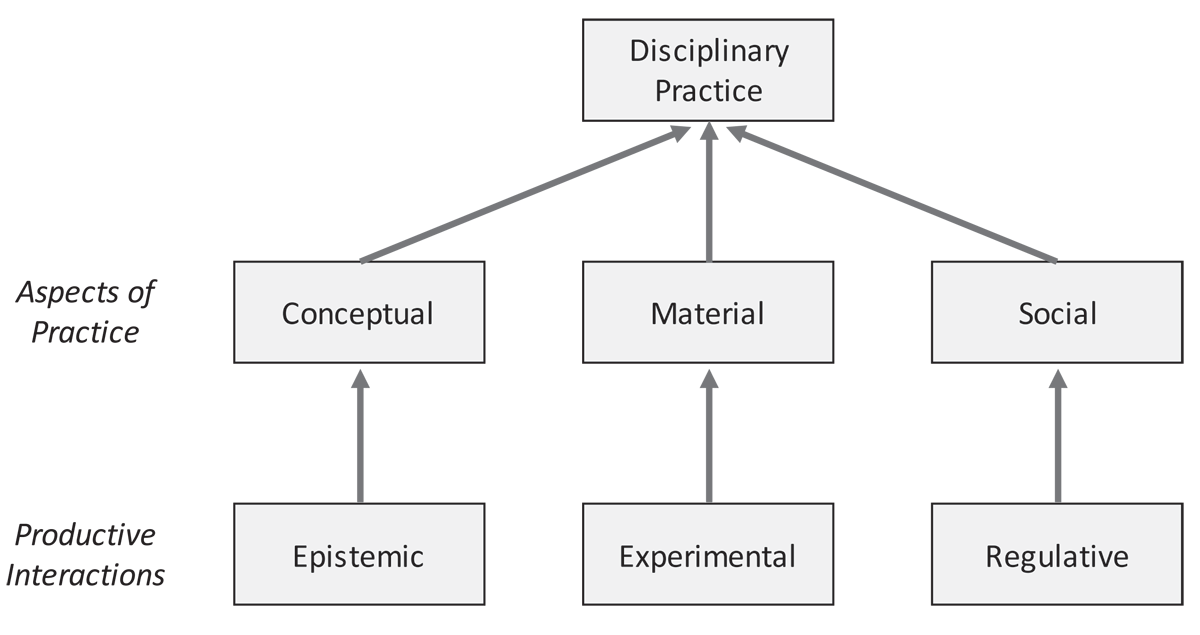
Figure 1
Relating dimensions of productive interactions to aspects of disciplinary practice.
The epistemic dimension involves interactions that include knowledge and dealing with knowledge-related aspects of engineering work (ideas and concepts; Damşa, 2014). This dimension aligns with the conceptual aspect of practice. Actions that aim to create a shared understanding of the task through the exchange of insights, ideas, and fundamental knowledge are part of the epistemic dimension. The regulative dimension involves interactions that aim toward project coordination between group members (Damşa, 2014; Saab, 2012), which aligns with the social aspects of practice. Division of labor, the organization of the collaborative process, and monitoring the work performed by the individual members are part of regulative interactions. To these two dimensions, we extend Damşa’s categories by adding an experimental dimension, defined as the activities that aim to design data collection events (Apedoe & Ford, 2010) or the production of prototypes (Campbell et al., 2007), to capture the material aspect of practice.
Theoretically, this study relies on the alignment of two frameworks, aspects of disciplinary practice and productive interactions, as shown in Figure 1. However, the epistemic and experimental group interactions used to identify conceptual and material aspects of practice, respectively, are verbal and, therefore, fundamentally also social. This aspect leads to classification issues. For example, in Damşa’s productive interactions framework, “critique” is categorized in terms of the content of the critique; thus, the interactions of critiquing, such as negotiating ideas, are placed in the epistemic dimension. Extending this organization in this study, critique is also found in the experimental dimension as part of the evaluation of measurement ideas or experimental strategy. In contrast, Ford and Forman (2006) regard “critique” as a social practice since it reflects social interactions among group members. While we follow Damşa’s categorization, we acknowledge Ford and Forman’s as equally valid.
Model of Influence
We adopt the model of influence from Engle and colleagues (2014), which was derived from observing persuasive discussions in a science classroom. The model of influence contains the following elements:
A member’s socially negotiated degree of influence
The socially negotiated merit of a participant’s arguments
A member’s socially negotiated degree of authority
A member’s socially negotiated degree of access to the conversational floor
We utilize the model of influence to relate the productive interactions of individual group members described above to the group practice.
The socially negotiated degree of influence represents the degree to which the group member is socially positioned as being able to sway others’ stances on the issue being discussed. According to the model, this degree of influence includes convincing others to adopt, weaken, strengthen, or change their positions on the topic being discussed. In this study, particular members are categorized with a socially negotiated degree of influence when they explicitly direct the group’s discussion and control group dynamics.
The socially negotiated merit of a member’s arguments represents the degree to which others respond to their arguments as being of high quality. According to the model, the quality of arguments is not judged by a disciplinary normative evaluation of merit, but through the group perceptions based on the group’s local norms about what arguments are considered as high quality. In this study, the local norms which contribute to the merit of arguments are apparent in the discourse when the members justify their arguments using information from resources or experimental data.
The member’s socially negotiated degree of authority represents the degree to which the member is treated as a credible source of information and, thereby, enhances the merit of their arguments. This aspect considers authority and status as the basis for the local negotiations about which member is treated as being a credible source of information in relation to the topic being discussed. In this study, group members who use information from various credible sources such as academic research papers and classroom documents to justify their arguments and enhance the arguments’ creditability boost their socially negotiated degree of authority and consequentially bolster their degree of influence.
The member’s socially negotiated degree of access to the conversational floor represents the degree to which a participant can initiate turns, complete them without interruption, and control who else has access to the floor. The conversational floor is defined as a socially negotiated space where group members present verbal contributions to a discussion. In this study, preventing a particular member’s access to the conversational floor (such as by talking over them) would reduce their influence since those members do not have the opportunity to express ideas or complete a discursive turn. In contrast, encouraging them with short utterances increases access to the conversational floor.
Research Questions
We characterize the group practice in a realistic, open-ended task by addressing the following research questions:
In two stages of the ISVL Project, what types of productive interactions (epistemic, experimental, regulative) manifest? What is their frequency? How does the talk distribute among students? How do earlier and later stages compare?
How does the influence of the individual group members differ between the earlier and later stages? In what ways do the members’ interactions with each other and with the supervisor (instructor) influence the emergent roles of each group member?
Methods
With this illustrative case study (Case & Light, 2011; Yin, 2014), we provide an in-depth description of the shifts in group practice of one student group as they complete a realistic, open-ended engineering project. Illustrative case studies employ one or two instances of an event to exemplify a situation, serving to render the unfamiliar into something recognizable. The study was motivated by the second author’s observations and experiences of shifts in group interactions as engineering students pursue realistic, open-ended engineering tasks. We are not so much interested in how work is divided between group members to complete portions on their own, but rather the situations where they need to jointly co-construct understanding and strategies to co-produce a design product (Koretsky et al., 2014, 2021; Volet et al., 2013). Analysis consisted of two parts. First, we addressed Research Question 1 through longitudinal coding of an earlier and later stage to identify types of epistemic, experimental, and regulative productive interactions and quantify the degree that each group member verbally contributed (Merriam, 2009; Miles et al., 2018). Second, we addressed Research Question 2 through discourse analysis, including a focus on intonation to reveal the influence of each student during each stage (Gee, 2004; Pickering, 2001). Taken together these analyses allowed us to infer changes in group practice and relate those changes to the task characteristics and instructor facilitation.
Participants and Setting
The data reported here were collected from one group of three students who were enrolled in a senior-level capstone laboratory course. Data were collected as the group completed an industrially situated virtual laboratory (ISVL) project. The project was the second of three laboratory projects during the term; the first and third projects used physical laboratories. The participants were placed in the same group throughout all three projects. The group members all had strong prior academic performance records but did not have internship experience. They consisted of two US-born White women (labeled A1 and A2) and one US-born White man (A3). The instructor, who serves as project supervisor, is a US-born White man. This research was approved by the institutional IRB (study #3660) and each participant signed an informed consent form.
The primary data source was audio recordings any time all group members met. There was no fixed number of meetings or length of meetings that each group could conduct during the three-week project; they simply coordinated their work to complete the project while also attending to other class and life commitments. A researcher was present to take ethnographic field notes and collect audio recordings during each meeting. Audio recordings were transcribed, and the transcripts and recordings served as primary sources for data analysis. Group work products and records of their interaction through the virtual laboratory database as well as the ethnographic field notes were used as secondary sources to confirm or refute analyses from the audio records.
Positionality
The researchers’ positionality is as follows. The first author is an able-bodied, cisgender male born in Thailand. He completed this study as part of his education-focused PhD dissertation in Materials Science. He also has BS and MS degrees in Electrical and Computer Engineering and teaching experience in higher education. His motivation to investigate the engineering students’ small group interactions stems from his experiences as an engineering student where he often felt his ideas were ignored during groupwork. In this work, the first author collected ethnographic data from students as they completed the ISVL project and provided a resource to analyze student discourse in this work. He drew on his linguistic background as a native Thai speaker, a tonal language, to develop innovative aspects of the discourse analysis described below.
The second author is a US-born, able-bodied, cisgender White male. As a faculty member, he teaches engineering and education courses and directs a research program in engineering education. One aspect of his research focuses on developing and investigating learning systems that challenge students to integrate and extend the knowledge they are taught in specific courses in the core curriculum to the more realistic, open-ended tasks they will face in professional practice. To that end, he developed and leads a research program studying a set of industrially situated virtual laboratories, such as the one studied here. Through many years of collaboratively analyzing recorded group work and student-instructor interactions, he has often found initial disagreements in interpretations of transcripts alone can be resolved through viewing the source recording. Here, he was intrigued by the tonal analysis suggested by the first author in providing a richer format in the archival record.
Both authors are committed to addressing inequitable social practices in engineering. We view team role-formation as central to instructional practice and not an idiosyncratic aspect of this study. We seek to understand how unproductive group practice might stem from the nature of the work that students have commonly faced in engineering school, and the resulting ways they have become accustomed to self-organizing. Correspondingly, this project is part of a larger reform effort to transform student activity in engineering school to address sociotechnical practices of engineering and involves expanding notions of instructor practice as well.
In this analysis, we fully recognize that the social practice of engineering students is complex and acknowledge the many opportunities to marginalize other students’ views in small group collaborative learning. We recognize that our motivations influenced and foregrounded aspects of the interactions studied here. Through holding each other accountable and through personal reflection, we strove to honestly report our findings, but this study should be read with our motivations in mind. Importantly, as an Asian man and a White man, we recognize our collective experiences have informed and also limited the ways we have analyzed the group’s social practice that preclude other ways this group’s story could be told.
Industrially situated virtual laboratory (ISVL) project
The ISVL project was assigned in a senior-level capstone laboratory course in chemical, biological, and environmental engineering at a large public university in the Pacific Northwest of the United States. In the project, students work in in-person groups while collecting data in a virtual laboratory environment. The assignment tasks the groups with the engineering objective of developing an optimal process “recipe” for a low-pressure chemical vapor deposition (CVD) reactor. The ISVL project embeds features which resemble the real engineering workplace experience such as developing a design plan before experimentation, weekly meetings with a supervisor, presentation of the final project deliverables, and budget management.
This three-week long project serves as a vehicle for students to interact and collaborate as a group to develop input parameters for one step of a multistep process in high volume semiconductor manufacturing. At the beginning of the project, the instructor presents the design criteria, key technical considerations, and provides a demonstration of the 3D interface. Optimization includes depositing a silicon nitride (Si3N4) film to target thickness that is as uniform as possible, consuming as much of the reactant gas as possible, and minimizing development and manufacturing costs. Participants are charged virtual money for each experimental run and each measurement. The relationship between the input parameters and the film characteristics is complex, thus providing a realistic engineering challenge. Each group is also required to keep a detailed laboratory notebook, similar to those kept in the industry.
More details of the learning system are provided elsewhere (Koretsky et al., 2008, 2011b).
Sampling strategy
The target group was selected for analysis from amongst available recorded data that has included over twenty student groups and three expert groups, described elsewhere (Fisher et al., 2016; Gilbuena et al., 2015; Hirshfield & Koretsky, 2018; Koretsky et al., 2014, 2021; Sherrett et al., 2013). The group was selected for microgenetic analysis based on Engle et al.’s (2014) three selection criteria. The group practice during the preparing stage followed Engle et al.’s (2014) first two selection criteria, one student was particularly influential (selection criterion 1), and the disciplinary quality of the student’s arguments was relatively low (selection criterion 2). Both these aspects disappeared during the experimenting stage which makes this case revelatory (selection criterion 3).
Groups spent a considerable amount of time completing the ISVL project. For detailed analyses, we chose two stages that we could clearly identify, the preparing stage and the experimenting stage where groups were addressing different aspects of the task. We also characterize the interactions of the group with the instructor (supervisor) during the group’s first design memo meeting (DMM 1–1 and DMM 1–2). While we focus on the details of the preparing and experimenting stages here as exemplars, we have coded the entire transcript closely and the shift in group practice found in these two stages are generally representative of the overall project.
Figure 2 shows the meeting timeline for the 21 hours that the group studied here collaboratively worked. Each block is scaled in proportion to the length of the corresponding meeting. The arrows labeled “10XX” represent an experimental run and measurement set. For example, “1001” represents the group’s first experimental run, “1002” the second run, and so on. The light grey blocks represent meetings with the instructor, who is socially positioned as the group’s supervisor. The first meeting is a design meeting (DMM 1) where the group presents their design memorandum to the supervisor, discusses their plans, and needs to receive approval in order to obtain the access code to perform experiments. The second meeting (DMM 2) is an update meeting after they have conducted several experiments. In the case studied here, the group needed to revise their memo in response to the supervisor’s critique in DMM 1–1, leading to a follow up meeting (DMM 1–2). The dark grey block at the end of the timeline represents the final group presentation after the group had submitted a process recipe to high volume manufacturing. In the preparing stage, the group refined their design to report in the DMM. In the experimenting stage, they made sense of the first set of collected data, after run 1001. These stages are denoted on the timeline in Figure 2.
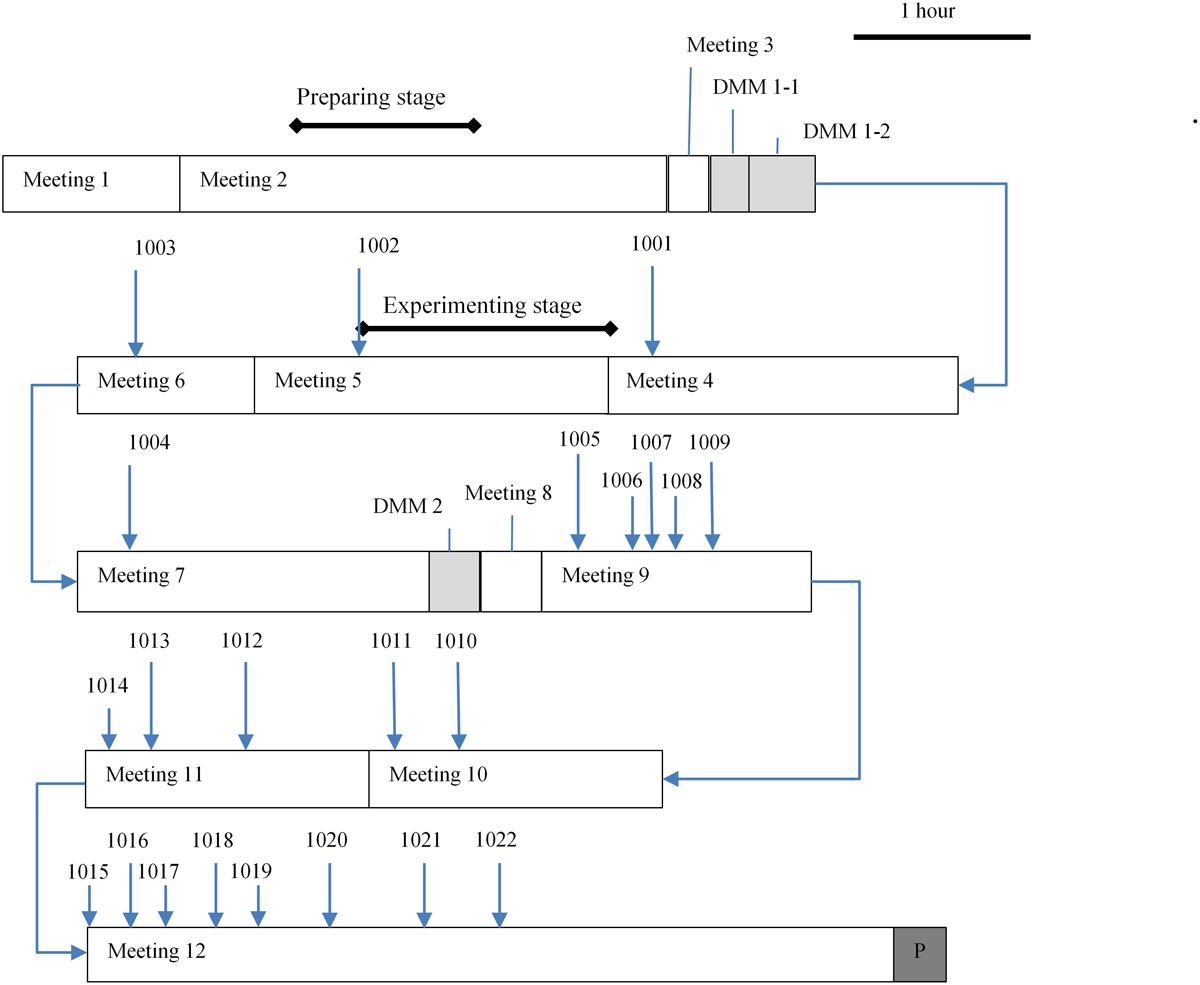
Figure 2
Meeting timeline for the group studied in this project with experimental runs (10XX), meetings with the supervisor (DMM), and final project presentation (P) shown.
Coding
The transcripts from each group were analyzed through open coding using both a priori and emergent codes (Merriam, 2009; Miles et al., 2018). An initial set of code categories was formed based on Damşa (2014) that corresponded to the epistemic and regulative dimensions of productive interactions and formed the basis for the categories describing the conceptual (Table 1) and social (Table 2) aspects of engineering practice, respectively. These were modified to fit the context of the IVSL project. The conceptual aspect of practice consists of productive interactions that aim to introduce fundamental knowledge, theories, and ideas to create shared understanding. Productive interactions codes that exhibit the collaboration between each group member represents the social aspect of practice. In addition, new code categories were formed by analogy to capture productive interactions that orient around designing data collection events, the material aspect of engineering practice (Table 3). Additional categories of productive interactions emerged through the iterative open coding process and are also shown in Tables 1, 3.
Table 1
Productive Interaction codes for conceptual aspects of practice (epistemic dimension).
| CODE NAME | CODE DESCRIPTION | EXAMPLE |
|---|---|---|
| Problematize (PROB) | This includes instances when a group member questions the shared concepts, data, or other group members’ ideas. | Creating awareness of the situation by raising questions such as “Why do you think that?” |
| Generating ideas (G-IDEA) | Bringing in ideas that can contribute to creating or extending a shared understanding of the problem or the situation at hand. | Bring in physical reactor characteristics to help illustrate gas flow. |
| Elaborating ideas (EL-IDEA) | Clarifying and justifying ideas to other group members | Explain to other group members about the operating regime of the CVD reactor. |
| Evaluating ideas (EV-IDEA) | Assess the feasibility of the proposed ideas | Evaluate the direction of gas flow inside the reactor. |
| Perform calculations (CALC) | This code applies when group members perform calculations, regardless of the type of computational tool. | Calculate process parameters such as precursor flow rate. |
| Develop computational tool (DEV-tool) | Develop and modify computational tools (Excel sheet, JMP). | Generating excel spreadsheet. |
| Analyze results from computational tool (ANZ-tool) | Review, interpret and share results from computational tools and graphical representation. | Examine a graphical representation of results. |
Table 2
Productive Interaction codes for social aspects of practice (regulative dimension).
| CODE NAME | CODE DESCRIPTION | EXAMPLE |
|---|---|---|
| Coordinating process (COORD) | Organizing activities within the group (plan for next meeting, assign responsibilities, dividing tasks). | Regulate other group members’ activities. |
| Sharing Information (SHARE) | Sharing information from sources (internet, book, lecture note, in-class demonstration, or other groups) among group members. | Provide process parameters from literature. |
| Reflecting on individual and collective actions (REFLECT) | Discussing the progress of the group’s work. | Express satisfaction in collective accomplishment, i.e., “We’re doing well.” |
| Agreeing (AGREE) | Exhibiting agreement among group members. | Express “Yeah” or “Yes.” |
Table 3
Productive Interaction codes for material aspects of practice (experimental dimension).
| CODE NAME | CODE DESCRIPTION | EXAMPLE |
|---|---|---|
| Generating experimental strategy (G-EXP) | Develop an experimental strategy as a solution to the problem or to acquire a better understanding of the situation. | Choose process parameter to be explored in the next experiment. |
| Elaborate experimental strategy (EL-EXP) | Clarifying and justifying experimental strategy to other group members. | Tell the group why growth temperature should be decreased on the next run. |
| Evaluating experimental strategy (EV-EXP) | Assess the feasibility of experimental strategy. | Make a judgment on the value of a process parameter. |
| Generating measurement strategy (G-MEA) | Develop a measurement strategy. | Propose the number of measuring points on a wafer. |
| Elaborate measurement strategy (EL-MEA) | Clarifying and justifying measurement strategy to other group members. | Explain the reason behind the measuring pattern. |
| Evaluating measurement strategy (EV-MEA) | Assess the feasibility of measurement strategy. | Make a judgement on a measuring pattern. |
Using the codes in Tables 1, 3, productive interactions were coded from the transcripts and audio recordings on a turn-by-turn basis. A turn, defined as an utterance from a single group member, forms the unit of analysis. An utterance when one group member speaks is counted as one turn until another group member speaks (Gilbuena et al., 2015). Often, another member begins to talk before the current speaker finishes speaking. In that scenario, a turn is assigned to the team member that enters the conversation, and the turn of the previous member is considered over. This classification is applied to show the dynamic exchange between team members, which is essential to this study. This study does not limit the size of the utterance. Backchannel utterances (ex. um, uh-huh, etc.) are often excluded from the turn-taking analysis because they do not provide a referential message (Maschler & Schiffrin, 2015). In team interactions, backchannel utterances can provide information for the speaker to adjust their talk accordingly (Clark & Krych, 2004; Clark & Murphy, 1982). Thus, the listeners are participating in a joint construction of developing dialogue (Tolins & Tree, 2014). We classify such utterances as either strong or weak. The strong backchannel utterances that illustrate commentary on the preceding utterance are counted in the frequency analysis whereas the weak backchannel utterances that serve as a grounding display (Clark & Brennan, 1991) are not.
Each turn could be assigned multiple codes. Reliability was ensured by regular coding meetings with the two authors where the two stages reported were jointly coded. During these meetings, the emerging coding categories were discussed and modified until consensus was achieved. Counts of code categories are presented to understand the degree to which each group member contributed to discussion of conceptual, material, and social aspects of practice during the preparing stage and the experimenting stage.
Discourse Analysis
This study includes qualitative analyses on the interactions between group members to illustrate the patterns of influence and connect them to aspects of practice in greater depth. We interrogated the data searching for connections between influence and practice. These interactions often occurred during episodes when the group encountered productive friction, moments when students needed to coordinate or reconcile discrepant information (Koretsky et al., 2014), which triggered the opportunity for collaboration. Following the extended case method (Burawoy, 1998), we sought to move from micro to macro by building on preexisting theory—using the model of influence framework (Engle et al., 2014). Specifically, during interactions, we identified instances of a group member’s: (1) degree of influence, (2) degree of authority, (3) degree of argumentative merit, and (4) access to the conversational floor. In particular, we focused on interactions when a group member made a bid to introduce a new idea or new strategy. For example, influence was inferred by the response of the group. If the bid was taken up, we could say that member had influence. On the other hand, if it was ignored or rebuffed, then that member lacked influence. The other aspects of the model of influence also emerged, as described in the Conceptual Framework above. Specific excerpts from the group discourse were selected to illustrate the general pattern of influence and group practice for each stage and for the meeting with the instructor.
The excerpts presented in this study are intonated to represent the tone of each utterance. Intonational features have a pragmatic function in illuminating the sociolinguistic information which is essential to establishing successful collaboration (Brazil, 1997; Clennell, 1997; Nattinger & DeCarrico, 1992; Pickering, 2001). For example, an intonation of a rising tone in the words “right” or “ok” after a group member finishes an explanation often conveys that the speaker is using these words as a comprehension check to seek clarification from other group members or to verify that they are following along. Alternatively, use of a series of level and falling tones can indicate the speaker has shifted their focus away from the group and is reading from a textbook (Pickering, 2001).
Intonational conventions from Pickering (2001) are used in this study as follows:
| // | represents the tone unit boundaries |
 | represents rising tone associated with the tone unit |
 | represents falling tone associated with the tone unit. |
| → | represents level tone associated with the tone unit. |
| UPPERCASE | represents prominent syllables indicating stressed or salient words. |
| UPPERCASE | represents tonic syllable carrying the tonal pitch movement associated with the tone unit. |
Findings
The findings are presented in two parts: (1) the quantitative percentage of productive interactions for each group member (Research Question 1) and (2) qualitative analysis of excerpts from representative episodes during the different stages of the project (Research Question 2). The first section (percentage of productive interactions) suggests that the participation pattern of members of the group studied shifted between the earlier preparing stage and later experimenting stage. The second part presents excerpts that illustrate a corresponding shift in the characteristics of the interactions between the group members. The design memo meeting, in between the two stages analyzed, provides indications of social repositioning that are commensurate with the shift. Taken together, these analyses provide evidence of a shift towards more equitable and distributed group practice.
Quantitative analysis: Percentage of productive interactions
For each of the two stages, the earlier preparing stage and the later experimenting stage, each discursive turn was coded for the identified productive interactions. For each stage, we first present the overall percentage of productive interactions for each group member and then the distributions of the specific productive interactions in the epistemic, experimental, and regulative dimensions. While we do not suggest that these data on their own are sufficient to draw conclusions about the group practices, certain patterns emerged that, taken together with the discourse analysis presented next, indicate a shift in the nature of the group’s practice. We interpret this shift as evidence for emerging roles of the less dominant group members and the shifting role of the high-status student.
Figure 3 shows the overall percentage of productive interactions of each group member (A1, A2, and A3) in the preparing stage and the experimenting stage. A Pearson’s chi-square test shows the distribution of talk moves is significantly different (χ2 = 16.2, df = 2, p < 0.001), shifting from the earlier stage where A1 clearly contributes more discursive turns than the other two group members to the latter stage which exhibits a more even distribution of discursive turns.
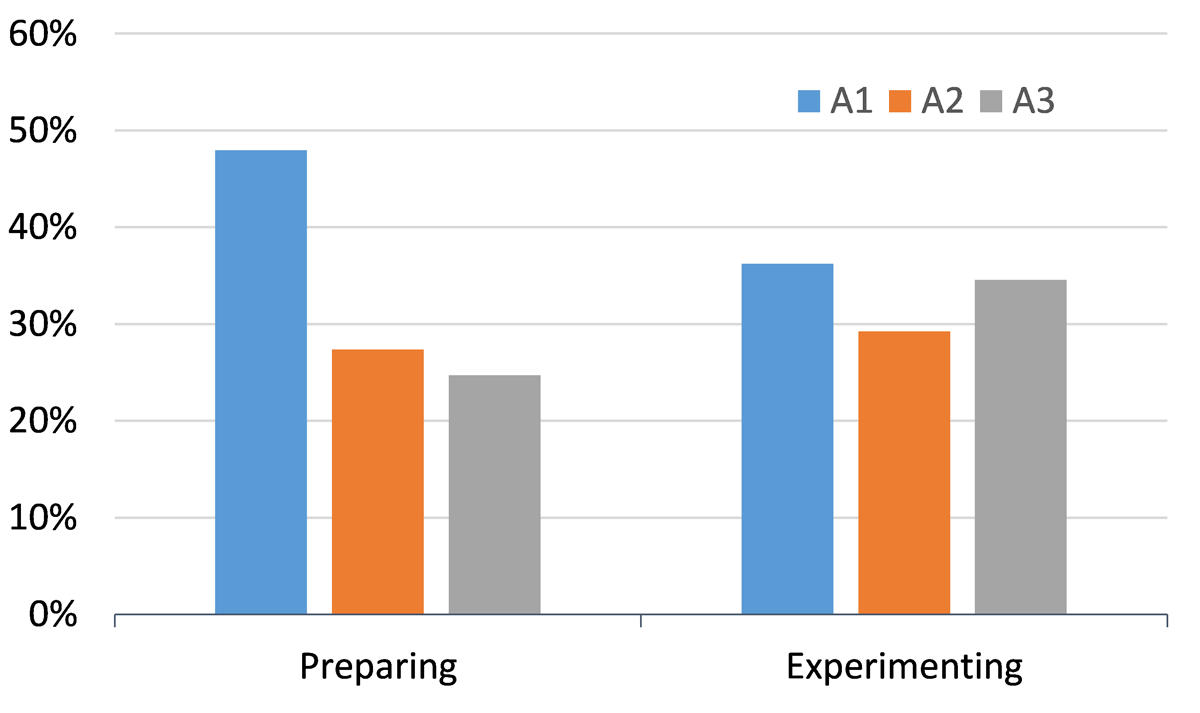
Figure 3
Overall percentage of productive interactions for group members A1, A2, and A3 for the preparing stage and the experimenting stage.
Figure 4 shows the frequency of turns in the epistemic dimension for each stage. Comparing the percentage of productive interactions reveals key changes between the three members across the two stages analyzed. In the preparing stage (Figure 4a), the interactions most observed from all three members are problematizing (PROB) and elaborating ideas (EL-IDEA). Group members also attend to generating ideas (G-IDEA) and evaluating ideas (EV-IDEA). In every case, A1 has the highest percentage of productive interactions with A2 second and A3 third. The productive interactions in the epistemic dimension are more distributed during the experimenting stage, as shown in Figure 4b. Other members emerge to have a higher percentage of turns in some categories. A2 has the highest percentage of interactions on problematizing (PROB) while A3 has the highest percentage of interactions on elaborating ideas (EL-IDEA). The tool-related interactions also appear in the experimenting stage. All three members interact in the tool-related interactions with A2 having the highest percentage of interactions in developing computational tools (DEV-tool) and analyzing results from computational tools (ANZ-tool).
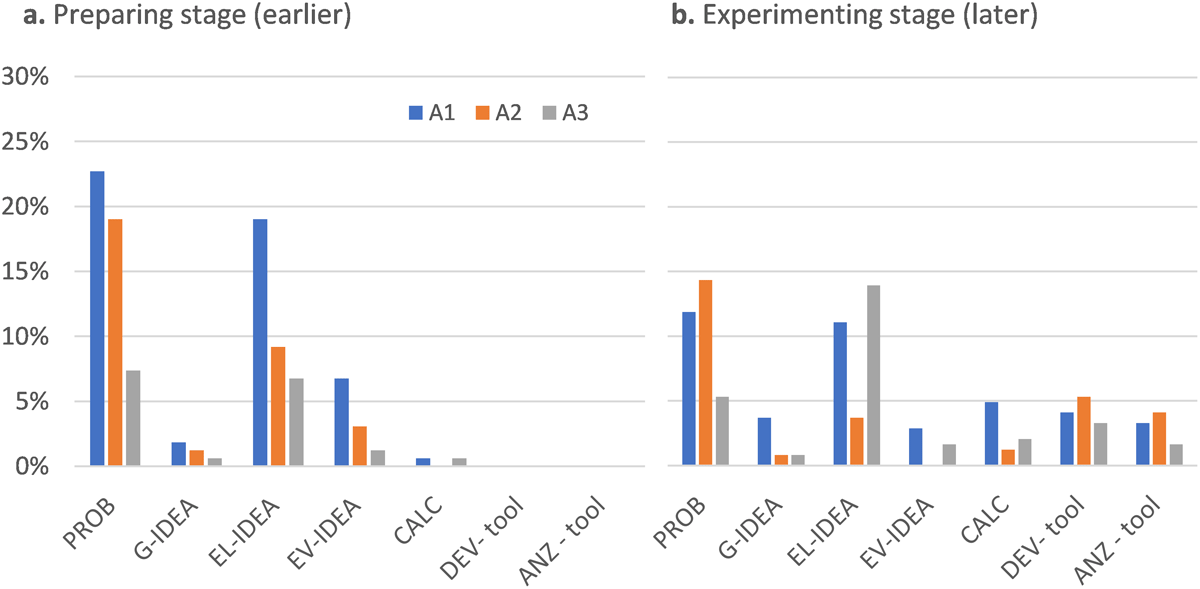
Figure 4
Percentage of productive interactions in the epistemic dimension. (a) Preparing stage. (b) Experimenting stage. Table 1 shows the code category definitions.
Figure 5 shows the frequency of turns of each group member in the experimental dimension for each stage. Comparing the percentage of productive interactions reveals similar key changes between the three members across the two stages. In the preparing stage (Figure 5a), the interactions most observed from all members are elaborating experimental strategy. A1 again has the highest percentage across every productive interaction revolving around the experimental strategy (generating, elaborating, and evaluating experimental strategy). A3 has the highest percentage in elaborating and evaluating measurement strategy. A2 has the highest percentage in generating measurement strategy (G-MEA). But these latter two categories are a small percentage of the group total discursive turns. Again, the distribution of productive interactions change during the experimenting stage (Figure 5b). Unlike the results from the preparing stage where A1 has highest percentage of interactions in most categories, A3 now has highest percentage across most categories. A3 interacts more on generating and elaborating experimental strategy. A1 interacts less in most categories except elaborating measurement strategy in this stage. A2 has the lowest percentage of talk turns in most categories.
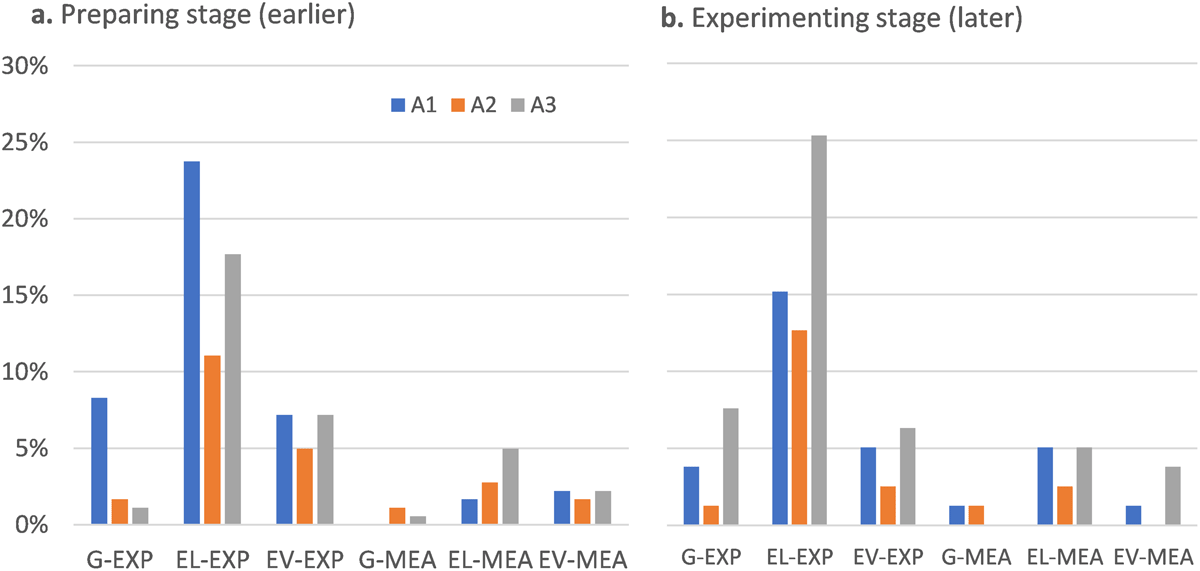
Figure 5
Percentage of productive interactions in the experimental dimension. (a) Preparing stage. (b) Experimenting stage. Table 3 shows the code category definitions.
Figure 6 shows the frequency of turns of each group member in the regulative dimension for each stage. Comparing the percentage of productive interactions reveals similar changes in the distribution of discursive turns. In the preparing stage (Figure 6a), all categories of productive interactions are observed from all three members. A1 has the highest percentage of interactions in most categories with A2 second and A3 third in coordinating process (COORD) and sharing information (SHARE). A3 has the highest percentage of interactions on agreeing (AGREE), followed by A1 and A2. In contrast, the productive interactions indicate a different pattern during the experimenting stage (Figure 6b). Unlike the results from the preparing stage where A1 has the highest percentage of interactions in most categories, A1 only has the highest percentage for the coordinating process (COORD). A1 interacts less frequently in other categories than observed in the preparing stage. A3 has the highest percentage and interacts more frequently on sharing information (SHARE) and agreeing (AGREE).
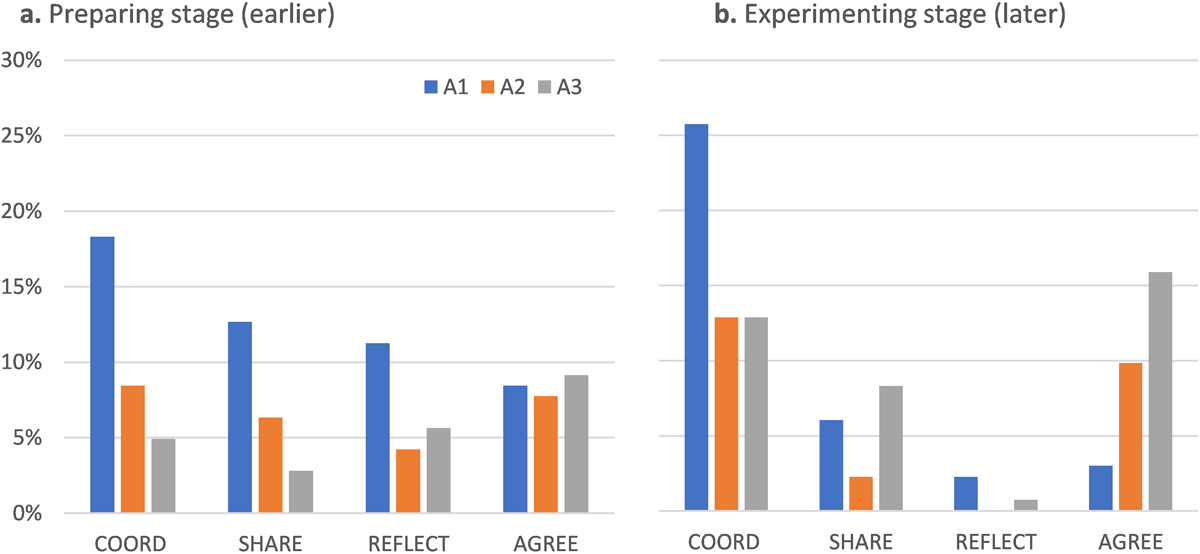
Figure 6
Percentage of productive interactions in the regulative dimension. (a) Preparing stage. (b) Experimenting stage. Table 2 shows the code category definitions.
In summary, A1 consistently has the highest percentage of productive interactions in the preparing stage. On the other hand, more discursive turns from other group members emerge during the experimenting stage; for example, A3 contributes the highest number of talk turns for the experimental dimension and A2 for the tool-related categories in the epistemic dimension. The results indicate a shift in group practices from being dominated by a single member in the preparing stage to more distributed group interactions in the experimenting stage.
The next section presents the discourse analysis for both stages to illustrate the dynamics between the three members also changes. In addition, excerpts taken from the design meeting with the instructor (supervisor) are also provided as this meeting appears to support the shift in group practice.
Discourse analysis: Shift of group dynamics during project stages
This section uses the model of influence (Engle et al., 2014) to interpret the changing roles of the group members and how their roles influence the group dynamics during the interactions in the preparing stage, the design memo meeting, and the experimenting stage. Table 4 provides a summary of the ten excerpts described. Intonation markers, adapted from Pickering (2001), are used to indicate the tone in each speaking turn (See Methods, Discourse Analysis).
Table 4
Discourse excerpts that illustrate shifting group practice.
| EXCERPT | TURN NUMBERS | STAGE | DYNAMIC |
|---|---|---|---|
| P1 | 91–98 | Preparing | A1 is influential through exhibiting the merit of an argument, authority, and access to the conversational floor. |
| P2 | 99–108 115–125 | Preparing | A1’s influence on other members continues |
| P3 | 126–134 | Preparing | A1 exercises authority to influence the group’s direction |
| D1 | 467–474 | Design Meeting | A1 accepts and takes on A3’s ideas |
| D2 | 494–500 | Design Meeting | A1 and A3 build on each other’s ideas |
| D3 | 534–538 568–569 | Design Meeting | Supervisor repositions A3 as author of an alternative perspective |
| E1 | 645–654 | Experimenting | A3 emerges as an influential member in the experimenting stage. |
| E2 | 656–665 | Experimenting | Accountability to nature bolsters A3’s degree of authority |
| E3 | 704–713 | Experimenting | Collaborative interactions between A1 and A3 ensue in the generation of experimental strategy |
| E4 | 597–609 | Experimenting | The access to tools foster A2’s authorship |
Preparing stage
During the preparing stage, the group is working to produce the design memorandum for their meeting with the supervisor (instructor). Activities from this stage include performing a literature search, identifying the salient phenomena inside the reactor, and developing the initial settings of the process parameters for the first experimental run.
Excerpt P1. A1 is influential through exhibiting the merit of an argument, authority, and access to the conversational floor
The following excerpt centers on the discussion between A1 and A2 as they read and interpret a paper on Si3N4 CVD from the literature in terms of diffusion and molecular transport. The excerpt illustrates dynamics common in the preparing stage where A1 is positioned as the most influential member of the group. Although A1 and A2 both have a high degree of access to the conversational floor, their degree of influence varies due to the difference in their degree of authority and merit of arguments. The numbers on the left indicate the turn number for the group among the excerpts analyzed.
| 91 | A2: | // → you KNOW diffusion //n |
| 92 | A1: | // → OH okay // → that’s what we want [laugh] // ↘ LET’s consider the case diffusion is MUCH longer // → than the system size // → OH, that’s not what we want. |
| 93 | A2: | // [reading] ↘ The diffusion length [pause] system size // ↗ uhhhh NO // [reading] ↘ reaction is very insignificant NO // [reading] ↘ convection is very significant // |
| 94 | A1: | // ↗ No it’s not // → Uh uh Uh uh // |
| 95 | A2: | // ↗ is IT? // |
| 96 | A1: | // ↗ NO // |
| 97 | A3: | // → WAIT ah ah // |
| 98 | A1: | // ↗ HE [the supervisor during the class-wide demonstration] said // → HE WAS saying that you are going to have that flow. It is not going to influence what goes in at all // → it’s all diffusion that influences // → And IT’S NOT important unless it is on top of the wafer // → Anything on the sides of the wafer don’t matter // → IT’s WHAT gets diffused that’s important // |
Although A2 generates ideas of diffusion in turn 91, it is A1 who elaborates the idea. A1 intellectually expresses a deep understanding of the concepts, which boosts her degree of argumentative merit. While A1 elaborates the idea, both A2 and A3 pay attention and listen to A1. This positioning shows evidence that the group views A1 as a credible source of information, which boosts A1’s degree of authority. In addition to the perception from other members, A1 uses the claim from their supervisor from the class demonstration to further gain authority. Referring to the supervisor’s claim positions A1 as a creditable source of information (turn 98). Using a rising tone and stressing the word “HE (the supervisor)” verbally bolsters A1’s degree of authority. The degree of argumentative merit, authority, and access to the conversational floor in this example is typical of how A1 positions herself as the most influential member throughout the preparing stage, where A1 largely controls and directs the group’s discourse and progress.
Excerpt P2. A1’s influence on other members continues
This following excerpt illustrates how A1 asserts authority and influences the interactions with other group members. It shows the continued discussion from excerpt P1 where A1 and A2 discuss the paper from the literature on diffusion in the CVD reactor:
| 99 | A2: | // ↘ do you do the reaction over there? // |
| 100 | A1: | // ↗ I don’t know // → my impression was that this was diffusive controlling, just like they’re saying // ↘ SEE, reactors behave like Thiele // ↘ which is saying that Thiele is diffusive // |
| 101 | A2: | // ↘ hmm // |
| 102 | A1: | // [A1 sigh] [pause] ↘ I’VE been wrong before // → but that was my impression // |
| 103 | A3: | // → um hmm // |
| 104 | A2: | // → It just doesn’t sound right // → it sounds kind of like saying you can // → JUST put this gas in the chamber and it will diffuse whether or not // → there is flow to it // |
| 105 | A1: | // → YEAH. that’s true // → you filled your reactor up, close it // |
| 106 | A2: | // → [Talking over A1] is that because of a low pressure sysTEM? // |
| 107 | A1: | // → YEAH // → IT’S, it’s, it’s just like if you // anything, there’s nothing there it’s in a vacuum it’s going to want to go over // → like // ↗ So THE FLOW the the the // the flow rate isn’t going to PUSH on it // → it’s the fact that it’s under VACuum // → Like REALLY low pressure // → that you get // → IF THIS IS EMPtiness HERE // → there’s there’s NO molecules there and this is full of molecules that go over // |
| 108 | A2: | // → um hmm // |
After proposing the mechanisms of diffusive transport, A1 makes a move where she positions herself with a falling tone as not understanding (“↘ I’VE been wrong before,” turn 102) that potentially opens the conversational floor and provides opportunity for other members to contribute. This type of move is unusual for A1 during the preparing stage and A2 takes this up and provides a critique (“→ It just doesn’t sound right,” turn 104) that the gas transport inside the reactor is diffusion controlled. Thus, A2 has access to the conversational floor and can evaluate and elaborate ideas (turn 104). During this turn, A2 has the opportunity to direct the conversation. Despite gaining access to the conversational floor and bolstering her degree of influence, the influence from A2 is short lived. A1 reasserts her degree of influence when elaborating ideas to the group (“// → YEAH // → IT’S, it’s, it’s just like if you…,” turn 107). This act reinforces A1’s authority within the group as the credible source of information. Throughout the preparing stage, A1 asserts her source of authority and remains the most influential member, directing the group’s conversation.
In the continuation of this excerpt, the group is reviewing the literature on uniformity. In this case we see A1 exert her influence on another member of the group, A3:
| 115 | A1: | // → YEAH that’s what I am saying // ↗ WE don’t need to solve for d right now // ↘ we want to figure out temperature dependence on d and that’s not here in the literature [pause] // [reading] ↗ RADIAL UNIFORMITY is almost AUTOMATIC |
| 116 | A3: | // ↗ REALLY? // |
| 117 | A1: | // → [reading] aXIal uniformity is achieved // → we have // ↗ so why WASN’T his [the supervisor during the demonstration] radially? // |
| 118 | A3: | // ↗ YEAH why // → um // |
| 119 | A2: | // → I DON’T agree with that // → ‘cause THAT’S the point of this experiment |
| 120 | A1: | // ↘ How? // |
| 121 | A2: | // → we have to change the parameters to make it work // |
| 122 | A3: | // ↗ Maybe // ↗ Maybe his wasn’t um // → radially as bad as // |
| 123 | A1: | // ↗ [Talking over A3] MAYBE it’s almost automatic // → maybe if you have something reasonable running [A2 giggles] like your normal settings // |
| 124 | A2: | // ↘ yeah // |
| 125 | A1: | // ↘ and his were just weird // |
The excerpt shows the moment when the group encounters an episode of potential productive friction (Koretsky et al., 2014) where the information from the literature contradicts the class demonstration that they observed. A1 is perplexed with the contradiction and starts to problematize (turn 117) using a rising tone (↗ so why…) to emphasize the contradiction (WASN’T his [the supervisor during the demonstration] radially?). In response to A1, A2 relates the disparity to the objective of their work, which is to develop the process parameters to achieve the required uniformity while A3 begins to think about the issue (turns 118 and 122). As A3 begins to elaborate ideas regarding the issue, A1 reenters the conversation (turn 123), talking over A3 with a rising tone to reestablish control of the conversational floor (“↗ MAYBE it’s almost automatic”). Once in control, A1 dismisses the opportunity for scientific sense-making by declaring that the result from class demonstration is just “weird” albeit with a more tentative falling tone.
This excerpt exemplifies how A1 shuts down the pathway for collaborative reasoning by exerting influence and determining the group’s direction. This move is evidenced when A3 attempts to open the conversation by reasoning about the discrepancy (turn 122). A3 uses a rising tone, but, in response, A1 disrupts A3’s access to the conversational floor, using a rising tone herself (turn 123). In addition to shutting down the collaborative opportunity, this excerpt shows how A1 positions herself as the primary authority in determining the group’s direction with other members only having limited influence. This authority is evidenced in turns 123 and 125 when A1 concludes that the results from the literature are “normal” and from the class’s demonstration are “weird.” There are no further challenges from other members on A1’s authority in the preparing stage and the group proceeds in the direction A1 chooses.
Excerpt P3. A1 exercises authority to influence the group’s direction
The next excerpt illustrates another case where A1 influences the group’s direction when A3 suggests an alternate perspective. The situation occurs as the group reviews the literature on the relationship between diffusion and temperature. A3 suggests that the group should focus on developing the experimental strategy to explore this relationship:
| 126 | A3: | // → SO WE already have a good idea // → Ah ah ah a // ↘ ball-park idea of what temperature to try // |
| 127 | A2: | // → Right // |
| 128 | A3: | // ↘ Like // |
| 129 | A1: | // ↗ [Talking over A3] BUT we DON’T have a ball-park idea // → of the difference between 1 and 5 [A3 still speaking] |
| 130 | A3: | // ↗ OH // → yeah // → we don’t have a ball-park idea of the difference between 1 and 5 //→ we also don’t have a ball-park idea of um // ↘ of what the FLOW sHould be |
| 131 | A2: | // → NO // |
| 132 | A3: | // → we KNOW we know what they should be in relation to // |
| 133 | A1: | // ↗ [Talking over A3] OK // [reading] ↗ surface reaction rate is Slow // → and then we get radial uniformity // |
| 134 | A3: | // → HUH // |
The excerpt shows how A1 asserts influence on the group to steer the group away from exploring an alternative direction suggested by A3. The excerpt begins when A3 makes a bid by pitching that the group should explore what temperature to try (turn 126). As A3 starts to elaborate on the bid using a falling tone (turn 128), A1 impedes A3’s access to the conversational floor (turn 129), interrupting with rising tone (// ↗ BUT we DON’T have a ball-park idea). By stressing the word “DON’T,” A1 asserts the group is not ready to take up the idea proffered by A3 in turn 126. The response in turn 129 indicates that A1 does not want to take A3’s direction because the relationship between temperature across zones is not well understood. In following turn (turn 130), A3 drops the bid to explore the alternative direction and follows A1’s direction instead. This sequence illustrates that A3 has a limited degree of influence. In turn 133, A1 uses a rising tone, stressing the word “OK” while talking over A3 to reassert control of the conversational floor. A1 uses reference to the literature to impose authority on the group and steers the group’s direction away from A3’s alternative idea. The use of literature to boost her authority is similar to the earlier move where A1 used the external authority of the supervisor to exert influence. Another instance occurred again later in the meeting where A1 uses information from a written source (class notes from a previous course) to bolster authority and assert influence, again talking over A3. Here, A3 again drops his bid and conforms with A1’s experimental strategy.
Excerpts from the preparing stage illustrate A1 bolsters her authority through various external sources (information from the supervisor, from the literature, and from course notes), which allows A1 to assert influence on the group’s direction. The dynamics from these excerpts show that A1 combines this source of authority with corresponding verbal moves, often interrupting with a rising tone, to keep control of the conversation floor. A1’s level of influence hinders the ability of the other group members to contribute their perspectives and ideas about the direction of the project or for the group to co-construct understanding. However, different group dynamics are observed in the experimenting stage, as discussed shortly.
Design memo meeting
To further gain understanding on this transition of group practice we also performed discourse analysis from the first design memo meetings (DMM 1–1 and DMM 1–2). Those meetings occurred between the preparing stage and the experimenting stage where the group interacted with the project supervisor. They were required to present their design memo to the supervisor to obtain access to the reactor. In this section, we present the discourse from when the group interacts with the project supervisor during the design memo meeting.
The interactions present some traces which potentially translate into the shift of group practice observed in the experimenting stage. Throughout the DMM, A1 remains the most influential member by consistently accessing the conversational floor while interacting with the project supervisor. However, there are several instances where the other group members (especially A3) are re-positioned and provided with an opportunity to increase their degree of influence. While we cannot say this re-positioning caused the shifts observed in the experimenting stage, it is consistent with those changes and, therefore, interesting to us.
Excerpt D1: A1 accepts and takes on A3’s ideas
During DMM, the supervisor (S) poses a question to the group on the concept of the mean free path. In response, both A1 and A3 access the conversational floor with different answers. The supervisor then uses both responses and asks the group again:
| 467 | S: | // → so the MEAN free path is the distance a molecule travels on average before it hit // → bangs into another molecule |
| 468 | A1: | // → okay // |
| 469 | A3: | // → uh huh // |
| 470 | S: | // ↘ and as the pressure drops what do you think happens to the mean free path? // |
| 471 | A1: | // → It gets smaller // |
| 472 | A3: | // → it gets LONGER // |
| 473 | S: | // → smaller or longer? // |
| 474 | A1: | // → is there // → uh uh // → okay LONGER // → cause it hit // → sorry // |
Both A1 and A3 have access to the conversational floor in this excerpt. The response from A1 changes from “smaller” in the previous turn (471) to “longer” (turn 474), which matches the original response from A3 (turn 472). We interpret that this exchange could help position A3 as a credible source of information, which then boosts A3’s degree of authority and degree of influence. A more collaborative group dynamic is evidenced in the next excerpt.
Excerpt D2: A1 and A3 build on each other’s ideas
The interactions between A1 and A3 illustrate different dynamics than observed in the preparing stage. Recall that in the preparing stage, there were moments when A3 would conform with A1’s ideas to sustain A1’s degree of influence. Such dynamics were not apparent during DMM, but rather more collaborative interactions were observed between A1 and A3, as also seen later in the experimenting stage:
| 494 | S: | // → temperature and what ELSE? // |
| 495 | A1: | // → ummm concentration? // |
| 496 | S: | // → CONCENTRATION // → so // ↘ what HAPPENS to concentration as pressure goes down // |
| 497 | A3: | // ↘ concentration goes down // |
| 498 | S: | // ↘ concentration goes down // |
| 499 | A3: | // → if the pressure goes down too much then it will limit how much // → how concentrated // |
| 500 | A1: | // → And the REACTION rate goes down // ↘ concentration goes down // |
Both A1 and A3 have access to the conversational floor, which provides them each with influence. In contrast to the previous stage where A3 conformed with A1’s ideas, A3 is able to introduce ideas without getting rebuffed by A1 (turn 497). This access is supported by the supervisor revoicing A3’s idea (turn 498). This results in A3 gaining a greater degree of argumentative merit as A3’s idea is taken up by A1 who goes on to elaborate and connect it to reaction rate (turn 500). A3 emerges as a credible source of information, which also boosts A3’s authority. Furthermore, both A1 and A3 not only sustain their degree of influence without impeding each other, they are able to collectively build on each other’s ideas and expand the ideas, a central characteristic of group practice.
Excerpt D3: Supervisor repositions A3 as author of an alternative perspective
During the DMM, the supervisor not only provided feedback on the group members’ technical understanding, but also observed and provided feedback on the group’s social interactions. This feedback is consistent with the shift in group practice in the experimenting stage:
| 534 | A1: | // ↘ we would um find the parameters you gave us and the size and then we would look at their parameters and their size // and um // ↗ YEAH // we we um // → I THINK one thing that we DON’T know a lot about is // → the flow rate and how it exactly affects the concentration profile within the reactor // |
| 535 | S: | // yeah so you’re thinking really complex [A1] // → you jumped in [A1 laughs] and you’re thinking about THIELE MODULI and how to model diffusion in the wafers // → really high level and you know um that’s where we aim the course // → that’s where your COURSE WORK is at right now // → so that’s not surprising // → LET just // |
| 536 | A1: | // → [A2 laughs] jump back |
| 537 | S: | // jump back // ↗ REAL simply // → what do you need? // → so you have a certain MOLE per time // → and you have a certain time RIGHT? 60 miNUTES // → so what does that give you? // |
| 538 | A1: | // ↘the mols that are // ↘ of each thing |
In this exchange, the supervisor encourages A1 to think at multiple levels of complexity during the project. The supervisor notes that A1’s thinking is at a high level consistent with the classes that they are currently taking (“that’s where your COURSE WORK is at right now,” turn 535). By bringing up the level of complexity, the supervisor does not hinder A1’s degree of authority or influence but affords the opportunity for other members to be more influential by contributing different perspectives to the project, which can bolster their authority.
Toward the end of DMM, the supervisor emphasizes the importance of considering multiple perspectives in the project to the group:
| 568 | S: | // → so that’s a good check for you to do [A3] // → is to say hey // → you know um [A1] likes to think about things on really HIGH levels // → is this getting too complex? // → Ok because the HIGHer level you think on things // → if you get it working // → that is GREAT // → but more likely you’ll end up with something that is not working // → alright so that is kind of // a useful thing about a team // and team dynamics // → everybody brings these inclinations and strengths // → and your ability to negotiate through those is // → is also going to be important in addition to making those decisions // ↘ Right? |
| 569 | Group: | [Agrees] |
In the ending remark, the supervisor repositions A3 in a role to provide his perspectives on the project (“so that’s a good check for you to do [A3],” Turn 568). This repositioning bolsters A3’s degree of authority and encourages A3 to bring other perspectives to the project. In addition to repositioning A3, the supervisor acknowledges and reiterates A1’s reputation on this project as having high level of thinking (“you know um [A1] likes to think about things on really HIGH levels,” turn 568) and points out the consequences of thinking in a high level (“if you get it working, that is GREAT, but more likely you’ll end up with something that is not working,” turn 568). The notion does not hinder A1’s degree of influence or authority but opens an opportunity for other members to bolster their authority by bringing other perspectives to this realistic engineering project.
During the DMM, the dynamics between A1 and A3 shift towards more collective interactions. We see a similar dynamic in the experimenting stage, as described next. However, the interactions during the DMM do not provide A2 with similar opportunities. A2 remains less vocal than the other members during DMM and the preparing stage, and while A2 participates more in the experimenting stage, it is still less than A1 or A3 (Figure 3).
Experimenting stage
The experimenting stage occurs after the first experimental run where the group is analyzing their data to interpret it based on their current understanding and to determine what changes to make for the next experimental run (See Figure 2). During this stage, the dynamics shifted from being controlled by A1 to more collaborative interactions, which is consistent with the pattern observed in the quantitative analysis of productive interactions. Those results indicated the possibility that A2 and A3 are developing emerging roles of greater consequence as they both have a greater frequency of turns of productive interactions than A1 in many categories in the experimenting stage. The excerpts from the experimenting stage presented in this section illustrate a corresponding change in the dynamics between the group members.
Excerpt E1: A3 emerges as an influential member in the experimenting stage
The following excerpt, taken from the experimenting stage, illustrates a different characteristic of interaction between A1 and A3 than in the preparing stage – one that is more distributed and collaborative. As A3 engages in the conversation, A3 gains a greater degree of influence than in the previous stage as illustrated in the following excerpt:
| 645 | A1: | // → NOW // is there a WAY we can make a column that says concentration // do we do we know the concentration gradient is it linear? // |
| 646 | A3: | // → I DON’T know if it is linear // ↘ because of the way the temperature things are set up // ↘ and // ↘ it would depend on // |
| 647 | A1: | // ↗ The temperature things don’t matter // → I am talking about // → there’s no heat at all // → just you release that gas you have a gradient // |
| 648 | A3: | // → YEAH But the temperature is gonna affect that gradient because it will diffuse faster so // |
| 649 | A1: | // → WE we want a gradient that // when we are done with the temperatures // but it’s non-existent // ↘ at faster diffusion will match up WITH how thick it is |
| 650 | A3: | // → Uh huh // |
| 651 | A1: | // → can we assume it is zero at the TOP? // |
| 652 | A3: | // → No because // → we didn’t have partial utilization // → we can calculate the utilization based on how thick all of the wafers ARE // |
| 653 | A1: | // → uh huh // |
| 654 | A3: | // → and we can calculate that based on the thickness // → um the density // → we can calculate how many moles we deposited total // after adding up all of the wafers // |
The conversation in this excerpt shows that A1 remains an influential member of the group as observed in the preparing stage, but there is greater attention to A3’s ideas than in the previous stage. When A1 speaks with the rising tone, the voice does not impede A3 as in the previous stage, but rather appears to be a tone of collaborative excitement as also illustrated by A1’s utterances. As A1 is puzzling through the effect of temperature, as evidenced by a falling tone (turn 649), she appears to ask a genuine question to A3 (“→ can we assume it is zero at the TOP?” turn 651). A3 is able to complete the following turn when elaborating ideas and experimental strategy, which bolsters A3’s access to the conversational floor. A1 becomes more attentive to A3’s authority and encourages him to elaborate his idea, as indicated by the utterance, “uh huh,” (turn 653). This interaction allows A3 to continue speaking and finish his idea, which boosts A3’s access to the conversational floor. In addition to gaining access to the conversational floor, this collective dynamic boosts A3’s degree of authority and degree of influence consequentially.
Excerpt E2: Accountability to nature bolsters A3’s degree of authority
In the preparing stage, we see A1 often refer to external sources of authority (supervisor, paper, course notes) to increase her influence. In the experimenting stage, we see that data from the reactor provide A3 a source of authority as well. In the following excerpt, the group discusses an anomaly between two experimental results. Results from the supervisor’s demonstration run showed that the film thicknesses from the wafers towards the bottom of the reactor were thicker than those at the top. But the results from the group’s first experimental run are opposite; the film thicknesses from wafers on the bottom of the reactor are thinner than those at the top. As before, the situation potentially creates productive friction. Now it propels A1 and A3 into a discussion to make sense of the phenomenon. The excerpt shows the collaborative dynamics between A1 and A3 as they make sense of their results and plan for the next experimental run:
| 656 | A3: | // ↗ OH // → oh sorry, that’s the reason why it’s different // → the reason why it’s different in HIS [the supervisor’s] system is because // → um if you have you know 5 mol per liter // → coming through a bottom // |
| 657 | A1: | // → uh huh // |
| 658 | A3: | // → and some of the wafers they SUCK it up and start using it to react. // |
| 659 | A1: | // → Ohhh // |
| 660 | A3: | // → By the time it reaches the top you won’t have 5mol per liter you’ll have 4 mol per liter // → We want to try to get it // →so that as it goes UP // → the heat increases // → to a // → CONTROLLED DEGREE // |
| 661 | A1: | // yeah // |
| 662 | A3: | // → that it keeps getting used up and used up and used up // → But at the same time whilst being used up faster // → because it’s getting thinner // → we’re not depositing // → like in our case overcompensated and then ended up that our TOP WAFER are thicker than our bottom wafers // → UM But that just means that um // ↘ we have way too much flow in there // |
| 663 | A1: | // ↗ We have way too much FLOW? // → It wasn’t necessarily as a function of our temperature being too much of a difference? // |
| 664 | A3: | // → I think we need to lower the flow and raise the time because at least for purposes of utilization because that is one of the things you need to look out for // |
| 665 | A1: | //→ Okay // |
In contrast to the dynamics observed in the preparing stage where A1 directs all discussion, the discussion in this excerpt is directed by A3 and supported by A1 through regular utterances (“uh huh”, “Ohhh”, “yeah,” in turns 657, 659, 661, respectively). The support from A1 indicates that A1 acknowledges the ideas from A3, unlike their interactions in the preparing stage. A3’s degree of influence is bolstered from gaining access to the conversational floor, merit of the argument, and authority. Furthermore, having a successful bid enables A3 to maintain his influence and direct the group. In addition, the availability of data from the experiment bolsters A3’s authority. Having access to data, A3 is positioned as a credible source of information through accountability to nature, albeit simulated (Ford & Forman, 2006). Using the experimental data as evidence, A3 is able to make the phenomena of gas flow and chemical vapor deposition, which occur inside the reactor, apparent to other members when elaborating ideas (turns 660 and 662). Thus, A3 becomes influential and provides ideas to help direct the group’s experimental strategy. However, in turns 663–664, A3 does not attend to A1’s problematizing to consider an alternative explanation (that temperature should also be considered).
Excerpt E3: Collaborative Interactions between A1 and A3 ensue in the generation of experimental strategy
Although A3 becomes more influential in this stage, A1 does retain her degree of influence. However, she does not dictate the group’s direction as in the preparing stage. Their interactions in this stage clearly show that both A1 and A3 can maintain a degree of influence but also support one another by contributing to and building on each other’s ideas. This type of interaction is illustrated in the next excerpt when they revisit the concept of the limiting regime in the reactor:
| 704 | A1: | // ↗ Did you say that the last time we ran it, we were surface // limited // ↘ or mass transfer limited? // |
| 705 | A3: | // → We didn’t know that // → um // → we didn’t know what we were doing last time in terms of whether or not // → it was // → surface or reaction // → But I am pretty sure // → it always reaction rate limited // → based on the // → stuff like that // |
| 706 | A1: | // ↗ Based on? // |
| 707 | A2: | // ↗ Why do you think that? // |
| 708 | A3: | // → um // → It’s // → just // → a common feature of low pressure chemical vapor deposition // → tools // → that are // → run about the conditions that we are using // ↗ It’s because of the fact that // |
| 709 | A1: | // ↗ That’s a good thing that saves // it makes our utilization even better right? |
| 710 | A3: | // → It will if we do it right // |
| 711 | A1: | // → Because if we let the diffusion be in control // → basically the LIMITING REACTANT // → then we’re going to lose more DCS // → than we do DCS every time the DCS gets there it reacts then it splits and the diffusion sits there // |
| 712 | A3: | // → So we probably can have a lot less excess than we’ve been pumping in there // → but at the same time if we cut off that excess // → we’re going to have to um // |
| 713 | A1: | // ↗ Make sure it diffuses in quickly // |
This excerpt represents the dynamics between all three members where A1 and A3 do not impede each other. A1 positions A3 as a credible source of information by asking for his opinion (turn 704). In addition, A3 is able to confidently elaborate ideas and translate the ideas to A1 (turn 708). A1 acknowledges them (turn 709), then builds on A3’s ideas and applies those ideas into the group’s experimental strategy (turns 711–713).
Excerpt E4: The access to tools fosters A2’s authorship
Although most discussion from the experimenting stage involved A1 and A3, the productive interactions analysis in this stage indicates that A2 has a higher percentage of turns in tool-related categories in the epistemic dimension (analyzing results from the computational tool and developing the computational tool). This result indicates that the availability of a computational tool (in this case an Excel worksheet that contained the group’s model of the reactor) supports the emergence of A2 as an influential member (although not to the same degree as A3). In this activity, A2 asserted more authority than in the preparing stage. The following excerpt is taken from an earlier part of the experimenting stage when the group obtains their first experimental results. The group is developing a computational tool to aid in analyzing and visualizing their experimental results. A2 is operating the computer while A1 and A3 gather around A2:
| 597 | A1: | // ↗ It would have been easier to just type is it because you want to do it EVERY TIME? |
| 598 | A2: | // → yeah I wanna type it out so that so we just just plug it in // |
| 599 | A3: | // → Can you just type in the times that are relevant to that four // five points? // |
| 600 | A2: | // → the time? // |
| 601 | A3: | // → Yeah // → oh wait // → you want to do it over? |
| 602 | A2: | // → I just want to graph it so that we can have like // → at all of THE points // → at this location // → you know where this // → radius // → that’s what we have // |
| 603 | A3: | // ↗ OH I SEE // |
| 604 | A1: | // → I have an idea // → why don’t you// → set up |
| 605 | A2: | // → Um // |
| 606 | A1: | // → set up a graph where you added every other point to it and then you have 2 ones // → one is // |
| 607 | A2: | // → That’s what I am trying to do // → that’s what I WILL do // |
| 608 | A1: | // → But you, you will need to // |
| 609 | A2: | // →It will just be nice if every Excel sheet that we get we put like // → the next one right HERE // → and we already have this column set up // → you know so it is always gonna be // → at midpoint // |
This excerpt illustrates how A2 took authorship in the development of the tool. A2 shows an agency to direct and drive this activity for the group by declaring to the team, “I just want to graph” (turn 602) and stressing on “WILL” (turn 607). The authorship and being positioned as the “tools engineer” bolsters A2’s degree of authority, which consequentially bolsters A2’s degree of influence. When A1 begins to direct the tool development (A1: “I have an idea….” turn 604), A2 responds with agency, showing that she is already aware of A1’s comment and is currently working on the suggested task (A2: “That’s what I am trying to do….,” turn 607). A2’s authorship is supported by A3 who responds enthusiastically with a rising tone in turn 603, “↗ OH I SEE.” In these ways, A2 remains poised to assert authority and remain influential on tool-related activity.
The analysis on excerpts from the experimenting stage reveal collective and cohesive dynamics between A1 and A3. Accountability to nature from the availability of data affords A3 a credible source of information and bolsters A3’s degree of authority and degree of influence. Although A3 emerged as an elaborator and became an influential member of the group, the influence from A3 does not deter A1’s influence. The exchanges between A1 and A3 in this stage show the acceptance and acknowledgement of each other’s ideas and experimental strategy. The dynamics between A1 and A3 allows them to build on each other’s ideas to develop their experimental strategy. While A2 emerges as an influential member on tool-related activity, the influence from A2 at other times is still hindered.
Discussion
The quantitative analysis shows that all three dimensions of productive interactions manifest in both stages, suggesting the realistic, open-ended task engaged the engineering group in conceptual, material, and social aspects of engineering practice. However, the participation patterns shifted between the earlier preparing stage and the later experimenting stage. A1 has the highest talk time for almost all the productive interactions in the preparing stage. In contrast, during the experimenting stage, talk time of productive interactions became more distributed among the three members. There are categories of productive interactions where each group member displays the highest percentage in the experimenting stage. The result is indicative of a shift in group practice during the task.
The discourse analysis illustrates the ways the group dynamics shifted between stages. During the preparing stage, A1’s increased talk time reflected a high-status student who essentially metered the group’s direction. Her interactions often hindered the influence of other members in ways that are often interpreted as characteristic of a domineering student. Evidence from the interactions between A1 and A3 shows that the excessive influence of A1 inhibited the opportunity for contributions from A3 to emerge. A1 used external authority through reference to the literature, class notes, and the instructor’s class demonstration to bolster her influence in ways that bypassed group sense-making and co-constructing understanding. In addition, A1 kept control of the conversational floor by not attending to the ideas other members presented but rather by talking over them using rising tones to shut off their access to the conversational floor. Such interactions reduce the opportunities for other members to engage or contribute to small group activities (Langer-Osuna, 2016; Rex and Schiller, 2010). The interactions between A1 and the other group members in the preparing stage suggest that the excessive exertion of influence may hinder the emergence of informal roles and collaborative reasoning by limiting the participation from the other members. Thus, it represents a particular form of group practice where the high-status member controls the group activity.
In contrast, the group displays more collaborative dynamics during the experimenting stage. Here, the less dominant members, especially A3, become more influential. Our data suggest three possible reasons for this shift. First, the availability of experimental data provided an alternative source of authority, what Ford (2008) terms an accountability to nature.1 A3 found access to the conversational floor and elaborated his arguments and sense-making of the phenomena using data from the reactor and scientific reasoning. This access bolstered A3’s authority and degree of influence. Second, the availability of tools for data analysis provided an opportunity for A2 to gain more influence. We see A2 expressing authority on tool-related activity in excerpt E4. A2 not only sought suggestions from other members, but also displayed authorship when developing the computational tool. However, the influence exerted from A2 was still hindered to some degree by the other members. Third, the design meetings provided an instructional feature that supported collaborative group dynamics by emphasizing the value of multiple perspectives. The repositioning of A3 during the interactions between group members and their supervisor reinforces status treatment (Cohen & Latan, 1995; Cohen et al., 1999), where increased contribution and participation of lower status members are solicited and valued. Although repositioning a member to provide an alternative perspective can open opportunities for engaging in collaborative dynamics, it is up to the specific member to recognize and take the opportunities that were afforded (Rex & Schiller, 2010).
The shift in group practice is supported by the ISVL project which contains the following “group-worthy” attributes (Horn, 2012; Lotan, 2003): (i) is open-ended and requires complex problem solving; (ii) provides students with multiple entry points where there are multiple ways that members can contribute; (iii) students interact with discipline-based, intellectually important content, (iv) there are clear criteria for group evaluation; and (v) solution requires positive interdependence between group members (Johnson & Johnson, 1999). The group-worthy attributes anchor and reinforce the basis of engineering practice where engineering work is rarely completed by an engineer working alone (Williams et al., 2013). For example, consider the access to tool use that provides A2 with an entry point to authorship on the project. Such authorship would likely not be available to the lower status member if the Excel tool was manipulated by a higher status member. We argue that the complexity of the project mitigated this risk. Since there are many simultaneous open issues that the group needs to resolve, members become “interdependent” and inevitably all members have opportunities to contribute in ways needed by the group to make progress.
Interestingly, A1 takes up the role as the coordinator during the later experimenting stage (see Figure 6) while A3 and A2 take up other roles in the group as they make progress on the realistic engineering task. We suggest that A1 could be viewed as coordinator in both phases, but rather it is her conceptions of effective coordination that changes, catalyzing a shift in group practice. Wieselmann et al. (2020) describe common “worksheet based, prescriptive science activities … [leading to a] ‘textbook culture’ in which correct answers are reached after following a defined series of steps” (p. 140). With such activities, it makes sense for the group to self-align around the direction of a single student, as was the case in the preparing stage, since students see the goal of the activity as reproducing a solution conceived by an authority, the instructor. Hence, the group might believe it is most efficient to follow the member (e.g., A1) who has the perceived authority to reproduce that solution, thereby reproducing the authority of the instructor. In this “textbook culture,” the role of coordinator essentially is translated as leading the group to produce a pre-conceived solution during a convergent problem-solving path. To the extent that the students studied here were accustomed to such problems in their schooling experience, this type of social organization may have manifested in the earlier preparing stage.2 While that role can be related to status and A1 could be interpreted as being the domineering student, alternatively it could be viewed as a configuration of group practice that makes sense to the group given their experience with prescriptive problems. With problems where elements of divergent thinking are also required like the realistic, open-ended task reported here, the groups’ needs shift and others’ ideas become resources to complete the task. These needs led here to a shift in group practice that is more distributed and equitable. While A1 remains the coordinator, her activity in coordination changes, leaving room for A3 and, to some degree, A2 to contribute to the group’s shared goal.
Like Wieselmann et al. (2020), we advocate for a consistent diet of these types of realistic, open-ended problems throughout the curriculum. When such problems are supported by appropriate social norms, such as provided by the supervisor here, the work becomes sociotechnical and normative group practice naturally shifts. We have embarked on such a programmatic curricular change and are currently characterizing similar shifts in group practice in the core middle year engineering classes as well.
Limitations
This study has several limitations which should be kept in mind in considering the findings. As an illustrative case study, the detailed quantitative and qualitative analyses on productive interactions analysis was limited to a single group. This complex task has a large solution space. Thus, other groups naturally demonstrate different strategies or approaches to this project. The variation in strategies and approaches will lead to different distributions of productive interactions and group dynamics than observed in this study. However, while outside the scope of this study, the second author has anecdotally observed similar shifts in several groups throughout the curriculum as they negotiate open-ended realistic engineering tasks.
The detailed analysis was conducted on only parts of two meetings from the entire project. Like the target group here (Figure 2), groups usually meet many times as they work on this task. The data presented in this study captures only the two stages, which does not address the longitudinal evolution of productive interactions for each group across the entire project. In the first stage, the team needs to produce a design memorandum for their instructor who is acting as supervisor. To some degree this part of the project may replicate school practices more than when they need to dynamically respond to measured data in the experimenting stage. In that way, the differences in interactions by the student groups may be coupled to the type of work in that part of the study. However, analysis of the entire transcript from this group indicates that the shift in group practice was durable, at least through completion of this project.
Finally, while progress was made from the preparing stage to the experimenting stage towards more collaborative and equitable group practice, A2’s contributions were still more limited than A1 and A3 in the experimenting stage. More work is needed to understand ways to further encourage all group members’ participation.
Conclusion
In this study, we sought to identify and explicate ways that realistic, open-ended tasks can contribute to students’ participation in sociotechnical practices that enable more effective and equitable interactions in engineering work. Others have shown how small group collaborative learning in engineering can reproduce undesirable social norms at play from the students’ broader lived experience (e.g., Cech & Rothwell, 2018; Fowler & Su, 2018; Hirshfield & Koretsky, 2018; Meadows & Sekaquaptewa, 2013). While such social currents need to be identified and navigated, this study shifts focus to illustrate the ways that the nature of classroom tasks and corresponding instructor framing can support productive shifts in group practice as well. While we describe a specific instructional scenario, the story here provides empirical evidence to support transferrable strategies to cultivate group practice with more equitable student interactions.
Two notable characteristics emerged in the preparing stage where the group practice was metered by one apparently high-status student. First, the student rhetorically used authority claims based on information from external authorities (the supervisor, the literature, the course notes) to exert influence. These sources were supported by discourse moves such as interruptions and the use of rising tones in ways that shut down collaborative reasoning and sense-making. We argue that, in this case, this mode of engagement cannot primarily be attributed to personality differences of the group members. Rather such engagement makes sense to group members as an effective social organization based on the “textbook culture” that they have experienced through much of their schooling experience. Thus, educators should seek to shift classroom norms of disciplinary authority away from authoritative sources (including themselves) towards dynamically evaluating scientific claims of evidence. We encourage educators to disrupt the prevalence of textbook culture by expanding the types of problems students are given and by more expansive framing of content in topic-specific courses (Engle et al., 2012). Simultaneously, research is needed to connect the nature and framing of classroom work to the type of social interactions that these instructional practices promote or impede.
This study also provides tangible ways for educators to change the nature and framing of classroom work. Three aspects of the learning activity reported here disrupted this group’s social organization and led to more collaborative and equitable group practice. First, the activity was dynamic providing the group members reactor data based on their experimental designs. While the task was set in a virtual environment, the reactor exhibited “material agency” (Pickering, 1995) in the sense that it was dynamically responsive to the group’s experimental inputs. The need to make sense of their data and leverage that for future experiments provided an alternative authority, the authority to nature (albeit simulated nature in this case). Such authority is more difficult for one student to meter and is readily accessible by other group members, such as A3. Second, the activity was “group-worthy.” The nature of complexity in the IVSL project cultivated input and contributions from different group members, such as from A2 who became the “tools engineer.” With problems like the realistic, open-ended task reported here where elements of divergent thinking are required, the groups’ needs shift and others’ ideas become resources to complete the task. These needs contributed here to a shift in group practice that is more distributed and equitable. Third, even though most of the group work was done outside class, there was opportunity for the instructor to promote equal-status interactions. This aspect is evidenced when the supervisor helped the higher-status student understand the value of having multiple perspectives. In addition, as observed in the first design meeting, reworking this group member’s assumptions about whose contributions are worthwhile was carefully curated in a way that did not hinder her influence but rather supported the “equal status” contributions of the other group members. As engineering educators, we need to view instruction as sociotechnical work as well where social re-positioning is valued as much as solving differential equations or operating distillation columns.
In his groundbreaking book, Clifford Geertz (1973), poses the rhetorical question: How do we know the difference between a twitch and a wink? Since the difference is “un-photographable,” other interpretable information is needed. Characterizing the complex and subtle sociotechnical practices among engineering groups faces similar challenges. Methodologically, this study illustrates to the engineering education community how intonation can support discourse analysis by illuminating the sociolinguistic information beyond the spoken word itself to include how the words were expressed. In our experience with coding complex social interactions through written transcript data, often the original recording needs to be consulted to reconcile contrasting interpretations. Such information, if it is included at all, is often idiosyncratic rather than a systematic part of the methodology. While we do not claim the use of intonation can completely replace the primary recordings, intonation does allow for a richer representation of that recorded information rendering interpretations to be more transparent. As with other forms of scholarly communication, it then forms a basis of comparison across studies and contexts. But, like the social practices of the students studied here, its use is predicated on being adopted as a valued practice in the community. We encourage engineering education researchers to consider the benefits of making explicit intonation available for readers.
Reproducibility
An anonymized transcript of the group is available by contacting the second author.
Notes
[1] While the group was working with simulated data, our previous work has indicated that the framing of the problem often led students to engage as if the data were real (Koretsky et al., 2011a).
[2] Wieselmann et al. (2020) also observe a gendered aspect where girls are well versed in the convergent thinking of textbook science but struggle more than boys with the divergent thinking required in open-ended engineering tasks. It is interesting to think about the roles and gender composition of the team studied here relative to that observation. More research is needed to unpack the deeply gendered ways of what it means to be a “good student.”
Ethics and Consent
This study was approved by the IRB under study #8242 and all participants provided informed consent.
Funding Information
We are grateful for the support provided by the National Science Foundation (EEC 1160353, DRL 1251866, EEC 1519467). Any opinions, findings, and conclusions or recommendations expressed in this material are those of the authors and do not necessarily reflect the views of the National Science Foundation.
Competing Interests
The authors have no competing interests to declare.
Author Contributions
The first author led the coding and discourse analysis and contributed the ideas of productive interactions and models of influence to the conceptual framework. The second author designed the learning system, collaborated in analysis, and contributed the ideas of group practice and aspects of disciplinary practice to the conceptual framework. Both authors contributed to writing and revisions.