
Introduction
Foundational courses in engineering curricula (FECs) are the foundation upon which discipline-specific courses are built (Chen, Whittinghill & Kadlowec, 2010). They are critical to student success in engineering (Lord & Chen, 2014) but have long been challenging student learning experiences that lead to attrition (Seymour & Hewitt, 1997; Suresh, 2006). Examples of these courses include Calculus and Statics, often described as conceptually challenging, abstract, and theoretical such that students often have a hard time recognizing practical application of the concepts (Lord & Chen, 2014; Marra et al., 2012). At some institutions in the United States, FECs are taught in large class environments of more than 150 students because of limited institutional resources (Coburn & Treeger, 1997; Parry, 2012), which creates additional challenges for students and instructors. There are also instances when FECs are managed by departments that are independent of each other and serve students from across multiple disciplines. For all of these reasons, these courses have earned such monikers as “gatekeeper,” “weed-out,” and “barrier” courses in engineering curricula (Gahagan & Hunter, 2006; Vasquez et al., 2015). Despite these challenges, it is still important to provide quality learning experiences for students in these courses because they provide critical foundational knowledge for the remaining engineering curricula.
Some efforts are being made to mitigate challenges and ensure that positive learning experiences are facilitated in FECs (Brewe et al., 2009; Stites et al., 2019), such as implementation of active learning techniques and inductive approaches to teaching engineering principles (e.g., Borrego & Henderson, 2014). Nevertheless, there is evidence showing that there has been little change to the way FECs have been taught over the years (National Academies of Sciences, Engineering, and Medicine, 2016; National Research Council, 2012). Change is needed, but certain situations (e.g., large class environments, heterogeneity of students in a class, availability of instructional resources) make adopting change difficult.
Thinking about change efforts, it becomes important to understand the context in which curricular decisions are made (McKeachie et al., 1987; Stark et al., 1988). At the core of the decision-making process is the instructor, who is responsible for designing effective learning environments and experiences for students (Jamieson & Lohmann, 2012; Pascarella & Terenzini, 2005). Several elements comprise the learning environment, including instructional activities born out of teaching and learning strategies (Lattuca & Stark, 2009). There is considerable knowledge about teaching and learning strategies (Menges & Austin, 2001), but less focus on the context and factors that affect the decisions that instructors make (Menges, 2000). Despite instructors of FECs’ knowledge about effective strategies (e.g., small group and facilitated peer interaction; providing individualized, timely and meaningful feedback) and the need for changing educational environments (Besterfield-Sacre et al., 2014; Soledad et al., 2018; Soledad & Grohs, 2016), these alone are insufficient triggers for sustained changes in behavior and practice. Inherent challenges related to course structure and context are among factors that may prevent instructors from adopting change (Finelli et al., 2013). Prior work also focuses mostly on individual courses (e.g., Christiansen et al., 2009); there is less knowledge about how FECs interact as a suite of courses that contribute to each other and collectively build a common foundation for engineering students across several disciplines. Furthermore, prior work has considered learning experiences holistically across curricula (e.g., Jablokow et al., 2014; Toral et al., 2007), and we can take the same approach in thinking about teaching experiences.
This study considers the suite of FECs as a common foundational curriculum within engineering, taken by students from multiple engineering disciplines (e.g., mechanical, civil, etc.) before those students advance to discipline-specific courses. We anchor this perspective of a common foundational engineering curriculum using Lattuca and Stark’s (2009) Academic Plan Model, which presents the curriculum as a holistic and comprehensive overview of the learning environment(s). Lattuca and Stark’s model defines elements within an academic plan (Figure 1) that need to be considered when making decisions meant to “foster students’ academic development” (Lattuca & Stark, 2009, p. 4). The Academic Plan Model also acknowledges the impact of influences, both external (e.g., industry-driven needs) and internal (e.g., institutional resources, student characteristics), on developing and implementing an academic plan. We discuss The Academic Plan Model further in Perspectives from Literature.
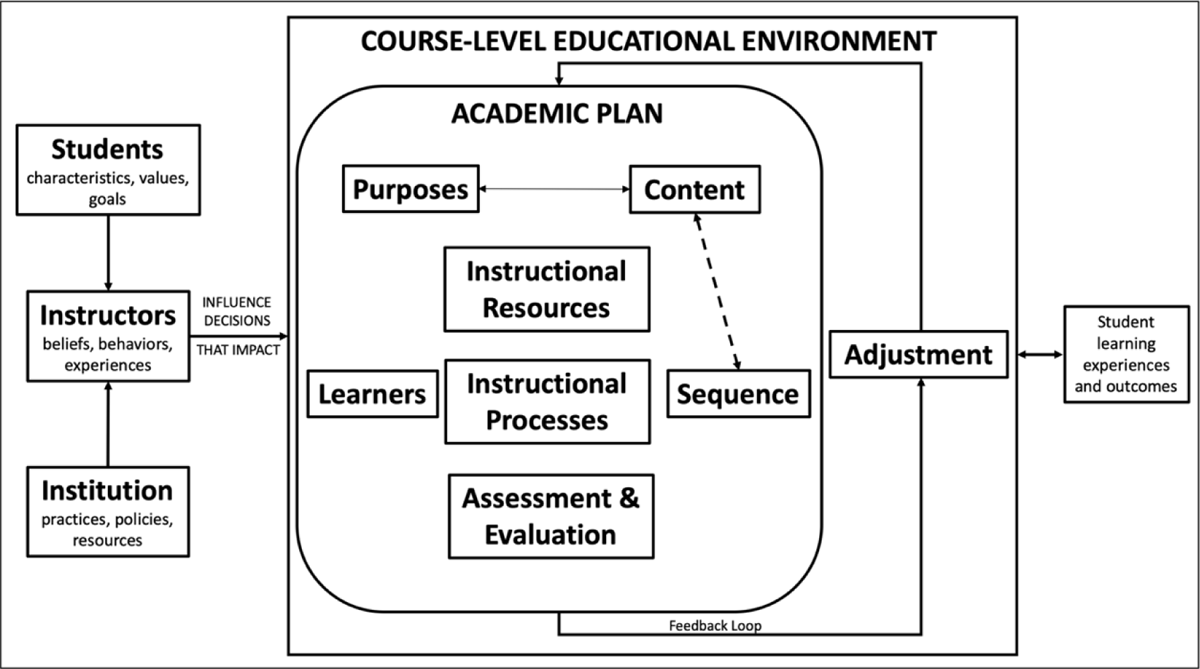
Figure 1
Adapted from The Academic Plan Model (Lattuca & Stark, 2009).
Motivated by the importance of FECs and acknowledging the challenges associated with these courses, we sought to examine the common foundational engineering curriculum, guided by the Academic Plan Model, based on instructors’ descriptions of elements of the academic plan as enacted in the educational environment. The following questions guided this study:
How do instructors describe the educational environment enacted through the foundational engineering curriculum?
How do instructors describe the factors that influence their curricular decision-making process?
To answer these questions, we used case study methodology (Stake, 1995; Yin, 2009) and examined interview transcripts and additional sources of data (e.g., course syllabi, course schedule). Our primary data consisted of semi-structured interviews conducted with instructors who teach FECs in a large research institution. This work is part of a larger institutional and community transformation project with the goal of transforming instructors’ experiences in FECs.
Perspectives from Literature
The Academic Plan Model
The Academic Plan Model (Figure 1) provides context for how the educational environment in FECs is shaped. The original model was developed by Lattuca and Stark (2009) as a means of thinking about academic curricula, in response to “a lack of a comprehensive definition of curriculum” (p. 4). Presenting the curriculum in the context of a plan provides an overview of the learning environment, the elements that interact and comprise it, and the factors that influence curricular decisions. The Academic Plan Model visualizes interacting factors that influence the educational environment, particularly in terms of decision making (Lattuca & Stark, 2009).
An academic plan may be developed for different organizational levels in an institution (e.g., course, degree program, college, entire institution), and it is “purposefully constructed to facilitate learning” (Stark et al., 1990). The plan consists of eight elements (purposes, content, sequence, learners, instructional processes, instructional resources, assessment and evaluation, adjustments) that interact and influence the others, ultimately shaping the educational environment and learning experiences of students.
Purposes refer to the “intended outcomes” (Lattuca & Stark, 2009, p. 4) for the academic plan. Content refers to the subject matter that the plan is expected to convey, and sequence is how content is arranged so that the plan’s purposes are met. Instructors tend to find a strong connection between purposes and content (Stark et al., 1990; Stark, Lowther, Ryan, Bomotti, et al., 1988). A similar link also exists between content and sequence, although instructors do not consistently make this connection.
Lattuca & Stark (2009) emphasize that learners—a specific group of students—should serve as the focal point for designing an academic plan. An academic plan should consider the “characteristics, goals, and abilities” (Lattuca & Stark, 2009, p. 14) of the students it is designed for. Keeping learners in mind, the academic plan identifies learning activities that will facilitate the learning process (instructional processes) and what is needed to implement them (instructional resources, e.g., textbooks, learning management systems, classroom infrastructure). Assessment and evaluation techniques determine whether the purposes of the plan are met, and yield opportunities for improvement that trigger adjustments to the academic plan (Lattuca & Stark, 2009; Stark et al., 1990). As highlighted in the research questions, the primary focus of this study is to understand how the academic plan is currently enacted in FECs. Findings from the study will provide context for the educational environment and reveal factors that affect instructors’ course-level decision-making processes as they adjust the academic plan.
Factors that shape the educational environment
The Academic Plan Model (Figure 1) acknowledges instructors as key players in the educational environment. It emphasizes that various factors influence instructors’ curricular decisions; that instructors themselves affect the educational environment; and that consequently, their decisions impact students’ educational outcomes. Among the factors that may impact curricular decisions are faculty beliefs about teaching, learning, and students, and the perceived barriers to effective teaching, such as workload (Eccles, 2007; Yerushalmi et al., 2007). Faculty beliefs, in particular, have been found to correlate with faculty behaviors enacted in the classroom, which in turn can impact student outcomes (Eccles, 2007; Soledad et al., 2018).
The Academic Plan Model also shows the educational environment as a dynamic process that should have feedback mechanisms that enable continuous improvement (Lattuca & Stark, 2009). However, creating educational environments that foster positive learning experiences, a responsibility placed mainly on the shoulders of instructors, includes non-academic and non-engineering considerations (e.g., student characteristics) for which instructors may not have the appropriate support and resources (Borrego & Henderson, 2014; Lattuca, Terenzini, & Volkwein, 2006; Schreiner, 2010; Stark, Lowther, Ryan, Bomotti, et al., 1988).
Finelli and colleagues (2014) found that instructors most frequently talked about “infrastructure and culture” (p. 340) as factors influencing the adoption of effective teaching practices, although they usually referred to these influences as barriers instead of facilitators for change in practice. Instructors also identified “classroom and curriculum,” referring to class sizes, physical infrastructure of classrooms, and flexibility of the curriculum as factors that influence decisions regarding teaching practices (Finelli et al., 2014). In particular, course structures that entail close coordination, similar to how courses in our study were departmentally structured, have been found to cause concerns about loss of autonomy among faculty members (Shadle et al., 2017). Although knowledge and awareness of effective teaching techniques is also a factor for the willingness to adopt change (Finelli et al., 2014), the prevailing structures and contexts in their classes serve as barriers and supersede interest in adopting them (Henderson & Dancy, 2011). The factors that influence teaching practices may not necessarily translate to implementation in classrooms (Knight et al., 2016), partly because of limitations presented by certain contexts (e.g., large class sizes, Grohs et al., 2018) that are beyond the purview of instructors, and competing demands on instructors’ time as they fulfill other faculty responsibilities and expectations beyond teaching (e.g., research and service) as required by their faculty role/rank and institutional structures (Henderson et al., 2011).
Methods
To address our research questions, we qualitatively analyzed transcripts of semi-structured interviews conducted with instructors and examined additional data sources (e.g., participant-provided artifacts, project documentation & artifacts), following guidelines for case study research (Yin, 2009). Analysis followed a single case study approach with embedded units of analysis (Yin, 2009) using the Academic Plan Model as framework.
Research Design
This study used single case study design with embedded units of analysis. The case is defined and bound by the experiences of participating instructors who have taught courses that introduce, address, and develop concepts and skills that are fundamental to engineering disciplines (Yin, 2009). An examination of the engineering curricula across the different engineering programs offered by the study location revealed that FECs function as a network of interacting courses, particularly from a purely conceptual and skills development perspective. An example of such a networked structure, focusing on mechanics courses, is shown in Figure 2. Fundamental or foundational courses are taught in years 1 and 2 of the curriculum. Students need to acquire and develop concepts and skills in Math and Physics to be successful in Statics. Statics, in turn, serves as the foundation for Dynamics and Strength of Materials; Figure 2 uses broken arrows for this pre-requisite chain because not all students need to take these two courses.
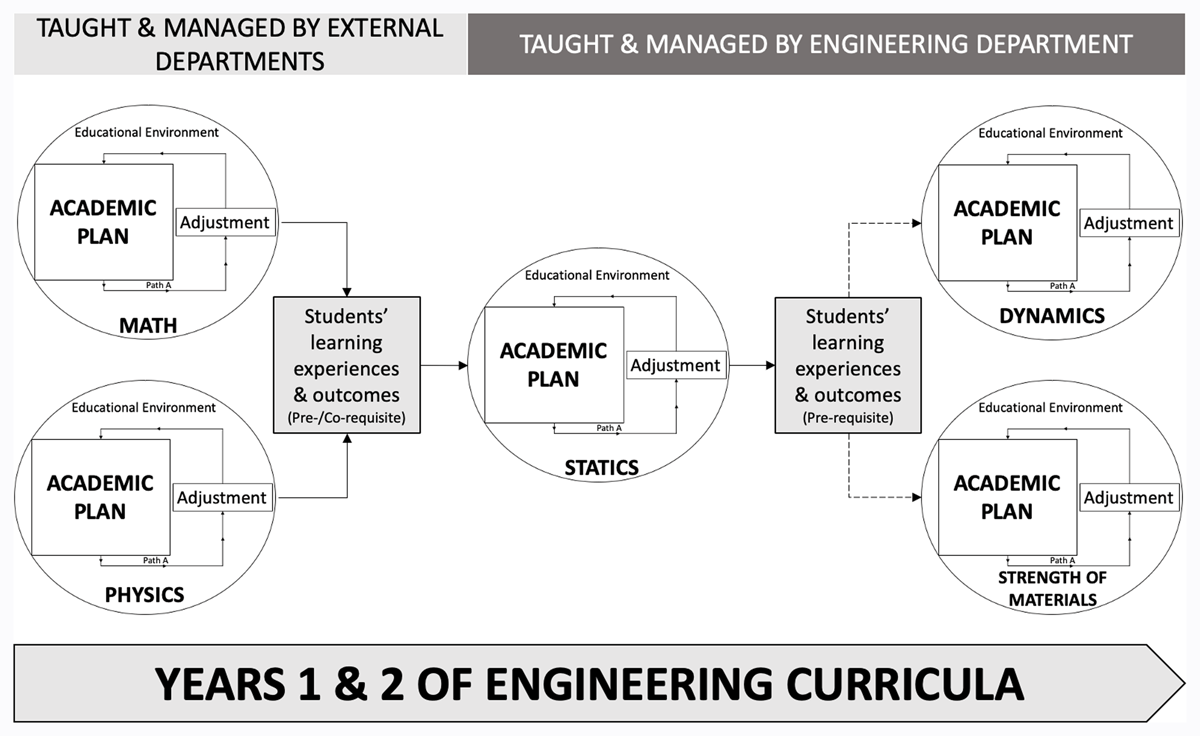
Figure 2
Network of interacting foundational courses in the mechanics track.
As shown in Figure 2, for engineering curricula at the study location, FECs are managed by multiple departments, some of which reside outside of the College of Engineering (e.g., Math, Physics). Exacerbating the disconnectedness in the planning and implementation of these courses, the tendency to take a “siloed” mentality to teaching (Alpay & Jones, 2012) is more likely to occur in a large research institution, something that is counterintuitive to the networked function of FECs. In this study’s context, courses are primarily managed by distinct, independent departments, and it is likely that instructors operate according to the administrative context and processes within their own department (Hammond, 2004).
Based on the structure presented in Figure 2, we chose the single-case study design with embedded units of analysis (Yin, 2009) because it allowed us to examine the experiences of instructors teaching FECs in a large research-intensive institution with high enrollment of engineering students, while still acknowledging the unique contexts, processes, and practices that departmental administrative structures may bring to their experiences. An embedded case study design is appropriate when the study is examining a single case, but there are subunits within the case that merit equal attention (Yin, 2009). We classified the participants into two clusters: participants teaching courses managed by engineering departments, and participants teaching courses for engineering students managed by servicing departments external to engineering.
We endeavored to describe specific instructors’ experiences within and across embedded units of analysis. Working with a small group of instructors allowed us to build a detailed description of their experiences in the context of the classes they taught. Descriptions from a few individuals’ experiences may be used as a springboard and lens for examining a phenomenon more broadly, an approach that has been found valuable in engineering education research (Foor et al., 2007; Pawley, 2019)
Participants and research location
This study analyzed data collected from seven participants teaching foundational courses included in engineering curricula in a large, research-intensive, residential, predominantly white institution; Table 1 describes the sample. For this study, we focused on project participants who have taught and/or managed the following courses: mathematics (math), physics, and mechanics courses (Statics, Dynamics, Strength of Materials). These courses are part of what we operationally define as the foundational courses in the engineering curriculum (FECs) (Figure 2).
Table 1
Participant Information.
| PSEUDONYM | COURSE TAUGHT | CLASS SIZE | PRIMARY ROLE |
|---|---|---|---|
| Victoria | Mechanics | 40–140 | Professional teaching faculty |
| Marie | Mathematics | 40–50 | Professional teaching faculty |
| Kevin | Mathematics | 40–50 | Professional teaching faculty |
| Mike | Mechanics | 40–140 | Professional teaching faculty |
| Diane | Physics | 150–180 | Professional teaching faculty |
| William | Physics | 150–180 | Adjunct teaching faculty |
| Vanessa | Mechanics | 40–140 | Professional teaching faculty |
All engineering disciplines at the institution where we conducted the study require students to take specific math (e.g., Multivariable Calculus) and physics (Foundations of Physics) courses that serve as pre- and/or co-requisites for foundational and discipline-specific engineering courses, including mechanics. Five of the institution’s fourteen engineering disciplines require the entire suite of courses included in the study, and an additional six disciplines require at least one of the mechanics courses. All the courses taught by the participants were primarily lecture-based courses; only physics has a hands-on experimental laboratory component that students take alongside the lecture component.
The courses included in this study have large enrollments; math and physics cater to approximately 2,000 students, and enrollment in each of the mechanics courses are about half that number. Thus, our analyses examine the academic plan that impacts a significant number of learning environments and experiences.
All our participants, who self-selected to participate in the study, are professional teaching faculty whose primary responsibilities are focused on undergraduate education and whose roles do not offer tenure (Fitzmorris et al., 2020), although our initial recruitment pool included tenure-track faculty. One participant held a role that included an expectation for research and scholarship, albeit to a lesser degree than what is traditionally expected of tenure-track faculty in a research-intensive institution. Despite the primary focus on teaching responsibilities, 4/7 participants shared artifacts related to research and scholarship. One participant continues to engage in discipline-specific research, and 3/7 participants engage in the scholarship of teaching and learning. We assigned pseudonyms to ensure participant confidentiality.
To accommodate large enrollments, departments managing the courses offer multiple sections of each course that are taught by multiple instructors. There is a designated course coordinator, usually an instructor who is actively teaching and/or has taught the course, who assumes course management responsibilities, like coordinating the course syllabi, schedule for the semester, and assessment methods, among other activities. Three of our participants have served as coordinators: one coordinated a specific lecture course, one coordinated three lecture courses at the same time, and one coordinated the laboratory component of a course.
Data collection
Primary Data Source
We used transcripts of semi-structured interviews with these faculty members, who each agreed to be a contributor to a larger institutional change initiative—interviews analyzed in this study occurred at the very start of the faculty members’ engagement in the initiative. Our research team developed the interview protocol, conducted interviews, and had access to project data, documentation, and artifacts. The interview protocol includes prompts focused on participants’ teaching experiences, available resources to support their teaching, and specific resource needs. Participants were also asked about the kinds of data (e.g., information about students, teaching strategies) that they felt were needed or found helpful, and how they might use those data to facilitate learning in their classes more effectively. Examples of interview prompts are shown in Table 2. The interview protocol and data collection procedure received ethical clearance through the Institutional Review Board (IRB). Interviews lasted for about one hour, documented using audio recordings and field notes, and transcribed by a professional transcription service.
Table 2
Sample Interview Prompts.
| Please describe how you planned for the class. What information did you use to make decisions? Imagine that I had the authority to provide you with any support services/resources/data/information that you need to create the learning environment that you want for your students. What will you ask from me? What are the things that you care about the most when teaching a class? |
Additional Data Sources
Case study research guidelines stipulate the triangulation of multiple data sources (Creswell, 2012; Stake, 1995; Yin, 2009). We examined field notes (i.e., notes taken during interviews, meetings focused on the larger institutional change initiative, and a summer summit on teaching large foundational engineering courses), memos (during analysis), participant-provided artifacts (e.g., course syllabi, course schedule), project artifacts (e.g., brainstorming outputs from project cohort meetings and the summer summit), and institutional data (e.g., checksheets, historical timetable of classes). Field notes and memos complement and corroborate statements documented in interview transcripts. Artifacts supplement and provide context for descriptions and perceptions given during the interviews.
Data analysis
Primary Data Source
Data analysis consisted of two coding cycles, acknowledging the iterative nature of qualitative data analysis (Miles & Huberman, 1994; Saldana, 2016). Two project team members concurrently and independently conducted analysis and periodically engaged in case analysis meetings to discuss coding decisions, definitions, and themes (Miles & Huberman, 1994). To ensure the integrity of analysis across researchers, the first author conducted first cycle coding by assigning labels to meaningful excerpts in the interview transcript on a subset of the project dataset, supplemented by memos when appropriate. This step generated an initial list of codes and observations about the data. The first case analysis meeting consisted of a discussion of the initial analysis and observations with another researcher, generating an agreement for approaching coding, prior to concurrent analysis by both researchers. Both researchers coded using Dedoose™, a cross-platform online qualitative research analysis tool.
Second cycle coding employed pattern coding (Saldana, 2016) to the labels and excerpts from first cycle coding. We used elements of the Academic Plan Model (see Figure 1) as categories for coded interview data, classifying first cycle coding outputs under each element. In looking within and across categories, we created tabular displays (Miles & Huberman, 1994). We merged similar codes and excerpts when appropriate, ensuring that we documented each decision so that we can still trace back all consolidated codes to its original form. Although we followed a pattern coding process to account for emergent categories, none of the first cycle codes established a pattern that merited a new category.
Additional Data Sources
We used additional data sources, consisting of instructor-provided documents, project artifacts, and accessible institutional data (e.g., course schedules, summer summit workshop outputs, program checksheets) to support and complement statements made in the primary data source. We referred to additional data sources as they relate to, support, and provide context for the findings from the primary data source.
Research Quality and Limitations
It is important to discuss how research quality and trustworthiness were ensured when conducting case study research (Yin, 2009, p. 14). We used three methods to establish research quality and trustworthiness, using descriptions by Leydens, Moskal, and Pavelich (2004). First, two researchers employed a code-recode process for first cycle coding. Code-recode consists of initial coding, waiting for a period of time, then recoding to ensure that all meaningful excerpts were coded appropriately and reconfirm initial coding decisions. Second, we conducted member checking by providing participants with the results of analysis as part of a project report. Third, we employed triangulation through multiple researchers and sources of data.
All members of the project team have experience as instructors and academic administrators, two in both tenure-track and professional teaching faculty roles. One has taught similarly structured courses included in this study. Our experiences contributed to the motivation to engage in the project, informed the development of our data collection protocol, and helped frame our analysis approach (Massoud, 2022).
This study was limited to project data provided by participants who willingly engaged in a project examining the large class environment in foundational courses in engineering curricula. Similarly, all participants’ main role is to teach; we recognize that instructors in roles with different responsibilities and expectations (e.g., tenure-track faculty) might have unique perspectives and experiences that we are unable to explore. We also acknowledge that there may be inherent biases in responses since participants all show a commitment to providing positive student learning experiences by being part of the larger institutional change initiative. Their perspectives remain valuable, however, as an initial insight into the teaching experiences across FECs in the same institution. Although this single case study is limited to one institution, similar curricular arrangements are present at other large engineering colleges in the United States and globally—we would anticipate these findings would resonate in those kinds of contexts.
All research work was approved by an Institutional Review Board.
Results
This study sought to view the suite of courses in the foundational engineering mechanics curriculum (Figure 2) as an academic plan. Participants’ perceptions and descriptions of the various elements of the Academic Plan Model (Figure 1) describe the educational environment, addressing RQ1: How do instructors describe the educational environment enacted through the foundational engineering curriculum? Events or situations that lead to adjustments to the academic plan describe the factors that influence instructors’ curricular decision-making processes, addressing RQ2: How do instructors describe the factors that influence their curricular decision-making process? As indicated in our Methods section, we have two embedded units of analysis: 1) Courses taught and managed by external departments (Math and Physics), and 2) Courses taught and managed by an engineering department (Mechanics – Statics, Dynamics, and Strength of Materials).
We organize our findings by presenting participants’ descriptions of the elements of the academic plan and discuss the enactment of each element of the academic plan. We share participants’ perceptions and self-described experiences, supported by selected quotes from the interview and information gleaned from additional sources of data when appropriate.
In general, we found that despite teaching distinct courses managed by different departments, participants described the educational environment in their courses and factors that influence curricular decision making in similar ways (see Figure 3). The text preceded by a (+) sign represent activities that instructors perceive they are doing well and provide high value for both the students and the institution. The text preceded by a (–) sign represent activities that can be improved, or that instructors wished they had. Text not preceded by the aforementioned symbols are general descriptions of students, prevailing practices, and common resources, where applicable.
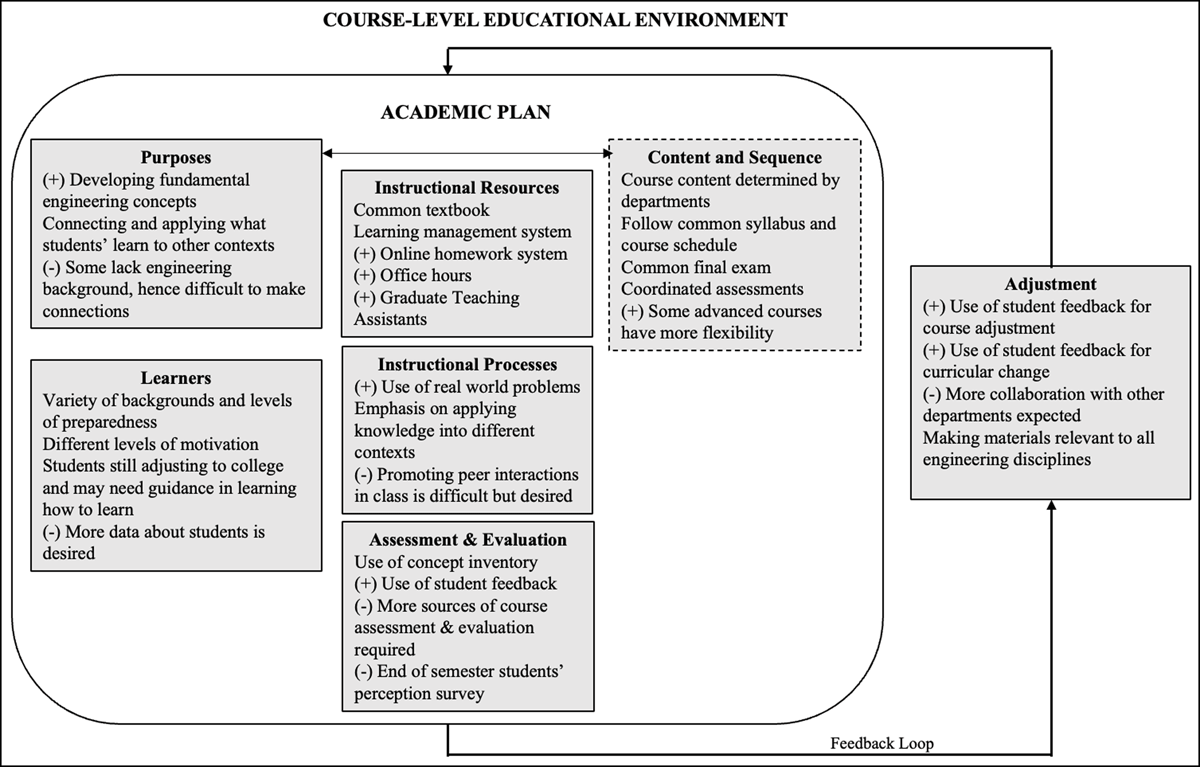
Figure 3
Summary of our results.
We discuss the findings depicted in Figure 3 in more detail in the sections that follow.
Purposes
All participants shared that they cared about conveying fundamental course concepts and commented on the introductory and foundational nature of the courses that they taught. Participants also shared that they care about ensuring that students are able to connect and apply what they learned to other contexts. Here is an example from two different departmental contexts:
Understanding fundamental physics is extremely important for engineers… having them sort of understand the concepts of physics that underlies a lot of engineering disciplines. (Diane, Physics)
What I’m looking for is that they’re understanding the main concepts that we’re talking about, especially in these fundamental, introduction courses. If they can get just a few basic concepts down, that should support them through all the rest of their courses. (Mike, Mechanics)
Two of the four participants teaching in the external service departments expressed, however, that it can be challenging to help students make connections and ensure that their teaching is relevant to the engineering degrees students intend to pursue, because they (the participants) lack an engineering background:
Definitely conveying the topics is my main concern, but also keeping the students interested in what I’m talking about… I also want to have the material I’m teaching somehow relevant to them, and that’s something that I struggle with a little bit, because I don’t have the engineering side. (Marie, Math)
Participants shared common perceptions about the purposes of the courses they taught, but some participants teaching courses managed by departments external to engineering expressed concerns that they attributed to their non-engineering backgrounds.
Content and Sequence
We present content and sequence together, as all excerpts address these two elements in conjunction. This approach is consistent with the link between content and sequence as indicated in the Academic Plan Model (Figure 1). Although Lattuca & Stark (2009) indicated that this link is not always evident to instructors, we found that participants’ narratives address both elements as a combined entity, a likely outcome of the coordinated nature of departmental course management.
Participants’ descriptions indicate department-level course management for both units of analysis. Consequently, all participants shared that they followed a common syllabus and course schedule shared across multiple sections and instructors; that their students take a common time final exam; and that certain policies, including that of assessment, are coordinated at the department level, although to varying degrees. An examination of participant-provided documents that included course syllabi and department-level detailed course schedules corroborated the descriptions shared by our participants. In combination, these findings indicate that departments largely determine course content and provide a common syllabus for instructors to follow:
There is a central syllabus… assignments are chosen by the course coordinators according to the syllabus with assigned dates across all 50 sections. There’s no deviating from that… even the exams are common. Not only the final, but every exam is common. (Marie, Math)
Participants who also served as course coordinators for lecture courses described decisions related to coordinating courses as a way to give students across sections a relatively common and comparable learning experience and to ensure that similar student outcomes are addressed across instructors:
What I’ll do at the start of the semester is put together… a time table. I sent this out to all of the instructors… it lists all the topics that we’re going to cover, and dates for the tests, and homework assignments and that kind of thing. Instructors will play about this a little bit to fit their own teaching style… The idea is all of those students, so that’s maybe eight hundred in statics, will be getting the same experience no matter who’s teaching it. They’re all learning the same material at the same pace, doing most of the same homework assignments. (Participant, Coordinated three courses)
The rationale to coordinate courses to ensure coherent learning outcomes and experiences, and designating a coordinator to facilitate conversations and activities across instructors, is in keeping with curriculum planning strategies for implementing systemic change in STEM education (Reinholz & Apkarian, 2018).
Coordinating course schedules and assessment policies varied by course, even within departments managing multiple courses. Based on participants’ narratives for both units of analysis, instructors’ autonomy increases as the course becomes more advanced. For example, Marie qualified that for math, instructors’ autonomy varies depending on the course. The description Marie gave in the excerpt above is for the first course in the calculus sequence; instructors teaching succeeding courses in the sequence, such as multivariable calculus, have a little bit more flexibility in terms of assigning homework and writing exams. For some courses, only the central syllabus and the common time final are the same across multiple sections; the instructor may then assign homework and administer other tests of their own design and choosing, as described by Victoria:
We are given a syllabus… We do not have to exactly follow that syllabus, so we have some freedom in… structuring things a little differently. What is set is the grading structure, and they ask that you don’t deviate from policies in terms of substituting exams for test grades and stuff like that. And then, the exam is a common time final that’s sort of handed to you to give to your students. But there is some freedom in how you teach the course and how you handle the topics, but you need to cover all the topics. (Victoria, Mechanics)
Although there were some variations, participants described course content and sequence as coordinated at the department level, indicating little input, if any, from instructors. Examples of participant input, in cases where input is gathered, included collaboratively writing exams and/or assignments with the other instructors teaching a course:
So, they write tests as teams. They’ll have certain instructors on a test one team where they’ve written that test, and then another set of instructors will be on the test two team, test three, and then the final. (Participant, Coordinated one course)
This narrative is similar across participants, whether they have served in coordinator roles or not.
Instructional processes
Participants shared instructional activities related to solving word problems, and caring about ensuring that students are able to apply the skills learned through these activities to other contexts. We present two examples from different departmental contexts:
We’re trying to help them learn how to solve problems, to think critically, to look at a situation and sort of figure out what is extraneous information, what’s the most relevant to the problem, being able to apply some fundamental situation to different circumstances that might have different surface features, but realizing there’s some deeper thing. (Diane, Physics)
I will explain a concept, talk about how it relates to what we were doing last week and what we’re going to do next week, then I’ll relate it to a problem out of the textbook. I’ll solve one and then I’ll have them solve one. They can learn the concept, they can see how to apply it, and then they get some practice doing that. Then these homework problems will relate to that same topic so they get a bit of practice by themselves. (Mike, Mechanics)
Participants did not expound much on the specific activities and interactions that are going on in the classroom, a possible limitation of the interview prompts. They did, however, share some instructional activities that they would ideally like to do but find difficult, such as effectively facilitating peer interaction in class:
One thing that I want to happen in my classes, and some semesters it happens, and some it doesn’t, is having conversation between the students and interaction in the classroom… I just have found that I don’t end up having them work in groups as much. You definitely give up certain things, when you get in these big classroom [class] sizes. (Marie, Math)
I really think making students talk and learn in groups is really important for these harder concepts… if they’re teaching each other, I feel it ingrains better. I don’t think the course as structured right now allows for a lot of that, because there’s so much content to go through. (Vanessa, Mechanics)
The narratives shared by Marie and Vanessa indicate how the choices that they made in their classes have been influenced and altered by departmental structures that are beyond their control, factors that have been identified as barriers to the implementation of change in STEM classrooms (Finelli et al., 2013; Shadle et al., 2017).
Diane, however, shared the approach she used to facilitate peer interaction in her class:
I would present a question or a problem, and I would say, “Okay, work with your neighbor, see what you can do.” It was me and an undergraduate learning assistant who would run around the classroom trying to help people, and that worked pretty well considering, you know, there was 150-ish students in there and just the two of us. At least by having them grouped, you know that if you can get at least one person in a group to understand what’s going on, they can disseminate sort of what’s happening. (Diane, Physics)
In the section discussing Purposes, participants described conveying fundamental course concepts and facilitating ways for students to connect and apply what they learned to other contexts. Modeling how a concept is applied in problem solving and facilitating peer interaction are examples of behaviors that allowed participants to achieve their perceptions of the purpose of the courses they taught.
Instructional resources
Instructional resources are the “materials and settings used in the learning process” (Lattuca & Stark, 2009, p. 5). Participants all mentioned the following instructional resources available for students to support their learning process: a common textbook, a learning management system, an online homework system, and office hours. Since the choice of learning management system is an institutional decision, the two embedded units of analysis use the same system. All participants referred to using an online homework system, but we noted that homework systems and practices varied across departments. Math and physics shared very coordinated use of the online homework system; mechanics instructors, on the other hand, can opt out of using the suggested online homework system, although all three of our participants teaching mechanics chose to use it.
Participants shared several opportunities for students to seek help, including descriptions of how their departments conduct office hours:
You can get help outside of lecture, and that’s either in my office hours, we have recitation, which is a kind of homework help resource, then they also have common office hours. (William, Physics)
When they come in here and they work and I keep my door open. At least with the handful of students that utilized that in the fall, it was a very free experience for them to come in here and work. If they had a question, they just came in and ask. They came back out, worked some more… I try to keep a lot of office hours for that reason too, because it is a thing where you can’t accommodate everybody’s learning styles. Some people really just need that… really to be able to sit down and show them on paper something, and it helps them. (Victoria, Mechanics)
It is interesting to note that Victoria’s office, which the research team was given access to, is located within a larger space that includes a common area that students can use for study purposes. This arrangement is not true for the other participants.
Teaching assistants (TAs) may serve as graders, assist in class, or independently conduct office hours to ensure that students had access to help and feedback, although the function of TAs vary across departments and courses. For example, participants teaching Physics do not receive grading assistance from TAs “mainly because all our tests have to be multiple choice” (William, Physics), but TAs help conduct common office hours:
This is a service provided by the Physics department where there’s a couple of TAs in a room in [building], and any introductory physics students can go there and get help. (William, Physics)
The Math department, on the other hand, assigned graders depending on class size:
Once I got to the larger class I qualified for a grader and while it was a huge benefit in terms of time, because I didn’t have that, there is obviously a little bit of a setback to that because then I’m not looking at my students’ papers. (Marie, Math)
Diane and William (Physics) also mentioned using clickers in their classes. The use of student response technology, such as clickers, is a means of encouraging and facilitating student engagement in the classroom, particularly in large classes (Martyn, 2007). Mike, however, acknowledged the potential benefits that may be derived from using them in the classroom, especially for encouraging student engagement, but expressed concerns about cost and undue burden that requiring these tools may place on students:
Things like clickers… Using something like that to encourage participation would be great. The only reason I don’t do it in my classes is I don’t want students to have to buy one more thing to have to attend this university. They have to buy laptops… textbooks… If it’s something that everybody did, I wouldn’t mind doing it for my class. At least it’s useful to them for their whole four years here, but I’m not going to make them buy something just for my class. (Mike, Mechanics)
Participants have common access to some resources, particularly those that are institutional in nature (i.e., learning management system), but there are variations in the instructional technologies used in the classroom or required of students (e.g., homework system, clickers) between our embedded units of analysis. There is an opportunity to coordinate the use of instructional technologies across departments in order to maximize the benefits that may be derived from these tools and resources.
Learners
Lattuca and Stark (2009) emphasize that academic plans should include efforts to accommodate varying student goals, characteristics, and abilities. In this section, we focus on participants’ descriptions of students in their classes to get a sense of who the instructors are interacting with and how students might impact instructors’ decisions. We found that our participants’ interactions with learners are closely tied with small adjustments that they make to the course throughout the semester, which we discuss in the Adjustments section.
Participants, particularly those teaching math and physics, recognized that students in their classes come from a variety of backgrounds and levels of preparedness for college in general and their courses in particular. For example, Marie mentioned that some students may already have credits for Calculus 1: “They’ve had [advanced placement] credit, they’ve got dual enrollment credit.” But there are also students who, for a variety of reasons that include performance in the SATs and high school math [grade-point averages], are not considered “math-ready” and would have been required to take a Precalculus class, unless they are able to pass a readiness test: “Some that really want to be in engineering or math are not ready for [Calculus 1] as we declare them, they don’t pass their math readiness test. They would start in [Precalculus].”
Participants also acknowledged that because they are teaching required fundamental courses, there may be differences in students’ motivations for taking the course:
I understand that not everybody… loves mathematics, that this is something that they have to take because their major in some other department says they have to take it, and they may love that, but they don’t really love this. (Kevin, Math)
Since students who take fundamental courses usually do so in the first few academic terms of their undergraduate careers, participants also commented on how students are still going through a period of adjustment and may need guidance in learning how to learn:
With teaching freshman classes, you know another goal I think is just to get them to learn how to be students, and get them ready for the next step… build in some assessments of their conceptual understanding, and have that be a valuable piece of the course, and not just doing the math and just getting a right answer… I’ve never been an engineering student at [institution] so I don’t know, but just from my interactions with the students that I’ve had, I think students can feel really lost as engineering students, just because their departments are so large. At the beginning, they haven’t picked their track, so it’s just like they’re one big mass. (Diane, Physics)
There was a dearth in excerpts specifically describing students and the current ways in which student characteristics are integrated into course planning. This may be because of limitations of the interview protocol, as well as prevailing departmental practices related to course management and coordination, where course planning, especially in terms of purposes, content, and sequence, is an exercise that seems to be beyond individual instructors’ purview.
Participants did identify data on students that they wished they had access to and how they might use it to make curricular decisions:
It would be helpful to know if there are particular concepts that they’re stuck on that are sort of hindering understanding the broad concepts or being able to apply them correctly… if I find that students are responding better to having more active time in class and really even teaching them the background material or the derivations or whatever are not really that helpful at all that it might be, then I can certainly adjust my approach into focusing more on one thing than the other. (Victoria, Mechanics)
Mike (Mechanics), on the other hand, expressed frustration with lack of access to data about students beyond what he can deduce through in-class interactions. He wished for access to information about how they were performing in their other classes, and whether he was discussing material at the appropriate level. He said: “I don’t necessarily know what level or how they’ve been performing in their other classes… [there’s] probably a good reason I don’t, but if everyone in my class has a GPA of 3.8 then that tells me something about the class. If everyone is down at 2.6, maybe I need to spend more time on the fundamentals.” (Mike, Mechanics)
Comments regarding access to data, or lack thereof, was corroborated through project artifacts and field notes collected during the summer summit on teaching large foundational engineering courses conducted by the project team. All our study participants are part of a larger group of instructors who participated in two summer summits on teaching experiences in large foundational engineering courses, and having access to certain types of data emerged as among the factors that would help support instructors’ curricular decision-making processes during group brainstorming sessions.
Participants’ descriptions of their students indicate large classes composed of a heterogeneous mix of students from varying degrees of preparedness for both the course and navigating the undergraduate engineering learning environment, and motivation to learn. Heterogeneity in a large class setting makes it challenging to relate to and meet individual students’ needs (Mulryan-Kyne, 2010).
Assessment and Evaluation
Assessment and evaluation refers to “strategies used to determine whether decisions about the elements of the academic plan are optimal” (Lattuca & Stark, 2009, p. 5). Participants who taught physics mentioned using the Force Concept Inventory (Hestenes et al., 1992) for course assessment purposes:
We do something called a Force Concept Inventory test… that helps us gauge the efficacy of the course and that helps us determine what we need to change about it. So they [students] take it at the beginning of the semester, and at the end of the semester, and we see how they improve. (William, Physics)
Participants also shared the ways they personally sought student feedback to assess the impact of instructional activities on students’ learning processes:
Periodically, not every semester, I’ll do like a mid-semester survey to the students and just say, “Hey, what’s working, what’s not working?” and I’ve made changes based on those findings before. (Diane, Physics)
Sometimes when I can sense that the students are struggling a bit, especially with certain topics just at the beginning of class, asking how did the homework go? What did you think of that? Then if they’re still confused about the certain topic, taking that class to go over that topic again. (Vanessa, Mechanics)
Beyond the Force Concept Inventory, which was unique to physics, and personal attempts by participants to elicit feedback from students, we found little evidence of prevailing practices related to course assessment and evaluation that feed into decisions on adjustments to the academic plan.
The institution, however, administers end-of-semester student evaluations of teaching surveys, which collect data on students’ perceptions of their experiences in the course. Although a convenient source of institutionally collected data on students’ perceptions of the course and the educational environment, research on end-of-semester student evaluations of teaching surveys has shown issues of bias and related challenges (Marsh & Farrell, 2015). Participants’ comments indicate that despite the availability of this institutionally collected assessment data, they encounter challenges with using them meaningfully and constructively for course planning:
I don’t feel like it’s honestly helped me at all. My scores have been fine. I’m very happy with the scores that I get, but I get like a 30-something percent response rate… Generally, all they’re saying is that I go too fast, when I’m always behind with the schedule I should be, so I don’t know how much slower I can go… they’re not really giving me anything constructive… I have to cover all the material, so when they’re saying I’m going too fast, I don’t know. (Marie, Math)
The institution allows departments to append course-specific items to end-of-semester student evaluations of teaching surveys. Mike (Mechanics) shared that their department included items in the survey that asked students to provide self-reported ratings on particular course-related skills. He lamented, however, that instructors only had access to their own data and not aggregate responses across course sections. Since courses are coordinated across section, Mike argues that such information would have been helpful for coordinated course planning:
If there’s something that every single section is not coming across properly, that would be nice to know. I don’t know that at the moment. That would be nice to know because then I can kind of change the schedule around and make a point to tell people we need to spend more time on this. (Mike, Mechanics)
Kevin (Math), on the other hand, expressed a desire to evaluate the course he taught based on students’ perceptions of how the course prepared them for success in the succeeding course:
I’d like to have some student-generated data on how effective was I at my goal of connecting this course to what came later. I’d like to know if I teach Linear Algebra in the fall semester, I like to hear back at the end of the spring semester, now that you’ve taken Differential Equations… how successful was I at that goal? (Kevin, Math)
Participants’ comments above indicate missed opportunities to leverage student-provided course assessment data productively. In the absence of course-level practices that inform adjustments-related decisions to the academic plan based on the data, it indicates a need to strengthen the link between assessment and adjustments, at least for the courses included in the study.
Adjustments
Participants shared that interaction with students, which generates student-based feedback in various forms, primarily inform the curricular decisions and adjustments that they make for the course:
As I teach something on Monday, my students, there are things that they have questions about, or not sure about, and now I have to rethink what I’m going to do on Friday to incorporate that feedback… If there is something I have attempted differently, I might ask them specifically, I would like to see your comments… That’s the part that’s valuable for me. I will sometimes ask them to comment on some specific aspect that I’ve had to change, or adapt, or something. (Kevin, Math)
Every class is so different depending on the students that are in there. They all kind of have a different personality, and so it’s purely driven by what I’m feeling like what I’m getting back from the students. (Victoria, Mechanics)
Although participants mentioned making adjustments to their courses, the data did not address what these specific adjustments were, to what elements in the academic plan these adjustments were made, and how the course changed because of these changes. Most narratives imply changes to instructional activities, and most referred to small changes to the planned activities for the day to accommodate the need to address difficulties or the need to clarify specific topics. Adjustments to the purposes, content, and sequence, for example, were not discussed; we consider this as an outcome of the close coordination implemented in the courses, which render these elements stable because planning for them is beyond individual instructors’ control. The general narrative is that details and plans regarding these elements are prepared at the department and course coordinator level and given to instructors for them to follow in an effort to provide students with common learning experiences across multiple instructors.
One idea related to course planning and curricular decision making is the notion of collaborating with instructors from other departments:
So, as a resource that I would like, like from the department from the university is maybe to afford us some time to connect with colleagues outside of the department when we’re teaching a class that services other departments, to get some input from those departments on why their students are in my room. (Kevin, Math)
Kevin spoke of this suggestion as a means of getting input for planning what course topics to emphasize and what skills are critical for succeeding in courses taken in other departments. Kevin also cared about making relevant to students’ disciplines the examples he discusses in class and the learning activities he facilitates so that students may more easily make connections between the math concepts and skills with discipline-specific contexts:
I want them to come out of this class with a sense of understanding why their department decided that this was an important class for them to take. That, they have some confidence about how this class fits into their profession, and their field… that this isn’t just a bureaucratic hoop they had to jump through. (Kevin, Math)
In particular, he asks the following questions:
The challenge for me is that if I want to make this course meaningful, connected to the other field of study, and it’s not a field of study that I know much about, I want to know enough about these other fields to get an insight as to why they made their students take a [math] class, where are they going to be using this? So, I find myself asking, what kinds of things do you cover in statics, and what kind of things do you cover in crystallography, and what other topics do you cover that cause a student to have issues with this? (Kevin, Math)
Marie (Math), Diane (Physics), and Mike (Mechanics) also shared Kevin’s sentiments about the potential benefits of collaborating across departments during their interviews. Mike, in particular, commented:
Being able to get instructors of these different courses together, usually even different departments which is probably why we don’t do it, getting them together, talk about exactly what’s covered, what isn’t covered, what they expect, and what they don’t teach as well, would probably make our instructors’ lives a lot easier, especially the new ones coming in the first couple times they teach these courses. (Mike, Mechanics)
This idea of collaborating across departments was also documented in project artifacts examined for this study. It emerged during an institutional change project meeting conducted with the larger group of project participants, and thus received agreement from other faculty members who were not part of this particular study.
Discussion and Recommendations
We observed similarities across embedded units of analysis, for all elements of the Academic Plan Model, which confirm our earlier assertion that institutions may want to consider the suite of interacting foundational courses in engineering curricula more explicitly as a common curriculum. We highlight the following key findings:
Courses within foundational engineering curricula have a shared purpose, strive to provide a common learning experience for students, and contribute to achieving student outcomes that promote student success in subsequent discipline-specific courses, based on our participants’ perspectives. We found that this shared purpose transcended current institutional structures, where separate departments managing the courses operated in silos. Thus, it may be beneficial to consider these courses collectively and establish an overarching governance structure focusing on students, enacted through an academic plan designed for streamlined course planning across a foundational engineering curriculum. Such a structure may facilitate the design of effective learning environments at this stage of undergraduate engineering students’ academic careers.
The fundamental concepts and skills developed in each foundational course that have been known to be critical for success in courses within and beyond the foundational engineering curricula are interconnected at some level or form. Thus, FECs are closely related. There are opportunities for synergy across these courses that will be beneficial for instructors teaching the courses and for students’ learning processes and experiences.
Results confirm that instructors are both critical decision-makers and stakeholders in a broader academic plan in which they have limited control. Promoting continuous improvement through an overarching student-focused academic plan for a foundational engineering curriculum will benefit from engaging instructors across multiple departments as equal partners in course and curriculum planning.
Shared purposes, learning experiences, and outcomes: An academic plan for Foundational Engineering Curriculum
Participants’ descriptions of the purposes, content, sequence, instructional processes, instructional resources, assessment and evaluation, and adjustments indicate that Academic Plan Model (Figure 1) elements are enacted in a similar manner across courses in the foundational curriculum and impact the same group of learners, despite institutional structures indicating that courses are managed in a siloed manner. Thus, it is feasible to develop a student-focused, consolidated academic plan that creates similar and streamlined educational environments and learning experiences encompassing all courses in the foundational curriculum. We found that it may be beneficial to develop both a coordinated and collaborative course planning process that: concurrently and collaboratively designs academic plans across the interacting courses in the foundational curriculum, managed by multiple departments; includes active participation and input from the instructors who teach these courses; and considers the goals, characteristics and abilities of the students who take these courses sequentially and/or concurrently.
Foundational courses in engineering curricula have been described as seemingly unrelated courses that develop critical skills (Lord & Chen, 2014). Our results indicate that this notion of un-relatedness may be an outcome of the siloed management of these courses, despite their common goal of cultivating conceptual knowledge and skills, and the fact that these concepts and skills are crucial for success in other courses (Streveler et al., 2008), including those within the foundational curriculum. The silo mentality for teaching and managing courses is more likely to occur in large research-intensive institutions (Alpay & Jones, 2012). It was thus important to understand prevailing teaching and learning experiences in FECs in a “bottom-up” approach to develop the appropriate course planning structure (Hammond, 2004) that will provide students with effective learning environments and positive learning experiences across FECs.
Participants teaching distinct courses across multiple departments, and who have little to no opportunities for collaboration with each other, expressed similar aspirations of working together and learning from each other as they strive to facilitate meaning- and connection-making for students across their courses. The need to facilitate connections for students is supported by literature; at this stage of their academic careers, undergraduate engineers are still in need of assistance in connecting what they already know to how their knowledge and skills can be applied to new contexts (Ambrose et al., 2010). Thus, helping students make connections across courses is an important point for an instructor to consider (Sheppard et al., 2009). Some participants found it challenging to help students make connections between fundamental course concepts and applications, particularly when they need information beyond their discipline-specific backgrounds; developing a holistic academic plan by collaborating with other departments will help streamline efforts at meaning-making and transfer across courses. It also addresses the perception of disjointed but scaffolded foundational courses by providing students with opportunities to see how the knowledge and skills developed in one course are applied in their other courses and encouraging students to take a deeper approach to learning engineering. Furthermore, developing a holistic and integrated academic plan addressing foundational courses in engineering curricula may serve as initial steps towards taking a networked approach to the academic preparation of engineers (Sheppard et al., 2009).
Opportunities for synergy across courses
There are three main considerations when engaging in course planning, as espoused by Posner & Rudnitsky (2006): what should be learned, why it should be learned, and how to facilitate the learning process. Instructors commonly address these considerations within their own courses. Based on our participants’ narratives, we found that what should be learned is largely determined by the department, through course coordinators, and provided to instructors. How to facilitate the learning process depends on instructors’ preferences and experiences (Stark et al., 1988); factors that influenced our participants’ decisions include available instructional resources and interactions with students. Their information on why students need to learn is largely based on their department’s discipline-specific lens and the intended learning outcomes for the course they are teaching as outlined in the common syllabus provided to them. They recognize, however, that as instructors of foundational courses, their role involves facilitating opportunities for students to develop knowledge and skills that are critical to meeting not only the learning outcomes of the courses that they are teaching, but of succeeding discipline-specific courses as well. The outcomes of succeeding discipline-specific courses, however, are usually beyond the purview of instructors teaching foundational courses in servicing departments, particularly those external to engineering.
Shared course planning efforts across silos through a broader foundational engineering curriculum would seem to address the disconnects described by participants. For example, mechanics courses may share learning outcomes, course content, sequence, and instructional processes with math and physics, so that instructors in these servicing departments may know what skills are important for students to develop and why they need them. Sharing information on sequence (i.e., arrangement of course content) is particularly critical for co-requisite courses taught by service departments that students may concurrently take with engineering courses, to ensure that students are able to develop knowledge and skills in a timely manner. Sharing instructional processes and course material may help instructors determine how to facilitate learning in ways that students will find meaningful and relatable. Efforts to address the concerns raised by participants on information-sharing and collaboration across departments may lead to a more robust learning experience for students.
We also noted opportunities to share instructional resources and synergize technology-based learning tools. Through project cohort meetings and summits, participants learned about the practices and resources of the departments represented in the project, and identified best practices that may inform departmental decisions. Expanding and institutionalizing opportunities for collaboration beyond our project may maximize the use of institutional resources and streamline processes. An example related to our findings may be the use of student response systems; departments may come together and agree to using the same technology so that associated gains for students are realized across multiple courses that share similar course structures.
Conclusion
Findings from this study highlight the potential benefit of 1) having instructors be more actively engaged in departmental course planning and management processes; and 2) facilitating collaboration across departments managing interacting foundational courses. An implication for practice at the department level is to facilitate these opportunities for instructors, acknowledging that foundational courses in engineering curricula function as a network of interacting courses, and allowing instructors to collaborate when planning learning activities and align course coverage according to the needs of succeeding courses. The institution may consider exploring what organizational structures and resources are needed; what existing structures and resources, such as faculty development and support programs, can be leveraged; and identifying possible constraints, to develop an overarching governance structure for coordinated course planning across foundational courses in engineering curricula managed by different departments. This work may serve as impetus for conversations towards establishing an entity to develop, enact, and facilitate collaboration among stakeholders through an academic plan for the foundational engineering curriculum at the institution where we conducted the study. This approach of acknowledging the networked nature of foundational courses in engineering curricula is in keeping with recommendations for the academic preparation of engineers offered by Sheppard and colleagues (2009), and such an approach could be translated to other institutional contexts.
Funding Information
This work was funded in part by a National Science Foundation Grant (DUE-1712089).
Competing Interests
The authors have no competing interests to declare.
Author Contributions
Michelle conceptualized the study, conducted qualitative data analysis, and prepared the initial draft of the paper. Michelle selected the theoretical framework and methodology by incorporating discussions with and input from Jacob, who serves as PI for the grant funding the work. David, who is also a co-PI on the grant, and Homero also provided insights into data analysis and initial draft preparation. These discussions and inputs were provided through weekly grant meetings and regular correspondence. Homero conducted quantitative data analysis and provided insights into both qualitative and quantitative analysis, and manuscript preparation.