Have a personal or library account? Click to login
Evidence Integration Review of Multimodal Interventions for PTSD, Social Reintegration, and Economic Stability in Veterans Cover

Evidence Integration Review of Multimodal Interventions for PTSD, Social Reintegration, and Economic Stability in Veterans

By:   
Open Access
|Aug 2025

Figures & Tables

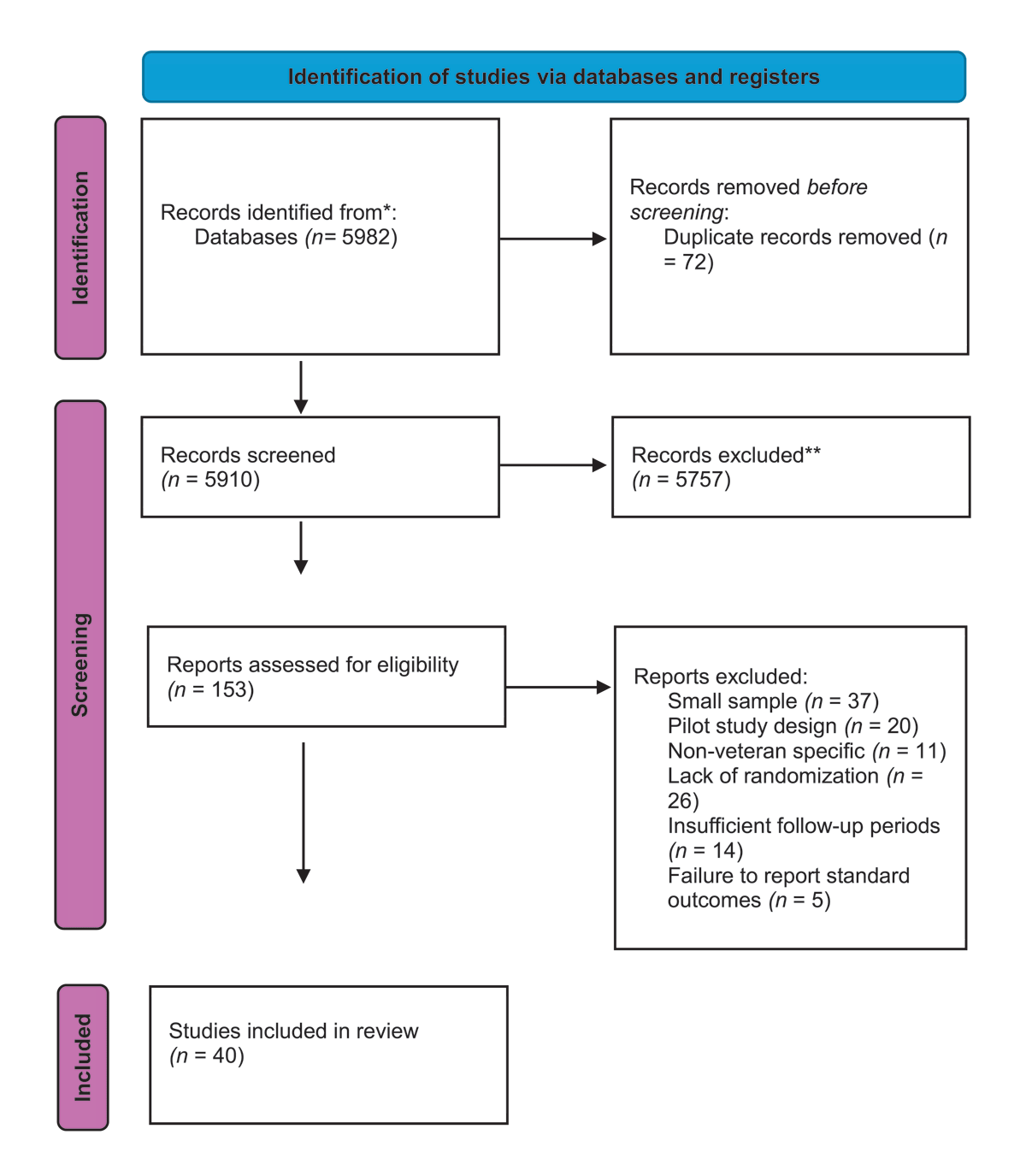
Figure 1

PRISMA 2020 Flow Diagram of Study Selection.

Note. This flow diagram depicts the identification, screening, eligibility and inclusion stages for the 40 studies synthesized in this Evidence Integration Review. Adapted from PRISMA 2020 guidelines; n = sample size.

Table 1

Integration of Quantitative and Qualitative Findings Across Thematic Domains.

THEMEQUANTITATIVE FINDINGSQUALITATIVE INSIGHTS
Psychological Benefits
  • - PTSD reduction (Schnurr et al., 2022: CAPS-5 reduction, d = 0.8). –

  • - Significant reductions in grief and depression (Acierno et al., 2021: ICG-R reduced by ~14 points, BDI-II by ~6 points, PCL-5 by ~13 points).

  • - MBCT-S improved attentional control (Chesin et al., 2021: F(3, 161) = 3.07, p = .03). Mindfulness facets (Non-Reactivity, Acting with Awareness) predicted PTSD reduction (Stephenson et al., 2017). – Self-compassion reduced PTSD symptoms and functional disability (Dahm et al., 2015: f2 = .25 for PTSD, f2 = .41 for functional disability).

  • - Veterans reported improved emotional control and resilience through mindfulness (Chesin et al., 2021).

  • - Trauma-focused therapies effectively reduced PTSD symptoms (Castillo et al., 2016).

  • - Self-compassion is key to addressing trauma-related distress and disability (Dahm et al., 2015).

Social Support & Connection
  • - Increased reintegration and employment rates (Bond et al., 2022: NCCP participants earned $703 more monthly, worked 56.5% of months vs. 42.8% in control, p < .01).

  • - Enhanced life satisfaction (Davis et al., 2020: +20% improvement in reintegration scores).

  • - Mindfulness associated with increased mental health service utilization (Barr & Kintzle, 2019: PTSD cases utilizing MHSU increased by 27%, p < .005; SSOSH predicted help-seeking behavior, β = –0.34, p < .001).

Barriers to Engagement
Physical Activity Improvements
  • - Improved daily step counts during interventions (Agarwal et al., 2021: +1,224 steps with financial incentives, p = .005; no sustained effect during follow-up).

  • - Enhanced physical health (Damschroder et al., 2020: moderate increases in active minutes).

  • - Yoga increased satisfaction but did not outperform traditional education in reducing physical disability (Roseen et al., 2023: adjusted between-group difference for disability = –0.95, 95% CI [–3.14, 1.23], p = .39; pain intensity = –0.20, 95% CI [–1.06, 0.66], p = .65).

  • - Veterans appreciated gamification strategies (Agarwal et al., 2021) but reported difficulty sustaining engagement post-intervention.

  • - Tailored programs enhanced adherence (Damschroder et al., 2020).

  • - Veterans valued tailored physical activity programs but noted difficulty sustaining engagement (Roseen et al., 2023).

[i] Note. CAPS-5 = Clinician-Administered PTSD Scale for DSM-5; BDI-II = Beck Depression Inventory-II; PCL-5 = PTSD Checklist for DSM-5; MBCT-S = Mindfulness-Based Cognitive Therapy for Self-compassion; MHSU = Mental Health Service Utilization; SSOSH = Self-Stigma of Seeking Help Scale. d = Cohen’s d; f2 = effect size; p = probability value; CI = confidence interval.

Table 2

Practical Implications for Implementation by Intervention Type.

INTERVENTION TYPETARGET OUTCOMESPRACTICAL IMPLICATIONS
Mindfulness PracticesPTSD, Depression, AnxietyOffer mindfulness-based stress reduction (MBSR) in group settings or as online modules to increase accessibility and address stigma.
Exercise ProgramsPhysical Health, Chronic Pain, Mental HealthImplement tailored fitness programs using wearable technology and gamification strategies to sustain engagement post-intervention.
Social Support GroupsSocial Connection, ReintegrationDevelop peer-led and family-inclusive support groups to foster connection, targeting both urban and rural veterans for equitable access.
Employment-Focused InitiativesEconomic Stability, ReintegrationIntegrate job coaching and career readiness programs into veteran services; collaborate with local employers to create veteran-specific job opportunities.
Telehealth PlatformsAccessibility, Mental HealthInvest in telehealth platforms with user-friendly interfaces; include technical support and training to reduce technological barriers.
Gender-Specific ProgramsPTSD (Women Veterans)Design interventions tailored for women veterans, including safe spaces to discuss MST and coach-assisted online modules for flexibility.

[i] Note. MST = Military Sexual Trauma; MBSR = Mindfulness–Based Stress Reduction; PTSD = Posttraumatic Stress Disorder.

Language: English
Page range: 15 - 27
Submitted on: Feb 17, 2025
Accepted on: Jun 6, 2025
Published on: Aug 25, 2025
Published by: Virginia Tech Publishing
In partnership with: Paradigm Publishing Services

© 2025 Tony Carlton, published by Virginia Tech Publishing
This work is licensed under the Creative Commons Attribution 4.0 License.