
Migrants acculturate, meaning they change through contact with another culture (Birman, 1994). How well they acculturate can affect how well migrants adjust to their new lives. While some migrants quickly learn the language and customs of their locale, others struggle to communicate and learn how things work in their new land. Recently, some military scholars have compared veterans to migrants, using ideas from acculturation to study military transition (Joseph et al., 2022; Smith, 2023; Tkachuck et al., 2022). Indeed, the military does have a distinct culture (Burk, 2008; Daley, 1999; Truusa & Castro, 2019), and when service members leave the military, they can struggle to transition and have trouble adjusting socially and psychologically (Brunger et al., 2013; McCormack & Ell, 2017; Orazem et al., 2017; Smith & True, 2014; Smith-MacDonald et al., 2020; Young et al., 2022). Ironically, some veterans are literal migrants born outside their country of military service. If service members acculturate to civilian life, then foreign-born service members must acculturate in multiple ways, both internationally and military-to-civilian. Are both transitions similar or different in their type of acculturation? What can we learn about the culture of military transition from foreign-born service members?
Acculturation and Migrants
When most people in the United States (US) think about acculturation, the traditional attitude is to assimilate newcomers, insisting that they learn to speak English and adopt American traditions like watching baseball and celebrating Thanksgiving. Subsequently, most people assume this comes with a loss of heritage culture and that cultures are a zero-sum game. This is the idea behind the “melting pot,” where the old-world ways are blended into the fondue of the new nation (Karakayali, 2008; Phinney, 1990). This assimilation attitude has appeal, but it is flawed because it is possible to learn a new culture while maintaining your heritage (Berry, 1990; Birman, 1994; LaFromboise et al., 1993; Rudmin, 2003; Schwartz et al., 2010). The melting pot also assumes people homogenize rather than come together while remaining distinguishable, more like a salad bowl rather than fondue. Indeed, newcomers may have their own ideas of acculturation, such as what beliefs and traditions they want to leave behind versus the ones they want to carry forward. Lastly, newcomers have their own view of the parts of the new culture that are worth adopting. Scholars call these attitudes about acculturation “orientations,” usually represented with the two-by-two diagram (Figure 1) (Berry, 1990). In this model, there are four orientations, the result of combining either high or low identification with the host and recipient culture.
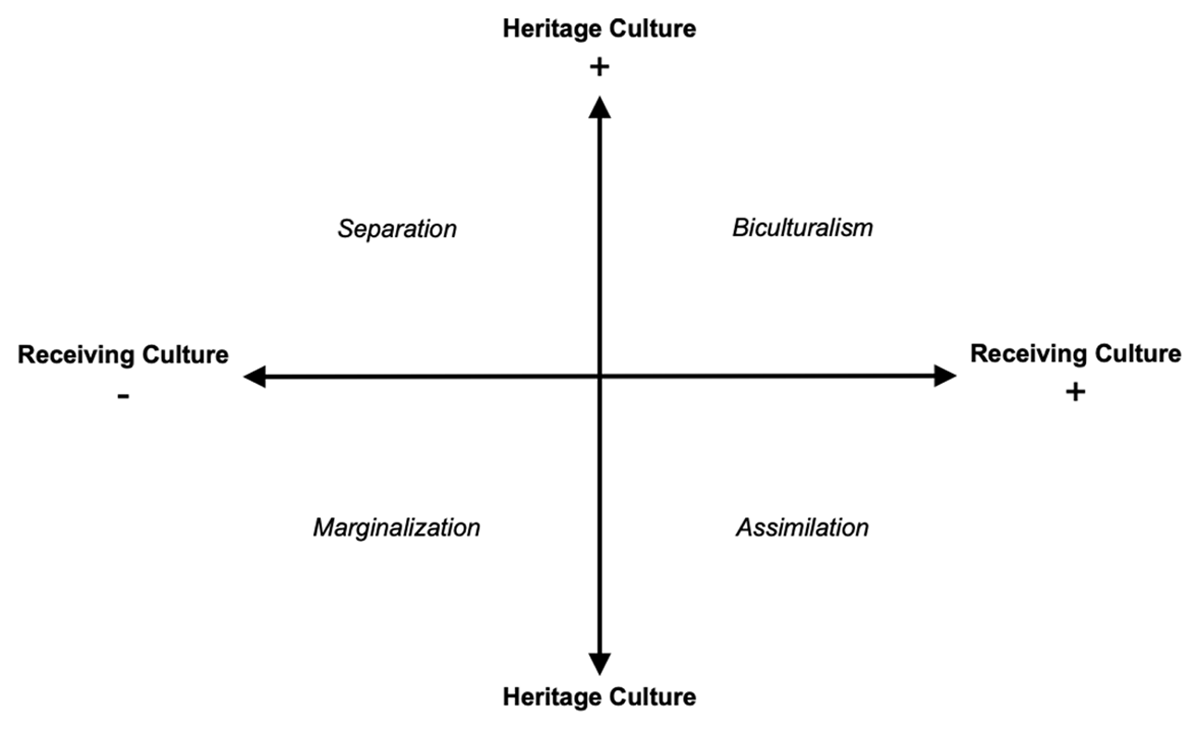
Figure 1
Four Acculturation Orientations.
Note. The arrow lines represent the strength or weakness of an individual’s identity with the respective culture, leading to four orientations. Adapted from Berry (1990).
The benefit of the four orientations model is that assimilation is only one option. Some migrants may embrace both cultures, known as biculturalism. They might speak two languages fluently and have friends from both cultures. Other people assimilate to the new culture at the expense of leaving the old one behind. The first author’s grandfather, for example, was forbidden from speaking Italian at home by his immigrant parents who wanted him to assimilate. Other migrants strive to maintain their heritage at all costs, staying separated to not lose the old ways. Had the author’s great-grandparents wanted to stay separated from American culture, they might have forbidden his grandfather from speaking English at home, even sending him to an Italian-speaking school if they could find one. The fourth orientation, marginalization, refers to low identification with both cultures. People rarely choose to be marginalized (Berry, 1997; Del Pilar & Udasco, 2004; Schwartz & Zamboanga, 2008). Instead, migrants may become marginalized by losing connection to their homeland while also facing hostility in their new land. Like losing a round of musical chairs, marginalized migrants leave one cultural seat but cannot find another.
No matter the orientation, acculturation can be stressful (Miller et al., 2011). Migrants can feel lonely, isolated, and cut off from their old way of life. Learning a new language can be difficult, and they may face discrimination and xenophobia. Ideally, migrants will acculturate and adapt to the new country (Berry, 1997). How well they adapt can affect their health, including self-esteem, anxiety, depression, and how well they function at work and in school (Aycan & Berry, 1996; Nguyen & Benet-Martínez, 2013; Searle & Ward, 1990). Adaptation can also affect relationships (Searle & Ward, 1990) and finances (Aycan & Berry, 1996), all similar to the concerns faced by service members when they leave the military, leading some military scholars to claim that veterans are acculturating to civilian life (Joseph et al., 2022; Smith, 2023; Tkachuck et al., 2022).
Acculturation and the Military
The link between military transition and acculturation is not obvious until you think about military culture. The military has unique values, meanings, symbols, rituals, and beliefs (Smith & True, 2014) and is an occupation that is accompanied by a highly regimented lifestyle (Romaniuk et al., 2020). Military codes of conduct regulate how people should act, dress, and behave, plus orders from commanding officers inform them of their scheduled location of work and rest (Smith & True, 2014). These standards ensure that military personnel are disciplined, ready to effectively work, and fight in coordination to complete the mission (Adler & Sims, 2017; Daley, 1999; Goodwin et al., 2018; Hall, 2013). Additionally, close quarters and teamwork foster deep bonds and camaraderie between members of the military, which is what the US military calls esprit de corps (Department of the Army, 2015). This collective mentality means service members live for something bigger than themselves. Military service gives them a purpose that can become a large part of their identity.
Given the attraction of military life, leaving the military can feel like moving to a new country. While the military is highly regimented, civilian life is unstructured. Outside of the military, people make their own missions and pursue individual goals. This can be disorienting for veterans without the military to guide their time and energy. Civilian life can also seem mundane compared to the thrills of military service (Smith & True, 2014; Young et al., 2022). Service members can save as well as take people’s lives. Their jobs are critical for global and national security. The stakes are high. Civilians, on the other hand, suffer from an endless series of bills and home repairs, small talk, and parent-teacher conferences. It can be hard for service members to relate to these mundane aspects of adulting. In civilian life, veterans may feel that their military skills, habits, and traditions are misunderstood (Brunger et al., 2013; Smith & True, 2014), and civilians can come off as rude, insinuating that all service members are violent (DiRamio et al., 2008; Parks et al., 2015; Zinger & Cohen, 2010). It is easy for veterans to feel as if they do not belong (Brewster et al., 2021). These struggles are similar to migrants, who themselves can also often feel like outsiders in their new land, facing accusations and hostile attitudes, but also being disconnected from their homeland and not quite fitting in with the culture they left (Hayes & Endale, 2018).
Researchers have started to frame military transition as acculturation, borrowing concepts and measures from studies of migrants (Joseph et al., 2022; McCaslin et al., 2021; McNally, 2020; Smith, 2023; Tkachuck et al., 2022). For example, Smith (2023) asked veterans about the differences between military and civilian culture. Some of the veterans surveyed said they needed to censor themselves around civilians to appear less threatening. Others felt misunderstood and stereotyped and were disappointed by the individualism of civilian life. In a different study, Tkachuck and colleagues (2022) tried to learn if a self-report scale measuring acculturation in migrants could also apply to service members. Adjusting the questions was straightforward, as most measures of acculturation are already adjustable for use with different pairs of cultures (Celenk & Van de Vijver, 2011). For example, the item “I feel caught between the Chinese and American cultures” (Benet-Martinez & Haritatos, 2005) is easily changed to “I feel caught between the military and civilian cultures” without losing its meaning (Liles, 2018; McNally, 2020). Even with the adjustment, several questions were not relevant to transitioning service members, like those asking about adaptation to new weather and climate. Still, most of the items were valid for veterans, and the scales had good internal consistency in the sample (Tkachuck et al., 2022). Together, the studies are a sign that the acculturation questions make sense to veterans, but there is still no strong evidence that culture matters for veterans the same way it does for migrants, which begs the question, is military-to-civilian transition on par with migration as a cultural transition?
Who Acculturates?
Some veterans are also migrants and fit the traditional focus of acculturation. Over one million people born outside of the US have served since 1776 (Rodriguez & Manley, 2020; Wong, 2007), taking part in over 30,000 overseas missions from 2001 to 2014 (Chishti et al., 2019). The foreign-born can be an attractive demographic for military recruitment. In the US, they represent the only source of net population growth among 18 to 24-year-olds (McIntosh et al., 2011; Passel & Cohn, 2008; Sutton & Hamilton, 2011), and many people born outside the US possess in-demand linguistic and medical skills (McIntosh et al., 2011). Section 329A of the Immigration and Nationality Act of 2001 granted immediate US citizenship to foreign-born service members who die on active duty, enabling close relatives to naturalize (Stock, 2013). In 2002, President George W. Bush’s Executive Order 13269 let foreign-born service members apply for US citizenship after the first day of duty, shortening the process from 5 years to 3 months (Cunha et al., 2014; Rodriguez & Manley, 2020), and extending eligibility to 15,000 people (Dragomir, 2014).
While military service is a pathway to US citizenship, little is known about the experiences of foreign-born service members. The limited evidence suggests military service is a part of acculturation for foreign-born service members. In a survey with the Swiss Armed Forces, foreign-born service members were more likely than Swiss-born counterparts to say military service would make them more Swiss, raise their social status, and improve their chances of employment (De Rosa & Szvircsev Tresch, 2022). In a separate study, a Romanian-born US service member told researchers she joined the military to gain immigration rights, but she also gained American identity through her service (Dragomir, 2023, p. 37):
Being in the military made me proud to be an American, much more than I would have been as a civilian. You know, to me, maybe I am more like the sentimental person, but whenever they play the national anthem, I just … it is a moment of emotion for me.
While the published experiences of foreign-born service members are few, it is clear the international type of acculturation is already occurring in the US military and others. Ironically, scholars of foreign-born service members use acculturation theories to understand their subject (e.g., Resteigne, 2022), raising questions about how applicable acculturation is for the general military population. Is leaving the military an intercultural transition? If not, then what is the added value of talking about military acculturation?
Rethinking Acculturation and Military Transition
While acculturation is one way of thinking about military transition, it is not the only way. The widely accepted model is Military Transition Theory, which states that the quality of reintegration depends on a person’s life before and during service and immediately before, during, and after separating from the military (Castro & Kintzle, 2014; Pedlar et al., 2019). Veterans who have had their basic needs met, such as housing and healthcare, should have better long-term outcomes in reintegration (Markowitz et al., 2022); therefore, planning for transition and life after military service is crucial (Kleykamp et al., 2021). Table 1 shows risk factors for poor transition based on Military Transition Theory. The factors are arranged by career stage, with an emphasis on the circumstances of transition.
Table 1
Military Transition Theory: Risk Factors for Poor Reintegration Across Military Careers.
| BEFORE SERVICE | IN SERVICE | TRANSITION | PERSONAL CHARACTERISTICS | AFTER SERVICE |
|---|---|---|---|---|
| Low socioeconomic status Low education Childhood trauma | Early service leavers Unexpected separation Health problems Trauma | Unfavorable conditions Organizational support | Culture Identity Professional skills Coping Help-seeking Gender, race, and sexuality | Opportunities Support Stigma Military-civilian relations |
[i] Note. From Duel and colleagues (2019).
Acculturation theory faces one major obstacle to adding value to veterans’ studies—how to define the civilian lifestyle as a culture unto itself. While military culture is different from civilian culture, it is hard to say exactly what constitutes civilian culture. Acculturation theory was developed to study international migration, where there is a much clearer distinction between two national cultures as opposed to the military and its civilian counterpart. Recall the idea of orientations (Figure 1), which assumes two separate cultures that migrants can embrace or not. To apply this model to the military context, we can say that veterans have orientations toward maintaining military culture and gaining civilian culture, but what does civilian culture mean? The model breaks down if civilian culture cannot be defined or if the difference between military and civilian cultures is so minor as to not really matter. Culture may only play a minor role in the military reintegration process. For example, veterans usually do not have to learn a new language. Instead, much of the difficulty regarding military transition might be called practical rather than cultural. For example, veterans need to find employment, housing, and access to other resources such as healthcare.
Although practical concerns are important for veterans, the mere idea of a civilian can still hinder reintegration, even if the concept of civilian is vague. Indeed, no one ever calls themselves a civilian the same way they would call themselves an American or a Romanian. Instead, a civilian is something that a person in the military calls someone outside of it. Sometimes, the term is even used as slang to describe an outsider to any clique. For instance, the accountants might complain among themselves that “those civilians in the marketing department do not understand how cash flow works.” The idea of a civilian, therefore, exists more in the minds of service members than within the minds of the civilians themselves. This does not mean that civilian does not matter. Social identity theorists have long argued that arbitrary categorization of people into identity groups can spark inter-group conflict (Abrams & Hogg, 1988; Tajfel & Turner, 1986). Accordingly, service members, who think civilians are against them, might be more guarded and less gracious, not giving civilians a chance to learn and grow. In turn, the civilians might think veterans are defensive or standoffish, playing into inter-group identity conflict.
From an acculturation perspective, identity conflict is internalized by individuals, with some bicultural migrants incorporating multiple cultures into their identity. How well integrated these cultural identities are–either conflictual or harmonious, blended or separated–can impact the social and psychological adjustment of migrants (Benet-Martínez et al., 2002; Benet-Martinez & Haritatos, 2005; Huynh et al., 2018). For example, a person may feel their cultural identities are too separated to perform both at one time; thus, they alternate between identities given the setting (LaFromboise et al., 1993). An immigrant might speak Arabic at home and at the mosque but alternate at work to speak fluent German and talk about the latest Bundesliga match. Even among these alternating bicultural migrants, some might feel their two cultural identities are conflictual, with incompatible values and customs. For example, a migrant’s parents might expect them to have an arranged marriage while they secretly date and dream of finding love on their own.
We propose the internal distinction between military and civilian identity is more consequential for veterans than the cultural differences between the military and civilian worlds, which do exist, although these differences are also not as extreme as international migration. Even if civilian culture is vague, the strength of military culture and the civilian identity combine to create a type of bicultural identity in veterans: military-civilian biculturalism. Civilian culture may be vague in real life, but it is real in the minds of veterans. To the extent that veterans cannot see themselves as civilians, it will likely hinder their post-service adaptation. Given this proposition, we point your attention to Figure 2. These six diagrams represent hypothetical military-civilian bicultural identities. The circles each represent military and civilian culture, and the “X” indicates a veteran’s core sense of self or identity.
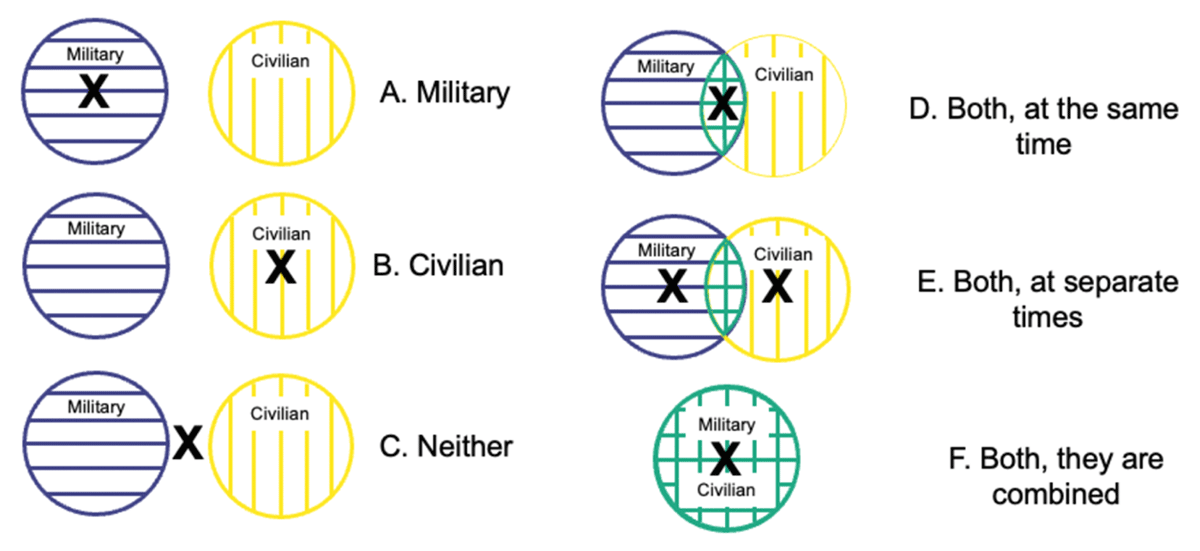
Figure 2
Different Relationships between Identity, Military Culture, and Civilian Culture.
Note. Adapted from Phinney and Devitch-Navarro (1997).
From the identities displayed on the left in Figure 2, we expect only B, the civilian identity, to be adaptive for service members after leaving the military. With each of these three identities on the left, a veteran sees the military and civilian cultures as separate, distinct, and different, as indicated by the space between each cultural circle. In the case of A and B, veterans’ identities are firmly in one of those worlds and not the other. In the case of C, the veteran is marginalized, having left the military musical chair only to have the civilian chair pulled out from under them. In contrast, the identities diagrammed on the right are all bicultural, as indicated by the overlapping circles. D indicates a person in the middle of two cultures, which overlap somewhat but not completely. E indicates an alternating bicultural, someone who switches between a military and civilian, given the situation. In the case of F, the circles completely overlap, fused together in the identity of a person (Jiménez et al., 2016). These three identities on the right side are likely to be most adaptive for service members since they all bridge the person they were in the military with the person they are after service.
Studying Military-Civilian Biculturalism: An Agenda for Research
We propose six questions to inform a research agenda for military-civilian bicultural identity.
What leads to different military-civilian bicultural identities?
What is the effect of different kinds of military-civilian bicultural identities on reintegration?
How should military-civilian biculturalism be measured?
How does the role of the military in society affect veterans’ bicultural identities?
How do cultural beliefs about reintegration affect veterans?
How do military and civilian identities relate to other identities and cultures?
First, what leads to different military-civilian bicultural identities? In answering this question, attention should be paid to marginalization. Having lost military friends and having difficulties connecting to civilians, veterans may feel caught between two worlds, not quite service members and not quite civilians (Brunger et al., 2013). The factors contribute to this sense of marginalization should be explored further. Some have argued that certain in-service events may worsen veterans’ identity marginalization, such as acquiring a moral injury or other trauma (Hodges, 2023; Moon, 2019; UCLA/VA VFWC, 2021). Research should also be focused on learning what contributes to bicultural identity integration in veterans. Many service members come from military families; thus, they may see less difference between military and civilian life. Conversely, as military service in the US has concentrated within military families since the end of the draft, the division between the “warrior caste” and the rest of American society may be widening (Schafer, 2017). Countries with conscription, such as South Korea or Israel, may have less difference and conflict between military and civilian realms (Atuel & Castro, 2018). These hypotheses should be investigated empirically, including in comparative studies across different countries.
Second, what is the effect of different kinds of military-civilian bicultural identities on reintegration? Whereas migrants might be able to alternate between cultures, veterans may lose the ability to go back and forth between military and civilian worlds (Herman & Yarwood, 2014). This suggests that the ability to alternate might be less useful for veterans unless they find communities of veterans where they can engage that part of their identity, such as the American Legion or Veterans of Foreign Wars. Similarly, service members who go from active duty to reserve duty with a part-time commitment might be better able to alternate between identities and, therefore, have an easier time adapting to civilian life (Vest, 2013). Some veterans might find civilian jobs that are similar to the military, such as working in security, defense contracting, or emergency services (Herman & Yarwood, 2014). This career similarity may make it more likely that a veteran develops a fused military-civilian identity.
Third, how should military-civilian biculturalism be measured? The existing approach is to adopt measures from acculturation studies for use with veterans. As we have already seen, some researchers take care to test the face validity of adapted measures before administering them to veterans, for instance, by running the items by a panel of experts and then analyzing their internal consistency with statistics after the fact (Tkachuck et al., 2022). Taking this approach a step further, future research might generate original items from inductive research with military veterans (Cortina et al., 2020). For example, a recently created measure of reintegration difficulties, the Military-Civilian Adjustment and Reintegration Measure, was created from interviews with veterans to learn about their post-service experience (Romaniuk et al., 2020). A similar technique could inform a measure of military-civilian biculturalism that fits the experience of veterans, rather than adapting measures initially created for migrants.
Fourth, how does the role of the military in society affect veteran’s bicultural identities? Future research should consider the societal conditions that influence military-civilian relations as well as the ways that military and civilian cultures overlap, exchange meaning, and relate in terms of power. The military is nested within the national culture, but military meaning, terms, and prerogatives of militaries can also become prevalent in the wider culture, a phenomenon known as militarization (Enloe, 2014). The interplay between the military and civilian world is not static, and the gap between the military and civilian world can affect reintegration, as suggested by acculturation. This relationship between the military and society does not occur in a vacuum. Rather, it takes place within the context of international relations and national and global security challenges.
Fifth, how do cultural beliefs about reintegration affect veterans? A corollary to the previous question is that cultural beliefs about military transition may affect veterans’ identities. This suggests that existing transition programs may be inadequate if they do not address preconceptions about transitioning that exist in the wider culture. The US military requires a one-day course for separating service members called the Transition Assistance Program offered by the US Department of Labor (n.d.). Such programs attempt to shape the way that people approach reintegration. However, transition programs contend with the shared meaning that exists in military culture and the wider cultural meaning of being a veteran and serving in the military. These conceptions may be deeply engrained in national and military culture, meaning a short-term class may not be sufficient to shape notions about civilian life that are ingrained in military culture. Culture offers a new perspective on transition, allowing interveners to think broadly about creating a culture of transition within the military and in the wider national community.
Finally, how do military and civilian identities relate to other identities and cultures? Meca and colleagues (2021) suggest veterans with stronger American identity may have less difficulty in reintegration. As the military and civilian world are both nested in a wider national culture, American identity might help veterans bridge military and civilian cultures (Meca et al., 2021). In other studies, veterans have reported how identities shared with civilians, such as a religious identity, can help them relate to civilians (Smith, 2023). As a system of shared meaning derived from experience (Avruch, 1998), culture permeates all these domains and career stages. However, culture is not a monolithic concept—individuals share multiple cultures with different sets of people. These sets of people overlap at various levels of social organization, including at the global and national level, but also within subnational and transnational groups, such as religion, ethnicity, and professions. Intertwined with culture is the identity trio of sex, gender, and sexuality. These cultures and identities extend into each other, overlap, and blur. Altogether, this tapestry of cultures is reflected in the individual as cultural identity (Schwartz et al., 2006). Countries are diverse and so too are their militaries. Understanding how this diversity impacts military-civilian biculturalism is thus an area for further exploration.
Conclusion
While the application of acculturation theories to military transition is a novel trend, some of its assumptions need rethinking, particularly the role of civilian culture. In this manuscript, we have argued that the civilian identity combined with the strength of military culture and identity, may make veterans bicultural. The implication of military-civilian biculturalism is to formalize the language in veterans’ studies to describe different types of identities in transition. Indeed, the field has struggled with how to label post-military identity crisis, calling it identity loss (Albertson, 2019; Herman & Yarwood, 2014; Romaniuk & Kidd, 2018), identity transition (Brunger et al., 2013), and identity dissonance (Moore et al., 2022), let alone ground these labels in theory and articulate how post-service identities can vary. With the classification presented in this article, factors leading to different military-civilian bicultural identities can be explored. The relationship between the military and society can also shape these bicultural identities. Programs to assist veterans in transition should consider ways to engage service members who see civilian life as distant and conflictual with their identity. Part of the solution is to build authentic bridges between veterans and civilians, not just based on platitudes and stadium flyovers, but grounded in building empathy, compassion, and relationships through strategically designed training, activities, and difficult conversations. Reshaping culture is no easy feat, but we all have a responsibility to play in forging new practices, beliefs, and relationships that can steer cultures toward acceptance of newcomers, be they migrants, veterans, or both.
Acknowledgements
We thank Jaxson Shickler for providing a disinterested reading of the article.
Competing Interests
The authors have no competing interests to declare.