
Introduction
The emergence and widespread availability of mobile devices and sensing aids have encouraged the use of more creative instructional approaches. Augmented reality (AR) is among the most innovative mobile learning applications to be used in education (Hongnimitchai et al. 2022; Liu et al. 2018; Nikimaleki & Rahimi 2022). For instance, Google announced at its 2017 annual conference that it plans to integrate AR into its immersive education platform, Google Expeditions (Ravipati 2017). Similarly, Apple revealed that it would release thousands of AR apps compatible with its new iPhone and an update to the iOS system (Graham 2017). Research has shown that the use of AR that combines learners’ senses (i.e. sight, sound, and touch) with virtual-based features enhances learners’ interactions with the world around them and helps them reach higher levels of authenticity in learning (Chiang et al. 2014; Liu et al. 2018).
According to Li et al. (2016), ‘Augmented Reality is a technology of real-time streaming computation. It generates a view between physical reality and virtual reality called mediated reality (Christopoulos et al. 2022). Through the recognition of objects appearing in the live video, the virtual objects can be inserted into the video at the corresponding positions.’ It allows a user to have an active interaction with the virtual objects in the app using predefined orders. When applied in education, AR can be viewed as an interactive tool with multimedia and 3D features that complement traditional materials, such as textbooks. Modern mobile devices have great processing capabilities and are equipped with sensors that enable them to use various AR applications, although the use of AR for educational purposes remains limited (Mota et al. 2018).
Regarding language instruction, Abdullah et al. (2014) argued that second and foreign language courses might present different circumstances to others because they entail requirements that go beyond simply grasping knowledge to acquiring the ability to use the languages with an adequate level of accuracy. Unfortunately, schools might not be able to offer sufficient exposure to these languages to help every student learn language forms and reach the desired target level. As mobile devices and technological tools are available at an affordable price to most learners, they could be viewed as an extra resource to take learning to a higher level.
AR technology could offer an interactive and attractive method of teaching (Vallera 2019) that helps learners achieve better language proficiency. Given that AR-based instruction can be a more interactive source of learning for students to achieve their language learning needs, this study explored the effectiveness of an AR-based language learning course to enhance English as a Foreign Language (EFL) learner achievement.
As a relatively novel technology, research on the integration of AR in language instruction remains limited (Özçelik et al. 2022), particularly within the context of Arabic language education (Al-Amir 2019; Al-Shathri & Obeikan 2016; Al-Zein 2018). According to Scrivner et al. (2017), despite the increasing attention to this area of research, there are still several questions, such as the effectiveness of AR technology in classrooms and how it might enhance learning experiences. The focus of the current study is thus on exploring the effectiveness of integrating AR technology in learning English as a foreign language in an Arabic context.
Statement of the Problem
Teaching English to speakers of other languages can be particularly challenging in non-English-speaking contexts, where students often lack access to the authentic resources readily available in English-speaking environments. As such, teaching English in the Arabic context faces obvious challenges, as indicated by low academic achievement (Ba-Sirah 2015; Rahman & Alhaisoni 2013). Similarly, English language learners may face significant challenges in acquiring target language forms when they lack access to interactive and rich resources, which can lead to poor learning outcomes (Che Dalim et al. 2020; Richardson 2016). In this regard, Ba-Sirah (2015) noted that weaknesses in the English teaching programs in a war-torn context led to obvious shortcomings in the academic achievement of the students. She also attributed this weakness to the lack of rich input, such as audio and visual aids and multimedia resources, that may enhance the learning of the foreign language.
AR is a relatively recent tool in education with much potential. It is therefore vital to study the effectiveness of applying it in foreign language classes, (Che Dalim et al. 2020) especially in the Arab context (Al-Amir 2019). The integration of AR technology in an educational setting is a novel trend that requires more investigation to evaluate its potential. Scrivner et al. (2017) indicated that despite the reported capabilities of AR applications, scarce research had explored its effectiveness in language learning. Not too surprisingly, there are very few studies on its use in an Arabic context (Al-Amir 2019; Al-Hujaili 2019; Al-Sharif & Mas’ad 2017; Al-Shathri & Obeikan 2016), and most of these studies have been conducted within computer science teaching classrooms.
Our exploration of the prevailing literature indicates that no study has explored the effect of implementing AR applications in English language classrooms in the Yemeni context. In this study, employing an AR-based course could be seen not only as a complement to formal classroom learning but also as a means to enhance it (Che Dalim et al. 2020). These learners in the Arabic context are not exposed to authentic language learning activities, which could be provided through AR-based learning to include audio, video, and authentic learning materials.
The present study was thus conducted to expand what is known about the educational uses of this innovative technology by exploring the effectiveness of AR-based learning in teaching English as a foreign language. The study addressed the following question: What is the effect of an AR-based language learning program on the achievement of EFL learners?
Significance of the Study
AR is a relatively recent technological development, and one that can be exploited to accommodate EFL learners. Research is therefore needed to critically examine the use of these new technologies to better evaluate their impact and determine their potential to enhance the teaching and learning process. Such research would also provide a theoretical basis for applying AR-based teaching programs to address the lack of related research in the Arabic literature.
To the best of the researchers’ knowledge, the current study may be one of the first Arabic studies in the field of integrating AR in teaching EFL. In effect, it aimed to open new directions for researchers in the Arabic context to help fill the research gaps in this area. In addition, quantitative tools were developed to collect data on the impact of implementing AR-based teaching programs, which may be used in future studies.
Literature Review
Augmented Reality
One innovative way to implement technology programs is to integrate AR. According to Sansone (2014), AR is the ‘overlaying of digital images onto the real world’ (p. 6). Carmigniani et al. (2011) defined AR as ‘a real-time direct or indirect view of a physical, real-world environment that has been enhanced/augmented by adding virtual computer-generated information to it’ (p. 342). AR has interactive features, is rendered in 3D, and can present both real and virtual objects. This technology is a mixture that can span between the real environment and the virtual environment. AR can bring virtual information to the immediate user’s surroundings or any indirect spot in the real world (Huang et al. 2021; Wang et al. 2020).
Rapid developments in AR technology have begun to make it easy for teachers to design activities that use it (Arbogast 2019). A practical feature of AR use in educational settings is that students do not need access to the internet when using some apps and programs, they may just need a mobile device with a camera (Billinghurst & Dunser 2012).
Types of Augmented Reality
AR has three main methods for collecting data.
Marker-based Augmented Reality is based on a visual reading of ‘triggers’ or QR codes (Quick Response) by the mobile camera. A distinctive image can be used as the trigger of the device’s camera to access AR and explore information and images (Kapp & Balkun 2011). It can also provide links to websites that provide more information on the topic.
Markerless-based Augmented Reality does not depend on markers from the real world; it is called markerless-based AR. In this case, the user adds digital content anywhere and in any size or position (Arbogast 2019). A good example is when a user can add digital content to reality by using IKEA’s AR service for the online shopper to show the suitability of the product’s size and color within the customer’s house.
Location-based Augmented Reality makes use of the Global Positioning System (GPS) and device location, as noted by Kapp and Balkun (2011). It compares spatial location images to a library of images stored on the device or application, showing these images and data in the real world. The Pokémon Go application is an example of an existing AR that uses GPS.
Achievement
Achievement in AR is indicates the impact of learning, through which the teacher can see the extent to which the goals have been achieved. It provides educational institutions with data that help them to assess the success of plans and programs. Scientific research has been an effective means of studying methods and strategies that can help learners achieve higher levels of academic success in educational programs (Hadda 2013).
According to Cobuild (2006), achievement can be viewed as a target that an individual aims for, particularly after demanding work. Similarly, Good (1973) defined achievement as ‘knowledge gained, or skills developed in the school subjects, usually designated by test scores or by marks assigned by teachers, or by both’ (p. 7). In this research, achievement is defined as all that the learner acquired as a result of passing through the educational program during the study, measured by the score the student received on the tests prepared by the researchers for this study.
In the Yemeni context, Abdullah and Patil (2012) found that learners struggle with all aspects of English language learning throughout the country’s education system. Despite studying English for at least six years, beginning in the seventh grade, most Yemeni students remain unable to communicate effectively in the language. This persistent deficiency is widely attributed to curricula that are poorly aligned with effective foreign language teaching practices (Shamsan 2003). Numerous studies have highlighted the alarmingly low levels of English language achievement in Yemen, particularly in real-life communication contexts (Al-Mushriquee 2003; Al-Sohbani 2013). Research by Bataineh et al. (2011) and Al-Ahdal (2010) further indicates that more than two-thirds of high school graduates lack the proficiency to express themselves adequately in English. This widespread underachievement is commonly linked to shortcomings in the curriculum, as noted by Al-Mansoori (2008), Al-Hammadi (2017), and others (Bataineh et al. 2011; Al-Ahdal 2010).
It should be noted that the current curriculum in Yemen is outdated, having been developed in 1990 and published in 1993, which is more than a quarter of a century ago. Interestingly, one of the researchers studied the same curriculum when he was a high school student. The curriculum, English Language Teaching for the Arab World, was developed by O’Neill and Snow (1993) and published by Oxford University. Technology integration at this time was typically limited to the use of audio cassettes.
English Language Achievement and Augmented Reality
Some studies have reported on the potential of integrating AR technology into education to enhance the learning process for students, compared to traditional education. Antonioli et al. (2014) concluded that AR activities could provide experiences that improve learners’ critical thinking skills, and that AR can be used to improve the content and the teaching process within traditional classrooms, and can expand the use of educational materials beyond school walls.
To explore the effectiveness of location-based AR in language teaching, Richardson (2016) conducted a study to verify the effect of using AR games in improving English language learning by using an AR game that posed a set of tasks for students to achieve while they are on the move in a city in Germany. The study found a positive impact of this game in engaging learners. Richardson indicated that AR could be seen as an effective tool in creating rich sensory experiences because it can add more activities to the educational environment and be a two-way process.
In a study exploring the impact of AR in teaching vocabulary, Ibrahim et al. (2018) found that the experimental group studying vocabulary using AR excelled in vocabulary learning compared with the control group that used the usual vocabulary cards. The participants indicated that the AR experience was enjoyable. It was effective in teaching vocabulary, and the study recommended employing AR in teaching and learning foreign languages.
Similarly, Solak and Cakir (2015) concluded that AR-based materials could have a significant influence on increased learner motivation toward the learning of language vocabulary. Their study found a clear positive correlation between the learners’ achievement and their motivation when using AR in language classrooms.
In a recent study, Che Dalim et al. (2020) studied the effect of AR, in addition to a voice recognition program, for teaching foreign language vocabulary to four- to six-year-old Malaysian preschool students. That study found positive results in vocabulary acquisition and that learners completed activities faster and more easily.
A qualitative study that used AR to teach English as a second language (Liu et al. 2018) reported that the interviewees found the lesson interesting and expressed positive attitudes toward learning the language with AR. The researchers recommended conducting experimental studies to address the impact of AR in English language teaching.
Integrating AR technology into education has gained increasing research attention (e.g. Elmira et al. 2022). This technology, with its attractive features, may help level up English language learners’ achievement in a foreign context where they are typically deprived of interactive resources.
Arabic Studies in Augmented Reality
Investing in technology programs is of interest in the educational field, and research in the Arabic context has made some limited contributions. In computer achievement for high school students in Saudi Arabia, several studies (Al-Amir 2019; Al-Hujaili 2019; Al-Shathri & Al-Obaikan 2016; Eldokhny & Drwish 2021) reported positive effects of AR on achievement.
Al-Amraji (2017) conducted a study on the impact of AR on the teaching of high school history in Saudi Arabia. The study looked at academic achievement, historical thinking, and motivation for learning. In showing the potential for AR, Al-Amraji (2017) found a positive effect when integrating AR in the teaching of history to stimulate learner motivation and historical thinking skills.
In a study with female students at Princess Noura University in Saudi Arabia the following year (Al-Zein 2018), the impact of a course on developing AR design skills was investigated. That study reported a significant positive impact on students’ learning, and the researchers recommended investigating the impact of AR programs on academic achievement in other courses and at different grades.
In the Egyptian context, Al-Shami and Al-Qadi (2017) worked with student teachers to study the impact of a training program on the use of AR in the design and production of electronic lessons for students at the school of economics at Al-Azhar University. The study found differences in favor of AR-based lessons and indicated increasing interest in teachers’ colleges to prepare pre-service teachers for the use of such programs.
Ahmed (2016) investigated the effectiveness of AR-based teaching on developing visual thinking skills in science in ninth-grade students in Gaza. In this study, there was a significant impact from the AR program in enhancing visual thinking skills. Based on these findings, Ahmed (2016) recommended that AR be used in educational programs for all grades and subjects and that more research should be conducted on this topic.
Despite the above studies and their pointed recommendations (Ahmed 2016; Al-Amir 2019), research on AR is still limited in the Arab world. In fact, the research on AR in education is distributed across a small number of countries, such as Saudi Arabia, Palestine, Egypt, and Kuwait, but is almost non-existent in others, such as Yemen. The dearth of research on AR in education in the Arab world can be explained by the lack of awareness of workers in the field of education and training regarding this technology. Al-Anazi and Al-Failakawi (2018), surveyed one hundred faculty members of the school of Education in the State of Kuwait and reported weak awareness of technology integration.
Generally, the integration of AR in education is gaining more research interest because this technology has attractive advantages. However, the impact of building an AR-based English language education program in the Arabic context has not yet been given enough attention. It is vital, therefore, to conduct more research in this area.
Theoretical Framework
This study was conducted within the frameworks of multimodality and constructivism. Multimodal learning emphasizes the perspective that the way students are exposed to knowledge is significant to the success of their learning. As suggested by Jewitt (2008), various modes of representation could lead to completely different constructions of how learners build their knowledge of the world around them. It can be beneficial for schools to provide teaching content that is as creative and innovative as what learners are exposed to in their real life (Adami & Kress 2014; Bulfin & Koutsogiannis 2012).
According to Jewitt and Kress (2003), although instructional text may be seen as a traditionally limited teaching medium, more can be conveyed via the use of pictures, images, and sound. Multimodality as a framework works with the variety of features that AR learning can present to learners, such as 3D, videos, audio recordings, and the ability to integrate the virtual world with the real one.
Regarding the use of constructivism as a framework, AR applications match student-centered learning and work within learners’ interests, aligning with constructivist principles. The use of AR applications can provide learners with the ability to interactively experience the real world (Hyttinen & Suhonen 2023). Similarly, constructivist principles alter the teacher’s role to be a facilitator and helper, with the students taking charge and being responsible for their learning by interacting with, synthesizing, and analyzing the learning content (DeLucia et al. 2012). AR-based learning can align with the principles of constructivist learning when AR applications are utilized to enable learners to interact with virtual items in augmented environments. This alignment can bridge the gap between learning theories and learning practices via the integration of real-world and virtual activities available in AR experiences (Wang 2012).
Methodology
After developing the AR-based English language teaching program, a quasi-experimental design was implemented by administering a pre-test and post-test with the control and experimental groups. A quasi-experimental design aims to test the causal relationship between variables (Abu-Alam 2011). In this study, the impact of the AR-based English language teaching program on the academic achievement of learners was studied using a control group and an experimental one. The achievement pre-test was administered to the two groups before the experiment. Participants in the control group were then taught using ordinary teaching, which involved the teachers lecturing and minimal use of an audio player; participants in the experimental group received the AR-based English language teaching. Later, the achievement post-test was administered to the two groups.
Treatment
The AR-based English language teaching program was developed utilizing the ADDIE model (Molenda 2015). The AR application provides the ability to design, share, and manage content while generating data on usage. It employs trigger technology, and users can take advantage of geolocation to develop identifiers from the real world using the application, as well. This AR program can provide a variety of content and activities, such as audio and video recordings, images, websites, and 3D models. For example, a range of augmented reality (AR) activities was created to accompany each page of the students’ textbooks. These included a webpage that explained the language lesson, a video featuring native speakers demonstrating the target language in context, and an interactive vocabulary game designed to reinforce new vocabulary items through active engagement. Figure 1 provides examples of these activities.
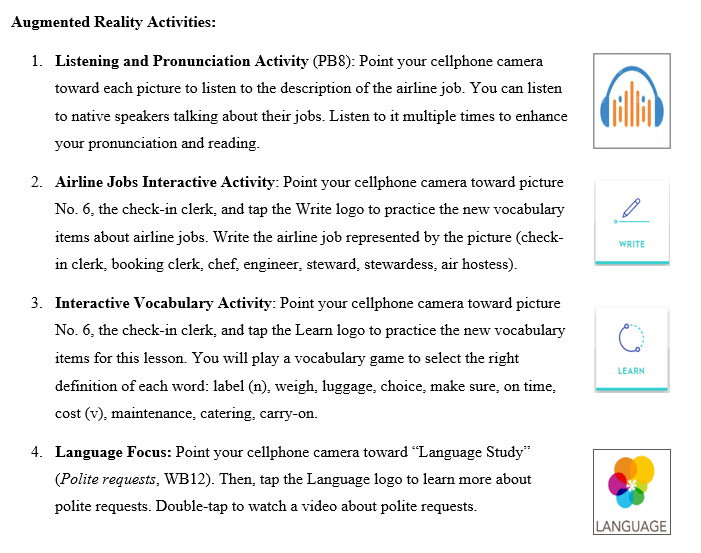
Figure 1
Examples of Activities in the Augmented Reality-based Program.
The class activities were designed and delivered through the AR program, which students were required to access to complete both in-class tasks and homework. The teacher could monitor students’ engagement with the content, and most of the activities were carried out during class sessions.
Importantly, the researchers developed a user guide for the AR-based program, explaining the types of activities and experiences and how to implement them. Figure 2 shows an icon for the program (Augmented Reality 4 Yemen) as an interface for the program.
Figure 2
The Interface of the Augmented Reality-based Teaching Program.
The AR program was reviewed by a group of 17 specialists in the fields of English language teaching, instructional design, instructional technologies, curricula, teaching, and assessment. Theyhelped in evaluating the program and determining its suitability for the purpose of the study, and the suitability of materials for the target learners. The researcher collected the comments of the specialists and made suggested changes until the program reached its final form.
Study Population and Sample
The study population consisted of first-year high school students in Tarim city, Hadhramaut governorate, the Republic of Yemen. The school was chosen based on the collaboration of its administration, and the availability of the internet. Two classes were randomly selected from the first-year cohort of the school and were randomly assigned as the experimental group and control group. The total number of students in the sample was 87, with 44 in the control group and 43 in the experimental group.
With Arabic as their mother tongue, most of the participants had already studied English as a foreign language in Yemeni schools for approximately three years. Generally, they learned their English in instructional settings and had very few opportunities to practice English for real communicative reasons outside of schools. Table 1 shows the number of participants in each group during the experiment. The data from some students was eliminated because they missed one or two tests.
Table 1
Number of the Participating Students throughout the Stages of the Study.
| GROUP | CONTROL | EXPERIMENTAL | TOTAL |
|---|---|---|---|
| Before the experiment | 44 | 43 | 87 |
| Pre-test | 41 | 41 | 82 |
| Post-test | 40 | 40 | 80 |
Equivalence of the Control and Experimental Groups
A t-test for two independent samples was calculated between the means of the two groups’ pre-tests. As seen in Table 2, the t-test value was 0.467, which is not a statistically significant value at p = 0.05. The results indicated no statistically significant differences between the means of the control (M = 29.93) and experimental (M = 30.95) groups in the achievement test before the experiment, indicating the equivalence of the two groups in achievement.
Table 2
t-Test for two Independent Samples Results for the Groups’ Equivalence.
| PRE-TEST | GROUP | N | M | SD | t VALUE | SIG. (2-TAILED) |
|---|---|---|---|---|---|---|
| Achievement | Experimental | 40 | 30.95 | 10.576 | 0.467 | 0.642 |
| Control | 40 | 29.93 | 9.127 |
In addition, the control and experimental groups were taught by the same teacher to avoid the different performances of the teachers. The teacher was trained by the researchers before the experiment and communicated with them continuously during the course and application of the study to address observations on the program or obstacles to the application of the study, if any. Further, the selection of the two groups from the same high school in Tarim, Hadhramout province, contributed to some extent to the provision of cultural, social, and intellectual equivalence within the study population.
Achievement Test
To answer the research question, an achievement test was developed and validated. To study the impact of using the AR-based program on academic achievement, the lead researcher followed a series of steps to develop the achievement test.
The units chosen, Air Travel and Living Abroad, were scheduled to be taught in the target semester of the experiment, based on communication with the subjects’ supervisor and teacher.
The behavioral objectives of the units were analyzed by the researchers and determined to address all levels of Bloom’s taxonomy in the cognitive hierarchy of remembering, understanding, applying, analyzing, evaluating, and creating (Anderson & Krathwohl 2001). There was 95% agreement between the two analyses. Then, the analysis was reviewed by educators to check the face validity of the analysis.
The relative weight of each level of objectives in the two units was determined.
A specification table was created to calculate the importance, the relative weight for each unit, the lessons in each unit, the number of classes, the number of lessons in each class, and the number of objectives in each lesson and unit. Table 3 describes each unit’s relative weight and the behavioral objectives.
The type of achievement test was determined, the type of test items selected, and the questions formulated. The test consisted of five sections, each with 20 points, so the total score of the test was 100. Each of the five sections contained eight items, each with two and a half marks. The types of questions varied to include multiple-choice, short answer, completion, re-ordering, and matching question types.
The achievement test was piloted on an exploratory sample to calculate the difficulty and discrimination index and to determine the time of the test.
Table 3
Relative Weight and the Behavioral Objectives for Each Unit.
| UNIT | SECOND | THIRD | TOTAL |
|---|---|---|---|
| Number of goals per unit | 18 | 22 | 40 |
| Unit weight | 45% | 55% | 100% |
Difficulty and Discrimination Index
Difficulty and discrimination coefficients were calculated from the pilot application with an exploratory sample of 25 students drawn from the study population but with a group other than the main study sample. The coefficients of difficulty ranged from 29.8 to 84.4, while the coefficients of discrimination for test items ranged from 20.0 and 63.6, and these coefficients are educationally acceptable (Hassan 2011).
Validity of the Achievement Test
The test was presented to a group of faculty members from local and international universities with expertise in curricula, teaching methods, English language teaching and assessment, and to several English language teachers and supervisors to ensure the clarity of the questions and their relevance to the objective of assessment and students’ level. Based on their suggestions and recommendations, the proposed amendments to the test were addressed by revising the wording of some objectives, correcting some items, and ensuring the clarity of the questions.
To investigate the internal consistency of the test, the Pearson correlation coefficient was calculated between the score of each test item in relation to the score of its axis, as shown in Table 4.
Table 4
Pearson’s Coefficients of the Achievement Test Items.
| AXIS | ITEM | PEARSON’S COEFFICIENTS | ITEM | PEARSON’S COEFFICIENTS | ITEM | PEARSON’S COEFFICIENTS | ITEM | PEARSON’S COEFFICIENTS |
|---|---|---|---|---|---|---|---|---|
| First | 1 | 0.560** | 3 | 0.546** | 5 | 0.578** | 7 | 0.673** |
| 2 | 0.632** | 4 | 0.716** | 6 | 0.684** | 8 | 0.657** | |
| Second | 1 | 0.759** | 3 | 0.752** | 5 | 0.624** | 7 | 0.692** |
| 2 | 0.671** | 4 | 0.753** | 6 | 0.687** | 8 | 0.659** | |
| Third | 1 | 0.585** | 3 | 0.807** | 5 | 0.678** | 7 | 0.542** |
| 2 | 0.747** | 4 | 0.588** | 6 | 0.658** | 8 | 0.687** | |
| Fourth | 1 | 0.712** | 3 | 0.661** | 5 | 0.692** | 7 | 0.545** |
| 2 | 0.734** | 4 | 0.632** | 6 | 0.558** | 8 | 0.668** | |
| Fifth | 1 | 0.787** | 3 | 0.635** | 5 | 0.674** | 7 | 0.612** |
| 2 | 0.749** | 4 | 0.639** | 6 | 0.495** | 8 | 0.702** |
[i] **Correlation is significant at the p = 0.01 level (2-tailed).
It is clear from Table 4 that the values of the correlation coefficient of each of the items with its axis are positive and statistically significant at the significance level of p = 0.01. The data in Table 4 indicate that all test items have a high degree of internal consistency, confirming the strength of the internal correlation between all test items. This result shows the consistency of the test items and their validity for field application.
Reliability of the Achievement Test
The reliability of the test was assessed by administering the test twice to the exploratory sample, with an interval of three weeks, and calculating the correlation coefficient between the first and second iterations of the test. The reliability of the achievement test was calculated using Cronbach’s alpha coefficient, as shown in Table 5.
Table 5
Achievement Test’s Cronbach’s Alpha Coefficient.
| AXIS | NUMBER OF ITEMS | CRONBACH’S a |
|---|---|---|
| First | 8 | 0.721 |
| Second | 8 | 0.752 |
| Third | 8 | 0.712 |
| Fourth | 8 | 0.692 |
| Fifth | 8 | 0.756 |
| Test Axes | 40 | 0.732 |
Table 5 shows that Cronbach’s alpha coefficients for the test’s axis ranged from 0.692 to 0.756, while the tool as a whole reached 0.732. These coefficients and ratios are educationally appropriate (Hassan 2011).
Findings and Discussion
The statistical software package SPSS 25 was used to calculate the means and standard deviations of the students’ results in the post-test. The t-test was applied to two independent samples to identify if there were any significant differences between the two means of the study groups on the post-test. In addition, Cohen’s equation was used to identify the effect size of the teaching experiment.
The findings in Table 6 show that the experimental group students outperformed the control group in the achievement post-test. The mean of the students’ scores in the achievement post-test for 40 students in the experimental group was 76.80, higher than the mean score of the 40 students in the control group at 69.83. The differences in the achievement post-test of the English language course are statistically significant in favor of the experimental group with the t value = 2.264, at a statistical significance level of 0.026. The effect size (Cohen) was 0.523, the average effect size of the AR-based teaching program.
Table 6
t-Test Results for the Achievement Post-Tests for Experimental and Control Groups.
| GROUP | N | M | SD | t VALUE | SIG (2-TAILED) | COHEN COEFFICIENT | IMPACT SIZE |
|---|---|---|---|---|---|---|---|
| Experimental | 40 | 76.80 | 13.33 | 2.264 | 0.026 | 0.5231 | Average effect |
| Control | 40 | 69.83 | 14.21 |
The results of the current study on the effectiveness of an AR-based English language course align with the findings of several related studies (e.g. Antonioli et al. 2014; Cai et al. 2022; Chin et al. 2020; Marrahí-Gómez & Belda-Medina 2022; McMahon et al. 2019; Miralay 2022). Richardson (2016) found AR effective in learning English through games based on locations. In the Arab context, studies by Al-Sharif and Al-Masaad (2017), Mansour (2017), and Al-Shathri and Al-Obaikan (2016) found AR effective in computer learning.
The better language achievement of the students that were exposed to the AR program can be explained in several ways. First, the AR activities provided the experimental group of students with various material representations, which in turn enhanced the learners’ cognitive construction and academic achievement. This approach is supported by the theory of multimodality learning, in which Jewitt (2013) confirmed that the representation of knowledge in multiple formats through multimedia, images, sound, and other features of AR leads to greater transfer of the desired skills. This leads to better cognitive construction than can be transmitted through text only or through traditional presentation methods, such as the textbook or class blackboard.
AR-based instruction presents knowledge in multiple forms, commensurate with the different tendencies of students and compatible with the progress of the times. It helps escape the limitations of learning through written texts only and gives the curriculum life, sound, images, and interaction, which traditional learning methods lack. The diversity of activities provided by the AR course gives learners opportunities to practice the language in multiple forms and then apply it in different activities, new situations, and obtain direct feedback anytime and anywhere (Suwastini et al. 2021).
Learning through the AR program requires learner exploration to access the various activities and interact with their content, thus developing learners’ skills (Bruner 1966; Onyema et al. 2019; Vygotsky 1978). The educational characteristics of the AR activities and learning inquiry led to the academic achievement of learners (Sáez-López et al. 2020; Wang et al. 2020; Zhang et al. 2022). These forms of learning fall under the framework of constructivist theory, in which learning occurs more effectively when the learner takes the initiative and adopts a more active role (Driscoll 2000; Onyema et al. 2019). In addition, the learning that occurs through the AR program encourages the learner to take on interactive roles, which help the learner to form additional experiences, especially in the zone of proximal development (Vygotsky 1978), where the learner can understand some linguistic concepts with the help of images, audio, and video provided by augmented reality or video explanations of the grammar associated with augmented reality.
The activities that the learners were exposed to in the AR program may have had a positive role in enhancing their academic achievement. These listening activities and audio content in the course were presented by native speakers, giving the learners opportunities to be exposed to the language and its native pronunciation. This feature was available at all times by using the camera on their mobile device. The AR program provided learners with videos that explained the language and its use in its proper cultural framework. In addition, it provided activities that required learners to use the language in situations that simulated linguistic reality. For example, one activity required learners to send an audio message to a friend from the United States, telling him about their city and how it looks. The learner could record the message in one of the programs integrated with the AR program. With such activities, learners can feel that the vocabulary learned in the class can be used in authentic situations. In this context, constructivism as a learning theory calls for providing authentic educational activities for the learner (Reinfried 2000).
Finally, the positive results in the experimental group’s achievement could also be attributed to the possibility that AR helped to overcome time and space limitations by opening up the learning horizons beyond the boundaries of the school classroom. At any time, students could use a mobile device to browse various activities, listen to educational content, watch language lessons in videos, and complete interactive assessment activities through playing games. The constructivist perspective calls for continuous learning through the use of tools that enable learners to access educational activities as it suits their life circumstances and the pace of their learning (Duffy & Jonassen 1992).
Suggestions and Recommendations
Several recommendations have been developed based on the results of this study. It is recommended that English language teaching curricula employ modern technologies and include AR-based activities. Most of the AR software currently available is developed for commercial purposes. There is a need to develop AR programs of an educational nature to make it easier for teachers to integrate AR into their classrooms.
It is also recommended that professional development programs for in-service teachers educate them about the benefits of AR technology to help them use the technology in the classroom and to develop positive attitudes toward it. Teachers are recommended to take advantage of free and pre-prepared AR programs and to adapt and develop their content in teaching English to provide authentic and attractive activities that enhance academic achievement and achieve the objectives of the curriculum.
Educational policies need to be revised to support the use of technology in school classrooms and allow the use of mobile devices by students for educational purposes. There should be more support for teachers’ efforts to integrate technology in school classrooms, which is not the case in most Arab countries.
The current study, however, was limited to quantitative research exploring the efficiency of integrating AR technology in teaching English in a foreign context. Further qualitative or mixed-method research is required to intensively investigate learners’ views of the AR program in teaching English, and how they believe that the program helped them improve their academic achievement. In some developing countries, not all students may have access to the required technology. A qualitative or mixed-method study could explore how schools can enhance accessibility or otherwise reduce inequality among students to better serve those who do not possess modern technological tools or the skills to use them.
Data Accessibility Statement
The data is available on request.
Competing interests
The author has no competing interests to declare.