
Introduction
The integration of instructional technologies into K-12 education has emerged as a cornerstone of modern pedagogy, particularly within technology education classrooms, where digital tools are pivotal in preparing students for a technology-driven world. The rapid proliferation of digital resources, from computing environments to virtual learning platforms, has reshaped educational practices, offering opportunities to enhance accessibility, engagement, and personalized learning. However, the effective integration of these technologies requires a nuanced understanding of how they are implemented and the pedagogical strategies that maximize their educational impact.
As a point of clarity, the authors feel that it is important to make distinctions between technology education and instructional technology. For the purpose of this paper, in defining technology education it refers broadly to the field of study concerned with helping students achieve technological literacy. Stated more eloquently, Dugger’s (2001) proffered that the “ultimate goal of a school program that involves the study of technology is to provide technological literacy to all students.” (p. 514). This area of study serves as both the educational context and content area for our review. Conversely, when speaking of instructional technology, this paper will refer to the Association for Educational and Communications Technology’s (AECT, 2023) definition of education technology as, “…the ethical study and application of theory, research, and practice to advance knowledge, improve learning and performance, and empower learners through strategic design, management, implementation, and evaluation of learning experiences and environments using appropriate processes and resources.” Whereas instructional technologies could be applied across different content and classroom environments, our systematic literature review is keenly focused on its use in technology and engineering education classrooms.
A notable challenge in technology education is the misalignment between the intended and actual use of instructional technology in the classroom. This misalignment can undermine the efficacy of tools designed to enhance education. When instructional technologies are applied without consideration of their purpose or alignment with pedagogical goals and strategies, they can become distractors rather than facilitators in the classroom. This misalignment can result in instructional technologies becoming less effective when implementing them in the classroom.
Moreover, another predictable source of resistance to implementing instructional technologies in the classroom is the teacher's reluctance to regard or use new technologies as a tool to assist teaching and student learning (Johnson, et al., 2012). Some faculty members, especially those of older age, may need help adapting to new instructional technology tools. They might prefer the more traditional math teaching methods, such as using a blackboard and white chalk. Johnson et al., (2012) discovered that technology anxiety is the most difficult challenge to overcome when learning new instructional technologies. This anxiety is more noticeable in senior faculty members who have not grown up with technology as an integral part of their lives (Johnson et al., 2012). This anxiety often stems from a lack of familiarity and insufficient training.
Given the known challenges and points of resistance for integrating instructional technologies, the aim of our study was to (1) map the current landscape of published literature on instructional technology use in K-12 technology education classrooms; (2) identify pedagogical strategies (published within the last ten years) that most effectively enhance student engagement, and (3) provide evidence-based recommendations for aligning technology with pedagogical goals to promote sustainable integration practices. To accomplish this, our study used a systematic literature review (SLR) approach to answer the following research questions: 1) How are instructional technologies integrated into K-12 technology education classrooms? and 2) What pedagogical strategies for integrating instructional technology enhance student engagement during the teaching and learning process? The findings will contribute to the growing literature on technology- enhanced learning, offering practical guidance for educators to overcome barriers and leverage technology to foster engaging, effective, and equitable learning environments. In technology education, where hands-on and project-based learning is paramount, understanding these dynamics is crucial for preparing students with the skills needed for 21 st-century challenges.
Method
This study utilized a systematic literature review to explore how instructional technologies and pedagogical strategies are integrated into K-12 technology and engineering education classrooms. The review encompassed peer-reviewed articles published between 2014 and 2024, ensuring the inclusion of current and relevant research reflective of recent technological advancements. With the exponential growth of technology, in general but more specifically instructional technologies, the authors felt that an extant review of the literature in lieu of more seminal works would be more valuable to the field. A comprehensive search was conducted across several academic databases, including ERIC, Scopus, ProQuest, and IEEE Xplore, as well as specialized journals such as Computers & Education and Journal of Educational Technology & Society.
To locate relevant articles and address the research questions (RQs), the following specific keywords were employed: "technology education," "instructional technology," "educational robotics," "instructional strategies," and "K-12." These keywords were carefully selected to capture a broad spectrum of studies focusing on both the different kinds of instructional technologies utilized in the classrooms and pedagogical approaches central to this investigation. The search was further refined by categorizing instructional technologies commonly integrated into K-12 settings, such as direct instructional delivery tools, immersive technologies, fabrication tools, programming/robotics technologies, and AI-driven chatbots. This categorization guided targeted searches to ensure comprehensive coverage of the field.
The selection process adhered to specific inclusion and exclusion criteria to maintain the quality and relevance of the reviewed studies. Articles are included if they (1) addressed the integration of specific instructional technologies in K-12 technology education classrooms; (2) explored pedagogical strategies for integrating instructional technology to enhance student engagement, and (3) were published in peer- reviewed journals. On the other hand, exclusion criteria encompass (1) non-English articles; (2) studies lacking empirical data, and (3) studies published outside the 10-year time frame (2014–2024). These criteria ensured that only high-quality, empirical, and contextually relevant studies were included in the analysis. A total of 98 records were identified across all databases and were uploaded into Covidence (2024), where duplicates were removed, resulting in 68 unique records for screening. Title and abstract screening were conducted against the aforementioned five criteria. The final screening resulted in 25 peer-reviewed articles included in this literature review. In Figure 1 we provide the PRISMA Flow Chart including our 1) Identification of relevant literature, 2) Screening procedures, and finally our 3) Included studies. The authors were guided by the latest PRISMA reporting guidelines (Page et al., 2021) including referencing the 27 item-checklist for systematic literature reviews.
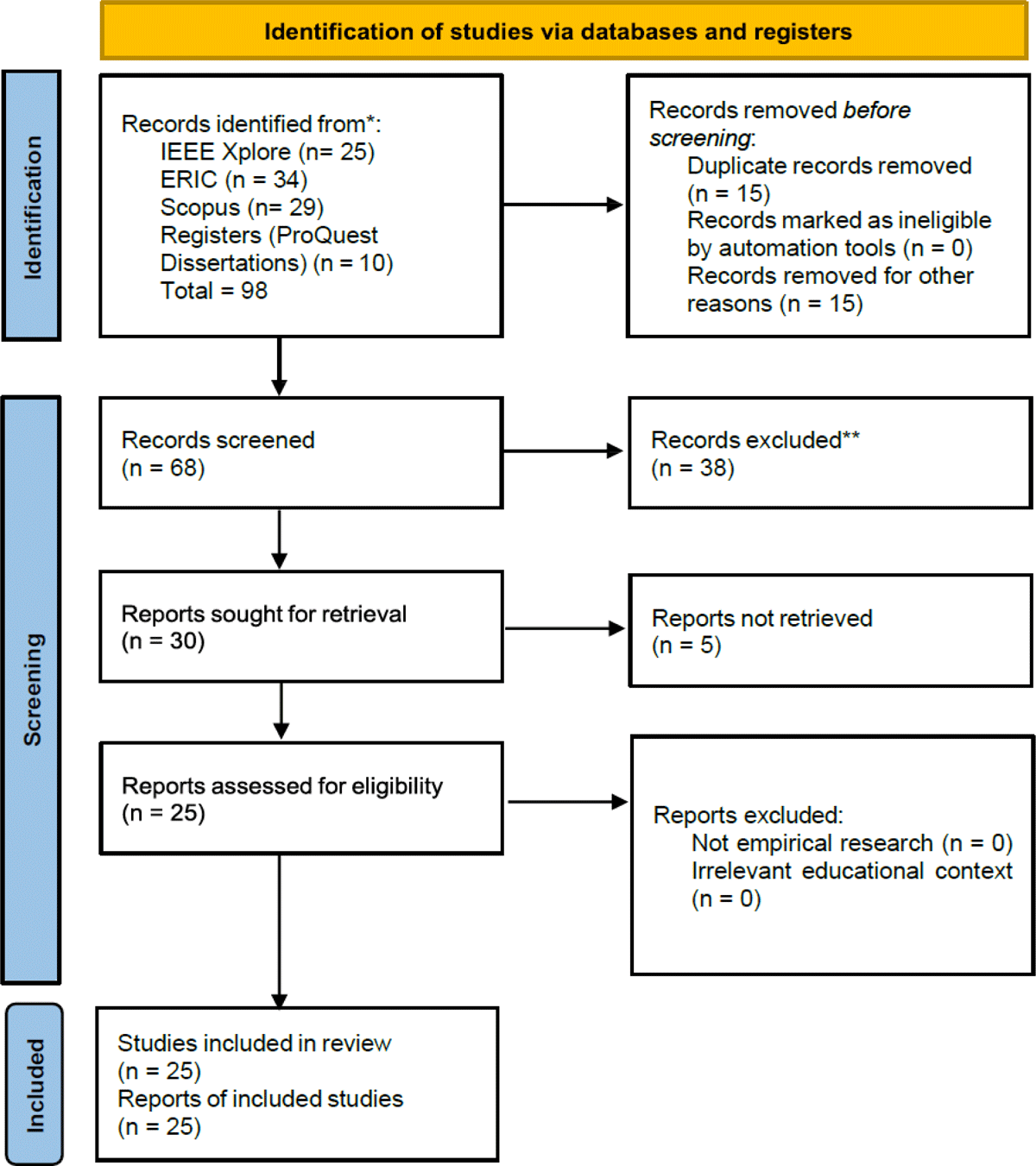
Figure 1
PRISMA Flow Chart: Article Screening and Identification Process
Data Analysis
Analysis of the 25 selected articles provided evidence that instructional technologies in K-12 technology education include a diverse array of tools designed to enhance hands-on learning, creativity, and technical proficiency. Categorized by technology, Table 1 provides results denoting the a) Technology Category, b) Number of Papers included from respective technology category, c) Key Pedagogical Strategies, and d) Student Outcomes.
Table 1
Pedagogical Strategies and Student Engagement Outcomes
| Technology Category | Papers Per Category | Key Pedagogical Strategies | Student Outcomes |
|---|---|---|---|
| Direct Instructional Delivery Tools | 6 | Dialogic teaching, collaborative activities, teacher training, strategic integration | Enhanced engagement, improved motivation and achievement (with support) |
| Immersive Technologies | 4 | Activity-based learning, discovery learning, hands-on exploration, collaborative strategies | Improved behavioral and cognitive engagement, boosted motivation and technical skills |
| Fabrication Tools | 4 | Project-based learning, experiential learning, collaborative learning | Enhanced creativity and critical thinking |
| Programming/Robotics Technologies | 5 | Collaborative learning, project-based learning, adaptive instructional designs | Sustained engagement, skill development |
| AI-Driven Chatbots | 6 | Role-playing, prompt engineering, personalized feedback | Personalized learning, support for critical thinking and digital literacy |
Instructional technologies included in a given category are based on their functions and the roles they play in the learning process, each serving distinct roles in cultivating skills in problem-solving, design thinking, or technological literacy. Drawing on the analyses of articles reviewed, the following sections present evaluations of the roles these tools play in K-12 technology education and explores the pedagogical strategies that maximize their effectiveness in boosting student engagement.
Findings
Direct Instructional Delivery Tools
One essential instructional technology category includes tools that support direct instruction for content delivery, such as interactive whiteboards (IWBs), digital projectors, computers, tablets, and mobile devices. These tools facilitate multimedia presentations and enable teachers to integrate videos, simulations, and other digital media into their lessons. In technology education, direct instructional delivery tools are foundational, often serving as entry points for integrating digital resources into curricula, enhancing content delivery and student engagement.
Interactive whiteboards are versatile tools in K-12 technology education, used to support multimedia presentations, present technical concepts, demonstrate software applications like CAD, and facilitate student interaction through touch and annotation features. These capabilities align with the hands-on, problem-solving focus of technology education. Research consistently shows that IWBs can enhance student engagement when paired with effective pedagogical strategies. For instance, a 2021 study by Aniela and Lopez (2021) found that IWBs in distance education settings yielded high engagement scores, with mean scores of 4.56 for enjoyment, 4.83 for understanding abstract concepts, and 4.72 for class engagement on a 5-point scale. Similarly, Lant and Lawson noted that IWBs improve classroom interaction quality through dialogic methods, which can be adapted for collaborative problem-solving activities in technology education (Artemis Kyriakou & Higgins, 2016).
Murcia’s (2014) case study in primary science, published in the Australian Journal of Education, explored how teachers and students use IWBs for multimodal pedagogy, combining visual, auditory, and kinesthetic learning, which enhanced engagement through interactive and collaborative activities. This speaks to increased engagement as a result of group problem- solving. This approach transforms learning from passive reception to active participation, deepening student involvement. Tsayang et al., (2020) evaluated the use of interactive SMART boards in secondary schools in Botswana using the Context Input Process Product (CIPP) evaluation model. Their study found that SMART boards promoted a variety of interactive learning experiences—from simulations to group discussions—that not only increased student engagement and motivation but also led to measurable improvements in academic achievement. However, they noted that the technology’s efficacy was closely linked to the availability of adequate teacher training and proper contextual support
In a recent peer-reviewed study, Lenin (2021) examined best practices for smart board usage in primary level education. Their research emphasized that effective use of smart boards depends on thoughtful lesson design and comprehensive teacher training. The authors found that when educators plan lessons with the smart board’s interactive features in mind integrating multimedia elements such as videos, animations, and interactive quizzes, they can transform traditional lectures into engaging, dynamic learning experiences. Moreover, the study highlighted that regular professional development and practice in using the board significantly enhance teachers’ ability to capitalize on its affordances, ultimately improving student engagement and comprehension.
In another study, Liu and Cheng (2015) investigated the application of interactive projectors in Taiwanese middle school science classes. Their quasi-experimental design compared classrooms using interactive projectors to those using standard data projectors. The interactive projectors were shown to boost classroom interactivity, allowing students to manipulate displayed content remotely. The study found no significant difference in learning outcomes between the two groups. The authors concluded that the impact of these tools is highly dependent on the teacher’s instructional strategies rather than on the technology alone.
Collectively, these studies demonstrate that direct instructional delivery tools, whether in the form of interactive whiteboards, SMART boards, or projectors, can significantly enhance the teaching and learning process when paired with effective pedagogical practices and sufficient teacher training. Their full potential is realized through pedagogical strategies that prioritize interactivity and collaboration, supported by careful planning and teacher training.
Immersive Technologies
Immersive technologies, such as virtual reality (VR) and augmented reality (AR), are increasingly integrated into K-12 technology education to bridge theoretical concepts with hands-on and interactive learning. These tools are applied across disciplines to simulate real- world engineering, design, and scientific processes, enabling students to explore various simulations that make abstract concepts tangible. Immersive technologies foster engagement through experiential and collaborative strategies.
A study conducted in 2021 examined the instructional design contexts, methods, and techniques that have been implemented using VR, as well as assess the impacts of these interventions on student outcomes, engagement, and learning performance in K-12 settings (Pellas et al., 2021). Studies were grouped into strategies such as activity-based, discovery, presentation, experiential, and collaborative learning. Several studies used VR-based games and hands-on tasks where students engaged in specific activities. These implementations often follow constructivist and constructionist pedagogies, where students actively construct knowledge through experimentation (Lin, et al., 2025; Pellas et al. 2021).
For instance, VR allows students to explore 3D engineering models or conduct virtual experiments, offering practical experience with systems that are difficult to grasp through traditional methods (Pellas et al., 2021). Pedagogical strategies that maximize VR’s potential include activity-based learning, where gamified features like instant feedback and rewards drive problem-solving, and discovery learning, which encourages independent exploration within simulations (Pellas et al., 2021). Collaborative learning also thrives in multi-user VR environments, enhancing teamwork and communication skills. Additionally, teacher-guided approaches, such as virtual field trips or 360°video lessons, enrich traditional instruction by placing students in contextual settings (Pellas et al., 2021). Research shows VR boosts behavioral engagement through active participation, strengthens emotional connections to content, and improves cognitive outcomes like attention and retention (Lin et al.2025; Pellas et al., 2021).
On the other hand, the article “The Integration of Augmented Reality in Education” provides a comprehensive review of how AR is being implemented across various educational levels, including preschool, primary, and secondary schools (Marrahi-Gomez, & Belda-Medina, 2023). This article has direct parallels to the ways instructional technologies are used in technology education. One of the key takeaways from the AR research is its ability to foster active participation and hands-on exploration, a principle that is central to technology education.
AR enriches K-12 technology education by blending digital content with the physical world, creating interactive and contextualized learning opportunities. AR enables students to manipulate 3D simulations, such as engineering components or overlay interactive diagrams onto real-world objects, supporting hands-on, constructionist learning (Marrahi-Gomez, & Belda-Medina, 2023). Key pedagogical strategies include interactive 3D modeling, which builds technical skills, and contextualized learning, where digital enhancements on traditional resources improve understanding and engagement (Marrahi-Gomez, & Belda-Medina, 2023). AR also empowers students to create content, such as designing immersive projects, fostering both technical proficiency and digital literacy (Wiemer & Rothe, 2024). These studies highlight AR’s edge over conventional methods, with increased motivation and academic performance in technology subjects (Marrahi-Gomez, & Belda-Medina, 2022). Like VR, AR promotes active learning, but its accessibility via common devices makes it a versatile complement to VR’s immersive depth, though challenges like cost and technical complexity persist (Wiemer & Rothe, 2024).
Despite their advantages, VR and AR face shared obstacles in K-12 technology education that limit their broader adoption. High costs for hardware and software restrict access, particularly in under-resourced schools, while effective implementation demands significant teacher training to craft and oversee immersive lessons (Lin et al., 2025; Wiemer & Rothe, 2024). Additionally, the initial excitement of these technologies can diminish over time without ongoing innovation in lesson design (Pellas et al., 2021). To overcome these hurdles, researchers suggest robust professional development programs for educators and digital literacy initiatives for students (Lin et al., 2025). Partnerships with technology providers could also reduce costs and promote equitable access (Wiemer & Rothe, 2024). Addressing these challenges is crucial to fully harnessing the interactive potential of VR and AR for meaningful educational outcomes.
VR and AR are pivotal in advancing K-12 technology education by delivering experiential learning environments that enhance engagement and skill development. VR’s immersive simulations support activity-based and collaborative strategies, while AR’s digital overlays enable interactive, contextualized learning. However, barriers like cost, training needs, and engagement sustainability require strategic solutions, such as teacher support and industry collaboration.
Fabrication Tools
Fabrication tools such as 3D printing are central to both project-based and design-based learning in technology education. CAD software enables students to design, visualize, and refine digital models, while 3D printing transforms these models into physical prototypes. These tools empower students to prototype physical models, fostering iterative design and manufacturing skills. This iterative process designs, tests, evaluates, redesigns, and develops real-world engineering practices. 3D printing is frequently integrated into K-12 curricula to promote hands-on activities, project-based/design-based learning, and teach STEM-related subjects. Modeling is used in engineering, technology, and science fields and is important for success in engineering (Sorby, 2009)
An article by Despeisse et al. (2017) synthesizes a broad body of research on the use of 3D printing in STEM settings, examining how this digital fabrication tool is integrated across a variety of educational contexts. For example, several cases demonstrate how 3D printing is used in STEM education teaching atomic structure in chemistry or audio frequency concepts in physics using 3D printed models. This study highlights the use and role of 3D printing in creating a sustainable and circular economy. This is key in espousing and inculcating principles that hold significant promise for moving towards a more sustainable society.
The review also examines professional development initiatives aimed at equipping teachers with the necessary skills to adopt 3D printing. Several studies describe workshops and short courses ranging from two-hour sessions for early childhood educators to multi-day intensive training for in-service teachers, where educators learn the basics of 3D printing technology, from 3D modeling to printer maintenance. However, the review was also able to highlight the need for more research on education and skill development programs to support the inculcation of 3D printing technology into the economy (Despeisse et al., 2017).
Pearson and Dubé (2022) analyzed 3D printing studies, identifying dominant theories such as situated learning and constructionism, which emphasize learning through doing. Integration involves students engaging in hands-on projects, such as designing and printing models, aligning with STEM education goals. To maximize student engagement, the article recommends collaborative learning, where students work in teams, and experiential learning, where they actively participate in the design-print cycle. Learning outcomes include critical thinking, creativity, and collaboration (Pearson & Dubé, 2022). This suggests 3D printing integration is rooted in active, theory-driven practices, enhancing engagement through peer interaction.
Song (2018) focused on how Korean teachers prepare to integrate 3D printing, using the TPACK framework to analyze training programs. Integration involves two main paths: (1) collaboration between teachers across subjects and industry experts to develop technical knowledge and curriculum, and (2) contextualizing 3D printing within open-source digital culture (Song, 2018). The study found technological knowledge is often overemphasized in training, suggesting a need for balanced development. This study highlights project-based learning and flipped classroom approaches, where students engage in real-world problem- solving, such as designing prosthetics, leading to increased motivation and active participation These results underscore the importance of teacher preparation and design-based activities for effective integration and engagement.
Trust and Maloy (2017) explored 3D printing projects in classrooms, advocating for maker education to develop 21 st-century skills like design thinking and collaboration. Integration is characterized by project-based learning, where students undertake full-cycle projects, such as printing historical artifacts or robot parts, achieving high engagement levels, suggesting that maker education is a key strategy for both integration and engagement in STEM, enhancing students’ technical and creative skills.
Fabrication tools, such as 3D printing and CAD software, are integrated into technology education through curriculum development that aligns with STEM objectives, teacher training that equips educators with essential technical skills, and collaborative projects that foster hands-on, team-based learning (Song, 2018; Trust & Maloy, 2017). To promote student engagement, educators can utilize strategies like collaborative learning, where students work in teams to solve problems, and project-based learning, which engages them in full-cycle design and prototyping (Pearson & Dubé, 2022; Trust & Maloy, 2017). Additionally, experiential learning in this context enhances engagement by connecting abstract concepts to tangible outcomes, making the learning process more meaningful (Despeisse et al., 2017).
Programming/Robotics Technologies
The integration of technology in K-12 education, particularly in technology education classrooms, has seen significant advancements with the adoption of robotics and programming. Robotics involves physical robots that students can design, build, and program, often using platforms like LEGO Mindstorms, Arduino, or VEX kits, while programming education focuses on teaching coding skills, frequently through visual tools like Scratch or block-based languages. These technologies are used to teach subjects such as computer science, engineering, and design, offering hands-on experiences that enhance student engagement and learning outcomes.
Research suggests that robotics are integrated into K-12 technology education classrooms through hands-on activities, problem-solving tasks, and collaborative projects. A systematic review by Ching and Hsu (2023) examined 22 peer-reviewed empirical studies on educational robotics for developing computational thinking in young learners, from pre-kindergarten to 6th grade, which finds that robotics activities are mostly studied in formal education settings with durations ranging from 80 minutes to 24 hours. The review indicated that LEGO Mindstorms were the most frequently adopted robotic kits, and instructional strategies like collaborative learning and project-based learning were often implemented.
Another study provides empirical evidence for effective integration of robotics into K-12 classrooms by examining the impact of educational robotics on 112 sixth-grade students using Arduino education kits over eight weeks, focusing on motivation, attitude, and achievement. The study found moderate motivation levels with a significant decrease in post-implementation, but positive attitudes towards robotics and good achievement levels, with no gender differences indicated (Selcuk et al., 2024).
According to a systematic review of 147 studies, robotics aligns with the core objectives of technology education by promoting hands-on learning and encouraging collaboration. The review categorizes the benefits of educational robotics into five key themes: general effectiveness, students' learning and transfer skills, creativity and motivation, diversity and broadening participation, and teachers' professional development (Anwar et al., 2019). The review highlights that educational robotics has been widely integrated into K-12 technology education through both formal and informal learning environments. In formal settings, robotics is often embedded within STEM curricula to teach subjects such as mathematics, physics, and computer science. For instance, studies demonstrated the use of LEGO Mindstorms to teach proportional reasoning and physics concepts (Anwar et al., 2019). In informal contexts, robotics is frequently employed in after-school programs, summer camps, and competitions like FIRST LEGO League, which emphasize collaborative problem-solving and iterative design (Anwar et al., 2019; Menekse et al., 2017).
Programming education is integrated into K-12 technology education through visual and block-based tools, aiming to develop computational thinking and digital literacy. Sun et al. (2022) conducted a systematic literature review of 86 studies from 1980 to 2020, defining K- 12 programming ability as consisting of metacognition, cognition, operation, and communication, with 17 sub-abilities, and constructing a teaching model based on educational levels, methods, tools, and assessment approaches. The review found that programming education focuses on cultivating cognitive and operational abilities, often using tools like Scratch and Python, with pedagogical strategies like project-based learning and collaborative activities.
The evidence leans toward robotics and programming being effective when supported by appropriate pedagogical strategies, such as project-based learning and collaborative learning. Sun et al. (2022) emphasizes the need for teacher training to implement programming effectively, with gaps noted in professional development programs. An interesting finding is the variation in classroom implementation. Some may use short, intensive sessions, while others span weeks, affecting student motivation differently (Ching & Hsu, 2023; Sun et al., 2022). This suggests that the duration and context of implementation can influence outcomes, an aspect that might not be immediately obvious but is critical for teacher adaptation.
Robotics and programming are integrated into K-12 classrooms through hands-on, interdisciplinary projects that align with constructivist principles. Effective pedagogical strategies should prioritize active learning, collaboration, and problem-solving. Addressing gaps
in teacher training and longitudinal research will further optimize technology integration and student engagement.
AI-Driven Chatbots
The integration of technology in K-12 education, particularly in technology education classrooms, has seen significant advancements with the adoption of AI-driven chatbots. These systems, including conversational agents like ChatGPT, leverage natural language processing to provide personalized support, instant feedback, and interactive learning experiences (Arora et al., 2023. In K-12 technology education, chatbots are used to teach subjects such as computer science, data science, and engineering, offering tailored assistance that aligns with the hands-on, problem-solving focus of the curriculum.
Research suggests that AI-driven chatbots are increasingly integrated into K-12 education, offering personalized and adaptive learning experiences. A systematic review by Zhang and Aslan (2021), published in the European Journal of Education, investigated the utilization of ChatGPT in Kindergarten to 12th grade educational settings, synthesizing findings from 13 selected papers. The review highlights that ChatGPT is used by educators to develop innovative curricula aligned with learning needs, prepare lessons with insights and resources, and act as instructional assistants for inquiries, discussions, and feedback (Lou, 2023; Mogavi et al., 2023). Specific examples include teachers using ChatGPT to prepare assignments and tests that foster critical thinking and evaluating student work, providing feedback and identifying areas for improvement (Bitzenbauer, 2023; Mogavi et al., 2023).
Another systematic review published in Computers & Education, focused on AI education in K-12 classrooms from 2018 to 2023, examining topics, instructional approaches, and learning outcomes. While not specifically on chatbots, it noted that AI applications, including conversational agents, enhance problem-solving skills, ethical reflections, foster motivation, positive attitudes towards technology, and career aspirations in STEM fields (Lee & Kwon, 2024).
Specific case studies illustrate the practical implementation of chatbots in K-12 technology education. Alneyadi and Wardat (2023) describe how educators in the UAE use ChatGPT to complement traditional teaching methods, enhancing digital literacy and supporting differentiation by analyzing student progress and recommending individualized approaches. Tools such as ChatGPT have allowed teachers to collaborate when preparing lessons, including designing curricula and syllabuses, and students may use it to co-create learning objectives, enhancing critical thinking.
For learners, ChatGPT serves as a personal tutor, providing instant feedback to boost conceptual understanding and acting as a language-learning companion (Othman, 2023; Woo et al., 2023). It supports students with disabilities or special needs by offering accommodation and adaptive resources for inclusivity and facilitates collaborative learning by enhancing teamwork and communication (Mogavi et al., 2023). In technology education, students can interact with ChatGPT to debug code, understand algorithms, or explore design principles, enhancing their hands-on learning experiences.
The evidence leans toward chatbots improving outcomes when supported by appropriate pedagogical strategies, such as project-based learning, collaborative activities, and prompt engineering. Zhang and Aslan (2021) completed a comprehensive review of artificial intelligence in education (AIEd) and were categorically reported through the following themes; benefits to education, technological innovation and educational application gaps, and practical utilization. Effective strategies include incorporating role-playing activities using content generated by ChatGPT for real-world applications (Mogavi et al., 2023), employing chatbots as complements to traditional methods for personalized learning and automated assessment (Alneyadi & Wardat, 2023), and aligning learning objectives with Bloom's Taxonomy to support knowledge acquisition, comprehension, problem-solving, critical analysis, synthesis, and evaluation (Mogavi et al., 2023).
AI-driven chatbots like ChatGPT are transforming K-12 technology education by providing personalized support, enhancing student engagement, and supporting teachers in their instructional roles. Systematic reviews and case studies illustrate their effectiveness in improving learning outcomes and AI literacy. However, challenges like ethical considerations and the need for teacher training highlight areas for future research and development. As the field evolves, it is crucial to integrate chatbot education across the curriculum and support educators to maximize the benefits of these advanced technologies, ensuring students are prepared for a technology- driven future.
Summary of Findings
This systematic literature review synthesized current evidence on the integration of instructional technologies and pedagogical strategies in K-12 technology education, addressing two research questions.
The review identified five categories of instructional technologies, each contributing uniquely to student engagement and learning outcomes. A recurring theme centered around the premise that instructional technologies alone are insufficient, with its educational impact hinging on pedagogical alignment and teacher preparedness. For instance, interactive whiteboards (IWBs) and SMART boards enhanced engagement when paired with dialogic teaching and collaborative activities (Aniela & Lopez, 2021; Tsayang et al., 2020), yet teacher efficacy diminishes without strategic lesson design (Liu & Cheng, 2015). Similarly, immersive technologies like VR and AR thrived under activity-based and discovery learning approaches but faced barriers such as cost and teacher training gaps (Lin et al., 2024; Wiemer & Rothe, 2024). These findings align with constructivist principles where active and hands-on learning drives deeper conceptual understanding (Halverson & Sheridan, 2014). Thus, the constructivist approach of teaching plays an indispensable role when it comes to integrating various technologies into the classroom.
Teacher anxiety and insufficient training emerged as persistent challenges, corroborating Johnson et al. (2012), who identified technology anxiety as a critical barrier. Venerable faculty still struggled with adoption, emphasizing the need for targeted professional development to bridge technical and pedagogical competencies, which underscores the necessity of holistic training programs that address both tool mastery and instructional strategies.
Conclusion
Using a systematic literature review (SLR) approach to discovery, this study was designed to answer two research questions: 1) How are instructional technologies integrated into K-12 technology education classrooms? and 2) What pedagogical strategies most effectively enhance student engagement during technology integration? The findings underscore the transformative potential of these tools while highlighting critical factors that influence their effectiveness. The following are brief summaries of how our systemic literature review addressed our guiding question, while discussing implications, and outlining directions for future research.
RQ1: How are instructional technologies integrated into K-12 technology education classrooms?
Direct Instructional Delivery Tool
The systematic literature review revealed a plethora of technological tools used in the classroom to include interactive whiteboards (IWBs), digital projectors, and tablets. IWBs facilitate interaction when paired with dialogic teaching and collaborative activities (Aniela & Lopez, 2021). In Botswana secondary schools, SMART boards are integrated to enhance motivation and achievement, though their success depends on teacher training and contextual support (Tsayang et al., 2020). Interactive projectors are also employed, but their impact on learning outcomes is minimal without strategic pedagogical integration (Liu & Cheng, 2015).
Immersive Technologies
Virtual reality (VR) and augmented reality (AR) are integrated to enable experiential learning by simulating real-world processes. VR supports activity-based and discovery learning through gamified simulations (Lin et al., 2025; Pellas et al., 2021;), while AR enhances hands-on exploration by overlaying digital content onto physical objects (Marrahi-Gomez, & Belda- Medina, 2022). Collaborative strategies are utilized in multi-user environments to deepen student involvement (Wiemer & Rothe, 2024).
Fabrication Tools
3D printing and CAD software are incorporated through project-based learning, allowing students to prototype designs and develop iterative skills. These tools are embedded within STEM-aligned curricula and collaborative projects (Despeisse et al., 2017; Trust & Maloy, 2017), fostering practical application of theoretical concepts.
Programming/Robotics Technologies
Robotics kits (e.g., LEGO Mindstorms) and programming platforms (e.g., Scratch) are used to foster computational thinking through hands-on, interdisciplinary projects. Collaborative and project-based learning are common integration strategies (Ching & Hsu, 2023; Selcuk et al., 2024), bridging technical skills with creative problem-solving.
AI-Driven Chatbots
AI tools like ChatGPT are integrated to personalize learning, providing instant feedback and differentiated instruction. They support critical thinking and digital literacy by adapting to individual student needs (Alneyadi & Wardat, 2023; Mogavi et al., 2023), enhancing the classroom experience through tailored interactions.
RQ2: What pedagogical strategies most effectively enhance student engagement during technology integration?
This systematic literature review highlights the transformative potential of instructional technologies in K-12 technology education, spanning direct delivery tools, immersive technologies, fabrication tools, programming/robotics platforms, and AI systems. These tools enhance student engagement, creativity, and technical literacy, yet their success relies heavily on pedagogical strategies such as collaborative learning, project-based approaches, and experiential learning, underpinned by robust teacher training.
Persistent challenges include equitable access and the need for ongoing professional development to address teacher adaptability and technology anxiety. To address these challenges, targeted professional development programs are essential. These programs must not only address anxiety but also emphasize the tangible benefits of technology integration, supported by research evidence and student feedback. Future research should pursue longitudinal studies to evaluate long-term impacts and investigate emerging technologies like advanced AI systems. Policymakers and educators are encouraged to prioritize comprehensive training programs and partnerships with technology providers to ensure sustainable and equitable integration. By aligning technologies with pedagogical goals and supporting educators, K-12 education can effectively prepare students for a rapidly changing technology- driven learning environment.
Limitations
This systematic literature review offers valuable insights into the integration of instructional technologies and pedagogical strategies in K-12 technology education, yet it is subject to several limitations. Firstly, the restriction to English-language articles may have excluded significant studies from non-English-speaking regions, where unique technology integration practices could be prevalent, thus limiting the global scope of the findings. In addition, the review process itself may introduce selection bias, as the interpretation and categorization of articles by the researcher could subtly influence the synthesis of findings. Creswell (1998) suggests that qualitative researchers look toward confirmability in lieu of objectivity to help establish the value of data. To provide objectivity to a very subjective process, themes were only established after consensus was met between the two researchers in this project. These limitations indicate the need for future research to incorporate a broader range of sources, languages, and contexts to enhance the comprehensiveness and generalizability of conclusions.
Acknowledgements
This article was written by (statement regarding the extent of AI usage in preparing this manuscript).