
Introduction
The design process is full of judgments, decisions, tradeoffs, and testing to attempt to develop the best solution possible (Crismond & Adams, 2012). When tackling an open-ended design problem, do designers anticipate instances when the design will not work or are they caught by surprise? And, taken in hindsight, are these design failures a valuable learning experience, dissected to uncover new insights, or are they ignored? Consider the contrasting experiences of two groups of beginning design students working on an engineering design challenge to produce a robotic gripper, which are retold from the qualitative observations in this study:
Sydney and Jordyn were adept students and friendly, even though this was the first project they had worked on together in the class. The two approached their design prototypes as an experiment, exploring different sizes of robotic gripper to refine their design.
“If it doesn’t work, we can fix it, change it, rearrange it,” Sydney said to her partner.
Eventually the two deliberated about their prototypes and made a decision. However, after selecting an idea and proceeding to their final design, several fabrication attempts failed. From a back-and-forth series of attempts and repair work, the team was able to get only momentary success—exclaiming “It was working! Oh, I love this project. Now that it might work, I’m very excited. We’re almost there.”—before their robot failed again.
Jordyn’s breath caught as she said, “My life is ruined,” then tempered her reaction. “It’s ok. Maybe we can reseal it. Again.” Despite making new mistakes in several more attempts at the process, the team persisted and was able to make a successful robotic gripper the following day.
Reflecting on the experience, Sydney stated, “I think something that we really focused on was trying not to give up after having to make so many attempts. Because it was really frustrating and we got really discouraged. Just trying to keep going though… you should keep trying no matter what.”
Sydney and Jordyn demonstrated overall persistence and adaptivity in spite of failure. Their initial successes were analyzed to determine the best route forward and they attempted repairs when their ideas did not work. However, they experienced some discouragement and frustration in the design process. In some phases of the process their work could be described as putting their head down and barreling forward, a trial-and-error approach that tended toward the latter, before ultimately producing a successful design.
Across the class, Evan and Fiona worked together on their project. Evan quickly restated the project expectations to design and test prototypes, before assembling a completed design. But their team progress was disjointed. When Evan stated one consideration for a design feature, Fiona responded, “Yeah, I think that sounds like a good option. I’m still not done with step one though.”
The two were slower than others in class to start their prototypes, working on the basics of documentation and research. “Practical, basic, and safe design?” Fiona offered, trying to negotiate an approach, “Or a more out there idea, with a larger chance of failure?”
Eventually the team chose a ‘base’ design, a good one they thought would work for their prototype. Alternatives were considered, but Evan said, “Ok, so I’ll just start designing random things. It doesn’t really matter that we’re testing them.” And the merit of these alternatives was reinforced in testing.
“Did you pop it? Yet again deciding to break my project,” Evan joked.
“No. This is our test. Now we know this one isn’t good. There you go. You’re welcome,” Fiona replied before referring to the favored design. “I told you this was the best one.”
As they continued to fabricate their final design, Evan and Fiona carefully followed instructions. Fiona noticed suggestions about how to make repairs, even in the completed design. Yet, when testing, the team circumvented more intensive repair attempts by their framing of how the robotic gripper worked.
“Aw… This one’s not inflating at all,” Fiona said as she began to test their product.
“No, so I think we need to make a repair here. That’s the problem,” described Evan as he inspected the gripper. As he tried to make improvements he continued, “Ours only inflates partly. It’s still not doing anything.” Then, when tinkering, the gripper broke entirely.
“It picked up the marker that we used,” Evan reflected.
“Yeah…,” Fiona replied cautiously.
“So, we can repair it. But it worked. So it’s fine. We’re done,” he determined. “Do you want to fix this and keep going, or no?”
In the process, Evan and Fiona had fixated on early ideas that they thought would be successful, without planning or reflection about alternatives. In the end, despite a faltering final design, Evan rationalized that their team had been successful and the work was done. And once Fiona was convinced that their design performance could fulfill expectations for documentation, she was satisfied to move on and complete their documentation, without further reflection, repair attempts, or producing an enduringly successful design.
In these cases, there are arguably merits to the choices of each group. In the first instance, persistence through challenges is admirable; in the second, having established clear criteria for success is important to measure performance while designing. However, there are also evident opportunities to encourage more thoughtful management of the design process that might signify a greater proficiency in design thinking (Lawson & Dorst, 2009; McDonnell, 2015). Neither anticipation of future problems nor sufficient reflection on progress was demonstrated by these teams. And because of the interplay between past, present, and planned experiences in design, effects of each decision have the potential to ripple throughout the design process. In light of the unused learning opportunities when conducting design tests, and the potential for negative consequences, such as frustration arising when experiencing failure, further understanding the experiences and perspectives of beginning designers as they work and fail is imperative. Furthermore, as little attention has been given to understand secondary technology and engineering student learning from failure or process regulation (Alexander et al., 2011; Jackson, Godwin, et al., 2021), attention to the nature of student interactions and self-regulation in these contexts is necessary to inform design education.
Focusing on the experiences of beginning designers, this qualitative thematic analysis examines how self-regulation is manifest when completing an iterative design. I gather critical moments in the design process when ideas were tested, as well as the preparation for such results and the iterative repercussions that unfold. By leveraging a qualitative approach, such in-depth descriptions may resonate and can allow the reader to develop a more nuanced view of reality (Flyvbjerg, 2006; Thomas, 2011).
Expertise in Design Thinking Entails Development of Self-Regulation
Self-regulation includes the “thoughts, feelings, and actions that are planned and cyclically adapted” when working to attain a goal (Zimmerman, 2000, p. 14). The process of self-regulation is generally divided into three or four phases, beginning with some trajectory setting activity, engaging with the task, and adapting the approach (Panadero, 2017; Winne & Perry, 2000). Zimmerman (2000) articulated a three-phrase process that is widely used, including forethought, performance control, and self-reflection. The forethought phase of self-regulation includes activities in preparation for a task, including analyzing the task, planning and goal setting, and ingrained motivational beliefs that might influence performance. Concepts from a number of motivational and interest theories, such as appraisal of one’s confidence, the expected value or costs of the task, and motivation may be used to inform orientation towards the task. During the performance phase of self-regulation, strategies are applied to control and monitor execution of the task. The final phase, self-reflection, involves judgment and reaction; assessing and explaining performance outcomes, respectively. This process involves comparison of performance to the desired goals and interpretation of the causes of success or failure. This pattern continues to operate in cycles, with information from earlier phases shaping later attempts of learning and performance.
Notably, compared to other types of problems, design problems “require greater commitment and self-regulation by the problem-solver” (Jonassen, 2000, p. 80), and Ates Akdeniz (2023) described self-regulation as one of the most important tools in the design process. Misunderstanding the design process may lead beginning designers to move linearly, rather than cyclically. Then, to paraphrase Crismond and Adams (2012, p. 772), these beginning designers show no awareness of what they are doing, what they need to know, or what matters in their design (Mentzer et al., 2023). For example, up to the undergraduate level there is evidence that beginning designers tend not to iterate as much as more experienced designers (Adams & Fralick, 2010).
Prior research on engineering design thinking has described a number of additional indicators of experts’ abilities to regulate the process. Experienced design thinking incorporates “opportunities to inspect and introspect about behavior, perspectives, worldviews” (McDonnell, 2015, p. 117). Furthermore, experienced designers studied by Dorst and Cross (2001) demonstrated an ongoing dialog between the problem- and solution-space in their work, which enabled greater understanding of the design process. Their self-regulatory practices also shift during the design process and include greater monitoring and evaluation than beginning designers (Dixon & Johnson, 2012). Such expertise with the design process develops into greater freedom (Daly, Adams, & Bodner, 2012) and personalization (Cross & Clayburn Cross, 1998) within design work. In other words, a designers’ capacity for self-regulation—that is their ability to plan, reflect, and think strategically—is a crucial element in fostering their ability to learn while designing and continually develop design expertise (Barak, 2010).
Design Thinking is Replete with Opportunities for Learning
Because design involves ill-structured problems, with more than one right answer, there are many opportunities for iteration, failed attempts, and therefore learning (Goel & Pirolli, 1992; Wynn & Eckert, 2016). A wide number of visual depictions of the design process exist (Dubberly, 2004), but most commonly, models for the design process include a type of feedback loop indicating a return to earlier steps or reworking information before proceeding. Each subsequent phase of the design process is then informed by new knowledge created during the work. Indeed, reinforcing the need to take these opportunities, Crismond and Adams (2012) indicated that “learning while designing” and a “managed and iterative design” were important milestones attained in the maturation of beginning designers. Several studies have also noted the necessity of iteration for beginning designers to arrive at effective solutions, since the quality of their solutions was related to breadth of ideas considered (Atman et al., 2005; Atman et al., 1999).
Wynn and Eckert (2016) examined discussion around iteration in design studies and noted a prevailing theme of “progression” for how it is experienced. This progress might be in the form of reduced ambiguity, optimization, or incrementally completing design goals. Yet, whether designers realize the benefits of their attempts depends on the task, their experience, and whether other intervention occurs to stimulate reflection (Jackson, Godwin, et al., 2021; Trenshaw et al., 2014; Wynn & Eckert, 2016).
In particular, previous research has also summarized key aspects related to whether experiences of failure while designing were taken as a learning opportunity (Jackson, Godwin, et al., 2021). “Failure, by itself, is not believed to be the mechanism that promotes learning. Rather, positive student reactions to failure are linked with later success” (Jackson, Godwin, et al., 2021, p. 1861). Different conceptualizations of failure in design thinking mean that, in some cases, failure is seen as part of the way forward (Lottero-Perdue & Parry, 2017; Sawyer, 2019). Teacher and context-based messaging influence whether students adopt such a perspective (Trueman, 2014; Upadyaya et al., 2012). Then, when handled positively, experiences of failure can cause students to slow down, while highlighting key concepts and different solutions (Kapur, 2014; Pathak et al., 2011).
Self-Regulated Learning Contextualized as Learning While Designing
Even with the general applicability of self-regulation, as previously described, the interconnected nature of self-regulation and domain knowledge makes it difficult to distinguish learner’s abilities (Winne & Perry, 2000). On the one hand, with additional familiarity of the content in question, “expertise sidesteps some elements of self-regulation” (Winne & Perry, 2000, p. 559). Domain experience can influence how a task is approached, making up for some inabilities to manage the process, and masking the learner’s true self-regulatory capabilities. On the other hand, self-regulation is always implicitly influenced by context (Alexander et al., 2011) and differences in domain beliefs that may be held.
Rather than trying to disentangle self-regulation from domain knowledge then, a different approach to investigating self-regulation is to contextualize it in a domain-specific manner. This approach necessitates intentionality over convenience when selecting the domain under study and enables a more focused view of the regulation strategies exhibited by learners (Alexander et al., 2011; Peters-Burton, 2018). Several other studies have also drawn on self-regulation to explore the behavior of design students, and offer insight into students’ approaches to design problem solving (Li et al., 2020; Zheng et al., 2020). In the model of self-regulation for engineering design proposed in those studies, the general phases of self-regulation were coupled with design process steps, and used trace data (Winne & Perry, 2000) to characterize students’ behavior in completing the task. These studies contribute to the identification of specific behaviors showing self-regulation in engineering design, and describe potential learner profiles and trajectories during the design process. Ates Akdeniz (2023) also provided instruction to support self-regulated learning behaviors in a design studio setting, and demonstrated a positive impact in terms of both student perceptions and their design performance.
The nature of design tasks, with inherent iteration, failure, and embedded learning, warrants a reconceptualization of self-regulation that is adapted to the context. Nevertheless, the similarities between self-regulation and design thinking processes ease their combination. Both design iteration and models for self-regulated learning are cyclical, where information and thoughts shape behavior proactively (such as when planning or goal setting) and reactively (when reflecting on experiences; Zimmerman & Cleary, 2006). These cyclical patterns are why Kapur and Bielaczyc (2012) noted self-regulatory functioning as a useful framework to study learning from failure. Reflection, a vital phase in self-regulation, is also a hallmark of good design (Crismond & Adams, 2012) and may even be requisite for learning while designing, according to Purzer et al. (2015).
Therefore, I offer a framework combining self-regulation and design thinking phases, which I applied in this research (see Figure 1). Self-regulation phases and subcomponents identified in the framework are those proposed by Zimmerman (2000), and have been extensively supported in self-regulation literature. The general self-regulatory phases are matched to distilled phases of the design process: analysis, synthesis, and evaluation (Dorst & Cross, 2001; Dubberly, 2004; Jones, 1963). Analysis includes early stages of design thinking such as establishing the problem, criteria, and gathering information. It is divergent, expanding possibilities in design, and setting an initial trajectory. Synthesis is a convergent phase involved in processing information toward attaining a solution. Evaluation includes judgments of the design progress and generates energy for successive iterations of design.
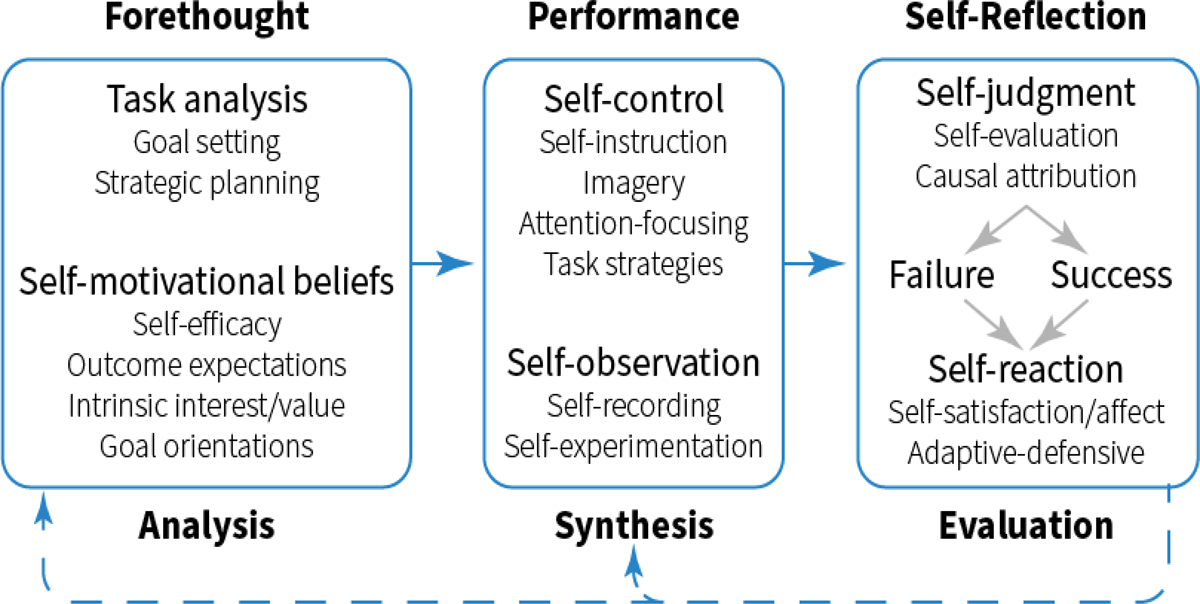
Figure 1
Theoretical framework for regulated responses to design failure.
Importantly, the framework emphasizes that self-judgment elements of self-regulation (self-evaluation and causal attribution) lead to a determination of whether the idea was a failure or success, catalyzing self-reactions (satisfaction or adaptation). It is not guaranteed that design students will notice or understand failures (Matlen & Klahr, 2013), so the interpretation of failure or success here is their own. Then, from this self-reflection phase, information from each attempt can be used to shape later attempts. Reactions to previous attempts are assimilated (forethought) to shape the approach (performance) and then results are measured against the criteria to determine whether further iterations are needed (self-reflection). Ideally, both self-regulation and designed solutions become more sophisticated in each round.
This prior research summarizes the interplay between design and self-regulation. Experts in design show proficiency when managing the process, despite its open-ended nature. When applied while designing, self-regulation facilitates learning throughout the design process—capitalizing on the abundant opportunities provided in an iterative process—and greater intention when responding to design successes and failures.
Method
With the theoretical framework for self-regulated learning applied in design, the research question of the study was, “How do beginning designers use self-regulation in the context of iterative design?” The study was designed as an instrumental case study (Creswell & Poth, 2018). I immersed myself in the authentic context of two high-school classrooms as the setting of this research in order to illustrate issues of self-regulation based on a contextualized understanding of student thinking (in contrast to prior lab-based studies or quantitative research). However, rather than seeking to generalize about the experience, adopting a qualitative focus in this study enabled me to focus on the undiluted experiences of several student teams, and build “exemplary knowledge” (Thomas, 2011, p. 211) that can expand understanding of beginning designer thinking and reactions to failures and iteration beyond the specifics of this learning experience. The analytical approach developed a description of student behavior based on patterns observed across the design teams, again connecting back to the concept of self-regulated behavior while designing. As an indicator of quality in qualitative research this account may also offer resonance and overlap with past experiences of the research audience (Tracy, 2010).
Setting and Participants
Two high-school classes delivering an introductory level engineering design course were selected for observation from a district in Maryland, USA. The rural district is predominantly white, with minority enrollment about 20%, and about as many students with low socioeconomic status. Both classes were participating in a larger study to support diversity in engineering, focused on student attitudes and the efficacy of the instructional materials. The teachers were purposefully chosen based on familiarity with their teaching and assurance that their classes would provide relevant, detailed data.
The course, Foundations of Technology, helps students understand and apply technological concepts in design-based activities. Instruction in Foundations of Technology uses a mixture of group and individual activities in design-based instruction, giving students natural chances to explain their thinking and make plans together (International Technology & Engineering Educators Association, 2017). It is the first course in the engineering pathway, yet it was required for all students in the district, whether or not they continued in the pathway. Subsequently, most students were in ninth or 10th grade. For the unit observed, students completed the design project in pairs. Therefore, the course setting represents a strong opportunity to examine self-regulated design thinking as it occurs.
Teachers in both classes were experienced, each with more than 10 years teaching and familiarity with the specific content of instruction. Several criteria influenced the selection of four pairs of students for observations. A university Institutional Review Board and the district’s Research Review Board conducted a review of the study and approved the method. Then, eligibility for students was determined by having had parent permission and individual assent to be audio recorded as part of the larger study being conducted. Next, teams were recommended by teachers as being cooperative and able to verbalize their thinking (van Someren et al., 1994), to “maximize what we can learn” (Stake, 1995, p. 4), even though they had not worked together previously. The selected teams comprised two pairs of female students and two pairs of a female and male student. Each teacher and student participant included in the study was represented in the results by a pseudonym chosen by the researcher.
Iterative Soft Robotics Design Experience
The content of instruction was a soft robotics design challenge which had been developed in the course of a design-based research project to support diversity in engineering and was taught in the second half of the course (Jackson, Mentzer, & Kramer-Bottiglio, 2021; Jackson et al., 2017). Soft robotics is a “young” (Bao et al., 2018, p. 229; Tauber et al., 2023, p. 9) area of engineering application which uses compliant, soft, and bioinspired systems to solve robotics problems (Trimmer, 2013). Compared to traditional robotics these systems have advantages such as handling fragile objects and human-centered applications (Wang et al., 2015). Given its nascency, there have been relatively few attempts to integrate soft robotics in secondary curricula, though these experiences have shown potential to grow students engineering conceptual understanding (Cayetano-Jiménez et al., 2024; Holland et al., 2018). Soft robot design is fundamentally iterative and involves many decisions for effective performance (Rus & Tolley, 2015). Furthermore, the pneumatic inflation mechanism of the fabricated robots provided clear evidence of success or failure—did it inflate? Yet, there were a variety of possible failure modes (Zhang et al., 2017) meaning that progression through the experience provided students with many opportunities to exhibit self-regulated learning as they planned for and tried to make sense of the results of their design.
The instructional experience was structured similarly by both teachers: a design challenge was introduced and students were scaffolded through design process steps such as defining the problem, research, brainstorming, prototyping, and iteration to develop their solution. The specific challenge given was to construct a soft robotic gripper to assist a farm operation to be more efficient in handling delicate produce without damage. Teachers’ initial instruction described the underlying principles of pneumatics and demonstrated fabrication of the gripper, which was through cast silicone adhered to a layer of cotton fabric to constrain inflation and produce curvature in the gripper. Fabrication was aided by the use of a reconfigurable mold that allowed students to adjust several design variables, such as the length and configuration of inner air chambers (see Figures 2, 3, 4). However, both teachers also expressed that iteration should be part of the experience, as teams initially worked on producing gripper “fingers” as a test of their function, then scaled the production to a completed gripper.
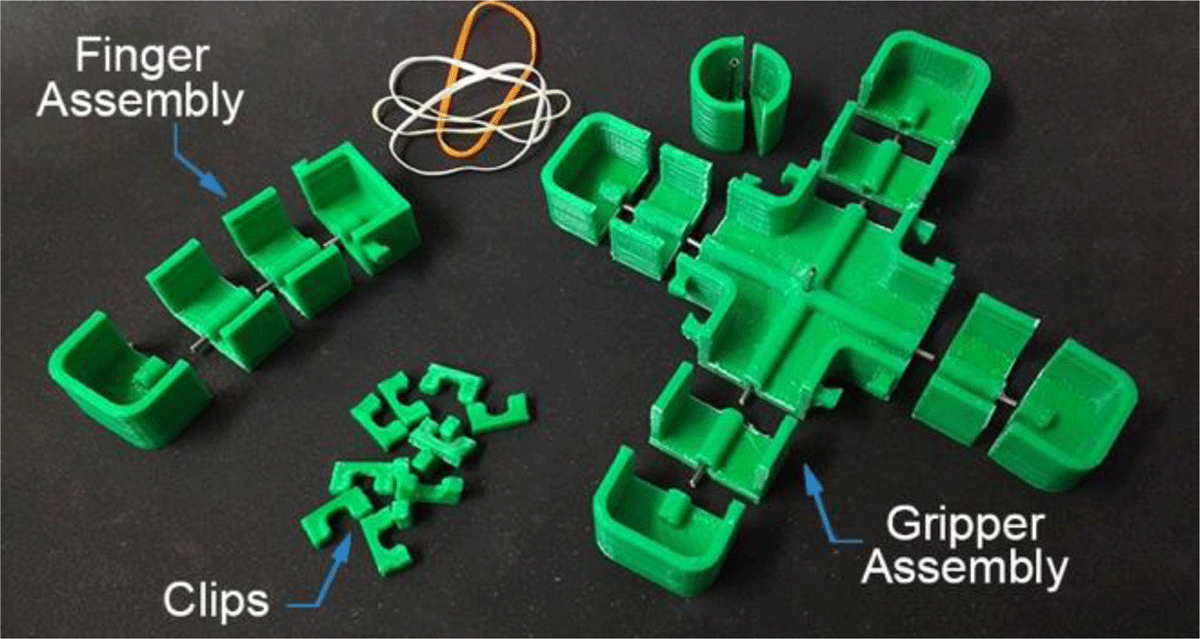
Figure 2
Reconfigurable Mold Parts.
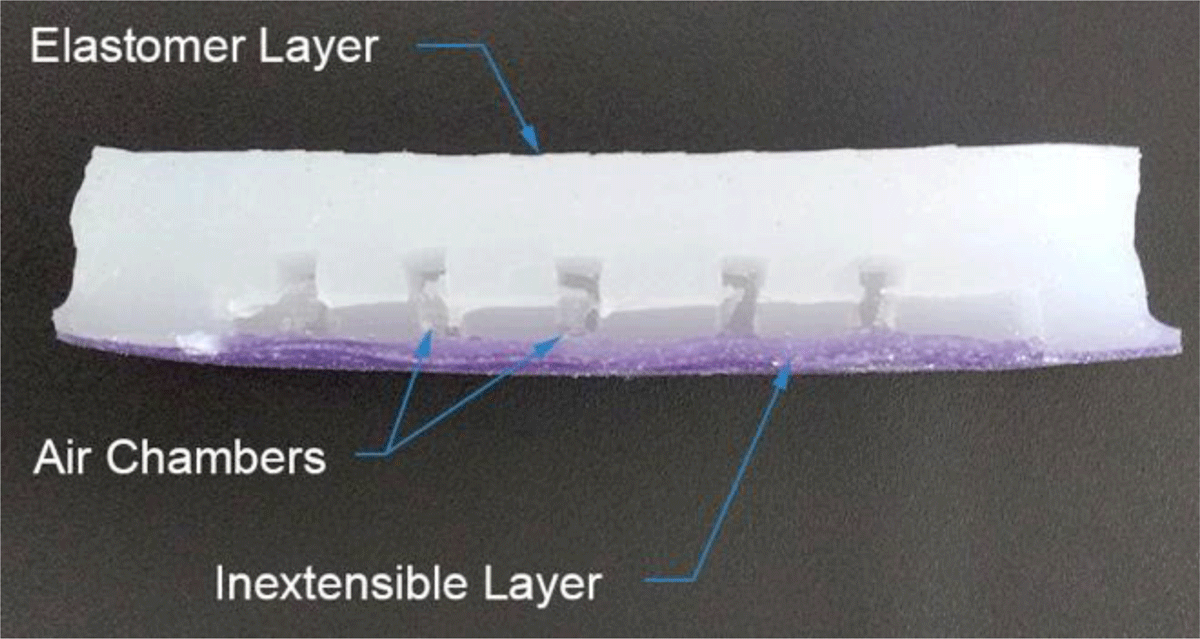
Figure 3
Cross Section of Finger.
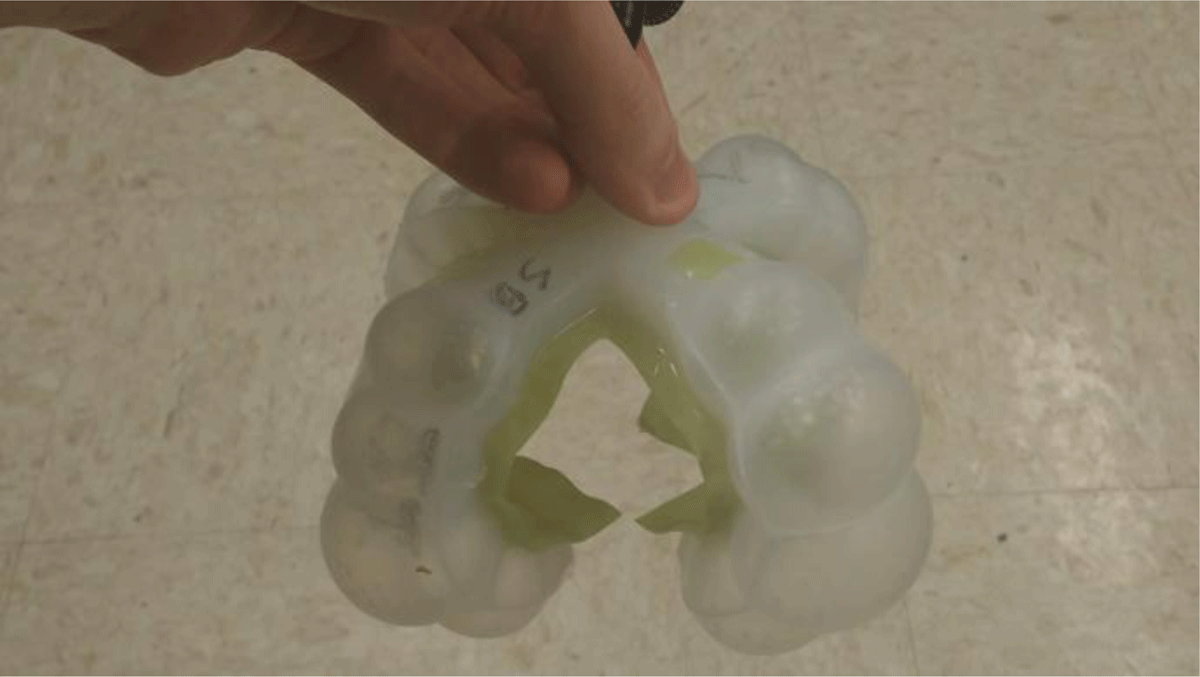
Figure 4
Completed Gripper Being Inflated.
Once the challenge was introduced, student work on the project proceeded for 5–6 days on a block schedule (i.e., 90 min classes). Daily routines began with class-wide instruction and discussion before allowing students to work at their own pace and document their work in design notebooks. There were occasional class-wide check-ins at the end of the day by the teacher, to get a sense of students’ progress overall and address potential concerns. During work time, students were free to move through the classroom space to acquire materials or ask questions of the teacher or peers and the teacher moved through the class to interact with students. Assessment for the project was based on documentation in the design notebook which included evidence of the final robotic gripper performance.
Data Collection
A variety of information sources were used to understand student processes of self-regulation while designing, as summarized in Table 1. The use of several perspectives, called triangulation, is addressed by many researchers as a means to strengthen qualitative research (Creswell & Poth, 2018; Merriam, 1995). First, observations and field notes were completed as a “nonparticipant” (Creswell & Poth, 2018, p. 168), with limited interference with student groups in order to observe students’ natural regulation strategies and reactions to failure. After each observation the notes were digitized and summarized in a researcher memo.
Table 1
Summary of Information Source Quantities.
| Design Team | Observations | Design Pagesb | Follow-up | ||||
| Days | Fulla | Condensed | Transcript | Interview | Transcript | ||
| Sydney + Jordyn | 5 | 6:13:27 | 3:09:54 | 99 pages 32,336 words | 12 | 0:17:55 | 5 pages 1970 words |
| Evan + Fiona | 5 | 5:42:31 | 2:08:23 | 85 pages 22,898 words | 11 | ||
| Brynn + Katelyn | 6 | 6:06:32 | 2:43:45 | 89 pages 24,773 words | 6 | 0:18:21 | 6 pages 1969 words |
| Wes + Taylor | 6 | 6:38:06 | 4:06:04 | 94 pages 25,860 words | 8 | ||
[i] a Full recording time calculated by summing maximum length of either team member, per day.
b Design pages is the combined page count of each students’ design notebook.
Second, think-aloud audio recordings were maintained for each student during the project. Think aloud protocols are commonly used in design research (e.g., Atman et al., 1999; Daly, Yilmaz, et al., 2012; Mentzer et al., 2015) and have also been used in self-regulation studies (Baker & Cerro, 2000; Dixon & Johnson, 2012; Winne & Perry, 2000). Since students were working in pairs, very few prompts were needed to ask students to share their thinking while working—collaborative discussion was the status quo. In fact, Goldschmidt (1995) noted that team conversation offered similar insight to thinking. Compared to analysis through observations or student work alone, verbalization of thinking offers greater insight into design reasoning and strategy use (van Someren et al., 1994, p. 4).
Third, students were required to keep a design notebook that documented their work and was one of the main assessment procedures, as previously mentioned. Given the timing of the study, students were already familiar designing and documenting their work. As such, the design notebooks represented an opportunity to “corroborate and augment evidence from other sources” (Yin, 2014, p. 107). Some students referenced design process steps in their notebooks or reviewed previous projects to ensure they included the necessary elements in their current work.
Finally, two weeks after the soft robot design lessons concluded, semi-structured interviews were conducted with student pairs as a means of corroborating my account of the experience and to uncover additional information related to design and self-regulation acts that was not directly observed. These semi-structured interviews served as a form of member checking, to build trustworthiness in the research (Creswell & Poth, 2018), as well as providing another information source. The conversation touched on the approaches used while designing and recounted the various attempts that the teams had made (with images of their artifacts for reference). When discussing each sequential design version, teams were asked whether or not the attempt was successful. I interpreted their explanations and labeled each attempt as a success, a mitigated success (i.e., partly successful), or a failure (Sleezer et al., 2016). The semi-structured interviews were conducted with the two teams in each class together, and lasted less than 20 minutes.
Data Analysis
Analysis of qualitative data began informally from the moments of observation, through reflection and researcher memos (Creswell & Poth, 2018), with more formal analysis beginning after the observations had concluded. As a preliminary step to analysis, I compiled design process information from each pair through iterative milestones of design and labeled outcomes, as reported in the follow-up interviews. Photographs of design artifacts were put in order and described according to their design configuration and any deficiencies in performance. Daily progress in the design notebooks was also annotated to clarify the goal setting, planning, and evaluation conducted throughout the experience.
With each pair’s abridged design experience, think-aloud data, and follow-up interview, I used typological analysis (Hatch, 2002) to begin identifying patterns. Typological analysis is a deductive coding method that applies labels to the data from a predetermined list, then reviews these for patterns. Selected codes were based on the terminology used in the theoretical framework of self-regulation (Figure 1). The first pass through the data involved annotating the transcript for instances of each code. However, during this phase it became evident that some aspects of the study obscured routine performance (e.g., my prompting for think-aloud data differed from normal practice, and design documentation—a type of self-record—was ubiquitous). Therefore, performance elements of self-regulation were not included in further analysis.
Following labeling, collected forethought and self-reflection codes were summarized, followed by further analysis to identify patterns and themes. Hatch (2002, p. 155) noted that examples of these connections may be on the basis of similarity, difference, frequency, sequence, correspondence, or causation. Themes of behavior in forethought and self-reflective phases of self-regulation are described next, followed by a synthesis of conclusions related to patterns of success and failure while designing.
Results
Accounts of each student pair offered a unique trajectory for the design process and, subsequently, the varied planning, testing, and reflective actions of each pair portray a range of self-regulatory approaches. Implementations of the lesson were also slightly different in each classroom, based on the teachers’ professional judgment and teaching style, which may emphasize different self-regulation practices. Vignettes of two pairs, (a) Sydney and Jordyn and (b) Evan and Fiona, were in the introduction of the paper and are briefly summarized here. The trajectory of the other two pairs, (c) Brynn and Katelyn and (d) Wes and Taylor are outlined next.
Abridged Design Experiences
Sydney and Jordyn approached the design of their gripper fingers as an experiment and varied designs strategically so that they could build an understanding of the relationship to performance. The team quickly moved on from each attempt—yet, in their frustrations, the team introduced new, crucial errors in the fabrication process that undermined each further attempt. In sum, the team produced three successful gripper fingers, three unsuccessful grippers, and one successful gripper.
Evan and Fiona similarly recognized opportunities for flexibility in the design process early on, however team decision-making was out of harmony. When their gripper was completed, it popped quickly in the testing process while picking up an object. Further negotiations between the pair reframed the expectations, moving from “So we can repair it though?” (Evan) to “But it worked, so it’s fine, we’re done” (Evan). The team had fixated on their ideas, having only one successful gripper finger out of four attempts, and one attempted gripper that was a short-lived success.
Brynn and Katelynn set early expectations based on the fact that they “didn’t think that this [project] would be that easy” (Katelynn). They asked questions of the teacher throughout the process which provided confidence to proceed. Their ability to diagnose failures in the first two fingers led to incremental improvements in their fabrication process and even supported their attention to and prevention of a potential failure mode on the third finger attempt. These preventative actions carried through to the gripper fabrication, but a small hole from an air bubble led to only partial success. Midway through class, the pair regrouped to identify problems and decide whether to change their design or do the same one over again. Because their reflection pointed to errors in fabrication (not function), they continued with their last iteration—the same design but a refined process. They made sure the mold was level and clips were firmly attached, they carefully and evenly spread materials, they made sure to mix slowly to prevent air bubbles. Unfortunately, their final design had uneven inflation despite troubleshooting. The team was able to pick up objects “for a second, or two” (Brynn) and the design was judged “successful but not quite successful” (Katelynn). The pair noted hypothetical solutions that could be carried out in another iteration, but after three attempted fingers, and two grippers—none completely successful—the team was done.
Wes and Taylor referred to earlier experiences with the design process as an orientation for the soft robotic gripper design project. They were eager to explore different arrangements as a way to experiment and see how the final operation of the design would be affected. The pair developed several configurations and tested them in sequence. Wes lingered on the design of the first finger once it was made, exploring its characteristics, even while Taylor began constructing their next attempt. The success of their first prototype excited new ideas, which were shared with neighboring design teams. The first and second fingers successfully inflated. The pair even contrived a new test of their second finger by inflating it from the other end (and holding the first point closed) to see how it behaved. Unfortunately, the team did not conduct as thorough analysis of their later designs, and moved on before successful troubleshooting. They abandoned the third finger test when it tipped sideways while curing and there were holes in the top. During construction of their first gripper the pair remembered details at critical times, which prevented some errors, but the design did not successfully inflate due to a poor seal. A second gripper was rapidly constructed, with the students noting “it’s actually a lot harder to build than you think” (Wes). The two made a cursory attempt to address errors observed in fabrication, but had low expectations for success. However, surprising the team, the gripper was partly successful—two fingers inflated well, two poorly, but it was airtight and able to pick up objects. By the end of the project, Wes and Taylor had produced two out of three successful fingers, an unsuccessful gripper attempt, and a partly successful gripper attempt. When they had lingered on analysis and troubleshooting, their attempts were successful.
Thematic Analysis of Design Experiences
Once codes were applied across the data sources, deeper analysis explained how successes and failures occurred for these beginning designers. Several main themes related to self-regulation in design are revealed through the focus on forethought and self-reflection.
Forethought: Goal Setting and Visualization
During the design process students set goals with a variety of timeframes, each representing forethought for the designated period. Several steps of the design process had been used in previous projects and translated clearly to goal setting: “defining the problem” and “identifying constraints and criteria.” Pedagogical structures were also highly influential for the students to establish their goals.
Early introductory comments from the teacher helped set goals for a day or more, corresponding to these design-project goals, whereas proximal goals in the design process oriented teams toward specific next steps. Comments from both teachers emphasized iterative aspects of the soft robot design challenge, meaning that students also anticipated opportunities for learning and iteration. When constructing the robot, short-term goals were often articulated by students and ensured continual progress toward the distal goals of the design. For instance, as a matter of short-term planning Wes stated, “Basically, all I’m doing is putting the pieces in and then I’ve got to fill them with the silicone mixture.”
Because the project was unfamiliar to students, research, first ideas, and beginning steps in the design process also inspired their goals. However, teams were required to operate on initial assumptions and proceed with the design process to see whether these were borne out. Fiona illustrated this uncertainty when stating that she “didn’t really understand what the process was going to be to make the finger.” Handling materials from the project, such as molds or fabric and seeing visual representations of other soft grippers from research helped to solidify goals. Many teams also developed analogies between human hand structures and the soft grippers to build a shared vision for the project. Then, as teams progressed through cycles in design, their confidence grew.
Forethought: Catalysts for Improved Performance
Planning stages of design and self-regulation represented a critical step for success in design—influencing both design performance and process. The established phases of prototyping in the project meant that students could plan for variation in their design to see what worked best. They often manipulated variables from a base design to explore the impacts in their testing: “We should make a long finger, and then we should make a short finger, and then a medium finger” (Katelyn). Unfortunately, there were few cases of broad divergence in the planned ideas, though knowing about iteration may be a way to encourage risk taking. Sydney illustrated this mindset with her statement, “Worst comes to worst we can fix it, change it, … rearrange it.”
Once teams started the design process and began acquiring information, their planning phase represented an opportunity to enact what they had learned. Teams based decisions about the fabrication process on what had worked well in the past—for example, Katelyn asked Brynn to mix the silicone because she had done it successfully before—or on what had not worked well, such as Sydney putting on gloves because her hands had gotten messy the day before. These examples demonstrate how information cascaded forward through design, stemming from both successes and failures.
Reflection: Evaluation Throughout the Design Process
In the theoretical framework guiding this work, the self-reflection phase includes evaluation and causal attributions related to the design work which lead to a designer’s determination about success or failure. Because of the range of information used by students when making these determinations, a broad definition of success or failure was required to respond to the design testing results or the procedural developments that occurred while designing.
More formal means of identifying failure were based on design testing milestones, described in the previous section. When designs did not work, the failure stimulated students to further inspection and reflection on underlying problems (Jackson, Godwin, et al., 2021). Problems were then documented to inform next steps. In the context of the soft robotics project, attributions for failure could be organized into three areas: materials, process, or conceptual understanding. Errors of materials, such as uneven molds, were especially frustrating for students because of their external nature. When students recognized a process-related error it was noted for later attempts and synthesized in a forethought phase of self-regulation. Finally, there were times where students missed instructions or did not have appropriate understanding to attribute the errors.
Informal evaluation by students took place throughout the design process based on in situ evidence. Examples included observations when constructing the robot, “I feel like that’s pretty good, maybe a tiny bit right there” (Jordyn); impromptu reactions to ideas, “Ours looks pretty solid if you wanted to know” (Brynn); or evaluation of brainstormed ideas, “I think we need to make it longer” (Wes). These fleeting moments tended to be based on assumption rather than tested results, but nonetheless informed the design process.
Reflection: Accumulating Information to Iterate or Interrupt Design
Students chose whether to change their soft robot designs or fabrication process based on a combination of their informal and formal evaluations and identification and attributions of success or failure. As teams navigated the results of their design tests, they referred to earlier goals, constraints, and criteria set in the design process. Initial cycles of design were most variable in terms of the design configuration, corresponding to the prefigured design tests of the forethought phase. These tests and evaluations allowed teams to converge on successful ideas: “We had one [finger] that was successful and the rest of them were varying. So [we’ll] kind of just stick with the one that worked” (Evan).
However, as teams proceeded with their grippers, the most salient information in reflection related to the fabrication process; attributions of failure were associated with the process instead of the design. Once teams had settled on a final design configuration, the main challenge became to execute that idea successfully. Sydney reflected that this point was “focused more on the changing of how we were executing the process rather than actually changing our design.” The abridged design experiences show that most teams did choose to iterate, though in different ways—some with repairs, some with new fabrication.
Discussion
The fact that the behaviors of these beginning designers can easily be understood through the lens of self-regulation supports the claim that design thinking and self-regulation practices are closely aligned and compatible. While the findings of this work are primarily descriptive, they still portray impacts of design and self-regulation in practice with the potential to inform design education and research. For beginning designers, the application of self-regulation theory to design thinking may be used to support explanations beyond what to do while designing—the design process that we already teach in our classes—to open a conversation about what to think while designing (Adams et al., 2011; Dall’Alba, 2009).
One characteristic of design emphasized through its combination with self-regulation is the cyclical and non-linear nature of the process. The design process has been described as a back-and-forth process between divergence and convergence (Dym et al., 2005). Various representations of design have encouraged such practice (Crismond & Adams, 2012; Dubberly, 2004), though this is not always seen in the process of beginning designers. Yet, here, the conjunction of self-regulation theory and design thinking in this research shows a way to formalize another pattern of back-and-forth in design—looking ahead and back at each iteration.
Working with design thinking and self-regulation in tandem may also support greater reflection and more proactive thinking. Zimmerman (2000, pp. 26–27) noted that a main dysfunction in self-regulation is relying primarily on reactive methods to achieve outcomes. When well-planned out however, early design steps and goals serve to orient designers to both short- and long-term goals. Furthermore, cycles of iteration are transition points that can naturally engender reflection on what has occurred and planning for what is next.
Implications for Educators
Although there are unique aspects of the soft robotics design context used here, several practices supporting students’ self-regulation during this study can be leveraged to help cultivate informed designers. First, teachers should provide contextual resources while students are designing that can support planning and reflection. For many of these beginning designers, limited conceptual understanding and past experiences meant that tangible materials were necessary to explore early in the design process. However, with instructional resources and the ability to collaborate on the project, technical difficulties of the project were mitigated. This finding also reinforces the importance of authentic design experiences and appropriate scaffolding and mentorship, so that students have a means to build experience (Jackson & Strimel, 2018). In authentic learning activities, the ability to refer to authentic situations (e.g., users, real-world problems) naturally offers students feedback on thinking and opportunities for planning and reflection (Strimel, 2014).
Second, teachers can encourage greater interaction with documentation in order to support learning while designing. When getting started with a new project, many of the students observed in this study referred to past projects and instruction for an initial structure. Later, students referred to constraints and criteria (set early in the design process) to write about whether their ideas were successful. They may have kept brief notes during the design process on the results of their design tests. Yet, these few opportunities represent the extent to which students referred to their documentation. Merely recording this information without referring back to it through reflection and evaluation is insufficient (Ates Akdeniz, 2023).
A chief intention of documentation is reflection (Lin et al., 1999), and the cyclical processes of design and self-regulation reinforce the benefits of using documentation in a more proactive manner. Students can be taught that the basis of informed decision making in design should be the information they have gathered from earlier stages. Then, at the transition of each iterative cycle in designing, they can be encouraged to reflect on what they have learned (reviewing past documentation and noting new insights) and what they will apply in their next attempts. Such review may work with other prompts to stimulate revisions to design in subsequent cycles of the process (Strong et al., 2020).
Limitations
This case study research was qualitative and focused on a small sample size to afford close investigation and rich detail in the description. Variation in the experiences of participants is inherent to qualitative research and reflects the richness of the data collected, even though different student groups may have exhibited distinct behaviors or strategies. Even with a small sample, the scope of the experience required that my report be narrowed to what I felt was most salient in the students’ design journey. As a result, other perspectives may exist and be underrepresented in the account. However, the multiple information sources obtained in this study, especially the member check after the lessons had concluded, provided mechanisms to assure the trustworthiness of my interpretation.
Before my analysis, audio recordings of each student were also narrowed to focus attention to the students’ on-task activities. This decision omitted students’ transitions in and out of design, and may have made some self-regulation strategies unavailable in the analysis. On the other hand, it focused the analysis on forethought, and reflection phases of the project, which provided greater utility in addressing the research question.
Given the limitations of the study, one potential future research opportunity relates to investigating less obvious phases and practices in self-regulation. The performance control phase of self-regulation was not accessible under this research design, but may be captured in other observation strategies (e.g., video). Another research direction might explore decision-making for iteration. Themes in this work demonstrate that students’ formal and informal evaluations turn to cycles of improved performance, yet external factors (e.g., time constraints) or personal factors (e.g., self-satisfaction and affect) may play a role in these decisions in a way that was not fully manifest here. Examining students’ justifications (e.g., through close analysis in a think aloud protocol or reflective journaling) may reveal how students identify and prioritize information when deciding to iterate or end the design process.
Conclusions
This research documented several patterns in the self-regulation of beginning designers, which unfolded in tandem with the engineering design process. Forethought and self-reflection shaped student iteration and improvement, thereby impacting whether and how students proceeded with their design work when encountering failures throughout the process. However, the types of failures have a variety of underlying causes, and also shift while designing.
When considered through the distilled phases and goals of the design process, early examples of self-regulation relate to analysis—goal setting, information gathering, and planning to ideate. During these phases of design, poor self-regulation may lead to failure to understand the problem, generate sufficient ideas (whether by quantity or quality), or recognize and correct faulty assumptions. Such problems can lead to an impasse or poor trajectory that carries into later stages of design.
Separate opportunities for self-regulation await in later stages of design synthesis and evaluation, when designers focus on developing and communicating an effective solution. When these designers, even as beginners, conducted thorough reflection and attribution of failures it moved each team closer to a successful design through changes to their product or process. My analysis noted that design testing milestones were decisive moments for self-reflection. Moving forward from this point without integrating information from previous design steps resulted in erratic design progress or a designed solution that was flawed in other ways. An incorrect decision about whether to iterate or end the design process could also result in a proposed solution that performs poorly or does not meet constraints and criteria.
On the other hand, this research suggests affordances from interpreting the design process through a lens of self-regulation. This emphasis might mean that designers apply strategies that help them anticipate, or at least notice and effectively respond to, critical moments of success or failure. Forethought and early planning stages can set the right direction, while reflection on a range of information gathered while designing can allow designers to understand their progress. From these, the recursive nature of design and self-regulation lead to application of this information in new attempts, removing barriers to meaningful iteration.