
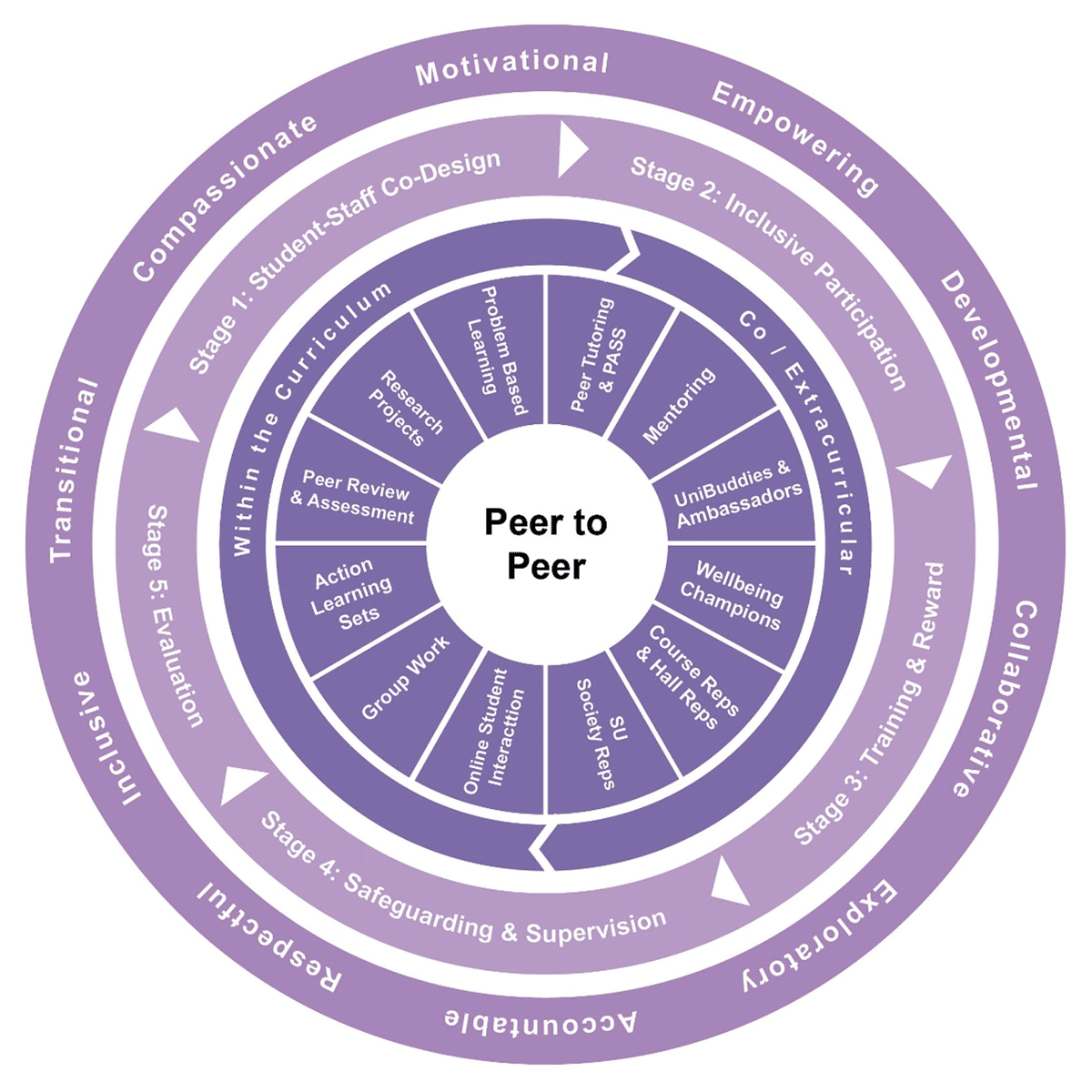
Figure 1
The Peer-to-Peer Model.
Table 1
Participant Information.
| PARTICIPANTS | n = | % OF PARTICIPANTS |
|---|---|---|
| UG architecture students | 3 | 18.75 |
| UG pharmacy students | 2 | 12.5 |
| UG paramedic students | 2 | 12.5 |
| UG nursing students | 3 | 18.75 |
| Academic staff course or module leaders | 3 | 18.75 |
| Educational developers | 3 | 18.75 |
Table 2
Mapping of Institutional Approaches to Peer Learning and Support from Curricular, Cocurricular, and Extracurricular Contexts.
| CURRICULAR | COCURRICULAR | EXTRACURRICULAR |
|---|---|---|
|
|
|
Table 3
Principles of PASS Perceived as Most Important.
| PRINCIPLE OF PASS | FREQUENCY |
|---|---|
| PASS is participative | 10 |
| PASS encourages collaborative rather than competitive learning | 10 |
| PASS benefits all students regardless of current academic competency | 8 |
| PASS gives privacy to practice the subject, make mistakes, and build up confidence | 7 |
| PASS encourages learner autonomy | 6 |
| PASS challenges the barrier between year groups | 6 |
| PASS is confidential | 5 |