
Introduction: Why Do We Need a Peer-to-Peer Model?
This paper argues for the importance of institutional strategic guidance for staff practitioners in developing a variety of peer-to-peer practices. At a UK host institution, a research-informed peer-to-peer model (Figure 1) was developed to guide curriculum design and co/extracurricular activities. It enables a more inclusive approach, maximizing the benefits of peer learning and ensuring that all students have a variety of opportunities to participate throughout their university experience, both within their courses and through extracurricular opportunities. Staff need a variety of peer-to-peer activities to consider implementing in the context of varying cohort sizes, institutional resourcing, and disciplinary pedagogies.
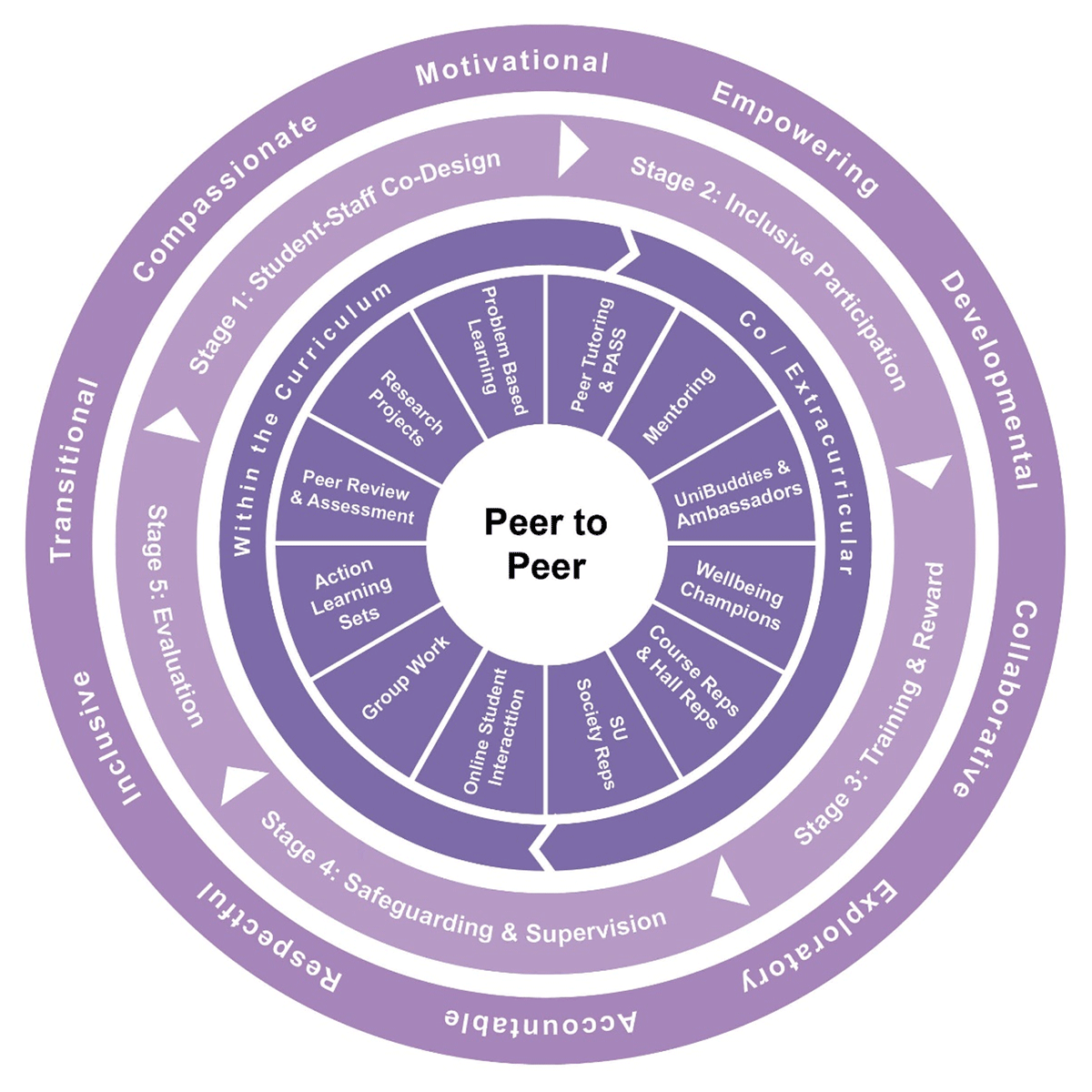
Figure 1
The Peer-to-Peer Model.
Peer learning and support are identified as an effective way for institutions to enhance student retention and engagement (Thomas et al., 2017; Thomas, 2012). At the host institution of this research, the learning and teaching (L&T) strategy seeks to strengthen students’ engagement in their own learning and in the wider student experience through peer relationships and learning communities (University of Brighton, 2019), but the strategy lacked staff professional development to develop this practice. Specific guidance was needed for implementing, quality assuring, auditing, evaluating, and researching the wide variety of peer learning and support practices found in literature.
Without an institutional model, pockets of good practice, engaged staff and students, and certain disciplines lead the way in peer learning practices. Informal peer learning and support happen organically between some students, but what about the students for whom this is more challenging? The challenge could come from circumstances such as having caring responsibilities or commuting logistics, lacking confidence to connect with others, or from being neurodiverse or having introverted personality types. Students from lower socioeconomic backgrounds may lack the social capital to realize the benefits of connecting with others for their own professional development (Brook, 2005). The stigma associated with extracurricular support is often perceived as remedial (Hill et al., 2010). These challenges highlight the importance of embedding peer learning within the curriculum in addition to co/extracurricular programs.
At the host institution, a key provision of peer learning for over a decade was a centrally coordinated cocurricular Peer Assisted Study Sessions (PASS) program. The coordination of PASS was funded through UK government access and participation funds for supporting student retention, particularly for students from lower socioeconomic backgrounds and black, Asian, and minority ethnic identities (Office for Students, 2023). Unfortunately, the quantitative evaluations did not produce datasets of statistically significant size to evidence the benefits of participating in PASS for students of these demographics. Collecting PASS attendance data was a particular challenge in the previous absence of a university attendance monitoring policy, a culture of low attendance in some courses, and student PASS leaders being relied on to collect attendance data.
On the other hand, qualitative data did identify a wide range of beneficial impacts of PASS on student participants’ engagement and motivation (Gill & McConnell, 2016; Jones et al., 2013), transition (Chilvers, 2016), and PASS leaders’ confidence and professional development (Chilvers & Waghorne, 2018). However, despite this qualitative evidence, and the wider evidence in literature for the effectiveness of PASS (Szeto et al., 2022; Dawson et al., 2014; Malm et al., 2012), a difficult decision was made to redirect the funding to more targeted retention activities for students of these demographics. PASS was decentralized and continues to be coordinated at the course level.
This change, while disappointing for many, did initiate new positive opportunities to develop an institution-wide, inclusive approach to peer learning. The L&T Hub were tasked by senior management to design an institutional peer-to-peer model and curriculum design resources for academic staff. These were required to equip and support staff 1) taking on the coordination of PASS schemes, 2) embedding peer learning in the curriculum, and 3) developing other forms of co/extracurricular peer support.
Methodology
This research aimed to generate knowledge and understanding about existing peer learning and support practices both within the literature and at the host institution. A constructivist approach to the creation of knowledge (Guba & Lincoln, 1994) and interpretivist approach to analysis (Cohen et al., 2000) frame this research to explore the student and staff lived experiences of peer learning. Two stages of exploratory research were conducted: desk-based research reviewing literature and then conducting focus groups with students and staff. Both stages were guided by the following research questions:
What are the key approaches taken for peer learning and peer support activities across departments at Brighton? (This informed the inner ring of model.)
In order to ensure quality and consistency across peer learning activities, what are the essential practices to be embedded in any existing and new peer learning and peer support activities at Brighton? (This informed the middle ring of model.)
Are there any key uniting values that inform and characterize the embedding of peer learning and peer support practices at Brighton? If so, what are they? (This informed the outer ring of model.)
A mixed-methods approach was initially planned, using a survey and focus groups to build upon the findings from the literature review. However, due to the exceptionally challenging circumstances of the pandemic during which this research was conducted, an institutional survey was not permitted due to the number of other surveys into remote learning. Instead, the researcher, having worked as an educational developer at the institution for over 13 years in peer learning, was able to produce a summarizing list of the current peer learning and support activities and pedagogical approaches offered by courses and departments. The insider-researcher (Greene, 2014) nature of the project and full immersion of the researcher in the practice and research data was considered a strength that informed the development of the research questions.
Two focus groups were conducted via Microsoft Teams. OneNote documents were used for framing discussions on peer learning practices and underpinning values. Participants (n = 16) are summarized in Table 1; three of the students participated in PASS, and others shared experiences from their course or mentoring schemes.
Table 1
Participant Information.
| PARTICIPANTS | n = | % OF PARTICIPANTS |
|---|---|---|
| UG architecture students | 3 | 18.75 |
| UG pharmacy students | 2 | 12.5 |
| UG paramedic students | 2 | 12.5 |
| UG nursing students | 3 | 18.75 |
| Academic staff course or module leaders | 3 | 18.75 |
| Educational developers | 3 | 18.75 |
Reflexive thematic analysis (Braun & Clarke, 2006) was used to analyze the focus group transcripts due to the integral role the researcher plays in making interpretative meaning from the data. This complemented the insider researcher nature of the project and enabled the researcher’s knowledge of the institution’s practices to bring richness to the analysis (Braun & Clarke, 2006). Reflexive thematic analysis involves initially coding the transcripts with words to encapsulate meanings. Then these codes were brought together and reflected upon, with emerging themes connecting these codes identified. Themes developed by the researcher for the research questions—approaches, practices, and values—were used across all transcripts. Other themes emerged as the result of the coding. For example, a focus group quotation:
“In a peer learning context, sometimes other things come up to do with mental health. … It’s a supportive environment based around a common interest of your course.”
This quotation was coded as “support” and was grouped together with other emerging codes such as “trust,” “respect,” and “motivation” under the theme of “values.”
The subsequent peer-to-peer model (Figure 1) is the result of literature review findings, knowledge from the professional experience of the researcher at the host institution, and insights gained from the perspectives of student and staff participants.
Findings: Literature Review
Scope and Definitions
There is a vast amount of literature exploring the terminology and nuances of different types of peer learning and support (Keller & Porter, 2020; Topping & Ehly, 2001; Boud et al., 2001). Within the scope of this study, the key approaches, practices, and values are explored. For this research, the terms “peer learning” and “peer support” are used as broad terms to encompass formal activities in which students interact with one another, either vertically or horizontally across levels of study, for the purpose of enhancing their learning or development, or for pastoral support within the curriculum or as co/extracurricular activities. These interactions can encompass student-led or staff-led activities. This definition aligns with the terms used by the growing international community, The Association of Peer Learning and Support (Malm, 2024). Furthermore, this study also refers to the useful umbrella term of “peer-to-peer interaction” from transition pedagogies’ literature (Kift, 2009), which is used at the host institution to frame transition support.
Approaches
This paper emphasizes the importance of embedding peer learning and support within the curriculum across all courses in addition to co/extracurricular opportunities, thus enabling all students to benefit from a variety of peer-to-peer interactions. This research is underpinned by theoretical perspectives of learning in higher education (HE) as a socially situated and co-constructed active process (Vygotsky, 1978; Bandura, 1986). The role of student interactions with more knowledgeable others and participation in communities of practice are vital ways for students to develop their learning and disciplinary identities (Wenger-Trayner et al., 2015; Lave & Wenger, 1991).
Vast amounts of research share approaches to peer learning in the curriculum designed to enhance student learning and achievement of module learning outcomes (Thomas et al., 2017; see also Barrineau et al., 2019; Boud et al., 2001), develop professional skills and attributes relevant for the workplace (Chilvers & Waghorne, 2018; Burgess & Nestel, 2014), and share pragmatic ways of teaching and supporting large cohorts (Boud & Cohen, 2014). There is not scope to examine these approaches in depth, but a summary of curriculum-embedded approaches to peer learning include the following examples: group work assignments (Hartley et al., 2022), peer feedback and peer assessment (Boud et al., 1999; Topping, 2018, 2009), peer-led critiques and reviews (Blair et al., 2007), action learning sets for focused group discussion (McGill & Beatty, 2001), simulated learning for practicing professional skills (Chernikova et al., 2020), and problem-based learning using case studies or briefs for group work (Yew & Goh, 2016).
Online learning research highlights two key principles: the foundational importance of scaffolding the curriculum with regular opportunities for students to build course community through student-to-student interaction in synchronous and asynchronous modes, and the important role of teachers’ online presence for facilitating these interactions (Garrison et al., 2000; Sakulwichitsintu et al., 2018; Salmon, 2011). As many institutions beyond the pandemic returned to predominantly on-campus delivery, online learning communities as well as digital interaction and collaboration remain vitally important (Abu et al., 2021).
In this context of the curriculum, a key distinction made in peer learning literature is between cooperative learning and peer tutoring. Cooperative learning involves mutual peer interaction and exchange of knowledge or support, whereas peer tutoring is directional peer interaction organized across levels of study with the peer tutor providing the input (Topping et al., 2017). While the direction of support varies, it can be argued that both cooperative learning and peer tutoring are both mutually beneficial activities for students’ learning and development as peer tutors still gain the solidification of course knowledge and development of their confidence and professional attributes. Peer mentoring and peer coaching also provide mutually beneficial formalized relationships for students, which can take place as curricular or co/extracurricular activities, depending on their purpose. These purposes could include supporting students’ experiences on placement (Wilson & Huynh, 2020), developing course knowledge and academic skills (Saethern et al., 2022), or navigating challenges of university life or achieving personal goals (Hamilton et al., 2019).
For this research, the following definitions of coaching and mentoring are used: “Coaching and mentoring are supportive, developmental, learning relationships where support and challenge are provided to achieve personal outcomes and to realize potential” (Jones & Smith, 2022, p. 214). Coaching typically focuses on performance and achieving goals while mentoring focuses on personal and professional development (Jones & Smith, 2022; Clutterbuck, 2007). Importantly, the relationships provide the structure to have dialogue and exchanges for learning and growth.
In terms of the co/extracurricular contexts, Keenan’s (2014) mapping report of peer learning in the UK focused specifically on co/extracurricular activities led by students to facilitate peer learning and support. A variety of approaches were identified, focusing primarily on PASS and similar models of Peer-Assisted Learning (PAL) and Supplemental Instruction (SI), but also including peer coaching, peer mentoring, and peer tutoring. These approaches all involved experienced, trained students at higher levels offering one-to-one support or facilitating groups of students to study together (Keenan, 2014). Extracurricular activities such as Student Union societies, sports teams, and volunteering are evidenced for developing students’ friendships, sense of belonging, and wellbeing (Thomas et al., 2017).
There is a gap in publications exploring institution-wide approaches for providing peer learning and support spanning both curriculum-embedded and co/extracurricular delivery, which this paper seeks to address.
Practices
Regarding the practical logistics of peer learning and support, an Advance HE toolkit (2017) identified eight factors for consideration including strategic intent, organizational commitment, scope and focus, design of mentoring schemes, design of academic PAL, ownership and operation, outcomes and impact, and communities of practice. The toolkit focuses on practices from the context of co/extracurricular projects.
Topping and Ehly’s (2001) organizational dimensions to peer learning demonstrate the variety of factors to be considered when implementing peer-to-peer interactions either within the curriculum or as co/extracurricular activities:
curriculum content (knowledge and/or skills),
contact constellation (1:1, 1:4, 2:6, etc.),
within or between institutions,
year of study (within or across levels),
same or across-ability matching,
role continuity (switching roles in reciprocal),
time (class time or unscheduled time),
place (formal or informal),
helper characteristics (selected subgroup or various),
characteristics of helped (selected subgroup or various),
objectives (cognitive, social, attitudinal, transferable skill gains),
voluntary or compulsory, and
reinforcement (reward and recognition) (p. 120).
A curriculum-embedded approach can help to reduce resource and workload implications. Instead of peer leaders who require supervision (and payment in some institutions), module leaders have more involvement in scaffolding, facilitating, and monitoring group work and peer-to-peer interactions. However, some students may be skeptical about the value of peer learning and peer feedback (Lelis, 2017); others may feel negatively toward group work due to differing levels of contributions (Hartley et al., 2022). For other students with sensory or behavioral challenges, interactions with peers can be a source of stress or anxiety, and supporting these students in navigating curriculum-based peer interaction is important (Bax, 2020). In their guidance on the practical implementation of peer learning, Topping et al. (2017) highlight the importance of staff introducing the purpose and value of peer-to-peer activities and quality-assuring the process so that students are supported and safeguarded in navigating the challenges that may arise.
However, where peer learning and support in the curriculum involves students taking on peer leadership roles (such as mentors, coaches, tutors, or buddies), then training, supervision, reward, and payment are still important practices to consider carefully.
Values
Educational values can be useful for guiding implementation or framing reflection and evaluation of practices. The underpinning “21 Principles of PASS” (University of Manchester, 2010) offer practitioners values to guide the implementation and evaluation of PASS, SI, and PAL programs:
“PASS is:
a methodology for learner support
small-group learning
facilitated by other students acting as mentors
confidential
voluntary
non-remedial
participative
content-based and process-oriented
encourages collaborative, rather than competitive learning
benefits all students regardless of current academic competency
gives privacy to practice the subject, make mistakes, and build up confidence
gives opportunity to increase academic performance
proactive, not reactive
targets high-risk courses, not high-risk students
decreases drop-out rates and aids retention
encourages learner autonomy
does not create dependency
integrates effective learning strategies within the course content
enables a clear view of course expectations
works in the language of the discipline
challenges the barrier between year groups” (p. 10a).
Couchman (2008) critiques the PASS principles as lacking reference to the increasing diversity of student backgrounds (cultural, linguistic, and age) and to the transformation of the traditional HE disciplines to include new disciplines and professional education. For the broader context of curricular and extracurricular activities, and for the post-pandemic blended delivery modes of teaching and learning in HE, a new set of guiding values are needed.
Values of collaboration, cooperation, and co-creation were identified as key principles underpinning social and constructive learning, as explored by the Advance HE (2017) peer learning scheme toolkit. In addition, Topping et al. (2017) highlight the importance of preparation for constructive peer interactions. Rawlinson and Willimott (2016) integrated social justice principles of rights, self-determination, access, equity, and participation into their peer mentoring scheme.
These are interesting values to consider; however, they do not encompass the social and interpersonal values relevant in the context of students reintegrating post-pandemic: navigating the nuances of social reconnections and challenging complexities of student life such as commuting, caring responsibilities, and multiple part-time jobs.
Findings: Focus Groups
Themes from the focus groups and reflections from the researcher shall be shared in response to each research question informing the peer-to-peer model (Figure 1). A staff guidance document containing more detailed advice under each section of the peer-to-peer model is on the institution’s intranet, available to readers upon request.
Research Question 1: What are the key approaches taken for peer learning and peer support activities across departments at Brighton?
The wide variety of peer learning and support activities taking place at the host institution are summarized in Table 2.
Table 2
Mapping of Institutional Approaches to Peer Learning and Support from Curricular, Cocurricular, and Extracurricular Contexts.
| CURRICULAR | COCURRICULAR | EXTRACURRICULAR |
|---|---|---|
|
|
|
During the focus groups, staff and students referred to peer learning and support activities that they were involved with, which informed Table 2. When students were presented with a list of peer learning activities, many had not realized how much peer learning and support they engaged with: “I didn’t realize how many peer learning opportunities I’ve done until I had looked at the list” (Student 1).
Staff shared examples of activities happening within and alongside the curriculum and the beneficial impacts for the students involved, providing opportunities for participation and building connections:
“We do simulations on first-year modules with third-year student actors. … The first years had to de-escalate a patient who was in distress. … It’s the little moments between the simulation when the students can have informal discussions” (Lecturer 1).
“We’re doing cocurricular action learning sets, reading groups, and discussion-based group work. … One of my students said that even though she didn’t say anything, she felt part of that group and could listen” (Lecturer 3).
Research Question 2: In order to ensure quality and consistency across peer learning activities, what are the essential practices to be embedded in any existing and new peer learning and peer support activities at Brighton?
The key considerations for staff designing peer learning and support activities have been summarized into an accessible five stages in the peer-to-peer model, which intends to distill the key points from Advance HE’s (2017) toolkit, some key themes that emerged from the focus groups, and the experience of the researcher at the host institution.
Stage 1: Student-Staff Co-Design
Building upon Advance HE’s reports on the valuing of co-creation between students and staff (2017) and engaging students as partners in learning and teaching (Healey et al., 2014), it is essential that peer-to-peer activities are co-designed in partnership with students. This means students being actively involved in curriculum or project design from the outset, staff contributing expertise in the course and discipline, and students contributing expertise in their own learning and student experience.
In the focus groups, students shared insights from their own experiences of peer learning, demonstrating how staff could benefit from involving students in the initial stages of curriculum or project design:
“Sometimes…peer groups don’t work well together. … There could be a leader who bosses everyone around causing tension” (Student 4).
“It’s the classic feeling that some people just aren’t contributing to group work, and other people are doing all the work. … Agreeing upfront that you’re gonna play a part is a good start” (Student 6).
Stage 2: Inclusive Participation
To encourage wider participation, literature highlights the value of staff preparing students for peer learning by explaining the purpose and benefits of activities (Topping et al., 2017). This explanation can be done through introductory activities in the curriculum, students sharing their own experiences, and clear communication in promotion materials.
In co/extracurricular contexts, where students are recruited for peer leader roles, recruitment is usually relatively easy due to students seeking additional experience for their CVs. However, this motivation does not guarantee the diversity of peer leaders, as some will lack confidence in taking on leadership roles and will need further encouragement. Approaches for inclusive recruitment could involve providing information sessions to answer questions and address concerns, role application workshops offering support, recruitment advertising being visually diverse, personalized invitations to specific students, and allocating students to work in pairs to build confidence.
Stage 3: Training and Reward
Training and reward are important for equipping, developing, motivating, and rewarding students taking on peer leader roles, either in curricular contexts—such as leading group work, facilitating “peer crits,” or mentoring students—or in co/extracurricular contexts, such as PASS leaders, peer coaches, or mentors.
At the host institution, on-campus training workshops are coordinated at a department or project level. Online resources are available through LinkedIn Learning, and a set of peer leader resources are on the virtual learning platform developed by the Learning and Teaching Hub. Students work through these resources asynchronously online, equipping them with strategies for leadership, facilitation, and small-group learning. In blended delivery modes of learning and teaching, it is essential that students and staff are equipped with the digital skills to facilitate peer learning and support activities remotely online, as highlighted in the focus groups:
“You’re meant to know how to use all these cool tools. You’re meant to be able to find them already, but I don’t think we do” (Student 2).
“I found people on my course don’t know how to use Teams even now and it’s really difficult to say, ‘Let’s edit this document together’” (Student 7).
Students can receive reward and recognition through LinkedIn Learning endorsements from staff, and some departments provide certificates. The Student Union Awards also provide an opportunity to nominate students to recognize their contributions. Staff training and development shall be discussed further in the paper.
Stage 4: Safeguarding and Supervision
In the context of one-to-one and small-group peer support, it is important that staff and students discuss boundaries for managing expectations and safeguarding students’ mental health and wellbeing (Clutterbuck, 2007). This discussion could include definitions of the purpose of activities and students’ roles, technologies and platforms to use, topics for discussion and those to avoid, and key contacts to refer students to for further support.
Creating a safe space for students to engage in peer learning and support is also important. Establishing some ground rules can be a useful discussion to set the scene in group work, including topics such as meeting timings, showing mutual respect, listening and agreed levels of confidentiality, and allocating roles and responsibilities to group members. As one student highlighted in the focus groups, students’ broader life experiences and backgrounds will impact their engagement with their peers, and structure can help:
“We’ve had to revise shared values a bit in remembering appropriate behavior in MS Teams Groups, but that happens for every cohort. It’s nothing unusual” (Lecturer 5).
“Some students don’t trust easily because of what might have happened in their previous life. … So they can’t really have all this peer-to-peer collaborative stuff” (Student 8).
Discussions about the 10 values from the peer-to-peer model could help to prepare students or prompt reflections on students’ interactions with each other at the start or end of a module, group work task, or peer-to-peer relationship.
Stage 5: Evaluation
Identifying the rationale for evaluating peer learning activities in the early stages of designing practice can help to plan the methods for collecting data. In terms of evaluating the student experience of peer learning, the rationale could be evidencing the enhancement of students’ engagement with their studies, their grades or progression, their personal and professional development, or future employability. From a course or institutional perspective, the rationale may be to demonstrate value of staff time or use of funding, evidencing the impact on student satisfaction or achievement and retention, or strengthening the student voice. After identifying the rationale, consideration of the data available to collect could include:
Quantitative data: Student attendance data, grades and entry qualifications or Universities and Colleges Admissions Service (UCAS) points as a control factor, progression and retention data, demographic data, National Student Survey and midterm module evaluation feedback, and Destinations of Leavers HE data.
Qualitative data: Student and staff perceptions of the impact of the peer learning activities on their learning and student experience, their development of course understanding, and personal and professional skills. Course evaluation feedback and observations from staff on changes to workload or student engagement could also be useful.
Depending on the rationale for evaluation, the data collected could be useful for comparing the students participating in peer learning activities with those from the wider cohort or institutional data.
Research Question 3: Are there any key uniting values that inform and characterize the embedding of peer learning and peer support practices at Brighton? If so, what are they?
Values have been selected that encompass the breadth of peer learning and support activities, emerging from literature and the focus groups. Focus group participants were presented with the 21 principles of PASS and asked to reflect on which three principles they considered most important for peer learning. Those that got highlighted the most are summarized in Table 3.
Table 3
Principles of PASS Perceived as Most Important.
| PRINCIPLE OF PASS | FREQUENCY |
|---|---|
| PASS is participative | 10 |
| PASS encourages collaborative rather than competitive learning | 10 |
| PASS benefits all students regardless of current academic competency | 8 |
| PASS gives privacy to practice the subject, make mistakes, and build up confidence | 7 |
| PASS encourages learner autonomy | 6 |
| PASS challenges the barrier between year groups | 6 |
| PASS is confidential | 5 |
Respect and compassion emerged strongly as missing and important values to include:
“It’s important to have compassion towards someone. … In a peer learning context, sometimes other things come up to do with mental health. … It’s a supportive environment based around a common interest of your course” (Educational Developer 1).
“You know other peoples’ points of view respecting you, know how other people want to live their lives and respecting other people’s opinions. … Respect needs to be underlying” (Student 10).
Motivation also emerged as a benefit of peer learning, highlighted by remote learning during the pandemic: “Studying remotely—most of it was just personal research, and obviously you can’t get in contact with the teacher all the time, so you have to do the work yourself, chat with your friends and people in the course, and see if they have any different opinion” (Student 5).
The following list has been distilled for the peer-to-peer model to encapsulate values addressing the experiences and challenges students are navigating in the post-pandemic HE landscape:
Empowering: Increases students’ personal sense of agency to influence their own or their peers’ learning and development
Developmental: Participation leads to enhancements in students’ academic skills, course knowledge, personal development, and/or professional attributes and skills
Collaborative: Encourages non-competitive and supportive learning partnerships
Exploratory: Offers a safe space for students to experiment, explore, and make mistakes
Accountable: Students take responsibility for their participation, honoring confidentiality and accountability to peers
Respectful: All peer-to-peer interactions are mutually respectful, valuing the contributions and mutual exchange of experiences
Inclusive: All students of any background, demographic, or perspective are all equally valued and encouraged to engage with peer learning and support activities
Transitional: Provides support through times of transition, such as into and throughout different levels of study or navigating different aspects of the student experience
Compassionate: Shows kindness and empathy, considers each other’s personal contexts, such as their backgrounds, responsibilities, home life, challenges, or resources available
Motivational: Encourages students’ autonomy, engagement, independent study, and drive to remain focused on their studies
Discussion
The findings from the literature review and focus groups, combined with reflections from the researchers’ practice, have informed the development of an institutional peer-to-peer model. The central ring summarizes the wide variety of peer learning and support practices taking place at the host institution, which can inform staff’s design and implementation of the curriculum and extracurricular activities. Student and staff experiences have highlighted the beneficial impact of these activities for enhancing students’ engagement, motivation, learning, and support within their course communities. Challenges for students in navigating peer learning have been identified, such as social dynamics, expectations, levels of contributions, and perceived value. These challenges highlight the value of staff scaffolding and safeguarding; preparation of students for the purpose of peer learning; and the training, supervision, and reward for peer leaders.
The five key stages to the practical coordination of these peer-to-peer activities, summarized in the middle ring of the model, highlight a number of important considerations for practitioners. There will be resourcing implications; careful planning is required to ensure sufficient time, resources, and staffing are allocated so that activities are sustainable. To equip staff through continuing professional development in this area, the host institution’s staff intranet contains a peer-to-peer guidance document and accompanying set of detailed resources for facilitating specific peer learning and support activities for curricular and co/extracurricular contexts. Sessions about embedding peer learning and support are included and modeled on the Postgraduate Certificate in Academic Practice and Curriculum Design workshops.
The values of peer learning and support identified through this research can serve as a teaching tool for preparing students for the purpose and value of peer learning, for framing activities and establishing expectations for behavior such as group work or mentoring, or for guiding staff and student reflections. The list is not exhaustive but is a starting point for discussion. For institutions conducting impact evaluation of co/extracurricular activities and interventions, the 10 values could provide a framework for guiding evaluation and research. If developed further into institutional policy, the dimensions of the peer-to-peer model (5 stages and 10 values) could frame the auditing and quality assurance of curriculum design and extracurricular activities.
In terms of limitations, while the peer-to-peer model is grounded in exploratory research in the context of the host institution, it is also informed by a review of literature. Therefore, the model can be modified to represent different institutions’ approaches. The 5 stages and 10 values are transferable in nature and are a useful resource for practitioners across the sector. To strengthen the representation of the model across the HE sector, a national survey will inform the peer-to-peer model’s co-development and use across institutions.
The peer-to-peer model can also be used across institutions to offer targeted support for students, driven by data to target courses with low attainment, progression, retention, or low National Student Survey scores. In this context, further research could explore the impact of peer learning interventions on specific modules or courses using a theory of change methodology. Individual aspects of the model could frame further research. For example, the 10 values could be used as a lens to explore the student experience; stage 1 could be used to explore student and staff experiences of co-designing.
Conclusion
This research has described an institution’s approach for broadening and embedding peer learning and support provisions both within the curriculum as well as providing co/extracurricular opportunities. This approach provides a more inclusive and accessible offer to students, ensuring that all students have multiple opportunities throughout their course experience to benefit from peer-to-peer interactions. This embedded approach, in addition to also having co/extracurricular opportunities to opt into, adds value and enhancement to the student experience. The peer-to-peer model frames this approach, supporting staff professional development to inform the co-design and implementation of a variety of peer learning activities. Other institutions and educational practitioners are encouraged to use the peer-to-peer model as a tool for developing their own staff professional development, to support staff and students working in partnership to design their practices, and as a framework for informing research and impact evaluation.
Competing Interests
The author has no competing interests to declare.