
INTRODUCTION
Climate change poses substantial risks to agricultural production and food security, particularly in developing countries that depend heavily on rain-fed agriculture. Rising temperatures, droughts, rainfall variability and extreme weather events can adversely affect crop productivity across sub-Saharan Africa (IPCC, 2023). These risks are particularly important in Zimbabwe, where agriculture supports food security, rural livelihoods and the broader economy, but where production remains highly dependent on rainfall (Matarira et al., 2004). Maize, the country's principal staple crop, is central to household consumption and national food security. However, domestic maize production has fluctuated considerably and has frequently fallen below consumption requirements, thus contributing to greater reliance on imports and food assistance (FAO, 2022; USDA, 2023).
Temperatures can influence crop performance through several interconnected mechanisms. Higher temperatures increase evapotranspiration and atmospheric evaporative demand, potentially accelerating soil-moisture depletion, while heat exposure during sensitive stages such as flowering and grain filling can reduce crop productivity (Schlenker and Roberts, 2009; Challinor et al., 2014). These effects are especially important in rain-fed systems because temperature stress interacts with rainfall and soil-moisture availability. Crop responses may also be nonlinear, with substantially greater losses once critical thermal thresholds are exceeded (Schlenker and Roberts, 2009). Unprecedented seasonal heat therefore represents an important risk to agricultural production and food security (Battisti and Naylor, 2009).
Empirical studies have documented negative relationships between high temperatures and agricultural and economic performance (Dell et al., 2012; Hsiang et al., 2017). Evidence also indicates that maize yields are particularly sensitive to warming and extreme heat (Lobell et al., 2011). In sub-Saharan Africa, these risks are amplified by widespread reliance on rain-fed agriculture and constraints on adaptive capacity (Sonwa et al., 2017). For Zimbabwe specifically, Magwaza and Lyaro (2024) examined rainfall, temperature and maize production using an autoregressive distributed lag (ARDL) approach and Granger causality analysis, highlighting the importance of climatic variability and adaptation measures for maize production.
Despite this growing literature, important empirical gaps remain. The present study complements Magwaza and Lyaro (2024) in three respects. Firstly, rather than considering maize production alone, it examines four indicators of maize-sector performance: production, yield, imports and exports, thereby extending the analysis from domestic agricultural performance to maize-trade dependence. Secondly, it uses a long annual dataset covering 1961–2022. Thirdly, it estimates both level and first-difference regression specifications to examine long-term and year-to-year statistical associations between temperature anomalies and maize-sector outcomes. The analysis does not seek to identify a temperature-specific causal effect because rainfall, drought, technological change, agricultural policy and macroeconomic conditions may also influence maize-sector performance.
This study examines the relationship between temperature change and maize-sector performance in Zimbabwe from 1961 to 2022. It hypothesises that higher temperature anomalies are negatively associated with maize production and yield and positively associated with maize imports. By considering production, productivity and trade outcomes together, the study provides evidence relevant to climate adaptation, agricultural policy and long-term food-security planning.
MATERIAL AND METHODS
This study adopted a quantitative research design using annual time-series secondary data for Zimbabwe covering the period 1961–2022. The methodological framework adopted in this study differs from previous Zimbabwean climate–maize studies that primarily employed autoregressive distributed lag (ARDL) and cointegration approaches using combined climatic variables. The empirical strategy was informed by the general regression-based framework and diagnostic approach used by Kozak and Wierzbowska (2025), particularly the use of quantitative secondary data, regression analysis and statistical diagnostic testing to examine climate-related economic outcomes. The present study does not replicate their model specification, since the dependent variables, geographical context and agricultural outcomes differ substantially. The general linear regression model estimated in the study was specified as follows:
where Yt – represents maize production, maize yield, maize imports, and maize exports, – represents annual temperature change from the long-term average, β0 – is the intercept, β1 – represents the estimated association between temperature change and the respective maize-sector outcome, and ɛt – is the stochastic error term. Definitions of the applied variables are presented in Table 1.Table 1.
Definition of variables and data sources
| Variable | Description | Unit of measurement | Source |
|---|---|---|---|
| Temp | Annual mean land-surface air temperature anomaly relative to the 1951–1980 climatological mean | °C | FAOSTAT (based on NASA–GISS GISTEMP) |
| Prdxn | Maize production | ‘000 tonnes | FAOSTAT |
| Yield | Maize yield | kg/ha | FAOSTAT |
| Imports | Maize imports | ‘000 tonnes | FAO |
| Exports | Maize exports | ‘000 tonnes | FAO |
Production and yield were modelled separately because they represent related but distinct dimensions of maize-sector performance. Production measures aggregate national output and is jointly determined by yield and harvested area, whereas yield measures output per unit of harvested land. Harvested area was not modelled because the study aimed to examine aggregate maize availability and productivity rather than separating production into area and yield effects. Consequently, the production coefficient should not be interpreted as a purely physiological yield response to temperature.
Before regression estimation, Augmented Dickey-Fuller tests were used to assess stationarity. Temperature, production and imports were stationary in levels, whereas the unit-root null could not be rejected at the 5% level for yield and exports; all variables were stationary after first differencing. Breusch-Pagan/Cook-Weisberg tests were used to assess heteroskedasticity, while Breusch-Godfrey tests assessed residual serial correlation. Because heteroskedasticity and serial correlation were identified in several specifications, Newey-West heteroskedasticity- and autocorrelation-consistent (HAC) standard errors were used as a robustness check. Shapiro-Wilk and Shapiro-Francia tests of the individual variables were treated as descriptive distributional assessments rather than tests of regression-residual normality.
RESULTS
Descriptive statistics for the study variables are presented in Table 2, while temporal patterns are shown in Figures 1 and 2.
Table 2.
Descriptive statistics of variables used in the study
| Variable | Obs | Mean | Median | Std. dev. | Min | Max |
|---|---|---|---|---|---|---|
| Temp | 62 | 0.317 | 0.2 | 0.458 | −0.476 | 1.336 |
| Prdxn | 62 | 1 399.8 | 1 362.7 | 588.4 | 361.9 | 2 833.3 |
| Yield | 62 | 1 210.9 | 1 186.5 | 488.82 | 286.7 | 2 311 |
| Imports | 62 | 183.4 | 27.8 | 271.18 | 0 | 1 208.1 |
| Exports | 62 | 207.7 | 180.3 | 245.65 | 0.003 | 1 279.9 |
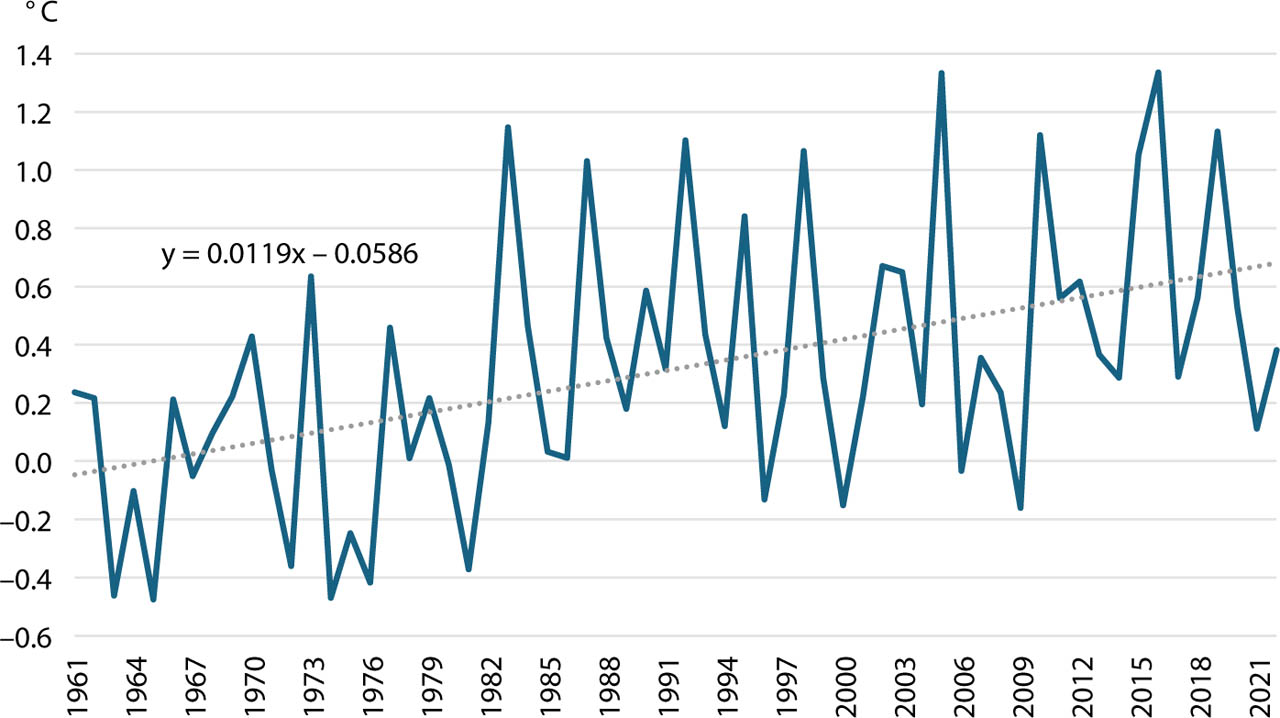
Fig. 1.
Temperature changes in Zimbabwe
Source: own work based on FAOSTAT data.
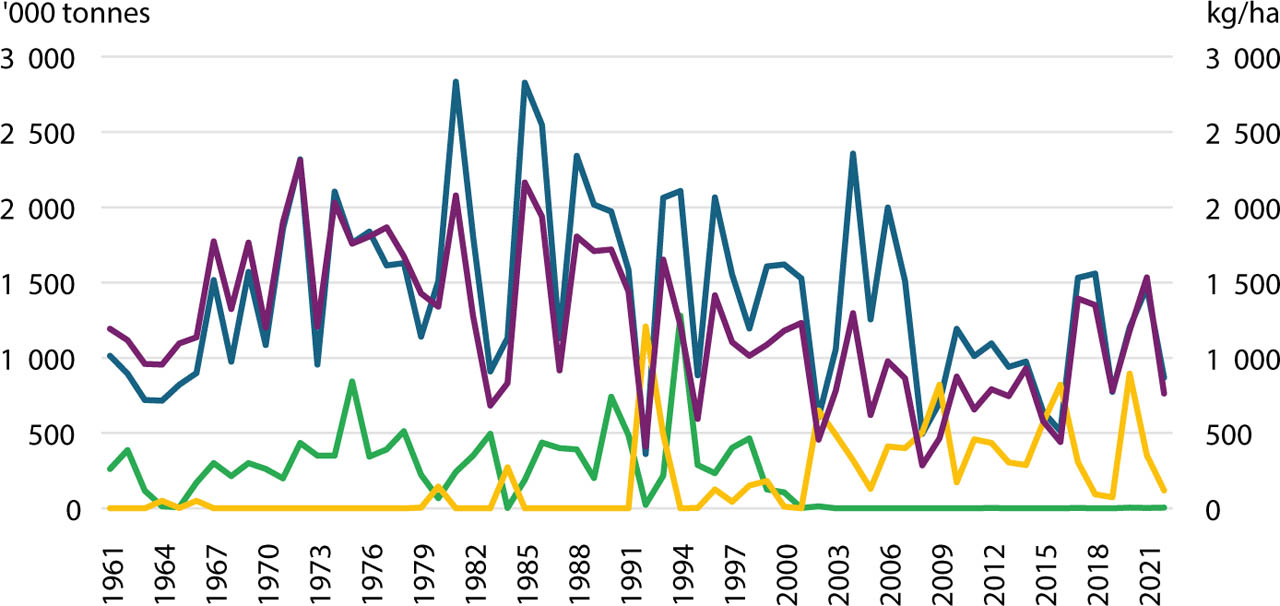
Fig. 2.
Production, export, import, and yield of maize in Zimbabwe
Source: own work based on the FAOSTAT.
Temperature anomalies showed an upward trend and substantial variability during the period 1961–2022, ranging from approximately −0.5°C to 1.3°C (Fig. 1). Maize production and yield were also highly variable, with several high-temperature years, including 1983, 1992, 2015 and 2016, coinciding with relatively low production and yield (Fig. 2). Mean maize production was 1.3998 million tonnes and mean yield was 1,210.9 kg/ha, while imports and exports averaged 0.1834 and 0.2077 million tonnes, respectively. Imports were particularly variable and tended to increase during periods of lower domestic production.
The pairwise correlation matrix presented in Table 3 was used to examine the direction and strength of the relationship between temperature and maize sector variables. The results revealed significant negative correlations between temperature and maize yield (r = −0.58) and production (r = −0.46), and a positive correlation with imports (r = 0.37). The correlation between temperature and exports was negative but statistically insignificant (r = −0.17). Production and yield were strongly positively correlated (r = 0.82), consistent with their close mechanical relationship.
Table 3.
Correlation matrix of temperature and maize variables
| Variables | Temp | Imports | Exports | Yield | Prdxn |
|---|---|---|---|---|---|
| Temp | 1.0000 | ||||
| Imports | 0.3665* | 1.0000 | |||
| Exports | −0.1664 | −0.5018* | 1.0000 | ||
| Yield | −0.5771* | −0.5674* | 0.4561* | 1.0000 | |
| Prdxn | −0.4563* | −0.4171* | 0.4054* | 0.8231* | 1.0000 |
Diagnostic testing indicated that temperature, production and imports were stationary in levels, while the unit-root null could not be rejected at the 5% level for yield and exports; all series were stationary after first differencing. Heteroskedasticity and serial correlation were detected in several specifications, and Newey–West HAC estimates were therefore used as a robustness check. The HAC estimates did not alter the substantive conclusions. The regression results are presented in Table 4.
Table 4.
OLS estimates with heteroskedasticity-robust standard errors for maize-sector performance in Zimbabwe
| Variables | Prdxn | Yield | Exports | Imports |
|---|---|---|---|---|
| Temp | −585.77*** (151.38) | −615.29*** (104.98) | –89.15 (60.83) | 216.78** (87.84) |
| Cons | 1 585.51*** (528.14) | 1 405.98*** (402.51) | 236.01*** (74.92) | 114.69 (92.41) |
| Observations | 62 | 62 | 62 | 62 |
| F-stat | 14.97 | 34.35 | 2.15 | 6.09 |
| Prob > F | 0.00 | 0.00 | 0.15 | 0.02 |
| R-squared | 0.21 | 0.33 | 0.03 | 0.14 |
The level regressions indicate significant negative associations between temperature anomalies and maize production and yield (Table 4). A 1°C higher temperature anomaly was associated with approximately 585.77 thousand tonnes lower maize production (p < 0.01) and 615.29 kg/ha lower maize yield (p < 0.01). The respective bivariate models accounted for approximately 21% and 33% of the variation in these outcomes.
Temperature was also positively associated with maize imports: a 1°C higher anomaly was associated with approximately 216.78 thousand tonnes higher imports (p < 0.05). The relationship with exports was negative but statistically insignificant. These coefficients represent statistical associations rather than causal effects because rainfall, drought, harvested area, technological change, agricultural policy, macroeconomic conditions and other time-varying factors are not controlled for.
First-difference models were additionally estimated to examine associations between annual changes in temperature and maize-sector outcomes while reducing the influence of persistent trends and potential non-stationarity (Table 5).
Table 5.
First-difference OLS estimates with heteroskedasticity-robust standard errors
| Variables | Δ prdxn | Δ yield | Δ export | Δ import |
|---|---|---|---|---|
| Δ temp | −845.971*** (135.192) | −573.193*** (107.279) | −9.378 (47.201) | 32.059 (80.114) |
| Cons | −0.364 (68.494) | −5.688 (53.869) | −4.19 (21.462) | 1.875 (39.12) |
| Observations | 61 | 61 | 61 | 61 |
| F-stat | 39.16 | 28.55 | 0.04 | 0.16 |
| Prob > F | 0.00 | 0.00 | 0.85 | 0.69 |
| R-squared | 0.481 | 0.408 | 0.001 | 0.004 |
The first-difference models show significant negative associations between annual temperature changes and changes in maize production and yield (Table 5). A 1°C annual increase in temperature was associated with approximately 0.84597 million tonnes lower annual maize production and 573.19 kg/ha lower annual maize yield. The respective models accounted for approximately 48% and 41% of the variation in annual changes. The import and export coefficients were statistically insignificant.
The level and first-difference specifications provide complementary rather than directly comparable evidence. The level models describe associations between temperature anomalies and outcome levels, whereas the first-difference models examine year-to-year changes. Differences in coefficient magnitude between Tables 4 and 5 should therefore not be interpreted as evidence that short-term temperature changes have stronger effects. Rather, the first-difference results indicate that the negative production and yield associations remain evident when persistent trends are reduced.
Overall, the first-difference results provide additional evidence of a negative association between annual temperature variability and changes in Zimbabwe's maize production and yield.
DISCUSSION
The findings are consistent with previous studies reporting negative relationships between high temperatures and agricultural productivity through heat stress, moisture loss, and shortened crop development periods (Challinor et al., 2014). Similar findings have been reported across different agricultural contexts, where higher temperatures were associated with lower cereal production and agricultural performance (Lobell et al., 2011; Chen et al., 2016). The 2015–2016 El Niño episode provides a useful context for understanding the vulnerability of Zimbabwe's maize sector to compound climatic stress. High-temperature anomalies during this period coincided with severe drought conditions, low maize production, and increased food import requirements. However, because the empirical models used in this study do not include rainfall or a drought indicator, the respective contributions of temperature, rainfall deficits and their interaction cannot be separately identified. The episode should therefore be interpreted as evidence of broader climate vulnerability rather than as direct evidence of a temperature-specific causal effect.
Temperature stress should also be understood in relation to moisture availability. Higher temperatures increase atmospheric evaporative demand and evapotranspiration, potentially accelerating soil-moisture depletion. This mechanism is particularly important in Zimbabwe because maize production remains predominantly rain-fed. Consequently, identical temperature anomalies may produce different agricultural outcomes depending on rainfall availability, soil-moisture conditions and the timing of heat exposure during the growing season. The estimated temperature coefficients in this study may therefore partly reflect compound heat–moisture stress rather than temperature operating independently.
The linear specification used in this study should also be interpreted taking into account evidence that crop responses to temperature are nonlinear. Maize may tolerate or benefit from temperature increases within an agronomically favourable range, whereas exposure beyond critical heat thresholds can result in disproportionately larger yield losses, particularly during sensitive stages such as flowering and grain filling. Schlenker and Roberts (2009), for example, identified pronounced nonlinear responses of maize yields to extreme heat exposure. Consequently, the single linear temperature coefficient estimated in the present study represents an average association over the 1961–2022 period and may conceal substantially stronger effects during exceptionally hot conditions. Future research using daily temperature data, growing-degree days, extreme-heat indicators or nonlinear specifications would provide a more precise assessment of thermal thresholds relevant to maize production in Zimbabwe.
The statistically insignificant relationship between temperature and maize exports suggests that export performance may be influenced more strongly by domestic production deficits, trade dynamics, and national food security priorities than by temperature changes alone. The statistically insignificant export coefficient may reflect the influence of domestic supply requirements, trade policies and other economic factors that are not captured by the present temperature-only specification. Consequently, export performance appears less responsive to short-term climatic variability than production and yield indicators.
The findings should also be considered within Zimbabwe's broader agricultural context, where substantial reliance on rain-fed farming and constraints in irrigation and adaptive capacity can increase exposure to climatic variability (Sonwa et al., 2017). Rising temperatures may therefore be associated with risks to agricultural productivity, rural livelihoods, household welfare, employment creation, and broader economic stability. Given the importance of maize within Zimbabwe's food system, continued climatic deterioration may intensify food insecurity, poverty, and dependence on external food supplies.
Overall, the study provides empirical evidence of a significant negative association between higher temperature anomalies and maize productivity and agricultural sustainability in Zimbabwe. The results highlight the urgent need for climate adaptation policies that boost resilience in the agricultural sector while strengthening long-term food security under changing climatic conditions.
This study acknowledges the existence of previous research examining climate change and maize production in Zimbabwe that used alternative econometric approaches and combined climatic variables. However, the present study differs in scope, methodology, time coverage, and analytical focus by specifically examining temperature-maize relationships and their implications for maize trade dependence and food security dynamics. All datasets utilised in the analysis were obtained from publicly accessible secondary databases, including FAOSTAT, FAO, and the World Bank Climate Change Knowledge Portal.
CONCLUSIONS
This study examined the relationship between temperature variability and maize-sector performance in Zimbabwe over the period 1961–2022. The results indicate that higher temperature anomalies were significantly associated with lower maize production and yield, while higher temperature levels were also associated with greater maize imports. No statistically significant relationship was identified for maize exports. First-difference models further showed significant negative associations between annual temperature changes and annual changes in maize production and yield, although these estimates should not be directly compared in magnitude with the level-model coefficients.
These findings highlight the vulnerability of Zimbabwe's maize sector to climatic variability, particularly given the country's reliance on rain-fed agriculture. However, the estimated relationships should not be interpreted as causal temperature effects. Rainfall, drought, harvested area, technological change, agricultural policies and macroeconomic conditions were not simultaneously controlled for and may account for part of the observed relationships.
The findings nevertheless reinforce the importance of strengthening climate resilience within Zimbabwe's maize sector through irrigation development, climate-smart agriculture, heat- and drought-tolerant maize varieties, improved water management, climate information services and agricultural extension support. Future research should combine temperature with rainfall and drought indicators, account for structural changes in Zimbabwe's agricultural sector, examine nonlinear temperature responses, and use subnational data to identify differences across agro-ecological zones.
POLICY IMPLICATIONS AND RECOMMENDATIONS
The findings highlight the risks associated with rising temperatures for Zimbabwe's agricultural productivity, food security, and economic stability. Since maize remains the country's primary staple crop, declining productivity increases the risk of food shortages and greater dependence on imports. The study therefore emphasises the importance of strengthening agricultural resilience through climate adaptation strategies. Key policy recommendations include expanding irrigation infrastructure, promoting climate-smart agriculture, adopting locally appropriate drought- and heat-tolerant maize varieties, improving water-management systems, and strengthening agricultural extension services (Setimela, 2017). In addition, improved climate information systems and early-warning mechanisms are necessary to help farmers adapt to changing climatic conditions.
Adaptation policies should also recognise the substantial differences in climatic exposure, water availability, farming systems and production potential across Zimbabwe's agro-ecological zones. A uniform national adaptation strategy may therefore be less effective than locally targeted interventions. Irrigation investment, crop-variety selection, planting calendars, soil-moisture conservation and extension advice should be adapted to local rainfall regimes, temperature exposure and farming conditions. Future research using district- or province-level data would help identify the areas in which temperature and moisture stress pose the greatest risks to maize production. Overall, the study recommends integrating climate adaptation measures into Zimbabwe's agricultural and food security policies to improve long-term sustainability and resilience within the maize sector.
STUDY LIMITATIONS AND AREAS FOR FUTURE RESEARCH
Despite providing long-term empirical evidence on the relationship between temperature variability and maize-sector performance in Zimbabwe, this study has several limitations that should be considered when interpreting the results. Firstly, the regression models focus primarily on temperature and do not control for other important climatic factors, particularly rainfall, drought severity, humidity, soil-moisture conditions and extreme weather events. Since high temperatures can interact with rainfall deficits by increasing evapotranspiration and accelerating soil-moisture depletion, the estimated temperature coefficients may partly capture the influence of compound heat and moisture stress. The results should therefore be interpreted as statistical associations rather than temperature-specific causal effects. Secondly, total maize production is influenced not only by yield but also by harvested area, which was not explicitly modelled in this study. Thirdly, the long study period from 1961 to 2022 encompasses substantial structural, institutional and macroeconomic changes in Zimbabwe's agricultural sector, including changes in agricultural policies, farming systems, technology, input availability, and broader economic conditions. These time-varying factors may also have influenced maize production and trade and are not fully captured by the bivariate models. Fourthly, the use of national-level data may mask important differences in climatic exposure, agricultural performance and adaptive capacity across Zimbabwe's agro-ecological zones. Finally, while the study employs a linear specification, the relationship between temperature and maize productivity may be nonlinear, with potentially greater losses once critical thermal thresholds are exceeded. Future research should therefore incorporate rainfall and drought indicators, harvested area and relevant socioeconomic and structural variables. It should also investigate possible structural breaks and nonlinear temperature responses, and use district-, provincial- or agro-ecological-zone-level data where available. Such extensions would provide a more comprehensive assessment of climate-related risks to maize production and food security in Zimbabwe.