
INTRODUCTION
Cocoa occupies a strategic position in the global economy, both through its role in international trade and its cultural and nutritional value. Produced mainly in West Africa and Latin America, it constitutes the primary raw material of the international chocolate industry and provides income for millions of producers (ITC, 2024). However, despite their dominant position in global cocoa bean production, African countries transform only a small proportion of their output locally, exporting most of it in raw form to industrialised nations (Acosta-Alba, 2024). This situation limits local value creation and perpetuates structural economic dependence.
In Togo, the cocoa sector represents an important economic activity, yet local processing remains embryonic. In recent years, however, artisanal and semi-industrial initiatives have emerged, producing chocolate, cocoa powder, cocoa butter, and other derivatives for national and sub-regional markets (Kouassi, 2021). These initiatives are part of a broader shift towards food sovereignty and the promotion of local resources, responding to growing demand for authentic and high-quality products (FAO, 2023).
Despite the importance of this issue, few empirical studies have examined consumption behaviours of cocoa derivatives in West Africa, and even fewer in Togo. Most research has focused on production and export dynamics, neglecting the dimension of local consumption and processing (Otekunrin, 2025). This gap limits the understanding of market dynamics and hinders the development of public policies and marketing strategies adapted to local realities.
Understanding consumer motivations for purchasing locally processed cocoa derivatives is essential for shaping the development strategies in the sector. Indeed, purchasing decisions are not based solely on economic considerations but also integrate psychological, social, and symbolic dimensions (Fishbein and Ajzen, 1975; Maslow, 1943). Consumers may be motivated by gustatory pleasure, the search for quality, support for the local economy, or social distinction (Amoah et al., 2024; Aertsens et al., 2011).
Despite their growing economic importance, consumer motivations for locally processed cocoa products remain underexplored in West African markets. Understanding these motivations provides insights into purchasing behaviour that can guide producers, policy-makers, and marketers in promoting sustainable agri-business models. Moreover, the study addresses a gap in empirical evidence linking consumer preferences with rural development outcomes. By focusing on Lomé, the research contributes context specific findings that can inform broader regional strategies.
This study seeks to address this gap by analysing the factors motivating consumers to purchase locally processed cocoa products in Lomé, the capital of Togo. More specifically, it aims to: (i) identify the types of cocoa derivatives consumed and their supply channels; (ii) analyse consumer purchase motivations; and (iii) characterise consumer profiles according to their motivations. The results of this research will provide practical recommendations for stakeholders in the Togolese cocoa sector, including processors, distributors, and policymakers.
LITERATURE REVIEW
Local processing and food sovereignty
Local processing of agricultural products contributes to value creation, job generation, reduced dependence on imports, and strengthened food security. However, it also represents a major challenge for food sovereignty and economic development in sub-Saharan Africa (FAO, 2023). In the cocoa sector, local processing remains constrained by structural barriers, including limited access to technology, weak financing capacity, insufficient infrastructure, and a lack of technical expertise (Acosta-Alba, 2024; Kouadio and Konan, 2024).
Nevertheless, promising initiatives are emerging in several West African countries, driven by local entrepreneurs, producer cooperatives, and supportive public policies. These initiatives emphasise product quality, authenticity, and local origin, responding to a growing demand among urban consumers who value these attributes (Adabe, 2023). The development of local cocoa processing requires a deeper understanding of consumer expectations and motivations in order to adapt supply and enhance the competitiveness of local products.
Cocoa and chocolate consumption in West Africa
Although West Africa produces more than 70% of the world's cocoa, local consumption of cocoa-derived products remains relatively low compared to Western countries (ITC, 2024). Recent studies, however, indicate a gradual increase in urban demand, driven by the emergence of a middle class, rapid urbanization, and evolving lifestyles (Cockx and Boti, 2024). Young urban consumers, in particular, are developing a taste for chocolate and cocoa-based beverages, which are perceived as modern and prestigious products (Amoah et al., 2024).
In Togo, the consumption of locally processed cocoa products reflects this broader trend. Artisanal and semi-industrial enterprises, such as Chocotogo, produce chocolate, cocoa powder, and cocoa butter for the domestic market (Kouassi, 2021). These products are valued for their authenticity, natural quality, and contribution to the national economy. Nevertheless, their market share remains limited compared to imported products, which are often perceived as more accessible or more prestigious.
Purchase motivations and symbolic dimensions of consumption
The motivations behind food purchases are multidimensional, integrating hedonic, utilitarian, and symbolic factors (Macht and Dettmer, 2022). Hedonic motivations refer to the sensory and emotional pleasure derived from consumption. Chocolate, in particular, is strongly associated with enjoyment, reward, and mood enhancement (Macht and Dettmer, 2022).
Altruistic (oblative) motivations concern the desire to please others, especially family members and close relatives. In African societies, where the values of sharing and solidarity are central, purchasing high-quality food products for the family is a common and socially valued practice (Aertsens et al., 2011).
Self-expression and social distinction motivations are also significant. The purchase of high-quality local products may express commitment to the national economy, an appreciation of authenticity, or the pursuit of social distinction (Amoah et al., 2024). In this context, locally processed cocoa derivatives can be perceived as markers of identity and social status.
Theoretical framework
The study is grounded in two theoretical frameworks: Maslow's hierarchy of needs theory and the Fishbein and Ajzen model of attitudes and purchase intentions.
Maslow's theory (1943) provides a fundamental conceptual framework for understanding human motivation. According to this theory, human needs are organised into a five-level pyramid: physiological needs, safety needs, belongingness and love needs, esteem needs, and self-actualization needs. Individuals seek to satisfy basic needs first before progressing toward higher-level needs (Taormina and Gao, 2013).
Applied to consumer behaviour, this theory suggests that food purchases may respond to different levels of needs. Cocoa-derived products, for instance, can satisfy physiological needs (nutrition, gustatory pleasure), belongingness needs (family sharing, conviviality), esteem needs (social distinction, self-enhancement), or self-actualization needs (supporting the local economy, responsible consumption). This approach moves beyond a purely utilitarian view of consumption and integrates its symbolic and affective dimensions.
The model developed by Fishbein and Ajzen (1975), together with the theory of planned behaviour (Ajzen, 1991), posits that purchasing behaviour is determined by the intention to purchase, which is itself influenced by three factors: attitude toward the behaviour, subjective norms, and perceived behavioural control. Attitude reflects the positive or negative evaluation of the product; subjective norms refer to perceived social pressure; and perceived behavioural control concerns the perceived ease or difficulty of performing the purchase (Al-Swidi et al., 2014; Yazdanpanah and Forouzani, 2015).
This model has been widely applied to the study of food consumption, particularly organic and locally produced goods. It provides insights into how consumer beliefs about product attributes (quality, taste, price, origin) shape attitudes and ultimately purchasing decisions. In the context of locally processed cocoa derivatives, this theoretical framework helps identify key levers to strengthen positive attitudes and facilitate product accessibility.
METHODOLOGY
Study area
The study was conducted in Lomé, the capital city of Togo, located in the Maritime region in the southern part of the country. Lomé has a population of approximately 1.5 million inhabitants and serves as the main economic, commercial, and administrative hub of Togo. The city is characterised by rapid urbanization, socio-economic diversity, and a high concentration of commercial activities, making it a relevant setting for analysing consumer behaviour toward locally processed cocoa-derived products.
Target population and sampling
The target population of this study consists of consumers of locally processed cocoa-derived products residing in Lomé. A stratified random sampling technique was employed to ensure the representativeness of the sample. The city of Lomé's five administrative districts were divided into four strata; two of the administrative districts (zones four and five) share similar characteristics and were consequently treated as a single peripheral stratum. Within each stratum, respondents were randomly selected at points of sale for cocoa-derived products, including supermarkets, specialised shops, markets, and outlets operated by local processors. The detailed distribution of the sample is presented in Table 1.
Table 1.
Distribution of respondents
| Stratum | Point of sale | Frequency | Percentage |
|---|---|---|---|
| Central districts | Adawlato Grand Market, FAO Local Products Shop | 67 | 26.8 |
| Tokoin (RamCO Supermarket, Champion) | 63 | 25.2 | |
| Peripheral popular districts | Agoe (Agoe Assiyeye Market, Artisanal kiosks | 57 | 22.8 |
| Bè (Bè Market, Suprmarket, Kiosks) | 63 | 25.2 | |
| Total | 250 | 100 |
The sample size was determined using Cochran's formula for an infinite population, with a confidence level of 95% and a margin of error of 5%. In total, 250 consumers were surveyed between January and March 2024. The inclusion criteria were: (i) being 18 years of age or older; (ii) having purchased at least one locally processed cocoa-derived product within the past six months; and (iii) residing in Lomé.
Data collection
Data were collected using a structured questionnaire administered through face-to-face interviews. The questionnaire comprised three main sections : (i) sociodemographic characteristics of respondents (age, gender, education level, occupation, income); (ii) consumption behaviours (types of cocoa-derived products consumed, purchase frequency, supply channels, modes of consumption); and (iii) purchase motivations.
The study assessed consumer purchase motivations using 15 items covering hedonic, altruistic (oblative), utilitarian, and symbolic dimensions. Respondents were asked to indicate their level of agreement with the following statement, measured on a fivepoint Likert scale (1 = strongly disagree to 5 = strongly agree): “I purchase cocoaderived products because they are locally processed and offer the following attributes:”
Natural quality without additives
Pleasant and authentic taste
Attractive packaging
Advertising and communication
Availability at points of sale
Geographical accessibility
Personal pleasure and satisfaction
Mood improvement
Personal reward
Pleasing the family
Pleasing others (friends, guests)
Appreciation of local products
Support for the national economy
Perception of luxury and prestige
Affordable price.
The questionnaire was pre-tested with 20 consumers to verify the clarity of the questions and the relevance of the items. Minor adjustments were made before the final administration. Enumerators were trained in interview techniques and ethical procedures for data collection. Informed consent was obtained from all respondents prior to each interview, and anonymity of responses was guaranteed in accordance with the ethical code of the University of Lomé.
Data analysis
The collected data were entered, cleaned, and analysed using SPSS version 26. Three types of analyses were performed: descriptive statistics, factor analysis, and cluster analysis.
Descriptive statistics
Descriptive statistics (frequencies, percentages, means, and standard deviations) were used to characterise the sample, identify the types of cocoa-derived products consumed, supply channels, and purchase frequencies. Chi-square tests were applied to examine associations between categorical variables.
Factor analysis
Principal component analysis (PCA) with Varimax rotation was conducted on the 15 purchase motivation items to identify the underlying dimensions structuring consumer motivations. The suitability of PCA was verified using Bartlett's test of sphericity and the Kaiser-Meyer-Olkin (KMO) measure of sampling adequacy. The number of factors to retain was determined according to Kaiser's criterion (eigenvalues greater than 1) and a scree plot analysis. The internal consistency of each factor was assessed using Cronbach's alpha coefficient, with an acceptability threshold set at 0.70 (Nunnally and Bernstein, 1994).
The data analysis followed a structured factor analytic procedure to identify latent dimensions underlying consumer motivations:
Suitability tests
Prior to factor extraction, the Kaiser–Meyer–Olkin (KMO) measure of sampling adequacy and Bartlett's test of sphericity were conducted.
A KMO value above 0.70 and a significant Bartlett's test (p < 0.001) confirmed that the correlation matrix was appropriate for factor analysis.
Extraction method
Factors were extracted using Principal Component Analysis (PCA).
Eigenvalues (equation 1) greater than 1 (Kaiser's criterion) and a scree plot were used to determine the number of factors to retain.
where λi represents the variance explained by each principal component.
Rotation
To improve interpretability, Varimax rotation (orthogonal) was applied.
This maximised the variance of loadings within each factor, producing clearer clusters of variables.
Factor loadings and reliability
Items with loadings ≥ 0.50 were considered significant contributors to a factor.
Internal consistency of each factor was assessed using Cronbach's alpha (equation 2):
where:k – number of items
σ2yi – variance of each item
σ2x – variance of the total score.
Interpretation
Factors were labelled according to the thematic grouping of items (quality perception, cultural identity, community support).
These latent constructs were then used in subsequent cluster analysis to classify consumer segments.
Cluster analysis
A hierarchical ascending classification (K-means method) was performed using the factor scores obtained from the principal component analysis (PCA) in order to identify homogeneous consumer profiles. The optimal number of clusters was determined by combining the elbow method, analysis of inter-cluster variance, and the interpretability of the profiles.
Clusters were characterised based on their mean scores across the motivational factors as well as their sociodemographic characteristics. Analysis of variance (ANOVA) tests were applied to verify the statistical significance of differences between clusters.
RESULTS
Sociodemographic profile of respondents
The sample consisted of 250 consumers of locally processed cocoa-derived products in Lomé. Results show that women accounted for 58.4% of the sample, while men represented 41.6%. The average age of respondents was 35.6 years (standard deviation = 11.2 years), with a predominance of the 25–44 age group (62.8%).
The level of education was relatively high: 68.4% of respondents had attained higher education, 24.8% secondary education, and 6.8% primary education. The main socio-professional categories represented were private sector employees (32.4%), civil servants (28.8%), traders and entrepreneurs (22.4%), students (10.8%), and other categories (5.6%).
Consumption behaviours
The results reveal that chocolate is the most widely consumed locally processed cocoa-derived product, with 90.8% of respondents reporting its consumption (Fig. 1). Cocoa powder ranks second (58.8%), followed by cocoa butter (40%), cocoa paste (23.2%), and cocoa juice (18.4%).
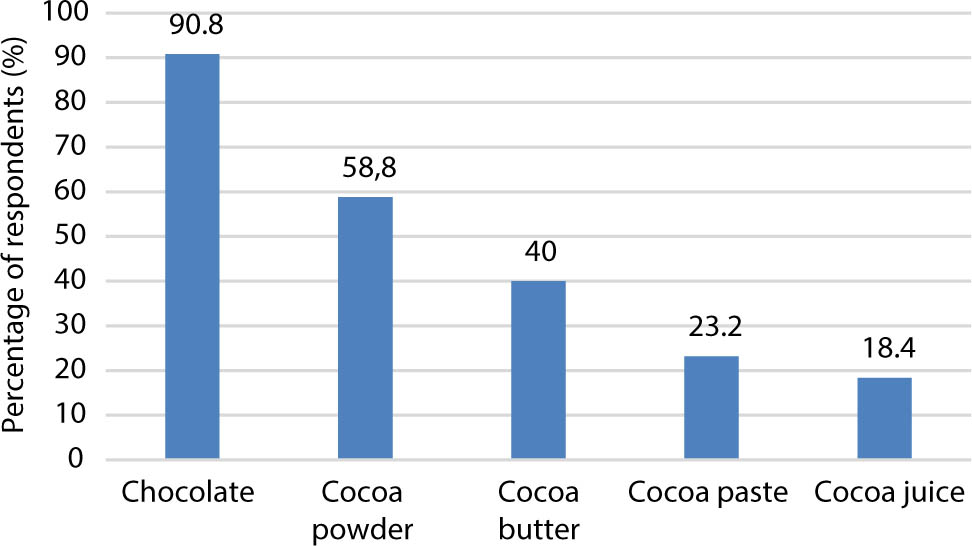
Fig. 1.
Locally processed cocoa-derived products consumed
Source: own elaboration.
These findings indicate a progressive diversification of the supply of locally processed cocoa products and a growing demand for varied products that meet different uses, including direct consumption, culinary preparation, and cosmetic applications).
Local cocoa processing enterprises and consumers supply channels
The main enterprises producing locally processed cocoa-derived products cited by respondents were indicated in Fig. 2. These are Chocotogo (78.4%), Cacao Togo (45.2%), Délices du Togo (32.8%), and other artisanal producers (18.4%). These enterprises are recognised for the quality of their products and their commitment to promoting Togolese cocoa.
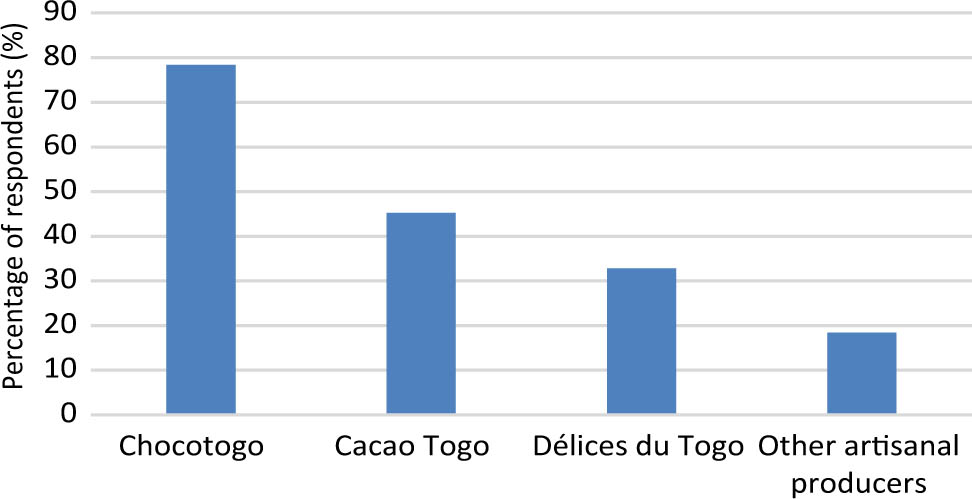
Fig. 2.
Enterprises producing cocoa-derived products
Source: own elaboration.
Preferred supply channels among consumers were indicated in Fig. 3. These are supermarkets and specialised shops (52.4%), direct sales outlets operated by producers (34.8%), local markets (28.4%), and online purchases (12.8%).
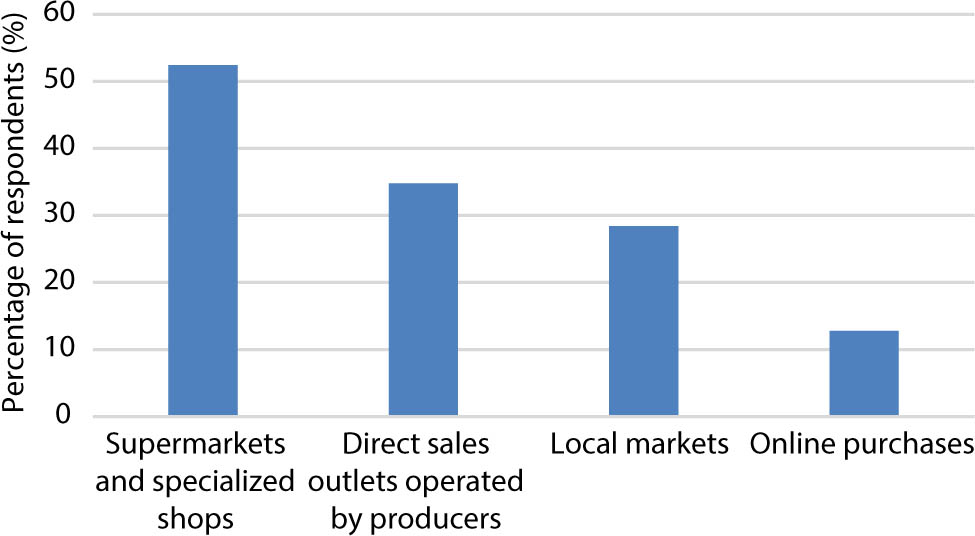
Fig. 3.
Preferred supply channels among consumers
Source: own elaboration.
The multiplicity of distribution channels reflects a diversification strategy adopted by producers to increase the accessibility of their products.
Purchase frequency and consumption mode
The frequency of purchase of locally processed cocoa-derived products varied among consumers. 36.8% of respondents purchased these products at least once a week, 42.4% at least once a month, 16.4% several times a year, and 4.4% occasionally (Fig. 4).
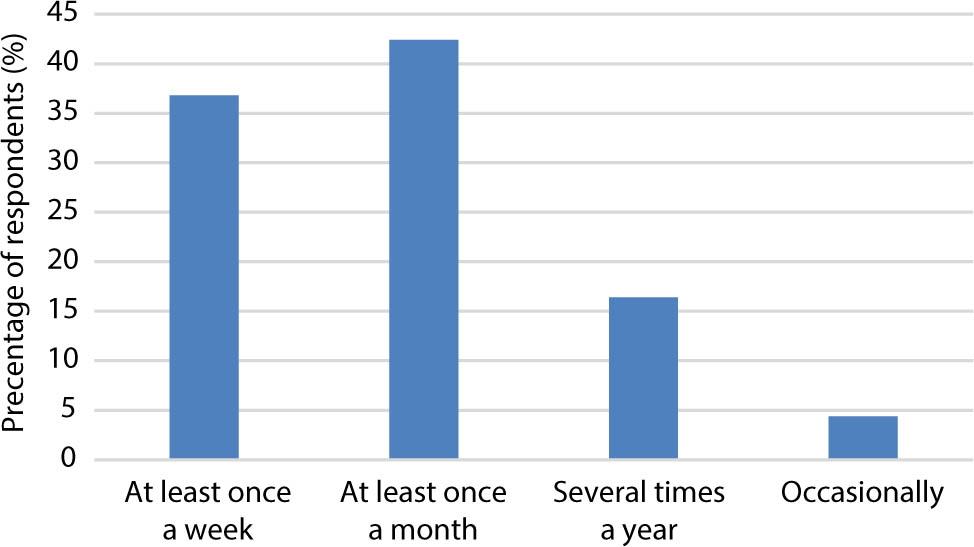
Fig. 4.
Frequency of purchase of locally processed cocoa-derived products
Source: own elaboration.
This relatively high purchase frequency suggests a progressive integration of these products into the consumption habits of urban households.
Consumption patterns were diversified among respondents. 93.6% consumed cocoa-derived products at breakfast (cocoa-based beverages, chocolate spreads), 68.4% as snacks, 42.8% in the preparation of desserts and pastries, 28.4% as gifts or during celebrations, and 18.4% in cosmetic applications (cocoa butter for skin care).
These findings highlight the versatility of locally processed cocoa products, which are integrated into both daily dietary practices and broader cultural or symbolic uses.
Factor analysis of purchase motivations
Principal component analysis (PCA) was applied to the 15 purchase motivation items. Bartlett's test of sphericity was significant (χ2 = 1847.32, p < 0.001), and the Kaiser-Meyer-Olkin (KMO) measure was 0.84, indicating that the data were suitable for factor analysis (Kaiser, 1974).
The PCA with Varimax rotation extracted three factors that together explained 68.7% of the total variance. Table 2 presents the results of the factor analysis, including the factor loadings of each item on the three retained factors.
Table 2.
Rotated component matrix of purchase motivation items
| Motivation items | Factor 1 | Factor 2 | Factor 3 |
|---|---|---|---|
| Natural quality without additives | 0.812 | 0.142 | 0.089 |
| Pleasant and authentic taste | 0.798 | 0.156 | 0.112 |
| Attractive packaging | 0.756 | 0.201 | 0.134 |
| Advertising and communication | 0.723 | 0.189 | 0.167 |
| Availability at points of sale | 0.701 | 0.234 | 0.145 |
| Geographical accessibility | 0.689 | 0.256 | 0.123 |
| Personal pleasure and satisfaction | 0.134 | 0.834 | 0.178 |
| Mood improvement | 0.156 | 0.812 | 0.145 |
| Personal reward | 0.189 | 0.789 | 0.167 |
| Pleasing the family | 0.201 | 0.767 | 0.234 |
| Pleasing others (friends, guests) | 0.178 | 0.745 | 0.256 |
| Valorization of local products | 0.234 | 0.189 | 0.823 |
| Support for the national economy | 0.256 | 0.167 | 0.801 |
| Perception of luxury and prestige | 0.267 | 0.234 | 0.779 |
| Affordable price | 0.645 | 0.123 | 0.289 |
[i] Note: The three extracted factors explained a cumulative variance of 68.7%, with Factor 1 accounting for 32.4%, Factor 2 for 21.8%, and Factor 3 for 14.5%. Internal consistency was satisfactory for all factors, with Cronbach's alpha coefficients of 0.86 for Factor 1, 0.83 for Factor 2, and 0.79 for Factor 3, exceeding the recommended threshold of 0.70 (Nunnally and Bernstein, 1994).
Factor 1 (32.4% of the variance) grouped items related to product quality, taste, packaging, advertising, availability, geographical accessibility, and price. This factor can be interpreted as “satisfaction and accessibility drivers,” reflecting the tangible and functional attributes of products that influence consumer satisfaction and facilitate purchase decisions.
Factor 2 (21.8% of the variance) encompassed items related to personal pleasure, mood improvement, personal reward, family enjoyment, and pleasing others. This factor corresponds to “hedonic and oblative motivations,” highlighting both the pursuit of personal gratification and the desire to share pleasure with others.
Factor 3 (14.5% of the variance) included items associated with the value accorded to local products, support for the national economy, and perceptions of luxury and prestige. This factor can be interpreted as “self-expression and social distinction motivations,” reflecting consumer engagement with local economic development as well as the search for social differentiation through product choice.
Cronbach's alpha coefficients for the three factors were 0.86, 0.83, and 0.79, respectively, indicating good internal consistency and reliability of the measurement scale (Nunnally and Bernstein, 1994; Hair et al., 2019).
Cluster analysis results: Typology of consumers
A hierarchical ascending classification (K-means method) was performed using the factor scores obtained from the principal component analysis (PCA). The analysis identified three clusters of consumers with distinct motivational profiles.
Table 3 presents the mean scores of each cluster across the three motivational factors, highlighting differences in satisfaction and accessibility drivers, hedonic and oblative motivations, and self-expression and social distinction motivations.
Table 3.
Consumer profiles identified by cluster analysis
| Cluster | Frequency | Percentage | Factor 1 | Factor 2 | Factor 3 |
|---|---|---|---|---|---|
| Cluster 1: Altruists | 95 | 38.0 % | 0.42 | 1.23 | 0.38 |
| Cluster 2: Status-oriented consumers | 125 | 50.0 % | 0.68 | 0.45 | 1.45 |
| Cluster 3: Individualistes | 30 | 12.0 % | 1.12 | −0.89 | −0.76 |
| Total | 250 | 100.0 % |
Table 4.
Sociodemographic characteristics of the clusters – altruists (38%), status-oriented (50%), individualists (12%)
| Characteristics | Altruistes (38%) | Status-oriented (50%) | Individualistes (12%) | χ2 / F | p |
|---|---|---|---|---|---|
| Sex (% women) | 64.2 % | 56.8 % | 46.7 % | χ2 = 3.12 | 0.210 |
| Average age (years) | 33.8 | 36.4 | 38.2 | F = 2.45 | 0.088 |
| Higher education level (%) | 62.1 % | 72.8 % | 70.0 % | χ2 = 4.56 | 0.102 |
| Average monthly income (FCFA) | 185 000 | 245 000 | 210 000 | F = 8.34 | < 0.001 |
| Weekly purchase frequency (%) | 42.1 % | 38.4 % | 23.3 % | χ2 = 5.67 | 0.059 |
Three distinct consumer profiles were identified:
• Cluster 1 – Altruists (38% of the sample)
This group displayed high scores on Factor 2 (hedonic and oblative motivations) and moderate scores on Factors 1 and 3. Consumers in this cluster are primarily motivated by personal pleasure and the desire to please family members and close relatives. Their consumption behaviour emphasises sharing and conviviality around cocoa-derived products.
• Cluster 2 – Status-oriented consumers (50% of the sample)
This cluster revealed very high scores on Factor 3 (self-expression and social distinction motivations) and moderate scores on Factor 1. These consumers are mainly driven by the appreciation of local products, support for the national economy, and perceptions of luxury and prestige. They use the purchase of locally processed cocoa-derived products as a means of expressing identity, civic engagement, and social status.
• Cluster 3 – Individualists (12% of the sample)
Respondents in this cluster recorded high scores on Factor 1 (satisfaction and accessibility drivers) and negative scores on Factors 2 and 3. Their motivations are primarily functional, focusing on product attributes such as quality, taste, price, and availability. They place less importance on hedonic, oblative, and symbolic dimensions, adopting a pragmatic and rational approach to consumption.
Status-oriented consumers reported a significantly higher average monthly income compared to the other clusters (F = 8.34, p < 0.001). This finding is consistent with their pursuit of social distinction and their perception of locally processed cocoa-derived products as luxury goods.
The differences between clusters on other sociodemographic variables were not statistically significant, suggesting that purchase motivations partly transcend traditional sociodemographic categories.
DISCUSSION
The results from principal component analysis revealed a three-dimensional structure of purchase motivations for locally processed chocolate products in Togo, explaining 68.7% of the total variance. This configuration converges with previous studies highlighting the complexity of chocolate consumption determinants (Prete et al., 2020). The first factor, “Satisfaction and accessibility” (32.4%), combines hedonic dimensions (quality, taste) with utilitarian attributes (price, availability, packaging), confirming that African consumers simultaneously evaluate sensory and functional product attributes (Femi-Oladunni et al., 2022). This hedonic–utilitarian duality has also been documented in South Africa, where young consumers combine pleasure with practicality, even more so in the package (Zeeman, 2013; Mphafi et al., 2023).
The second factor, “Hedonic and oblative motivations” (21.8%), emphasises the central role of personal pleasure and social sharing. These findings those of corroborate Sahu (2017), who identified chocolate as a hedonic reward consumed for mood regulation and celebration. The oblative dimension, reflecting the desire to please others, aligns with Uzo and Okpara's findings (2018), which highlighted the importance of collective domestic consumption and the involvement of others in purchase decisions.
The third factor, “Self-expression and social distinction” (14.5%), reveals an identity-driven and civic dimension. Purchasing local chocolate is perceived as both an act of support for the national economy and a marker of social status, consistent with theories of consumer ethnocentrism and economic patriotism (Mkedder et al., 2025). In Ghana, Ahenkora and Adarkwa (2018) showed that attitude is the strongest predictor of purchase intention for local brands, despite relatively low intention levels. In Togo, this identity dimension coexists with prestige motivations, creating a composite factor, where local chocolate functions simultaneously as a premium product and a symbol of civic engagement. Similar dynamics have been observed in Ecuador, where premium local chocolates such as Pacari are purchased as gifts and perceived as high-quality products (Gómez, 2014).
Cluster analysis further revealed heterogeneity in consumer profiles. The “Altruists” (38%) scored high on hedonic–oblative motivations, privileging sharing and conviviality. This profile resonates with literature on social image concerns in ethical consumption. Teyssieret al. (2015) demonstrated that consumers are willing to pay more for fair-trade chocolate when decisions are public, reflecting social image concerns. In the Togolese context, this social dimension appears to manifest more through family and friendship sharing than through formal ethical considerations.
“Status-oriented consumers” (50%), the largest cluster, scored high on self-expression and social distinction. This group reported significantly higher income levels (F = 8.34, p < 0.001), confirming the link between socio-economic status and ostentatious consumption. These results converge with Barauskaite et al. (2018), who showed that conspicuous consumption and descriptive normative influence are positively associated with the evaluation of product distinctiveness. In Africa, Maulana (2024) emphasised that social influence and conspicuous consumption extend beyond traditional luxury goods to shape perceptions of social status in food consumption. Our findings suggest that chocolate, historically imported and associated with modernity, functions as a positional good enabling Togolese consumers to signal socio-economic status and civic commitment.
The “Individualists” (12%) adopted a pragmatic and rational approach, scoring high on satisfaction–accessibility and negative on hedonic–oblative and symbolic dimensions. Their motivations are primarily functional, focusing on product attributes such as quality, taste, price, and availability. This profile recalls consumers oriented toward functional attributes identified by Yazdi et al. (2024), where price, sensory quality, and packaging directly influence purchase intention, independent of social or identity considerations. The existence of this segment suggests that despite the importance of social and symbolic dimensions in the African context, a proportion of consumers maintain a transactional approach to chocolate consumption, privileging value-for-money and availability.
From a theoretical perspective, three specificities emerge in the West African context. Firstly, the integration of the oblative dimension within hedonic motivations suggests that individual and shared pleasure are linked in Togolese consumers' perceptions. This contrasts with Western models, which tend to separate personal hedonic motivations from social motivations (Bettiga et al., 2020). Secondly, the emergence of a factor combining appreciation of local products, support for the national economy, and prestige reveals an original articulation between economic patriotism and social distinction. Unlike other emerging contexts, such as Saudi Arabia, where perceived quality and price dominate local product purchases (Mkedder et al., 2025), in Togo, local cocoa products appear to function as status markers linked to development and value-chain reap-propriation. Thirdly, the absence of significant sociodemographic differences between the clusters, except for income, suggests that purchase motivations largely transcend traditional categories of age, gender, or education. This contrasts with studies identifying gender differences in hedonic and utilitarian motivations (Dalziel and De Klerk, 2017; Zeeman, 2013). In Togo, psychographic factors – values, attitudes, and lifestyles – seem more influential than demographic variables in explaining consumer heterogeneity.
The results of this study align with previous research highlighting the importance of cultural and contextual factors in shaping consumer preferences for cocoabased products. For instance, Kouassi et al. (2019) emphasised that local identity and trust in traditional processing methods strongly influence purchasing decisions in West African markets. Similarly, Kumar and Sahu (2021) found that perceived quality and authenticity were decisive drivers of consumer choice in agribusiness value chains. Our findings extend these insights by demonstrating that in Lomé, motivations are not only linked to product quality but also to broader considerations of rural development and community support. This suggests that consumer behaviour in emerging markets reflects both individual preferences and collective socioeconomic aspirations, reinforcing the multidimensional nature of agribusiness demand.
Comparative studies including other cocoa-producing countries such as Ghana, Côte d'Ivoire, or Nigeria would help distinguish national specificities from regional trends. For instance, Ahenkora and Adarkwa (2018) showed that purchase intentions for local chocolate brands in Ghana remain relatively weak, suggesting significant variation among neighbouring countries. Further qualitative research, such as interviews or ethnographic surveys, would provide deeper insights into the cultural meanings of chocolate in Togo and the identity processes associated with its consumption.
Beyond its empirical findings, this study contributes to literary theory by demonstrating how consumer narratives and purchasing motivations can be interpreted through the lens of cultural identity and symbolic meaning. The analysis shows that locally processed cocoa products are not only commodities but also texts that embody values of authenticity, tradition, and community. By framing consumer behaviour as a form of discourse, the research extends literary approaches to agribusiness studies, illustrating how market choices function as cultural expressions that can be read and theorised in ways similar to literary texts. This interdisciplinary perspective enriches both agribusiness scholarship and literary theory by bridging economic practices with symbolic interpretation.
While the findings provide valuable insights into consumer motivations for locally processed cocoa products in Lomé, several limitations should be acknowledged. Firstly, the sample size of 250 respondents, although adequate for factor and cluster analyses, is restricted to an urban context and may not fully represent rural consumption patterns or broader West African markets. Secondly, the crosssectional design captures consumer behaviour at a single point in time, limiting the ability to assess changes in motivations over longer periods. Finally, the study focuses primarily on quantitative measures; complementary qualitative approaches, such as interviews or ethnographic observation, could provide deeper insights into the cultural meanings and symbolic dimensions of cocoa consumption.
CONCLUSION AND RECOMMENDATIONS
This research has shed light on the dynamics of the consumption of locally processed cocoa-derived products in Lomé. The findings reveal a diversified supply and a growing demand, driven by multiple motivations ranging from satisfaction and accessibility to hedonic, oblative, and identity-related dimensions. Three consumer profiles were distinguished: altruists, sensitive to pleasure and sharing; status-oriented consumers, attached to the appreciation of local products and social distinction; and individualists, more focused on functional attributes. These insights underscore the importance of quality, taste, and authenticity as essential drivers of satisfaction, while highlighting the central role of conviviality and civic engagement in the valuing cocoa products.
From a strategic perspective, the Togolese cocoa sector should strengthen communication, improve packaging and design, adapt marketing approaches to different consumer segments, and expand distribution channels to enhance accessibility. The implementation of differentiated pricing strategies also appears necessary to meet the diverse expectations of consumers, ranging from affordability to premium positioning.
The study opens avenues for further research across broader geographical and temporal contexts to better understand the evolution of consumption behaviours and the symbolic dimensions of cocoa consumption in West Africa. It thus contributes to clarifying the challenges of local value addition and the opportunities for sustainable development of the Togolese cocoa sector.