
INTRODUCTION
Climate change is a pressing global issue that significantly impacts development, especially in Africa (Pauline et al., 2017; IPCC, 2021). Defined by the IPCC (2008) as a persistent change in climate that alters its average state or variability, climate change poses severe challenges, particularly to vulnerable regions like West Africa, where variability has profoundly affected communities over the past four decades. Agriculture, a sector highly sensitive to temperature fluctuations and rainfall patterns, is among the most impacted. Rising temperatures and erratic rainfall disrupt food production, worsening food insecurity and poverty (Seaman et al., 2014). Forecasts suggest that these adverse conditions will intensify, with models predicting higher temperatures, more erratic rainfall, and a rise in extreme weather events (Ayanlade et al., 2018; Hein et al., 2019). Studies have projected a 15–25% reduction in yields for staple crops like maize, rice, and cassava as climate change increases pest and disease outbreaks, further jeopardizing crop productivity (Harvey et al., 2018).
Africa is particularly vulnerable due to its limited adaptive capacity. For instance, the agricultural sector, primarily rain-fed, suffers from increasingly unreliable weather patterns, making farmers more susceptible to poor yields and subsequent economic hardship (UNFCCC, 2007). Projections indicate that crop yields may decline by 10–20% by 2050, with potential losses reaching as high as 50% in some areas (Jones and Thornton, 2003). In Nigeria, the repercussions of climate change manifest in rising sea levels, desertification, erosion, flooding, and overall land degradation (Medugu, 2009). The erratic rainfall patterns and crop yield reductions due to climate change heighten hunger and food insecurity, affecting roughly 45 million people globally due to declining agricultural outputs (GHF, 2009).
Subsistence farmers, who depend heavily on agriculture, are especially at risk, as changing climate conditions diminish crop production, sometimes forcing them to purchase food at high prices during shortfalls (GHF, 2009). Additionally, the reliance on a limited number of crop varieties like rice, maize, cowpea, and cassava leaves farmers vulnerable, as the nutritional and economic stability of rural populations depends on these climate-sensitive crops (Padulosi et al., 2011). This vulnerability underscores the urgent need for adaptation strategies to mitigate climate risks and maintain livelihoods (Marie et al., 2020).
Adaptation strategies are essential tools for mitigating the negative impacts of climate change. Adaptation involves adjustments in social, economic, and ecological systems to respond to actual or anticipated climatic changes (Onah et al., 2016). Such strategies include irrigation, improved crop varieties, and soil conservation, all of which can enhance resilience and reduce potential food deficits in Africa (Shinde and Modak, 2013; Onah et al., 2016). However, adaptation at the farm level requires not only an awareness of climate change but also the resources and capacity to implement suitable strategies (Ojo and Baiyegunhi, 2020).
Effective adaptation can help farmers meet their food-, income- and livelihood objectives amidst shifting climatic conditions (Kandlinkar and Risbey, 2000). Yet adaptation choices are influenced by diverse factors–social, economic, and environmental (Bryan et al., 2013). Understanding these influences is crucial for supporting African farmers in implementing sustainable practices. While numerous studies have examined climate adaptation strategies across various Nigerian regions (Belay et al., 2017; Tessema et al., 2013), little research focuses on the unique challenges and strategies of communities near the Okomu Forest Reserve. This study addresses this gap by exploring factors influencing adaptation choices among the dwellers of settlements around Okomu Forest Reserve (OFR). Specifically, the study aimed to assess the following objectives: to examine the socioeconomic characteristics of respondents, identify the effects of climate change, evaluate the adaptation strategies used, and investigate the challenges facing adaptation in the study area.
METHODOLOGY
Study area
Okomu Forest Reserve is a significant protected area located in the Niger Delta Region of Nigeria, specifically within Edo State in Southern Nigeria. The reserve is situated between latitudes 6.08° and 6.30°N and longitudes 5.01° and 5.27°E (see Fig. 1). Covering approximately 108,200 hectares, it represents the lowland rainforest ecosystem typical of southern Nigeria. This forest reserve is home to numerous plant and animal species that are unique to West Africa. Notable wildlife includes the white-throated monkey (Cercopithecus albogularis), as well as several endangered species such as the African forest elephant (Loxodonta cyclotis), dwarf crocodile, bush cow, various species of monkeys, leopards, and a diverse range of birds. Common avian species found in the reserve include eagles, hornbills, kites, hawks, egrets, and numerous water birds (Akinsorotan et al., 2011; Enaruvbe, 2018). The flora is equally rich, characterized by dense undergrowth and towering timber trees such as mahogany (Terminalia spp), Chlorophora spp, and many others (NCF, 1996). As with all forest reserves in Nigeria, activities such as farming, collection of forest products, and hunting are strictly prohibited to preserve the biodiversity of the area. The primary language spoken by the local community is Bini, and the local economy is predominantly agricultural, with most households engaged in cassava cultivation, which is the major crop in the region. Other crops commonly cultivated alongside cassava include maize, melon, and groundnut.
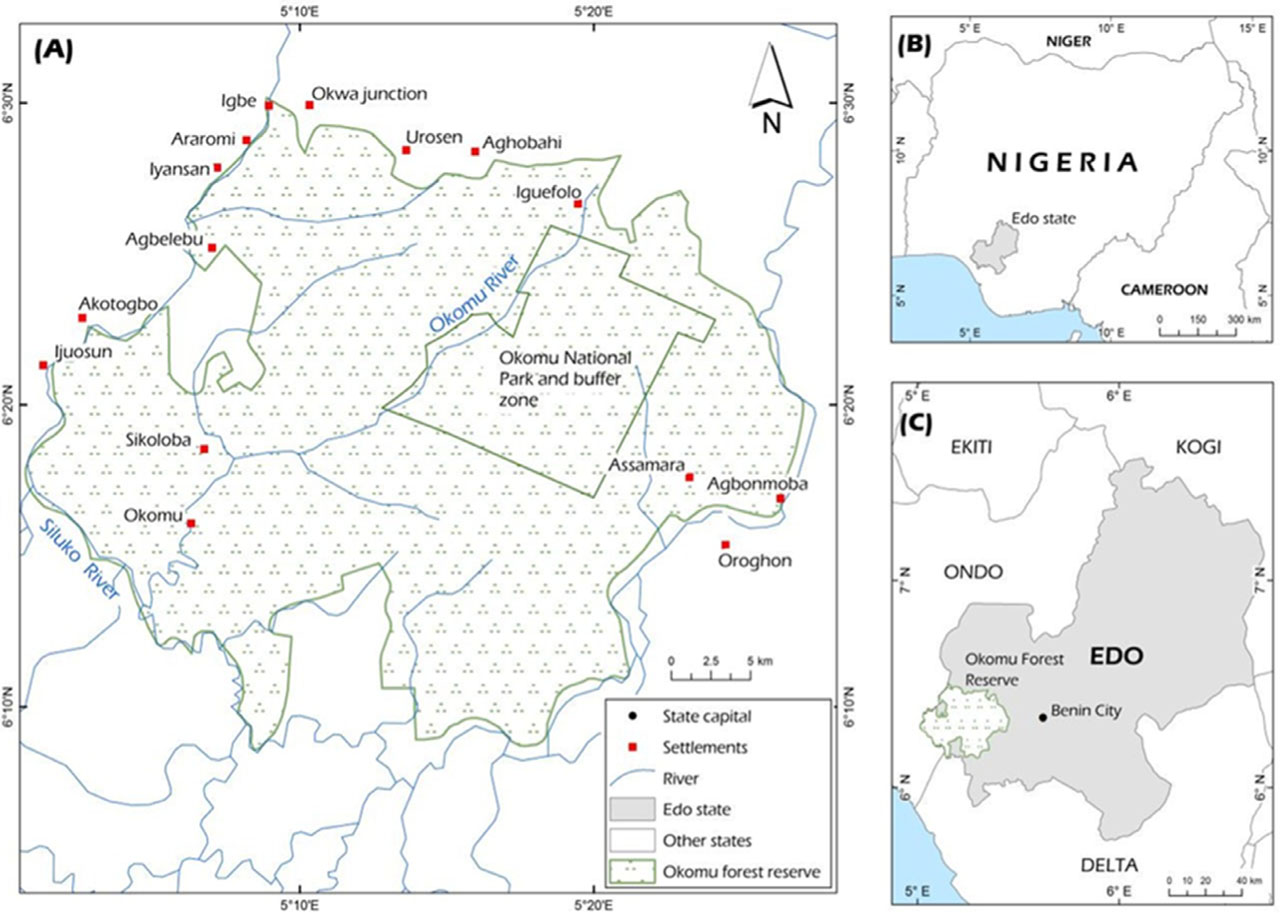
Fig. 1.
Map of study area showing the Okomu Forest Reserve (A) and insert maps Nigeria showing Edo state (B) and Edo state showing the Okomu Forest Reserve (C)
Source: Onojeghuo and Onojeghuo, 2015.
Sampling procedure, sample size and data collection
The Okomu Forest Reserve (OFR) is home to fifteen communities, whose main occupation is farming. It has a population of 60,000 peasant farmers. The Okomu Forest Reserve is one of the most important and critically threatened protected area in southern Nigeria, where hectares of the reserve have been converted to farms, fuel wood, timber harvesting and indiscriminate bush burning–all threatening the integrity and long-term viability of the forest reserve. Most of the people involved in the forest farming are indigenous, resource-poor households in immediate villages in the area. The surrounding villages are characterized by a shortage of cassava farmlands, degraded uplands with limited opportunity for expansion of farm size. To obtain a better insight into the multitudes of functions (goods and services) provided by Okomu Forest Reserve, a function-evaluation system developed by de Groot (1992) was used for the study.
Reconnaissance studies were conducted in the Okomu Forest Reserve (OFR) by three researchers (the 3 authors) to become acquainted with the study area and acquire first-hand information from the rural dwellers (rural survey). A multistage random sampling procedure was used in selecting settlements around the reserve. In the first stage, the settlements around the OFR were purposively selected due to the particular interest in the rural community and their response to climate change in the reserve. In the second stage, a random sampling technique was used to select five (5) of the surrounding settlements: Sikoloba, Iguefolo, Assamara, Okomu, and Agbonmoba. The sample selection was carried out with randomly sampling of 22 respondents from each selected settlement. Hence, a total of 110 (one hundred and ten) respondents were used for the study. Data for the study were collected from both primary sources. The primary source was a well-structured questionnaire with an interview. The secondary source was the use of relevant literature, research journals and other relevant publications. A structured questionnaire and in-depth interview were used to collect information on the functions of Okomu Forest Reserve (OFR) and from the dwellers of settlements around the OFR. The interviewers were the three researchers who conducted the interview aspect of data collection from the start to the end. The data collected were analysed using descriptive and inferential statistics. Descriptive statistics was used to analyse the objectives and inferential statistics was used to test the hypothesis which include: Hypothesis one, were tested with Chi square and Hypothesis two, were tested with Multivariate probit model.
The study tested the following null hypotheses:
HO1: Test of Association between respondents’ socio--economic characteristics and climate change adaptation outcomes.
HO2: Estimating Multivariate Probit of factors influencing climate change adaptation outcomes.
Ranking of mean scores
Respondents were asked to indicate their perception of the effect of climate change around the OFR using a 3-point scale of High, Moderate, and Low. The scores were for High = 3, Moderate = 2, and Low = 1, respectively. The benchmark for the 3-point scale was obtained thus: 3+2+1 = 6 divided by 3 equals 2.0. Hence, a cut-off mean point of ≥ 2.0 implies a high score for the effect of climate change, while a mean < 2.0 implies a low score for the effect of climate change, and the mean scores were ranked. This was used to operationalise how respondents perceive the effect of climate change around the OFR. Note: Any means score between 1.5 and 2.0 from the distribution for effect of climate change on livelihood activities around the OFR were ranked high.
The same applies to challenges confronting the adoption of climate change adaptation outcomes, CCAO in the Okomu Forest Reserve. Respondents were also asked to indicate their perception about barriers confronting the adoption of CCAO in the OFR using a 4-point scale of Considerable Extent, Moderate Extent, Slight Extent, and No Extent. The scores for Considerable Extent = 3, Moderate Extent = 3, Slight Extent = 1, and No Extent High = 0. Benchmark for the 4-point scale was obtained thus: 3+2+1+0 = 6 divided by 4 equals 1.5. Hence, a cutoff mean point of ≥ 1.5 implies a high score for adoption of CCAO, and a mean < 1.5 implies a low score for adoption of CCAO.
Model specification
Chi-square
where:χ2 – Chi-square
Σ – total
fo – frequencies of observed nominal variables, that is the selected flood management parameters.
fe – expected frequencies of occurrence determined from response categories.
Multivariate probit model
where:Yij(j = 1, 2, 3, 4 ……..) – represents the different adaptation approaches used by the ith farmers (i = 1, 2, 3, 4…..)
Xi – residents’ socio-economic characteristics and other factors which were used as independent variables include: (X1 – Sex; X2 – Age; X3 – Education; …)
X´ij – is a 1 × k vector of observed variables that affect dwellers’ choice decisions
Βj – is a k × 1 vector of unknown parameters
εij – is the unobserved error term.
RESULTS AND DISCUSSION
Socio-economic characteristics of residents around the Okomu Forest Reserve
Table 1 presents the socioeconomic characteristics of respondents. The majority of the residents (75.2%) are male, indicating that male gender predominantly drives decision-making regarding climate adaptation approaches to mitigate climate change’s impact on the livelihoods of OFR residents.
Table 1.
Socio-economic characteristics of residents around Okomu Forest Reserve
| Variables | Frequencies | Percentages |
|---|---|---|
| 1 | 2 | 3 |
| Gender | ||
| Male | 75 | 75.2 |
| Female | 24 | 24.2 |
| Age (years) | ||
| 20–30 | 27 | 27.3 |
| 31–40 | 23 | 23.2 |
| 41–50 | 7 | 7.1 |
| > 50 | 42 | 42.4 |
| Marital status | ||
| Single | 42 | 42.4 |
| Married | 40 | 40.4 |
| Divorced | 1 | 1.0 |
| Widowed | 16 | 16.2 |
| Religion | ||
| Christianity | 36 | 36.4 |
| Islamic | 22 | 22.2 |
| Traditional | 41 | 41.4 |
| Education level | ||
| Informal education | 50 | 50.5 |
| Primary education | 21 | 21.2 |
| Secondary education | 28 | 28.3 |
| Annual income (₦) | ||
| < 250 | 45 | 45.5 |
| 251–300 | 17 | 17.2 |
| 301–450 | 33 | 33.3 |
| > 451 | 4 | 4.0 |
| > 250,000 | 1 | 0.8 |
| Years of experience | ||
| 2–6 | 34 | 34.3 |
| 7–11 | 35 | 35.2 |
| 12–16 | 14 | 14.3 |
| > 17 | 16 | 16.2 |
| Household size (number of person) | ||
| 2–4 | 21 | 31.3 |
| 5–7 | 49 | 49.5 |
| > 8 | 29 | 29.2 |
| Membership of social organization | ||
| Yes | 94 | 94.9 |
| No | 5 | 5.1 |
| Occupation | ||
| Farming | 75 | 75.8 |
| Trading | 15 | 15.2 |
| Others | 9 | 9.0 |
| Farm size (acres) | ||
| 1–3 | 44 | 44.4 |
| 4–6 | 33 | 33.3 |
| 7–9 | 5 | 5.1 |
| 10–12 | 17 | 17.2 |
| Access to credit | ||
| Yes | 79 | 79.8 |
| No | 20 | 20.2 |
| Access to extension services | ||
| Yes | 89 | 89.9 |
| No | 10 | 10.1 |
This aligns with Asfaw and Admassie (2004), who found that male farmers are more inclined to take risks, adopt new technologies, and adjust farming practices. Age distribution shows that 42.4% of respondents are over 50, while 27.3% are between 20–30 years, with 23.2% between 31–40 years. This suggests that most respondents are within an active age range, equipped for the physical demands of climate adaptation activities. This is consistent with Oluwasusi and Tijani (2013), who reported similar age-related capabilities in agricultural work. Regarding marital status, 42.4% of respondents are single, 40.4% are married, and 16.2% are widowed. This distribution indicates variability in adaptation choices, as marital status influences responsibility and decision-making in climate adaptation, supporting Okoro et al. (2016). Religious affiliation is mixed, with 41.4% practising traditional beliefs, 36.4% Christians, and 22.2% Muslims. Education levels reveal that 50.5% have no formal education, 28.3% have secondary education, and 21.2% have primary education. This lower education level could affect adaptation choices, as education tends to increase the likelihood of adopting adaptive measures (Deressa et al., 2011). Annual income data show that 45.5% of respondents earn less than ₦250,000 (< $166.6) and 33.3% earn between ₦301,000–450,000 ($200.6–300), indicating generally low incomes. This aligns with findings of Ige et al. (2020) that arable crop farmers often incur additional costs in mitigating climate impacts. Furthermore, 35.2% of respondents have farmed for 7–11 years, and 34.3% for 2–6 years, indicating substantial agricultural experience, which can enhance adaptation responses (Nhemachema and Hassan, 2007). Household size varies, with 49.5% having 5–7 members and 29.2% with more than 8 members, potentially impacting climate adaptation choices, as larger households may support greater adaptability (Deressa et al., 2009). Additionally, 94.9% of respondents belong to social organizations, providing access to credit, inputs, and essential information on climate adaptation approaches, which aligns with Adeagbo et al. (2021). Farm size data indicate that 44.0% of residents have 1–3 acres, while 33.3% have 4–6 acres, suggesting that farm size may influence adaptation choices. Furthermore, approximately 80.0% of respondents have credit access, and 90.0% have access to extension services, enhancing their ability to receive guidance on climate adaptation.
This supports the findings of Oseni et al. (2014), who noted that regular contact with extension agents is valuable for informing farmers about climate adaptation.
Effects of climate change around the Okomu Forest Reserve
Table 2 presents the effects of climate change in the study area. The result shows that the reduction in crop yield and quantity on farmland (mean = 1.5) is ranked highest (1st), alongside changes in land suitability for agricultural production (mean = 1.5). These results suggest that increased atmospheric CO2 levels, higher temperatures, and shifts in precipitation and extreme events negatively impact crop production and the natural agricultural environment.
Table 2.
Effects of climate change in Okomu Forest Reserve
| Parameters | High | Moderate | Low | Mean scores | Rank |
|---|---|---|---|---|---|
| Reduction in yield and quantity of crops on farmland | 71(71.7) | 9(9.1) | 19(19.2) | 1.5 | 1st |
| Shortage of food supply | 0(0.0) | 75(75.8) | 24(24.2) | 0.6 | 8th |
| Pests and diseases outbreak | 30(30.3) | 28(28.3) | 41(41.4) | 0.8 | 6th |
| Threatening or reduction in forest products like Fuel-wood | 38(38.4) | 34(34.3) | 27(27.3) | 1.1 | 3rd |
| Reduction in animal yield | 19(19.2) | 61(61.6) | 19(19.2) | 1 | 4th |
| Death of animals | 35(35.4) | 19(19.2) | 45(45.5) | 0.8 | 6th |
| Erosion/flooding | 14(14.2) | 41(41.4) | 44(44.4) | 0.6 | 8th |
| Sudden rise in heavy rainfall | 34(34.3) | 55(55.6) | 10(10.1) | 1.2 | 2nd |
| Reduction of feed quality and fodder shortage | 35(35.4) | 35(35.4) | 29(29.2) | 1.1 | 3rd |
| Excessive moisture during harvesting due to excessive rainfall | 31(31.3) | 43(43.4) | 25(25.3) | 1.1 | 3rd |
| High intensity of temperature | 31(31.3) | 35(35.4) | 33(33.3) | 0.9 | 5th |
| Alteration in land suitability for agricultural production. | 56(56.6) | 38(38.4) | 5(5.1) | 1.5 | 1st |
| Increase competition for resources in terms of food and water | 34(34.3) | 51(51.5) | 14(14.2) | 1.2 | 2nd |
| Drought due to reduced rainfall increase vulnerability of residents to disease | 19(19.2) | 38(38.4) | 42(42.4) | 0.7 | 7th |
This aligns with Brussel (2009), who found that adverse climate conditions diminish crop yield, quantity and land suitability for farming. Additionally, competition for resources like food and water (mean = 1.2) ranked 2nd, implying that declining crop yields and altered precipitation patterns have limited resource availability, impacting food and water sufficiency. This supports the findings of Eneke and Achike (2008), who reported that climate change threatens food security in Africa, where population growth intensifies demand for food, water, and forage. The study also highlights increased heavy rainfall (mean = 1.2) as a significant impact, ranked 2nd, possibly due to global warming’s influence on rainfall patterns and increased flooding. This finding confirms that of Ozor and Cynthia (2010), who observed excessive rainfall in recent seasons. The reduction in forest products like fuelwood (mean = 1.1) ranked 3rd, suggesting a negative impact on essential forest resources for rural livelihoods. This is consistent with Onyekuru and Marchant (2014), who noted that climate change severely affects the resources upon which Nigeria’s rural communities rely for daily sustenance. Lastly, the reduction in feed quality and fodder shortages (mean = 1.1) ranked 3rd, while the decline in animal yield (mean = 1.0) ranked 4th. As animals rely on crops such as maize and soybeans, climate impacts on these crops lead to feed shortages, reducing livestock productivity. This finding aligns with those of Enete (2014), who found that climate change negatively affects livestock due to decreased availability of critical feed resources like maize, fodder, and hay.
Adaptation approaches utilized by rural dwellers of the Okomu Forest Reserve
Table 3 highlights the adaptation strategies used by rural dwellers in the Okomu Forest Reserve area. The results shows that approximately 71.0% of respondents reported using irrigation facilities, such as drip and surface irrigation, to address water shortages for crops, a finding that aligns with Osasogie and Omorogbe (2018), who noted that farmers in Benue State, Nigeria, employ irrigation to adapt to climate change. Additionally, 74.0% of respondents adopted minimum tillage practices, indicating they minimized soil disturbance to protect soil nutrients and prevent topsoil erosion. Planting cover crops was a strategy used by 64.6% of respondents, while 59.6% adjusted planting times and seasons, and 57.6% opted for drought-resistant crop varieties. These practices underscore the respondents’ focus on crop management to preserve soil moisture, nutrients, and protect against pests and diseases.
Table 3.
Adaptation approaches utilized by rural dwellers of Okomu Forest Reserve
| Parameters | Utilized | Not utilized | ||
|---|---|---|---|---|
| F | % | F | % | |
| Use of irrigation facilities (70.7%) | 70 | 70.7 | 29 | 29.3 |
| Planting of improved and resistant crop varieties | 37 | 37.4 | 62 | 62.6 |
| Use of mulching method and materials | 52 | 52.6 | 47 | 47.4 |
| Planting of cover crops | 64 | 64.6 | 35 | 35.4 |
| Use of indigenous knowledge-based conservation practices | 53 | 53.5 | 46 | 46.5 |
| Planting early maturing crops | 37 | 37.4 | 62 | 62.6 |
| Adjusting planting time and season | 59 | 59.6 | 40 | 40.4 |
| Planting drought resistant varieties | 57 | 57.6 | 42 | 42.4 |
| Renting-out or leasing land | 60 | 60.6 | 39 | 39.4 |
| Livelihood diversification | 65 | 65.7 | 16 | 16.8 |
| Practicing multiple cropping/mixed farming | 44 | 44.4 | 55 | 55.6 |
| Switching from livestock to crop | 65 | 65.7 | 34 | 34.3 |
| Rural-urban migration | 46 | 46.5 | 53 | 53.5 |
| Construction of drainage around homes/farms | 69 | 69.7 | 30 | 30.3 |
| Use of minimum tillage system | 73 | 73.7 | 26 | 26.3 |
| Carryout reforestation/afforestation | 39 | 39.4 | 60 | 60.6 |
This aligns with Bryan et al. (2013), who suggested that effective farm-level climate adaptation involves practices like adjusting planting dates, planting cover crops, and managing soil fertility. Furthermore, 69.7% of respondents constructed drainage around their homes and farms, helping to mitigate flood effects and prevent soil erosion and nutrient loss during heavy rainfall. This finding echoes the findings of Opaluwa et al. (2020), where 67.8% of respondents reported using drainage systems to manage flood impacts. Livelihood diversification was reported by 65.7% of respondents, with a similar percentage shifting from livestock to crop farming to diversify income sources in response to climate-related challenges. This concurs with Akinbami et al. (2016), who observed that farmers diversify their livelihoods to adapt to climate risks. Overall, these findings illustrate how rural dwellers in Okomu are employing diverse strategies to enhance their resilience to climate change.
Challenges confronting adoption of climate change adaptation outcomes in the Okomu Forest Reserve
Table 4 reveals key challenges affecting respondents’ climate adaptation strategies in the study area. The top-ranked barriers include inadequate information on climate change (mean = 1.9), poor agricultural programme and service delivery (mean = 1.9), distance to extension agents (mean = 1.9), insufficient government support (mean = 1.9), lack of access to weather forecasting (mean = 1.9), limited knowledge of adaptive measures (mean = 1.9), and reliance on shifting cultivation (mean = 1.9).
Table 4.
Challenges confronting adoption of climate change adaptation outcomes in Okomu Forest Reserve
| Parameters | Considerable extent | Moderate extent | Slight extent | No extent | Mean scores | Rank |
|---|---|---|---|---|---|---|
| Distance to extension agents | 46(46.5) | 18(18.2) | 15(15.2) | 20(20.2) | 1.9 | 1st |
| Inadequate government support | 19(19.2) | 57(57.6) | 18(18.2) | 5(5.0) | 1.9 | 1st |
| Inadequate access to weather forecasting information | 35(35.4) | 33(33.3) | 24(24.2) | 7(7.0) | 1.9 | 1st |
| Inadequate knowledge of coping or building resilience | 5(5.1) | 26(26.3) | 49(49.5) | 19(19.2) | 1.1 | 8th |
| High cost of irrigation facilities | 20(20.2) | 14(14.1) | 16(16.2) | 49(49.5) | 1.0 | 9th |
| Unpredictable weather condition | 26(26.3) | 34(34.3) | 20(20.2) | 19(19.2) | 1.6 | 4th |
| Land tenure issues | 19(19.1) | 25(25.3) | 29(29.3) | 26(26.3) | 1.3 | 6th |
| Shifting cultivation | 31(31.4) | 34(34.3) | 34(34.3) | 0(0.0) | 1.9 | 1st |
| Unavailable drought resistant varieties | 43(43.4) | 14(14.1) | 27(27.3) | 15(15.2) | 1.8 | 2nd |
| Poor agricultural program and service delivery | 36(36.4) | 35(35.4) | 19(19.2) | 9(9.0) | 1.9 | 1st |
| High cost of fertilizer and other farm inputs | 15(15.2) | 41(41.4) | 24(24.2) | 19(19.2) | 1.3 | 6th |
| Poor financing of adaptation strategies | 23(23.2) | 25(25.3) | 27(27.3) | 24(24.2) | 1.2 | 7th |
| High cost of improved varieties | 30(30.3) | 36(36.4) | 23(23.2) | 10(10.1) | 1.8 | 2nd |
| Poor households income | 12(12.1) | 39(39.4) | 39(39.4) | 9(9.1) | 1.5 | 5th |
| Lack of access to improve crop varieties | 32(32.3) | 29(29.3) | 18(18.2) | 20(20.2) | 1.7 | 3rd |
| Inadequate information on climate change | 29(29.3) | 45(45.5) | 15(15.1) | 10(10.1) | 1.9 | 1st |
| Limited knowledge on water management method | 19(19.2) | 51(51.5) | 10(10.1) | 19(19.2) | 1.7 | 3rd |
| Inadequate knowledge on adaptive measures | 34(34.3) | 31(31.3) | 25(25.3) | 9(9.1) | 1.9 | 1st |
| Bush burning | 20(20.2) | 51(51.5) | 5(5.1) | 23(23.2) | 1.6 | 4th |
These findings suggest that most respondents lack essential climate information, likely due to limited dissemination by extension agents, which is further complicated by the distance to these services. Inadequate government support, particularly financial aid, and limited access to reliable weather forecasts–potentially due to gaps in meteorological services–are also significant factors. Additionally, the unavailability of drought-resistant crop varieties (mean = 1.8) and the high cost of improved seeds (mean = 1.8) are ranked second among the challenges. This aligns with the findings of Fagariba et al. (2018), who noted how similar constraints were also hindering farmers’ adaptive efforts on food production activities in Ghana’s Northern Region.
Hypothesis testing
Ho1: Test of association between respondents’ socioeconomic characteristics and climate change adaptation outcomes
The chi-square test results reveal a significant relationship between irrigation as a climate change adaptation outcomes (CCAO) and several socioeconomic factors, including religion (χ2 = 8.39), education (χ2 = 7.75), annual income (χ2 = 12.52), occupation (χ2 = 13.13), farm size (χ2 = 22.78), access to credit (χ2 = 5.19), and access to extension services (χ2 = 26.85) at a significance level of p < 0.05. These results suggest that religion may contribute to awareness about irrigation as a climate adaptation approach. Education improves respondents’ knowledge about irrigation methods, while farm size influences the perceived necessity for irrigation based on production needs. Access to credit and extension services further supports accessibility to irrigation facilities.
Overall, socioeconomic characteristics play a crucial role in determining adaptation choices, indicating that the socioeconomic status of residents enhances CCAO and fosters a sustainable environment for productivity in the study area. These findings align with studies by Obayelu et al. (2014) and Alhassan (2020), which identified factors like education, farming experience, household size, credit access, farm income, non-farm income, and extension agent interactions as influential in climate adaptation choices. Furthermore, the results indicate a significant relationship between planting cover crops as a CCAO and factors like marital status (χ2 = 23.33), religion (χ2 = 10.39), education (χ2 = 6.38), annual income (χ2 = 11.75), years of experience (χ2 = 45.82), farm size (χ2 = 27.11), and access to extension services (χ2 = 20.34). Marital status, educational background, and farm size are influential, suggesting that cover crop planting is more prevalent on larger farmlands and among more educated individuals. This finding is consistent with Marie et al. (2020) and Esfandiari et al. (2020), who reported that education and farm size significantly impact farmers’ decisions on adaptive strategies. Higher income levels facilitate the adoption of cover crops due to the financial investment required, while access to extension services aids decision-making through information on cover crop benefits. For livelihood diversification, significant relationships were observed with occupation (χ2 = 11.84), farm size (χ2 = 14.87), access to credit (χ2 = 47.92), and access to extension services (χ2 = 21.27). These results indicate that residents’ occupational backgrounds and access to credit influence their decision to diversify their livelihoods in response to climate change challenges. Access to credit is especially critical, as it supports diversification by offsetting climate-related impacts on food production. Additionally, access to extension services supports residents with information and resources essential for adapting to climate change. These findings echo those of Mwinkom et al. (2021), who identified factors like farm size, occupation, household size, access to credit, education level, and climate awareness from extension services as key influencers in households’ climate adaptation strategies. This suggests that socioeconomic and resource accessibility factors play a pivotal role in shaping adaptation outcomes, further underlining the need for targeted support systems to bolster climate resilience among rural residents.
Table 5.
Chi square test of association between respondents’ socio-economic characteristics and climate change approaches outcomes (CCAO)
| Socio economic characteristics | Use of irrigation | Planting cover crops | Adjusting planting date | Livelihood diversification | Switching livestock to crop | Use of minimum tillage system |
|---|---|---|---|---|---|---|
| Sex | 0.25(0.62) | 1.52(0.47) | 0.02(0.89) | 0.75(0.39) | 0.75(0.39) | 1.51(0.47) |
| Age | 5.27(0.15) | 5.37(0.49) | 0.43(0.94) | 1.32(0.72) | 1.32(0.72) | 3.03(0.81) |
| Marital status | 2.98(0.39) | 23.33(0.001)* | 0.92(0.82) | 2.62(0.46) | 2.61(0.45) | 1.04(0.98) |
| Religion | 8.39(0.02)* | 10.39(0.03)* | 3.84(0.15) | 1.67(0.43) | 1.67(0.43) | 5.62(0.23) |
| Education | 7.95(0.02)* | 6.83(0.15)* | 0.36(0.84) | 1.80(0.41) | 1.80(0.41) | 3.66(0.45) |
| Annual income | 12.52(0.01)* | 11.75(0.07)* | 1.15(0.77) | 1.47(0.69) | 1.47(0.69) | 4.53(0.61) |
| Years of experience | 10.25(0.85) | 45.82(0.05)* | 14.44(0.57) | 14.34(0.57) | 14.34(0.57) | 20.41(0.9) |
| Household size | 12.50(0.13)* | 8.44(0.94) | 7.82(0.45) | 2.83(0.95) | 2.83(0–95) | 25.13(0.0) |
| Members of social organization | 0.22(0.64) | 0.99(0.61) | 0.91(0.34) | 0.48(0.49) | 0.48(0.49) | 0.40(0.82) |
| Occupation | 13.13(.001)* | 8.34(0.08) | 23.47(0.00)* | 11.84(0.003)* | 11.84(.003)* | 1.28(.02)* |
| Farm size | 22.78(0.00)* | 27.11(0.00)* | 9.41(0.02)* | 14.87(0.002)* | 14.87(0.02)* | 81.2(.00)* |
| Access to credit | 5.19(0.02)* | 3.17(0.21) | 0.96(0.34) | 47.92(0.00)* | 47.92(0.00)* | 8.93(.01)* |
| Access to extension services | 26.85(0.00)* | 20.34(0.00)* | 16.41(0.00)* | 21.27(0.00)* | 21.27(0.00)* | 3.96(0.14) |
Ho2: Estimating multivariate probit of factors influencing Climate Change Adaptation Outcomes (CCAO)
Hypothesis two reveals that both occupation and access to extension services significantly influence the adoption of irrigation practices (p < 0.05). This suggests that residents’ occupations play a role in their likelihood to implement irrigation, while access to extension services provides essential information about various irrigation methods, aiding decision-making among residents in the study area. This finding aligns with Ibrahim et al. (2011), who noted that extension services positively impact arable crop farmers’ selection of effective irrigation methods in Ogun State, Nigeria. Additionally, Table 6 indicates that access to extension services is significantly associated with the planting of cover crops (p < 0.05).
Table 6.
Multivariate probit of factors influencing choice of climate change approaches
| Variables | Use of irrigation | Planting cover crops | Adjusting planting date | Livelihood diversification | Switching livestock to crop | Use of minimum tillage system | ||||||
|---|---|---|---|---|---|---|---|---|---|---|---|---|
| β | S.E. | β | S.E. | β | S.E. | β | S.E. | β | S.E. | β | S.E. | |
| Sex | –0.064 | 0.221 | 0.369 | 0.306 | –0.088 | 0.256 | 0.283 | 0.197 | 0.283 | 0.197 | 0.219 | 0.651 |
| Age | –0.008 | 0.084 | 0.135 | 0.117 | –0.017 | 0.098 | 0.076 | 0.075 | 0.76 | 0.075 | –0.038 | 0.141 |
| Annual income | 0.069 | 0.056 | 0.032 | 0.078 | –0.055 | 0.065 | 0.038 | 0.050 | 0.038 | 0.050 | 0.041 | 0.094 |
| Years of experience | 0.007 | 0.094 | 0.016 | 0.010 | 0.003 | 0.009 | –0.017 | 0.007 | –0.017* | 0.007 | –0.005 | 0.012 |
| Occupation | 0.08* | 0.032 | –0.025 | 0.044 | –0.098 | 0.037 | 0.063* | 0.028 | 0.063* | 0.028 | 0.077 | 0.053 |
| Farm size | 0.054 | 0.041 | –0.020 | 0.057 | 0.029 | 0.048 | 0.049 | 0.037 | 0.049 | 0.037 | 0.33* | 0.069 |
| Access to credit | 0.085 | 0.151 | 0.261 | 0.210 | –0.658* | 0.176 | 0.943* | 0.135 | 0.943* | 0.135 | –0.276 | 0.254 |
| Access to extension services | 0.63* | 0.201 | 0.940* | 0.027 | 1.318* | 0.234 | –0.200 | 0.180 | –0.200 | 0.180 | –0.199 | 0.033 |
This suggests that available technologies through extension services can enhance farmers’ adaptive capacities for climate resilience, echoing Ibrahim et al. (2011), who observed that access to extension services positively influenced farmers’ choices of effective soil conservation over non-adaptive practices in Ogun State. Furthermore, Table 6 highlights that occupation and access to credit significantly influence livestock diversification (p < 0.05). This implies that residents’ occupational backgrounds, which impact their income levels, and access to credit, which alleviates financial burdens, are crucial in supporting livestock diversification. These findings are consistent with those of Ibrahim et al. (2011), who reported that access to credit increases farmers’ likelihood of selecting sustainable soil conservation techniques, underscoring the role of financial resources in climate adaptation decisions.
CONCLUSION
Based on the findings from this study, it was evident that males engage more in climate change adaptation strategies than females in the study area. A characteristic factor was a young demographic with low-income levels, many of whom were members of cooperative societies. The study further revealed that residents were significantly affected by climate change, experiencing issues such as reduced crop yields and altered land suitability for agricultural production. Additionally, residents implemented various adaptation strategies to manage climate change impacts in the Okomu Forest Reserve (OFR). These strategies included utilizing irrigation facilities, transitioning from livestock to crop farming, and constructing drainage systems around their homes and farms. However, they faced several challenges in executing these adaptation approaches, including distance to extension agents, inadequate government support, shifting cultivation practices, and limited knowledge of water management techniques in the region. To address these challenges, the study recommends that the government enhance the capacity of residents (farmers) through educational campaigns, training, and workshops focused on improved production methods. These initiatives should cover climate change and variability, its effects, and potential coping strategies. Furthermore, the government should strengthen linkages between residents and extension agents to improve the distribution of inputs to farmers. This can be achieved through mass media and other communication methods, such as improved transportation, to mitigate the challenges posed by distance to extension services. Lastly, the government and relevant stakeholders should provide support to farmers, either through financial assistance or by supplying essential materials, equipment, and knowledge necessary for effectively mitigating climate change impacts.