
INTRODUCTION
South Africa’s fresh produce market, a vital component of the nation’s agricultural sector, is currently a subject of regulatory scrutiny due to concerns over market concentration and competition dynamics (Ginindza, 2025). This sector plays an essential role in economic development, food security, and employment, with an estimated value of over R53 billion annually (Opperman, 2024). A recent inquiry by the Competition Commission (2025) identified several issues within the fresh produce value chain, including limited competition, high barriers to entry, and price mark-ups (Dludla, 2024). It found that certain practices by retailers and market agents have led to sustained high mark-ups, indicating a lack of competition (Cornins, 2024). Additionally, the limited integration of historically disadvantaged small-to-medium enterprise (SME) farmers into the various retailers’ supply chains was noted as a significant concern (Dludla, 2024).
Within this broader market, the tomato industry plays a particularly significant role. South Africa’s most important vegetable crop is potatoes, accounting for 44.1% of the market. This is followed by tomatoes at 14.8%, one of the staple vegetables in South African households, then onions, peppers and carrots, at 11.4%, 4.6% and 4.4%, respectively (Majola, 2025). The tomato market is notably dominated by a few large market agents (Competition Commission, 2025). For instance, in the Johannesburg fresh produce market, the top four top market agencies accounted for approximately 90% of the total value of goods sold in 2022. Similarly, in the Durban fresh produce market, the top two agencies accounted for about 82% of the total value of goods sold (HortiDaily, 2024). Such concentration levels suggest limited competition, which can lead to price manipulation and reduced market access for smaller players.
Despite its economic importance, there is limited empirical evidence on vertical and spatial price transmission within South African tomato supply chains. A study by Baiyegunhi et al. (2018) found strong cointegration between the Durban and Johannesburg fresh produce markets and reported that price shocks are transmitted within approximately one month (Baiyegunhi et al., 2018). Similarly, Mandizvidza (2018) analysed the Limpopo tomato value chain and observed a symmetrical price adjustment between farm and wholesale levels, but asymmetry between farm and retail (Mandizvidza, 2018).
While previous studies provide useful insight into tomato price transmission in selected regions, the literature remains limited in terms of inter-market dynamics across multiple urban centres. To address this gap, the objective of this study is to evaluate the price transmission of tomato prices among five major fresh produce markets–Johannesburg, Tshwane, Bloemfontein, Cape Town, and Durban. This will be accomplished by an analysis of monthly price movements in these five key markets, examining how past prices in one market influence current prices as well as those in other markets. Additionally, the study will assess how price shocks in one market impact on tomato prices in the others over time.
STUDY CONTEXT
This section reviews current research on global and South African tomato production and consumption trends, as well as price transmission in the South African tomato market.
Global Tomato Consumption
Tomatoes are among the most widely consumed vegetables globally, forming an essential component of both fresh diets and processed food industries. Their versatility in culinary applications and growing demand for healthy diets have contributed to their sustained global consumption. The global tomato consumption reached approximately 158 million metric tons (MT) in 2021 and is projected to increase to about 161 million MT by 2026, reflecting a modest but stable growth trend (ReportLinker. 2024). This steady increase suggests that tomatoes remain a staple commodity in global food systems, despite changing dietary patterns. Table 1 shows the top 10 global leading tomato producers. The distribution of tomato production was dominated by China, which contributed approximately 68 241 811 million metric tons, representing about 36.7% of world tomato production. This is followed by India at 20 694 000 million metric tons (11.1%), Turkey at 13 000 000 million metric tons (7.0%), United States at 10 199 753 million metric tons (5.5%), Egypt at 6 275 444 million metric tons (3.4%), Italy at 6 136 380 million metric tons (3.3%), Mexico at 4 207 889 million metric tons (2.3%), Brazil at 3 809 986 million metric tons (2.0%), Nigeria at 3 684 566 million metric tons (2.0%) and Spain at 3 651 940 million metric tons (2.0%).
Table 1.
Top 10 global leading tomato producers
| Rank | Country | Production (Tonnes) | % of global tomato production |
|---|---|---|---|
| 1 | China | 68 241 811 | 36.7 |
| 2 | India | 20 694 000 | 11.1 |
| 3 | Turkey | 13 000 000 | 7.0 |
| 4 | United States | 10 199 753 | 5.5 |
| 5 | Egypt | 6 275 444 | 3.4 |
| 6 | Italy | 6 136 380 | 3.3 |
| 7 | Mexico | 4 207 889 | 2.3 |
| 8 | Brazil | 3 809 986 | 2.0 |
| 9 | Nigeria | 3 684 566 | 2.0 |
| 10 | Spain | 3 651 940 | 2.0 |
Asia accounts for 62.62% of global tomato production, followed by America, Europe, Africa, and Oceania at 13.08%, 12.20%, 11.89% and 0.18%, respectively (Table 2). This indicates that global tomato production is heavily skewed towards Asia, reinforcing the region’s central role in both production and consumption dynamics. The regional distribution of production has important implications for global market dynamics. For instance, high production and consumption within the same regions suggest relatively limited reliance on international trade compared to other commodities. However, emerging markets, particularly in Africa, are experiencing gradual increases in consumption driven by population growth, urbanisation, and changing dietary preferences. For example, tomato consumption in Africa reached approximately 22 million tons in recent years and is expected to continue growing steadily in the coming decade (IndexBox, 2025).
South Africa’s tomato consumption
Tomato production in South Africa reached approximately 530,843 tons in 2022 (NAMC, 2024). Between the period 2013–2022, the tomato production of South Africa experienced fluctuations; it experienced an increase of 30.93% from 2014 to 2017 and a significant decrease in production of 13.53% from 2018 to 2022 (NAMC, 2024). This decline has been influenced by factors such as high production costs, unfavourable weather conditions, and pests and diseases. South Africa planned to harvest 160,000 tons of tomatoes in 2024 for processing (WPTC, 2024). However, adverse winter conditions, with six days of persistent “black frost” in Northern Limpopo, led to a yield loss, reducing the projected harvest to 140,000 tonnes. These fluctuations underscore the sensitivity of tomato production to environmental conditions and input constraints.
Despite these challenges, the tomato industry remains a key commodity within South Africa’s agricultural economy. The industry employs approximately 25,000 to 28,000 people annually, with employment levels increasing during peak production periods (NAMC, 2024). This highlights the sector’s contribution not only to food supply but also to rural livelihoods and employment creation. In terms of market structure, the majority of tomatoes produced in South Africa are consumed domestically, largely due to their perishable nature. Between 83% and 87% of the annual crop is distributed through national and regional fresh produce markets, with just a smaller portion supplied directly to supermarket chains (PHIP, 2024). This indicates the central role of fresh produce markets in price formation and distribution within the tomato value chain.
Price transmission in South African tomato markets
A study by Baiyegunhi et al. (2018) examined the Durban-Johannesburg tomato market for the period of 2008–2012. The findings revealed a strong long-term relationship between prices, with price shocks adjusting back to equilibrium within approximately one month, with the Durban market adjusting faster after a shock than Johannesburg. Mandizvidza’s 2018 study on the Limpopo province tomato chain analysed farm-gate-to-wholesale and retail price links. The study found a symmetric price transmission between farm-gate and wholesale, but asymmetry between farm-gate and retail levels, wherein upward price shocks transmit more strongly (Mandizvidza, 2018). This therefore highlights the presence of markup and margin issues.
Shrestha et al. (2014) noted that poor marketing infrastructure and lack of market integration hinder cointegration in fresh produce chains, reinforcing the importance of infrastructure improvements in facilitating competitive pricing. Alemu and Ogundeji (2010) analysed price transmission in South African food markets. They found asymmetric transmission between producer and retailer prices, where retailers adjust quickly to margin increases but slowly to decreases, indicating potential market power and anticompetitive behaviour (Alemu and Ogundeji, 2010). These two similar studies noted a price transmission on data ranging from 2000–2012, making this study relevant, as it will give an up-to-date analysis from 2019–2024. Previous studies examining tomato price transmission in South Africa largely focused on one or two regional markets. No study has attempted to investigate the dynamics across all five major national fresh produce markets. This constitutes a knowledge gap that the present study aims to fill.
MATERIALS AND METHODS
Dataset
The monthly time series data ranging from January 2019 to December 2024 was used in this study. The data was sourced from the Directorate: Economic and Statistics Services at the Department of Agriculture. The focus was on five major fresh produce markets in South Africa, including Johannesburg, Tshwane, Bloemfontein, Cape Town, and Durban. The study uses the average monthly tomato prices per ton from the five fresh produce markets to analyse price transmission. Stata SE 15 statistical tool was used to analyse the empirical results for this study.
Empirical model
To analyse the price transmission of tomato on all five fresh produce markets in South Africa, the study employed a Vector Autoregressive Model. The VAR Model’s ability to capture dynamic interrelationships among multiple time series variables simultaneously made it especially suitable for this study. It allows each market to be modelled as a function of its own past values and the past values of all other markets, which therefore facilitates a comprehensive analysis of price interactions and transmission between markets. Three separate procedures were performed: (i) evaluating the stationarity of tomato prices in all five markets, (ii) examining how past prices in one market influence its own current prices as well as those in other markets, (iii) assessing the impact of price shocks in one market on tomato prices in the other markets over time.
Unit root testing
The Augmented Dickey-Fulker (ADF) test, originally developed by Dickey and Fuller (1981), is used to determine whether a time series contains unit roots, which would indicate non-stationarity. In this study, the ADF was used to assess the stationarity of the data series. The null hypothesis of a unit root (i.e., time series data is non-stationary) was tested against the alternative hypothesis that data series are stationary. The ADF test builds on the Dickey-Fuller (DF) test, which checks for the null hypothesis that δ > 0 against the alternative hypothesis that δ > 0 in the following equation:
where:Δ – is the first difference operator
Yt – is time series data and
εt – is a random error term.
If δ is found to be zero, the conclusion is that the time series Yt is non-stationary. If δ is negative, Yt is stationary (Dickey and Fuller, 1979).
The DF test assumes that the error terms are independently and identically distributed. However, this is an assumption that is not frequently satisfied in economic time series data. Therefore, it is a limited or low power test (Gujarati and Porter, 2009). The ADF test adjusts the DF test to account for possible autocorrelation in the error terms by adding the lagged difference terms of the regression, as shown in equation (2)
where:Δ – is the first difference operator
Yt – is time series data
α – is the intercept
ΔYt–1 – are the lagged difference terms of the time series data
εt – is a random error term.
Cointegration test
The Johansen cointegration test was used to test for the existence of a long-term relationship among the variables. Two likelihood ratio tests were employed in the study, namely, the trace test and the maximum eigenvalue test. The equations of the two tests were expressed as follow by Johansen (1988):
where:T – is the sample size
λi – is the largest canonical correlation
r – is the number of cointegration vectors.
The null hypothesis is that there is no cointegration among the variables. Therefore, the null hypothesis is rejected when either the maximum eigenvalue statistic or trace statistic is greater than the critical value.
Vector Autoregressive Model
When data is stationary in both levels and a multivariate time series analysis is being conducted, models such as Vector autoregression, Least Squares, maximum likelihood, or the Bayes method must be considered (Ambya et al., 2022). The Vector Autoregression model was therefore used in this study. Vector Autoregressive (VAR), developed by Holtz-Eakin et al. (1988), is a statistical method used to analyse the relationship between several influencing variables. VAR processes are popular in economics and other sciences because they are flexible and simple models for multivariate time series data (Love and Ariss, 2014).
In econometrics they became standard tools after researchers questioned the specification and identification of classical simultaneous equations models and advocated VAR models as alternatives (Gupta, 2021). The VAR model combines several models of autoregression (AR), where these models form a vector between the variables affecting each other (Gupta, 2021). The VAR model is also a quantitative forecasting approach usually applied to multivariate time series data. This model describes the relationship between the values of a particular variable with its own lagged values and its association with past values of other variables. VAR is a simple regression with the equation:
where:Yt – is an endogenous variable
Γ1 – matrix of coefficients for the lagged values
Xt–1 – lagged endogenous variables
εt – error term.
The lag length selection criteria
For VAR analysis, selecting the length lag is essential for determining the lag length for the VAR(p) model. This is typically done using the optimum model selection criteria. Determining the optimal lag order of the VAR model can eliminate the autocorrelation existing in the residual error and improve the effectiveness of the model parameter estimation (Lütkepohl, 2013). In line with Akaike (1969), we used the lag length selection criteria which involve the Akaike Information Criterion (AIC), Schwartz-Bayesian (SBIC) criterion, Hannan-Quinn (HQIC) criteria, Likelihood Ratio, Sequential modified (LR) criteria, and Final Prediction Error (FPE).
Impulse Response Function
The VAR analysis often leads to the estimation of impulse response functions (IRFs), which is the fundamental parts of the VAR method (Alkunain et al., 2024). IRFs are computed to produce a better picture of the short-run dynamics between the variables (Lütkepohl, 2018). IRF is used in the current study to examine how a price shock in one market influences the price in another market. These functions measure the marginal responses of the endogenous variables of the system to an impulse in one of them (Ahoba and Gaspart, 2019). For a stationary VAR (p) process yt, the impulse response is basically derived from the moving average representation:
where:Φ0 = Ik,k – being the number of endogenous variables
p – the number of lags of the VAR process.
RESULTS AND DISCUSSION
This section presents the descriptive statistics and empirical results of the price transmission analysis among five major South African fresh produce markets.
Descriptive statistics
Table 3 presents the descriptive statistics of the price per ton of tomatoes from five major fresh produce markets in South Africa.
Table 3.
Descriptive statistics of the five fresh produce markets on their price per ton for tomatoes in 2019–2024
| Variables | Observations | Mean | Std. Dev | Min | Max |
|---|---|---|---|---|---|
| Johannesburg | 72 | 9 226.68 | 3 044.77 | 4 525.69 | 19 810.40 |
| Tshwane | 72 | 9 143.89 | 2 806.65 | 4 707.61 | 18 138.69 |
| Bloemfontein | 72 | 10 178.21 | 3 355.72 | 4 796.30 | 23 387.15 |
| Cape Town | 72 | 9 227.30 | 2 788.07 | 4 400.00 | 16 910.14 |
| Durban | 72 | 9 088.53 | 2 891.60 | 4 500.00 | 17 620.26 |
Bloemfontein has the highest average price per ton (R10178.21), with the second highest average price per ton being Johannesburg at R9226.68. Bloemfontein also has the widest spread (min–max) at R18 590.85, therefore showing notable volatility. This may stem from smaller scale and lower liquidity, which can increase price shocks. These results are in line with those of Chikazunga et al. (2008), who highlighted how smaller markets often face greater volatility due to few agents/buyers. Figure 1 illustrates how the tomato prices of all the five fresh produce markets evolve over time.
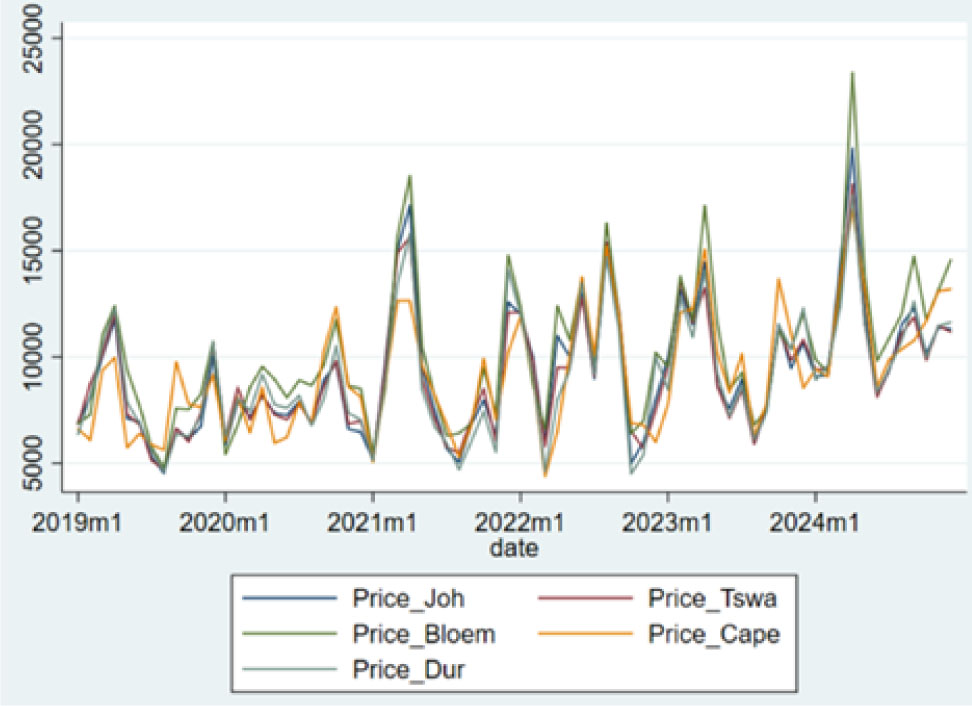
Fig. 1.
Tomato prices of five fresh produce markets in 2019–2024
Source: own elaboration.
Augmented Dickey-Fuller (ADF) test results
Table 4 represents the results of the unit root test, indicating whether the variables are stationary or non-stationary.
Table 4.
Augmented Dickey-Fuller test
| Variable | Level form | First difference | ||
|---|---|---|---|---|
| Test statistic | 5% Critical value | Test statistic | 5% Critical value | |
| Johannesburg | −4.875*** | −2.913 | −9.356*** | −2.914 |
| Tshwane | −4.932*** | −2.913 | −9.378*** | −2.913 |
| Bloemfontein | −5.140*** | −2.913 | −9.837*** | −2.913 |
| Cape Town | −4.688*** | −2.913 | −9.122*** | −2.915 |
| Durban | −5.313*** | −2.913 | −9.984*** | −2.917 |
The results show that all market price variables (Johannesburg, Tshwane, Bloemfontein, Cape Town, and Durban) are statistically significant at the 1% level, both in terms of levels and first differences. This implies that the null hypothesis could not be accepted, as non-stationarity occurs at >5%. The strong rejection of the unit root hypothesis across all markets highlights the stability of price dynamics within the selected fresh produce markets. This finding implies that price shocks in these markets are not persistent over time, but rather tend to revert to equilibrium levels.
VAR Lag length
Table 5 represents the results of the suitable VAR lag that was selected.
Table 5.
VAR lag length results
| Lag | p | FPE | AIC | HQIC | SBIC |
|---|---|---|---|---|---|
| 0 | 1.5e+30 | 83.648 | 83.713 | 83.812* | |
| 1 | 0.000 | 8.7e+29* | 83.128* | 83.516* | 84.108 |
| 2 | 0.122 | 1.1e+30 | 83.373 | 84.084 | 85.168 |
| 3 | 0.014 | 1.3e30 | 83.476 | 84.510 | 86.087 |
| 4 | 0.000 | 9.8e+29 | 83.147 | 84.505 | 86.574 |
The results in Table 5 reveal that lag 1 was significant, with the lowest AIC (83.128), HQIC (83.516), and FPE (8.7e+29). Lag 0 was not significant but has the lowest SBIC (83.832) with lag 4 being significant with a high AIC (83.147), HQIC (84.505), FPE(9.8e+29), and SBIC (86.574). Liew (2004) emphasizes that AIC and FRE perform best for identifying the true lag order, minimizing underestimation while maintaining consistency. Therefore, lag 1 was considered. The selection of lag 1 has meaningful economic implications. It suggests that price adjustments across markets occur relatively quickly, with current prices being influenced primarily by prices from the immediately preceding period. This reflects short-term transmission mechanisms and supports the notion of rapid information diffusion across South Africa’s fresh produce markets. Appropriate lag selection is crucial because the Johansen cointegration test is sensitive to lag specification; incorrect lag choice may lead to biased or misleading inference (Baek and Koo, 2008).
Johansen cointegration test results
Table 6 presents the results of the cointegration test to check cointegration among variables.
Table 6.
Johansen cointegration results
| Maximum rank | Trace Test | Maximum Eigenvalue Test | |||
|---|---|---|---|---|---|
| Eigenvalue | Trace statistics | 5% critical value | Maximum Eigenvalue Statistics | 5% Critical Value | |
| 0 | 185.129** | 68.52 | 60.540** | 33.46 | |
| 1 | 0.574 | 124.589** | 47.21 | 45.2556** | 27.07 |
| 2 | 0.471 | 79.333** | 29.68 | 29.921** | 20.97 |
| 3 | 0.344 | 49.412** | 15.41 | 26.495** | 14.07 |
| 4 | 0.311 | 22.918** | 3.76 | 22.918** | 3.76 |
| 5 | 0.276 | ||||
The trace test indicates five cointegrating relationships at the 5% level. The maximum eigenvalue test also indicates five cointegrating relationships at the 5% level. Both the trace and max-eigenvalue test reject the null hypothesis that there is no cointegration amongst the variables. The existence of multiple cointegrating relationships implies that the fresh produce markets are highly integrated and share common long-run equilibrium price dynamics. This suggests that prices in one market are not determined in isolation but are linked to prices in other markets over time. Such integration is indicative of efficient spatial arbitrage, where price differences across markets are corrected through trade and market interactions.
Vector Autoregression Model (VAR)
Table 7 presents the results of the vector autoregression model, showing how the previous tomato price of a market influences its own current price and that of other markets.
Table 7.
Results of the Vector Autoregression Model
| Regressors | JHB average tomato price | Tshwane average tomato price | Bloem average tomato price | CPT average tomato price | DBN average tomato price |
|---|---|---|---|---|---|
| JHB average tomato price (−1) | (1.868) [0.012]** | (1.540) [0.024]** | (2.200) [0.006]*** | (1.329) [0.051]* | (1.549) [0.034]** |
| JHB average tomato price (−2) | (1.115) [0.204] | (0.931) [0.253] | (1.065) [0.267] | (1.193) [0.138] | (0.581) [0.494] |
| Tshwane average tomato price (−1) | (−0.265) [0.739] | (−0119) [0.871] | (−0.680) {[0.431] | −0.494 [0.499] | (−0.464) [0.553] |
| Tshwane average tomato price (−2) | (−0.254) {[0.786] | (−0.325) [0.709] | (0.061) [0.952] | (−0.643) [0.454] | (0.088) [0.923] |
| Bloem average tomato price (−1) | (−0.760) [0.028]** | (−0.791) [0.013]** | (−0.640) [0.089]* | (−0.422) [0.184] | (−0.688) [0.044]** |
| Bloem average tomato price (−2) | (−0.749) [0.067]* | (−0.658) [0.083]* | (−0.806) [0.071]* | (−0.319) [0.395] | (−0.499) [0.206] |
| CPT average tomato price (−1) | −(0.124) [0.591] | (0.082) [0.701] | (0.135) [0.591] | (0.351) [0.097]* | (0.055) [0.807] |
| CPT average tomato price (−2) | (−0.243) [0.376] | (−0.189) [0.458] | (−0.09) [0.762] | (−0.110) [0.662] | (−0.156) [0.556] |
| DBN average tomato price (−1) | (−0.270) [0.545] | (0.099) [0.810] | (−0.493) [0.308] | (−0.274) [0.502] | (0.010) [0.981] |
| DBN average tomato price (−2) | (0.201) [0.690] | (0.312) [0.521] | (−0.063) [0.913] | (−0.058) [0.904] | (0.052) [0.918] |
The VAR results revealed that the Johannesburg market’s average tomato price per ton from the previous month positively and significantly influences the current month’s average tomato price in its own market (Coef = 1.868, p = 0.012), as well as in Tshwane (Coef = 1.540, p = 0.024), Bloemfontein (Coef = 2.200, p = 0.006), Cape Town (Coef = 1.329, p = 0.051), and Durban (Coef = 1.549, p = 0.034) market. This means that a 1-unit increase in Johannesburg’s tomato price in the previous month led to increases across all five markets, namely, Johannesburg, Tshwane, Bloemfontein, Cape Town and Durban market at 1.868, 1.540, 2.200, 1.329 and 1.549, respectively. By revealing Johannesburg market to be the price leader in the fresh produce market, these results align with the Competition Commission’s (2025) report, showing that Johannesburg market still maintains a dominant share of trade volumes and serves as a key hub in the country’s fresh produce market. These consistent cross-market effects signal Johannesburg market’s leadership role in price formation, likely due to its total size, buyer diversity, and a historical role as the country’s largest NFPM (Johannesburg fresh produce market). The findings presented by Baiyengunhi et al. (2018) further revealed that Johannesburg market is the leading terminal in tomato price transmission to Durban.
The previous month’s price in Bloemfontein market was found to negatively and significantly influence not only its own market (Coef = −0.640, p = 0.089) but also the current prices in Johannesburg (Coef = −0.760, p = 0.028), Tshwane (Coef = −0.791, p = 0.013), and Durban (Coef = −0.668, p = 0.044) market. A 1-unit increase in Bloemfontein market’s previous month price causes a decrease in the price of its own market, Johannesburg, Tshwane, and Durban market at 0.640, 0.760, 0.791, and 0.688, respectively. This negative influence may reflect local supply surges or institutional pricing practices distinct from those of the larger metropolitan markets.
Cape Town market’s previous month prices influence its own current tomato price (Coef = 0.351, p = 0.097). A 1-unit increase in its own previous month price increases its current price by 0.351. The market in Cape Town seemed to be independent, with only marginal evidence of price influence from Johannesburg market only. These findings align with the study by Nyopa and Khumalo (2022), who highlighted that markets with a high own variance share but low cross-market spillovers show relative stability and insulation.
In Bloemfontein market, the average tomato price from two months ago negatively and significantly influences the current average tomato price in its own market (Coef = −0.806, p = 0.71), as well as in Johannesburg (Coef = −0.749, p = 0.067) and Tshwane (Coef = 0.658, p = 0.053) market.
Diagnostic test
Table 8 to Table 10 present the results of the diagnostic test that was done using VAR’s Lagrange-Multiplier test, Jarque-Bera test and Eigenvalue stability condition.
Table 9.
Jarque-Bera test
| Variable | P-value |
|---|---|
| Johannesburg | 0.942 |
| Tshwane | 0.768 |
| Bloemfontein | 0.733 |
| Cape Town | 0.865 |
| Durban | 0.270 |
| All | 0.939 |
Table 10.
Eigenvalue stability condition
| Eingen value | Modulus |
|---|---|
| 0.518173 + 0.2788821i | 0.588454 |
| 0.518179 – 0.2788821i | 0.588454 |
| 0.2597886 | 0.259789 |
| 0.2058214 | 0.205821 |
| −0.05094438 | 0.050944 |
Table 8 reports the Lagrange-Multiplier test results for serial correlation. The p-values for both lag 1 (0.416) and lag 2 (0.603) exceed the 5% significance level, indicating that the null hypothesis of no autocorrelation cannot be rejected. This implies that the residuals are serially uncorrelated and behave as white noise. The absence of autocorrelation is a critical requirement for a well-specified VAR model, as serially correlated residuals would indicate omitted dynamics or model misspecification. These findings suggest that the selected lag structure is appropriate and sufficiently captures the dynamic interactions among the variables. Similar studies confirm that p-values greater than 0.05 in LM tests indicate no residual autocorrelation and validate the model specification (Saputri et al., 2026). The Jarque-Bera test results presented in Table 9 reveal that p-values for all markets–Johannesburg (0.942), Tshwane (0.768), Bloemfontein (0.733), Cape Town (0.865), and Durban (0.270)–were higher than 5%, implying that the residuals are normally distributed. The normality of residuals enhances the reliability of statistical inference, including hypothesis testing and confidence intervals. This suggests that the estimated VAR coefficients are statistically valid. The literature similarly emphasises that normally distributed residuals strengthen the credibility of econometric results and inference (Saputri et al., 2026).
The VAR’s stability condition requires that the moduli (absolute values) of all eigenvalues from the model’s companion matrix must be less than 1. As depicted in Table 10, all five eigenvalues lie inside the unit circle, with modulus 0.588454, 0.588454, 0.259789, 0.205821, and 0.050944. Since all moduli were <1, this implies the VAR is stable. A stable VAR model ensures that shocks to the system dissipate over time rather than exploding, thereby guaranteeing meaningful dynamic analysis (Mapila, 2025).
Impulse Response Function (IRF)
Figure 2 presents the results of the Impulse Response Function to identify how one price shock in one market influences the price in another market.
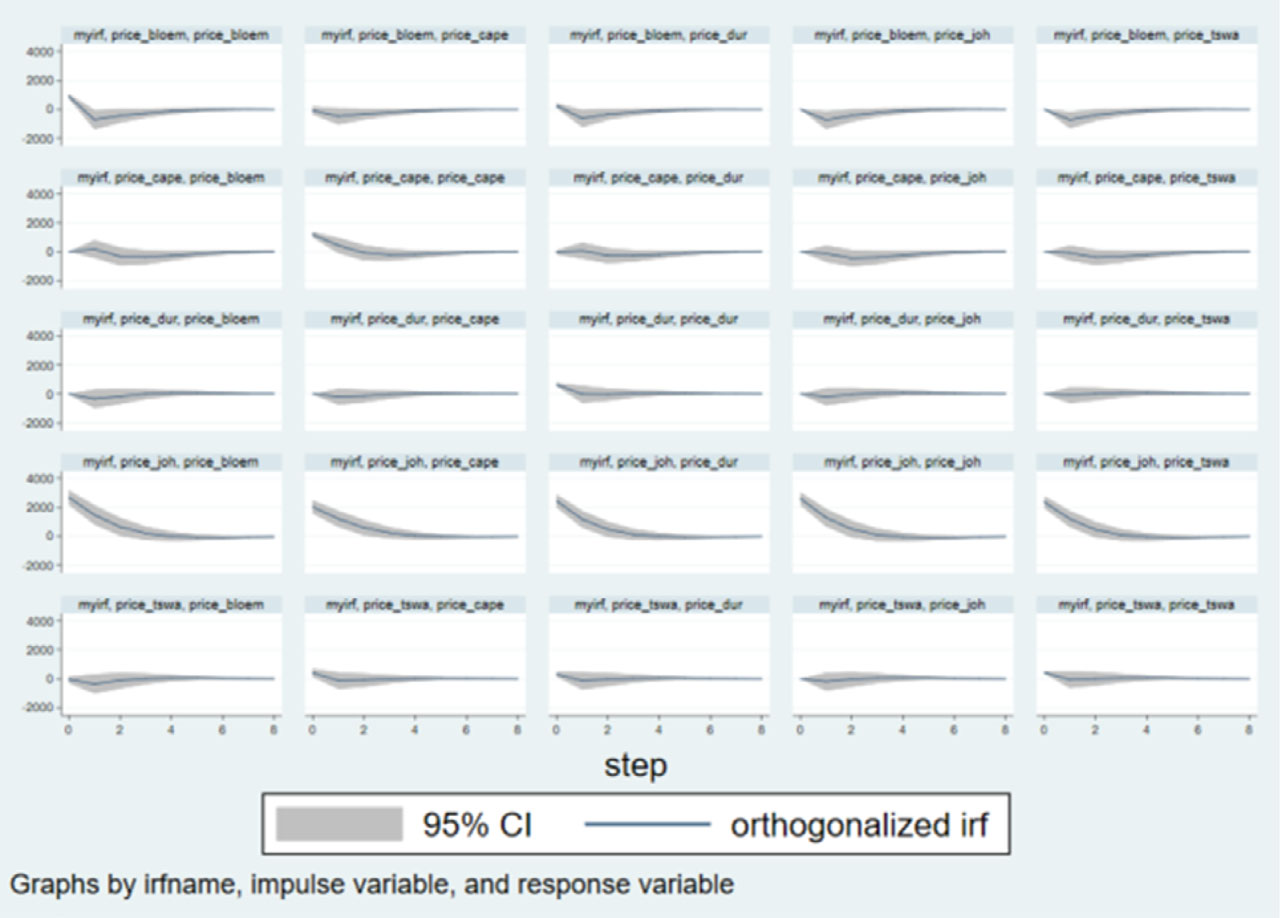
Fig. 2.
Results of the Impulse Response Function
Source: own elaboration.
Johannesburg market shocks lead to an average increase of R 3 000 in Bloemfontein and Durban markets within one month. By contrast, Tshwane and Cape Town markets responded more moderately. The peak impact is immediate, and the effect fades to baseline by the fifth or sixth month, indicating efficient short-run reversion in a stable system. The 95% confidence bands exclude zero during these initial months, confirming that the shock effects are statistically significant. In contrast, a shock in Bloemfontein market mainly affects the same market, with negligible, non-significant spillovers elsewhere. These findings therefore support Johannesburg’s role as the price leader and highlight asymmetric inter-market transmission, which is consistent with patterns observed in stationary VAR applications.
CONCLUSION
The study examined tomato price transmission among five major South African fresh produce markets (Johannesburg, Tshwane, Bloemfontein, Cape Town and Durban). Diagnostic tests confirmed that the model was well-specified, with stationary series, cointegration among markets, and stable VAR dynamics. The results show clear price transmission asymmetries, with Johannesburg identified as the dominant price leader significantly influencing prices in Tshwane, Bloemfontein and Durban, but only marginally affecting Cape Town. Bloemfontein exhibited negative and significant spillovers on its own and other markets, while Cape Town appeared largely isolated, with prices mainly driven by its own past values. Impulse response analysis further showed that shocks in Johannesburg generated strong but short-lived effects in Bloemfontein and Durban, dissipating within five to six months, whereas smaller markets displayed weaker and more localised spillovers.
The study recommends a hybrid reform strategy to improve price transmission and resilience in South Africa’s tomato markets. While Johannesburg fresh produce market should be formally recognised as a national reference price centre through transparent, daily benchmark price publication to strengthen price discovery, and over-reliance on a single market must be avoided through deliberate decentralised integration. Evidence of negative spillovers from Bloemfontein points to structural distortions that require tighter regulatory oversight, which is consistent with concerns raised by the Competition Commission’s Fresh Produce Market Inquiry. At the same time, weak price responsiveness in Durban and partial isolation of Cape Town highlight logistical and institutional constraints that call for targeted investments in cold-chain infrastructure, digital market systems, and transport support mechanisms to reduce spatial transaction costs and better link regional producers, particularly smallholders, to major markets. Given that the market system is stable but not fully efficient, policy focus should shift toward transformational reform, which includes revising the National Fresh Produce Market Model and piloting a multi-tier, ICT-enabled national price transmission platform led by DoA, NAMC and SALGA. Collectively, these measures would enhance market efficiency, reduce systemic vulnerability, and promote more inclusive participation across South Africa’s tomato value chain.