
INTRODUCTION
Agri-food products are among the key goods satisfying basic human needs. One of the food security criteria is economic accessibility, which ensures that society as a whole or individuals have the necessary purchasing power to obtain an adequate amount of physically available food (Maciejewski, 2018). Among the factors that led to significant market disruptions and food security consequences was the war in Ukraine, which triggered a series of events with global consequences, especially in terms of energy and food supplies. Disruptions in these markets increased both global and local prices of agri-food goods (Arndt et al., 2023; Ben Hassen and El Bilali, 2022). Along with macroeconomic factors, this translated into food inflation growth in Europe (Kornher et al., 2024) and worldwide (Adjemian et al., 2024; Algieri et al., 2024; Hamulczuk et al., 2023b).
In recent years, Poland has also experienced inflation increases, both in general and food prices. The rise in food prices was already observed during the Covid-19 pandemic (Jędruchniewicz and Wielechowski, 2023); however, its peak occurred after the outbreak of the war in Ukraine. Although this war is widely indicated as a contributing factor to the surge in retail food prices in Poland, no in-depth studies on this subject have been found in the literature, indicating a significant research gap. Numerous studies (e.g., Budzyńska and Kowalczyk, 2024; Hamulczuk et al., 2023a) have demonstrated the war in Ukraine impacts on how the Polish agri-food sector functions and on selected commodity prices; however, there is no scientific study in the literature that quantitatively indicates the true rise in consumer food prices as a result of the conflict. Therefore, the primary objective of our paper is to examine the impact of the war in Ukraine on changes in Polish retail food prices. We sought to identify not only how much Polish food prices have risen due to the Russia-Ukraine conflict, but also to investigate the transmission mechanisms of this conflict for food prices in Poland. Understanding the determinants of prices allows consumers and producers to better comprehend the causes of price changes and make more informed decisions. At the same time, it is crucial for policymakers to make evidence-based decisions regarding monetary, fiscal, and trade policies. Therefore, the authors make a significant contribution to the existing body of knowledge.
LITERATURE REVIEW
In a globalized world, the impact of an armed conflict like that which erupted in Ukraine in 2022 cannot be confined to a single country or region. The war has significantly impacted global supply chains, particularly in the agri-food sector, where Ukraine is a key exporter of grain and oilseeds (Arndt et al., 2023; Ben Hassen and El Bilali, 2022). The blockade of Black Sea ports and traditional export routes significantly disrupted supply, forcing countries to seek alternative routes through EU countries. Initiatives such as the Black Sea Grain Initiative (BSGI) agreement aimed to mitigate these challenges, enabling grain exports to resume despite the conflict. However, border closures and heightened customs and logistics controls resulted in additional delays and higher transportation costs, which in turn drove up global commodity and food prices (Budzyńska and Kowalczyk, 2024; Hamulczuk et al., 2023a). In the initial phase of the conflict, food security became a significant challenge for many countries, particularly those heavily reliant on agricultural imports from the region.
The war’s negative consequences on agricultural and food prices are widely discussed in the literature. However, conclusions drawn by the authors depend on the time and a country/region perspective. At the beginning of the war, world agri-food prices rose sharply (Glauben et al., 2022; Nasir et al., 2022). However, in the long run, we observed a decline in world agricultural commodity prices due to global supply responses and the conclusion of the BSGI (Carter and Steinbach, 2024). The short-term increase in global agri-food prices is in line with simulations conducted immediately after the outbreak of the war by Berndt et al. (2022).
This dramatic surge in global prices in the first phase of the war stemmed from a physical reduction in supply, combined with growing uncertainty about future harvests and export opportunities (Ihle et al., 2022). However, the shock to the commodity market caused by the conflict affected not only the agri-food sector: Russia, Belarus, and Ukraine were also significant suppliers of coal, crude oil, natural gas, and mineral fertilizers (Alexander et al., 2022). Trade restrictions and embargoes imposed on the Russian Federation led to significant worldwide price rises in the energy market. As indicated by Just and Echaust (2023), a significant increase in volatility spillover between energy and grain prices occurred after an outbreak of war. The war-induced surge in energy and fuel prices affected the international agri-food market, translating into higher agricultural production costs, processing costs, and transportation costs.
Furthermore, high energy and fuel prices weakened household purchasing power, reducing families’ ability to purchase food (Arndt et al., 2023). The problem of rising retail food prices did not only concern low-income and food-import-dependent countries. Kornher et al. (2024) emphasized the negative impact of the conflict on inflation processes in the EU countries, mainly due to increases in energy prices and transportation costs. Rising food production and storage costs are primarily reflected in retail food prices in regions where food production processes are multi-stage. Developed countries consume more processed food, making the production and processing of food products more complex and energy-intensive. Consequently, the final product price largely depends on changes in marketing costs (Dębkowska et al., 2023; Hamulczuk et al., 2023b). Apart from supply-side factors, Adjemian et al. (2024) stress that the money supply is a significant driver of food inflation in the US. This issue was also emphasized by Jędruchniewicz and Wielechowski (2023), who noted the lagged impact of the increase in the money supply on fluctuations in agricultural prices in Poland.
Poland, also an EU member state, likewise experienced rising retail food prices during the war. However, few researchers have addressed this issue. The war-induced increase in fuel and energy prices in turn contributed to the rising indirect costs of food production and transportation (Dębkowska et al., 2023). Furthermore, the decline in Ukrainian workers in Poland has intensified labour shortages, driving up labour costs. As a consequence, the combined disruptions in production, trade, transportation, and labour availability could have significantly impacted the overall increase in food prices felt by consumers in Poland (Krzykowski, 2022). Supply chain disruptions and higher operating costs resulting from the war also proved significant, as noted by Zając and Bogusz (2024). It is worth emphasizing that higher food prices in Poland occurred despite strong supply-side pressure in Ukrainian agricultural goods.
MATERIAL AND METHODS
Our empirical research focuses on the short-term consequences of Russia’s aggression against Ukraine on retail food prices in Poland. According to Eurostat data, food price analyses were based on the Harmonised Indices of Consumer Prices (HICP) from Eurostat. The monthly food and non-alcoholic beverage price index (2015 = 100) and its main components (10 aggregates) from January 2010 to December 2023 were used. To estimate the impact of the war in Ukraine on changes in food prices in Poland, we compared the actual level of price indices with the forecasts of these variables obtained from forecasting models estimated on the basis of data from before the outbreak of war (till February 2022). Positive error values indicate that the conflict raised prices, whereas negative errors indicate that food prices decreased. A similar approach was used by Hamulczuk et al. (2023b) in assessing the impact of the war in Ukraine on global food prices.
The percentage forecast errors calculated for individual price aggregates were the starting point for further qualitative analysis. To explain the obtained results and facilitate scientific discussion, we referenced other data and information, including the export of agricultural goods from Ukraine (Comtrade, Eurostat-Commext), world food prices (OECD-FAO), and food prices in other EU countries (Eurostat).
Ex-post forecasts of retail prices (price indices) were calculated using univariate regARIMA models, which means that the model learns from the data and makes predictions based on patterns (trends, seasonality) that it identifies in the past. Its merits lie in its having minor requirements for data, coupled with relatively high prediction accuracy. The disadvantage is that it does not delve into the economic mechanism of data generation. It is therefore important to evaluate the obtained results and considering other information qualitatively. Comparing actual data with counterfactual values derived from forecasting models can be an alternative to approaches based on simulations or econometric models. The approach used is undoubtedly easier to implement due to the relative simplicity of these models and the low data requirements. In other alternative simulation models, a no-war scenario would also need to be estimated.
RegARIMA models were estimated using a price series from January 2010 to February 2022, data covering the pre-war period. In contrast, ex-post forecasts were calculated for the war period from March 2022 to December 2023. The regARIMA is a part of the preliminary modelling within the well-known and widely used X-13 ARIMA-SEATS deseasonalization procedure (X-13..., 2020). RegARIMA model has the following form:
where: Yt – original time series, βi – parameter at the i-th explanatory variable, Xit – i-th explanatory variable, Zt – residual from the model, estimated using the SARIMA(p,d,q)(P,D,Q)s model (Box and Jenkins, 1970):In SARIMA model d and D are the orders of non-seasonal and seasonal differentiation, p and P are the numbers of non-seasonal and seasonal autoregressive lags, q and Q are the numbers of non-seasonal and seasonal lags in the moving average, s is the number of seasons in a year, φ, Φ, θ and Θ are the model parameters, B is the backward shift operator and (1 – B) is the differentiation operator. Among regARIMA regressors, we can include variables responsible for: additive outlier AO, level shift LS, temporal shift TS or Easter effect.
We can see that the regARIMA model is an extension of the SARIMA model. Apart from autoregressive and moving average lags, it includes additional explanatory variables to cover the impact of moving holidays, outliers, or structural changes in the time series. The estimation of regARIMA models was preceded by a unit root test, which revealed that all series were I(1). The specification of the regARIMA model covers selecting the regression variables and their timing, and the number of ordinary and seasonal differences, as well as the number of autoregressive and moving average lags. It was performed within the X-13-ARIMA procedure using information criteria. For more information on the regARIMA or X-13-ARIMA models, see, among others, the X-13 ARIMA-SEATS Reference Manual (2025).
To test the robustness of the research results, analogous ex-post forecasts were estimated using the multiplicative exponential Holt-Winters model (Hyndman et al., 2008). In this model, the forecast is a function of three components: level, trend, and seasonality, whose levels depend on ‘smoothing constants’. It is recommended for irregular (stochastic) changes in phenomena. Food prices belong to this category of economic phenomena. More on this model can be found in Hyndman et al. (2008).
Generally speaking, both models are based on the assumption that existing price trends and patterns will continue (see Fig. 1 as an example). Therefore, if a new event occurs–in our case, a war–that changes price dynamics, the differences between prices and their forecasts can be attributed to it. Their main drawback is that the war is assumed to be the only factor influencing forecast errors in our case. However, it appears that during this period, the war in Ukraine and all economic activities were primarily focused on mitigating the negative effects of the conflict. Other factors played a lesser role, although their influence cannot be ruled out. For example, the direct effects of the COVID-19 pandemic, related to restrictions, were short-lived, and the restrictions themselves did not play a significant role during the war, as Poland and most EU countries lifted most of them in early 2022. However, the pandemic undoubtedly led to a shift in monetary and fiscal policy, resulting in an increase in inflation. However, the rise in energy prices due to the pandemic was largely reflected in prices (and their trends) until the outbreak of the war, and such series were used to prepare ex-post forecasts for the war period. Therefore, while the effects of the pandemic on forecasting bias may appear minimal, they cannot be ruled out (second-round effects). Among the other exogenous factors, changes in sectoral conditions may have played a greater role, potentially affecting price dynamics only within a given commodity group.
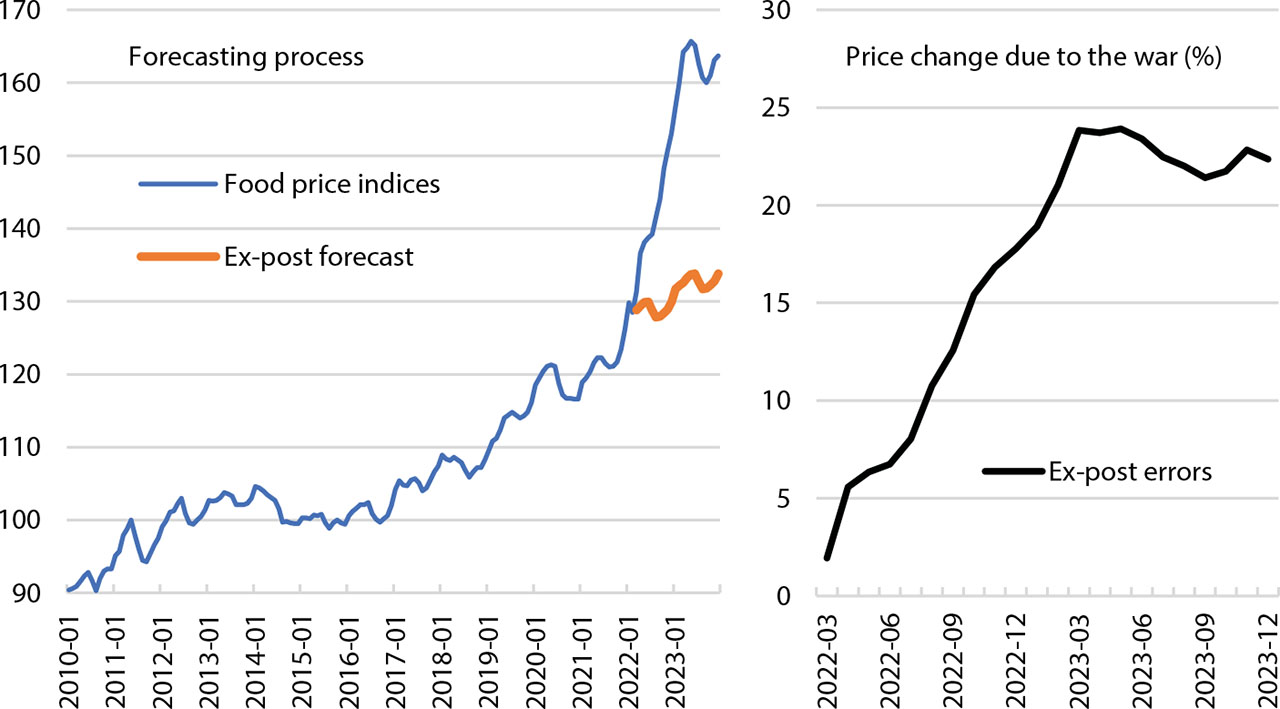
Fig. 1.
Sample of the ex-post forecasting process and calculation of the ex-post errors for food prices
Source: own calculations based on RegARIMA models and Eurostat data.
RESULTS
Model estimation
As part of the empirical study, regARIMA models were estimated for the entire food aggregate and individual food product groups (Table 1). The automatically selected models were most often of the form (1,1,0)(0,1,1), characteristic of data exhibiting seasonality and trend. The number of regressors (for outliers such as AO, LS, TS, or the Easter effect) varied depending on the variable, ranging from single observations in models like Vegetables or Total Food to up to six variables in the Fish and Seafood model. Most models fulfilled the basic statistical assumptions regarding the autocorrelation of residuals and their distribution, allowing for their further use.
Table 1.
Basic characteristics of regARIMA models used in ex-post prediction
| Specification | ARIMA model | Regressors (for outliers and shifts) | Standard error | Normality: Doornik-Hansen | Autocorrelation: Ljung-Box (12) |
|---|---|---|---|---|---|
| Food (total) | (1,1,0) | AO (1-2022), LS (6-2011) | 0.583 | 1.550 (p = 0.460) | 4.741 (p = 0.907) |
| (0,1,1) | |||||
| Bread and cereals | (1,1,0) | AO (1-2022), LS (9-2010), LS (3-2011) | 0.255 | 7.713 (p = 0.021) | 7.269 (p = 0.699) |
| (0,1,1) | |||||
| Meat | (0,1,2) | LS (12-2019), AO (2-2022), LS (4-2019), LS (5-2020) | 0.644 | 3.820 (p = 0.148) | 10.828 (p = 0.287) |
| (0,1,1) | |||||
| Fish and seafood | (0,2,1) | LS (12-2021), AO (1-2022), TC (11-2021), TC (12-2011), LS (11-2011), AO (3-2016) | 0.280 | 1.649 (p = 0.438) | 10.728 (p = 0.379) |
| (0,1,1) | |||||
| Milk, cheese and eggs | (1,1,0) | LS (11-2017), AO (1-2022), LS (3-2012), TC (4-2012), AO (12-2021) | 0.324 | 3.044 (p = 0.218) | 12.473 (p = 0.254) |
| (0,1,1) | |||||
| Oils and fats | (1,1,0) | TS (9-2021), LS (9-2021) | 1.031 | 28.462 (p = 0.000) | 19.735 (p = 0.032) |
| (0,1,1) | |||||
| Fruits | (0,1,1) | Easter[15] | 2.674 | 0.142 (p = 0.931) | 5.158 (p = 0.880) |
| (0,1,1) | |||||
| Vegetables | (0,1,0) | LS (6-2011) | 3.532 | 12.785 (p = 0.002) | 8.269 (p = 0.668) |
| (0,1,1) | |||||
| Sugar et all | (1,1,0) | LS (3-2011), TC (4-2011), TC (2-2011), LS (4-2014), TC (9-2010) | 0.511 | 2.821 (p = 0.244) | 5.648 (p = 0.843) |
| (0,1,1) |
The exception is the model for Oils and Fats, where the Doornik-Hansen test indicated substantial deviations from normality of residuals, and the Ljung-Box test indicated the presence of autocorrelation at 5% level, indicating that this model does not meet key assumptions and requires cautious interpretation. Nevertheless, the regARMA algorithm was unable to find a substantially better model for a given information criterion, which may indicate the complex and time-varying dynamics of this product group. The models for Fruits (standard error 2.674) and Vegetables (3.532) were characterized by the weakest fit, which results from the high volatility of prices of these goods.
Ex-post errors
The left panel of Figure 1 presents the food price index (HICP) and the ex-post forecasts (no-war scenario). The right panel shows the percentage differences between the actual HICP and its forecast, confirming the war’s impact on price formation. Up until early 2022, food prices in Poland followed a moderate upward trend. However, following the outbreak of the conflict, prices began to rise sharply, with a surge in food inflation. The divergence between prices and their ex-post forecast peaked in the first half of 2023, when the forecast error rate climbed to 19.29% (May 2023), coinciding with the peak of fuel prices in Poland. Despite a subsequent slowdown in agricultural and energy price dynamics, retail food prices did not return to their earlier forecasted trend. This indicates the lasting nature of the changes, which were not merely a short-term shock. Market reality in Poland regarding retail prices significantly deviated from pre-conflict assumptions, underscoring the depth and persistence of the war’s impact. It is also worth noting that the persistently high prices were not solely driven by increase in the costs of agricultural raw materials–in later phases, secondary factors, such as the rising cost of labour, food processing and distribution, gained prominence.
The full results are included in Table 2. The values contained therein are positive, indicating that the ex-post forecasts were lower than the actual prices of food products in Poland during the analysed period. The greatest and most persistent deviations from the forecast values occurred for bread and cereal products, for which the average percentage forecast error (PE) was 11.96%, with the maximum deviation level reaching 15.95% in June 2023. The price increase in this group was primarily the result of direct disruptions in the availability of raw materials from the conflict region and increased non-raw material costs (processing, logistics).
Table 2.
The war impact on food prices in Poland – the ex-post errors (%) based on regARIMA models
| Period | 03.2022 | 06.2022 | 09.2022 | 12.2022 | 03.2023 | 06.2023 | 09.2023 | 12.2023 |
|---|---|---|---|---|---|---|---|---|
| Food (total) | 1.94 | 6.75 | 12.57 | 17.77 | 23.83 | 23.40 | 21.41 | 22.36 |
| Bread and cereals | 0.59 | 6.71 | 10.96 | 14.26 | 18.38 | 18.98 | 18.33 | 16.54 |
| Meat | 2.57 | 11.84 | 16.11 | 19.49 | 21.89 | 23.51 | 21.52 | 21.62 |
| Fish and seafood | 1.20 | 5.97 | 9.60 | 16.13 | 17.62 | 17.52 | 15.20 | 13.21 |
| Milk, cheese and eggs | 0.11 | 8.39 | 14.72 | 23.09 | 25.97 | 26.10 | 23.46 | 22.45 |
| Oils and fats | 1.70 | 13.27 | 19.42 | 23.27 | 18.41 | 12.35 | 4.99 | 5.43 |
| Fruits | 3.17 | −0.64 | 4.62 | 12.58 | 17.69 | 8.13 | 7.09 | 14.84 |
| Vegetables | 1.84 | 0.55 | 4.75 | 10.21 | 26.19 | 21.52 | 15.79 | 18.78 |
| Sugar et all | 1.52 | 6.11 | 17.60 | 22.37 | 27.44 | 31.16 | 30.52 | 30.51 |
A similarly significant price surge occurred in meat, where the average PE reached 15.37%, peaking at 19.41% in May 2023. These significant price fluctuations can be attributed to rising feed, energy, and fuel costs, as well as disruptions in the grain supply chains, which form the basis for livestock production. The milk, cheese, and eggs group recorded an average PE of 15.61%, peaking at 20.86% in April 2023. Such significant price fluctuations demonstrate the group’s considerable sensitivity to macroeconomic factors resulting from the war, including increased production and logistics costs. Oils and fats saw a sharp but short-lived price spike, with an average PE of 11.05% and a peak of 18.88% in December 2022. Although prices stabilized in 2023, their significant increase at the beginning of the war indicates strong dependence on the availability of raw materials imported from Ukraine. Fish and seafood prices also rose significantly, although the variation was more minor–the average PE was 10.92%, peaking at 15.50%. This group demonstrates moderate sensitivity to external changes. For vegetables, the average PE was 11.04%, but the maximum value–20.75% in March 2023–was among the highest in the entire analysis. High volatility resulted from both weather factors and rising energy and labour costs. Fruit was the least sensitive of the analysed groups–the average PE was 7.76%, peaking at 15.03%. However, the seasonal nature of production and rising labour costs (due to factors such as the limited migration of seasonal workers from Ukraine) influenced price formation. Finally, prices of sugar and confectionery products rose sharply and persistently from the second quarter of 2022, reaching PE values above 20% in the final months of the analysis. This increase stemmed from export restrictions and rising costs of raw materials and energy.
In summary, the war in Ukraine has significantly impacted food prices in Poland, with the most vulnerable groups experiencing a high share of non-raw material costs and strong ties to the market for raw materials imported from the East. The results of this analysis confirm the significant role of geopolitical factors in shaping local retail prices in Poland. It can be argued that the war and its accompanying economic policies induced a structural increase in retail food prices. Although global agricultural commodity prices declined rapidly following the signing of the Black Sea Grain Initiative, food prices in Poland remained high. This can be attributed to persistently high energy prices and wages, which affect the final consumer prices. It seems that the latter two factors were influenced not only by global conditions but also resulted from loose monetary and fiscal policies, as well as relatively high inflation expectations in Poland.
Robustness check
Ex-post forecasts were additionally estimated using the Holt-Winters model to assess the robustness of the results. Table 3 presents the percentage differences between the actual values and these forecasts. Comparing the results in Table 3 and Table 2, some general conclusions can be drawn. First, the directional changes in forecast errors in subsequent periods (from March 2022 to December 2023) are consistent across food categories. Conclusions about the commodity groups most affected by wartime price increases in the Holt-Winters model did not change substantially compared to those derived from the regARIMA model.
Table 3.
Robustness check: the war impact on food prices in Poland – ex-post errors (%) from on Holt-Winters models
| Period | 03.2022 | 06.2022 | 09.2022 | 12.2022 | 03.2023 | 06.2023 | 09.2023 | 12.2023 |
|---|---|---|---|---|---|---|---|---|
| Food (total) | 1.33 | 4.51 | 11.49 | 16.00 | 21.06 | 18.84 | 18.35 | 18.57 |
| Bread and cereals | 0.31 | 5.53 | 9.31 | 11.69 | 14.89 | 14.26 | 13.13 | 10.49 |
| Meat | 4.52 | 14.50 | 19.13 | 22.72 | 24.79 | 27.00 | 25.19 | 25.44 |
| Fish and seafood | 0.91 | 5.76 | 10.58 | 15.80 | 16.86 | 17.14 | 16.23 | 12.98 |
| Milk, cheese and eggs | −0.21 | 7.17 | 14.55 | 23.21 | 26.61 | 25.10 | 23.45 | 22.64 |
| Oils and fats | 0.86 | 12.96 | 19.72 | 23.57 | 17.21 | 12.10 | 5.13 | 5.48 |
| Fruits | 1.47 | −3.88 | −1.51 | 9.29 | 13.34 | 2.78 | −0.72 | 9.77 |
| Vegetables | −0.71 | −4.47 | 0.60 | 9.45 | 20.93 | 13.45 | 9.74 | 16.01 |
| Sugar, et all | 0.32 | 0.70 | 12.65 | 18.62 | 23.14 | 22.22 | 22.85 | 24.32 |
Secondly, for most categories, according to the Holt-Winters models, the impact of the war in Ukraine on food prices in Poland is lower than the regARIMA model would suggest. The differences between the ex-post forecast errors calculated from these two models for similar categories grow over time. The differences between the two forecasts reach a maximum of 4.5 percentage points (and average 2.5 percentage points) for the Food aggregate. The most substantial differences are found in the Fruits, Vegetables, Sugar, jam, honey, chocolate and confectionery. On the other hand, the Holt-Winters model indicates a higher impact of the war on meat prices than the regARIMA model. In the case of Fish and seafood, Milk, cheese, egg, and Oils and fats, there are no significant differences between the estimated impact of the war.
When analysing these differences, it is essential to consider the distinct characteristics of each model. The regARIMA model, by its nature, generates rather conservative forecasts, assuming a return to long-term equilibrium. In contrast, the forecasts in the Holt-Winters model essentially consider recently observed changes (e.g. trends). Considering the emerging symptoms of rising global energy prices even before the outbreak of the war, Holt-Winters model seems to provide a more realistic estimate of the war’s impact on food prices in Poland.
CONCLUSIONS
This paper aimed to analyse the impact of the war in Ukraine on retail food prices in Poland, with a particular emphasis on the transmission mechanisms of external shocks to the domestic agri-food sector. Using a counterfactual approach, we compared expected (no-war scenario) price developments with actual data to assess the conflict’s impact on food prices. The general findings indicate that the war in Ukraine contributed to a sharp increase in prices of agricultural commodities, energy, fuels, and labour. This led to a significant rise in food prices in Poland. Kornher et al. (2024) confirmed that global market turbulence associated with the Russia–Ukraine war contributed to rising food price inflation in the EU countries. Retail food price increases in Poland affected all major commodity groups, with the most significant changes being observed in meat and dairy products between 2022 and 2023. The increase in fruit and vegetable prices was least noticeable after the outbreak of the war, which aligns with the findings of Kornher et al. (2024).
The mechanism by which the war impacted food prices in Poland is quite complex. Initially, the outbreak of the war in Ukraine led to restrictions on food exports, resulting in a short-term global rise in agricultural commodity prices. Given the relatively small share of agricultural raw materials in consumer prices, changes in the non-raw material costs of food production and distribution played a greater role in food inflation. Rising fuel and energy prices and increasing labour costs played a key role in the growth of food prices in Poland. The increase in fuel prices raised operational costs across the entire supply chain, while higher electricity and gas prices significantly impacted energy-intensive processing sectors. Maintaining low interest rates in the early phase of the conflict, along with numerous government support programmes, intensified inflationary and wage pressures. Adjemian et al. (2024) also attribute a large proportion of the food price inflation experienced in the US to the money supply. Therefore, the main recommendation is to adopt a more responsible monetary and fiscal policy in response to global inflationary processes. This recommendation is supported by the fact that during the period covered by the research, food inflation in Poland was among the highest in the EU, which raises questions about the effectiveness of the economic policy. It appears that the government and the National Bank of Poland failed to act rationally, or in a manner that prioritized non-economic criteria, by simultaneously maintaining strong support for households, low interest rates, and high energy prices for businesses. This fed into higher non-agricultural costs of food production, which were later passed on to retail prices.
Although the quantitative study results are quite robust when using an alternative impact analysis method, they have certain limitations. A key limitation of the analysis performed is the assumption that the war in Ukraine and its sectoral and macroeconomic implications were the primary drivers of food price increases in Poland during the research period. Therefore, future research should focus on more complex simulation models that would control for other factors, such as economic policies, interventions or agrometeorological conditions. Potential models may include econometric difference-in-difference models or the dynamic stochastic general equilibrium models.