
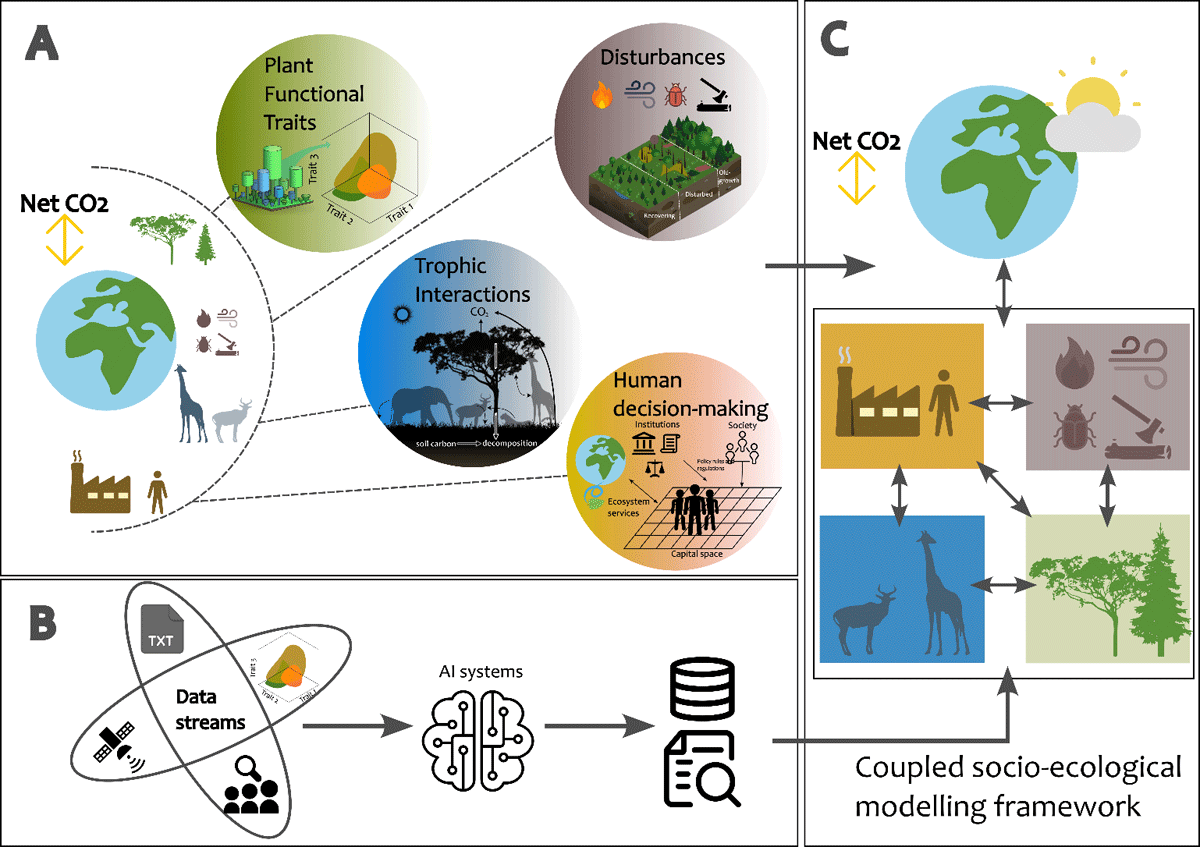
Figure 1
A conceptual overview of the critical processes missing from land system modelling.
Panel A highlights four groups of processes that are particularly missing in DGVMs: The need to better represent functional biodiversity and its impact on ecosystem function. This could be improved by representing plant functional trait dynamics and trophic interactions; the need to explicitly capture disturbances, such as insect outbreaks or storms, as well as land management; and the need to explicitly incorporate human land-use decision-making. Panel B illustrates a complementary strand of development related to the use of diverse datasets and machine learning (ML) modelling. Data sources could include remote sensing, citizen science, large databases or text mining. AI-based methods allow these diverse data to be combined to create information that can be used to strengthen modelling. In a coupled socio-ecological model framework illustrated in Panel C, the improved process interactions, enhanced by information gained from ML, could be integrated to quantify interactions and feedback in the land system under climate change. While the figure is modelled on the LandSyMM approach (Landsymm.earth), it also provides a broader visualization of relevant modelling gaps.