
Introduction
The land biota critically modulates the global carbon cycle, shaping both long-term trends and interannual variability in atmospheric CO2 and, thus, Earth’s climate (Murphy et al., 2026). What is now a well-established fact, was a vivid area of research only two to three decades ago when some of the key processes in land ecosystems affecting global carbon sources and sinks were first quantified. Influential papers in Tellus contributed to the rapid progress that occurred during that time. For instance, they identified the significant role of soil respiration in the terrestrial carbon balance (Jones, Cox, & Huntingford, 2003; Raich & Schlesinger, 1992) and provided an in-depth comparative analysis of the first two fully coupled carbon cycle-climate simulations (Friedlingstein et al., 2003). In the 1990s and early 2000s, it also became apparent that land use and land cover changes significantly alter the interactions between biota and the atmosphere (Houghton, 1999; Houghton, 2003). This increased awareness of the substantial amount of carbon dioxide emitted from land-use changes (Houghton, 1999; Houghton, 2003). As a result, land use change, as a key feature of the human-shaped land carbon cycle, has gained increasing attention. Today, strategies such as avoided deforestation and restoration of ecosystems are widely considered to be important climate change mitigation options, with critical co-benefits for biodiversity and many ecosystem services (Smith et al., 2022).
Despite major advances in the late 1990s and early 2000s, progress in representing key land ecosystem processes in dynamic global vegetation models (DGVMs)—the state-of-the-art tools for modelling the global carbon cycle—appears to have stalled, particularly with regard to processes affected by human activity. Net carbon emissions from land cover change remain the largest uncertainty in the historical carbon budget (Bayer et al., 2021; Friedlingstein et al., 2026; Sitch et al., 2024). A major shortcoming is that most DGVMs still neglect critical land management practices such as tillage, residue removal, grazing, or selective timber harvesting (Friedlingstein et al., 2025; Pongratz et al., 2018). These practices have a significant influence on carbon pools and fluxes (Arneth et al., 2017; Pugh et al., 2015). They are also increasingly being discussed in the context of adapting land use to climate extremes and associated disturbance events. Although satellite remote sensing has improved land cover reconstructions (Winkler et al., 2021), global historical datasets on management practices (such as fertilizer use, grazing practices or forest management) remain limited (Erb et al., 2016; Pongratz et al., 2018). However, even the best data will be insufficient if the underlying processes that govern human-nature interactions are inadequately represented. Furthermore, the growing recognition of biodiversity loss as a challenge comparable in importance to climate change, and the interconnectedness of these issues underscores the need for greater biological realism in DGVMs (Figure 1). An increasing body of literature, supported also by paleo research, has emphasised the critical role of biodiversity and animal abundance in shaping habitats and ecosystem carbon cycling (Pearce et al., 2023; Schmitz & Leroux, 2020; Trepel et al., 2024). Overall, substantial gaps persist in understanding and modelling the impact of land management intensity on biodiversity, the role of biodiversity in ecosystem adaptation and the interactions between biodiversity and ecosystem function more broadly (Davison et al., 2021; Dullinger et al., 2021; Mokany et al., 2016). This perspective article highlights key advances and the remaining research frontiers in addressing critical modelling capacity gaps, particularly with regard to the role of DGVMs in tackling urgent questions in the human-land system. Where relevant, we use the land-system modular model LandSyMM (www.LandSyMM.earth; Alexander et al., 2018) and its components as illustrative examples.
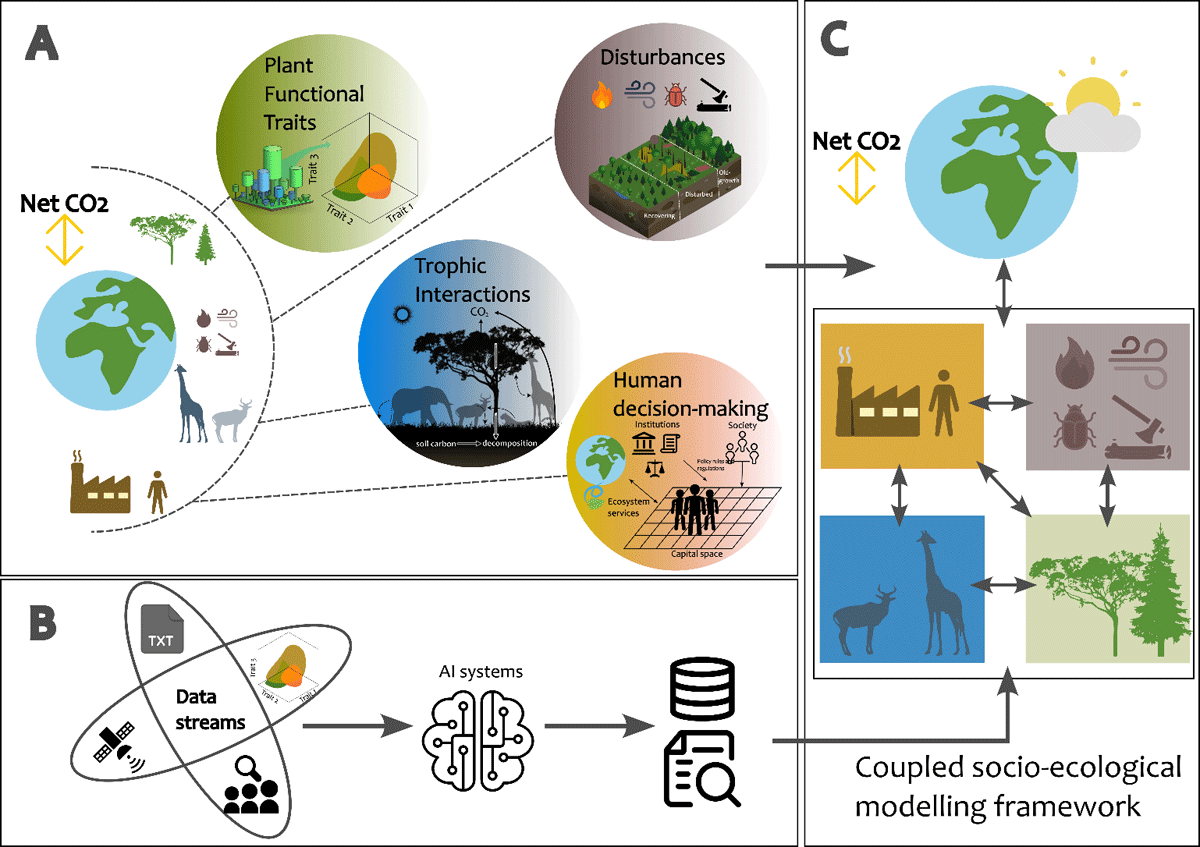
Figure 1
A conceptual overview of the critical processes missing from land system modelling.
Panel A highlights four groups of processes that are particularly missing in DGVMs: The need to better represent functional biodiversity and its impact on ecosystem function. This could be improved by representing plant functional trait dynamics and trophic interactions; the need to explicitly capture disturbances, such as insect outbreaks or storms, as well as land management; and the need to explicitly incorporate human land-use decision-making. Panel B illustrates a complementary strand of development related to the use of diverse datasets and machine learning (ML) modelling. Data sources could include remote sensing, citizen science, large databases or text mining. AI-based methods allow these diverse data to be combined to create information that can be used to strengthen modelling. In a coupled socio-ecological model framework illustrated in Panel C, the improved process interactions, enhanced by information gained from ML, could be integrated to quantify interactions and feedback in the land system under climate change. While the figure is modelled on the LandSyMM approach (Landsymm.earth), it also provides a broader visualization of relevant modelling gaps.
Integrating biodiversity and trophic interactions into carbon-cycle models
Ecosystems support multiple ecological functions, many of which depend on biodiversity. Research focussing on vegetation composition shows that higher plant species diversity often correlates with enhanced productivity and terrestrial ecosystems’ net carbon uptake, by enabling better use of light, water, and nutrient resources (Brun et al., 2019; Huang et al., 2018; Mori et al., 2021; Weiskopf et al., 2024). Mixed-species ecosystems use resources in different ways and at different times, including under stress such as heat and drought (Mahecha et al., 2024). There is thus a strong argument for biodiversity-carbon cycle-climate change feedback (Lade et al., 2019). Using a simplified model system that emulates vegetation-soil interactions Lade et al. (2019) showed that loss of biospheric integrity, especially via the biodiversity–productivity effect, amplifies warming in response to reduced carbon storage. But also, for example, the further amplification of heatwaves through reduced evapotranspiration as stomata close in hot conditions, and the observation that different tree species can exhibit significantly different conductance and transpiration rates, suggests feedback loops in response to variations in the composition of the tree canopy (Mahecha et al., 2024).
Yet, current modelling approaches fall short of capturing these relationships. Species distribution models, well established tools for studying potential climate-induced shifts in species ranges lack the complex biotic interactions to represent physiological processes in vegetation communities and food-webs and how these interact with ecosystem processes (Jarvie & Svenning, 2018; Tsiftsis et al., 2024). In turn, most DGVMs, in particular those embedded as land surface components in climate models, still represent the global vegetation using roughly ten to twenty Plant Functional Types (PFTs; Harrison et al., 2010) each defined by a fixed set of parameters that aim to represent global average plant traits for that PFT. It has long been acknowledged that this approach ignores the true variability that exists within plant groups that have important physiological or phenological similarities, such as tropical evergreen broadleaved trees, and may misrepresent crucial ecosystem processes (Sakschewski et al., 2015; Scheiter, Langan, & Higgins, 2013; van Bodegom, Douma, & Verheijen, 2014). This limitation is especially concerning given the need to understand how ecosystems adapt to rapid climate change and increasing weather extremes (Mahecha et al., 2024).
With the integration of large amounts of field data on plant functional traits in global data bases such as TRY (Kattge et al., 2020; Kattge et al., 2011), it has become feasible to represent within-PFT trait variation and related diversity in DGVMs (de Paula et al., 2021; Langan et al., 2025; Sakschewski et al., 2016; Scheiter, Langan, & Higgins, 2013; Figure 1). Building on empirical evidence, applications have so far confirmed the hypothesis that integrating traits that determine whether trees endure or avoid water shortages indeed mediate ecosystems’ responses to climate change, at least in the case of the Amazon rainforest (Langan et al., 2025; Sakschewski et al., 2016).
Moving beyond plants, trophic cascades driven by top predators or large herbivores, propagate through food webs and alter canopy species composition and structure, productivity and the cycling of carbon and nitrogen (Malhi et al., 2022; Schmitz et al., 2018; Schuldt et al., 2018; Tanentzap & Coomes, 2012; Weiskopf et al., 2024; Figure 1). Various strands of empirical evidence demonstrate that local herbivory impacts can rival those of warming, elevated CO2, or nitrogen changes (Flombaum, Yahdjian, & Sala, 2017; Hooper et al., 2012; Smith et al., 2015). A critical challenge is scaling these local effects globally to assess their relevance—especially how the interactions between biodiversity and carbon dynamics may shift with climate change (Mokany et al., 2016; Runting et al., 2017; Shin et al., 2022). Such a scaling is crucial for accurately capturing the role of biodiversity in carbon cycling and related ecosystem processes, and it supports our call for DGVMs to be integrated with biodiversity modelling more effectively than has been achieved so far. Initial work has started to integrate herbivores and trophic interactions into DGVMs, aiming to enhance the accuracy of carbon and nutrient cycling and to produce more realistic simulations of vegetation dynamics (Berzaghi et al., 2019; Dangal et al., 2017; Krause et al., 2022; Pachzelt et al., 2013; Rizzuto, Leroux, & Schmitz, 2024). For instance, Pachzelt et al. (2015) integrated a physiological ungulate grazer population model into the DGVM LPJ-GUESS. Although the predicted impact on carbon cycling in African savannas was smaller than expected, the results clearly showed the effect of grazing on the availability of fuel, and therefore on wildfires. Berzaghi et al. (2019) incorporated observations of selective browsing by forest elephants as disturbance into an ecosystem demography model. Their model revealed that selective elephant browsing might promote large late-successional trees and increase carbon storage, in sharp contrast to, for example, the effects of elephants in savannahs (Asner et al., 2009). Krause et al. (2022; 2025) present the development of a fully coupled modelling framework that links a multi-trophic model of functional diversity (Madingley; Harfoot et al., 2014) with LPJ-GUESS. Analogue to plant representation in DGVMs, Madingley represents animals as a number of functional groups, defined by ecological and physiological traits (Harfoot et al., 2014). These similarities facilitate coupling. Initial results show animal population dynamics in the coupled model to be more realistically represented, while herbivory through foliage removal has consequences for photosynthesis, productivity and canopy structure (Krause et al., 2025). The experiments in Krause et al. (2025) integrate over the entire modelled herbivore size-spectrum (mg to ton), but Madingley, in principle, also allows separate exploration of the impact of different types of herbivores by manipulating abundance of light-weight ectotrophic (representing insects) or heavy endotrophic (representing large mammals; Hoeks et al., 2020) functional groups. Together, the emerging modelling studies confirm that intact—or degraded—trophic chains indeed resonate throughout the entire ecosystem, but their impact varies by local conditions and vegetation type. At present, however, critical connections between herbivory (of all size classes) and vegetation, and soils, including impacts of animal litter on organic materials decomposition, animals as ecosystem engineers, or the separation of grazing and browsing, are not yet captured. Further developments, such as incorporating coupled carbon-nitrogen (CN) cycling into the simulation of animal ecology (similar to developments in DGVMs over the last 1–2 decades) would allow to deepen the understanding of animals’ roles in natural and managed ecosystems.
Capturing the role of disturbances
Episodic abiotic or biotic events, such as heat, drought or storms, outbreaks of insects or pathogens, and wildfires—often termed ‘disturbances’—have an integral role in the rejuvenation of ecosystems, particularly in forests and savannahs (Figure 1). Through mortality and regrowth, the frequency and intensity of these disturbances also affect carbon dynamics (Anderegg et al., 2022). Fire, in particular, has been described as a ‘herbivore’ and is a defining feature that maintains ecosystems with strong feedback to canopy structure and productivity (Bond & Keeley, 2005; Hantson et al., 2020). Disturbances are expected to increase in a warmer climate, with potentially large impact on carbon dynamics (Anderegg et al., 2022). In temperate forests, more frequent disturbances have occurred, in recent decades, in response to droughts and above-average temperatures (Sommerfeld et al., 2018). The ecosystem impact of disturbances can be amplified by certain land-management practices such as even-aged monocultures, or homogeneous landscapes, with large fuel loads (Piazza et al., 2024).
Natural and anthropogenic disturbances are a key driver of the ecosystem carbon residence time (Erb et al., 2016; Pugh et al., 2019) and accounting for their effects is essential for robust projections of future carbon sinks under climate change and land-use change. In process-based DGVMs, reduction of net carbon uptake through heat and drought are in principle represented, as these affect stomatal conductance, photosynthesis and respiration, more recently progress has also been made in representing drought-related mortality (Papastefanou et al., 2024). Still, aside from wildfires (Rabin et al., 2017) the impacts of other disturbances on ecosystem dynamics, which are particularly relevant for woody ecosystems, are ignored or subsumed into background stand-replacing disturbances (Pugh et al., 2019). Using aerial survey data for Eastern US forests, Kautz et al. (2017) prescribed defoliation and tree mortality from beetles and pathogens in LPJ-GUESS and simulated a total loss of 252 MtC for the period 1997–2015, far exceeding carbon losses from wildfires (Kautz et al., 2018). Defoliation impacts simulated by LPJ-mLfire in Canadian boreal forest in response to spruce budworm resulted in increased tree mortality and initial increase in area burnt, followed by a decline as fuel decreases (Sato et al., 2023). Focusing on storms, Wu et al (2019) explored another, often stand-replacing episodic event, applying SEIB-DGVM. For mixed larch forest in Japan, combinations of typhoon frequency and intensity in future climate change scenarios led to a significant decrease in above-ground biomass, followed by a dynamic response in the carbon cycle. This was driven by factors such as the productivity of the understory in forest gaps and subsequent regrowth, which transformed the forests into a carbon sink by the end of the 21st century. A recent study across different DGVMs suggests that the models’ underestimation of the northern hemisphere forest carbon sink during the first two decades of the 21st century, when compared to sources and sinks estimates derived from analysing atmospheric CO2 concentration data (inversions), may stem from overestimated fire emissions and underestimated forest regrowth rates (O’Sullivan et al., 2024). Climate change impacts on disturbance-related carbon dynamics can be dampened by management impacts if in managed forests the impacts of disturbances lead to adaptive responses (Ferretto et al., 2025) aimed at reducing economic losses and maintaining carbon sinks. Quantifying such types of interactions is an area of research that has recently been opened up by progress in land system modelling (Robinson et al., 2018). Advances in data availability on land cover change and land management changes, together with conceptual advances in how to represent human agency and decision making, open up the prospects to better represent human-environment interactions and feedbacks in land-use models (Robinson et al., 2018; Rounsevell et al., 2021).
Integrating human decision-making into land-use models
Integrated Assessment Models (IAMs) were pioneering the integration of human processes into global-scale modelling, including land system representation (Keppo et al., 2021). They play an important role in informing IPCC assessments, particularly in evaluating pathways to climate mitigation targets such as limiting warming to 1.5°C above pre-industrial levels (IPCC, 2018). However, recent research has highlighted several limitations in IAM outcomes, such as the ambitious rates of land-use change required for bioenergy (Turner et al., 2018), land area demands for climate change mitigation that would be comparable to current global cropland (Anderson et al., 2023; Creutzig et al., 2021), limited consideration of time-lags in policy implementation (Brown et al., 2019; Seo et al., 2024), and insufficient attention to the environmental, social, and political contexts influencing climate change mitigation feasibility across regions (Creutzig et al., 2021; Deprez et al., 2024; Dooley, Pelz, & Norton, 2024; Perkins et al., 2023; Rubiano Rivadeneira & Carton, 2022).
IAMs focus on economic utility maximization, but real-world land decisions are also shaped by social networks, norms, knowledge exchange, attitudes, land ownership, and inheritance (Malek et al., 2019; Swart et al., 2023). A new generation of land system models addresses these limitations (Alexander et al., 2018; Robinson et al., 2018; Rounsevell et al., 2021; Figure 1) by integrating diverse modelling paradigms to capture human behaviour beyond economics alone (Brown, Holman, & Rounsevell, 2021), while also emphasizing equity, justice, and sustainability transitions for well-being (Diaz General, Brown, & Rounsevell, 2025; Sevekari et al., 2025). In particular, agent-based modelling techniques are seen as well-positioned due to their ability to represent heterogeneous actors and complex land system dynamics across spatiotemporal scales (Matthews et al., 2007). Having customarily been applied at local scales, recent developments such as the CRAFTY-ABM extend to large regional (Brown et al., 2019), and global applications (Saxena et al., in preparation). CRAFTY also forms part of LandSyMM. The integration in LandSyMM allows for vegetation productivity data from carbon cycle models (in this case: LPJ-GUESS) to be used to drive the response of land use to changing climatic conditions. Resulting land use and management intensity outcomes can be returned to LPJ-GUESS in order to simulate ecosystem processes including carbon and nitrogen cycles. Hence, next-generation models such as LandSyMM represent an important new direction in integrated modelling at the human-ecosystem interface for assessing the carbon cycle.
Opportunities arising from new data and methods
Several complementary data-streams have emerged over recent decades that can provide step-changes in overcoming some of the model development challenges, including satellite-based Earth observations, global open-access trait datasets (among others: Herberstein et al., 2022; Iversen et al., 2017; Kattge et al., 2020; Newman & Furbank, 2021), and unstructured ecological information from citizen science (Wolf et al., 2022) or embedded in text (e.g., from scientific literature, governmental reports, and news articles). Together, these hold potential to advance the biological realism of carbon cycle models and our understanding of the human impacts (Figure 1). Yet, they also present significant challenges in transforming raw data into usable information for modelling. A natural way of exploiting these data streams is data assimilation (DA) (Talagrand & Courtier, 1987), the integration of observations into models to constrain poorly known parameters governing key processes in the climate-carbon-vegetation nexus (Bacour et al., 2023; Luo et al., 2015). However, applying DA at global scale in DGVMs, which involves hundreds to thousands of parameters and non-linear process representations, is generally prohibitively expensive computationally (Raoult et al., 2025). Machine learning (ML) is increasingly offering a tractable path for this barrier, in particular through hybrid approaches that embed neural networks within DGVMs, allowing parameters and functional relationships to be learned directly from data and opening the door to parameter representations that vary continuously in space and time rather than being fixed to PFTs. One example is the better representation of vegetation response to soil water stress (Fang & Gentine, 2024) and the replacement of an empirical parameterisation of fires in a process-based model by machine learning (Son et al., 2024).
Deep learning (DL), a group of machine learning approaches that allow computational models composed of multiple processing layers to learn representations of data with multiple levels of abstraction (LeCun, Bengio, & Hinton, 2015), is demonstrating significant potential to extract relevant information from diverse data streams for use in DGVM modelling, both offline and as part of coupled land-system modelling. For remote sensing, DL approaches have reached important milestones, enabling enhanced land cover classification (Ienco et al., 2019), mapping of tree species distributions (Bolyn et al., 2022; Schiefer et al., 2020; Wegler et al., 2025), quantification of fractional cover of standing dead trees and forest disturbances (Sani-Mohammed, Yao, & Heurich, 2022; Schiefer et al., 2023; Schiller et al., 2024), and estimation of forest structure variables such as canopy height (Lang et al., 2023). On the textual side, large language models (LLMs) are showing promise in automating information extraction (Farrell et al., 2024; Gougherty & Clipp, 2024). For example, Gabud et al. (2024) extracted habitat and reproductive traits of plants from scientific literature, Marcos et al. (2025) automated the curation of morphological plant trait data, and Scheepens et al. (2024) applied LLMs to acquire, for example, species and geographic information from literature on invertebrate pests and controls. The rise of AI is also offering new ways to represent human processes in land-use models (Zeng et al., 2024; Zeng et al., 2025). For example, LLMs now help simulate policy-making by representing diverse policy agents with competing goals (think of the tensions between agricultural and environmental ministries) and resource constraints. These models generate narrative explanations for policy decisions—like regulations or subsidies—and can integrate with agent-based models (Zeng et al., 2025).
Despite these manifold advancements, several challenges prevent a more extensive adoption of DL approaches in DGMVs and land-system modelling. Even though remote sensing, in particular, offers increasingly rich sources of data, mostly with global coverage, ground-based observations, and monitoring in ecosystems, data for training DL models remains geographically biased (Chapman et al., 2024; Koldasbayeva et al., 2024). As with any empirical model, uncertainty arises also when applying these approaches for future (climate or socio-economic) conditions that have not been ‘seen’ in the training data-set (Koldasbayeva et al., 2024). Further methodological issues relate to the lack of transparency of the DL approach and difficulties with its generalisation, and their high computational and energy demands (Cui et al., 2023; Perry et al., 2022). For social science applications, such as land-uses decision making, concerns have also been raised on whether LLMs indeed can represent human agency, given that different LLMs showed significant divergence in their responses and results have been found sensitive to analytic choices made by the researcher (Cummins, 2025). In experiments, the ‘silicon samples’ differed notably from human participants (Cummins, 2025; Gao et al., 2025). For all applications, LLMs based on payment for access are yet another approach that favours researchers in affluent countries and institutions and conflicts with principles put forward by open science (Farrell et al., 2024).
Bringing it all together
Global ecosystem models are now challenged to address a far greater number of open questions than in the 1990s and 2000s. Given the feedback loops between human activities and ecosystems, advanced DGVMs need to be part of modelling these interactions if they are to contribute to answering these questions. Accelerating climate change, biodiversity loss, and rapid socio-economic change are creating risks that conventional modelling will be unable to address. Biodiversity must be treated not just as a constraint on land allocation, but as a dynamic driver of ecosystem processes and human decision-making (Cabral et al., 2024; Synes et al., 2019). Future models should therefore embed biodiversity impacts as active variables, rather than passive constraints, in land-use and carbon cycling studies. Modelling efforts must also explicitly account for increased impacts due to weather extremes and disturbances, factors that likely render current projections of nature-based climate change mitigation over-optimistic (Anderegg et al., 2020). Moving forward, models should not only assess losses from extreme weather but also explore whether and how climate-driven ecosystem degradation, and the associated loss of material and non-material ecosystem services could lead to adaptive management practices including shifts in species composition.
Land ecosystems and humans form a single, complex, dynamic system with two-way feedback. Unlike traditional DGVMs that treat human impact as a fixed parameter, or land-use change models that lack representation of ecological processes, coupled land-system models capture the influence of human decision-making on ecosystems, as well as the way environmental changes drive behavioural shifts in humans (Farahbakhsh et al., 2022). This modelling capacity is clearly needed to better inform environmental and social targets, and it should be prioritised. The examples we highlight here provide a compelling argument for what is already possible and also draw attention to areas of research at the forefront of the highly dynamic field of research into more realistic scientific assessments of pathways towards more sustainable land use.
Author Contributions
AA developed the concept of the paper. CN designed and drew Figure 1. All authors wrote first drafts of different sections of the manuscript. All authors contributed to subsequent revisions of the entire text.