
Taking charge is a proactive behavior intended to bring about constructive change to the work environment, in particular by improving work procedures (Morrison & Phelps, 1999; Parker & Collins, 2010). Taking charge starts with identifying issues that need attention, includes goal generation and planning, and comprises phases of implementation and reflection (Parker et al., 2010; Sonnentag & Starzyk, 2015). Organizational scholars emphasize the utility of proactive behaviors such as taking charge because these behaviors contribute to performance (Thomas et al., 2010), without being (too) straining (Strauss et al., 2017). However, scholars also suggested examining negative consequences of proactive behavior (Bolino et al., 2010; Liu et al., 2019). Accordingly, studies examined negative outcomes, such as impaired detachment from work during leisure time (Cangiano et al., 2020), low coworker support (Zhang et al., 2020), or poor well-being (Zacher et al., 2019). In this study, we focus on taking charge. Taking charge may be a double-edged sword, because continuously identifying and addressing issues concerning work efficiency reflects high commitment but might imply that employees overtax themselves.
Accordingly, we examine depletion as a potentially negative consequence of taking charge. Depletion as a state of diminished cognitive resources is important (Johnson et al., 2017) because it can lead to undesirable outcomes, such as decreased organizational citizenship behaviors (Johnson et al., 2014), low in-role performance (Deng et al., 2016), or moral disengagement (Lee et al., 2016).
Accordingly, we draw on the strength model of self-control (Baumeister & Vohs, 2016).1 This model proposes that exerting self-control depletes resources, which in turn impairs functioning on (other) activities. One might expect that the voluntary nature of proactive behaviors such as taking charge or personal initiative (Frese & Fay, 2001) implies that it does not rely on self-control. However, we argue that taking charge requires self-control, because it asks for persistence in the face of obstacles and focus when implementing plans to improve work procedures (Parker et al., 2010). Taking charge demands to overcome impulses to give up, requires flexibility, and asks for effort beyond in-role duties. Supporting this view, Fay and Hüttges (2017) found that daily personal initiative (which may be similar to taking charge) relates positively to bedtime fatigue. However, proactive behaviors have also been found to be vitalizing and relate to competence experiences (Cangiano et al., 2019; Fay & Sonnentag, 2012). To conclude, findings are inconclusive; on the one hand, results point to a vitalizing effect, but on the other hand to a depleting effect of proactive behavior.
Our study attempts to make sense of these inconclusive findings by considering two aspects that may help to better understand the relationship between proactive behavior and depletion further. First, seemingly contradictory findings may point to the need to consider temporal aspects. More specifically, the effects of taking charge on depletion may need some time to unfold and become draining. Following this idea, we separate taking charge during the morning and taking charge during the afternoon as depletion predictors and examine immediate and lagged within-day effects unfolding throughout the day. Second, inconclusive effects may be due to (not yet considered) moderating variables. As a consequence, we investigate daily job control and daily self-control demands as moderators. So far, related studies either investigated stable individual (e.g., motivation; Cangiano et al., 2020; Pingel et al., 2019; Strauss et al., 2017) or interpersonal features (e.g., punitive leadership, team innovation climate; Cangiano et al., 2019; Zhang et al., 2020) as moderators that shape negative consequences of proactive behavior. However, on each day, employees behave proactively under potentially different constraints at work. Thus, by investigating daily job control and self-control demands as moderators, we examine the idea that taking charge is draining when circumstances constrain behavioral options or require (more) self-control.
We contribute to the literature in several ways. First, by examining immediate and lagged effects of taking charge on depletion, we consider temporal issues in organizational research (Sonnentag, 2012). With this approach, we trace depletion at work by taking charge as a within-person process starting at the beginning of the workday until its end, taking into account temporal aspects of the relationship between taking charge and depletion.
Thus, we recognize that depletion can be perceived (a) during acts of taking charge, (b) immediately thereafter, (c) after a certain period of time, or (d) not at all. Depletion may not arise immediately after taking charge in the morning, but later towards the end of the workday as draining effects may need time to unfold (Leikas & Ilmarinen, 2017). Further, examining lagged relationships from morning taking charge to depletion at the end of work is important, because immediate vitalizing effects of taking charge may mask depletion that may surface later (e.g., Cangiano et al., 2019). In addition, draining effects may be more likely in the afternoon because employees already have spent energy or attention in the morning and resource expenditure accumulates across the day. Supporting such a view, Hülsheger (2016) found that fatigue only increases from midday towards the end of work, but usually not during the morning. Further, this perspective on temporal processes within the workday calls for a within-person examination of outcomes of taking charge. Studies showed substantial within-person variance in the constructs included in our research (Clinton et al., 2020; Fay & Sonnentag, 2012) emphasizing the suitability of a daily-survey design.
Second, we focus on job control and self-control demands as two daily working factors relevant for proactive behaviors such as taking charge (Ohly & Fritz, 2010) and depletion (Rivkin et al., 2018). Research already identified job control as predictor and outcome of proactive behavior but failed to support a relation with energetic states (Parker et al. 2019; Zacher et al., 2019). Alternatively, we consider job control as a moderator which may shape the relationship of taking charge with energetic states. In particular, low job control seems relevant because it may limit how employees can engage in taking charge. Low job control may constrain in ways that taking-charge behaviors become resource demanding (Parker & Sprigg, 1999). For instance, eliminating a redundant work procedure may be burdensome when no alternatives for other work procedures exist. Further, high self-control demands may be relevant as a moderator. When self-control demands are high, they add self-control requirements (Schmidt & Diestel, 2015) which may increase the effort necessary to maintain effort to improve work procedures. For instance, trying to change counterproductive rules when work requires suppressing feelings of frustration may be depleting.
Third, we rule out alternative explanations for the link between taking charge and depletion, namely affect and in-role performance. Because taking charge can lead to affective consequences, it is important to disentangle affect from depletion. For instance, Daniels et al. (2009) found that proactively changing work activities to solve problems related to positive affect via learning. Further, studies on the energy-depleting role of proactivity did not separate depletion effects that may result from in-role performance (Cangiano et al., 2019; Fay & Hüttges, 2017). However, doing so is important, because in-role behavior can deplete (Chiaburu & Baker, 2006; Parker, et al., 2006). Moreover, performing well on in-role tasks may lead to success which may vitalize employees what potentially counteracts depletion (Wang et al., 2020). In sum, not controlling for affect and in-role performance might yield spurious associations between taking charge and depletion.
Theory and Hypotheses
Taking charge implies self-control processes (Grant & Ashford, 2008). Accordingly, we apply the strength model of self-control (Baumeister & Vohs, 2016). Further, we argue that high daily self-control demands and low daily job control, respectively, should strengthen the positive relationship between proactive behavior and depletion. Figure 1 shows our conceptual model.
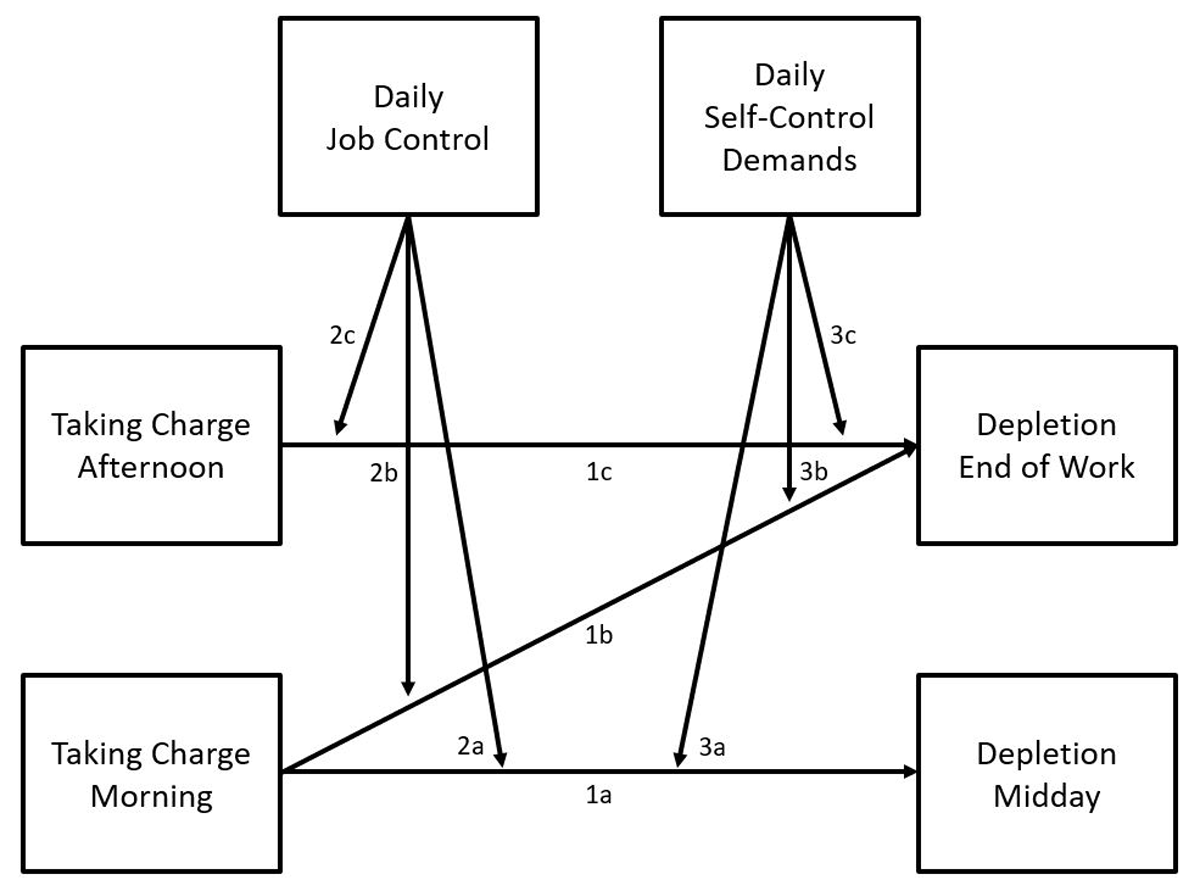
Figure 1
Conceptual Model.
Depletion in the Strength Model of Self-Control
Two core premises of the strength model of self-control are (a) the domain-generality of self-control and (b) the psychological costs of exerting self-control (Friese et al., 2018). Domain-generality means that self-control draws on one common resource, which is used in several domains requiring self-control (e.g., work, health, or social life). The psychological-cost premise means that self-control depletes resources, with depletion in one domain making self-control failures in other domains more likely (Baumeister & Vohs, 2016).
In our study, depletion refers to the state perception that the self-control capacity is limited.
The strength model of self-control has been criticized (Friese et al., 2018; Vohs et al., 2020), regarding the precise meaning and processes behind depletion (Inzlicht & Berkman, 2015; Lurquin & Miyake, 2017). Nevertheless, the general idea of depletion remains highly plausible for the work context: After a long workday facing several demands, employees are depleted and incapable of exerting further self-control. Daily taking charge with its potentials to vitalize and to deplete is an interesting candidate to test the generality of this idea.
Taking Charge and Depletion
In line with the strength model, we propose that taking charge depletes self-control resources. Taking charge refers to employees’ voluntary, future-directed efforts to positively change their work environments that can be shown from workers across different work roles and hierarchical levels (Grant & Ashford, 2008; Parker et al., 2010; Parker & Collins, 2010). Taking charge aims at improving organizational efficiency by, for instance, eliminating redundant procedures, suggesting new technologies or trying to change counterproductive rules. There are several reasons why taking charge may be depleting.
According to Parker et al. (2010), proactive behavior such as taking charge entails a goal-driven process encompassing goal generation and goal striving. Goal generation as the first part encompasses envisioning, generating, and planning how to implement proactive goals (Parker et al., 2010). Planning depletes cognitive self-control resources (Sjåstad & Baumeister, 2018).
Goal striving as the second part can be further differentiated into enactment and reflection (Parker et al., 2010). Enactment represents the actions employees engage in to realize their proactive plans, which can be risky. If, for instance, an employee takes charge to introduce new, more efficient work methods, they challenge the status quo, identify critical issues and, demand to change routines (Chiaburu & Baker, 2006; Parker et al., 2010). Accordingly, others may respond with resistance or social disapproval (Burris, 2012). To deal with these social demands, it is key to be persistent and to overcome the temptation to give up (Frese & Fay, 2001). Persisting when others are resistant requires self-control (Vohs et al., 2005).
Further, taking charge requires to maintain focused and shield off distractions when enacting proactive goals (Rom et al., 2020). Also, monitoring and reflecting if proactive behaviors are effective requires concentration. In particular, when results of taking charge behaviors have not been effective, additional effort needs to be exerted to adjust behaviors (Achtziger & Gollwitzer, 2018).
Finally, taking charge may go beyond fulfilling core job duties (Chiaburu & Baker, 2006; Morrison & Phelps, 1999; Parker et al., 2006). When one is exhausted from core job duties, additional self-control may be needed in order to act in a goal-directed way (Fay & Hüttges, 2017). Relatedly, taking charge involves monitoring and adjusting behaviors (Achtziger & Gollwitzer, 2018; Parker et al., 2010)
Potential Lagged Depletion Effects of Taking Charge
In addition to the assumption that proactive behavior requires self-control, prior studies indicate that proactive behavior could also vitalize employees (Cangiano et al., 2019). It may be that taking charge fulfills competence needs, and therefore elicits initial feelings of vitality (Cangiano et al., 2019). These findings justify the more specific view that taking charge may not translate into immediate depletion as initial vitality cancels out the depleting effect of taking charge. Resource-draining effects may need time to manifest as immediate depletion is masked by initial feelings of vitality. For instance, effort spent in the morning may trigger depletion only later that day. Relatedly, Fay and Hüttges (2017) reported that personal initiative in the afternoon relates to fatigue at bedtime. Likewise, Leikas and Ilmarinen (2017) found that during productive and responsible behavior positive mood was increased and fatigue reduced, but three hours later fatigue was increased.
To incorporate that possibility, we examine potential immediate and lagged relationships of taking charge with depletion within the day. More specifically, we test if depletion at midday and the end of work can be predicted by taking charge during preceding time periods (i.e., morning and afternoon).
Hypothesis 1. Taking charge in the morning positively relates to an increase in depletion (a) at midday and (b) at the end of work. Taking charge in the afternoon positively relates to an increase in depletion at the end of work (c).
Daily Job Control as a Moderator
We propose that daily low job control moderates the relationship of taking charge and increase in depletion. Job control describes the degree of latitude employees have over their work tasks. This includes latitude over task-scheduling, work procedures, and methods (Hackman & Oldham, 1976). Job control varies daily (Kühnel et al., 2012).
First, when job control is low, the ways in which one can take charge are limited. This may not only undermine initiation of taking charge behavior, but also forces persons to draw on resource-consuming strategies when already engaging in taking charge (Parker & Sprigg, 1999). For instance, if for suggesting ideas only one technological platform is available on certain days, persons would have to stick to this potentially disliked option. Suggesting ideas via a disliked platform might require more effort fostering depletion. When having access to a more diverse set of technological platforms (i.e., more job control), more behavioral options are available what allows choosing the least depleting option. This is to say that a mismatch between behavioral requirements associated with taking charge and the amount and quality of available behavioral options may be responsible for potential depleting effects.
Second, low job control may foster perceiving the locus of causality as external. An external locus of causality may thwart autonomous motivation (Humphrey et al., 2007; Martela et al., 2016). Low autonomous motivation may not only make persons less likely to engage in taking charge in the first place, but also foster a more draining experience when already doing so (Muraven et al., 2008). More self-control is necessary because proactive behaviors may be perceived as chosen for extrinsic reasons. Accordingly, experiments based on the self-determination perspective (Moller et al., 2006) show that a lack of choice is linked to depletion.
Third, when job control is low, persons cannot take breaks when needed. Taking breaks at the right time may be important to efficiently recover resources that would otherwise be depleted by taking charge (Trougakos et al., 2014).
In sum, we expect that job control moderates the relationship of taking charge and increase in depletion. We expect that the lower the daily job control, the stronger the relationship. Thus, we test moderation effects for the relationships proposed in Hypothesis 1.
Hypothesis 2. Daily job control moderates the relationship (a) between taking charge in the morning and increase in depletion at midday, (b) between taking charge in the morning and increase in depletion at the end of work, and (c) between taking charge in the afternoon and increase in depletion at the end of work. The lower the daily job control, the stronger the relationship.
Daily Self-Control Demands as a Moderator
We propose that high self-control demands moderate the relationship between taking charge and increase in depletion. Self-control demands can refer to work characteristics requiring to control impulses (e.g., not yelling at unfriendly customers), to resist distractions (e.g., focusing despite a noisy work environment), and to overcome inner resistances (e.g., motivating oneself to start with an unpleasant or difficult task, Neubach & Schmidt, 2006). Self-control demands vary daily (Rivkin et al., 2015). For example, on one day, the work environment may be noisy, placing higher self-control requirements on employees, whereas on other days, it is silent and focusing is easier. Self-control demands may increase the relationship of taking charge with depletion.
When self-control demands are high, employees may have to exert more self-control to maintain adequate levels of proactive performance. When employees are engaged in proactive behavior such as taking charge, they are motivated to be successful (Parker et al., 2010). Thus, they are likely to exert additional self-control effort if this is necessary to achieve proactive goals (Wright et al., 2019). If employees have to exert more self-control effort when behaving proactively, depletion afterwards should be higher (Baumeister & Vohs, 2016).
Thus, we expect that daily self-control demands act as a moderator in the relationship between taking charge and increase in depletion. We expect that the higher the daily self-control demands are, the stronger the relationship is. Again, we test moderation effects for the relationships proposed in Hypothesis 1.
Hypothesis 3. Daily self-control demands moderate the relationship (a) between taking charge in the morning and increase in depletion at midday, (b) between taking charge in the morning and increase in depletion at the end of work, and (c) between taking charge in the afternoon and increase in depletion at the end of work.The higher the daily self-control demands, the stronger the relationship.
Method
Sample and Procedure
Data was collected within a research project on self-regulation at work in Germany (Sonnentag et al., 2022). Participants were recruited by advertising the study on the social-media site www.xing.com. Eligibility criteria for participants were: working at least 20 hours per week, working with a personal computer with internet access for at least 50% of their working time. To minimize drop-out, participation was compensated.2
Participants provided informed consent about participation and were informed that they could withdraw at any time without negative consequences. They did not provide consent to make data publicly available. Afterwards they chose a two-week participation period and indicated their working hours. In total, 255 persons signed up and received a link to the entrance survey. After completion of the entrance survey, participants received three survey links per day over two workweeks (Monday through Friday3). Links to the daily surveys were sent at 6:00 am (morning survey), at 10:45 am (midday survey), and, depending on individual working hours, at 2:30 pm, 3:00 pm, or 5:00 pm (afternoon survey). Daily data was dropped from further analyses when not provided within specific time frames.4 Two months after completion of the daily surveys, participants received a follow-up survey not relevant to the current study.
One hundred seventy-one participants filled in the entrance and 165 filled in daily surveys. Data from three participants were excluded from further analyses due to data-quality concerns (i.e., participants did not fully comply with instructions). Morning, midday, and afternoon surveys were matched to respective persons and days. To allow for within-person predictions, participants had to provide at least two complete days. Thus, the final data set used for hypotheses testing consisted of 136 participants (ndays = 963). On average, participants completed daily surveys at 7:59 am (morning survey), 12:31 pm (midday survey), and 4:54 pm (afternoon survey). On average, participants provided 7.01 daily records.
More than half of the participants were woman (57.4%). The average age was 36.8 years (SD = 9.2); 21.3% worked in their job less than one year, 44.9% between one and five years, 22.8% between five and ten years, and 11.1% more than ten years. Most participants (54.4%) worked between 40–50 hours per week, 36.1% worked between 30–40 hours per week, 4.4% worked more than 50 hours per week, and 5.2% worked between 20–30 hours per week.Participants worked in a broad range of jobs, mainly in administration, marketing and sales, communication, and IT. The 136 persons who provided usable daily-survey data did not differ with respect to gender, age, job tenure, work hours, or leadership position from the 35 persons who only filled in the entrance survey.5
Measures
Surveys were in German. When no German scale(s) was available, we applied backtranslation procedures (Brislin, 1970). If not stated otherwise, items were answered on a 5-point rating scale ranging from 1 (not true at all) to 5 (very true).
Morning Survey
Depletion at the beginning of work
We assessed state depletion with four items from a German version (Bertrams et al., 2011) of the state self-control scale developed by Ciarocco et al. (2007). The scale is commonly used in well-recognized organizational studies (e.g., Lanaj et al., 2016). A sample item is “Right now, I feel mentally depleted.” Mean Cronbach’s alpha over 10 workdays was .89 (range from .83 to .91).6
Midday Survey
Depletion at Midday
We used the same four items as in the morning survey. Mean Cronbach’s alpha over 10 workdays was .90 (range from .87 to .92).
Taking Charge in the Morning
We used six items from the measure of Morrison and Phelps (1999). Our item selection from the original ten-item scale was guided by the aim to cover a broad range of possible taking-charge behaviors (e.g., making suggestions, improving work methods, eliminating unnecessary procedures). In order to fully capture daily taking-charge attempts, all items except the item referring to making suggestions, started with “This morning, I tried….” Participants were asked to refer to their morning at work when completing items. A sample item was “I tried to institute new work methods that are more effective to the company/organization.” Mean Cronbach’s alpha over the 10 workdays was .92 (range from .87 to .95).
Afternoon Survey
Depletion at the End of Work
We used the same four items as in the morning and midday survey. Mean Cronbach’s alpha over ten workdays was .91 (range from .87 to .93).
Taking Charge in the Afternoon
We used the same six items as in the midday survey. Participants were asked to refer to their afternoon at work. Mean Cronbach’s alpha over the ten workdays was .93 (range from .91 to .94).
Daily Job Control
We used four items from Semmer et al. (1999). Wording was adjusted for a day-specific assessment. A sample item was “Today, I could decide on my own how I do my tasks.” Mean Cronbach’s alpha over the ten workdays was .91 (range from .87 to .93).
Daily Self-Control Demands
We used nine items of the self-control demands scale (Schmidt & Diestel, 2015) adjusted for a day-specific assessment. Participants were asked to refer to their work when responding to the items. A sample item was “Today, even if I sometimes felt very irritated, I was not allowed to show that by any means.” Mean Cronbach’s alpha over the ten workdays was .87 (range from .83 to .90).
Control Variables
Positive and Negative Affect
We measured state negative and positive affect in the midday and afternoon (end-of-work) using eleven items from the Positive and Negative Affect Schedule (Watson et al., 1988) in a German version (Krohne et al., 1996). The items for negative affect were “concerned,” “upset,” “irritable,” “nervous,” and “confused.”7; for positive affect the items were “active,” “interested,” “happily elated,” “strong,” “excited,” and “awake.” Participants reported how they felt right then. We used a 5-point Likert-type scale ranging from 1 (not at all) to 5 (very much). Mean Cronbach’s alpha for negative affect over the 10 workdays was .79 (range .67 to .84) at midday and .81 (range .73 to .85) at the end of work. Mean Cronbach’s alpha for positive affect was: .85 (range .83 to .87) at midday and .88 (range .82 to .90) at the end of work.
In-Role Behavior
We controlled for in-role behavior in the morning and the afternoon. We measured in-role behavior in the midday survey (retrospectively for the morning) and the afternoon survey (retrospectively for the afternoon) with four items each (Williams & Anderson, 1991). A sample item was “This afternoon, I adequately completed assigned duties.” Mean Cronbach’s alpha over the ten workdays was .79 (range from .72 to .83) for the morning and .76 (range from .69 to .86) for the afternoon.
Construct Validity
To examine construct validity, we conducted a multilevel CFA using Mplus Version 7.4 (L. K. Muthén & Muthén, 2012). We ran separate analyses for the variables assessed in the midday and the afternoon survey (for midday: depletion, negative affect, positive affect, in-role behavior in the morning, and taking charge in the morning; for afternoon: depletion, negative affect, positive affect, in-role behavior in the afternoon, taking charge in the afternoon, daily job control, daily self-control demands with its three sub facets).8 We modeled variables on the within- and the between-level. Both models fit the data reasonably well (for midday: χ2 (531) = 1832.670, p < .001, CFI = .859, RMSEA = .050; for afternoon: χ2 (1285)= 2835.105, p < .001, CFI = .906, RMSEA = .035),9 and were superior to other plausible models, (1) subsuming in-role behavior and taking charge under one factor (for midday: χ2 (539) = 2672.592, p < .001, CFI = .769, RMSEA = .064, Satorra-Bentler χ2(8) = 444.485, p < .001; for afternoon: did not converge), (2) subsuming self-control demands and job control in the afternoon under one factor: χ2 (1292) = 2901.094, p < .001, CFI = .903, RMSEA = .036, Satorra-Bentler χ2(7) = 106.616, p < .001), (3) subsuming negative affect and positive affect under one factor (for midday: did not converge; for afternoon: χ2 (1296) = 4032.734, p < .001, CFI = .834, RMSEA = .047, Satorra-Bentler χ2(11) = 4181.269, p < .001).
Data Analysis
Our data had a two-level structure, with days nested in persons. To test hypotheses, we specified one overall multi-level path-model in Mplus 7.4, with intercepts specified as random and slopes as fixed. We modeled the same paths on the within-person and between-person levels. Thus, variance was partitioned into within-person and between-person parts for all variables (Preacher et al., 2010). In more detail, we specified that depletion at midday should be predicted by taking charge in the morning, in-role performance in the morning, daily job control, daily self-control demands and by negative and positive affect at midday; in the same model, we additionally specified that depletion at the end of work should be predicted by taking charge in the afternoon and morning, in-role performance in the afternoon and morning, daily job control, daily self-control demands, and by negative and positive affect at the end of work. Because we wanted to predict changes in depletion, we always controlled for previous depletion states.
For the moderation tests, we created person-mean centered variables in SPSS 25, eliminating between-person variance (Enders & Tofighi, 2007). We used these variables to create interaction terms using the DEFINE command in Mplus.10 We entered interaction terms simultaneously at the within-person level as additional predictors. Simple slopes were specified using the CONSTRAINT command in Mplus.
Results
Means, standard deviations, ICCs, and correlations among variables are in Table 1. ICCs ranged between .39 and .57, a picture typically found in day-level studies (Podsakoff et al., 2019), and implying sufficient within-person variability. All hypotheses refer to the within-person level. We report unstandardized within-person estimates. Results for the main and moderation effects are in Table 2.
Table 1
Means, Standard Deviations, ICCs, and Correlations among Study Variables.
| Mbt | SDbt | SDwi | ICC | 1 | 2 | 3 | 4 | 5 | 6 | 7 | 8 | 9 | 10 | 11 | 12 | 13 | |
|---|---|---|---|---|---|---|---|---|---|---|---|---|---|---|---|---|---|
| 1. TC Afternoon | 2.14 | .83 | .72 | .57 | .93 | .40*** | .12** | .09* | .00 | .14** | –.05 | –.06 | .17*** | .09* | –.14*** | –.07 | .08* |
| 2. TC Morning | 2.18 | .78 | .75 | .52 | .99*** | .92 | .04 | .14** | .07 | .11* | .02 | .03 | .11** | .15*** | –.05 | –.02 | .07 |
| 3. IRB Afternoon | 4.06 | .49 | .54 | .45 | –.07 | –.08 | .76 | .25*** | –.10* | .15** | –.15** | –.08 | .18*** | .08* | –.15*** | –.09* | –.02 |
| 4. IRB Morning | 4.02 | .46 | .58 | .39 | –.14 | –.14 | .97*** | .79 | –.08* | .09* | –.07 | –.26*** | .09* | .26*** | –.14*** | –.22*** | –.08* |
| 5. D SC Demands | 2.64 | .67 | .57 | .58 | .18 | .19* | .18 | –.39*** | .87 | .06 | .24*** | .21*** | –.17*** | –.13** | .30*** | .22*** | .13* |
| 6. D Job Control | 3.70 | .72 | .76 | .47 | .20* | .19* | .39*** | .28** | –.06 | .91 | –.07 | –.10* | .08 | .03 | –.03 | –.00 | .06 |
| 7. Negative Affect (t3) | 1.43 | .35 | .44 | .39 | –.02 | –.03 | –.33** | –.44*** | .53*** | –.11 | .81 | .39*** | –.34*** | –.16*** | .44*** | .22*** | .13** |
| 8. Negative Affect (t2) | 1.45 | .35 | .44 | .39 | .08 | .08 | –.38*** | –.44*** | .50*** | –.12 | .97*** | .79 | –.16*** | –.30*** | .18*** | .42*** | .17** |
| 9. Positive Affect (t3) | 3.04 | .59 | .59 | .51 | .33** | .35** | .23* | .17 | –.10 | .30** | –.23* | –.22* | .88 | .31*** | –.52*** | –.20*** | –.11** |
| 10. Positive Affect (t2) | 2.81 | .58 | .52 | .55 | .35** | .38*** | .25* | .18 | –.10 | .24* | –.24* | –.21* | .89*** | .85 | –.18*** | –.48*** | –.20*** |
| 11. Depletion (t3) | 2.05 | .71 | .69 | .51 | .05 | .05 | –.47*** | –.45*** | .53*** | –.29*** | .58*** | .61*** | –.42*** | –.29** | .91 | .36*** | .20*** |
| 12. Depletion (t2) | 1.70 | .58 | .56 | .52 | .10 | .11 | .41*** | –.45*** | .51*** | –.11 | .63*** | .68*** | –.36*** | –.37*** | .88*** | .90 | .33*** |
| 13. Depletion (t1) | 1.68 | .58 | .58 | .51 | .02 | .05 | –.32*** | –.39*** | .43*** | –.04 | .72*** | .75*** | –.31** | –.40*** | .71*** | .88*** | .89 |
[i] Note. Mean Cronbach’s Alphas over the ten workdays are displayed in bold. Intercorrelations above the diagonal refer to the within level (n = 963), below the diagonal to the between-level (N = 136). t1, t2, t3 refer to the measurement points (morning, midday, afternoon). D = Daily, SC = Self-control, TC = Taking Charge, IRB = In-role-behavior, bt = between-level, wi = within-level.
* p < 05. ** p < .01. *** p < .001.
Table 2
Unstandardized Within-Person Coefficients from One Overall Multi-Level Path Analysis Predicting Depletion at Midday and at the End of Work.
| WITHIN-LEVEL PREDICTORS | DEPLETION MIDDAY (T2) | DEPLETION END OF WORK (T3) | |||||||
|---|---|---|---|---|---|---|---|---|---|
| ESTIMATE | SE | z | 95% CI | ESTIMATE | SE | z | 95% CI | ||
| Controls | |||||||||
| Negative Affect (t2) | .326 | .05 | 6.004*** | [.22, .43] | – | – | – | – | |
| Positive Affect (t2) | –.359 | .05 | –7.533*** | [–.45, –.26] | – | – | – | – | |
| Negative Affect (t3) | – | – | – | – | .372 | .07 | 5.748*** | [.25, .50] | |
| Positive Affect (t3) | – | – | – | – | –.427 | .04 | –11.252*** | [–.50, –.35] | |
| In-Role Behavior Morning (t2) | –.050 | .03 | –1.610 | [–.11, .01] | –.047 | .04 | –1.161 | [–.13, .03] | |
| In-Role Behavior Afternoon (t3) | – | – | – | – | –.016 | .04 | –0.353 | [–.10, .07] | |
| Model Variables | |||||||||
| Depletion Morning (t1) | .194 | .04 | 5.352*** | [.12, .27] | .079 | .04 | 2.037* | [.00, .15] | |
| Depletion Midday (t2) | – | – | – | – | .213 | .05 | 4.380*** | [.12, .31] | |
| Taking Charge Morning (t2) | .005 | .02 | 0.222 | [–.04, .05] | –.014 | .02 | –0.670 | [–.06, .03] | |
| Taking Charge Afternoon (t3) | – | – | – | – | –.055 | .03 | –2.252* | [–.10, –.01] | |
| Daily Self-Control Demands (t3) | .086 | .03 | 2.741** | [.03, .15] | .152 | .04 | 3.409** | [.06, .24] | |
| Daily Job Control (t3) | .013 | .02 | 0.555 | [–.03, .06] | .014 | .04 | 0.341 | [–.07, .10] | |
| Interaction Terms | |||||||||
| TC Morning × Daily Job Control | –.017 | .04 | –0.475 | [–.09, .05] | –.159 | .04 | –3.612*** | [–.25, –.08] | |
| TC Morning × Daily SC Demands | .024 | .04 | 0.591 | [–.06, .11] | .018 | .05 | 0.339 | [–.08, .12] | |
| TC Afternoon × Daily Job Control | – | – | – | – | .056 | .04 | 1.579 | [–.01, .13] | |
| TC Afternoon × Daily SC Demands | – | – | – | – | .052 | .05 | 1.002 | [–.05, .15] | |
| Residual Variance | .198 | .02 | 10.692*** | [.16, .23] | .273 | .02 | 11.607*** | [.23, .32] | |
| Within-Person R Square | 36.1% | .03 | 10.853*** | 42.8% | .03 | 12.937*** | |||
[i] Note. N = 136, n = 963. Unstandardized estimates from one overall analysis predicting Depletion Midday and Depletion End of Work. When controlling for reverse causality, the pattern of results remains. When not controlling for affect and/or in-role behavior, the pattern of results remains. When specifying both parts (i.e., on depletion at midday and depletion at the end of work) in separate models, the pattern of results remains. When controlling for day of study or weekday, results do not change. t1, t2, t3 refer to the measurement points (morning, midday, afternoon). TC = Taking Charge, SC = Self-Control, CI = confidence interval.
* p < 05. ** p < .01. *** p < .001.
The overall multi-level path-model showed a good fit, χ2 (14) = 46.699, CFI = .966, TLI = .869, RMSEA = .049, p < .001. With respect to the hypotheses, analyses showed that taking charge in the morning did neither positively relate to an increase in depletion at midday, γ = 0.005, SE = .023, p = .825, nor to an increase in depletion at the end of work, γ = –0.014, SE = .022, p = .503. Contrary to Hypothesis 1c, taking charge in the afternoon predicted a decrease in depletion at the end of work, γ = –0.055, SE = 0.025, p < .05. Hypotheses 1 (a–c) were not supported.
Hypothesis 2 stated that daily job control moderates the relationships between (a) taking charge in the morning with midday depletion, (b) taking charge in the morning with depletion at the end of work, and (c) taking charge in the afternoon with depletion at the end of work. Daily job control did not moderate the relationship between taking charge in the morning with midday depletion, γ = –0.017, SE = .036, p = .635. As predicted, daily job control moderated the relationship between taking charge in the morning with depletion at the end of work, γ = –0.159, SE = 0.044, p < .001. The simple slope for low job control was positive and significant, γ = 0.107, CI 95% [0.03, 0.19], SE = .041, p < .05. The simple slope for high job control was negative and significant, γ = –0.136, CI 95% [–0.21, –0.06], SE = .038, p < .001. Figure 2 depicts the effect. Daily job control did not moderate the relationship between taking charge in the afternoon with depletion at the end of work, γ = 0.056, SE = .036, p = .114. Hypotheses 2a and 2c were not, but Hypothesis 2b was supported.
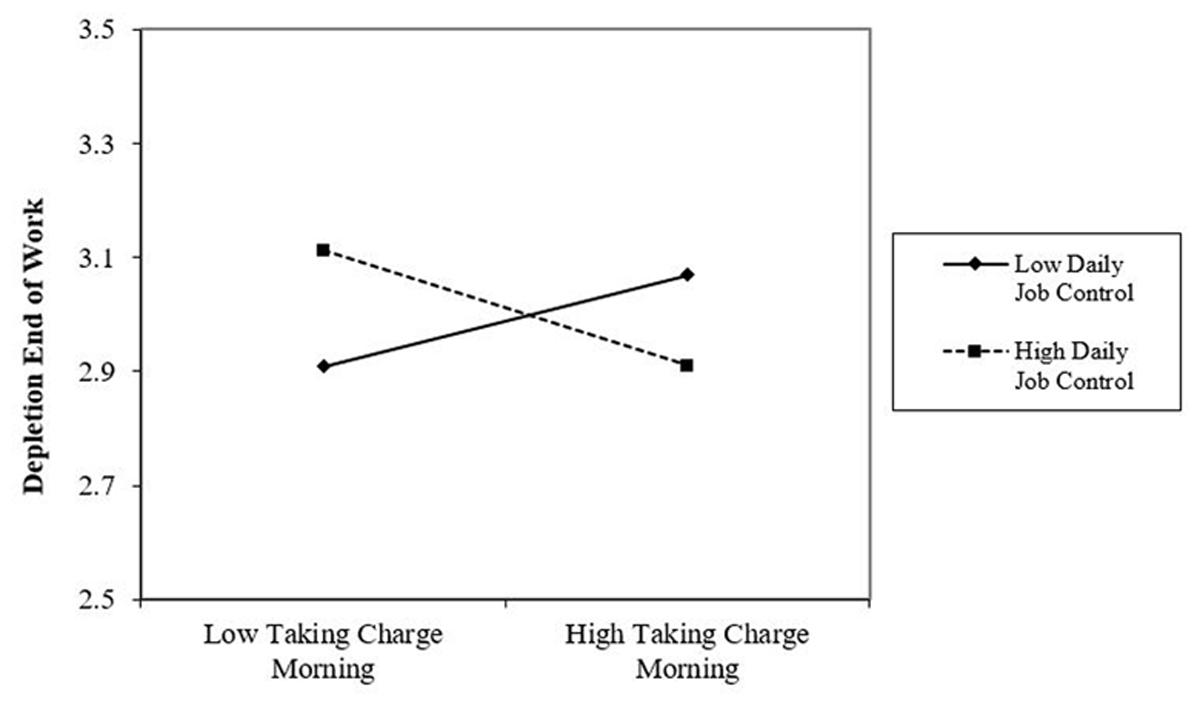
Figure 2
Moderation of Daily Job Control on the Relationship of Proactive Behavior in the Morning with Depletion at the End of Work.
According to Hypothesis 3, daily self-control demands should moderate the relationships between (a) taking charge in the morning with midday depletion, (b) taking charge in the morning with depletion at the end of work, and (c) taking charge in the afternoon with depletion at the end of work. Daily self-control demands did not moderate the relationship between taking charge in the morning and midday depletion, γ = 0.024, SE = .041, p = .554. Daily self-control demands did not moderate the relationship between taking charge in the morning and depletion at the end of work, γ = 0.018, SE = .052, p = .735. Daily self-control demands did not moderate the relationship between taking charge in the afternoon with depletion at the end of work, γ = 0.052, SE = .052, p =. 316. Hypotheses 3 (a–c) were not supported.
Additional Analyses
We tested three-way interaction effects at the within-level for morning and afternoon taking charge with the daily job control and daily self-control demands as the moderators. One of the three three-way interaction terms (i.e., taking charge in the morning X daily job control X daily self-control demands) was significant, γ = –0.160, SE = .069, p = .020. Accordingly, we specified simple slopes for the different combinations of these moderators at their high and low levels (+/– 1 SD) in Mplus for this three-way interaction (Stride et al., 2015). The simple slope for high job control and high self-control demands was negative and significant, γ = 0.209, SE = .077, p < .01. The simple slope for high job control and low self-control demands was negative and not significant, γ = –0.053, SE = .058, p = .359. The simple slope for low job control and high self-control demands was positive and significant, γ = 0.206, SE = .069, p < .01. The simple slope for low job control and low self-control demands was not significant, γ = 0.034, SE = .062, p = .587. The between-slopes difference test (Dawson & Richter, 2006) revealed that the slope for high job control and high self-control was significantly different from both slopes for low job control (for low/high: slope difference = –0.388; p < .001; for low/low: slope difference –0.244, p < .05). The slope for high job control and low self-control demands was significantly different from the slope for low job control and high self-control demands (slope difference: –0.257, p < .01). This finding indicates that the previously found two-level interaction effect of daily job-control moderating the relationship between taking charge in the morning with depletion at the end of work is more pronounced (i.e., in both directions) when daily self-control demands are high. Other possible slope differences were not significant. Figure 3 illustrates the effect.
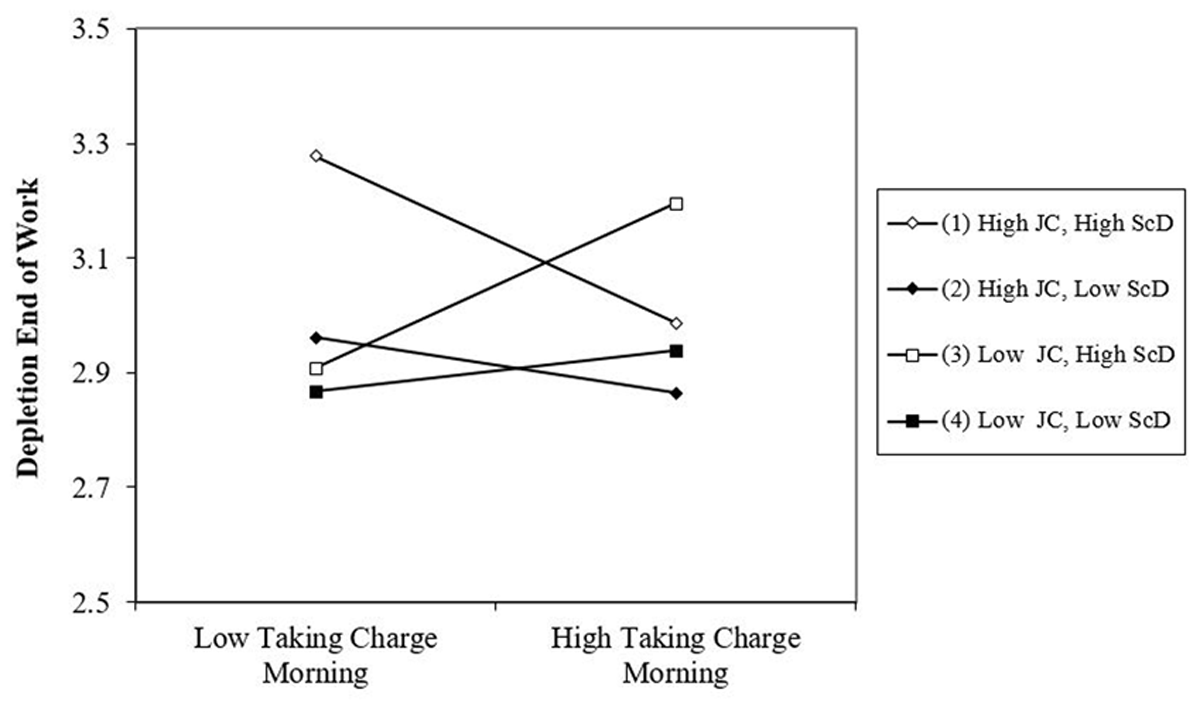
Figure 3
Three-Level Moderation of Daily Job Control and Daily Self-Control Demands on the Relationship of Proactive Behavior in the Morning with Depletion at the End of Work.
Note. JC = Daily Job Control, ScD = Daily Self-Control Demands.
Discussion
Our study shows that taking charge is depleting under specific conditions. Regarding main effects, we found that taking charge in the afternoon negatively related to depletion at the end of work. Taking charge in the morning neither related to depletion at midday nor to depletion at the end of work. Interestingly, the relationship between taking charge in the morning with depletion at the end of work was moderated by daily job control. When daily job control was high, the relationship was negative. When daily job control was low, the relationship was positive. Daily self-control demands positively predicted depletion at midday and the end of work but did not moderate any of the relationships of taking charge with depletion. However, in our additional analyses, we found a three-level interaction effect indicating that the relationship of taking charge in the morning with depletion at the end of work is more pronounced when job control is low and self-control demands are high.
Theoretical Implications
Supporting a vitalizing effect of taking charge (but contrary to hypotheses), we found that taking charge in the afternoon is associated with reduced depletion. One explanation stemming from a self-determination perspective may be that taking charge goes along with perceiving competence, which is vitalizing (Deci & Ryan, 2000). When one takes charge in the afternoon, one will perceive oneself as competent, and as a consequence vitality may offset depletion. Taking charge may fulfill competence needs because it involves overcoming challenges and mastery experiences (Cangiano et al., 2019). Further, because proactive behaviors such as taking charge are non-prescribed (Frese & Fay, 2001), standards for success are relatively malleable und in contrast to in-role job performance standards less objective. Thus, people have a higher latitude for interpreting their own proactive behaviors as successful, and even small achievements can elicit experiences of success (Fay & Sonnentag, 2012). Supporting this view, Cangiano et al. (2019) found a mediation from daily proactive behavior on end-of work vitality via daily perceived competence.
We find that taking charge fosters lagged depletion perceptions under specific circumstances. Taking charge in the morning related to depletion at the end of work when daily job control was low. We already argued that low job control (a) may limit options to behave proactively, (b) may foster controlled motivation when behaving proactively, (c) and may limit break latitude. However, when job control was high, taking charge in the morning negatively related to depletion at the end of work. On days with high job control, employees may choose proactive activities for autonomous reasons. This may make taking charge less effortful because behavioral alternatives are less salient (Kurzban et al., 2013) and goes along with a lower attractiveness of giving-in to temptations (Milyavskaya et al., 2015).
Strikingly, we found that daily job control as a moderator only on- and offsets depletion at the end of work when employees take charge in the morning, but not in the afternoon. One explanation may be that persons are not always able to correctly evaluate if engaging in taking charge will be taxing. In the morning, employees may view resources as plentiful and behave proactively without considering that depletion may unfold over the day when low job control is low. Employees may be more attentive to resources in the afternoon, and then only engage in taking charge when it is not overtaxing oneself.
Another possibility is that in the morning people may tend to address larger change projects because more time of the workday is available, whereas in the afternoon taking charge may be triggered by external demands (e.g., upcoming urgent tasks). Accordingly, Seibel et al. (2020) found that thoughts about leisure time increase toward the end of work supporting the idea that employees abstain from larger projects in the afternoon.
Self-control demands did not moderate the relationship between taking charge and depletion but predicted depletion at midday and the end of work. Thus, self-control demands seem to elicit depletion. It may be that daily self-control demands are better conceptualized as a predictor of depletion (Gombert et al., 2020), but not as a moderator, possibly because self-control demands elicit the need to exert more self-control effort (Wehrt et al., 2020) independently of self-control needed for taking charge.
Nevertheless, in an additional analysis, we found a three-level interaction effect indicating that under conditions of high self-control demands and low job control depleting effects of morning taking charge were particularly pronounced. However, under conditions of high job control and high self-control demands, vitalizing effects of morning taking charge were particularly pronounced, too. Thus, high self-control demands seem to increase the need to exert additional self-control when taking charge, but only when job control is low. On the flipside, a combination of high self-control and high job control may be ideal to take charge as a means to experience competence. Therefore, job control may be an essential factor influencing that demands elicit and increase a challenging character of taking charge, or alternatively become hindering—and make it depleting.
Further, findings indicate that taking charge needs time to translate into low energy (e.g., fatigue, depletion) and underscore the importance to consider time-lagged effects when investigating energetic processes (Sonnentag, 2012). Diary studies investigating how work behaviors relate to energy benefit from differentiating between specific time-periods during the day. Studies support this idea, such as Lanaj et al. (2016) who found that daily helping becomes depleting at an increasing rate after exceeding a certain level, or Hunter and Wu (2016) who found that on average breaks are more replenishing in the afternoon than in the morning. For studying daily work, it is fruitful to separate morning and afternoon because major resource-replenishing events occur after the morning at noon and after the end of work (i.e., lunch breaks, evening recovery).
Limitations and Future Directions for Research
Our study is not without limitations. First, our measurements of self-control demands and job control do not differentiate between the morning and the afternoon. We abstained from assessing these constructs in the midday survey to avoid overstraining participants. Accordingly, we could not analyze differential effects for morning and afternoon job control or self-control demands. Hence, future studies may want to assess job variables for morning and afternoon periods separately and look at energetic states prior to sleep or the next day (e.g., Fay & Hüttges, 2017). Relatedly, some main variables (e.g., depletion at the end of work) were assessed in the same end-of work survey, which may question the validity of causality claims. However, because hypotheses refer to depletion effects, we controlled for previous depletion states assessed in previous surveys to minimize these concerns.
Second, we did not assess resource replenishing events at midday (e.g., lunch breaks) or in the morning and afternoon (e.g., micro breaks). Trougakos et al. (2014), for instance, found that lunch break activities that fulfilled psychological needs of competence and relatedness (i.e., work and social activities) decrease end-of-work fatigue when lunch break autonomy is high. Similarly, Bennett et al. (2019) found micro-break experiences (e.g., detachment, relaxation) to positively impact energy levels. Accordingly, future studies on the depleting potential of proactive behavior can gain from considering such recovery events and experiences as conditions potentially offsetting resource depletion.
Third, we only assessed taking charge as a proactive behavior. Emphasizing the importance of taking charge, it that has been found to predict job performance (Kim et al., 2015) and job satisfaction (Kim & Liu, 2017). We selected taking charge as a proactive behavior occurring with sufficient daily variability (Fritz & Sonnentag, 2009), and not being limited to specific situations such as meetings (e.g., voice; Starzyk et al., 2018). Accordingly, we examined broad job characteristics (i.e., job control and self-control demands) as moderators. However, for other forms of proactive behavior (e.g., voice) depletion effects may depend on specific circumstances (e.g., social disapproval; Burris, 2012).
Fourth, we assessed all our variables via self-reports which may create common-method variance (Podsakoff et al., 2012). However, all our variables were person-mean centered holding individual response tendencies constant. Relatedly, we measured depletion states three times a day, and focused on the perception of depletion. Specifically, we tried to understand the interplay of time and work context in the relationship of proactivity with depletion perceptions. However, clarifying to which extent subjective reports relate to actual depletion remains important for advancing the understanding of self-control processes.
Fifth, the three-way interaction effect we found was not hypothesized. It may be that this effect does not reflect population effects and is simply a false-positive. Future studies that examine the replicability of this effect are encouraged.
Practical Implications
Our findings offer some practical implications. First, we found that taking charge in the afternoon can decrease depletion at the end of work. Taking charge as a proactive behavior may be an easy way for employees to vitalize themselves in the short term (Cangiano et al., 2019). Taking charge may be a strategy to uphold attention and persevere at work in the afternoon.
However, doing so may come with costs because depletion as a consequence of taking charge may surface later and may impair recovery in the evening (Cangiano et al., 2020; Fay & Hüttges, 2017). Our study shows that when job control is low, taking charge in the morning can be depleting. Thus, employees may try to attentively consider their available resources before they engage in taking charge.
Further, supervisors should avoid expecting their employees to take charge. This is especially important when job control cannot be provided. Such expectations may lead employees to engage in taking charge for extrinsic reasons which can make it straining (Bolino et al., 2010; Cangiano et al., 2020). Thus, taking charge can lead employees to overtax themselves or elicit work-home conflicts, for instance due to role overload (Bolino & Turnley, 2005; Cangiano et al., 2020).
Most importantly, our study suggests to design jobs with high job control (Parker et al., 2017). Although some studies indicate that (too much) job control may yield undesirable consequences (Stiglbauer & Kovacs, 2018), until this point job control seems a good option to enable taking charge without its negative consequences.
Notes
[3] Several theoretical approaches share the general tenet that investing resources (e.g., affective, motivational) can lead to over-taxation. However, in this study, we focus on cognitive resources, because taking charge mostly involves cognitive processes (e.g., goal generation, planning, reflection; Parker et al., 2010). In an attempt to specify what self-control resources are, Kotabe and Hofmann (2015) describe them as “non-motivational cognitive.” Therefore, applying the strength model of self-control is specific for our propositions.
[4] 20 Euros for filling in the entrance and daily surveys on at least five days, 30 Euros for the entrance survey and daily surveys on at least seven days, 50 Euros for the entrance survey and daily surveys on at least nine days.
[5] Persons working shorter times on Fridays (e.g., until 1:00 pm) received only two links, sent at 6:00 am and at 11:30 am. On public holidays, no links were sent.
[6] For morning surveys, data was dropped from further analyses when completed after 10:30 am, for midday survey when completed after 3:00 pm and for afternoon surveys when completed after 9:00 pm.
[7] Pearson’s chi-square and independent samples t-tests were performed for these comparisons, using SPSS 25.
[9] We excluded the item “anxious” from the negative affect measure because it did not load sufficiently on the factor for negative affect. However, results for hypotheses tests remain the same when this item is included.
[10] Only morning depletion was included in the morning survey. Thus, factor analyses were not needed for the morning survey.
Acknowledgements
We thank Maike Arnold, Monique Mohr, and Leon Toebben for useful comments on an earlier version of the manuscript and Fabienne Partsch for her help during data collection.
Funding Information
This research was supported by a grant from the German Research Foundation within the Priority Program “Intentional Forgetting in Organisations” (SPP 1921; SO 295/10-1, WE 5408/2-1). This grant is gratefully acknowledged.
Competing Interests
The authors have no competing interests to declare.
Author Contributions
Wilken Wehrt: Conceptualization, Analysis, Writing;
Sabine Sonnentag: Conceptualization, Review and Feedback on Analysis and Writing, Supervision.
Author Information
Wilken Wehrt is an Assistant Professor in Work and Organizational Psychology at Maastricht University, Netherlands. His research interests include habits, motivation, work-home conflict, and self-regulation.
Sabine Sonnentag is a full professor of Work and Organizational Psychology at the University of Mannheim, Germany. Her research addresses the question of how individuals can stay healthy, energetic, and productive at work. She studies recovery from job stress, health behavior (eating, physical exercise), proactive behavior, and self-regulation at work.