
Recovery from work stress has been shown to improve employee well-being. Recovery refers to psychophysiological unwinding after effort expenditure at work, and it is an opposite process for the activation that occurs during a demanding work period (Geurts & Sonnentag, 2006). A general distinction is made between recovery that takes place during workday breaks such as lunch breaks (i.e., internal recovery) and recovery that occurs during off-job time (i.e., external recovery; Geurts & Sonnentag, 2006). A significant number of studies have examined how to enhance recovery during free evenings, weekends, and vacations (Sonnentag et al., 2017). Lately, more studies focusing on the recovery potential of workday breaks, such as lunch breaks, have also emerged (Bosch et al., 2018; Sianoja et al., 2016; Trougakos et al., 2014; von Dreden & Binnewies, 2017). However, virtually all previous studies have focused on one temporal recovery setting at a time (e.g., lunch breaks or evenings), and how recovery at different temporal settings is interconnected is not well understood (Sonnentag et al., 2017).
We aim to investigate whether lunchtime recovery-enhancing activities are related to time spent on various recovery activities in the evenings after work. We focus on lunch breaks over other types of workday breaks because lunch breaks are typically the longest breaks and thus provide the most time to engage in recovery-enhancing activities. More specifically, we examine whether employees spend more time exercising, being physically active in natural surroundings, or engaging in social activities in the evenings on days when they engage in restoring lunchtime activities compared to days when lunch breaks are spent as usual (without these activities).
Following the conservation of resources (COR) theory (Hobfoll, 1989), to recover from job stress, employees must engage in activities that help them to replenish the resources lost at work. In the context of recovery, internal resources such as energy and positive mood are most relevant (Sonnentag & Fritz, 2007). According to the COR theory, the relationship between activities and resources is reciprocal: Not only do certain activities result in a resource gain, but gained resources facilitate engaging in (resource-restoring) activities (Gorgievski & Hobfoll, 2008; Hobfoll et al., 2003). This interplay may lead to a gain spiral of resources across different temporal recovery settings (Salanova et al., 2010).
Our study contributes to the evidence-based understanding of how recovery in different temporal recovery settings is interconnected. Understanding whether recovery activities facilitate engaging in further recovery activities later is important for practical reasons. Both employees and employers alike will benefit from knowing whether engaging in restoring lunchtime activities will make it easier for employees to engage in evening recovery activities that further benefit their health and well-being (i.e., benefits of recovery will accumulate). Lunchtime recovery activities can be an effective investment for organizations if they lead to health-promoting behavior in employees’ free time. Health-promoting free time activities such as physical activity may also increase employees’ energy levels at work and lead to better workability (ten Brummelhuis & Bakker, 2012; ten Brummelhuis & Trougakos, 2014; Kettunen et al., 2014).
Recovery activities and well-being
Earlier recovery research has examined how engaging in specific recovery activities is related to well-being. Regarding external recovery (i.e., activities carried during off-job time), work-related activities have been systematically found to inhibit recovery, whereas social and physical activities have been associated with multiple positive outcomes in daily diary studies (Sonnentag et al., 2017). For example, social and physical activities have been associated with improved well-being, high vigor, and low need for recovery at bedtime (Bakker et al., 2013; Sonnentag, 2001; Sonnentag & Zijlstra, 2006; ten Brummelhuis & Bakker, 2012; ten Brummelhuis & Trougakos, 2014). Intervention studies have provided further evidence that physical exercise can in fact decrease fatigue among exhausted employees (de Vries et al., 2017). De Vries et al. (2017) examined the effects of a 6-week physical exercise intervention. They found that overall fatigue decreased immediately after the intervention and these effects sustained at 6 and 12 week follow-ups. Additionally, in a cross-sectional study, free time spent interacting with nature was associated with low need for recovery from work (Korpela & Kinnunen, 2010). Need for recovery (Sluiter et al., 1999) refers to a state of being depleted of energy and having poor concentration and a desire to take a break from effortful activities. Thus, the study by Korpela and Kinnunen (2010) suggests that spending time interacting with nature is overall related to better recovery from work.
Lunch breaks and other workday breaks are much shorter and typically spent in a different environment (e.g., at worksite, with colleagues) than free time after work. Thus, not all activities that enhance external recovery necessarily benefit internal recovery. For example, lunchtime social activities have been linked to increased afternoon fatigue unless employees rate their lunchtime autonomy exceptionally high (i.e., employees get to freely choose how to spend their breaks; Trougakos et al., 2008).
Completing relaxation exercises, or otherwise engaging in relaxing activities, and taking lunchtime park walks have been shown to promote internal recovery. In daily diary studies, relaxing lunchtime activities have been linked to higher levels of positive affect after the break and less fatigue in the afternoon (Trougakos et al., 2008; Trougakos et al., 2014). In a six-month intervention study, a group of employees was asked to engage in a 20-minute progressive muscle relaxation (PMR) exercise during their lunch breaks (Krajewski et al., 2010; Krajewski et al., 2011; Schnieder et al., 2013). Compared to a small-talk control group, employees in the PMR exercise group experienced lower levels of strain and less sleepiness in the afternoon. Cortisol levels measured after lunch and at bedtime were also lower in the PMR group than in the control group.
Brown et al. (2014) conducted an intervention study comparing lunchtime walks in natural and urban environments and spending breaks as usual. The nature walk group reported higher levels of self-reported mental health, but several other health parameters did not improve. Another intervention study compared so-called savoring nature exercises and PMR exercises during lunch breaks to a wait-list control group (Steidle et al., 2017). Both 10-minute exercises were completed at the employees’ work desks. The savoring nature exercise combined auditory stimuli of a natural environment with a guided imagination technique. When treating both intervention groups as one, the intervention group experienced more vigor in the afternoon and less fatigue in the evening compared to the wait-list control group.
The present study builds on a lunchtime intervention study, where we found that 15-minute park walks and relaxation exercises on 10 working days improved day shift employees’ afternoon well-being at the within-person level (Sianoja et al., 2018). Walking a pre-determined route at a slow pace in a nearby park improved concentration in the afternoon compared to days when no walk was completed. Park walks also increased lunchtime enjoyment, which in turn was related to less afternoon fatigue. Relaxation exercises were associated with increased lunchtime detachment, improved afternoon concentration, and less afternoon stress and fatigue. To summarize, social activities, physical exercise, and spending time in natural environments during off-job time have been found to enhance recovery from work and increase employee well-being. Furthermore, relaxation exercises and park walks during lunch breaks are promising ways to improve internal recovery.
As in the studies introduced above, various temporal recovery settings have been generally examined in isolation. One exception is a cross-sectional study where de Bloom et al. (2015) found that using energy management strategies at work was positively related to recovery experiences in the evenings after work. Energy management strategies refer to very short breaks between work tasks, such as making a to-do list, getting coffee, or listening to music. Recovery experiences, in turn, include psychological detachment from work, relaxation, control, and mastery experiences (Sonnentag & Fritz, 2007). Additionally, unfavorable recovery states (i.e., high fatigue, anxiety, low vigor) at the end of the workday have been linked to experiencing evening activities as less enjoyable and reporting less need satisfaction during the evening (van Hooff & de Pater, 2017; van Hooff & Geurts, 2014).
Internal resources as mediators
As stated above, based on the COR theory, engaging in restoring activities is expected to result in resource gain, which in turn will facilitate engaging in restoring activities later. Given that internal resources are particularly relevant in the context of recovery from work, we examine whether fatigue and positive affect will mediate the relationship between lunchtime recovery activities and evening recovery activities. Based on the studies reviewed above, we expect that employees will be less fatigued and report higher levels of positive affect in the afternoon on days when they engage in park walks or relaxation exercises at lunchtime compared to days without these activities.
Furthermore, we expect that lower levels of fatigue and higher levels of positive affect in the afternoon will increase the time spent on physical exercise, physical activities in natural surroundings, and social activities in the evening after work. Engaging in these recovery-enhancing activities after work requires some initial effort and may be easier on days when employees’ resources are not depleted after work. Some day-level studies suggest that employees are less likely to engage in physical exercise after a stressful day at work when vigor is low, but not all studies have been able to replicate these findings (Nägel et al., 2015; Sonnentag & Jelden, 2009). In one study, situational constraints (i.e., having to work with outdated or incomplete materials and information) predicted less time spent on physical exercise and more time spent on low-effort activities (Sonnentag & Jelden, 2009). Furthermore, according to the broaden-and-build theory (Fredrickson et al., 2000), positive emotions broaden people’s awareness and encourage novel actions. Following the COR theory, the broaden-and-build theory, and previous research literature, we hypothesize the following:
Hypothesis 1: On days when employees complete a lunchtime park walk, they spend more time on (a) physical exercise, (b) physical activities in natural surroundings, and (c) social activities in the evenings after work compared to days when they spend the lunch break as usual.
Hypothesis 2: On days when employees complete a lunchtime relaxation exercise, they spend more time on (a) physical exercise, (b) physical activities in natural surroundings and (c) social activities in the evenings after work compared to days when they spend the lunch break as usual.
Hypothesis 3: The within-person effect of lunchtime park walks on time spent on evening recovery activities is transmitted via low afternoon fatigue and high positive affect.
Hypothesis 4: The within-person effect of lunchtime relaxation exercises on time spent on evening recovery activities is transmitted via low afternoon fatigue and high positive affect.
Given our hypotheses that employees are more likely to engage in evening recovery activities that may require some initial effort after engaging in recovery-enhancing lunchtime activities, we focused on physical and social activities rather than low-effort activities. However, to provide a more complete picture, as an additional analysis, we included evening relaxation as one of the outcomes. This was a post hoc analysis, and thus we did not set any specific hypotheses for the relationship between lunchtime activities and evening relaxation. Relaxation refers to a state with low activation and high positive affect and is known to enhance recovery from work (Sonnentag & Fritz, 2007). Specific relaxation exercises, such as the lunchtime relaxation exercise in our study, as well as various other activities, such as listening to music or reading a book, may elicit relaxation.
Methods
Participants
Utilizing the same dataset, this study builds on a previously published paper where we report how lunchtime park walks and relaxation exercises improve well-being in the afternoon (Sianoja et al., 2018) We contacted all employees working in seven participating organizations (altogether 2,226 employees). Employees mainly worked in knowledge-intensive and emotionally demanding jobs. The following exclusion criteria was used: (a) shift work or (b) inability to walk for 15 minutes. Initially, 279 employees volunteered to participate (response rate of 12.5%). We only included participants when at least 6 employees volunteered to participate from the same work site, reducing the number of participants to 225.
Participants were randomly assigned to one of three groups: (1) park walk, (2) relaxation, and (3) control group. The control group was instructed not to change their lunch break in any way and to spend lunch breaks in the same manner as before the study. The study was carried out in Finland, where it is typical to take a 30-minute lunch break and spend it eating lunch with colleagues or alone at a breakroom, cafeteria, or restaurant. Subsequently, 48 employees dropped out before the beginning of the study and 5 during the study. Furthermore, 19 employees were excluded from the dataset because they did not perform the intervention exercise regularly enough (i.e., less than 6 out of 10 performed exercises) or their data were largely missing. When analyzing sample attrition, participants did not differ from dropouts in terms of intervention group or background characteristics (i.e., gender, age, education, occupational status, type of contract, or working hours). However, employees experiencing high levels of exhaustion were more likely to drop out than less exhausted participants (M = 2.57 vs. M = 2.03; t(177) = 2.22, p < 0.05).
In this study, we focused on the within-person effects of completing a park walk or relaxation exercise on the same-day evening activities. Thus, the control group (n = 56) was excluded from the analyses (see de Bloom et al., 2017, and Torrente et al., 2017, for results including control group). Our final sample consisted of 97 employees, 51 of whom were randomly assigned to the park and 46 to the relaxation group.
Participants came from seven organizations working in various sectors, including public administration, education, health care, media, technology, and finance. Most participants were women (91.8%), and the average age was 46.8 years (range 25–62, SD = 9.6). Most participants (83.5%) were either married or cohabiting with a partner, and 58.2% had children (two on average) living at home. The participants were highly educated, with 49.0% holding an academic degree (master’s degree or higher) and 18.8% having a bachelor’s or a polytechnic degree. About one-third of the participants (32.3%) had a vocational education or less. Most participants had a permanent contract (90.6%) and worked full time (95.8%) with an average of 38.4 hours per week (range 25–50, SD = 3.50).
Procedure
Data were collected in two phases in spring (51 participants) and fall (46 participants) 2014. Each data collection lasted six weeks, two of which were intervention weeks (see Figure 1). During the intervention weeks, participants completed the park walk or relaxation exercise for 15 minutes daily during lunch breaks (10 working days in total). We chose the duration based on what we believed to be a maximum realistic time for a lunchtime activity in addition to eating lunch. In addition, previous studies have indicated that restorative benefits may occur within a 15-minute walk (Park et al., 2009). Before the study, participants filled out an online survey providing background information. Daily measurements were collected every Tuesday and Thursday one week before, two weeks during, and one and three weeks after the intervention, altogether on 10 days. A short SMS questionnaire was sent to participants’ cell phones in the afternoons about one hour before they usually left work. Participants were also asked to complete a pencil-and-paper questionnaire each evening.
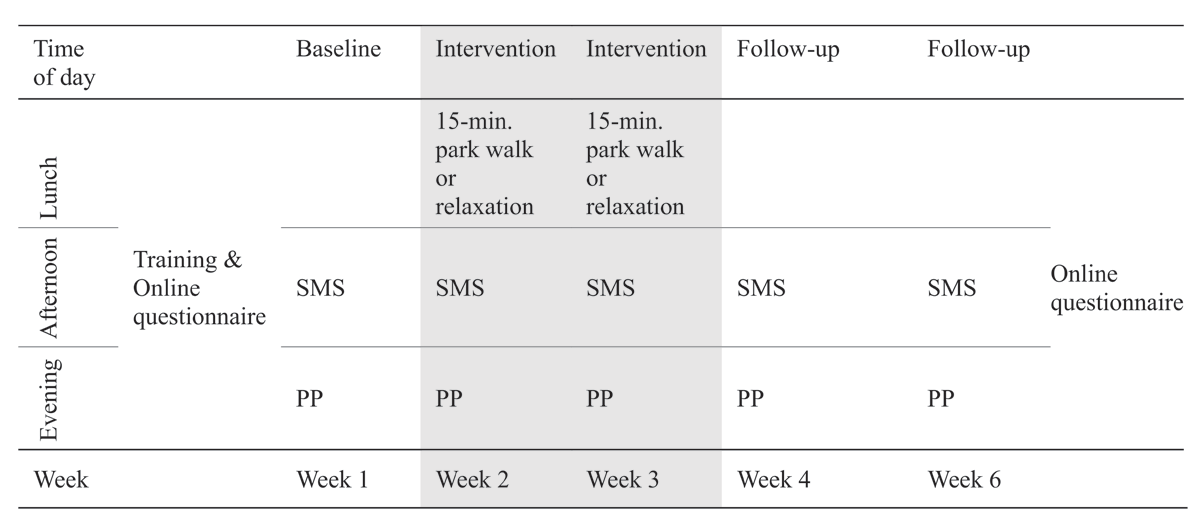
Figure 1
Study design. Daily data were collected twice a week, on Tuesdays and Thursdays. The intervention exercise was completed every day from Monday to Friday during the two intervention weeks. SMS = SMS questionnaire sent to participants’ cell phones; PP = pencil-and-paper questionnaire.
Before data collection, the researchers visited each work site and informed the participants about the data collection procedure and instructed how to complete the intervention exercises in person. Park walks were carried out in urban parks close to each participant’s workplace. Participants were advised to walk a predetermined route slowly and to focus on the surrounding natural environment. The participants were asked to refrain from talking to each other if they chose to walk in groups to keep their focus on the natural surroundings. The relaxation group was instructed to find a peaceful place within the office building to carry out the exercise based on the training session and written instructions for the exercise. This exercise consisted of the release-only version of PMR (Öst, 1987), deep breathing, and the acceptance component of mindfulness (Tuomisto, 2007).
Before the intervention, most participants (93.8%) took lunch breaks four to five times a week, with an average lunch break lasting 27.6 minutes. During the intervention, on average, participants completed the intervention exercise on 8.6 out of 10 days. In both groups, lunch breaks lasted 33 minutes on average, including the intervention exercise. The park walking group engaged in the exercise on average for 15 minutes (range: 8–20) and the relaxation group for 14 minutes (range: 8–20). The full protocol has been published elsewhere (de Bloom et al., 2014), and the study protocol was duly approved by the Ethics Committee [details omitted for blind reviewing].
Measures
Park walks and relaxation exercises
To confirm whether the participants completed the park walk or relaxation exercise on each intervention day, we asked, “Did you go for a walk during your lunch break?” or “Did you engage in relaxation exercise during your lunch break?” (no = 0, yes = 1) in the evening pencil-and-paper questionnaire.
Afternoon resources
Positive affect and fatigue were each measured with one item via afternoon SMS questionnaires. Positive affect was measured with the item “I feel happy” (Warr, 1994) and fatigue with the item “I feel fatigued” (Van Hooff et al., 2007) on a scale from 1 (= strongly disagree) to 7 (= strongly agree).
Evening recovery activities
To measure how much time employees spent on recovery activities in the evenings after work, we asked, “After finishing work, how much time [in hours] did you spend on …” “physical exercise?”, “physical activities in nature?”, and “social activities (e.g., spending time with friends or family)?” (adapted from Sonnentag, 2001). Relaxation in the evening was measured with one item from the Recovery Experience Questionnaire: “During time after work … I kicked back and relaxed” (1 = strongly disagree, 5 = strongly agree; Kinnunen et al., 2011; Sonnentag & Fritz, 2007). Measures of evening recovery activities and experiences were included in the evening pencil-and-paper questionnaire.
Control variables
Given our focus on the within-person effects, we did not control for any between-person level variables.1 At the within-person level, we controlled for daily working hours, as we expected that long working hours may lessen the likelihood of completing the given intervention activity as well as leave less time for evening recovery activities. We measured working hours by asking participants, “How many hours did you work today?” in the evening pencil-and-paper questionnaire.
As a robustness check, we explored the role of weather influencing the relationship between park walks and physical activity in natural surroundings. On days when employees completed the park walks, we asked, “How was the weather during your walk?” (1 = very bad, 5 = very good).
Statistical analysis
The daily data collected on 10 working days were nested within persons. Therefore, we used multilevel modeling to account for the non-independence of the data. We followed the analytical strategy suggested by Bliese and Ployhart (2002) and ran multilevel models in R using the NLME library (Pinheiro & Bates, 2000). Models were estimated using restricted maximum likelihood. Given our focus on the within-person level, we followed Raudenbush and Bryk (2002) and centered all independent variables measured at the day-level around the person mean. Even though our hypotheses were set to test the within-person effects (i.e., are lunchtime activities associated with evening activities at the day level), we additionally included grand-mean-centered variables in the models to account for the between-person effects and briefly present these results for the interested reader. We started by estimating a null model (i.e., a model where the intercept is the only predictor) separately for each outcome, which provides variance at the between- and within-person levels. Based on this information, we calculated the intraclass correlation coefficients (ICC1), which show the proportion of the total variance explained by the between-person variance. ICC1 above 0.05 suggests that substantial variability in daily responses is explained by person membership, and multilevel modeling is warranted due to the non-independence of the data (Bliese, 2000).
Next, we assessed the error structure of the model. The independence of the within-person errors was tested by including autocorrelation or heteroscedasticity. The best model fit was determined by using the likelihood ratio difference test and comparing the fit indices of the tested models. Then, we estimated (a) models including control variables (working hours) and predictors (lunchtime park walk and relaxation exercise) and (b) models including control variables, predictors, and mediators (afternoon fatigue and affect). Finally, we tested mediation using R mediation package, which allowed us to take the multilevel structure of our data into account and estimate the specific indirect effects and the respective 95% quasi-Bayesian confidence intervals (Preacher & Hayes, 2008; Preacher, Zyphur, & Zhang, 2010; Tingley, Yamamoto, Hirose, Keele, & Imai, 2014).
Results
Means, standard deviations, and zero-order correlations of the study variables are presented in Table 1. Participants worked on average 7 hours 38 minutes each day (SD = 45 min.). In the evenings, they spent on average 34 minutes exercising per day (SD = 22 min.), 18 minutes exercising in nature per day (SD = 20 min.), and 1 hour 58 minutes on social activities per day (SD = 1 h 3 min.). Evenings were often experienced as relaxing (M = 3.94, SD = 0.61).
Table 1
Means, standard deviations, and zero-order correlations between study variables.
| M | SD | 1. | 2. | 3. | 4. | 5. | 6. | 7. | 8. | 9. | |
|---|---|---|---|---|---|---|---|---|---|---|---|
| 1. Work hours | 7.64 | 0.76 | – | 0.01 | –0.07 | 0.03 | –0.13** | –0.07* | –0.05 | –0.22** | –0.21** |
| 2. Park walkinga | 0.24 | 0.23 | –0.10 | – | –0.01 | –0.06 | 0.05 | 0.08* | 0.11** | –0.04 | 0.04 |
| 3. Relaxation exerciseb | 0.21 | 0.24 | 0.29** | –0.75** | – | –0.16** | 0.03 | 0.03 | 0.05 | 0.03 | 0.07 |
| 4. Fatigue (1–7) | 3.81 | 1.15 | –0.01 | 0.04 | –0.02 | – | –0.28** | –0.04 | 0.004 | –0.04 | 0.03 |
| 5. Positive affect (1–7) | 4.85 | 0.93 | 0.12 | 0.02 | 0.15 | –0.36** | – | 0.02 | –0.05 | 0.05 | 0.14** |
| 6. Evening physical exercise | 0.57 | 0.37 | –0.06 | –0.04 | –0.04 | –0.18 | 0.08 | – | 0.42** | –0.16** | 0.20** |
| 7. Evening physical activity in nature | 0.31 | 0.33 | –0.20 | 0.01 | –0.07 | –0.27** | 0.14 | 0.32** | – | –0.05 | 0.11** |
| 8. Evening social activities | 1.97 | 1.07 | –0.11 | –0.05 | –0.05 | –0.25* | 0.22* | 0.09 | 0.11 | – | 0.18** |
| 9. Evening relaxation (1–5) | 3.94 | 0.61 | –0.29** | 0.09 | –0.17 | –0.28** | 0.31** | 0.17 | 0.18 | 0.20 | – |
[i] Notes: Correlations below the diagonal are between-person level correlations (person means aggregated over the repeated daily observations; N = 97), correlations above the diagonal are within-person (day level) correlations (N = 970). a 0 = no, 1 = yes, a park walk during lunch break; b 0 = no, 1 = yes, a relaxation exercise during lunch break.
* p < 0.05, ** p < 0.01.
The ICC1 for evening physical exercise was 0.24, for physical activity in nature 0.27, for social activities 0.43, and for relaxation 0.31. Thus, a large proportion of the variance in the outcomes is at the person-level, and a multilevel approach is warranted. When examining the error structure of the model, including the estimate of autocorrelation improved the model fit for physical exercise and including the estimate of heteroscedasticity improved the model fit for relaxation. Neither estimates of autocorrelation nor heteroscedasticity improved the model fit for physical activity in nature or social activities.
Physical exercise
The results responding to our hypotheses are presented in Table 2. On days when participants completed the park walk during their lunch break, they spent more time exercising in the evening after work compared to days when they spent the lunch break as usual. Other predictors or mediators were not associated with evening physical exercise: Daily work hours, completing lunchtime relaxation exercise, afternoon fatigue, or afternoon positive affect were not related to time spent exercising in the evening. Thus, hypothesis 1a predicting that completing a lunchtime park walk is associated with increased time spent exercising in the evening was supported. Hypothesis 2a predicting that completing a lunchtime relaxation exercise is associated with increased time spent exercising in the evening was not supported.
Table 2
Multi-level regression analyses.
| VARIABLE | EVENING PHYSICAL EXERCISE | EVENING PHYSICAL ACTIVITY IN NATURAL SURROUNDINGS | SOCIAL ACTIVITIES | |||||||||||||||
|---|---|---|---|---|---|---|---|---|---|---|---|---|---|---|---|---|---|---|
| MODEL 1 | MODEL 2 | MODEL 1 | MODEL 2 | MODEL 1 | MODEL 2 | |||||||||||||
| EST | SE | T | EST | SE | T | EST | SE | T | EST | SE | T | EST | SE | T | EST | SE | T | |
| Intercept | 0.67 | 0.07 | 10.34 | 0.69 | 0.07 | 10.10 | 0.28 | 0.06 | 4.93 | 0.28 | 0.06 | 4.87 | 2.00 | 0.17 | 11.64 | 2.06 | 0.18 | 11.63 |
| Within-person results | ||||||||||||||||||
| Time (diary day) | –0.01 | 0.01 | –1.90 | –0.02 | 0.01 | –2.22* | 0.004 | 0.01 | 0.75 | 0.003 | 0.01 | 0.53 | 0.01 | 0.01 | 0.81 | 0.02 | 0.02 | 1.41 |
| Work hours | –0.04 | 0.02 | –1.81 | –0.04 | 0.03 | –1.48 | –0.02 | 0.02 | –1.31 | –0.03 | 0.02 | –1.46 | –0.27 | 0.04 | –6.02*** | –0.29 | 0.05 | –5.58*** |
| Park walkinga | 0.14 | 0.05 | 2.69** | 0.16 | 0.06 | 2.70** | 0.16 | 0.05 | 3.49*** | 0.20 | 0.05 | 3.80*** | –0.10 | 0.11 | –0.84 | –0.12 | 0.12 | –0.97 |
| Relaxation exerciseb | 0.07 | 0.06 | 1.17 | 0.06 | 0.06 | 0.88 | 0.07 | 0.05 | 1.44 | 0.10 | 0.06 | 1.82 | 0.16 | 0.12 | 1.28 | 0.08 | 0.13 | 0.59 |
| Afternoon fatigue | –0.01 | 0.02 | –0.70 | –0.0002 | 0.02 | –0.02 | –0.01 | 0.04 | –0.37 | |||||||||
| Afternoon PAc | –0.002 | 0.03 | –0.09 | –0.03 | 0.02 | –1.32 | 0.02 | 0.05 | 0.38 | |||||||||
| Between-person results | ||||||||||||||||||
| Work hours | –0.02 | 0.06 | –0.44 | –0.05 | 0.06 | –0.84 | –0.08 | 0.05 | –1.72 | –0.10 | 0.05 | –2.10* | –0.12 | 0.16 | –0.80 | –0.13 | 0.16 | –0.81 |
| Park walkinga | –0.26 | 0.27 | –0.94 | –0.26 | 0.28 | –0.96 | –0.08 | 0.23 | –0.35 | –0.07 | 0.22 | –0.30 | –0.68 | 0.75 | –0.90 | –1.18 | 0.77 | –1.54 |
| Relaxation exerciseb | –0.23 | 0.27 | –0.85 | –0.26 | 0.28 | –0.92 | –0.06 | 0.23 | –0.27 | –0.07 | 0.23 | –0.31 | –0.59 | 0.74 | –0.80 | –1.26 | 0.77 | –1.62 |
| Afternoon fatigue | –0.08 | 0.04 | –1.97 | –0.09 | 0.03 | –2.86** | –0.20 | 0.11 | –1.82 | |||||||||
| Afternoon PAc | 0.01 | 0.05 | 0.29 | 0.03 | 0.04 | 0.62 | 0.26 | 0.14 | 1.86 | |||||||||
| Model fit statistics | ||||||||||||||||||
| Level-1 intercept variance (SE) | 0.31(0.56) | 0.31(0.56) | 0.20(0.45) | 0.21(0.46) | 1.24(1.11) | 1.18(1.09) | ||||||||||||
| BIC | 1528.41 | 1367.12 | 1163.35 | 1078.33 | 2682.62 | 2324.95 | ||||||||||||
| AIC | 1477.33 | 1299.95 | 1117.14 | 1015.95 | 2635.99 | 2261.96 | ||||||||||||
| –2*log(lh) | 1455.33 | 1269.95 | 1097.14 | 987.95 | 2615.99 | 2233.96 | ||||||||||||
[i] Notes: All variables were measured at the day level. a 0 = no, 1 = yes, a park walk during lunch break; b 0 = no, 1 = yes, a relaxation exercise during lunch break. cPA = Positive affect. BIC = Bayesian Information Criterion; AIC = Akaike’s Information Criterion. When comparing nested models, the smallest indices indicate the best model fit.
* p < 0.05, ** p < 0.01, *** p < 0.001.
Physical activity in natural surroundings
Similar to physical exercise, on days when employees completed the lunchtime park walk, they spent more time being physically active in nature in the evening after work compared to days when did not go for a walk during lunch break. Thus, hypothesis 1b was supported. Again, none of the other predictors or mediators were associated with time spent being physically active in nature at the within-person level. Contradicting hypothesis 2b, completing the lunchtime relaxation exercise was not associated with being physically active in the nature in the evening. Similarly, daily work hours, afternoon fatigue, or afternoon positive affect were not related to being physically active in nature in the evening. At the between-person level, working longer hours and experiencing higher levels of fatigue in the afternoon across the study period were related to spending less time being physically active in nature.
Social activities
When looking at time spent on social activities in the evenings, on days when employees worked longer hours, they spent less time on social activities in the evening after work. Hypotheses 1c or 2c were not supported, as lunchtime park walks or relaxation exercises were not related to time spent on social activities in the evening after work. Furthermore, neither fatigue nor positive affect were related to time spent on social activities in the evening.
Overall, hypotheses 3 and 4 predicting that the relationship between lunch break activities and evening recovery activities is transmitted via afternoon fatigue and positive affect were not supported.
Additional analyses
Evening relaxation
Longer daily working hours were also related to experiencing lower levels of relaxation in the evening after work (Table 3). Completing lunchtime park walks or relaxation exercises was not associated with relaxation in the evening. Furthermore, higher positive affect in the afternoon, but not fatigue, was related to experiencing higher levels of relaxation in the evening. At the between-person level, employees who worked shorter hours and experienced higher positive affect in the afternoons across the study period also experienced higher levels of relaxation in the evening after work.
Table 3
Multi-level regression analyses predicting evening relaxation.
| MODEL 1 | MODEL 2 | |||||
|---|---|---|---|---|---|---|
| EST | SE | T | EST | SE | T | |
| Intercept | 3.88 | 0.10 | 37.33 | 3.99 | 0.10 | 39.50 |
| Within-person results | ||||||
| Time (diary day) | 0.01 | 0.01 | 1.13 | 0.01 | 0.01 | 0.81 |
| Work hours within | –0.17 | 0.03 | –5.44*** | –0.09 | 0.04 | –2.51* |
| Park walking withina | 0.15 | 0.08 | 1.88 | 0.14 | 0.09 | 1.59 |
| Relaxation exercise withinb | 0.14 | 0.09 | 1.64 | 0.09 | 0.10 | 0.95 |
| Afternoon fatigue within | 0.04 | 0.03 | 1.62 | |||
| Afternoon positive affect within | 0.11 | 0.04 | 2.99** | |||
| Between-person results | ||||||
| Work hours between | –0.20 | 0.09 | –2.31* | –0.18 | 0.08 | –2.10* |
| Park walking betweena | –0.004 | 0.42 | –0.01 | –0.46 | 0.39 | –1.18 |
| Relaxation exercise betweenb | –0.28 | 0.42 | –0.65 | –0.84 | 0.40 | –2.12* |
| Afternoon fatigue between | –0.06 | 0.06 | –1.07 | |||
| Afternoon positive affect between | 0.24 | 0.07 | 3.34** | |||
| Model fit statistics | ||||||
| Level-1 intercept variance (SE) | 0.75(0.86) | 0.76(0.87) | ||||
| BIC | 2143.74 | 1857.53 | ||||
| AIC | 2092.39 | 1789.92 | ||||
| –2*log(lh) | 2070.39 | 1759.92 | ||||
[i] Notes: All variables were measured at the day level. a 0 = no, 1 = yes, a park walk during lunch break; b 0 = no, 1 = yes, a relaxation exercise during lunch break. BIC = Bayesian Information Criterion; AIC = Akaike’s Information Criterion. When comparing nested models, the smallest indices indicate the best model fit.
* p < 0.05, ** p < 0.01, *** p < 0.001.
Weather as a confounding factor
The intervention days were predetermined, and compliance with the protocol was high (8.6 out of 10 intervention exercises completed), suggesting that employees completed the park walks on the intervention days irrespective of the weather conditions. Participants’ rating of weather on the intervention days was not related to time spent exercising in the evening (r = –0.01, p = 0.89) or time spent being physically active in natural surroundings (r = 0.12, p = 0.10).
Finally, it is still possible that weather was particularly good on the intervention days compared to non-intervention days. In fact, when looking at the weather records for the spring study period, it seems that the evenings were partly rainy more often on the non-intervention days (67% of the measurement days) than on intervention days (25% of the measurement days). A similar comparison for the fall study period revealed that there was some rain in the evening of one intervention day but no rain in the evenings of non-intervention days. We therefore ran our models separately for the spring and fall groups to see whether the weather conditions in the spring influenced our results. Supporting the robustness of our findings, the results showed a significant relationship between completing the lunchtime park walk and being physically active in natural surroundings both in the spring (B = 0.19, SE = 0.07, p < 0.01) and fall (B = 0.14, SE = 0.07, p < 0.05) groups. Additionally, if weather would have determined how much time employees spent being physically active in nature in the evenings and weather was exceptionally good during the intervention weeks, we would have also expected to find a significant relationship between lunchtime relaxation exercise and being physically active in nature in the evenings. This is because the lunchtime relaxation exercise was completed during the same intervention weeks as the lunchtime park walks. Taken together, we are confident that weather did not cause our findings, but it is possible that good weather has enhanced the relationship between lunchtime park walks and being physically active in nature in the evenings.
Discussion
Our aim was to explore how recovery-enhancing activities across temporal settings are interconnected. We examined whether engaging in restorative lunchtime activities (i.e., park walks and relaxation exercises) is associated with more time spent on evening recovery activities at the within-person level. As evening recovery activities, we included physical exercise, physical activity in natural surroundings, and social activities, as these activities may require some initial effort but have been previously linked to improved health and well-being. As an additional analysis, we also tested the relationship between lunchtime activities and evening relaxation. Based on the COR theory (Hobfoll, 1989; Hobfoll et al., 2003), we assumed that restoring lunchtime activities generate resources, which in turn make it easier for the employees to engage in evening recovery activities. In addition to testing energy (low fatigue) as a resource in this relationship, we drew on the broaden-and-build theory (Fredrickson et al., 2000) and assumed that positive affect will be an important resource explaining the lunchtime activity–evening activity relationship.
Our findings showed that on days when employees went for a park walk during their lunch break, they spent more time exercising and being physically active in nature in the evening after work. However, contradictory to our expectations, lunchtime relaxation exercises were not related to evening recovery activities. Furthermore, internal resources did not mediate the relationship between lunchtime activities and evening activities. More specifically, low fatigue and high positive affect in the afternoon were not associated with time spent on physical exercise, physical activity in nature, or social activities in the evening. Thus, overall, our results did not support the idea based on the COR theory that internal resources would increase the time employees spend on evening recovery activities. While Sonnentag and Jelden (2009) found that daily stress was associated with less time spent exercising in the evenings through low vigor, in their study, fatigue did not mediate this relationship. Furthermore, not all studies have been able to replicate the significant findings between daily stress and time spent on physical exercise (Nägel et al., 2015). Therefore, it seems that other factors, such as exercise motives (Nägel et al., 2015) or exercise routines, play a greater role in determining how much time people spend exercising than internal resources.
Given that increased afternoon resources were not associated with time spent on evening recovery activities, other mechanisms must explain the significant relationship between lunchtime park walks and time spent on evening physical exercise and physical activity in nature. One possibility is that lunchtime park walks reminded the employees of how enjoyable walking in natural surroundings can be, and they were inspired to continue similar activities and be physically active in the evening. This idea is supported by our earlier finding that lunchtime enjoyment (“I enjoyed my lunch break”) was higher on days when employees completed the lunchtime park walk compared to lunch breaks without the park walk, suggesting that the park walks itself were enjoyable (Sianoja et al., 2018). Thus, lunchtime park walks that reminded employees of how enjoyable walking in natural surroundings can be may have increased their intrinsic motivation to engage in similar activities later on. Intrinsic motivation is characterized by behaviors engaged in out of interest and enjoyment for the activity (Deci & Ryan, 2000). To conclude, rather than supporting the general idea that any restoring lunchtime activity will increase time spent on other recovery-enhancing activities later, our results suggest that lunchtime activities may motivate employees to spend more time on similar recovery activities after work if the lunchtime activity was enjoyable.
Neither lunchtime park walks nor relaxation exercises were associated with time spent on social activities. As noted above, our results suggest that other factors than increased afternoon resources determine how much time employees spend on various evening activities. Social activities with friends or relatives may often be pre-planned, and time spent with family may be dependent on the schedules of other family members. Nevertheless, our results showed that on days when employees worked longer hours, they spent less time on social activities after work. This can be explained due to a time squeeze: When employees stay longer at work, there is less time to spend with family or friends in the evenings after work. However, it is also possible that when employees have made plans with friends or family after work, they will leave work earlier, and their working hours may be shorter.
Finally, as an additional analysis, we tested the relationship between lunchtime activities and evening relaxation experience. Neither of the lunchtime intervention activities were associated with evening relaxation. On days when employees worked longer hours, they experienced lower levels of relaxation in the evening. Furthermore, on days when employees experienced higher levels of positive affect in the afternoon, they experienced higher levels of relaxation in the evening.
To our best knowledge, our study was the first to examine the association between lunchtime recovery activities and time spent on recovery activities in the evening, and it expands the understanding of how recovery activities across multiple temporal settings are related. Our findings were somewhat contradictory with the results reported by de Bloom et al. (2015), who also focused on the relationship between internal and external recovery; however, their study was quite different by design, as they used a cross-sectional survey to understand how energy management strategies used during the working day are associated with recovery experiences during free evenings. Given the differences in study design (intervention study versus cross-sectional survey) and outcome measures (recovery activities versus recovery experiences), it is not surprising that the findings were quite different. Whereas de Bloom et al. (2015) found that energy management strategies used at work were positively related with various evening recovery experiences, our findings suggested a specific link between lunchtime park walks and similar evening activities but not an overall association between all lunchtime and evening recovery activities.
Limitations and suggestions for future research
Future studies should measure a broader range of evening activities, for example, the time spent in relaxation or meditation exercises. Furthermore, inquiry for the type of motivation for different evening activities would be good to be included. Additionally, there was a risk of overlapping responses to our measures of evening physical exercise and physical activity in nature. Future studies should consider using mutually exclusive measures, such as asking employees how much time they spent being physically active or exercising in nature and how much time they spent exercising indoors or in urban environments. Furthermore, objective measures of physical activity such as actigraphy would provide interesting insight on overall activity levels. We also used one-item measures to ease the burden on the participants given that some measures were collected in the middle of their working day via SMS messages. One-item measures do, however, limit the reliability and the validity of the studied constructs. For our predictors (whether someone completed the park walks or relaxation exercises) and outcomes (time spent in evening activities), one-item measures seem most suitable unless more objective measures, such as actigraphy, are included. However, future studies should consider incorporating multiple-item measures where suitable (for example here for afternoon experiences).
Our sample consisted of mainly females, and employees experiencing high levels of exhaustion were more likely to drop out than others. As far as we can tell, there is no reason to assume that the results would be different among men, but based on our sample, this remains uncertain. The effects may be different among highly exhausted employees. It seems likely that exhausted employees would be less inclined to engage in active evening pursuits. On the other hand, exhausted employees may benefit more from the intervention, as there is a higher need to improve their energy levels. Future studies should be careful to not overburden the participants. The current study was quite time consuming for the participants, which may have led to exhausted employees dropping out. Furthermore, participants mainly worked in knowledge-intensive or emotionally demanding jobs, and thus our findings may not be generalizable to other types of occupations. Given the general understanding that effective recovery activities should counterbalance the effects of job demands, it is unclear whether, for example, lunchtime park walks would equally benefit employees working in physical occupations.
Furthermore, the initial response rate (volunteers to participate) was rather low at 12.5%. It is quite possible that participants were healthier and more energetic than those who did not sign up for the study. Therefore, some of the non-significant findings could be due to ceiling effects, where employees are already so healthy that it is difficult to further improve their well-being. Employees with poorer health could benefit even more from the intervention. Future studies should find ways to target employees who are in a greater need of an intervention.
Intervention studies should incorporate process evaluation such as collecting qualitative data from the participants (Biron & Karanika-Murray, 2013; Nielsen & Abildgaard, 2013). This would offer valuable information when quantitative findings do not support the hypotheses. For example, in our study, process evaluation could have helped to understand the mechanisms behind why lunchtime park walks and evening physical activity were related given that our hypotheses of resources as mediators were not supported. Furthermore, collecting qualitative information would provide a broader understanding of how employees spend their lunch breaks on days with no intervention exercises.
Based on our data, it seems that the effects of the lunchtime park walks or relaxation exercises were relatively short lived and did not last after the intervention period ended (de Bloom et al., 2017). Thus, we believe that, in practice, the benefits of these 15-minute lunchtime activities do not last beyond a couple of days. We recommend that workplaces implementing these activities encourage employees to complete them daily or on most days to achieve best outcomes. Future studies may examine whether the benefits of these activities will increase or decrease over time if they are carried daily across several weeks or months.
Although our results are based on an intervention study where participants were asked to complete predetermined exercises on predetermined days, we cannot rule out all alternative explanations. Thus, we are not able to strictly establish causality between the study variables. Despite these limitations, our findings may be more reliable than results based on survey methods only.
Practical and theoretical implications
In the context of lunchtime and evening recovery, the idea based on the COR theory suggesting that resource-eliciting activities will increase resources and will in turn encourage people to engage in further resource-eliciting activities was not supported. Instead, enjoyable lunchtime activities (here park walks) may inspire employees to engage in similar activities after work. For practice, our findings further highlight the benefits of lunchtime park walks. We have previously shown that lunchtime park walks and relaxation exercises improve employee concentration and well-being in the afternoon (Sianoja et al., 2018). Our current study suggests that the benefits of park walks may accumulate, as employees spent more time exercising and being physically active in natural surroundings after work on days when they engaged in a 15-minute lunchtime park walk compared to days when the lunch break was spent as usual. Given the various health benefits of physical exercise (Warburton & Bredin, 2017) and the restorative qualities of natural surroundings (Hartig et al., 2014), our findings highlight the positive outcomes of lunchtime park walks.
Notes
[4] Between-person variables were treated as potential cross-level moderators that may influence the strength of the relationship between predictors and outcomes. However, our analyses revealed that slopes predicting our outcomes were not random. This suggests that the found relationships between predictors and outcomes do not vary across the participants, and thus testing for cross-level moderators is not possible.
Funding information
The first author thankfully acknowledges financial support from the Ella and Georg Ehrnrooth Foundation. This study was supported by the Academy of Finland (grant 257682).
Competing Interests
The authors have no competing interests to declare.