
1.0 Introduction
This article presents a review of the experiences of young adults with intellectual disabilities and their parents in relation to the transition to independent living, exploring the extent to which these experiences align with Article 19 of the Convention on the Rights of Persons with Disabilities (CRPD). Article 19 enshrines the right of persons with disabilities to live independently and to be included in the community (UN, 2006). This right is particularly significant during the transitional phase from childhood to adulthood—a pivotal period characterized by the pursuit of autonomy and the development of an independent identity. For most young adults, a successful transition to adulthood is conventionally defined by milestones such as completing education, securing employment, and establishing an independent household (Henninger and Taylor, 2014), making the realization of this right especially critical. This period is often described as a time for exploring identity and responsibility, pursuing independence, and forming romantic relationships (Arnett, 2001). The notion of a ‘natural’ progression into adulthood is shaped by contextual factors such as geography, social class, and gender. These factors lead to variations in the timing and nature of moving out across culture. Adulthood itself is a socio-cultural and political construct, with recent decades revealing more diverse and unequal pathways into adulthood, often marked by personalized milestones (Liddiard and Slater, 2018). As a socially constructed and historically variable concept, adulthood lacks definitive characteristics (Redgrove et al., 2016) providing the term with different meanings depending on the context. Despite this variability, many young adults perceive gaining independence, autonomy, and responsibility in their living situations as essential steps in their progression into adulthood (Salt et al., 2019). Building on this, the essence of adulthood is for many closely linked to the ability to live independently.
For young adults with intellectual disabilities, however, transitioning to adulthood presents unique and extensive challenges for both the young adults and their families (Leonard et al., 2016). Research also indicates that this period is prolonged, as they tend to remain in the parental home far longer than their non-disabled peers (Bibby, 2013; Dommermuth, 2009). Remaining at home beyond a certain age can lead to social stigma (Holdsworth and Morgan, 2005), particularly in Western cultures where moving out of one’s parental home is commonly perceived as a natural step associated with adulthood. The term ‘to launch’ from the family home is central to the concept of facilitating independent living (Isaacson et al., 2014). This is supported by recent research which finds that housing is established as a cornerstone for a normalized life and thereby works as a tool to develop adult status (Moya-Köhler, 2024). However, despite the critical nature of this transition, there is a notable scarcity of research focusing specifically on young adults’ perspectives regarding their transition and living arrangements (Cahill and Guerin, 2022). This gap in literature highlights the need for a deeper understanding of how young adults with intellectual disabilities experience this critical transition. In response to this need, this article presents a review of the experiences of young adults with intellectual disabilities and their parents regarding the transition to independent living, examining whether these experiences align with Article 19 of the CRPD. The focus is placed on both the extent and the manner in which their right to independent living is being realized.
From deinstitutionalization to the CRPD: Advancing the right to independent living
Individuals with intellectual disabilities have long been subjected to significant stigma and marginalization (Ditchman et al., 2013; Hall, 2005). Historically, societal views have evolved from perceiving them as ‘uneducable’ and ‘eternal children’ to recognizing their capacity for development, albeit primarily through institutional settings (Priestley, 2003). Consequently, they have often been presumed incapable of living independently. Institutionalization was based on the belief that segregation was beneficial for both individuals and society, and support, when available, was typically ‘tied to specific living arrangements’ (UN, 2017). The twentieth century saw a significant shift in attitudes, driven by the disability rights movement, which advocated deinstitutionalization, community integration, and equal rights. Hence, the right of people with disabilities to live independently was embedded in human rights. This principle, reinforced by the CRPD, has garnered significant academic and policy attention since its adoption (Sperrin, 2023). The convention was adopted on December 13, 2006, and has been ratified by over 185 countries to date. Through ratification, these states have formally committed to implementing the principles and obligations outlined in the convention.
Article 19 of the CRPD underscores the right of all persons with disabilities to live independently and be included in the community. Subsection (a) emphasizes the right to choose where and with whom they live, free from any obligation to reside in a particular living arrangement. Subsection (b) further reinforces this by mandating access to the support services necessary to facilitate their inclusion and participation in the community (UN, 2006). According to the UN (2017), living independently means being able to exercise choice, control, and make decisions concerning one’s own life. Article 19 is considered one of the most important rights in the CRPD, as ‘choice, freedom, and inclusion are prerequisites for exercising all other rights’ (Butora et al., 2018). It bears the recognition of the equal rights of people with disabilities to live independently in the community and have choices equal to others. Bigby et al. (2019, 396) underscore that equal recognition before the law implies that everyone, irrespective of cognitive ability, has the right to make their own life decisions and receive the necessary support to do so.
However, despite the progress made over the past 40 years through deinstitutionalization and efforts to end exclusion (Altermark, 2017), young adults with intellectual disabilities report experiencing limited control over their living arrangements (Salt et al., 2019). They often face neglect regarding their wishes, self-determination, and autonomy in areas such as housing, community participation, and self-advocacy (Gjermestad et al., 2017). For example, an American study found that fewer than half of nearly 7,000 adults with intellectual disabilities had the opportunity to choose where to live and with whom (Stancliffe et al., 2011). Furthermore, there is a deficiency in social support and protection schemes that are crucial for facilitating independent living within the community (UN, 2017).
This paper aims to investigate how the experiences of young adults with intellectual disabilities and their parents align with Article 19 of the CRPD, focusing on both the extent and the manner in which their right to independent living is realized. Given the absence of a comprehensive overview of research on this topic, a scoping review was conducted to address the following research question: What themes are highlighted in studies examining how young adults with intellectual disabilities and their parents perceive the transition to independent living, with a particular focus on housing arrangements? Scoping reviews are most used to explore the breadth and depth of the literature, map and summarize evidence. The methodology allows to identify or address knowledge gaps (Peters et al., 2020; Tricco et al., 2016) and is often combined with thematic analysis (Borch et al., 2024). Furthermore, the study incorporates the perspectives of both parents and young adults, addressing a significant gap in existing research that has predominantly centered on the viewpoints of parents and/or professionals (e.g., Piantedosi and O’Shea, 2023; Young-Southward et al., 2017).
2.0 Methods
A scoping review method was considered most appropriate for the current study as this is a systematic method to develop a broad understanding of previous literature on a topic (Levac et al., 2010). The most common reason to conduct a scoping review is to explore the breadth or depth of the literature on a topic but also to map and summarize the evidence available, clarify key concepts and identify or address knowledge gaps (Tricco et al., 2016). A preliminary search in MEDLINE, the Cochraine Database of Systematic Reviews and JBI Evidence Synthesis was conducted and found no systematic review or protocol related to this topic. This review has used the framework proposed by Arksey and O’Malley (2005) to structure the content. Reporting of the method and results is guided by the Preferred Reporting Items for Systematic Reviews (PRISMA-ScR: Checklist and Explanation (Tricco et al., 2018)) and a review protocol was made a priori.
2.1 Searching and screening process
The search strategy was developed from the research question in collaboration with a trained librarian. Relevant databases available through the institution were selected, including PsycInfo, PubMed, CINAHL, Sociology Abstracts, and Web of Science. As these databases primarily focus on scientific articles, additional searches were conducted in Google Scholar to identify other types of publications, often referred to as ‘grey literature,’ such as research reports and doctoral theses. Through a comprehensive and iterative process involving multiple pilot searches, relevant keywords were identified and adapted to align with the thesaurus of each database. These keywords, along with additional key terms and synonyms, were combined to construct the following search string: young adult + intellectual disabilit* + independent li + transitio.* The records were initially exported to the reference management software EndNote, where they were checked for duplicates. They were then further exported to Rayyan, a screening tool for systematic reviews, where they were independently and blindly screened by the first and second authors of this paper.
The criteria for including papers in the final sample were as follows:
papers published in scientific journals and/or published books from the year 2000 onward
papers written in English
papers with young people with intellectual disability in the age range 15–35 and/or their parents as participants
data focusing on perspectives related to living arrangements
Both quantitative and qualitative studies were included if they addressed the topic of living arrangements, even if this was not the primary focus or explicitly the subject of the research. The reason for the age range selection is because this is when transitions are likely to start to occur (Arnett, 2024) and because the transition for this group often occurs more slowly (Biswas et al., 2016; Dommermuth, 2009). The search was completed in September 2023, which marked the fixed end date for the search process. Setting a clear timeframe for the search is recommended to manage resources effectively and ensure the timely completion of the review (Peters et al., 2020). Additionally, relevant hand searches were conducted as needed throughout the process and up to the analysis phase.
During the screening process, the titles, abstracts and keywords were reviewed and categorized as either relevant, potentially relevant or not relevant. If the information provided in the titles, abstracts, or keywords was insufficient, the full papers were downloaded and examined in detail. In instances of disagreement, the articles were subjected to a second review and discussed further to resolve discrepancies or conflicting interpretations. Additionally, the bibliographies of the final sample were screened to identify any additional relevant records. The identification and screening process is summarized in the PRISMA 2020 flow diagram (Figure 1):
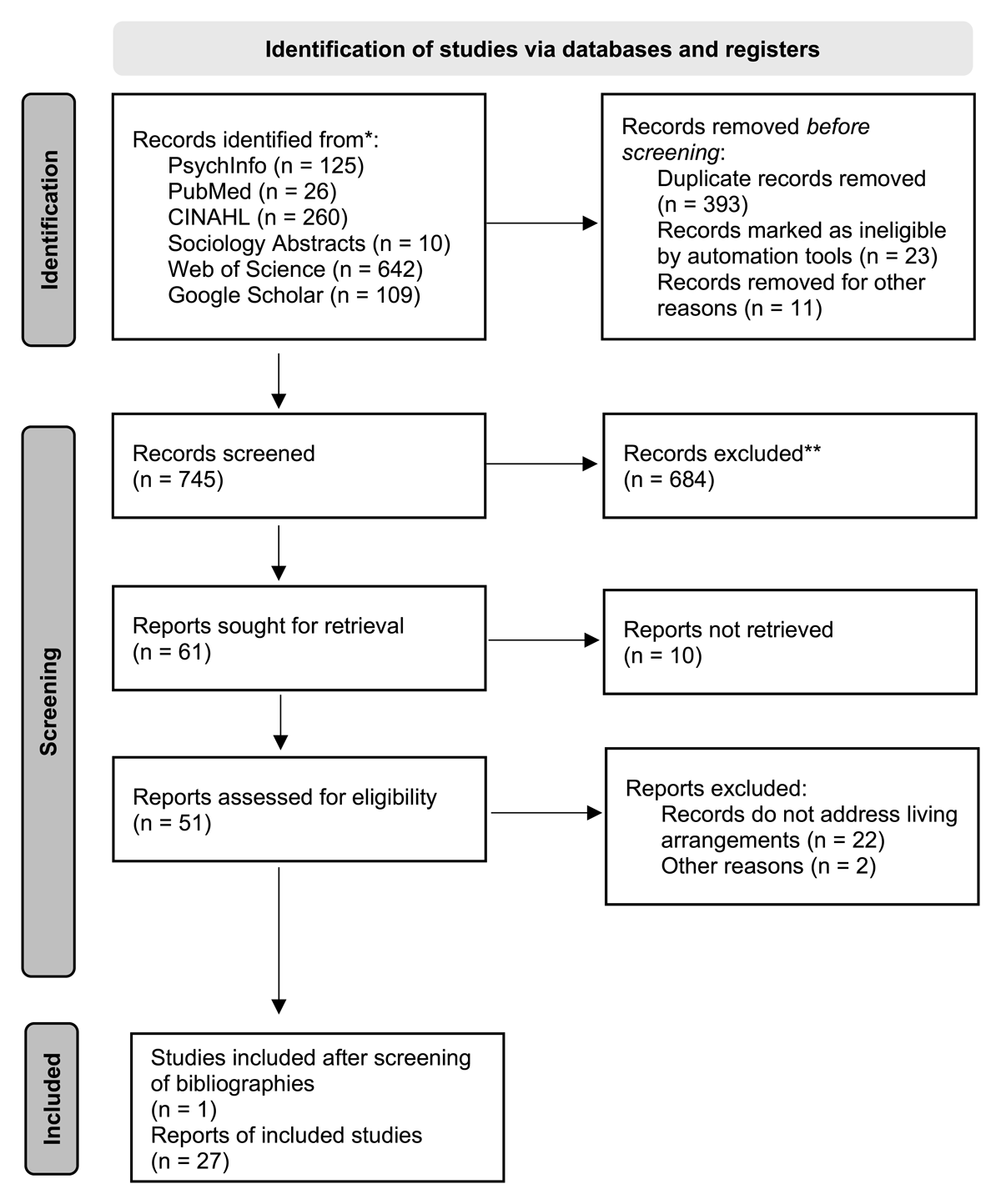
Figure 1
A PRISMA flow diagram illustrating the study selection process.
As illustrated in Figure 1, the search and screening process initially identified 1,172 records. In the final phase of screening, the sample was narrowed down to 27 records that specifically addressed perspectives on young people’s living arrangements.
2.2 Analysis and reporting
The analysis follows the thematic synthesis approach developed by Thomas and Harden (2008), a method specifically designed for systematic reviews. During the coding phase, paragraphs addressing living arrangements were coded line by line across all records. In the descriptive phase, emerging themes were grouped and reported in the results section under the following headings: ‘Understanding of Adulthood and Independent Living,’ ‘Living arrangements,’ ‘Involvement,’ ‘Barriers’ and ‘Burdens.’ Additionally, a subsection was included to address themes not covered by the sample. Table 1 provides an overview of the studies’ author, title, year of production, study type, and participants. The discussion section presents the final analytical phase which involved further analysis of the themes by examining the extent to which, and the ways in which, the identified themes align Article 19 of the UN CRPD.
Table 1
Records categorized by author, title, year, country, study type, and participants.
| AUTHOR | TITLE | YEAR | COUNTRY | STUDY TYPE | PARTICIPANTS | |
|---|---|---|---|---|---|---|
| 1 | Abbott, D. & Heslop, P. | Where next? Transition pathways for young people with learning difficulties in U.K. residential schools and colleges | 2008 | UK | Interviews | 13 y.a., 16 parents, 27 prof. |
| 2 | Blacher, J., Kraemer, B. & Howell, E. | Family expectations and transition experiences for young adults with severe disabilities: Does syndrome matter? | 2010 | USA | Interviews, questionnaires | 246 Care givers |
| 3 | Blue-Banning, M., Turnbull, A. P. & Pereira, L. | Hispanic youth/young adults with disabilities: Parents’ visions for the future | 2002 | USA | Focus Group interviews | 38 parents |
| 4 | Cahill, C. & Guerin, S. | Current and future living arrangements: The perspective of young adults with intellectual disabilities | 2022 | Ireland | Interviews | 10 y.a., |
| 5 | Chambers, C. R., Hughes, C. & Carter, E. W. | Parent and sibling perspectives on the transition to adulthood | 2004 | USA | Questionnaires | 8 y.a., 8 parents, 8 siblings |
| 6 | Cheak-Zamora, N. C.,Teti, M., Maurer-Batjer, A, & Halloran, D. | Snapshots of Growing Up: Youth with Autism Explore Adulthood Through Photovoice | 2016 | USA | Photovoice | 11 y.a. |
| 7 | Clegg, J., Murphy, E., Almack, K. & Harvey, A. | Tensions around inclusion: Reframing the moral horizon | 2008 | UK | Interviews | 28 y.a., 19 mothers, 3 fathers, 1 sister5 couples, 14 transition workers |
| 8 | Dyke, P., Bourke, J., Llewellyn, G. & Leonard, H. | The experiences of mothers of young adults with an intellectual disability transitioning from secondary school to adult life | 2013 | AUS | Interviews | 18 mothers |
| 9 | Engwall, K. | “I’m too old to think five years ahead”. Parent carers of adult children with intellectual disabilities in Sweden | 2017 | SWE | Interviews | 7 mothers, 1 father |
| 10 | Floyd, F. J., Costigan, C. L. & Piazza, V. E. | The transition to Adulthood for Individuals with Intellectual disability | 2009 | USA/CAN | Longitudinal study | 140 parents |
| 11 | Glidden, L. M., Ludwig, J. A., Grein, K. A. & Hodapp, R. M. | Transitions to Adulthood: De- and Re-construction | 2012 | USA | Longitudinal study/ | 249 parents |
| 12 | Gray, K. M., Piccinin, A., Keating, C. M., Taffe, J., Parmenter, T. R., Hofer, S., Einfeld, S. L., & Tonge, B. J. | Outcomes in young adulthood: are we achieving community participation and inclusion? | 2014 | AUS/CAN | Epidemiological study | 578 children/y.a. |
| 13 | Henninger, N. A. & Taylor, J. L. | Family Perspectives on a Successful Transition to Adulthood for Individuals with Disabilities | 2014 | USA | Internet survey | 198 parents |
| 14 | Isaacson, N. C., Cocks, E. & Netto, J. A. | Launching: The experiences of two young adults with intellectual disability and their families in transition to individual supported living | 2014 | AUS | Case study | 2 y.a., parents, 3 professionals |
| 15 | Kim, I. & Dababnah, S. | Transition to adulthood: perspectives of Korean immigrant parents of individuals with intellectual and developmental disabilities | 2022 | USA | Interviews | 5 fathers, 15 mothers |
| 16 | Kirkendall, A., Doueck, H. J. & Saladino, A. | Transitional services for youth with developmental disabilities: living in college dorms | 2009 | USA | Interviews | 6 y.a., parents/guardian (n = 12) |
| 17 | Marshall, S. K., Stainton, T., Wall, J. M., Zhu, M., Murray, J., Wu, S., El Bouhali, A., Parada, F., Zaidman-Zait, A., & Young, R. A. | Transition to Adulthood as a Joint Parent-Youth Project for Young Persons with Intellectual and Developmental Disabilities | 2018 | CAN | Action Project | Eight parent-youth dyads (n = 16) |
| 18 | Midjo, T. & Aune, K. E. | Identity constructions and transition to adulthood for young people with mild intellectual disabilities | 2018 | NOR | Interviews | 4 y.a., 5 mothers, 5 professionals |
| 19 | Mojee, M. D. & Jahoda, A. | Transition to adulthood by young people with intellectual disabilities: Relationships between aspirations, self-determination and core evaluative beliefs | 2006 | UK | Interviews | 18 y.a., 16 peers |
| 20 | Murphy, E., Clegg, J. & Almack, K. | Constructing Adulthood in Discussions About the Futures of Young People With Moderate-Profound Intellectual Disabilities | 2011 | UK | Observation, interviews, discussion groups, documentary analysis | 28 y.a., 20 mothers, 3 fathers, 1 sister, 14 professionals |
| 21 | Rehm, R.S., Fuentes-Afflick, E., Fisher, L. T. & Chesla, C. A. | Parent and Youth Priorities During the Transition to Adulthood for Youth With Special Health Care Needs and Developmental Disability | 2012 | USA | Field study | 64 y.a., 77 parents, 68 professionals |
| 22 | Roos, E. & Søndenaa, E. | Improving the transition process to independent living for adolescents with profound intellectual disabilities. Experiences of parents and employees | 2020 | NOR | Interviews | 9 parents, 9 professionals |
| 23 | Rubio-Jimenez, A.L. & Kershner, R. | Transition to independent living: Signs of self-determination in the discussions of Mexican students with intellectual disability | 2021 | UK | Discussions, observations | 6 y.a. |
| 24 | Scott, M. Foley, K-R., Bourke, J., Leonard, H. & Girdler, S. | ‘I have a good life’: the meaning of well-being from the perspective of young adults with Down syndrome | 2014 | AUS | Interviews | 12 y.a. |
| 25 | Skillern, S. & Carter, E. W. | La Transicion: parent perspectives on transition for Latino youth with intellectual and developmental disabilities | 2021 | USA | Interviews | 6 parents |
| 26 | Sosnowy, C., Silverman, C. & Shattuck, P. | Parents’ and young adults’ perspectives on transition outcomes for young adults with autism | 2018 | USA | Survey, interviews | 10 parents, 12 y.a. |
| 27 | Wilcox, G., McQuay, J. & Jones, K. | Transitioning to adulthood as a young person with an Intellectual Disability: Two case studies of mothers’ perceptions | 2019 | UK | Case study | 2 mothers |
2.3 Risks of biases
There are several risks of biases connected to the research’s design, sample, and publication. One noticeable limitation is the inclusion of only articles written in English, which systematically excludes records published in other languages. This language restriction may result in the omission of valuable insights from non-English sources. Except for one doctoral thesis, the sample consists only of scientific articles. This may imply that research results published in reports and other gray literature are systematically excluded despite our attempt to reduce this risk by making additional searches. Finally, it is important to acknowledge the possibility of publication bias, where studies reporting unpopular or less favorable findings may have been systematically ignored, as this is a general publication bias in all research (Borch et al., 2024).
3.0 Emerging Themes
Our systematic literature search showed that few studies (6 out of 27) exclusively addressed living arrangements for young people with intellectual disabilities transitioning to adulthood, and that most articles combined this focus with topics like education, employment, social relationships, self-determination, and health (21 studies). To address our research question, ‘What themes are focused on studies of how young adults with intellectual disabilities and their parents perceive the transitional phase toward independent living and adulthood focusing on living arrangements?’ we elaborate the five emerging themes (mentioned in section 2.2) in the forthcoming sections.
3.1 Understanding of adulthood and independent living
A central discussion in several studies is how to understand adulthood (10, 18, 21, 24, 25, 26) and independent living (13, 26), with particular focus on the relevance of moving out of the family home as a criterion for achieving these milestones for individuals with intellectual disabilities. While young adults and parents in some studies support leaving the family home as a success criterion (18, 24, 26), other studies argue for alternative understandings and criteria of adulthood and independent living that are not tied to how one live (10, 20).
According to three studies, for the young adults themselves, establishing autonomy and overseeing their own lives is the most important criterion (18, 24, 26). In five other studies, however, parents emphasize the acquisition of necessary skills so that the young adults can utilize their full potential and live as independently as possible, considering this the most crucial aspect (13, 20, 23, 25). Two studies report that parents appear to frame adulthood in a way that their offspring qualify, focusing on the offsprings’ resources rather than their limitations (10,13). Parents in three studies stress how they understand the adulthood of their offspring as characterized by interdependence rather than independence, recognizing that they will continue to require support (4, 10, 21).
3.2 Living arrangements
This scoping review includes 27 studies that address the living arrangements for young adults with intellectual disabilities. According to one study, many young adults with intellectual disabilities have the same or similar expectations as their non-disabled peers when it comes to the desire to live independently (19). This finding is supported by studies that give voice to young adults with intellectual disabilities themselves, as these articles indicate that most of them want to move out of the family home (6, 7, 14, 21, 23, 24). However, several articles describe conflicting desires between the young adults and their parents, with many parents preferring their children to continue living with them (5, 7, 25, 26), and in some cases, the young adults themselves preferring to remain at home (20, 26). One study also reports on gender differences, with fathers being more willing to consider independent living than mothers (15). Despite many of the young adults wishing to move out, 23 studies report that most young adults still reside with their parents (2–13, 15, 17–26).
A central theme in many of the studies is the future residential options for young adults with intellectual disabilities. The options are characterized by varying degrees of support and opportunities for independent living, and the most frequently mentioned alternatives (1, 2, 3, 5, 6, 8, 9, 20) are the parental home, residential settings, supported living, and living independently in a flat. Some articles highlight how the type and degree of impairment significantly influences the choice of living arrangements (2, 7, 8, 10, 11, 12). For example, parents of young adults with Down syndrome are more likely to expect them to continue living at home compared to those with autism (2), and parents of severely disabled young adults more likely to consider residential rather than independent settings than parents of more able young adults (7).
Two articles stress the importance of ‘placement fit’ for those living together with others, achieved through a good match between residents in terms of gender, age, interests, functional level, and the like (22, 27). Additionally, three studies emphasize how cultural differences might play a role in residential choices, with some immigrant families viewing at-home care as a cultural norm (3, 15, 21). Three articles highlight how parents experience moral pressure to facilitate their offspring’s transition to living independently away from the parental home, as well as judgment from both professionals and others if they allow them to continue living at home (7, 9, 20). Only one article addresses the opportunity to choose between renting versus owning your own apartment as influencing residential choices (22).
3.3 Involvement
Fifteen articles discuss the involvement of parents, siblings, or young adults in the transition process related to living arrangements (1, 4, 5, 9, 10, 14, 17, 18, 19, 20, 23, 24, 26, 27). The review reveals the parents are predominantly in charge of the transition process. The studies show significant parental involvement, particularly by mothers (9, 10, 18), which includes practical preparations (such as acquiring practical skills), planning (such as coordinating the process and finding suitable housing), and post-move support (e.g., practical, social, emotional, and financial support). However, two studies highlight how parental involvement also may interfere with and disrupt the young adults’ transition process, as parents, in their efforts to protect their offspring, sometimes inhibit their independence (18, 24). According to three studies parents’ involvement continues also after the young adults have moved out of the family home (9, 14, 22). Additionally, four articles highlight varying expectations for siblings’ participation in the transition process, from none to significant (5, 14, 15, 26).
The review also indicates variability in young adults’ involvement in decisions about their living arrangements. While some are actively involved (1, 14, 17, 18, 23) or wish to be (4), other studies explain why some parents opt for limited involvement (1, 9, 20, 24). Those who are actively involved are described as having a mild to moderate degree of intellectual disability.
3.4 Barriers
The articles identify several external, systemic, and skill-related barriers preventing or complicating the transition to independent living. While five articles describe parents experiencing a shortage of information about living options (1, 5, 14, 22, 27), six studies report a lack of fitting residential options (1, 12, 15, 22, 26, 27). Moreover, eight studies reveal a concern among parents and young adults regarding access to necessary support services (3, 4, 6, 12, 14, 21, 22, 26). Several studies highlight young people’s limited skills as a barrier to transitioning to independent living, and mentions among other things daily living skills, social skills, and communication skills (3, 4, 6, 16, 18, 20, 23, 25, 26, 27). Some studies underscore obstacles such as parents’ extensive efforts to facilitate their children’s move-out and professionals’ inadequate involvement in transition planning (8, 18, 27). Two studies indicate that immigrant parents may encounter additional obstacles in the transition process due to limited welfare system knowledge and language barriers (15, 25). Six studies reveal parental concerns about their offspring’s social lives, whether they stay at home or move out of the parental home (5, 7, 9, 14, 18, 25).
3.5 Burdens
While barriers pertain to the obstacles encountered during the transition to independent living, burdens refer to the impact of these obstacles on the well-being of both parents and young adults. While barriers emphasize external structural factors complicating the transitional process, burdens refer to the internal and subjective feelings and experiences while navigating the transition. The included studies predominantly report on parents’ experiences of burdens related to both during the transition and in the aftermath. Several articles describe parents’ worries about the young adults’ future lives (8, 9, 10, 14, 18, 20), particularly their safety (3, 14, 16, 26). Numerous articles illuminate how the burden of ongoing parental care and involvement in the transition process influences the parents’ emotional well-being, causing stress (1, 14), anxiety (8, 12, 27), frustration and exhaustion (14, 22). Some studies also highlight practical strains such as social limitations (12, 14, 18) and financial stress (11, 26). Two studies address the burden on parents who face judgment and must defend their decisions about their adult children’s living arrangements—whether to move out or stay at home—particularly when these decisions conflict with the young person’s wishes, cultural or societal norms (7, 21).
A few studies highlight the burdens experienced by the young adults themselves during the transition, reporting feelings of stress (1), nervousness (16), fear and sadness (23). However, two articles emphasize that the transition to adulthood for young adults living at home is not only a burden for the parents but also an experience they find rewarding and joyful (9), and beneficial as some young adults provide care for their parents (9, 18).
4.0 Discussion
The aim of this paper is to investigate how the experiences of young adults with intellectual disabilities and their parents align with Article 19 of the CRPD, with a particular focus on both the extent to which and the way their right to independent living is realized. By synthesizing findings across the included studies, this review seeks to provide a broader understanding of how Article 19 is upheld in the context of living arrangements, offering a more comprehensive perspective than that provided by individual studies alone.
Article 19 of the CRPD (UN, 2006) emphasizes that all persons with disabilities shall have the opportunity to choose where and with whom they live, without being obliged to reside in a particular living arrangement (Article19[a]) and shall have access to the support services necessary to enable inclusion in the community (Article 19[b]). While this framework establishes a clear vision for independent living and community inclusion, the studies included in this review reveal a persistent gap between these ideals and the lived realities of many young adults with intellectual disabilities. Notably, although most young adults expressed a desire to move out of their parental homes, the vast majority still reside with their parents. Based on the findings of this scoping review, we identified three dimensions as crucial to the realization of the right to independent living for young adults with intellectual disabilities: structural, familial, and cultural dimensions. Each of these dimensions will be discussed below in the following sections.
A key finding of this scoping review is the significant impact of structural dimensions—such as the organization and provision of housing and support services on the realization of Article 19 of the CRPD. Limited residential options (1, 12, 15, 22, 26, 27), insufficient information (1, 5, 14, 22, 27), restricted support services (3, 4, 6, 12, 14, 21, 22, 26), and predetermined housing options (1, 2, 3, 5, 6, 8, 9, 20) emerge as significant structural barriers that hinder young adults with intellectual disabilities from transitioning out of parental homes. These findings align with previous research highlighting how a lack of accessible housing and support are preventing the realization of Article 19 (Sperrin, 2023). However, what is particularly noteworthy is how these structural barriers align with the obligations of states that have ratified the CRPD to promote and ensure the full realization of these rights. Article 4(a) of the CRPD (UN, 2006) obliges state parties to adopt all appropriate administrative measures to advance human rights and to integrate these rights into all policies and programs. The structural barriers described, therefore, highlight a significant gap between the commitments made by states under the CRPD and their implementation in practice.
One possible explanation for this gap is that the provisions of the CRPD are subject to interpretation. In translating Article 19 into policies and implementing it in practice, misinterpretations and misappropriations appear to occur (Mladenov, 2025). A key challenge seems to stem from the fact that Article 19 represents a paradigm shift—from a paradigm of care to a paradigm of self-determination—which creates difficulties in aligning existing systems with the principles of the CRPD. According to Stalker (2012), normalization likely remains a dominant theoretical framework within service delivery for people with intellectual disabilities. It represents the paradigm of care, focusing on providing community care to ensure that individuals with disabilities have access to life experiences and living conditions similar to those of non-disabled individuals (Nirje, 1999). However, while normalization emphasizes community integration, it often upholds paternalistic care (Oliver, 1999), placing professionals in control of service design and limiting the autonomy of individuals with intellectual disabilities (Chappell, 1997). In contrast, the CRPD prioritizes self-determination, granting individuals the right to make choices about their own lives, including where and with whom they live, and the type of support they receive. These conflicting paradigms suggest that lingering normalization ideology may influence the interpretation of Article 19, perpetuating paternalistic practices and undermining the CRPD’s mandate to promote independent living based on individuals’ preferences.
While the conflicting paradigms of care and self-determination may contribute to the persistence of structural barriers, it is also important to consider the broader legal and practical challenges in assessing states’ compliance with their obligations under the CRPD. However, even though this scoping review clearly reveals structural barriers that reflect a failure among states to take necessary administrative measures to ensure the realization of the right to independent living, the review does not provide a sufficient basis to determine whether these failures constitute a direct violation of states’ obligations under the CRPD. Article 4(2) of the CRPD emphasizes that state parties are required to take measures to realize economic, social, and cultural rights, such as the right to independent living, ‘to the maximum extent of their available resources.’ This clause acknowledges that the rate of implementation may vary depending on a state’s developmental level and limited resources (de Beco, 2019). Therefore, assessing whether the lack of full implementation of Article 19 constitutes a violation would require a detailed examination of each state’s specific context, including its available resources and the measures it has taken to meet its obligations. Without such an analysis, it is not possible to definitively conclude whether the identified structural barriers represent a breach of states’ responsibilities under the CRPD.
Second, a key finding in this scoping review is the importance of the familial dimension in the realization of Article 19. Several studies highlight how some parents act as key advocates—seeking information about residential options, writing applications, and so forth—while others serve as gatekeepers. This occurs when parents refrain from taking actions that support a move away from the parental home, often because they perceive this alternative as the safest or as providing the best care, thereby hindering the realization of Article 19. These findings align with prior research highlighting the complex and sometimes contradictory roles parents play in facilitating transitions. While many parents actively advocate for their offspring’s transition to independent living (Codd and Hewitt, 2020), others—particularly mothers who continue caregiving roles into adulthood—may find themselves balancing between being ‘oppressors’ and ‘allies’ (Ryan and Runswick-Cole, 2008). Their efforts to protect their children, though well-intentioned, may inadvertently limit the young adults’ autonomy. This paradox is further underscored by Foley (2013), who highlights that many parents reluctantly navigate the tension between empowering and protecting their offspring. The critique of parents as ‘oppressors’ has been particularly emphasized by the Independent Living movement, which calls for challenging parental power to expand opportunities for people with disabilities to achieve independent living (Mladenov et al., 2023). However, other studies offer a more nuanced perspective on the role of parental power, showing that young adults may strategically draw on their parents’ ‘adult authority’ to amplify their own voices, particularly in interactions with professionals (Skagestad et al., 2021).
Another interesting finding from this review was parents’ ambiguous understanding of adulthood and independent living for their offspring (7, 18, 20, 21, 23, 25, 26), with many parents in this context associating these concepts with a lack of self-care skills. Such an understanding deviates from the concept of independent living outlined in the CRPD. As stated by the General Committee (UN, 2017, 4), independent living should not be interpreted solely as the ability to perform daily activities independently but as the freedom to exercise choice and control. Nevertheless, as documented both in this review and in other studies (Stancliffe et al., 2011), many young adults with intellectual disabilities face restricted opportunities to choose where and with whom to live. A key argument for this group’s general lack of autonomy has been their perceived limitations in mental capacity (Davy, 2015). However, this is not a legitimate argument, as Article 12 of the CRPD (UN, 2006) makes clear that everyone has the right to make decisions about their own life, irrespective of cognitive ability, and to receive the necessary support to do so (e.g., through supported decision-making). Article 12 can thus be interpreted as expressing an understanding of personal autonomy as relational, emphasizing that control and agency in one’s life require interdependence rather than isolated independence (Perkins et al., 2012). From this relational perspective on autonomy, the role of supporters, such as parents, would be to explain issues, explore different options, and support expressed preferences (Carney and Beaupert, 2013) regarding choices throughout the transition process. Ultimately, a relational understanding of autonomy can enhance young adults’ autonomy during the transition process by emphasizing the importance of fostering collaborative relationships between young adults and their parents, framing independence not as something achieved in isolation but as a process rooted in interdependence and shared decision-making.
A third interesting finding of this scoping review is that cultural dimensions sometimes seem to influence the realization of Article 19. Although cultural norms are explicitly highlighted in only three of the reviewed studies (3,15,21), this scoping review predominantly includes research conducted in Western contexts. Consequently, the findings may not fully capture the broader spectrum of cultural aspects that could affect the opportunities available to young adults with intellectual disabilities to make residential choices and are thus worthy of further discussion. This limitation points to a broader tension surrounding the concept of ‘living independently,’ which was also evident during the drafting of the CRPD. At that time, significant debate arose over whether the concept aligned with cultural norms in many countries, with some members raising concerns that it might imply people with disabilities should be separated from their families (Fina et al., 2017). This tension underscores the importance of moving beyond assumptions that Western ideals of independence are universally applicable, particularly when examining the implementation of Article 19 in non-Western contexts. A decolonial lens offers a valuable framework for such an examination by resisting the universalization of Western epistemologies and exposing how ‘normate standards’ (Dirth and Adams, 2019) imposed by Western regimes of knowledge can marginalize non-Western ways of knowing and being. For instance, Dirth and Adams (2019) critique the notion of independence as a universally ‘just-natural’ value, highlighting that in some non-Western communities, caregiving responsibilities and collective survival take precedence over individual autonomy. From this perspective, a decolonial approach not only sheds light on how cultural norms might influence the implementation of Article 19 but also challenges its underlying assumptions, raising critical questions about the relevance and transferability of its emphasis on ‘living independently’ to disabled people in non-Western parts of the world.
4.1 Knowledge gaps
This scoping review shows that, since 2000, research amplifying the voices of young adults with intellectual disabilities during their transition to independent living—particularly regarding housing—has increased. Over the last decade, studies have shifted from including young adults as informants alongside others to focusing exclusively on their perspectives. However, research on their lived experiences—particularly those with severe or profound intellectual disabilities—remains limited. Few studies focus solely on living arrangements, instead examining a combination of aspects related to transitions, including education, employment, and housing. Consequently, young adults’ perspectives on living arrangements within independent living remain underexplored.
Moreover, although one study briefly addresses economic factors influencing housing alternatives, this topic is rarely discussed in other studies included in this review. As a result, the review provides limited insights into how socioeconomic factors might shape young adults’ future housing situations. Notably, discussions on the nuances of renting versus owning are sparse, if mentioned at all, despite their potential significance. While a few studies note that some young adults are expected to live with others in the future, there is a noticeable lack of research exploring whether these young adults wish to live with someone, and if so, with whom. Consequently, the topic of young adults forming their own family units remains largely unexplored.
This scoping review highlights a lack of research on how cultural norms shape the realization of Article 19 of the CRPD, particularly in non-Western contexts. Most existing studies are conducted in Western settings, which may not fully capture the diverse cultural factors influencing residential choices for young adults with intellectual disabilities. This gap reflects a broader tension in the concept of ‘living independently,’ which may conflict with cultural values in non-Western societies, where caregiving responsibilities and collective survival often take precedence over individual autonomy. Research adopting a decolonial lens is needed to critically examine the applicability of Western ideals of independence and explore culturally specific approaches to implementing Article 19. The findings of this review indicate that most transitional-aged young adults, along with their parents, envision moving out. However, there is a significant gap in research concerning those who wish to remain in their family home. Previous studies emphasize that moving out is often seen as a prerequisite for independent living. This creates a conflict between the desire of some young adults to stay with their parents and the conventional Western norms of adulthood and independency. Western perspectives on independence tend to favor group-based living arrangements with distinct institutional directives, reflecting a clear bias. Additionally, there is a scarcity of research exploring how social and political structures influence the transition process and the range of housing options available to young adults.
4.2 Limitations
This scoping review has two main limitations. First, the lack of consensus within the field and among researchers regarding the definitions of terms such as ‘adulthood’ and ‘independent life/living’ posed a substantial challenge in identifying relevant studies and deriving conclusions from the research findings. This challenge may have introduced a potential bias, as important records could have been excluded due to differing interpretations of these terms. Second, the inclusion of only English-language material introduces a potential bias, as it disproportionately reflects perspectives on independence and independent living from the Western world. The absence of studies from non-Western countries limits the ability to incorporate unique cultural perspectives on independent living and transitions to adulthood, making it challenging to consider cultural nuances in the discussion. Addressing this limitation by incorporating studies published in other languages could provide a more comprehensive understanding of the topic. Such an approach would enrich the analysis by offering diverse viewpoints and expanding the breadth of knowledge beyond a Western-centric context. As a result, the findings of this review remain confined to a specific cultural framework, limiting their applicability to broader global perspectives.
Critical appraisal is generally not required in scoping reviews, as their primary aim is to map the available evidence rather than to synthesize findings to answer a specific research question (Peters et al., 2020). Since our sample consists exclusively of peer-reviewed publications, the overall quality of the scientific contributions included can be considered high. Nonetheless, the exclusion of non-peer-reviewed sources has likely limited the breadth of the literature captured in this review.
5.0 Conclusion
This scoping review investigated how the experiences of young adults with intellectual disabilities and their parents align with Article 19 of the CRPD, focusing on the extent and manner in which their right to independent living is realized. The findings reveal significant gaps between the ideals of Article 19 and the lived realities of these young adults, shaped by structural, familial, and cultural dimensions.
Structural barriers, such as limited housing options, insufficient support services, and predetermined living arrangements, hinder the transition to independent living. These barriers highlight the need for stronger alignment between state commitments under the CRPD and their practical implementation. Familial influences play a critical role, with parents acting as both advocates and gatekeepers in the transition process. Supporting a relational understanding of autonomy, as emphasized in Article 12 of the CRPD, can strengthen self-determination for young adults with intellectual disabilities during this transition. Finally, cultural norms shape how independence is understood and practiced, with collective values in some cultures challenging the Western emphasis on independent living and individual autonomy as the primary markers of independence. In summary, realizing the right to independent living requires addressing structural barriers, fostering collaborative relationships between young adults and their families, and adopting culturally sensitive approaches. A holistic effort is essential to bridge the gap between the principles of the CRPD and the lived experiences of young adults with intellectual disabilities.
Acknowledgements
We sincerely thank Grete Overvåg, Head Librarian at Library Collections at UiT the Arctic University of Norway, for her contribution in the search and screening process.
Competing Interests
The authors have no competing interests to declare.
Author Contributions
All authors contributed to the conception and design of the study. Evensen took primary responsibility for conducting the search process, while Evensen and Melbøe analyzed and interpreted the data. The manuscript was drafted by Evensen and Melbøe, with input and support from Borch. All authors reviewed and approved the final version of the manuscript.